The Science and Soul of Near-Home Care for Singapore Families

The Moment at the Door
There is a moment every parent in Singapore knows.
It happens at the door. The bag is packed, the bottle is ready, the car keys are in your hand, and your infant is in the arms of someone you have chosen carefully, vetted thoroughly, and decided to trust. And still, something in your chest tightens. You hesitate. You wonder if the day will be too long, if the goodbye will be too hard, if somewhere in the middle of your meetings and deadlines, your child will feel that something is missing.
That moment at the door. That is where this conversation begins.
Because if you are a working parent in Singapore, you have lived inside that hesitation. You have felt its weight. And you deserve to hear, very clearly, that the feeling is not a weakness. It is not a warning. It is the most honest proof that you love your child completely—and that you are navigating one of the most emotionally complex transitions of your life with nothing but love to guide you.

The Weight of Singapore’s Standards
Singapore does not make it easy to be a working parent. We all know this, and yet it remains strangely unspoken.
There is the pressure of school rankings, the weight of tutorial schedules beginning before Primary One, the quiet assumption that optimal parenting means constant presence. There are well-meaning relatives who ask when you are going back to work and why, and well-meaning colleagues who ask why you are still on maternity leave and how you manage.
There is the household that requires two incomes and the mortgage that requires two incomes and the childcare fees that somehow require three incomes. Layered over all of it, the relentless cultural messaging that these early years are everything, that you must get it right, that every choice made now echoes across your child’s entire future.
In this environment, the working parent carries a particular kind of guilt. It is not the guilt of negligence or indifference. It is the guilt of love colliding with necessity. The guilt of wanting to be present and knowing you will not always be. The guilt of placing your infant—your small, perfect, irreplaceable infant—in the care of another human being and trusting that it will be enough.
This guilt is not irrational. It is not spoiled. It is one of the oldest and most primal responses a parent can have. Across every culture and every era, the bond between parent and infant has been understood as sacred, as irreplaceable, as something that must be protected at all costs.
What you feel is not evidence that you are failing. It is evidence that you are fully, deeply, wonderfully present to the reality of what it means to raise a child in a world that asks you to be more than one person.

Your Infant Feels It Too
Here is the truth that sits alongside your guilt, and it matters just as much: separation anxiety is not only yours. Your infant feels it too.
Somewhere in the noise of parenting advice, a narrative has taken hold that suggests out-of-home care is inherently damaging to attachment. That the first days of separation leave wounds that echo. That choosing to return to work is a risk to the bond between parent and child.
This narrative is incomplete at best, and at worst, it weaponizes the guilt we have just acknowledged.
The science of attachment is nuanced. Decades of research show that what builds secure attachment is not proximity alone—it is the quality, consistency, and responsiveness of care. A child can develop deep, healthy, secure attachment with a dedicated, attuned caregiver in a warm, well-resourced environment.
What matters is not whether care happens in the home or outside it, but whether the care is present, consistent, and emotionally attuned.
Your child will learn something valuable in this arrangement: that love can be distributed across trusted relationships. That the world contains safe people beyond the immediate family. That caregivers exist who will hold them with the same care you would. This is not a compromise. For many children, it is the beginning of a rich social and emotional world.

The Honest Truth About the Transition
And yet. We must be honest about the transition.
The first week is hard. Let us say that plainly. The first week, and often the first month, involves crying at drop-off—sometimes from the child, sometimes from you, sometimes from both. It involves lingering at the door a moment too long. It involves coming home and studying your infant’s face for signs of distress, of withdrawal, of something being wrong.
It involves waking in the night with a start, half-dreaming that you have made a terrible mistake.
This is normal. It is not a sign that near-home care is failing. It is the natural rhythm of a child and a parent renegotiating the terms of their daily connection.
What infants need during this time is not for the anxiety to be removed—they cannot be protected from all discomfort—but for the care to remain steady, warm, and reliable. What parents need is not to be told that the feelings are unimportant, but to be supported by people who understand the grief of the transition without agreeing that it represents harm.

What Quality Care Actually Looks Like
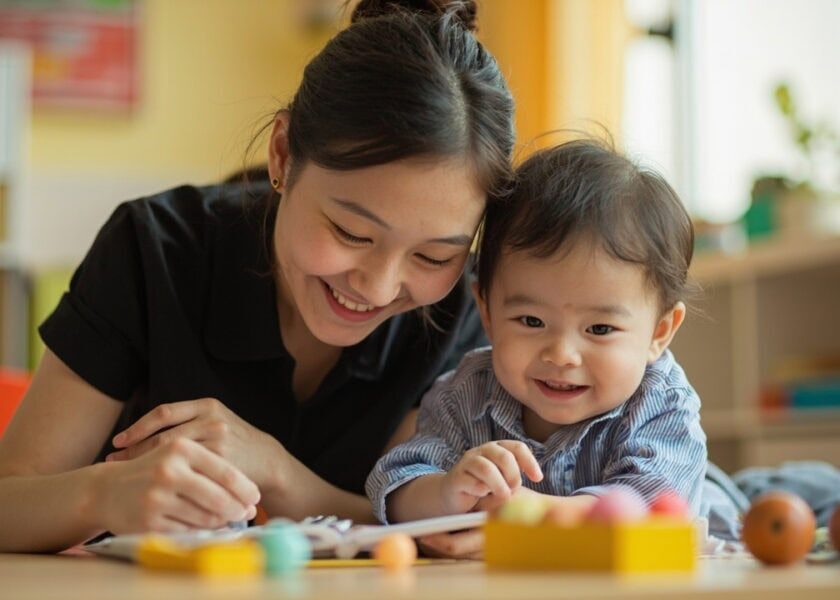
The caregivers who do this work well meet your anxiety at the door with calm, with honesty, with patience. They text you updates because they understand that a photograph of your child smiling at lunch is not just a courtesy, it is a lifeline. They learn your child’s cues, your family’s rhythms, the small rituals that matter. They become, over time, not a stranger you hired, but a partner you chose.
This is worth lingering on, because the word “trust” is used often in discussions of childminding, and it has become almost meaningless through overuse. Trust frameworks. Trust infrastructure. Building trust. As if trust were a system you install and then forget.
But trust, in the real human sense, is built in moments. It is built when your child’s caregiver notices a rash before you do and messages you before you have even finished your first meeting of the day. It is built when you receive a photo of your daughter mid-laugh during tummy time and feel a small warmth spread through your chest that has nothing to do with the presentation you are supposed to be giving.
It is built when your caregiver remembers that your son sleeps best with the white noise machine on and the curtains half-closed, and you realize that they are not just managing your child—they are learning him.
EduNanny was designed around this reality. The caregivers who work within the EduNanny by BUTLER model are not interchangeable service providers. They are trained, supported, and valued as professionals who carry profound responsibility.
They are part of a pilot recognized by the Early Childhood Development Agency—meaning the model has been reviewed, structured, and found worthy of broader investment. They operate within home-based settings where the ratio of caregiver to infant remains small, where your child is not one of fifteen in a room but one of two or three in a warm, responsive environment.
They communicate. Not because there is a checkbox for communication, but because EduNanny understands that a parent who is kept close feels less anxious, and anxious parents do not make better parents. The transparency, the updates, the openness—this is not a surveillance feature bolted onto a service. It is an expression of values. It says: we know you are trusting us with something irreplaceable, and we do not take that lightly.
For families navigating the costs of raising a child in Singapore, EduNanny’s pilot structure offers additional clarity. Within the ECDA Childminding Pilot, fees are structured to be accessible for eligible families. Government support mechanisms such as the Child Development Account and Baby Bonus schemes can be applied, reducing the financial burden that often adds another layer of stress to an already demanding transition.
The care runs Monday through Friday, across standard working days. It is designed to fit the reality of Singapore’s working life, not some idealized schedule that exists only in a brochure. And the model extends across Singapore, making this option available not just to families in certain districts or with certain connections, but to any parent in the city who is searching for care that feels right.

Redefining the Village for Modern Families
There comes a morning—not always predictable, sometimes not for weeks, sometimes not until months have passed—when you walk through the door and your child reaches for the caregiver with the easy trust of recognition. When the goodbye is not a tearful extraction but a quick, warm wave. When you realize that your child is not merely tolerating near-home care but genuinely enjoying it—not instead of you, but alongside you.
This is the milestone that no one puts on the chart. The morning you feel something you have not felt in months. The morning you walk to your car and realize you are not dreading the day. The morning you feel, for the first time, something close to peace.
This is not the absence of love. It is the presence of earned trust. And it is available to every parent who chooses near-home care with intention, who selects their caregiver with care, and who allows the relationship to deepen over time.
Near-home care is not a compromise. Somewhere along the way, the phrase came to imply lesser, when in truth it is simply different. Close care—where your child remains in a home environment, where the caregiver ratio is low, where the rhythms of the day are not governed by institutional schedules but by the needs of small children—is not settling. It is choosing a context that research consistently shows supports infant wellbeing: warm, consistent, responsive care in a setting that feels like home.
We invoke it constantly, the village it takes to raise a child. But we have often imagined the village as extended family, as grandparents and aunties and community networks that may or may not exist for any given family in the city.
What EduNanny proposes is that the village can also be built. That it can be professional, intentional, and chosen. That the village does not have to be inherited; it can be cultivated. This is not a rejection of family or community. It is a recognition that families today are complex, mobile, and often unable to rely on the traditional networks that previous generations took for granted.
Near-home care is not a replacement for those networks. It is an addition to them. It is one more thread in the fabric of support that allows a child to thrive.

Your Next Step
Here is the reframing that matters most: choosing near-home care is not a concession to circumstance. It is an act of thoughtful parenting. It is the recognition that your child benefits from consistent, high-quality care in a warm environment—and that you, as their parent, benefit from the ability to work, to contribute, to build a life that you can then share with your child.
The guilt that says otherwise is outdated. The science says otherwise. The lived experience of millions of working parents says otherwise.
EduNanny was built for this. For the parents who wake early and return late. For the families who are building something—a career, a home, a future—and who refuse to believe that doing so means sacrificing their children’s wellbeing. For the caregivers who choose this work and do it with skill, with warmth, with the seriousness it deserves.
What EduNanny offers is not a guarantee against all worry. There is no care model on earth that erases the tender anxiety of loving someone small. But what it offers is something more durable than a guarantee: partnership. A caregiver who sees your child. A team that sees you. A model designed not around efficiency but around the slow, patient work of earning your trust, day by day, morning by morning.
The door is not the end of something. It is the beginning of a new arrangement, one that honors both your love for your child and your commitment to your family’s needs.
You are not abandoning your child. You are teaching your child that the world contains safe hands beyond your own. You are teaching your child that love persists across distance, across time, across the brief hours of separation that end, always, in reunion.
And the day will come—perhaps sooner than you expect—when you will walk through that door and feel something you have not felt in months. You will feel that it is going to be all right.
And you will be right.
If you are ready to explore how EduNanny can support your family, we invite you to learn more about our caregivers, our approach, and how we can walk this journey with you.
EduNanny by BUTLER is part of the ECDA Childminding Pilot. For eligible families, fees may be supported through government schemes including the Child Development Account and Baby Bonus. Contact us to learn more about your options.
#workingparentsSingapore #nearhomecare #infantcareSG #childmindingSingapore #EduNannySG