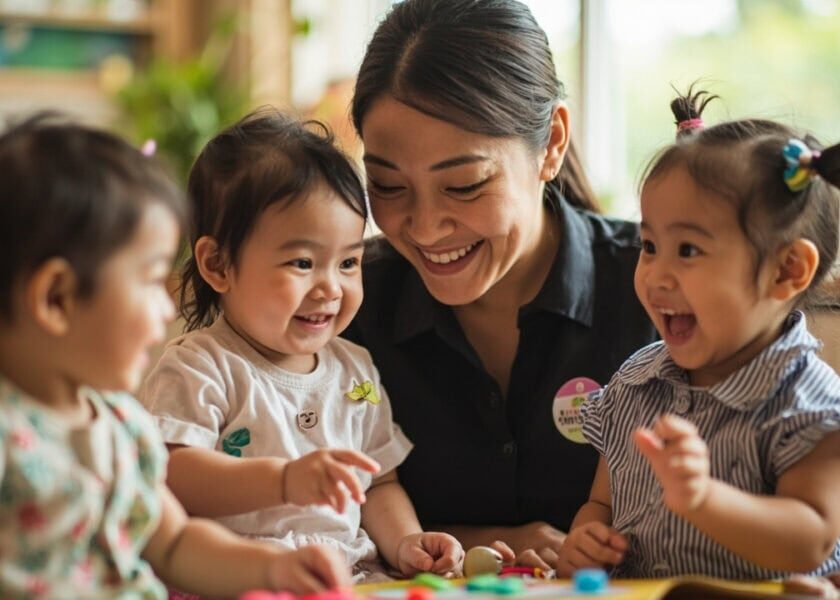
The Search for Trust, Not Just Childcare: A Singapore Parent’s Journey

The Door You Cannot Close: A Singapore Parent’s Journey from Anxiety to Trust in Infant Care
Some mornings, you stand at the door and you cannot leave.
Not because your child is crying — though sometimes that too. But because something inside you has not yet made peace with what you are about to do. You are about to hand your baby to someone else and walk away. You are about to go to work, to sit in meetings, to answer emails, and a part of your mind will remain in that other room, listening for your child the way you have never listened for anything in your life.
If you are a parent in Singapore — a working parent, a first-time parent, a parent who loves your child fiercely and also needs to return to the life that provides for them — you know this feeling. You have probably felt it at two in the morning when the house is quiet and your baby is finally asleep and you are scrolling through childcare options on your phone, wondering if any of them will feel right.
You have probably stared at a website that talks about developmental milestones and ratios and curriculum frameworks and thought: yes, but who will hold my baby when she cries? Who will notice when his mood shifts? Who will know — the way I know — that today is a hard day and she needs something different than yesterday?
This is the question no checklist answers. And it is the question at the heart of what we want to explore together.
In This Article
- Why finding infant care in Singapore feels so emotionally overwhelming
- What quality childminding actually looks like in daily practice
- How a near-home, home-based model bridges philosophy and reality
- A real parent’s experience moving from anxiety to earned confidence
- Practical questions to ask when evaluating your options

The Problem Is Not Finding Childcare. The Problem Is Finding Trust.
Singapore parents have more childcare information than ever before. There are forums, subsidies, comparison tools, CDA calculators, Baby Bonus guides, and government portals that walk you through every available option. The infrastructure for making an informed decision is genuinely impressive.
And yet. The anxiety remains.
This is not because parents are being irrational or overly cautious. It is because the thing you are actually searching for cannot be found on a website. You are not searching for ratios or curricula or even staff qualifications, though all of that matters. You are searching for a feeling. A feeling that your child is not just being supervised, but known.
That the person caring for your daughter will see her the way you see her — not as a slot in a ratio, not as an age group in a curriculum, but as a full, complicated, constantly changing little human who has moods and preferences and a specific laugh that means something specific and a specific whine that means something else entirely.
This is not a small distinction. It is the entire distinction.
The 2am Scroll: Where Decisions Really Happen
Most parenting decisions are not made in bright, organized office tours. They are made at odd hours, on your phone, in the gap between exhaustion and worry. You have probably been there: the 2am scroll through parenting forums, reading reviews of childcare centres with the desperate hope that someone, somewhere, has articulated what you are looking for in words you recognize.
You are looking for evidence. Not statistics. Evidence. Proof that somewhere, someone understands what it means to be responsible for a small, new person who cannot yet tell you what they need.
This is the gap that most childcare information does not bridge. It tells you what is available. It rarely tells you what it actually feels like to leave your child somewhere, morning after morning, and gradually — sometimes quickly, sometimes slowly — come to trust that place.

What Quality Childminding Actually Looks Like
Before we go further, let us talk about what we mean when we talk about good infant care. Because the word “quality” gets used so often in early childhood contexts that it has almost lost its meaning. Quality is not a list of features. Quality is what happens in the moments between the photos.
Attention That Is Real, Not Performed
Imagine a morning. Sunlight coming through a window in a home-based care environment. A childminder kneeling on the carpet, literally kneeling — not bending at the waist while checking her phone — but present, fully, at the level of the infant she is caring for.
She speaks to the baby in a voice that is not a performance of warmth. It is simply warm. The way a person’s voice is warm when they are genuinely interested in what they are doing. She changes the baby’s position and narrates each small action before doing it, so that the baby can begin to build the internal logic of the world: this hand means I am going to pick you up now, this one means the diaper is being changed, this voice means I am right here and nothing has changed.
This is not a scripted interaction. This is attention.
The Ability to Hear the Difference Between Cries
A childminder who has time — actual time, structural time, not aspirational time — to know your child will begin to hear the difference between cries. The cry that means hunger. The cry that means tiredness. The cry that means teething pain has spiked and the only thing that helps is being held in a specific way, at a specific angle, with a specific voice murmuring the same three words over and over until the small body relaxes.
This distinction is not possible in an environment where one caregiver is managing six, eight, or ten infants simultaneously. It is only possible when the ratio allows for it. When the attention is not stretched thin across a room, but can focus, fully, on a handful of children who become, over weeks and months, deeply known.
Communication That Bridges the Distance
You are at your desk. You have been in a meeting for forty minutes. Your phone is face-down because looking at it would make it obvious that you are not fully present. And yet your mind is not in this room. It is in another room, across the city, with your child.
Then your phone lights up. A photo — not a posed, professional photo, but a real one, slightly blurry, of your baby in the childminder’s arms, mid-cry, but being held completely and securely. And a message: she is settling. She had a bottle and now she is looking around. She is okay.
Three words. You read them six times. And for the first time in months, you actually believe them.
This is not a feature. It is not a policy. It is a small act of communication that costs nothing and means everything. And it is only possible because of a culture — a structural, deliberate culture — where trust, once offered, must be maintained through consistent, small actions of honesty and openness.

A Mother’s Story: From Spreadsheets to Peace of Mind
Let me tell you about a morning I think about often. This is a story about Lin, though not her real name, and her daughter Yani, though not hers either. What is real is the experience.
The Preparation That Could Not Quiet the Fear
Lin was getting ready for her first day back at work after her maternity leave ended. Her daughter was four and a half months old. She had done everything the books told her to do. She had toured three childcare centres. She had joined every parenting forum in Singapore. She had made spreadsheets. She had cried — not dramatically, just the quiet kind, the kind that happens in the shower when the water is running and no one can hear you.
Lin was not a dramatic person. She was a competent person. She managed projects. She ran meetings. And yet none of that competence could quiet the fear that giving her daughter to a stranger — however qualified, however certified — was a kind of surrender she was not sure she could make.
The centres she visited were fine. They were bright and clean and well-staffed and the teachers smiled in that trained, warm way that is both reassuring and, she admitted to herself later, slightly impersonal. The ratios were acceptable. The curriculum was comprehensive. Everything, on paper, was exactly what she needed.
But paper is not what holds your baby at two in the afternoon when the teething pain spikes. Paper is not what notices that Yani had barely slept and therefore needs her morning bottle slightly earlier than usual, and maybe a little more cuddling before the morning activity, because the world is a lot right now and she needs to know someone sees that.
The Search for a Feeling
What Lin was actually searching for — the thing she could not quite name on those parenting forums — was not a childcare centre or a nanny agency, though all of that mattered. What she was searching for was a feeling.
She found EduNanny by accident, or maybe by instinct. A colleague mentioned it — this was still early days, when the ECDA Childminding Pilot was just beginning to become known in parent circles. Near-home care, she said. Someone comes to your house, or you go to theirs, in your own neighbourhood. One to three infants. Monday to Friday. Not a centre — a home.
Lin listened, and something in her chest shifted. Not because it solved everything immediately. It did not. But because it spoke to something she had been trying to articulate for weeks and could not: that her daughter did not need a system. Her daughter needed a person. A consistent, present, attentive person in a consistent, warm environment — not a room full of other children and rotating staff, but a home where the rhythm of the day could actually slow down enough to match the pace of a four-month-old.
The Inquiry Call That Was Not a Sales Call
She made the inquiry call on a Tuesday afternoon. She expected — she told me this later, laughing at herself — to get a brochure. A price list. The standard conversation about availability and registration.
What she got instead was something she described as a real conversation. Someone asking about Yani — not just her age and her feeding schedule, but her temperament. Was she a watcher or a doer? How did she respond to new people? What sounds did she make when she was content? What did Lin’s instincts say about what Yani needed right now?
It was not a sales call. It was, unexpectedly, the first time since her maternity leave began that someone had asked her those questions as if they mattered. As if the answers were not just administrative details but the actual information that would determine whether this was the right fit.
The Trial Visit: What She Observed
The trial visit happened on a Saturday. Lin had brought Yani to a home-based care environment in her own neighbourhood — one of those quiet, residential streets in the heartlands that looks unremarkable from the outside and inside holds something much warmer.
She watched the childminder kneel to Yani’s level — literally kneel, on a carpet, with a morning’s worth of sunlight coming through the window — and speak to her in a voice that was not a performance of warmth but simply warm. She watched the childminder’s hands — unhurried, confident — as she changed Yani’s position, as she narrated each small action before doing it.
Here is the thing Lin noticed that I think about most: the childminder was not performing attention. She was simply paying attention. There was no effortful, trained warmth on display. There was just a person who was genuinely with the child in that moment — not multitasking, not glancing at a clipboard, not managing three other things simultaneously.
One to three infants. One to three. That ratio is not a bureaucratic number. It is the reason the childminder could kneel on the carpet and mean it. It is the reason she could hear the exact quality of Yani’s fussing and distinguish it from the fussing of a different tone, a different need. It is the structural guarantee that attention, in this environment, is not aspirational. It is actual.
The First Goodbye and the Moment That Changed Everything
Lin went back to work the following Monday. I want to be honest about what that morning was like, because this story is not about pretending that everything was suddenly easy. The first goodbye was hard. Yani cried — a brief, bewildered cry, the kind that says I do not understand why you are leaving but I trust you so I will stop soon.
And Lin stood at the door, her bag over her shoulder, and she had to physically restrain herself from picking Yani back up and cancelling the whole thing and staying home forever.
What she did instead was text the childminder. She did not expect a response immediately. She got one within minutes. That photo. Those three words: she is okay.
But the shift — the real shift — happened not during a big moment but during a small one. Lin came home to pick Yani up and the childminder was on the floor with her, a low wooden toy shelf nearby, and Yani was sitting — not quite independently, propped by a pillow but clearly delighting in her own uprightness — and she was reaching for a wooden ring with complete, consuming concentration.
When she grasped it, she made a sound. Not a word yet, but a sound that was unmistakably a discovery. A small explosion of pleasure and surprise at her own capability. And the childminder was narrating it, quietly, the way you narrate something beautiful: yes, you got it, look at that, you did that.
And Lin stood in the doorway and watched, and she felt something release in her chest.
Not because she had been proven right. But because she had chosen this, and it was working, and the word that came to her mind — the one that surprised her — was not satisfaction. It was gratitude. She was grateful. Not for a service. For a person. For the way that person was in her daughter’s life, with a quality of presence that she had only dared to hope might exist.

EduNanny’s Approach: What It Means in Practice
You may be wondering, at this point, what EduNanny actually is. Let us be clear and specific, because precision matters when you are making a decision about your child’s care.
EduNanny, operated by BUTLER, is a model of near-home, home-based childminding care that has been developed within the ECDA Childminding Pilot framework. It is not a childcare centre. It is not a nanny agency. It is not a technology platform. It contains elements of all three, but it is something more specific: a structured approach to quality childminding that takes seriously both the emotional needs of families and the developmental needs of infants.
The Structural Elements
- Near-home care: In your own neighbourhood, either in your home or in the childminder’s home
- Small ratios: One to three infants maximum — allowing for individualised attention
- ECDA-registered childminders: Who have been through a pilot programme that takes safety and quality seriously
- Consistent caregivers: The same person, every day, not rotating staff
- Monday to Friday care blocks: That fit the actual rhythm of working families in Singapore
- Financial accessibility: Baby Bonus and CDA utilisations are supported
The Human Elements
- A real conversation at inquiry: Understanding your child as an individual, not an intake form
- Regular, genuine updates: Not just photos, but observations about your child’s day, mood, and development
- Partnership, not transaction: You are not a client. You are a parent. You are included in your child’s day even when you are not physically there
- Support structures: There is a team behind every childminder, so no one is doing this important work in isolation
Tools That Reflect Modern Family Life
EduNanny families also have access to the Thomas AI Chatbot — not a surveillance system, but a bridge. A way to ask questions at eleven p.m., at six in the morning, in that liminal space when you are too tired to call but too anxious to sleep. A question about your child’s day, about a developmental concern, about something you noticed and want to understand better. It answers. Thoughtfully, promptly, with grounded knowledge that actually helps.
Because parenting in Singapore does not stop at the door when you leave for work. The support should not stop there either.
Addressing Common Concerns
Is home-based care actually safe?
Safety is not a feature at EduNanny. It is a precondition. ECDA-registered childminders in the pilot have been through a programme that takes safety seriously — because when a child is in someone else’s home, accountability matters. The pilot framework exists precisely to ensure that quality and safety are not left to chance or goodwill alone.
How is this different from just finding a nanny?
A nanny is one person, often managing a household alongside childcare. EduNanny childminders are focused caregivers — their professional attention is on the children in their care, not on household management. The support structure behind each childminder also means they are not isolated in their practice. And the small ratio means your child gets individualised attention that a nanny juggling multiple responsibilities cannot always provide.
What if my child has special needs or I have specific requirements?
The inquiry process at EduNanny is designed to surface these conversations early. The real conversation Lin had was not a sales pitch — it was an exploration of whether this was the right fit for her specific child and her specific family. If EduNanny is not the right fit for your situation, a good provider will tell you that.
Can I really afford this?
Near-home childminding is designed to be practically accessible, not just emotionally appealing. Baby Bonus and CDA utilisations can be applied. For many families, the near-home model also reduces secondary costs — no transport reimbursement, no centre opening hours to work around, no emergency backup care when the centre closes for holidays.

What You Are Actually Building: The Village
Singapore is a city of extraordinary capability. We have world-class infrastructure, cutting-edge education, a government that invests heavily in families and early childhood. And yet — this is not a criticism, it is simply an honest observation — the village that parents in Singapore are cobbling together today often feels improvised.
It is grandparents on video calls. It is the neighbour who can watch the baby for an hour. It is the domestic helper who becomes, by necessity, a part-time early educator. It is a patchwork of love and logistics held together by sheer parental willpower.
EduNanny is not trying to replace that village. It is trying to formalise and strengthen it — to take the instinct that every parent has, the deep human instinct that says my child should be known, should be held by people who care, should grow up in a home and not just a facility, and to give that instinct a structure.
A quality framework. A community of care that is regulated and accountable, because we are not naive about what it means to trust someone with your child. But one that is, above all, warm. Human. Built on the conviction that the best place for an infant is not the biggest room or the most sophisticated curriculum. The best place for an infant is wherever they are truly known.
Six Months Later: From Anxiety to Partnership
Six months into her EduNanny journey, Lin told me something I have not been able to stop thinking about.
She said: I used to come home and feel guilty. Like I was borrowing my own child back. Like I had to earn back the right to be her mother after a day apart.
She paused. And then she said: I don’t feel that anymore.
What she feels now is partnership. She texts the childminder on Saturday mornings about a developmental question. She asks about Yani’s favourite songs and sings them at home so that Yani has continuity between spaces. She has been invited — not as a formality, but genuinely — to be part of her daughter’s day, even when she is not physically there.
She receives a message about the new word Yani tried today and she reads it on the train and she smiles like a person who has just been given something precious. Because that word is proof — real, tangible, undeniable proof — that her daughter is growing, learning, becoming, and that the people caring for her are not just babysitting. They are witnessing. And they are sharing what they witness with the people who love that child most.
Lin does not call it a childcare service. She calls it — and she used these words, carefully — her family now. Not instead of her family. An extension of it. The childminder is not the person who watches Yani while Lin works. The childminder is the person who is raising Yani alongside Lin, in a quiet, daily, profoundly important collaboration that no curriculum and no centre and no amount of professional distance could replicate.

Practical Guidance: Questions to Ask When Evaluating Infant Care
If you are beginning to explore your options in Singapore, here are some questions worth asking — not just of EduNanny, but of any infant care arrangement you are considering:
About the Caregiver
- Who will actually be caring for my child, day to day? Will they be consistent?
- How do they handle different infant temperaments and needs?
- What is their approach when my child is distressed?
- How do they communicate with parents during the day?
About the Environment
- What is the caregiver-to-infant ratio?
- Is this a centre-based or home-based setting?
- How does the daily rhythm work? Is it flexible or rigid?
- How do they support infants who are having difficult days?
About Communication
- What can I expect in terms of updates and photos?
- How quickly can I reach someone during the day if I have a concern?
- How do they involve parents in their child’s care and development?
- What happens if there is an emergency or unexpected situation?
About Trust
- Can I observe a session before committing?
- How does the trial period work?
- What support structures exist for the caregiver themselves?
- How do they handle feedback or concerns from parents?

Coming Home to Something That Works
This is not a fairy tale. There are still hard mornings. There are still moments when Lin wonders if she should have stayed home longer, done things differently, been more present in the early months.
What EduNanny has given her — and what it is giving to a growing number of families across Singapore — is not the elimination of that worry. It is the transformation of it. From a sharp, daily anxiety into something quieter and more manageable: the knowledge that wherever your child is, they are known. They are held. They are in a home, not a facility, where the ratio is small and the attention is real and the door is open — literally and figuratively — to you, always.
The moment that cannot be automated is the moment when you hear your child laugh in a way you have never heard before, in a place that is not your home, in the arms of a person who is not you, and the laugh is not hesitant or performative or uncertain. It is full. It is the laugh of a child who feels completely at ease.
And you stand there, or you sit in your office chair, and you feel something you have not felt in months — maybe in years, if you are honest — and that feeling is peace.
Not the peace of a problem solved, but the peace of a trust rewarded. The peace of knowing that your child is in the right place. Not a perfect place. A human place, with human caregivers who bring their full selves to the work, who are respected and supported and treated as the professionals they are — because EduNanny does not treat childminders as interchangeable labour. It treats them as the cornerstone of everything: the people who hold the future, one child at a time, in the most formative years of all.
For the Parent Standing at the Door
If you are standing at the door right now — if you are the parent who is reading this and feeling every word because you are living this — I want you to know something.
You are not wrong to feel what you feel. The weight of this decision is real. The love that makes it hard is real. The fear that something might go unnoticed, or worse, uncared for, is not paranoia. It is the most sane and responsible thing a parent can feel.
But you do not have to carry that weight alone. And your child does not have to settle for a place that merely keeps them safe.
There is a home, in your neighbourhood, where someone is waiting. Someone who will kneel to your child’s level and speak to them in a voice that means it. Someone who will text you at eleven in the morning with a photo of your baby’s face mid-laugh, and three words that will make your whole day possible.
Someone who will become, over weeks and months, not a stranger but a collaborator in the most important work there is: raising your child. Not instead of you. Alongside you. In the village that you are building, one relationship at a time.
Ready to Explore Near-Home Childminding?
If this resonates with you — if you are a parent in Singapore looking for infant care that feels like home — EduNanny invites you to begin with a conversation. Not a sales call. A real exploration of whether this is the right fit for your family.
Find out if there is a childminder in your neighbourhood. Schedule a visit. Ask the questions that matter to you. And trust that the right place exists — not a perfect place, but a human one, where your child can be known.
Because that is what EduNanny is. It is not a brand. It is not a pilot programme — though it is that, registered and supported by ECDA in a framework that takes the safety and quality of home-based care seriously.
What EduNanny is, at its core, is a belief. A belief that the earliest years of a child’s life deserve more than supervision. They deserve attunement. Not as an abstract ideal, but as a daily, observable practice.
A belief that parents deserve more than a status update and a photo. They deserve to be true partners in their child’s care, even from across the city.
And a belief that the people who choose to do this work — who kneel on the carpet and narrate the morning and notice the first word and hold the crying child until the crying stops — deserve to be seen not as support staff but as the essential, irreplaceable human beings they are.
People who are shaping the future. One child. One home. One morning at a time.
EduNanny by BUTLER offers near-home, ECDA-supported childminding for infants in Singapore. To learn whether EduNanny might be right for your family, begin with a conversation.