The Science Behind Your Fear at the First Childcare Handover
Why This Moment Matters More Than We Admit
We talk about settling-in periods. We talk about building partnerships with caregivers. We talk about choosing quality childcare. We offer checklists, tour guides, and orientation sessions.
But none of that addresses what actually happens in the space between the car door closing and the first goodbye. None of that speaks to the parent standing in the corridor, already looking back, already second-guessing whether they packed the right milk, left enough hugs, or said the right words to make this moment okay for their child.
And none of that acknowledges the quiet courage it takes to walk away.
When a parent experiences that spike of fear at a first handover, they often interpret it as a warning sign — a signal that something is wrong, that they should not be leaving, that something inside them knows what the rational mind is ignoring.
But the science of attachment tells a different story.
That fear is not a red flag. It is the most ancient indicator in your nervous system that you love your child deeply enough to be afraid for them. Your fear is not your enemy at the first handover. Your fear is your love wearing its most protective face.
Understanding this changes everything. It means that when you stand at that door feeling the weight of what you are about to do, you are not failing. You are functioning exactly as a good parent should.
What Science Tells Us About Handover
Here is what is equally important: your child can feel this. Not as confusion or guilt or doubt, but as data.
Your child’s nervous system is reading yours in those first moments of handover, and what it reads shapes how safe they feel in this new environment. When a caregiver understands this — when they know that the quality of the handover is not just about what they do with your child but about how they hold you, the parent, in that transition — everything changes.
Consider what actually happens in those first sixty seconds when a handover is done with intention. A trained, emotionally intelligent caregiver does not simply receive your child. They receive you first. They see the weight in your face. They acknowledge what you are doing — not with a cheerful “Don’t worry, they’ll be fine!” but with something quieter and more honest.
They might say, “I know this is hard. Let’s do this together.”
And in that simple acknowledgment, something shifts. The handover stops being a transaction and becomes a collaboration.
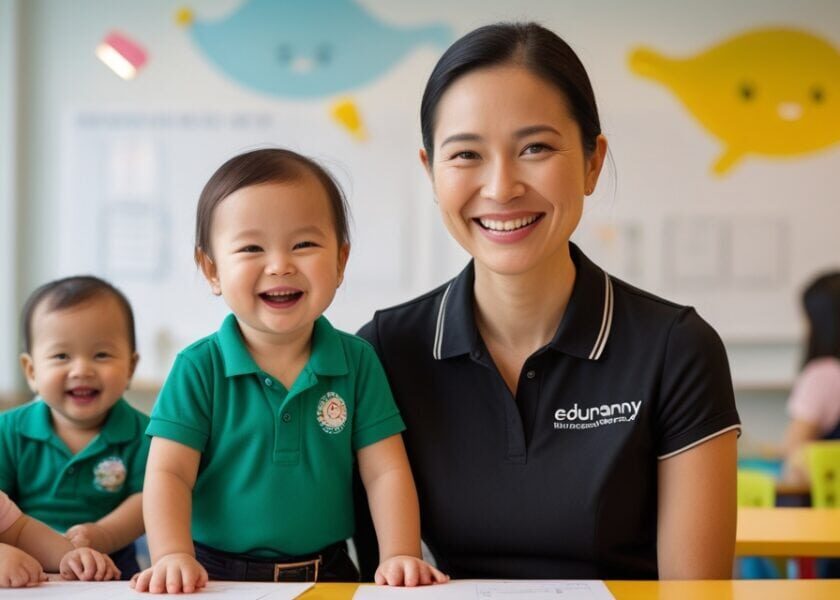
Then comes the transfer itself. The caregiver does not take your child from your arms like receiving a package. They lean in. They speak softly to your child, naming what is happening: “Mama is going to work now, and I am going to take care of you.” They make eye contact with your child. They allow a moment of transition, where your child can look between you and the new face and understand that this is not a loss — it is a change.
And crucially, they invite your child to feel secure in their presence before they ask you to leave.
Attachment science has shown us that a child’s stress response during separation is significantly modulated by the quality of the caregiver’s responsiveness in those first minutes. When a caregiver meets a crying infant with calm, warm engagement, when they pick up the child in a way that signals competence and tenderness, the child’s nervous system begins to regulate.
This insight applies to parents too. When you leave your child with a caregiver who is warm, competent, and emotionally attuned, your own nervous system also begins to regulate. The fear does not vanish. But it softens. It becomes manageable.
And over time, as you observe your child being genuinely nurtured by this new person, the trust that was extended in that first uncertain moment becomes real. The doubt that lived in the first handover gives way to something quieter and more grounded.
This is why the first handover is not just a logistical step in your childcare journey. It is the hinge upon which the entire relationship turns.
What Quality Childminding Actually Looks Like
For Singapore families navigating infant care options, it helps to understand what separates genuine quality from surface-level reassurance.
Quality childminding is not about flashy facilities or overly cheerful staff. It is about:
- Consistent caregiver presence: Your child develops trust through predictability. When the same person receives them each morning, the handover becomes a ritual rather than a repeated shock.
- Responsive interaction: Caregivers who attune to your child’s signals — hunger cues, sleep rhythms, comfort preferences — and respond accordingly.
- Real communication: Not just incident reports, but genuine updates about your child’s day. The moments that mattered. The small victories.
- Respect for the parent-child bond: Caregivers who understand they are partners with you, not replacements. Who welcome your input and honor your knowledge of your child.
- Emotional intelligence at transitions: Someone who understands that the morning handover sets the tone for the entire day — for your child and for you.
These are not luxuries. They are the minimum that every child deserves, and that every parent should expect.
Your Real Questions, Answered Honestly
“What if my child cries and won’t settle?”
Some crying at first handover is normal. What matters is how the caregiver responds to that crying. A quality caregiver does not ignore distress or wait for it to pass. They engage. They pick up your child with warmth and intention. They speak in calming tones. They create safety through presence.
Within minutes, a child’s nervous system — when supported by responsive care — can begin to regulate. If your child continues to be deeply distressed over weeks, that is information worth exploring together with your caregiver. But a few tears in the first days, met with skill, rarely signal a problem.
“How will I know what happens when I’m not there?”
Quality childminding services address this through transparency — regular updates, open communication channels, and where available, technology that allows you to feel connected rather than surveilled. The goal is not surveillance. The goal is partnership. You should feel invited into your child’s day, even while you are away.
“What if I never feel comfortable leaving my child?”
Some parents expect trust to arrive all at once, like a switch being flipped. For most, it builds gradually — one good morning at a time, one reassuring update at a time, one moment of seeing your child content in someone else’s care.
If weeks pass and you still feel constant dread, that is worth examining. But give yourself and your caregiver time to build the relationship. Trust is a process, not a feeling on day one.
“Is home-based care really as good as centre-based care?”
Research in early childhood development consistently shows that caregiver quality matters far more than setting type. A warm, responsive caregiver in a home environment can provide exceptional care. A large centre with high turnover and poor ratios can leave children emotionally unprotected.
What you want to evaluate is not the label — home-based or centre-based — but the specifics: Who will care for my child? How many children are in their care? How are they trained? How do they handle transitions?
How EduNanny Approaches the First Handover
EduNanny is part of the ECDA Childminding Pilot, and from its founding, it has understood something that many childcare models overlook: the handover is not a complication to be managed. It is a meaningful act that deserves to be done well.
When you bring your child to an EduNanny caregiver, you are not dropping them at a service. You are beginning a daily partnership, and that partnership deserves to start with the same care you would give to any important relationship in your life.
Before the First Goodbye
EduNanny caregivers are trained in attachment-informed practices, which means they understand not just what a child needs, but what a parent needs in that moment of transition. They communicate with you in the days and weeks before your child’s care begins, sharing information about how your child responds to new people, what soothes them, and what their rhythms look like. They want to know your child the way you know your child.
The Handover Itself
When the first handover arrives, your EduNanny caregiver is ready. They greet you and your child with warmth and presence. They take time. They do not rush. They understand that those first moments at the door will shape the hours your child spends in their care — and they treat that time with the gravity it deserves.
Ongoing Partnership
EduNanny maintains open communication channels. You receive updates about the moments that mattered — the first smile after you left, the new sound your baby made, the way they settled into nap time. You are not shut out of your child’s day. You are invited into it, even while you are away.
Service Structure
EduNanny operates across both home-based and community-based pathways, offering flexibility for Singapore families in different circumstances. The infant ratios are carefully maintained — up to one to three, depending on the setting — so that every child receives the individual attention that developing nervous systems require.
This is not a numbers game. This is about ensuring that when your child reaches for a hand, there is a hand there to reach for.
Access and Affordability
For many Singapore families, quality infant care has historically felt out of reach. EduNanny’s fee structures within the pilot are designed to be accessible, with CDA funds and Baby Bonus usable towards care. The quality of the first handover should not be a privilege reserved for those who can afford premium private arrangements.
Technology as a Support Tool
EduNanny also offers the Thomas AI Chatbot — a support tool for parents with questions about development, feeding, and infant care. Not to replace human judgment, but to support it. To give you answers grounded in evidence and experience, so that you feel not just informed, but confident.
Questions to Ask Before You Commit
- Who will actually be caring for my child? Ask about primary caregivers, not just centre directors. Consistency matters enormously in the first year.
- What does the handover process look like? A quality service will have a deliberate, thoughtful approach to how children are received each morning.
- How do you handle separation distress? Listen for attunement, not just reassurance. “We let them cry until they stop” is a different answer than “We work to help them feel safe quickly.”
- How will I know what my child’s day was like? Communication should be regular, specific, and meaningful — not just a daily log of meals and naps.
- What are the caregiver-to-child ratios? Younger children need more individual attention. Ask specifically about infant ratios.
- Can I visit or observe before committing? Quality services welcome this. Hesitancy to be observed can be a warning sign.
You Are Not Overreacting
Let us return to that moment. The one you are facing, or the one you remember. The one that lives in your body even now — in the memory of the weight of your child in your arms and the door waiting to close behind you.
What you felt was not weakness. It was not a sign that you were doing something wrong. It was the sound of your love asking to be trusted, and your fear asking to be soothed, and your child asking to be held by someone worthy of holding them.
You deserve to walk away from that moment feeling something other than doubt. You deserve to leave your child with the quiet confidence that comes from knowing they are in hands that understand what this moment means.
You deserve a goodbye that is not just endured, but honored.
The first handover asks you to extend trust before it has been earned, and to believe in a future where that trust will be justified. When it is done well — when your child is received with warmth and your fear is met with understanding — that future becomes real. It becomes the daily rhythm of a child who waves at the door instead of crying, a parent who drives to work without their heart in their throat, and a caregiver who has become family in every way that matters.
If you are a parent in Singapore exploring your infant care options, you are already doing something important: you are taking the time to understand what your child needs, and what kind of partnership you deserve.
That instinct — the one that made you pause at that door, the one that refused to let you walk away without asking questions — that instinct is exactly what will guide you to the right choice.
EduNanny is here to meet it — with caregivers trained in attachment-informed practices, with thoughtful handover processes, and with the kind of ongoing partnership that helps trust grow over time.
Because every parent deserves to leave their child’s first handover feeling held. And every child deserves to arrive at it feeling safe.
Learn more about EduNanny Singapore, explore the ECDA Childminding Pilot, or get in touch to begin a conversation about what your family needs.