Is Your Child’s Childcare Really Enough? Signs of Healing and Recovery
When “Good Enough” Was Not Enough: Understanding Healing, Recovery, and What Quality Childcare Can Actually Do for Your Child
There is a moment that many Singapore parents know, though few speak of it openly. It happens in the car after pickup, in the quiet of the nursery at bedtime, in the stolen minutes between work and the childcare door.
You look at your child and something does not quite add up. They are safe. They are fed. They are, by all external measures, fine. But something behind their eyes seems dimmed. A curiosity that should be burning is flickering. A trust that should be forming is holding back.
You tell yourself it is a phase. You tell yourself they are tired, or hungry, or simply adjusting. But a quieter voice, the one that speaks in the darkest hours, asks a harder question: What if the care I chose was not enough? What if my child is carrying something they cannot yet name?
These are not comfortable questions. But they are honest ones. And understanding the honest answer may be one of the most important things you do for your child.
If you are a parent reading this and feeling the weight of recognition, I want you to pause here and take something in: that weight you are carrying, that guilt, that worry, that fear that you may have already done damage that cannot be undone—it is not a sign that you failed. It is a sign that you are paying attention. And paying attention is the most important thing a parent can do.
Quick Summary: What This Article Covers
- The gap between functional childcare and the nurturing care young children actually need
- What developmental science tells us about children’s capacity for recovery in the early years
- Signs that your child may be struggling in their current care environment
- How quality care rebuilds trust, regulation, and curiosity
- Practical guidance for making a change with confidence
- What to look for when choosing care that supports healing
Singapore Has No Shortage of Childcare Options. But That Is Not the Same as Having What Children Need.
Walk through any residential estate in Singapore and you will find childcare centres opening their doors before dawn and closing after sunset. Frameworks are in place. Ratios are met. Compliance is maintained. For a working family navigating the demands of a career, a mortgage, and the relentless logistics of modern Singaporean life, this kind of functional care has become the water we swim in. We assume it is sufficient because it exists, because others use it, because it is all we have had time to find.
But functional is not the same as nurturing. Adequate is not the same as alive.
A child in a room of twelve, managed by one overwhelmed caregiver rotating through bottles, diapers, and naps, is not experiencing the kind of care that builds the architecture of a human being. This is not malice. It is mathematics. When one caregiver is responsible for too many small bodies, something has to give. And what gives, quietly and almost invisibly, is the responsiveness that babies need to learn that the world is safe, that people can be trusted, and that their needs matter.
Many Singapore children are spending their early years in environments that are clean, licensed, and operationally sound, but emotionally sparse. Rushed transitions. Minimal eye contact. Diapers changed efficiently but not tenderly. Bottles offered on schedule rather than in response to hunger. Hands wiped clean of tears before anyone has paused long enough to understand what caused them.
Signs Your Child May Be Carrying More Than You Realise
When a child has been in an environment where their needs were met but their cues were not truly seen, they often develop patterns that are subtle but identifiable.
Some children become unusually compliant. They seem almost too easy, too undemanding, too willing to go with the flow. This is not calm. It is resignation—a young child learning that their preferences do not move the world, so they have stopped expressing them.
Other children become dysregulated in ways that seem disproportionate. A small frustration sends them into a spiral that takes a long time to come down from. This is not bad behaviour. It is a nervous system that has been operating in a state of low-grade stress for too long, unable to distinguish between minor inconvenience from genuine threat.
Still other children withdraw. They are present but not quite there. They watch rather than engage. They have learned that connection is unpredictable, so they protect themselves by not reaching for it.
If you recognise any of these patterns in your child, you are not imagining it. And you are not alone. These patterns are not permanent. They are adaptations. What unmakes them is not therapy, not in the formal sense—though that has its place. What unmakes them is something simpler and more powerful: consistent, responsive, attuned care.
What Science Actually Tells Us About Early Childhood and Recovery
Here is what the research on early childhood development tells us, and it is one of the most hopeful truths we have: the brain in the first years of life is not a fixed structure waiting to be filled. It is a living, changing, extraordinarily adaptable organ.
Neuroscientists call this neuroplasticity, and in the early years, it is at its peak. The connections that form in a child’s brain in the first thousand days are vast and impressionable. But they are not permanent in the way we once believed. They can be reinforced. They can be redirected. They can be healed.
This matters enormously for the parent who is wondering if it is too late. The answer, according to what we now understand about early development, is almost never a simple yes. Recovery is not only possible. It is, under the right conditions, probable.
The child who has learned to hold back, to expect inconsistency, to protect themselves by not reaching for connection—these are adaptations, not permanent states. And adaptations, by their very nature, can be unmade.
What Quality Care Does for a Recovering Child
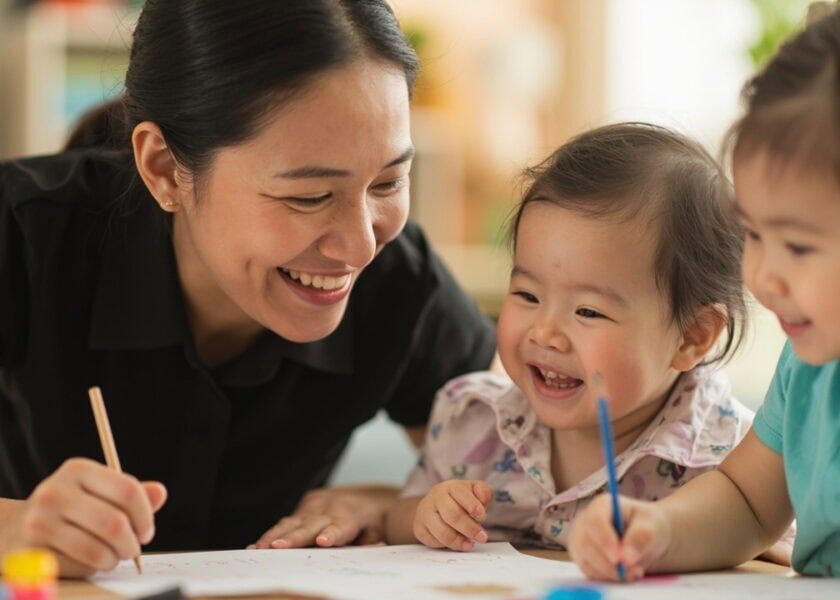
A caregiver who notices when a child is beginning to feel frustrated, and who intervenes before the frustration becomes a meltdown. A caregiver who greets a child’s arrival with genuine pleasure, who remembers that the child loves trucks, who notices when the child’s hair has been cut. A caregiver who is not merely supervising but truly present.
This kind of care does several things simultaneously:
- It regulates the child’s nervous system through co-regulation—the process by which a calm adult helps a child learn to calm themselves.
- It rebuilds internal working models—the unconscious templates a child develops for what to expect from other people.
- It reawakens something vital: the belief that learning is worthwhile.
When a child feels safe, they become curious. When they are curious, they explore. When they explore, they learn. And when they learn, they grow in every dimension simultaneously—cognitively, emotionally, socially, physically.
The foundations of school readiness, of cooperation, of empathy, of resilience are not built through flashcards or curriculum. They are built through the daily, hourly, moment-by-moment experience of being genuinely cared for.
Signs of Healing You May Start to Notice
Parents who make the switch to quality care often describe a period of adjustment—and then something remarkable begins to happen:
- A child who begins to protest when you leave, where before they barely seemed to notice. This is not regression. This is attachment waking up.
- A child who asks for things, expresses preferences, pushes back. This is not stubbornness. This is a sense of self emerging.
- A child who recovers from meltdowns more quickly, who can be soothed, who trusts that comfort is available.
- A child who plays more creatively, who invents stories, who lingers in exploration rather than moving frantically from one stimulus to the next.
- A child who sleeps better, who eats more peacefully, whose body seems less tense.
Recovery is not linear. There will be days when your child seems to have turned a corner and days when old patterns resurface. This does not mean the healing is not working. It means your child is testing whether this new safety is real, whether it will hold, whether they can afford to let their guard down.
The answer to that question, over time and with consistency, is yes.
Making the Transition: How to Change Care With Confidence
Re-enrolling a child in new care is not a small thing. For a child who has already experienced a disconnect between themselves and their caregiver, being moved again can feel like confirmation of their worst suspicion: that people leave, that attachments are not reliable, that the world does not hold steady.
This is a real concern, and it deserves a real answer. Yes, transitions are hard. But they are not necessarily harmful, and they can be done in ways that minimise distress and maximise safety.
Before the Transition
Talk to your child in simple, honest terms about what is happening. Use language that is warm and certain, not apologetic or guilty. You are not abandoning them. You are bringing them somewhere better. Children, even very young ones, are remarkably attuned to the emotional weather of the adults around them. If you approach the transition with calm confidence, they will take their cues from you.
During the Transition
Allow time. Rushed hellos and goodbyes at the door of a new environment create anxiety. Slow, supported introductions—where you are present for the first sessions, where the new caregiver has time to connect with your child before full separation—make an enormous difference.
After the Transition
Stay attuned. Watch for signs of regression, for changes in sleep or appetite or mood. These are not failures. They are expected. The child’s system is recalibrating, learning to trust again, and that process takes time and patience.
What to Look for When Choosing Care That Supports Healing
For parents in Singapore, the practical question becomes: how do I find care that actually provides what my child needs to recover?
There are specific things worth asking about:
Caregiver-to-Child Ratio
In infant care especially, this matters more than almost anything else. A caregiver who is responsible for three children is a very different presence from one who is responsible for ten. Ratio is not a bureaucratic detail—it is the difference between responsiveness and oversight.
Communication Quality
Are you receiving updates that tell you about your child’s day, not just that they ate and slept, but how they seemed, what made them smile, where they lingered? Quality care providers understand that transparency is not a feature. It is a responsibility.
Continuity of Caregiver
Children heal in relationships, and relationships take time. A caregiver who stays, who learns your child’s rhythms and preferences and fears, who grows alongside them, is irreplaceable. For a child who has learned to expect inconsistency, familiarity is not a luxury—it is medicine.
Environment and Scale
Smaller, home-based settings often provide a different quality of experience for children who are recovering. The familiarity of a home environment, the predictability of a consistent caregiver, the warmer atmosphere—these are not niceties. They are therapeutic elements.
EduNanny Singapore: Care Built on the Understanding of What Children Need
EduNanny by BUTLER, operating within the ECDA Childminding Pilot, represents something different in Singapore’s childcare landscape. It is built on a commitment to ratios that allow for attunement, to communication that keeps parents genuinely informed, and to pathways that are flexible enough to meet the reality of Singapore family life.
Whether through home-based care or community-based arrangements—whether in the familiar setting of the child’s own home or within a carefully structured small-group environment—EduNanny is designed around a central premise: that quality care is not a privilege for those who can afford premium packages. It is a right for every child.
The pilot structures in place through the ECDA Childminding Pilot reflect a genuine attempt to make this a reality. Fee structures are designed with real families in mind. For those navigating the financial realities of raising children in Singapore, the usability of CDA and Baby Bonus resources offers meaningful support. Monday to Friday care blocks cover the core needs of working families.
And throughout it all, the emphasis remains on something that cannot be automated or standardised: human connection.
Your Next Step: Choosing Differently With Confidence
You know who you are. You have already sensed that something was wrong. You may have already pulled your child from one arrangement and are searching for something better. You may be caught between the guilt of having stayed too long and the fear of making another wrong choice. You may be lying awake wondering whether the flatness in your child’s eyes is something they will outgrow or something that will define them.
I want you to hear this: you did not break your child. A system broke your child. A set of pressures, constraints, and insufficient options broke your child. And the same love that is making you feel guilty right now is the same love that can begin to repair what was damaged.
You are not too late. Your child is not broken. The door has not closed.
What We Owe Our Children in Those Early Years
Not in terms of academics or enrichment or the alphabet recited ahead of schedule. What do we owe them in terms of who they become, in terms of how their brains are building themselves, in terms of the relational foundations that will determine whether they grow into adults who can love, who can trust, who can regulate their emotions, who can sit with discomfort without falling apart?
The answer is simple and staggering: we owe them presence, we owe them responsiveness, and we owe them the experience of mattering.
This is not sentimentality. This is the science of human development, laid bare in decades of research that those of us in the childcare field have a responsibility to translate into action. The child who experiences consistent, attuned care in the first thousand days is not merely comfortable. They are building something inside themselves that will serve them for the rest of their life: a secure base from which to explore, a sense of self that is worthy of love, and the neural architecture that makes learning in all its forms possible.
Three Things to Leave With
If you are a parent who has read this far, I want you to leave with three things:
- Validation. The concerns you carry about your child’s care are not overreaction. They are appropriate responses to a system that often falls short of what children truly need. Your worry is love. Your search is action. And your willingness to consider change is one of the bravest things a parent can do.
- Clarity. Recovery from early care deficit is not wishful thinking. It is documented, understood, and possible. The science is on your side. Your child’s brain is not a closed system. It is waiting, even now, for the right input.
- Invitation. If you are looking for care that takes healing seriously, that understands what your child has been through and what they are capable of recovering into, EduNanny Singapore is here. Not as a promise of perfection, but as a commitment to the kind of responsive, human, consistent care that makes recovery possible.
Making the corrective choice now—not from guilt, but from clarity—is one of the most consequential decisions a parent can make. It is not a door that has closed. It is a door that you have the power to open.
Your child is not broken. They are waiting for you to trust that. And they are waiting, perhaps more than anything else, for you to find them the kind of care that will remind them, day after day, in small moments and large, that they are safe, that they are seen, and that the world can be trusted.
That is what quality care does. That is what EduNanny Singapore exists to provide.
And that is the hope this article ends with—not the hope that ignores reality, but the hope that is rooted in it. Your child can heal. Your family can heal. And the choice you make next, made with honesty and courage and the support of people who understand what is at stake, can be the beginning of something you once were not sure was possible.
It is not too late. And you are not alone.
Ready to explore care that takes your child’s healing seriously? Connect with EduNanny Singapore to learn about home-based and community-based childminding options available through the ECDA Childminding Pilot.