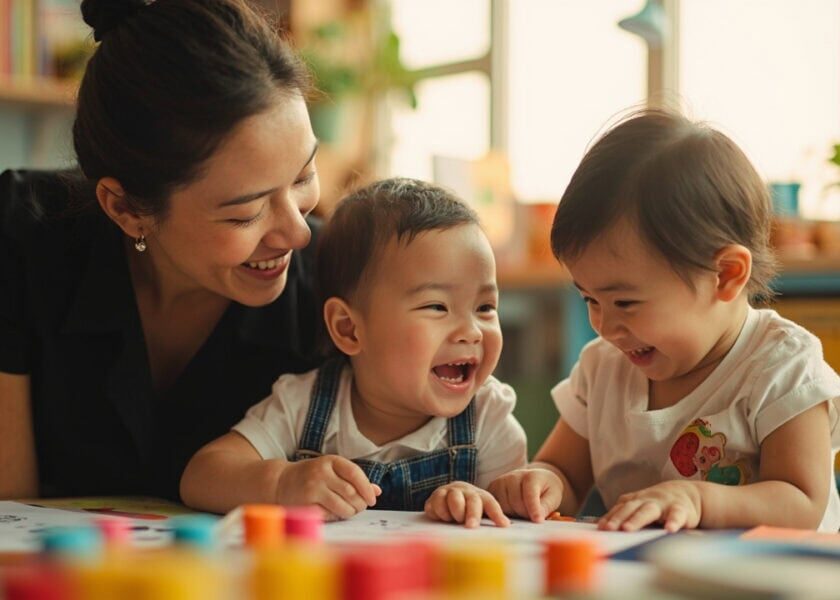
How to Read What Your Child Tells You After Care
What Quality Childcare Looks Like From the Inside
Understanding your child’s experience begins with understanding what actually happens inside a day of quality care. Not the programme, not the curriculum, not the facilities. The quality of attention your child receives.
The Morning Separation
When a child arrives in the morning, the first real act of the day is a separation. For the child, this is the world rearranging itself around the knowledge that you are leaving and someone else will be responsible.
The way this separation is handled sets the emotional temperature for everything that follows. In quality care, the caregiver does not rush this moment. They do not dismiss it or override it. They meet the child in it—allowing the discomfort of parting without amplifying it, signalling quietly and repeatedly that the world is still reliable.
This is not a technique. It is attunement. And attunement is the invisible architecture of every good childcare day.
The Rhythm of the Day
Once the separation settles, the day unfolds in ways that are deeply meaningful to the child, even when they cannot yet articulate them.
There are moments of discovery—something that catches the eye, a texture, a sound, a new word that suddenly connects to something real. There are moments of social contact with other children, complicated and illuminating, where small negotiations happen and small injuries are felt and small repairs are made. There are moments of rest, of hunger, of the body’s simple needs being met.
There is the caregiver who notices a child reaching for something just beyond their grasp and gently extends it. There is the caregiver who names what a child seems to be feeling and holds space for it. There is the caregiver who is simply present, nearby, reliable—the steady ground from which a child can venture and return, venture and return, growing more certain each time that the world away from you is not a threatening place.
This is what quality care looks like from the inside. It is a quality of attention. It is a caregiver who is genuinely, consistently present to your child in a way that lets them feel: I am seen. I am held. I am safe enough to explore, to struggle, to grow, to come back.
How Your Child Tells You What the Day Was Really Like
When a child experiences attuned care, it creates visible, legible effects at home. These effects are not subtle. They are available to any parent who knows how to look.
Direct Communication
Sometimes your child tells you directly. A four-year-old will re-enact an entire interaction from childcare—give the caregiver a name, assign roles, reproduce the emotional texture of an exchange. A two-year-old will repeat a song, name a texture, speak about a child or an adult who clearly mattered.
These are not random. They are the moments that were significant enough to survive the journey home. When your child shares these moments, they are giving you a window into their interior life—and what they are telling you, whether they know it or not, is what the day meant to them.
Indirect Communication
Sometimes it is indirect, and this is where parents need the most support.
A child who comes home flat, depleted, behaviourally dysregulated after a day in what looked like a perfectly adequate childcare setting, is communicating something important. A child who is clingy at home but only after childcare, not after other outings, is telling you something about the emotional cost of their day.
A child who resists going to childcare in the morning—not because of ordinary separation anxiety but because of something deeper—is often a child whose body has already learned what the day will feel like.
These signals do not mean the care is malicious or that the caregivers are unkind. They mean that something in the day is costing your child more than it should.
The Child Who Comes Home Full
And then there is the child who comes home full. Not hyper, not wound up, but vital. Full of themselves. Full of what they experienced and want to share. Willing to connect, to play, to let you into the world they built while you were apart.
This is a child who thrived. And you can feel the difference between a child who thrived and a child who survived, even if you cannot always name it in the moment. The difference is not about temperament. It is about what happened inside those hours.
Thrived or Survived? Understanding the Difference
When a child thrives in quality care, they are drawing on a reservoir of felt security. They have been engaged, not just supervised. They have been seen as individuals, not managed as a group. They have had their curiosities honoured and their struggles supported.
When they come home, they carry that inside them—the ease of a child who knows the world was good to them that day.
When a child merely survives the day, they have spent their emotional resources staying regulated in an environment that did not actively nurture them. They may have been physically safe. They may have been entertained. But they were not held in the way that lets a child relax and grow.
When they come home, they are running on empty. They need to be rebuilt. They need to be held close. They need the safety of you to restore what the day spent.
Both of these children come home. But they arrive as entirely different children. And if you know how to read this, you know something vital about the care you chose.
Making the Choice: What to Look For in Singapore
Understanding your child’s felt experience changes the question you bring to a childcare decision. You stop asking: does this centre have good programmes? You start asking: will my child flourish here, or merely endure?
The answer to that question has a texture to it. It is found in the ratio of caregivers to infants—the closeness of attention that allows a caregiver to know your child by name, by temperament, by the way their face changes when they are tired or hungry or overwhelmed.
It is found in the consistency of who cares for your child, day after day, so that trust can accumulate. It is found in the quality of communication you receive—not just daily reports about meals and naps, but genuine insight into your child’s emotional landscape. What did they discover today? What made them laugh? Who did they reach for?
For families in Singapore, finding care that prioritises your child’s felt experience means understanding what to look for—and what questions to ask.
The ECDA Childminding Pilot
EduNanny by BUTLER operates within the ECDA Childminding Pilot, which is built on childminding principles that prioritise exactly the conditions described above: small ratios, attuned care, a focus on the child’s individual experience.
In home-based care through models like this, ratios of up to one to three infants allow for a quality of attention that is simply not possible in larger settings. Community and centre-based pathways are also available, so that families can find the arrangement that best fits their child’s temperament and their own circumstances.
Where open communication channels are in place, they serve a real purpose: they let you stay connected to your child’s day, not in a surveillance way, but in a trusting way. You can be told not just what happened but what it meant.
Questions to Bring With You
When evaluating your options, bring these questions with you. Not as a checklist, but as a way of sensing whether the care is built around your child’s experience.
- What is the ratio of caregivers to infants? Can the caregiver genuinely know my child as an individual?
- Who will be caring for my child, day after day? Is there consistency, or does the team rotate frequently?
- How is the morning separation handled? Is there time and attention given to this transition?
- What kind of communication will I receive about my child’s day—not just logistics, but their emotional experience?
- Can I see, in how the caregivers speak and move, a quality of genuine attention? Do they seem present to the children, or just present in the room?
Questions to Ask Yourself After Pickup
After your child comes home, take a moment to observe honestly. You are not looking for perfection. You are looking for patterns.
- Does my child come home full of themselves—wanting to share, to play, to connect? Or do they come home flat, needing to be rebuilt?
- Does my child speak about the caregiver with warmth, as someone who matters to them?
- Does my child resist going in the morning with a depth of feeling that goes beyond ordinary separation anxiety?
- Does my child re-enact moments from the day, giving them life and meaning?
- Do I feel informed about what my child’s day was actually like?
These questions are not a test. They are a lens. And the answers, over time, will tell you whether the care you chose is truly serving your child.
What You Are Really Choosing
You are making a choice that many people do not fully understand. In Singapore, where family support is often closer than in other places but still not always available, and where the demands of work and life leave little room for the kind of presence young children need, you are finding someone to walk alongside you in the most important work there is: raising a human being.
You are not choosing convenience. You are choosing who will be present for the hours you cannot be present for. And that is one of the most consequential decisions you will make—not because the alternatives are inadequate, but because the stakes are real and you know it.
You are doing something that is easy to undervalue because it is invisible. You are filling your child’s hours with the conditions for healthy becoming. You are trusting that the world outside your home is safe enough for your child to venture into and return from, whole.
You are choosing, every morning, to believe that your child will be seen, held, and nurtured by someone who understands what they need. And every evening, when you read your child’s face and see what the day gave them, that belief is either confirmed or challenged.
What you deserve is the version of that belief that is earned, not just hoped for. The version that comes from knowing what to look for. The version that comes from choosing care that is built around your child’s felt experience, not just their physical safety.
The version that lets you drop your child off in the morning and drive away with something more than crossed fingers and good wishes—something that looks, at its best, like quiet confidence.
Not because the uncertainty disappears, but because you have become fluent in what your child tells you every evening. And what they tell you, when the care is right, is this: I was fine. I was more than fine. I was held, and I grew, and I came home full.
Ready to Learn More?
Quality childcare is not about finding someone to watch your child. It is about finding someone who will be present for your child in the way that lets them flourish. It is about choosing care that your child will feel in their body every evening—and that you will read in the vitality they bring home.
If you are exploring your options and want to understand what attuned, relationship-based care looks like in practice, we invite you to have a conversation about what your family needs—and how EduNanny by BUTLER approaches childminding with the attention, consistency, and developmental care that makes the difference between thriving and merely surviving.
Because the evening homecoming does not have to be a moment of uncertainty. It can be a moment of confirmation. And your child, every single day, is ready to show you what that day meant.
Learn more about EduNanny by BUTLER and our approach to childcare.