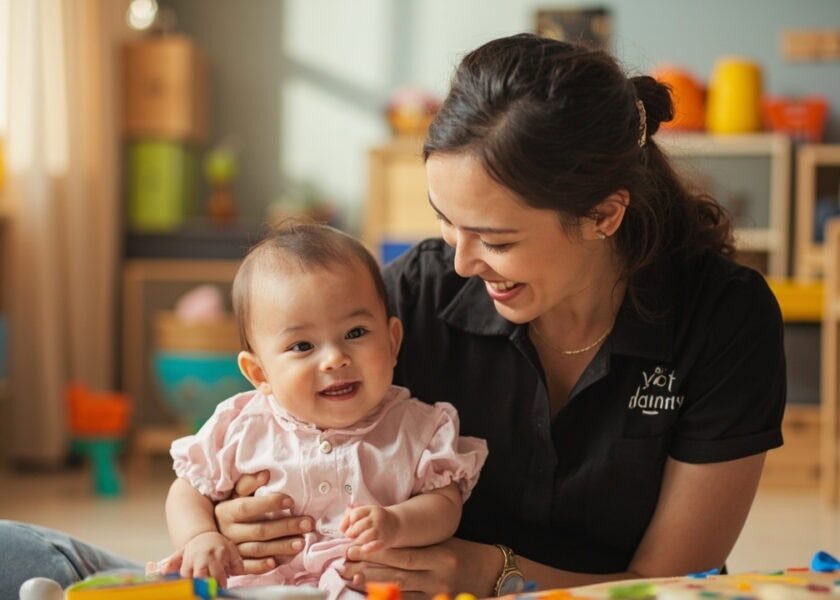
The Relationship Your Child Needs in the Early Years
Why Knowing Your Child Matters More Than Logistics
The architecture of early childhood care in Singapore has, quite understandably, been built around logistics. Schedules. Teacher-to-child ratios. Curriculum frameworks. Accreditation. These are not small things. They matter enormously. But they are the scaffolding of care, not its heart.
And for parents who have lain awake wondering whether their child is thriving or merely being managed, logistics alone cannot answer the question that keeps them searching. The question is whether their child will be known.
When parents describe what they are looking for—in conversations with friends, in late-night searches online, in visits to childcare centres across the island—they often struggle to articulate it precisely. They use words like “warm”, “loving”, “safe”. But beneath these words is something deeper: the desire for their child to be in a relationship that will endure, adapt, and grow alongside them.
What parents sense, often without being able to name it, is that a childcare arrangement is not simply a place where a child goes. It is a context in which a child develops—not just cognitively, but emotionally, socially, and in their fundamental sense of self.
The Story That Says Everything
Not long ago, a mother shared something she had noticed about her daughter’s caregiver. The caregiver had been with her family for almost two years, beginning when her daughter was just eight months old.
One afternoon, the mother arrived to collect her child and watched as the caregiver crouched down, placed a gentle hand on her daughter’s shoulder, and said softly: “You’re going to miss your picture book today, but we will read it together tomorrow, yes?”
The mother had said nothing about a picture book. She had not asked for updates about favourite stories or daily rituals.
The caregiver had simply noticed something about this child over many months of careful attention—a love of that particular book, the way her daughter reached for it at the beginning of each session—and she had carried that knowledge forward into the way she related to this child.
That is not supervision. That is not logistics. That is relationship.
And that is the kind of knowing that shapes a child’s earliest understanding of what the world feels like. The child who feels known emerges from their early years with something precious: the belief that they are worth knowing well.
Why Care Must Transform as Your Child Grows
Here is something we rarely say aloud, though every parent knows it in their bones: the early years are not merely a phase to be survived. They are a foundation upon which an enormous amount will be built.
In those first years, children are not just growing bodies and developing vocabularies. They are constructing the fundamental architecture of selfhood. They are learning, in the most primal and wordless way, whether the world is a trustworthy place, whether their needs will be met, whether they are worthy of attention and warmth and genuine curiosity about who they are becoming.
The caregiver who is present during these years—who walks alongside a child not just for weeks but for months, for years, through the enormous changes that early childhood brings—is not simply a service provider. They are, in the most literal and important sense, a developmental companion.
The Arc of the Early Years
- The infant who needed constant physical reassurance becomes the toddler who needs to climb everything and insist on doing it alone.
- The toddler who could not yet name their emotions becomes the preschooler who can tell you in precise and surprising detail exactly how they feel about their best friend, their grandmother, the moon last night.
- The child who was utterly dependent on their caregiver for every need becomes a small person with preferences, opinions, friendships, and a growing sense of themselves as someone separate and distinct.
Being Minded versus Being Accompanied
This is what the language of “being minded” so often misses.
To be minded is to be managed, to be watched over, to be kept safe. And safety is not a small thing. But it is not enough. What children need—and what parents are looking for when they search for something that feels right—is to be accompanied.
To be minded is to be in a place. To be accompanied is to be with a person. And the distinction matters enormously because accompaniment implies relationship, and relationship implies knowledge, and knowledge implies continuity, and continuity implies that someone has been paying attention.
A child who is accompanied through their early years by the same caregiver—through the emergence of language, through the discovery of independence, through the first friendships and the first disappointments and the first victories—carries something forward that a series of transitions cannot provide. They carry the sense of being known.
Most childcare arrangements are not designed to do this. They are designed for the child you have today. But the child you have today is not the child you will have in six months, in a year, in three years. The child you are raising is constantly becoming someone new, and the relationship that cares for them must be capable of becoming too.
What Quality Childminding Looks Like in Practice
For parents evaluating childcare options, it can be difficult to distinguish between arrangements that offer genuine accompaniment and those that offer competent management. Here are some markers of what quality looks like in practice:
In Infant Care
- The caregiver responds to distress with patience and attunement, not just efficiency.
- Feeding and sleep routines are observed and remembered, adapted to the individual child’s rhythms.
- The caregiver notices subtle cues—the particular cry that means hunger versus tiredness, the body language of curiosity.
- Transition rituals are personalised to the individual child, reflecting knowledge built over time.
In Toddler Care
- The caregiver scaffolds emerging independence with encouragement, not control.
- Frustrations are named and held, helping the child learn to regulate emotions.
- The caregiver remembers the child’s current obsessions, fears, and joys—and references them naturally.
- First steps and small victories are celebrated in ways that feel genuine, not performative.
In Preschool Care
- The caregiver helps children navigate friendships with patience and insight.
- Conversations go beyond surface logistics to engage with the child’s inner world.
- The caregiver can articulate something meaningful about who each child is becoming.
- The child speaks about their caregiver with familiarity and trust.
The Question to Ask
When visiting a potential childcare arrangement, consider asking: “Can you tell me something about my child that isn’t on any form?” A caregiver who has genuinely known your child will be able to answer this question. A supervisor who has merely managed your child will not.
EduNanny’s Approach: Built for Relationship
EduNanny was built around this insight. Not as an abstraction, but as a design principle.
When EduNanny by BUTLER was established, the founders understood something that many childcare models overlook: the quality of a child’s early care cannot be separated from the quality of the relationship that provides it. A beautiful facility with excellent resources is meaningful only insofar as there is a person in that facility who truly knows your child—who can read their cues, anticipate their needs, celebrate their small triumphs and hold them gently through their frustrations.
Beginning with People, Not Programming
EduNanny’s approach to infant care begins not with programming but with people. With the careful matching of caregivers and families. With attention to the kind of relationship that can sustain itself over time, through the many changes that early childhood brings.
In the ECDA Childminding Pilot that EduNanny participates in, this philosophy is given structural support. With ratios of up to one to three in infant care, EduNanny’s caregivers have the space and attention to do what no ratio of one-to-ten or one-to-fifteen can replicate: they can truly know each child in their care.
The care does not remain static while the child grows. It evolves. It deepens. The caregiver who begins by responding to an infant’s cries with patient, attuned presence becomes, as that child grows, a different kind of companion—offering encouragement for first steps, scaffolding for emerging language, gentle guidance as the child learns to navigate the complex social world of play and friendship. This is not accidental. It is designed.
The Parent Partnership
No care arrangement can succeed without parents as true partners. The relationship between caregiver and child is embedded within a triangle of trust that includes the parents. When parents and caregivers share information, share observations, share the small daily details that make up a child’s life—the new word they said yesterday, the way they have been asking about the neighbour’s cat, the book that has become an obsession—something powerful happens.
The child benefits from a coherent experience of being known not just at home but in care, by different people who are paying attention to the same small, significant person.
EduNanny has built transparency into this partnership. Regular updates, open communication channels, and where deployed, measures like CCTV for added reassurance—these are not features added to impress. They are practical expressions of a deeper commitment: that parents should never feel they are sending their child into a black box.
When parents feel trusted, they can extend trust. When they feel included, they can truly partner. And when they can see, clearly and honestly, what is happening in their child’s day, they can be present in a different way when they are home—less anxious, more attuned, more able to simply be with their child rather than managing their own worry.
The Real Concerns of Singapore Parents
The pressure here is immense. The hours are long. The cost of living is real. The workforce participation rates for mothers are among the highest in the region, and this is a strength of our society—a testament to the capabilities and ambitions of Singaporean women. But it also means that for many families, quality childcare is not a nice-to-have. It is an economic necessity.
And this is precisely why it matters so deeply that the care your child receives is not just adequate but genuinely excellent. Not just safe but relational. Not just educational but emotionally formative.
Accessibility and the Early Years
EduNanny understands this. The pilot fee structures have been designed with accessibility in mind, and pathways through CDA and Baby Bonus exist to ensure that cost is not a barrier to quality for families who need it.
This is not charity. It is a recognition that the early years belong to everyone—that every child in Singapore deserves to be known, to be accompanied, to be built up by people who care about who they are becoming.
The conversation about childcare should not be a conversation only for those who can afford the premium centres. It should be a national conversation about what we believe our children are worth.
How to Find Care That Accompanies
If you are a parent in Singapore researching infant care or childminding, here is what to look for—and what to ask:
Questions to Ask
- How long have you been working with children? How long have you been with this service?
- How would you describe your approach to understanding each child as an individual?
- What does a typical day look like, and how do you adapt it to individual children’s needs?
- How do you communicate with parents about their child’s day and development?
- What happens when a child’s needs change—as they move from infant to toddler, toddler to preschooler?
- Can you describe a moment when you noticed something important about a child that wasn’t obvious?
Red Flags to Watch For
- Caregivers who speak about children in generalities without evident personal knowledge.
- High ratios that make individual attention impossible.
- Communication that is one-directional—reports without dialogue.
- A curriculum that cannot be adapted to the individual child’s interests and rhythms.
- Resistance to questions about continuity of care relationships.
Green Lights to Look For
- Caregivers who seem genuinely curious about your child as an individual.
- An approach that emphasises relationship alongside development.
- Communication that feels like partnership, not performance.
- Attention to how the care relationship will evolve as your child grows.
- Transparency about ratios, training, and the matching process.
The Choice You Are Making
When you choose a childcare arrangement for your child, you are not simply choosing a service. You are choosing a relationship. Not the relationship you will have with the caregiver, though that matters. The relationship your child will have.
In the years ahead, as your child grows from the infant who needed to be held and soothed into the toddler who needed to explore and test and assert, into the preschooler who needed friends and autonomy and a sense of themselves as capable and valued—there will be a thread of continuity running through their life.
A person who was there at the beginning. A person who watched them change and who changed with them. A person who can say, with genuine knowledge and affection: “I have known you since you were this small, and I have seen who you are becoming.”
EduNanny by BUTLER was built for this. Not to replace the family, but to partner with it. Not to mind children, but to accompany them. Not to provide a service, but to build relationships that will shape who these children become.
Every parent who has stood at the door of a childcare centre, their child’s hand in theirs, feeling the weight of that daily separation, deserves to know that on the other side of that door, there is someone who will pay attention. Who will notice. Who will know.
Your child is not a placeholder. They are not a phase to be managed or a task to be completed. They are a person in the most profound sense—someone who is becoming, every day, someone new.
That is what EduNanny offers. That is the relationship you are choosing when you choose us.
Whether you are just beginning your search or ready to take the next step, EduNanny welcomes the opportunity to learn about your family and share more about how our approach to developmentally-oriented childminding might serve your child. We believe every family deserves to find care where their child will be truly known—and we would be honoured to walk that path alongside you.