What Your Child’s Caregiver Bond Reveals About Your Parenting
The Unnamed Feeling Every Singapore Parent Carries
When you enrolled your child in childcare, you expected certain things. You expected to worry less. You expected to feel confident dropping them off.
You did not expect to feel this particular twinge — this quiet mix of gratitude and something almost like grief.
It shows up differently for different parents. Some describe it as feeling “replaced” for a moment, even though they know their child loves them. Others feel guilty for even having the thought, because obviously they want their child to be happy at childcare. They do. They just did not anticipate how it would feel to witness that happiness from the outside.
In Singapore, where childcare decisions carry significant financial and logistical weight, this tension can feel especially acute. You have made a deliberate choice. You have entrusted your child to someone else for a large portion of their waking hours. You want that arrangement to be genuinely good. And when it is good — when your child clearly loves their caregiver — something unexpected can surface.
You might wonder: Is my child replacing me? Will this affect our bond? What if the caregiver leaves?
These are not irrational fears. They are the questions of a caring, thoughtful parent. And they deserve honest answers — not just reassurances, but real understanding of what is happening in your child’s emotional world.
What the Science Says About Attachment — and Why Secondary Bonds Matter
When most of us think about attachment, we think in singular terms. One primary attachment figure. Usually a parent. The bond that shapes everything else.
This is true, as far as it goes. The attachment your child forms with you in the first thousand days of life is foundational. It sets the template for how your child will experience relationships for the rest of their life. It teaches them whether the world is safe, whether people can be trusted, whether they are worthy of love.
But the science of attachment has evolved beyond this singular model. Research on multiple attachment figures — pioneered by developmental psychologists including Michael Lamb and extended through decades of ongoing study — tells us that children are not limited to one attachment relationship. Children can and do form multiple secure attachments. They can have a primary attachment to a parent and a secondary attachment to a grandparent, a family friend, a regular caregiver, or a childcare teacher.
Here is what is important to understand: when a child forms a secondary attachment with a responsive, warm, consistent caregiver, it does not diminish their attachment to their parent. It supports it.
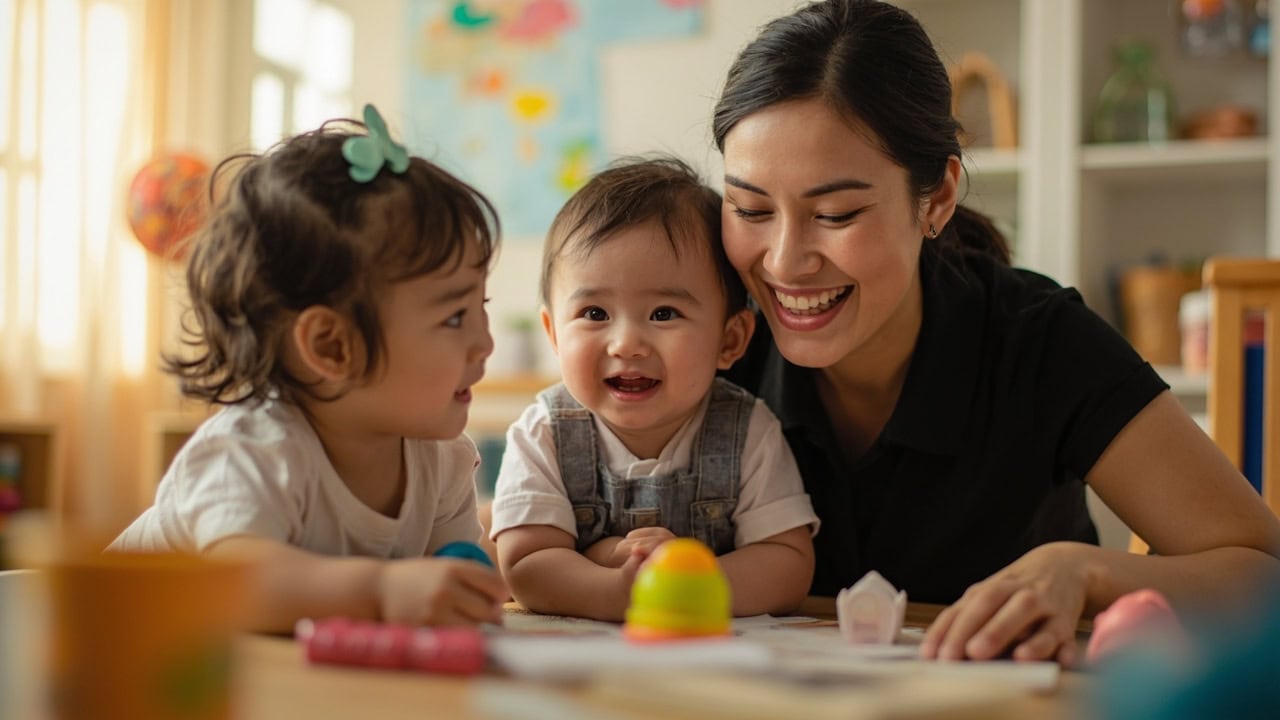
Developmental psychologists call this the multiple secure base model. Think of it as your child having a network of safe harbours. Your home is one. The childcare environment is another. Each safe harbour allows your child to practice the skills of trust, exploration, and connection. Each one builds confidence.
Children who have multiple secure attachments tend to be more socially competent, more emotionally resilient, more capable of managing separation, and — this is the part that should bring you enormous comfort — actually more securely attached to their primary caregivers overall.
Why? Because a child who trusts that their needs will be met — even when you are not the one meeting them — develops a deeper, more stable sense of security. They are not anxious about whether the world will take care of them. They know it will. And that means when they are with you, they can relax into the relationship rather than cling to it.
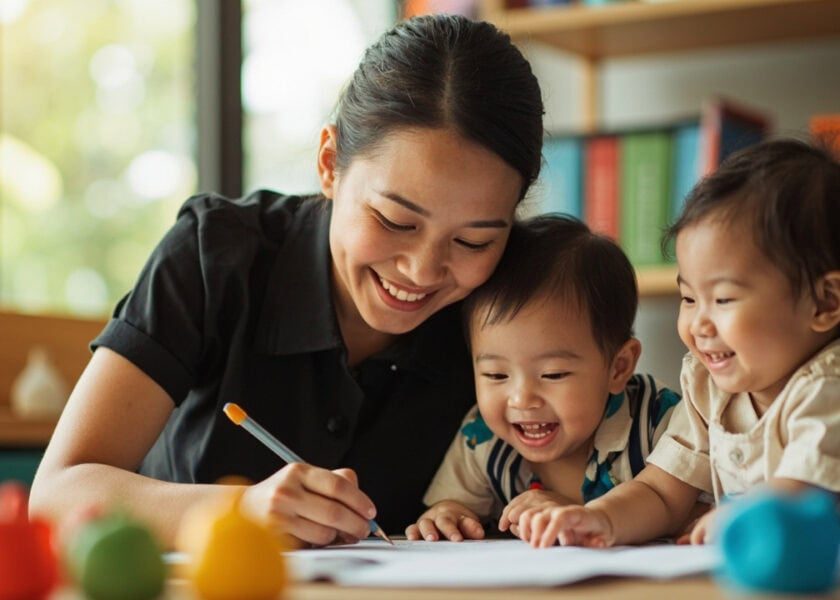
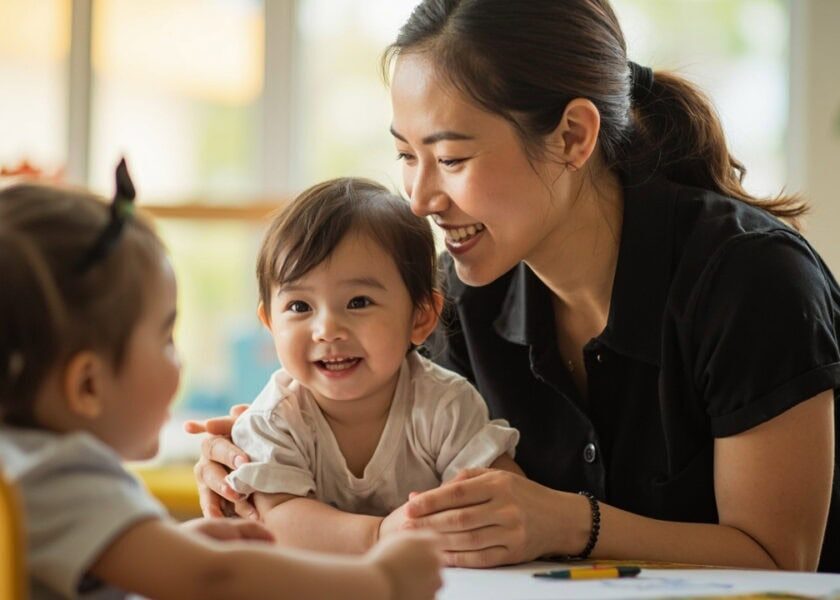
When your child waves goodbye without desperate crying, when they run to their caregiver with excitement at drop-off, when they come home and tell you about something their “Miss” taught them — these are not signs that your child is replacing you. They are signs that your child has learned something profound.
Your child has learned that love is not a scarce resource. That there is enough care in the world. That they can hold more than one person in their heart and still have room for you.
You are still the one they come home to. The one they reach for in the dark. The one whose absence matters and whose presence means everything.
The caregiver bond is not a threat to your bond. It is an extension of the security you have built.
Why Singapore Parents Feel This Tension More Intensely
In Singapore, the caregiver relationship may be one of the most important secondary attachments your child forms. This is not incidental to the local context — it is deeply connected to it.
Family structures are shifting. More parents are navigating demanding careers and complex logistics. Children are growing up in smaller households with fewer extended family connections than previous generations. The grandparents who once provided daily childcare may live in another country, another town. The neighbourhood auntie who knew your child by name is less likely to exist in a high-rise HDB estate.
When formal childcare steps into this space, it carries a weight that goes beyond supervision. For many Singapore families, the caregiver is the village — the secondary attachment that previous generations might have found in an extended family network.
This matters. But it also raises the stakes. Which is why the anxiety about caregiver bonds runs so deep — and why it deserves more than a dismissive “there’s nothing to worry about.”
There is something to understand here. And once you understand it, the worry transforms into something else entirely.
What Quality Childminding Looks Like — and Why Caregiver Continuity Matters
Not all caregiver relationships are created equal. Understanding the difference matters enormously for how you evaluate any childcare arrangement.
Professional warmth is different from parental attachment. Parents love their children with a fierce, biological, irreplaceable intensity. Caregivers offer something different but equally important: intentional relational warmth that is consistent, responsive, and professionally trained.
What does this look like in practice?
- Individual responsiveness: A caregiver who knows why your child is cranky today — not just that they are cranky. Who recognizes the signs of tiredness before the meltdown, the cues of hunger before the complaining.
- Consistent presence: The same familiar face meeting your child at drop-off, not a rotating cast of strangers.
- Intentional engagement: Not just supervising, but connecting. Getting down to your child’s level. Responding to their explorations with genuine attention.
- Respect for your role: A caregiver who speaks about you positively to your child. Who welcomes your child back to you at the end of the day, knowing that Mum and Dad are home base.
A child knows the difference between a caregiver who is present and a caregiver who is merely supervising. They feel the difference in their bodies, in their level of ease, in their willingness to explore.
For many Singapore parents, the worry is not just about the caregiver bond itself. It is about what happens to that bond over time. It is about caregiver turnover. The caregiver who was wonderful, who your child loved, who knew exactly how to calm your baby or read your toddler’s moods — and then, suddenly, she was gone.
This is one of the most legitimate anxieties in Singapore childcare, and parents are not given enough credit for how real and painful it can be. When a caregiver leaves, it is not just a logistical inconvenience. For your child, it is a small loss. For you, it is a trust disruption.
This is why caregiver continuity is not just a nice-to-have. It is a structural commitment.
At EduNanny Singapore, continuity is built into how the programme operates, not hoped for as a lucky accident. The ECDA Childminding Pilot framework allows for ratios of up to one to three infants in home-based settings — ratios that make true individual responsiveness possible and give caregivers the capacity to build genuine, individualised relationships.
When caregiver transitions do happen — because life involves transitions, and honest providers acknowledge this — they are managed with care:
- Transition plans are created with intention
- Parents are involved in the process
- New caregivers are introduced gradually
- Your child’s cues are monitored and responded to
The goal is for you to feel that you are part of your child’s day, even when you are not in the room.
Distinguishing Healthy Attachment from Dynamics That Need Attention
There is a difference between a healthy secondary attachment and a dynamic that actually warrants attention. As a parent, you deserve to understand that difference — not to increase your worry, but to give you clarity.
A healthy caregiver attachment looks like this:
- Your child is glad to see their caregiver, but also experiences appropriate separation distress when leaving
- They have moments of joy at childcare, but they also talk about you, look for you, and show that you hold a special place in their world
- The caregiver feels like a trusted, beloved figure — someone your child is glad to know, someone who adds to their sense of safety and joy
- You are still Mum or Dad. The hierarchy is clear, and it is not threatened
The “substitution anxiety” that many parents worry about — the fear that the caregiver is replacing them — is, in most cases, completely unfounded.
What might warrant further attention:
- Your child seems more attached to their caregiver than to you
- They resist going home to you
- They show signs of confusion about primary attachment
- The caregiver unconsciously positions themselves as a parental figure rather than supporting your role
These are moments to seek guidance — not to panic, but to understand what is happening and why. In most cases, a conversation with your caregiver and reflective observation will clarify that everything is normal. At EduNanny, caregivers are trained to understand this boundary. They are warm, but they are not parents. They support your child’s bond with you rather than competing with it.
Questions to Ask When Evaluating Any Childcare Arrangement
If you are currently researching childcare options in Singapore, here are the questions that matter most — the ones that go beyond licensing and ratios to get at the quality of relational care your child will actually receive:
- What is the caregiver-to-child ratio? Lower ratios mean more individual attention and genuine relationship-building is possible.
- How is caregiver continuity handled? Ask specifically what happens when a caregiver leaves. A thoughtful answer is a good sign.
- How do caregivers describe their approach to warmth? Listen for whether they distinguish professional warmth from parental attachment. That distinction matters.
- What does communication with parents look like? How will you know what happens in your child’s day? How are concerns raised and addressed?
- How are transitions managed when they occur? Will you be involved? Will your child be supported through the change?
- What training do caregivers receive? Beyond infant care basics — what about relational skills, emotional attunement, understanding attachment?
- How does the programme support your role as parent? A quality programme will speak about partnering with families, not replacing them.
Your Child’s Capacity to Love Is Evidence That Everything Is Working
Here is what I want you to carry with you.
Your child’s capacity to form a warm, trusting bond with their caregiver is not a threat to your relationship with them. It is evidence that your relationship is working.
Because a child who is securely attached to their parent is not a child who is dependent on only one person for safety. It is a child who has learned the fundamental lesson of attachment — that people can be trusted, that the world can be safe, that love is reliable — and who is now ready to extend that knowledge to others.
Your child is not choosing the caregiver over you. Your child is choosing to trust more than one person, because you taught them that people are worth trusting.
Your child is showing you that they know how to love well, and that they have more than enough love to share.
And when they run to their caregiver before they run to you at drop-off, it is not because they love that person more. It is because they feel safe with that person too. And safety does not diminish love. Safety multiplies it.
When your child forms a genuine bond with their caregiver, they are learning that the world is populated by trustworthy people. That not all bonds are the same, but all bonds have value. That love is not diminished by sharing it. This is a rehearsal for the social world. It teaches your child how to navigate multiple relationships, how to feel safe in new environments, how to trust and connect across difference.
That is not something to grieve. That is something to celebrate.
Moving Forward with Confidence — and Why EduNanny Exists
You did not just choose a childcare arrangement. You chose a relationship for your child — one that could support your child’s development in ways you might not have anticipated when you made the decision.
The caregiver your child loves is, in a very real sense, part of your child’s village. Part of the network of care you have built around your family.
EduNanny Singapore was built on a conviction — that how we care for infants in their first thousand days shapes not just their immediate happiness but their entire relational future. Infant care should be a partnership with families, not a replacement for them. The caregiver should be an extension of your care, not a substitute for it.
The programme is designed to make this kind of care possible: low ratios that allow for genuine individual attention, home-based care options that feel domestic and contained, and caregiver training that prioritises relational skills alongside technical competence.
Childcare costs are a real concern for Singapore families. Fee structures are designed to be accessible within the pilot, and the programme actively supports the use of CDA and Baby Bonus schemes. Quality infant care should not be a luxury reserved only for families who can pay a premium.
Trust is built slowly, through repeated experiences of reliability and honesty. That is why honest communication matters more than perfect promises. The programme will not tell you that your child will never have a hard day, or that transitions will never happen, or that childcare will solve every challenge of parenting. What it will do is tell you the truth — about what is done, how it is done, and why.
If you are researching infant care or childminding options in Singapore, you are doing something important. You are taking seriously the years that matter most. You are asking questions that reveal how much you care.
The fact that you felt the complicated feeling described at the beginning of this article — that quiet ache mixed with relief — is not evidence of weakness or overprotectiveness. It is evidence of love. It is the response of a parent who understands that relationships matter, that your child’s heart is precious, and that the people you entrust with their care are consequential.
You are right to care about this. You are right to ask questions. You are right to want more than just supervision for your child.
And when you find a childcare arrangement where your child forms a genuine, warm, trusting bond with their caregiver — where the caregiver meets your child with consistent presence and intentional warmth — you will know it. Not because your child stops needing you, but because your child becomes more themselves. More curious. More confident. More joyful.
More capable of loving well.
That is what quality care looks like. That is what the caregiver bond is for. And that is what EduNanny Singapore exists to build — not instead of your relationship with your child, but in service of it.
Every child deserves a village. We would be honoured to be part of yours.
Enquire about EduNanny Singapore’s infant care programme