What Your Child’s Morning Tears Are Really Telling You
The Morning You Let Go: Understanding Separation Anxiety as a Sign of Healthy Attachment
There is a moment, if you are a parent in Singapore, that you will recognize. It happens in the brief pause before the gate closes. The car is already running. Your bag is over your shoulder. And there is your child—not yet two years old—reaching toward you with arms that do not yet understand why you are leaving, and eyes that have not yet learned to hide what they feel.
You tell yourself it will get easier. You have heard it from friends, read it in articles, been assured by well-meaning colleagues that this part is temporary. And still, something in your chest tightens. Something that feels almost like grief. Something that whispers, in the quietest and most inconvenient hours of the night, whether you are doing the right thing.
Not because the question is unreasonable. Not because the feeling is weakness. But because somewhere between the morning handoff and the evening pickup, between the guilt you carry and the career you are building, between the love that pulls you home and the life you are creating for your family, there lies a truth that our culture rarely speaks about with the honesty it deserves.
A truth about what separation anxiety really tells us—not about our children, but about ourselves. And about how understanding that truth can change everything.
If You Are Feeling the Weight of the Morning Goodbye
- Your anxiety is not a warning sign. It is evidence that you are deeply, biologically bonded to your child.
- Your child’s tears are not a failure signal. They are a celebration of the trust your child has in you.
- Children are built to form multiple secure attachments. A warm, consistent caregiver does not replace you—it expands your child’s world.
- Separation pain is not the same as separation harm. Quality childcare actively prevents the second while navigating the first alongside you.
- Choosing quality care is not a compromise. It is an expansion of what parenting means in the modern world.
Your Anxiety Is Not the Problem. It Is the Proof.
Let us begin here, in that moment, because that is where most of us live. We live in the gap between knowing and feeling.
We know, intellectually, that quality childcare supports development. We know that children are resilient. We know that our own wellbeing matters, that families need income, that careers built in our twenties and thirties create stability in our children’s futures. We know all of this.
And still, when the caregiver takes your child’s hand and your toddler looks back at you with that unmistakable expression—the one that says, “Why are you leaving me?”—all of that knowledge becomes weightless.
What you feel in that moment is not ignorance. It is not a failure of understanding. It is the sound of your attachment system working exactly as it was designed to work.
The Neuroscience Behind What You Feel
The anxiety you feel when leaving your child is not evidence that something is wrong. It is evidence that you are deeply, biologically, fundamentally bonded to your child. It is the signature of attuned parenting.
Research on this is clear. When parents experience anxiety about separation, brain imaging studies show heightened activity in the same neural circuits that light up when we experience other forms of attachment threat—the same circuits that ensured our ancient ancestors kept their infants close. This is not a relic of evolution that modern life has rendered obsolete. This is a feature, not a bug.
Your anxiety is your body’s way of saying: this matters. You matter. What happens to you while I am gone matters.
Here is what is most beautiful about this mechanism: the very same neural architecture that makes you feel the weight of goodbye is the same architecture that allows your child to form the secure attachments that will carry them through life. You cannot have one without the other.
The sensitivity that makes leaving hard is the same sensitivity that allows your child to trust, to connect, to reach for you in the morning and run to you at pickup with equal abandon.
You are not supposed to feel nothing. You are supposed to feel this. And if you are feeling it, it means you are paying attention.
The Crying Child at Drop-Off: What Separation Tears Really Mean
Now let us turn to the other side of the gate.
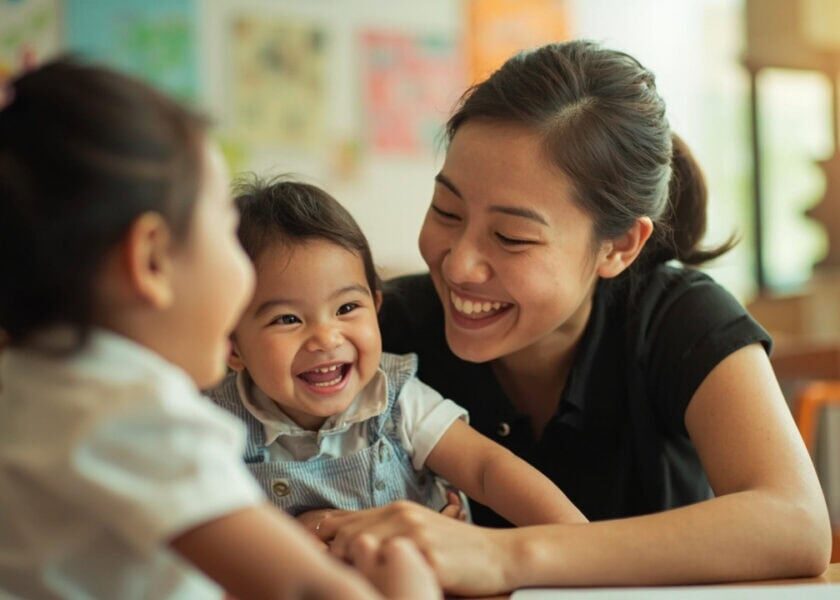
Because there is another moment, equally important, that we rarely discuss with the same honesty. That is the moment when your child cries at drop-off. When they cling. When they protest in ways that are loud and authentic and, frankly, difficult to witness from the other side of the door.
Here is what developmental understanding has shown us: the child who cries at drop-off is not a child who has failed to attach. The child who cries at drop-off is a child who has succeeded at attachment.
What Crying Actually Tells You
Think about what it means to cry. Crying at separation is not the expression of a child who does not trust their caregiver. It is the expression of a child who trusts you absolutely.
Your child cries because they know, with complete certainty, that you are the person who responds when they are in distress. The crying is not a failure of the attachment. It is a celebration of it. It is your child exercising, for perhaps the first time in their life, the confidence that their feelings will be heard. That someone will comfort them. That the world is not a place where you disappear and do not come back.
Developmental psychologists call this having a secure base. When your child cries at drop-off, they are using you as the foundation from which to express their legitimate distress. They are not afraid to show you how they feel because they have absolute faith that your love is real.
A child who had learned to suppress their emotions, who had learned that expressing need leads nowhere, would not cry. That child would look away. That child would adapt too quickly, too easily, too quietly.
The crying child at drop-off is a child who has learned something profoundly important: that they are safe enough to feel. And that is not a failure. That is a gift.
Of course, context matters. Duration matters. The quality of the caregiving relationship matters enormously. But when you see your child’s authentic emotional response at the gate, you are not seeing evidence of failure. You are seeing evidence of trust.
The Science of Multiple Attachments: Children Are Built for This
Here is where we arrive at one of the most counterintuitive truths of early childhood development, and it is a truth that modern parenting culture often obscures: children are not built to attach to only one person.
The Western model of intensive solo parenting—the idea that a child’s primary attachment should be to one caregiver, and that all other attachments are dilutions of that bond—is a cultural artifact, not a biological imperative.
What the Research Actually Shows
The developmental science is remarkably clear: children are neurologically primed to form multiple attachments. The human brain, designed for the complex social environments in which our species evolved, has what researchers call an “attachment expansion capacity.”
A child who has a secure attachment to a parent is not depleted by also forming a secure attachment to a grandparent, an aunt, a regular caregiver. What happens, when the secondary attachment is warm and consistent and responsive, is something remarkable: the child’s sense of security actually broadens. The world becomes a larger, safer place.
The child develops what psychologists call a “network of attachment figures” rather than a single point of failure.
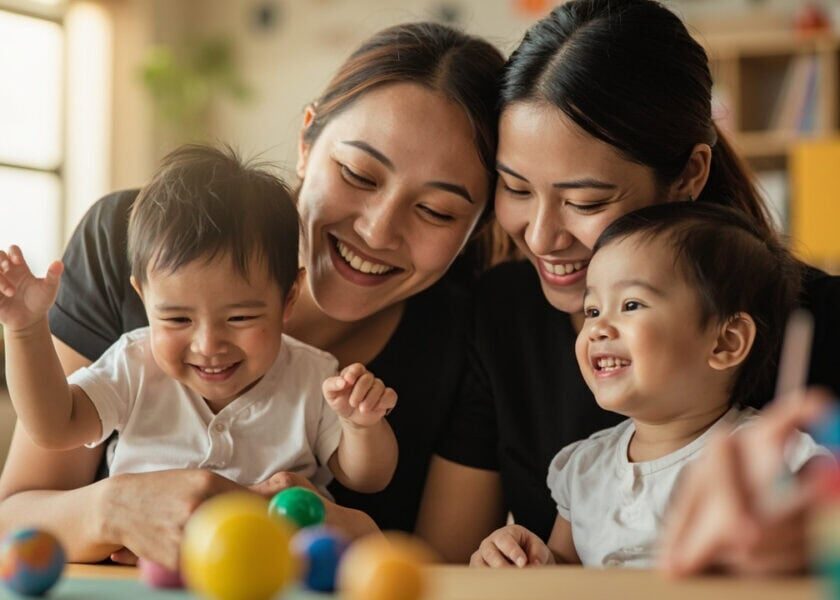
When your child comes home from a day with their caregiver and is happy to see you, is excited to share what they learned, is secure enough to separate from you again the next morning—that is not evidence that the caregiver replaced you. That is evidence that the caregiver expanded your child’s understanding of what it means to be loved and cared for.
Separation Pain Is Not the Same as Separation Harm
Separation pain is not the same as separation harm.
The former is the natural consequence of love meeting an imperfect world. The latter is what happens when care is cold, inconsistent, or unresponsive. The first is universal. The second is what quality childcare is designed to prevent.
This distinction matters more than almost any other piece of information we can offer you. It is the difference between a child learning that the world is large and full of trustworthy people, and a child learning that their needs will go unmet. One is growth. The other is damage. And the path between them is the path of quality care.
What Quality Childcare Actually Looks Like
Which brings us to the question that sits beneath all of this: what does quality actually look like? And how do we find it without surrendering our peace of mind?
In Singapore, we are fortunate to have a growing ecosystem of childcare options, each with its own philosophy and structure. But what distinguishes quality is not the setting—it is the responsiveness, the consistency, and the attunement that a caregiver brings to your child’s day.
A home-based arrangement can offer warmth and individualized attention. A centre-based program can offer structured development and peer interaction. What matters is not the label but the relationship.
How to Recognize Quality When You See It
- Attunement over aesthetics. The space matters less than how your child is responded to. Does the caregiver notice your child’s cues? Do they engage at your child’s pace?
- Consistency and continuity. Your child thrives on predictability. Do they see the same faces, follow similar routines, experience reliable rhythms?
- Responsive communication. You should feel connected to your child’s day—not just through logs and updates, but through genuine transparency about how your child is developing, what they enjoyed, where they seemed challenged.
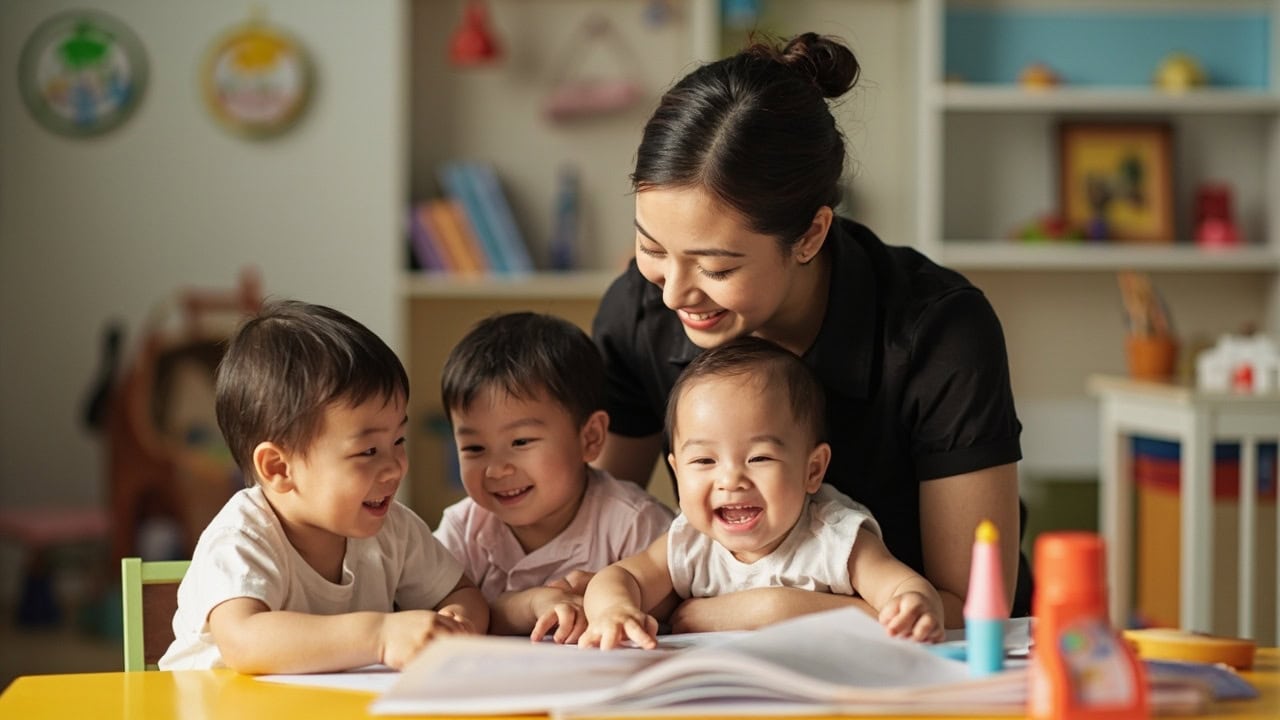
- Warmth that is authentic. Your child should be treated as a person, not a charge. The caregiver should delight in your child’s discoveries, comfort them in their distress, and celebrate who they are becoming.
What Singapore Parents Actually Need
Finding that quality consistently, affordably, and with the peace of mind that allows you to actually do your job during the day—this is not easy.
The cost can feel prohibitive. The logistics can feel overwhelming. The trust required can feel like too much to give to a stranger, no matter how highly recommended.
These are not irrational fears. They are the honest recognition of what we are asking of ourselves and our children. And they deserve honest answers.
The ECDA Childminding Pilot is part of this evolution—a recognition that families need options that are high-quality and within reach. Within a quality childminding framework, you will typically find attentive infant ratios, transparent communication systems, fee structures designed for sustainability, and consistent caregiver relationships that build familiarity and security over time.
These are not luxuries. They are the conditions under which children thrive and parents find peace.
Addressing the Fears That Keep You Up at Night
There are specific fears that surface again and again for Singapore parents. They deserve honest answers, not reassurance without substance.
“Am I damaging my child by leaving them?”
Separation pain is not separation harm. The research is clear: what creates damage in childhood is not parents who work, but parents whose children experience care that is cold, inconsistent, or unresponsive. The difference between a child who thrives in quality childcare and a child who struggles is not whether their parents work—it is whether their care environment meets their needs.
“What if my child doesn’t bond with me properly?”
Children who have secure attachments to their parents are more capable of forming additional secure attachments, not less. Your bond with your child is the foundation. Quality childcare builds on that foundation, not beside it.
“How do I know I can trust someone with my child?”
Trust is built through relationship, not through oversight alone. Look for caregivers who communicate openly, who invite your questions, who treat your concerns as legitimate rather than burdensome. Trustworthy care should feel transparent, not mysterious.
“What if my child cries every single day?”
Some children take longer than others to settle. This is normal. What matters is the trajectory—are tears shortening over time? Is your child developing trust with their caregiver? Are they becoming more confident in their ability to explore? Occasional tears, in the context of an otherwise settling child, are not a red flag. They are an expression of the secure attachment we have been discussing.
“Am I failing as a parent for wanting to work?”
This question deserves the strongest possible answer: No.
Children do not need parents who are present in every moment. They need parents who are present in the moments that matter—and who model, by their own example, what it looks like to live a full and purposeful life.
Children learn resilience not by being shielded from difficulty, but by watching the adults in their lives navigate difficulty with grace. They learn that love is not diminished by distance. They learn that the world is not a threat to be avoided, but a place to be explored, with the right people alongside them.
The False Choice: Ambition vs. Presence
There is a narrative that has taken hold in our culture: you can either be present for your children, or you can be ambitious in your career. You can either be at every milestone, or you can build a life that provides stability and opportunity.
This narrative is false. And believing it does damage to both parents and children.
When you choose quality childcare—when you take the time to find the right arrangement, when you build a relationship with your child’s caregiver, when you trust another person to hold your child in the way you would hold them—you are not stepping back from parenting. You are expanding what parenting means.
You are showing your child that love is not possessive. That trust can be extended. That the world contains people who will care for them as you do, and that this is not a betrayal of your bond but an expression of it.
That is not a compromise. That is one of the greatest gifts you can give your child.
Practical Guidance: Finding the Right Care for Your Family
If you are beginning this search—or if you are in the midst of it and feeling overwhelmed—here is a framework for thinking it through:
- Start with your child, not the facility. What does your child need to thrive? What are their temperament, their needs, their current developmental stage? The right fit depends on who your child is, not on what is most popular.
- Observe, don’t just interview. Visit the space. Watch how caregivers interact with children. Notice whether interactions feel warm and responsive. Trust your instincts about whether this feels like a place where your child would be seen.
- Ask about ratios and consistency. How many children per caregiver? Will your child see the same person each day? Continuity matters more than most parents realize when they first begin their search.
- Ask about communication. How will you know what your child’s day looked like? What is the expected frequency and depth of updates? Good communication is not a luxury—it is the infrastructure of trust.
- Trust the process, not just the outcome. Finding quality care often takes time and more than one attempt. If the first arrangement does not feel right, you have learned something valuable about what to look for next.
The Morning Goodbye Is Not the End. It Is the Beginning.
If you are standing there today, feeling the weight of what you are about to do, I want you to know that you are not alone.
That the anxiety you feel is not a sign of your failure. That the love you feel is not an obstacle to overcome but the very thing that will carry you through.
That your child, in crying for you, is showing you how much you mean to them—and that this is a form of trust, the most beautiful kind, that will serve them well in every relationship they form for the rest of their lives.
What Your Child Is Learning
The morning goodbye is not a failure. It is a beginning.
A beginning of your child learning that the world is larger than your arms. A beginning of your child discovering that love can extend beyond one person, one room, one relationship. A beginning of your child becoming the kind of person who can hold complexity, who can trust and be trusted, who can love fiercely and let go with grace.
And it is a beginning of something else, too. It is the beginning of your family becoming what all families eventually become: a circle that grows wider, that includes more people, that makes room for caregivers and teachers and friends and community, all of them holding your child in the way you dreamed of when you first held them in your arms.
Where Trusted Care Comes In
Finding the right caregiver means finding someone who understands this truth—not just intellectually, but in practice. It means finding a team that holds the difficulty of each morning handoff with the same care that goes into your child’s afternoon activities. That communicates with transparency and warmth. That sees your child as an individual worthy of genuine attention, not a task on a schedule.
At EduNanny, this is the foundation of how we work. We believe that quality childminding is not a service transaction—it is a partnership with families who care deeply about their children’s development and wellbeing. Our approach is built around the same principles this article has explored: secure attachment, consistent responsiveness, and the understanding that every child deserves to be held with intention.
If you are exploring your options, we welcome the conversation. Whether you are just beginning to think about childcare arrangements or are ready to take the next step, we would be glad to hear from you.
The morning you let go is not the morning you stop being a parent. It is the morning you prove, again, that you always were one.
Ready to Take the Next Step?
Go. Do what you need to do. Build your career. Serve your clients. Grow your contribution to this city we share. And trust that when you come home, your child will be there—happier than you left them, more secure than you feared, and ready, always ready, to show you who they are becoming.
That is what this is about. Not the goodbye. The homecoming.
#SingaporeChildcare #SeparationAnxiety #InfantCareSG #ChildmindingSingapore #EduNannySG