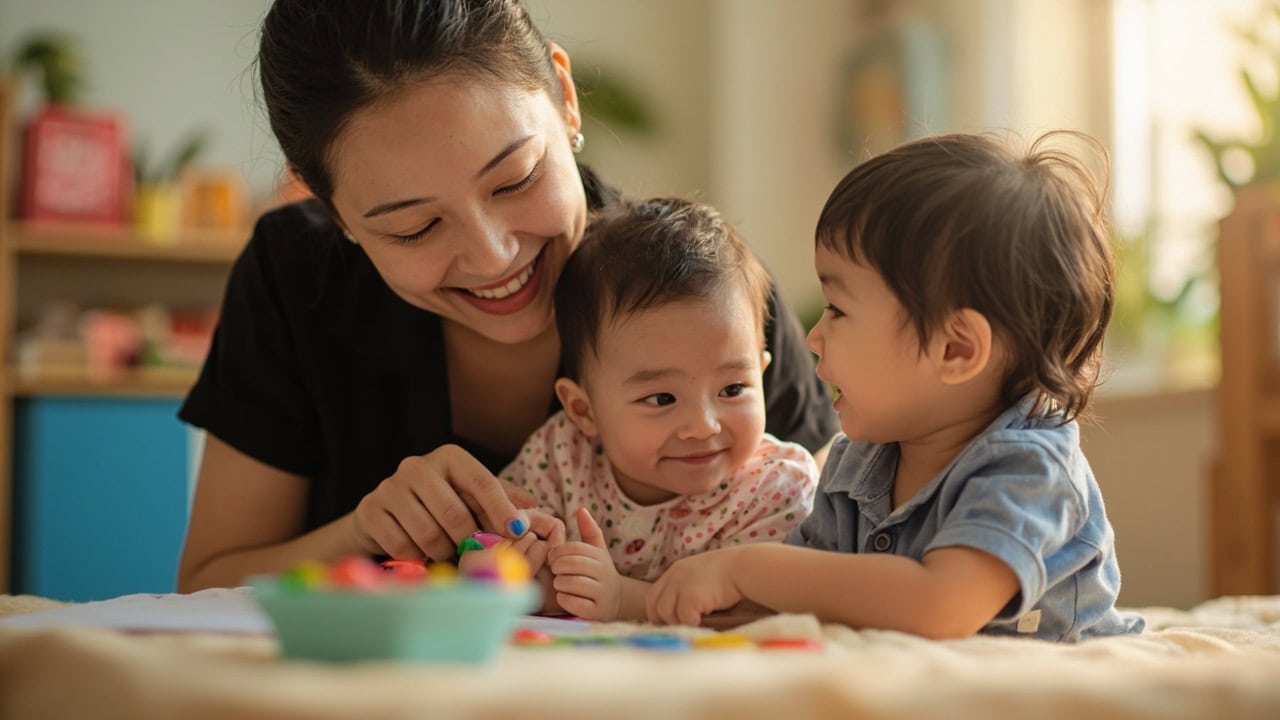
Why Quality Childcare Strengthens the Bond With Your Child
“`html
Understanding the Deeper Question
We spend a great deal of time, in conversations about childcare, talking about choosing the right place. The right caregiver. The right environment. And those things matter. But there is a conversation that almost no one is having, and it is this: what you do, as a parent, during the hours your child is in care, is not passive. It is not waiting. It is one of the most powerful acts of love you will ever perform for your child.
Let me tell you why.
When Your Child Runs to Their Caregiver
When your child runs to their caregiver with joy, something remarkable is happening in their internal world. They are not replacing you. They are using you. Everything you have built with them — every feed, every cuddle, every time you came when they cried and they learned that you would come — that is now giving them the confidence to say yes to someone new.
Your child is showing you, in the only way they know how, that they trust the world you have introduced them to.
That is not a threat to your bond. That is the result of it.
The Science of Attachment Hierarchy
Here is what attachment science tells us, in its most human and practical form. A child’s brain is designed to form multiple meaningful relationships. The parent remains the primary secure base — the person your child returns to for comfort, for co-regulation, for the deepest sense of safety.
But secondary attachment figures — trusted caregivers who are consistent, warm, and emotionally attuned — do not compete with that base. They expand it. They allow your child to feel secure enough to explore, to learn, to form connections that will serve them throughout their lives.
And here is the part I want you to hear clearly: they do this not in spite of your relationship with your child, but because of it.
So the question becomes not how do I make sure no one replaces me, but how do I remain the center of my child’s emotional world while they are in someone else’s care?
The answer is: you already do. You do it through intention. You do it through presence — not physical presence, but the kind of emotional presence that travels with your child through every hour of the day.
The Morning Transition: Walking the Bridge Together
It begins in the morning.
The transition from home to childcare is not a necessary inconvenience between two places. It is a bridge. And how you walk across that bridge with your child matters enormously.
When you arrive at the childcare space, a few things are happening for your child simultaneously. They are processing the change in environment, the change in the person who is holding them, and the change in their emotional register — from the familiar warmth of home to the stimulating, social world of care.
This is not easy work for a small person. And your role, in those first minutes, is to be the calm before the storm.
- Slow down at the door. Resist the urge to rush through the handover.
- Crouch to your child’s level. Meet their eyes. Be present physically.
- Narrate what is happening with warmth. Not to over-explain, but to emotionally anchor your child in the transition.
- Speak your love and return. I am here. We are here together. Miss Sarah is going to take very good care of you. I will be back.
This is not just words. For your child, who cannot yet read a clock or understand the concept of afternoon, your voice and your face in this moment are the last thing they carry into the hours apart from you.
You are not saying goodbye. You are saying I love you, and this is safe, and I will return.
There is a word for what you are doing in this moment. It is called emotional attunement. You are matching your child’s internal state, and then gently, lovingly, guiding them toward a place of calm readiness. You are not rushing them. You are not hovering anxiously, because children read our anxiety like a language.
You are simply, quietly, being the steady presence at the center of their world before they step out into it.
The Evening Return: Coming Home
And then you leave. And the work continues, even though you are not there.
What happens in the hours between dropping your child at childcare and picking them up at the end of the day? Your child is having experiences. They are learning. They are forming relationships with their caregiver. They are encountering frustration and joy and the small social negotiations of being with other children.
And all of this is happening inside a brain that is building itself, moment by moment, and it is happening in the context of the security you have given them.
Your Child Is Emotionally Returning to You
When your child comes home, they are not just physically returning to the house. They are emotionally returning to you. And this is a transition as important as the one in the morning — perhaps more so.
For young children, especially infants and toddlers, the hour after childcare pickup is sacred neurological real estate. Their nervous systems have been in an active, alert, socially engaged state all day. They need to come down. They need to come home — and home, for them, is not a building. Home is you.
- Begin with quiet holding. Before anything else, before questions, before food, before screens — hold them.
- Let your child lead. Follow their energy. Some children need to be held. Some need to run. Some need to show you something.
- Breathe with them. Let your own body communicate what words cannot yet fully express: I am here. You are safe. This is home.
It might look like a period of quiet holding before anything else. It might look like letting your child lead, following their energy, not immediately asking a dozen questions.
How was your day? Did you eat? Did you sleep? Who did you play with?
These questions are not wrong. But they are less important than what you do before you ask them. Before you ask your child to narrate, you let them feel held.
The Art of Evening Listening
For older toddlers and young children who can talk, the evening becomes a beautiful space for what I think of as emotional archaeology — gently uncovering the texture of your child’s day, not to interrogate, but to understand.
- I heard something wonderful happened today. Do you want to tell me about it?
- You seem really happy right now. I love seeing you so happy.
- What was the best part of your day?
This kind of listening — the open, curious, non-judgmental kind — is one of the most powerful things a parent can do. It teaches your child that what they feel and experience matters to you. It deepens your connection in ways that are invisible but profound. And it creates the kind of trust that means your child will come to you, always, when the world feels hard.
When Your Child Talks About Their Caregiver
There is a particular experience I want to address, because it is so common and yet so few people talk about it honestly.
Your child comes home, and they are full — full of someone else. They talk about their caregiver. They imitate her voice. They ask when they will see her again. And you feel something that is complicated and real and worth naming: it stings. A little. Or maybe more than a little.
Here is what I want to tell you about that feeling. It is not jealousy. It is the tenderness of witnessing your child grow.
When your child talks excitedly about their caregiver, they are doing something extraordinary. They are practicing the security you have given them. They are showing you that they have learned to trust, to connect, to extend the emotional warmth you have provided into new relationships.
This is not a sign that your bond is weakening. This is a sign that your bond was strong enough to allow this.
The caregiver becomes, in your child’s mind, a proof of something — proof that the world is safe, that love travels, that closeness is not limited to one room and one person.
Your child is more attached to you precisely because they have a caregiver they love, not despite it.
Because a securely attached child — a child who has a foundation so solid that they can venture out from it — is a child whose parent did something extraordinary. You gave them the kind of love that makes leaving possible. That makes trusting someone else possible. That makes the world feel navigable.
Let these moments be. Listen with interest, not with anxiety. Say things like: It sounds like she is wonderful. I am so glad you have so many people who love you. You are not competing. You are not replacing. You are simply, steadily, being the person your child comes home to.
Reading Caregiver Notes as Bridges
Your child’s caregiver will be observing your child throughout the day. They will notice things. Small things. Important things.
- The way your child approached a new toy today, differently than yesterday
- The food they ate with enthusiasm
- The moment they reached for another child
- The look on their face when they heard a familiar song
These observations are not just records of your child’s day. They are bridges back to you.
Reading a caregiver’s notes or daily update with intention — not just scanning for reassurance, but looking with curiosity — is one of the most underrated forms of parental connection.
When you receive a note that says, Your child was so proud when she stacked the blocks. She kept looking around to see if anyone was watching, you are being given a window.
You can say to your child: Miss Li told me you stacked the blocks today and you were so proud. Show me.
And suddenly, the childcare day is not a blank space. It is a story, and you are part of it. Your child knows that you know. That you care about what happened. That the hours apart from you still had you in them.
This is not about monitoring your child from a distance. It is about staying emotionally present in it. Your caregiver is your partner in this, not your replacement.
Why Quality Childcare Amplifies Your Bond
There is one more thing I want to say, because it is the piece that makes everything else make sense, and it is the piece that I believe most deeply.
When a child is truly, securely attached to their parent — when they have that primary secure base so firmly established that they can feel it in their bones — quality childcare does not compete with that base. Quality childcare amplifies it.
Because a securely attached child walks into a childcare environment with confidence. They can explore. They can learn. They can form relationships. They can engage with a caregiver who loves them, because they are not anxious. They are not clinging. They are free.
And when they come home at the end of the day, they come home full of the world — full of experiences, full of growth, full of discoveries — and they bring all of that back to you. To the place where they are most themselves. To the place where they are most loved.
The better the foundation, the further they can go. And the further they go, the more they have to bring back to you.
That is the cycle. That is what quality childcare does when it is done with this understanding at its center.
What Quality Childminding Looks Like in Singapore
For families navigating infant care and childminding, understanding what quality actually looks like matters enormously. Here are the elements that signal a childcare environment designed to work with your bond, not against it:
- Consistent, warm caregivers who demonstrate the emotional attunement you have been building at home
- Small group sizes that allow your child to be truly known, not just supervised
- Transparent communication — daily updates that give you windows into your child’s day, not just logs of meals and naps
- Respect for your role — a caregiver who sees themselves as your partner, not a replacement
- Attachment-aware practices that understand why the morning handover and evening return matter
How EduNanny Supports This
Which brings me to what EduNanny does, and why this matters so much in the context of Singapore, where so many families are navigating this beautiful, complex, demanding reality of modern parenting.
EduNanny, a service by BUTLER, is part of the ECDA Childminding Pilot. Here is what that means for you and your family in plain, honest language:
- Philosophy first: EduNanny was built on the understanding that parents are not clients who have outsourced a problem. You remain at the center of your child’s emotional world. We are your partners in that work.
- Pathways designed for real families: Home-based and centre-based options designed with real Singapore families in mind — with care blocks that fit the rhythm of working parents.
- Infant ratios that matter: Smaller ratios mean your child is truly seen and known, not just accounted for.
- Affordable by design: Structures designed to work within pilot fee frameworks, using your CDA and Baby Bonus so the financial reality of raising a child in Singapore is not a barrier to quality care.
- Communication you can trust: Daily, transparent, thoughtful updates so the childcare day is not a gap in your knowledge but a story you are part of.
- Transparency where it matters: Where CCTV measures are in place, they exist not for surveillance but for the kind of trust-building transparency that reassures the person who loves your child most.
This is not about replacing what you do. This is about partnering with you in the full, rich, demanding work of raising a child who is secure, curious, and deeply loved.
Common Questions and Where We Land
“Will my child forget me?”
No. A securely attached child does not forget. They return. The fact that your child can separate from you with increasing confidence is a sign of healthy attachment, not a threat to it. Every time you leave and come back, you are reinforcing the message: I always come back. You are loved. The world is safe.
“What if my child seems more attached to the caregiver?”
Children show different aspects of themselves in different contexts. Your child may be more playful with their caregiver, more independent, more exploratory — because they feel secure enough to be. This is not evidence that they love you less. It is evidence that you gave them a foundation strong enough to be fully themselves somewhere else.
“How do I know if my child is truly bonded with their caregiver?”
Signs of a healthy secondary attachment include your child seeking the caregiver for comfort in your absence, showing joy when they arrive, and incorporating the caregiver into their world naturally. This bond is additional to their bond with you, not a replacement for it.
“What if I feel guilty about using childcare?”
Guilt is often love without a clear target. When you understand that your role during the hours apart is not passive — that your morning transitions, your evening presence, your emotional attunement are active acts of love — the guilt often transforms into confidence. You are doing something extraordinarily difficult, and you are doing it well.
You are at the door of the childcare space. Your child turns and runs to their caregiver. There is that feeling again — that small, quiet ache.
But here is what I want you to know, and what I want you to carry with you when you drive home and the car is quiet:
Your child is not running away from you. Your child is running out into the world — out into a world full of new people and new experiences and new love — from the safest place they know.
And that place is not a room. It is not a routine. It is not a curriculum.
That place is you.
It has always been you. It will always be you.
And your task was never to be everything to your child. Your task was to be the foundation so strong, so warm, so utterly reliable, that your child would never be afraid to leave it.
Your child is not leaving you. Your child is building on you.
EduNanny is here — not to stand between you and your child, but to stand beside you — as your child builds something extraordinary in the world you have made safe for them.
That is what you want. And that is what you have.
If you are a parent in Singapore researching infant care or childminding, EduNanny invites you to learn more about how our approach supports not just your child’s development, but the bond you share with them. Every great childhood begins with a foundation of security — and we would be honored to be part of yours.
About EduNanny · ECDA Childminding Pilot · Connect with Us
“`