The Invisible Classroom: How Quality Childcare Shapes Your Child’s Future
What Your Child Actually Learns in Quality Childcare
For busy parents, here are the key developmental gains that quality childcare provides—often invisibly, until one day your child surprises you at the dinner table:
- Social intelligence: Learning to negotiate, share, and see another person’s perspective through peer interaction
- Language foundations: Expanded vocabulary and complex sentence structure through responsive caregiver conversations
- Self-regulation: The capacity to manage emotions, wait, persist, and recover from frustration
- Cognitive flexibility: The courage to guess, hypothesize, and embrace not-knowing as part of learning
- Curiosity and thinking: The habit of asking questions and following them further
- Belonging: The experience of being part of a community outside family, building school readiness
These are not soft outcomes. Research across neuroscience, developmental psychology, and economics has demonstrated, with remarkable consistency, that the capacities built in these early years predict academic achievement, relational health, and even economic stability decades later. What happens before age six matters—not as sentiment, but as evidence.
The Early Years: Not a Waiting Room
We know that the early years of a child’s life are not a waiting room. They are not a pause before the real business of growing up begins. The early years are, in the most precise sense, the years in which a child builds the architecture of who they will become.
The neural pathways that form in these years—the connections between language and meaning, between impulse and restraint, between self and other—these are not temporary scaffolding. They are the building itself.
For Singapore families, this reality carries particular weight. Our children grow up in one of the most accomplished education systems in the world. We plan. We prepare. We seek every advantage we can offer. Yet for many families, the first years of a child’s life—those years before formal schooling—remain something of a mystery.
Parents are told these years matter. They feel that they matter. But what actually happens in those hours of care, when a parent is at work or managing the demands of a household and career? What is being built, in that time, in that place?
This is the question we want to answer—not with abstract theories or reassuring platitudes, but with the specific, observable, sometimes startling ways in which quality childcare shapes the children who experience it.
What Quality Childcare Actually Looks Like
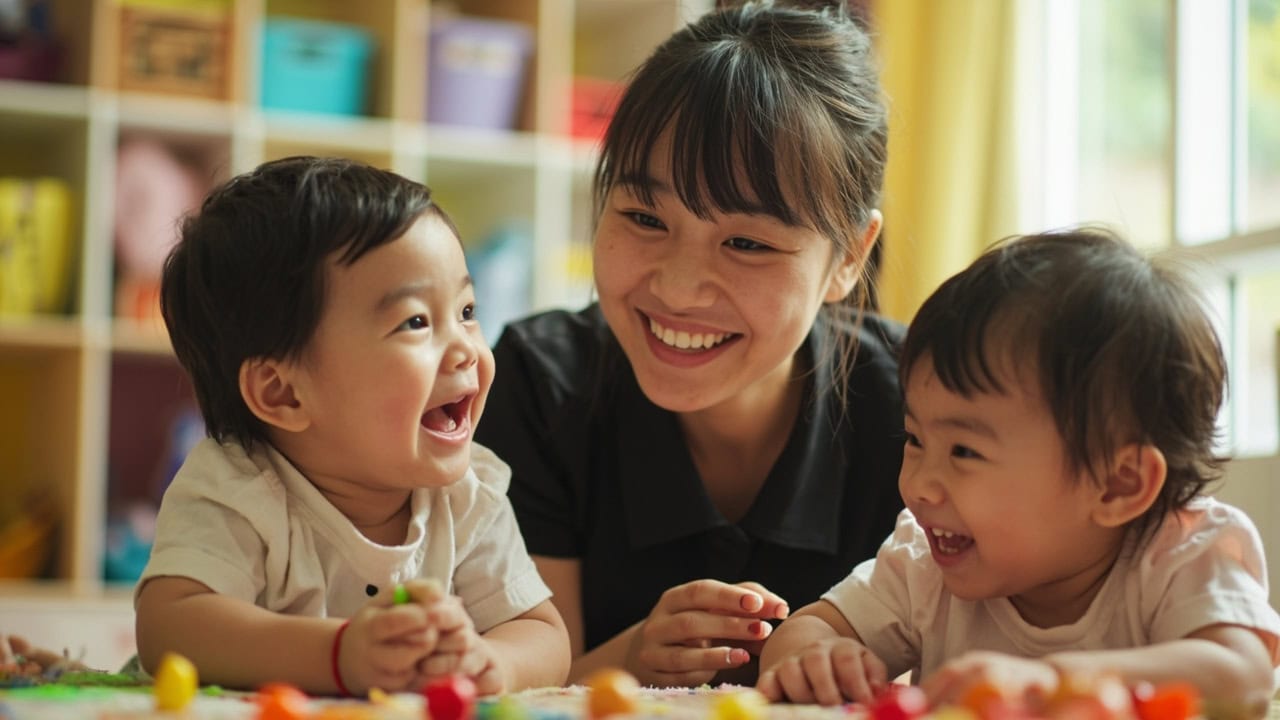
Walk into a well-designed childcare environment—one where caregivers have been trained not merely to supervise but to educate—and observe what unfolds.
You will see children engaged in what looks like play. Blocks are stacked and knocked over. Puzzles are solved or abandoned. Small hands work clay or crayon or sand. But beneath this apparent simplicity, something profound is occurring.
The Social Intelligence Hidden in a Toy Truck
In one corner, two children negotiate over a toy truck. This is not trivial. This is a masterclass in social intelligence, compressed into a two-minute exchange.
One child wants the truck. The other is using it. Words are exchanged—firmly at first, then with modifications. An offer is made: “You can have it after I build the road.” A compromise is reached. A promise is made. The promise is kept.
These are the raw materials of conflict resolution, of empathy, of the capacity to see another person’s desires as real and valid. This is how children learn that they are not the only minds in the room.
The Courage to Guess in Story Time
In another space, a caregiver sits with a small group of children during a story. She does not merely read the words on the page. She pauses before turning to the next page and asks, “What do you think will happen next?”
A child answers confidently—incorrectly, as it turns out. The caregiver does not correct. She says, “That’s one idea. Let’s see.”
The page turns. The child was wrong. But the caregiver’s response is the same: “Now we know what did happen. What will happen on the next page?”
The lesson here is not about story comprehension, though that is happening too. The lesson is about the value of guessing, of hypothesizing, of the courage it takes to offer an idea when you are not sure. This is cognitive flexibility. This is one of the most reliable predictors of lifelong learning.
Self-Regulation Built in Frustration
Now observe what happens when a child becomes frustrated. Perhaps a puzzle will not fit. Perhaps another child has taken a toy. The instinctive response is crying, grabbing, hitting.
In a quality childcare environment, the caregiver does not intervene with punishment or quick resolution. She bends down. She names what she sees.
“You worked so hard on that puzzle. It is frustrating when the piece does not fit.”
The child, seen and understood, begins to settle. The caregiver might offer a suggestion: “Shall we try turning it this way?” Or she might simply stay close, letting the child find the path back to calm.
This is the scaffolding of self-regulation—the ability to manage one’s own emotions and impulses, to recover from disappointment, to persist. Executive function is built not in lectures but in moments exactly like this, repeated across hundreds of days, until the child begins to internalize what calm feels like, what it means to wait, what it means to try again.
The Six Domains of Hidden Learning
Quality childcare operates as a structured developmental environment with intentional learning principles. Here is what that means in concrete terms—across the six domains where your child is growing, even when you are not in the room.
1. Social-Emotional Intelligence
Beyond learning to share toys, children in quality care environments develop the capacity to read social cues, manage group dynamics, and respond appropriately to the emotions of others. When a caregiver narrates emotions—”I can see that Ming feels sad because his tower fell”—children learn to name and understand feelings. When they see a peer comforted, they learn that their presence matters. These are the foundations of empathy.
2. Language and Communication
Children in quality childcare environments hear a wider variety of words, in more conversational contexts, than they typically encounter at home—even in homes where parents are highly attentive. Caregivers narrate the day. They name objects and emotions. They expand on a child’s half-formed sentence:
“Ball!”
“Yes, that is a big red ball. It bounces very high.”
These are not merely kindnesses. These are the precise mechanisms by which vocabulary expands, syntax develops, and the capacity for complex thought takes root. By the time a child enters primary school, the language gap between children who have had rich early care and those who have not is measurable, significant, and consequential.
3. Executive Function and Self-Regulation
Executive function—the set of mental skills that include working memory, flexible thinking, and self-control—is built through repeated opportunities to practice. In quality childcare, children encounter situations that require them to wait, to share, to recover from disappointment, and to persist when something is difficult.
Caregivers provide what researchers call “scaffolding”—temporary support that helps children succeed at tasks just beyond their current ability, gradually withdrawing as the child develops competence.
4. Motor Skill Refinement
Whether it is the gross motor skills developed through playground climbing and ball games, or the fine motor control required for puzzles, cutting with scissors, or holding a crayon, quality childcare provides structured opportunities for physical development. These are not merely physical achievements—they support cognitive growth as well, as the brain’s motor and cognitive systems develop in parallel.
5. Curiosity and Cognitive Flexibility
Quality childcare environments are designed to spark curiosity, not extinguish it. When caregivers respond to a child’s endless “why?” with patience and further questions—when they treat wrong answers as stepping stones rather than failures—they are building something essential. They are building the habit of inquiry, the comfort with not-knowing, and the confidence that comes from discovering that questions have the power to lead somewhere.
6. Belonging and Identity
In quality childcare, children learn that they are part of something larger than themselves. They learn that routines create safety. They learn that teachers have names and preferences and boundaries, just as they do. They learn that the classroom is a community, and that their presence and participation matter.
This sense of belonging, so often underestimated, is not a soft outcome. It is the foundation of school readiness—the willingness to engage, to try, to persist in an environment that is not home. Children who have learned to belong do not face the first day of school as a stranger. They have practiced belonging many times before.
Evaluating Quality: What to Look For
If you are researching childcare options in Singapore, here are the concrete indicators of quality that you can observe and ask about:
- Caregiver responsiveness: Do caregivers respond to children in the moment, with attention and verbal engagement? Do they bend down to a child’s level? Do they narrate what is happening and expand on what children say?
- Language environment: Is there continuous conversation happening—between caregivers and children, and encouraging children to talk with each other? Are children listened to, not just spoken to?
- Emotional attunement: When a child is frustrated or upset, how do caregivers respond? Do they name the emotion? Do they offer presence rather than quick solutions?
- Structured flexibility: Is there a predictable routine that creates security, while also allowing for child-directed exploration and choice?
- Peer interaction support: Do caregivers facilitate peer play rather than just supervising it? Do they help children navigate conflicts as learning opportunities?
- Transparent communication: Are parents kept informed—not just about meals and naps, but about engagement, learning, and development?
Understanding what quality childcare actually provides helps you in several ways. It helps you articulate why your choice matters, especially when others question whether childcare is “necessary” for such young children. It helps you ask better questions when evaluating care options. It helps you recognize and celebrate the developmental milestones that reveal quality care at work. And it helps you partner more effectively with caregivers, understanding the “why” behind their approaches.
EduNanny by BUTLER: Quality Care Within National Standards
Understanding what quality looks like raises a practical question: where can Singapore families find it?
EduNanny by BUTLER operates within the ECDA Childminding Pilot, a framework designed to bring quality, accessibility, and accountability to home-based and community-based care across Singapore. This is not a generic service operating in a regulatory vacuum. It is a structured pathway, grounded in national standards, that has been developed to meet the real needs of Singapore families.
The ratios matter. In infant care, EduNanny maintains ratios of up to one to three, ensuring that every child receives the responsive attention that developmental science tells us is essential. This is not a marketing claim. It is a structural commitment to presence.
The communication matters too. EduNanny has built transparency into its model—ensuring that parents receive regular, meaningful updates about their child’s day, not just photographs but observations. You should know what your child explored, who they played with, what made them laugh. You should be able to ask questions and receive answers. Where deployed, technological measures such as CCTV provide an additional layer of clarity and trust—not for surveillance but for partnership.
The fee structures within the pilot are designed to make quality care accessible. For families utilizing the Child Development Account or Baby Bonus, EduNanny ensures these pathways are integrated, reducing the financial friction that so often stands between families and the care their children deserve.
And the caregivers themselves—these are not babysitters recruited for availability. They are trained professionals in the Childminding Pilot, equipped not just with childcare skills but with developmental understanding. They know the difference between supervising and scaffolding. They know how to read a child’s cues, how to support emerging language, how to help a child navigate the complex, exhausting, exhilarating work of being small in a world that is very large.
Monday to Friday, across Singapore, EduNanny’s caregivers show up. They create the environments in which the moments we described earlier can happen. They name emotions. They expand language. They sit with frustration until it passes. They offer presence, warmth, and the particular kind of attention that tells a child: you are not just being kept. You are being seen.
No childcare arrangement, no matter how excellent, replaces the bond between a parent and a child. That bond is irreplaceable. It is the foundation on which everything else is built. Quality childcare does not threaten family values or teaching. It supports them. A skilled caregiver reinforces the same skills you are building at home—patience, sharing, trying again after failure—in a different context, with different peers, providing additional opportunities for growth.
And quality childcare does something else. It gives your child a second harbor from which to launch, a place where they can practice the skills they are learning at home in the company of peers and trained caregivers who are neither judges nor distractions, but companions in growth.
Choosing Quality: The Decision That Compounds
We began with a question: where did that come from?
Now you know. It came from the hours you could not see. It came from a caregiver who paused to listen. It came from a peer who shared a toy. It came from a story that asked “what next?” and an environment that rewarded the answer. It came from a thousand small moments, each one designed with intention, each one building on the last, until your child—your extraordinary, unpredictable, becoming child—surprised you at dinner with a word, a question, a kindness you had not taught them directly.
That is what quality childcare offers. Not just a place where your child is safe, but a place where your child is growing.
And it gives you something equally valuable: the knowledge that your child is not just occupied while you are away, but engaged. Developing. Building the very capacities you hope they will carry into school, into friendships, into the demanding and rewarding work of becoming themselves.
Choosing quality childcare is not a logistical compromise. It is a developmental decision. It is an investment in the architecture of your child’s future self. For the families of Singapore, for the children who will grow up to build this city further, that investment is not a luxury.
It is an inheritance you give your child, one day at a time, one moment at a time, in the places where they learn what it means to belong, to try, to become.
If you are ready to explore what quality childminding looks like for your family—grounded in national standards, delivered by trained caregivers, and designed to support your child’s development in the years that matter most—we invite you to connect with EduNanny by BUTLER.
Because your child’s future begins in the moments you cannot see.