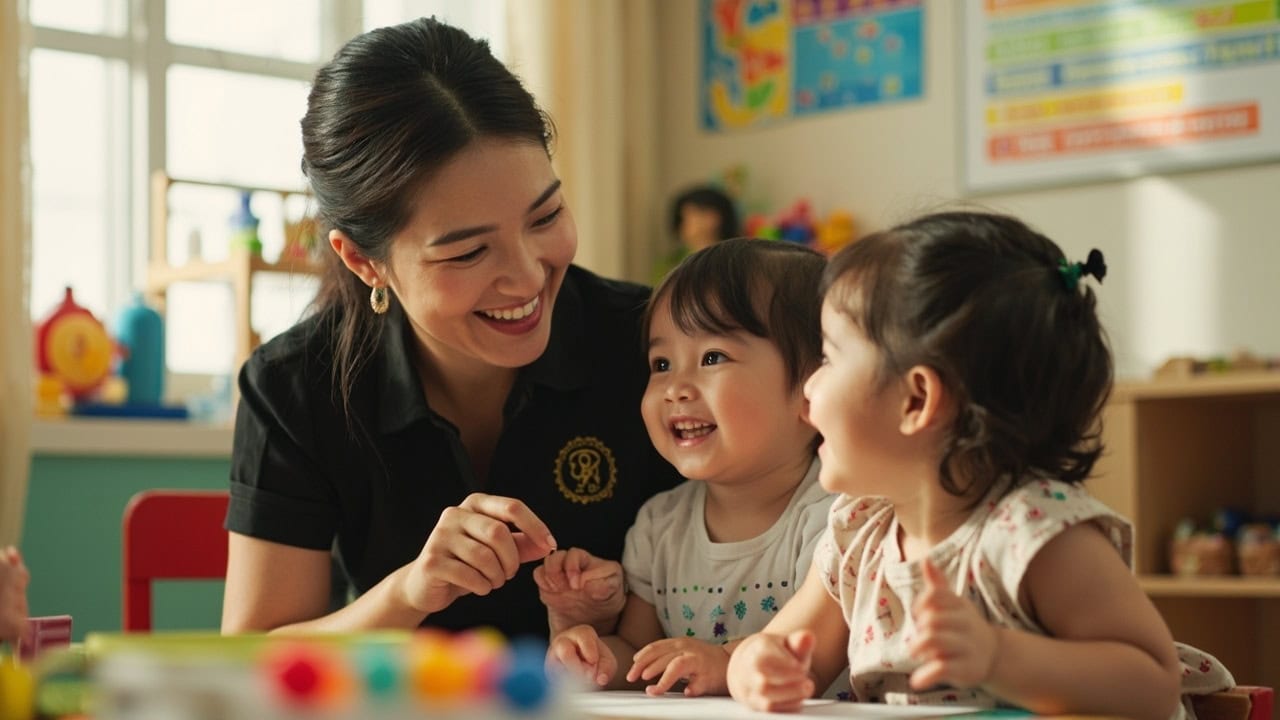
The Hours That Build Your Child’s Brain
The Question Every Singapore Parent Carries (But Rarely Asks Aloud)
There is a question that lives somewhere beneath every enrollment form, every facility tour, every conversation with a prospective caregiver. It is not about credentials or ratios or whether the centre has air purifiers. It is quieter than that. It sounds something like this:
What is my child actually experiencing in those hours when I am not there?
This question does not reflect doubt or anxiety in the way we usually frame parental worry. It is not about guilt or inadequacy. It is something more honest and more profound — the desire of every thoughtful parent to know that the hours their child spends away from them are not simply passing time, but are being inhabited, fully and deliberately, by someone who understands what childhood requires.
If you have ever felt this, you are not alone. And you are asking exactly the right question.
What Quality Childcare Actually Looks Like
When we speak about quality childcare, we typically speak about it from the outside. We talk about ratios and qualifications, safety certifications and curriculum frameworks, whether a centre has outdoor space or whether a caregiver has been trained in first aid. These things matter — they are the architecture of accountability, the baseline beneath which no one should fall.
But they do not answer the question. They describe the scaffolding, not the building. What parents genuinely want to understand is what is happening inside that scaffolding, within the hours that their child is actually living.
The Sensory Architecture of Early Experience
Consider for a moment what it means to be a young child in an unfamiliar space. The sensory world of an infant or toddler is not the filtered, cognitive world of an adult. Children do not simply enter a room and assess it intellectually. They receive it entirely, through every channel available to them.
The quality of the light. The temperature of the air. Whether the surfaces beneath their hands are smooth or rough, warm or cool. The sounds that layer and echo and create a sense of either calm or chaos. The smells that anchor memory and belonging before words can form.
This is the first architecture of experience, and it happens before any lesson can be taught or any relationship can be consciously built. In a truly developmental environment, every element of the physical space has been considered with this in mind:
- Light is soft and abundant, not harsh and fluorescent
- Materials are natural where possible, offering varied textures that invite touch and exploration
- The soundscape is managed so that it supports focus and calm rather than overstimulation
- Ventilation and air quality are attended to, because even smell matters to how a child inhabits a space
This is not luxury. This is neuroscience translated into environment. We know, from decades of research into early brain development, that the sensory architecture of a child’s early environment literally shapes the neural pathways that will be used for a lifetime.
The Science of Attunement
Beneath the sensory environment lies something even more important: the relational environment, and what the child is experiencing within it emotionally and developmentally.
Developmental psychologists have a term for this: attunement. It refers to the quality of attention and responsiveness that a caregiver brings to a child’s emotional and physical state. An attuned caregiver does not simply supervise. They read the child’s face, their body language, their cry or their silence, and respond with precision and warmth.
They match their own energy to the child’s needs in that moment. They are present not just physically but psychologically, holding the child’s internal experience with the same care they would give to something precious.
This matters enormously for brain development. When a child experiences consistent attunement in their early environment, they develop what neuroscientists call secure attachment, and this becomes the template for how they will relate to the world for the rest of their lives.
Securely attached children are not merely comfortable or content. They are, research consistently shows, more resilient, more curious, more capable of regulating their own emotions, and more confident in exploring new environments and relationships. The hours of attunement that a quality caregiver provides are not a luxury add-on to childcare. They are the core of it.
What this means for you: When you walk into a space, before you ask about curriculum or credentials, ask a simpler question — how does this space feel? Not to you as an adult, but to a child whose height brings them to a different vantage point, whose hands are at knee level, whose eyes are still learning to filter the world’s complexity. Does it feel warm or clinical? Does it invite movement or restrain it? Is there evidence of children’s presence — their drawings on walls, their materials within reach, their scale reflected in furniture designed for them?
The Power of Accumulated Hours
A single hour of quality developmental care is meaningful. A thousand hours of it is transformative.
The brain does not develop in leaps and bounds, through dramatic interventions or significant lessons. It develops through repetition, through the daily layering of experience upon experience, through the gradual strengthening of neural pathways that are used over and over until they become automatic.
The child who has spent two years in an attuned, sensory-rich, developmentally intentional environment has not simply had more experiences than the child who has not. They have built a different brain — one that is more integrated, more flexible, more prepared for the demands of learning and relating.
When you place your child in care, you are not renting hours of supervision. You are opening an account in your child’s developmental future, and the currency that accumulates there is not money but experience, not curriculum but care.
Every responsive interaction, every sensory invitation, every moment of attunement deposits something into that account. And over the course of months and years, those deposits compound in ways that matter enormously for:
- School readiness
- Emotional regulation
- The capacity to form healthy relationships
- The confidence to approach the world without fear
This is what quality childcare feels like from the inside, and it is what the hours apart are actually doing when they are truly developmental. They are not wasted time. They are generative time, filled with the small and invisible work of building a human being.
What to Look For: A Parent’s Practical Guide
So what can a Singapore parent look for? How do you read the quality of an environment from the inside rather than just evaluating its features from the outside?
The answer begins with observation — but not the kind of systematic, analytical observation that we usually associate with evaluating services. It begins with a different kind of noticing that asks not what is being provided but what is being experienced.
Watch the Children, Not Just the Caregivers
- See how they move. Do they move with ease and confidence, or are they constrained, either physically or emotionally?
- Do they seek out interaction with the caregivers, or do they move past them indifferently?
- Do they touch materials with curiosity, or do they seem to have lost interest in their environment?
Observe the Caregiver’s Gaze
- Where are their eyes when the children are present?
- Are they watching, truly watching — noticing not just behavior but emotional states?
- Do they respond to children who are quietly engaged as attentively as they respond to children who are loudly demanding attention?
The child who is quietly playing, absorbed in their own exploration, may be having the most significant developmental experience of the day. A caregiver who recognizes this, and who guards that space of concentration with gentle awareness, is demonstrating something that cannot be taught in a training course.
Listen to the Sound Environment
- Is there a comfortable level of noise — the natural hum of engaged children and attentive adults — or is there chaos, the kind of overstimulation that exhausts rather than energizes?
- Is there also quiet available, the kind of silence that allows a child’s mind to settle and process?
Notice Your Child When You Return
Not just whether they are clean and fed — which matters but is baseline — but how they are:
- Are they settled and content, moving easily between you and the caregiver?
- Are they curious and alert, ready to share what they have been experiencing?
- Or are they dysregulated, either overstimulated or withdrawn, carrying something in their system that suggests the hours were not restorative?
A child’s internal state upon returning from care is, in many ways, the most honest assessment of what the care environment has been providing.
Ask Different Questions
Ask questions not about curriculum or certifications, but about philosophy:
- How does this environment understand the child’s experience?
- How do caregivers learn to read a child’s signals?
- What happens when a child is struggling, not behaviorally but developmentally?
The answers to these questions will reveal whether the people caring for your child have thought deeply about what they are doing and why.
Understanding EduNanny Singapore
EduNanny Singapore was built to embody this understanding. As a service of BUTLER operating within the ECDA Childminder Pilot, the framework reflects a conviction that childcare in Singapore should not be a one-size-fits-all system, but should offer genuine pathways that meet families where they are.
Whether through home-based care, where a childminder comes to the child’s familiar environment, or through community and centre-based options that create rich peer experiences, EduNanny is designed to provide genuine developmental engagement rather than mere supervision.
The Architecture of Attunement
The ratio structure, with up to one to three infants in care, is not simply a compliance measure. It is the architecture of attunement. When a caregiver is responsible for fewer children, they can read each one more accurately, respond more precisely, and hold each child’s internal experience with greater attention. This is a deliberate choice to create the conditions in which genuine attunement becomes possible.
Accessibility and Transparency
Pilot fee structures have been designed with accessibility in mind, making quality developmental care achievable for families across Singapore. Payment mechanisms including CDA and Baby Bonus usability ensure that financial logistics do not become a barrier to developmental excellence. Care blocks run Monday to Friday, recognizing the rhythms of working family life while providing the consistency that young children need.
Communication and transparency are built into the EduNanny model. Where deployed, CCTV measures provide parents with reassurance that their child’s environment is not hidden from them. Beyond technology, EduNanny has invested in creating a culture of openness, where parents feel they can ask questions, observe their child’s experience, and understand what is happening during the hours apart.
A Philosophy of Care
But beyond the structural elements, what EduNanny truly offers is a philosophy of care that understands childhood from the inside.
The approach recognizes that a child’s early environment is not just a context for development but is, in a very real sense, the substance of development itself. Every sensory detail, every relational moment, every accumulated hour of experience is doing work in the child’s brain and nervous system that cannot be undone or redone later.
EduNanny’s caregivers are not simply supervised staff members following a curriculum. They are trained to observe, to attune, to understand the child’s internal experience as the primary data of their work. They are supported by the ECDA framework, yes, but also by a deeper conviction that what they do matters in ways that extend far beyond the years of early childhood, into the capabilities and confidences that the child will carry throughout their life.
This is not an abstract aspiration. It shows up in the small details of how EduNanny structures its environments, how it trains its caregivers, how it thinks about the daily rhythms and transitions that shape a child’s experience. The approach is intentional at every level, because genuine developmental care cannot be accidental.
The Hours Apart Are Not Empty
There is something important to acknowledge here, and it is a truth that the language of childcare often obscures.
The hours that a child spends in quality developmental care are hours of their life. And life, even in its earliest and most unformed stages, is not about passing time. It is about growing, exploring, discovering, and becoming.
When your child is in a quality developmental environment, they are not merely being kept safe while you work. They are living, in that place, the experiences that are building their brain, their confidence, and their capacity to be in the world.
This is not a justification for parents who work. It is a recognition of what is actually happening. The hours apart are not empty. They are full of the small, invisible, profoundly important work of development. And when that work is being done well, your child is not missing you in some tragic or damaging way. They are growing, in your absence as well as in your presence, because the environment you have chosen for them understands what childhood requires and provides it with skill and care.
The Reframe That Changes Everything
This reframing matters. Parents in Singapore carry so much invisible weight around their choices regarding childcare. There is guilt, often unspoken, about the hours apart. There is doubt about whether those hours are harming rather than helping. There is the quiet fear that children are somehow diminished by not being with their parents full time.
The science does not support these fears. The research supports something else entirely: that children who experience consistent, attuned, developmentally intentional care in their early years develop more robustly across every domain than those who do not.
This is not an argument that parents are dispensable. It is an argument that quality matters, and that when quality is present, the hours apart can be as generative as the hours together.
What Your Child Is Actually Experiencing
So let us return to the question that opened this article — the one that sits beneath every enrollment decision, the one that is rarely asked aloud but is always present.
What is my child actually experiencing in those hours when I am not there?
The answer, when care is truly developmental, when the environment is designed with the child’s internal experience as its purpose, when caregivers are attuned and intentional and supported, is this:
Your child is growing.
- Not just in size, but in capacity.
- Not just in knowledge, but in confidence.
- Not just in the ability to be managed and occupied, but in the ability to be curious, to explore, to relate, to trust, to wonder.
Your child is living the hours that build their brain. They are accumulating the sensory richness that creates neural pathways for a lifetime of learning. They are experiencing the attunement that becomes the template for every relationship they will ever have. They are discovering, in small and quiet moments that you may never hear about, what it feels like to be seen and held and responded to by a world that understands what they need.
If you are a parent in Singapore researching infant care or childminding, you now have language for what you have been sensing. You know what questions to ask. You know what to look for when you visit a space. You know what to notice when you pick up your child at the end of the day.
EduNanny Singapore is here for families who want more than supervision — for families who understand that the early years are not a waiting period but a construction period, and that every hour matters. The question you have been asking deserves an honest answer. We are here to provide one.
Every child deserves a beginning built on understanding, attention, and genuine care. Learn more about the EduNanny approach or connect with our team to explore what thoughtful, development-oriented childminding can look like for your family.