The Quiet Architecture of Your Children’s Lifelong Bond
Where Sibling Bonds Actually Begin
The conventional answer would point you toward birth. Toward the hospital room where a four-year-old meets her new brother for the first time. Toward the first shared Christmas, the first fight over a LEGO set, the first time one stands up for the other at school.
These moments matter. They are real, and they are remembered.
But if we are honest, they are not where sibling bonds take root. They are where we notice them.
The truth is quieter and more structural than that. The sibling bond begins to form in the daily hours you are not in the room. In the moments when your children are learning, without knowing they are learning, how to be partners. In the care environment that either watches them together or shapes them together.
Consider what happens during a typical weekday in Singapore. Your older child is at primary school while your toddler is at home with a caregiver. Your school-age child returns, tired and hungry, to a house where the toddler has been the sole focus of attention for six hours. The transition can be fraught. The toddler reaches for the caregiver’s attention; the older child feels displaced. Tension builds not because of anything done wrong, but because no one is holding the space between them.
Now consider a different scenario. Your school-age child returns to find her younger sibling engaged in an activity the caregiver has thoughtfully set up alongside her own space. The caregiver notes the older child’s arrival with warmth, includes her in the transition, and creates a moment where the younger child can observe what “doing what sissy does” looks like. The relationship shifts. The siblings are not merely coexisting in the same home; they are being taught to be together.
This is what we mean when we speak about sibling bond architecture. The hands of a caregiver who understands that two children from the same family are not simply sharing space—they are building something that will outlast your home, your school district, and eventually your direct influence.
The Difference That Changes Everything
There is a distinction worth making early, because it changes everything about how you evaluate a childcare arrangement.
Siblings can be supervised together. This is what most arrangements offer. Two children in the same space, looked after by the same person, surviving the same afternoons. There is nothing wrong with this. It is practical. It is often necessary.
But it is not the same as siblings being developed together.
To develop siblings together is to understand that their relationship is itself a curriculum. That the dynamic between your five-year-old and your two-year-old is teaching both of them things that no amount of parent-child interaction can replicate.
What Siblings Learn From Each Other
Sibling relationships are the first durable peer bonds most children experience. They are the training ground for:
- Negotiation—learning that two people can want the same thing and find a way forward
- Compromise—discovering that giving way does not mean losing
- Empathy—practicing what it feels like to be known by someone who shares your history
- Perspective-taking—learning that another person has needs and desires that matter as much as your own
The sibling bond is the first place a child practices what it means to be known by someone who will share your future. No other relationship quite fills this role—not friendship, not school connections, not even the bond with parents. Siblings are the only people who will have grown up in the same home, under the same daily rhythms, shaped by the same small moments of care.
What This Looks Like in Practice
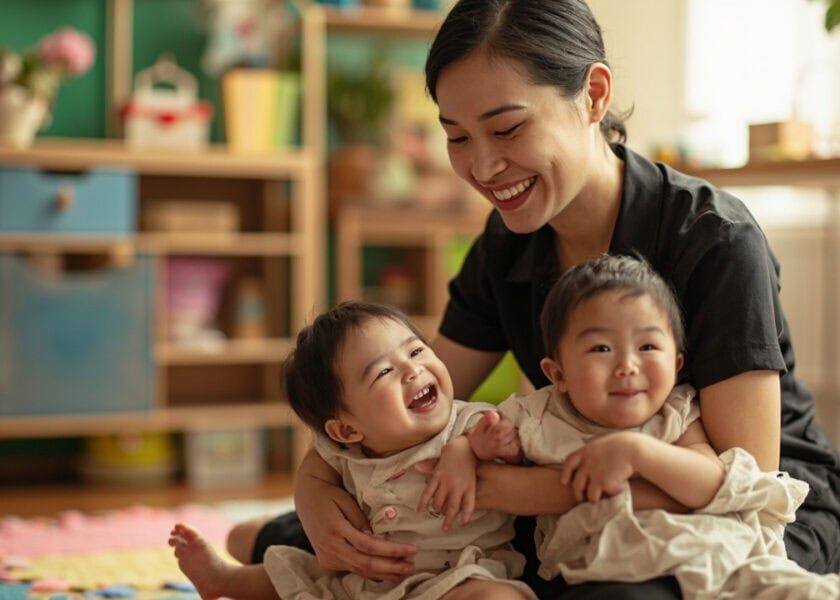
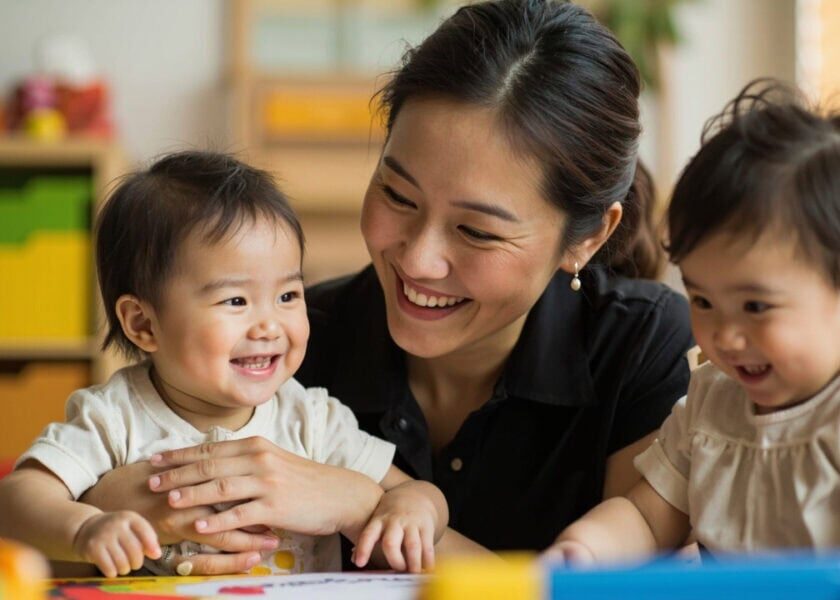
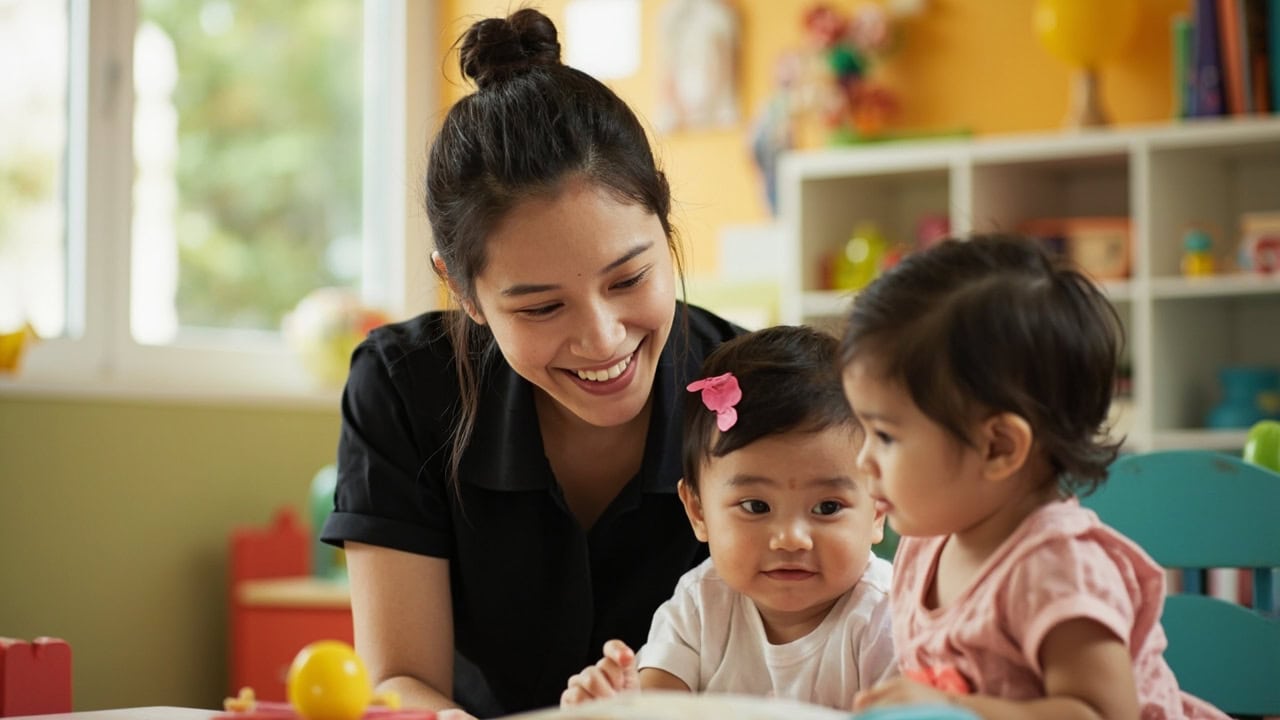
When a childcare environment is designed for sibling development rather than mere sibling supervision, something shifts. The caregiver is not simply managing two children in one room. She is holding the space between them.
She is noticing when your older child is becoming frustrated with the younger one’s pace, and naming that feeling in a way that teaches empathy rather than suppression. She might say, “I see you’re waiting. It can be hard to wait when you want to move fast. Your brother is learning too, and he really notices how patient you are with him.”
She is creating moments where your younger child can imitate your older child and experience the quiet pride of competence. “Your sister built that tower so carefully. Do you want to try the next level?”
She is allowing conflict to surface because she knows that conflict between siblings is not a failure of the care environment—it is the curriculum in action. When siblings fight, something important is being learned. The question is whether an adult is present to help them learn it well.
What Quality Childcare Actually Does
Consider what is actually happening when two siblings are in a quality care environment together, with a trained caregiver holding the space between them.
Your Older Child Is Learning
Your older child is learning patience. Not the abstract patience you have lectured her about at home, but the embodied patience that comes from waiting for her brother to finish a puzzle she completed in two minutes, and from hearing a caregiver say, “He’s working on it. Watch how focused he is.”
Your older child is learning that her brother’s development is not a threat to her status but a source of family richness. She is learning this not because you told her, but because she is living it.
She is also learning to be a mentor, a guide, a first teacher. These are roles that build self-efficacy and a sense of family contribution. When the caregiver involves your older child in helping the younger one—appropriately, with support—she begins to see herself as capable and kind, not just as “the big sister who has to give things up.”
Your Younger Child Is Learning
Your younger child is learning aspiration. Not the pressure of achievement, but the gentle pull of imitation that comes naturally when a beloved sibling is doing something fascinating just out of reach.
The caregiver notices this and creates a moment: “Your sister is building with the blocks. Do you want to try the smaller ones beside her?” This is peer scaffolding at its most organic. Your younger child reaches upward because someone nearby has already climbed, and the path is visible.
Your younger child is also learning that there is a world beyond immediate family. The sibling is the bridge to broader social understanding—someone who is not a parent, not an authority figure, but a peer who has needs, preferences, and feelings that interact with her own.
The Caregiver as Emotional Bridge
Between them, the caregiver is doing work that most parents do not have the bandwidth for during a busy weekday. She is the emotional bridge. She is not replacing the bond between your children but deepening it through her presence, her observation, and her response.
When your children fight—and they will—she does not simply stop the fight. She uses it. She names what happened, helps each child understand the other’s perspective, and lets the moment become a lesson in relationship repair that they will carry into every future connection.
This is why trained caregivers make a difference that cannot be measured in certifications alone. It is not about the certificate on the wall. It is about the quality of attention, the patience to let learning unfold, and the understanding that siblings in care are not two children who happen to share a room. They are a relationship in formation, and that relationship deserves to be tended.
What Singapore Parents Are Really Worried About
You are managing school runs and work deadlines and the logistics of a household that would overwhelm most people in a single week. You are navigating the cost of raising children in one of the world’s most expensive cities, and you are making decisions about childcare with incomplete information, competing advice, and a desperate desire to get it right.
You also carry something that you may not have named clearly, even to yourself. You carry the fear that your children will not be close. That they will grow up sharing a home and a surname but not a life. That the bond you hoped for will fade into polite phone calls and obligatory birthday messages.
This fear is not irrational. It is the fear of every parent who has watched adult siblings grow apart and wondered where the connection went.
Three Concerns We Hear Most Often
“I’m worried my children will compete for attention.”
This is a real concern, and it reflects your understanding that sibling relationships contain both love and rivalry. In a supervisory arrangement, competition can indeed become the dominant theme. But in a developmentally designed environment, competition becomes a doorway to empathy. The caregiver helps each child feel seen and valued as an individual, while also helping them understand what they contribute to the family. When children feel secure in their own place, they have less need to compete.
“I’m afraid childcare will just babysit them rather than nurture their bond.”
This is precisely why the distinction between supervision and development matters. When you evaluate childcare, you are not just asking “Will my children be safe?” You are asking “Will the person caring for them see that they are siblings? Will she tend the relationship between them as carefully as she tends each child individually?” This question will not have an obvious answer on every brochure. But it will lead you to pay attention to things that matter.
“What if my children fight more because they’re together all the time?”
They might—and this is actually a sign that the relationship is developing, not failing. Conflict between siblings is the curriculum in action. What matters is not whether your children fight but how the conflict is handled. In a quality environment, every disagreement is an opportunity for co-regulation, perspective-taking, and repair. Your children learn that relationships can survive friction, that they can be angry at each other and still love each other, that making up is part of being close.
How to Evaluate Childcare Through the Sibling Lens
When you visit a potential childcare arrangement—whether a centre or a home-based childminder—here are the questions worth asking that go beyond the standard checklist:
Questions to Ask
- How do you handle sibling conflict when it arises?
- Do you see my children as individuals or as a sibling pair with a relationship worth nurturing?
- How do you create opportunities for my children to play and learn together, not just exist in the same space?
- What do you do when one child needs individual attention? How do you help the other child feel included?
- Can you describe a recent moment when you helped my children work through a disagreement?
What to Look For
- How the caregiver speaks about sibling interaction. Does she use language that values the relationship, or does she speak about your children as separate individuals who happen to share a home?
- How the physical space allows for collaborative play. Are there materials and zones that invite siblings to work together, create together, and solve problems together?
- How conflict is handled when it arises. Do you see a caregiver who pauses, observes, and mediates—or one who simply separates the children?
- The ratio of children to caregiver. Attention is not just supervision. A caregiver who is spread too thin cannot hold the space between siblings the way this work requires.
You will begin to notice the difference between a caregiver who tolerates sibling presence and one who actively cultivates sibling connection. And that difference, compounded over months and years, becomes the difference between siblings who share a home and siblings who share a life.
How EduNanny by BUTLER Approaches Sibling Relationship Development
For families in Singapore navigating these decisions, EduNanny by BUTLER was designed with this sibling lens at its core.
Our Framework
We are part of the ECDA Childminding Pilot, which means we operate within a framework designed to make quality childminding accessible to Singapore families. Our caregivers are trained not just to care for individual children but to hold the sibling relationship as part of their responsibility.
In our home-based and centre-based pathways, we maintain ratios that allow for attention—not just supervision—across multiple children from the same family. This is not accidental. It is structural.
What Parents Gain
For families in the pilot, the fee structures are designed with affordability in mind. Monday through Friday care blocks are available, aligned with the rhythms of working parents. CDA and Baby Bonus are usable, so the financial architecture of your family planning can extend naturally into your childcare decision. These are practical details, but they matter because they remove friction from a choice that should be driven by what is best for your children’s development, not by what you can barely afford.
Communication and Trust
Communication is essential to trust, and trust is essential to this work. Where our services include transparency measures such as regular updates and, in certain locations, CCTV access, we offer these not because we have anything to hide but because we know that parents need to feel connected to their children’s daily experience.
You cannot tend a sibling bond from your office. But you can know that someone is tending it well, and that knowledge makes all the difference.
What We Do Not Promise
We do not promise that every sibling pair will be inseparable. Human relationships are too complex, too influenced by temperament and circumstance, to make such promises honestly.
What we promise is intention. We promise that when your children are in our care, they are not merely supervised. They are developed. They are seen as siblings, not just as individuals sharing a room. Their bond is tended with the same care we bring to their safety, their nutrition, and their emerging sense of self.
Moving Forward With Intention
The sibling relationship is the longest partnership most of us will ever have. Longer than most friendships. Longer than many marriages. Longer than the years we spend under the same roof with our parents.
It deserves to be built well. It deserves to be tended by people who understand that the conversations your children are having in the playroom at 2 p.m. on a Tuesday are conversations about trust, about sharing, about learning that another person’s needs matter. These are not small things. These are the foundations of everything that comes after.
You may have moments—perhaps many of them—when your children seem to fight constantly, to compete for every scrap of attention, to struggle against each other more than they seem to love each other. This is normal. It is developmental. And it is, paradoxically, a sign that the sibling bond is forming. Siblings who have no friction often have no depth. The children who learn to negotiate frustration, to repair ruptures, to hold space for each other’s different paces—they are building something that will serve them for life.
The goal is not a conflict-free sibling relationship. The goal is a relationship where conflict is not destructive, where love is deeper than convenience, and where the bond survives the inevitable pushes and pulls of growing up together.
The hope you carry for your children to be close as adults is not naive. It is one of the most important hopes a parent can hold. And it is a hope that can be shaped—not guaranteed, but shaped—by the choices you make in these early years. Not just the choice of school or the choice of neighbourhood, but the choice of who stands beside your children in the hours when you cannot.
If you are exploring childcare options for more than one child in Singapore, we invite you to consider what we have described here. Visit our programme. Meet our caregivers. Ask the questions we have outlined. See whether the environment feels designed to hold the space between your children the way this work requires.
We are here to answer those questions honestly and to walk with you as you make one of the most important decisions your family will face.
Because this is the work that quality childminding makes possible. And it is work we are honored to do, one sibling pair at a time.
EduNanny by BUTLER is a trusted, development-focused childcare and childminding service for families in Singapore. Learn more about who we are or explore our ECDA Childminding Pilot programme.