The Hidden Lessons That Shape Your Child in Singapore Childcare
The Invisible Curriculum: What Your Child Is Really Learning in Childcare
Close your eyes for a moment. It is morning. You have done this perhaps dozens of times. The bag is packed. The shoes are on. You walk through the door, and your child looks up at you with that expression — equal parts excitement and uncertainty. You kneel down. You kiss their forehead. You say something reassuring. And then you leave.
And here is where I want you to pause.
Because in that moment of leaving, in the seconds after the door closes, something begins. Something you cannot see. Something that no daily report will fully describe. Something that may be the most important learning your child will ever do.
We spend a great deal of time in Singapore talking about school readiness. We ask: Can my child recognize letters? Can they count? Can they sit still? These are fair questions. But they are incomplete ones.
Because the truth is, long before your child learns to read or solve a math problem, they are learning something far more foundational. They are learning who they are. They are learning how the world responds to them. They are learning whether it is safe to feel, whether they will be comforted when they cry, whether another person can be trusted, whether they are worthy of care.
They are learning about being human.
This learning — this invisible curriculum — is not happening at a desk or in front of a screen. It is happening in the smallest, most ordinary moments of childcare. In the way a caregiver kneels to meet your child’s eyes during drop-off. In the moment a toddler’s frustration is named and held instead of dismissed. In the quiet afternoon when a small child learns that the parent who left this morning always, always comes back.
These moments look like childcare. But what they actually are is the building of a person.
What Children Learn: Trust, Emotion, Social Skills, and Self
When you chose your childcare arrangement, what were you really choosing? You were choosing, of course, safety. Supervision. A trusted pair of hands during the hours you needed to work.
But beneath all those practical considerations, there was something else — something you may not have had the language for until now. You were choosing, whether you knew it or not, the environment in which your child would learn what it means to be human.
That is an enormous thing to entrust to someone. And it deserves to be understood with the same seriousness we would give to any decision that shapes who our children become.
Trust: The Foundation of Everything
A child learns trust — but not the kind that simply exists. The kind that is built, brick by brick, through repeated experience.
When an infant cries and a responsive caregiver consistently meets that need, something profound is happening. The infant is not just being fed, changed, or soothed. They are building a mental model of the world as a place where their needs matter, where their voice has weight, where other people are reliable.
The infant brain is wiring itself around the expectation that the world is trustworthy or untrustworthy, based on the consistency of care received in those earliest years. This foundation will shape everything from your child’s future relationships to their capacity to take healthy risks as they grow.
Emotional Literacy: The Gift of Being Understood
Imagine a toddler in a warm, well-staffed environment — one where the ratio of caregivers to children is small enough that each small person can be truly seen. This child is frustrated. Perhaps another child took a toy. Perhaps the morning transition was hard. The child is at the edge of a meltdown — not because they are misbehaving, but because they are two years old and their prefrontal cortex is still under construction.
They cannot yet regulate their own emotions from the inside.
What happens in this moment? A skilled caregiver does not shame the child. Does not ignore the feeling. Does not simply say “stop crying.” The caregiver bends down, names the emotion: “I can see you are really frustrated right now.” And stays present while the child moves through it.
This is emotional literacy. There is no worksheet. There is no lesson plan. But your child is learning something that no curriculum can teach if it is not present in real relationships: that feelings are survivable, that they can be named, that an adult will stay with them in the hard moments, and that they will not fall apart.
Social Competence: Learning to Be Human Among Humans
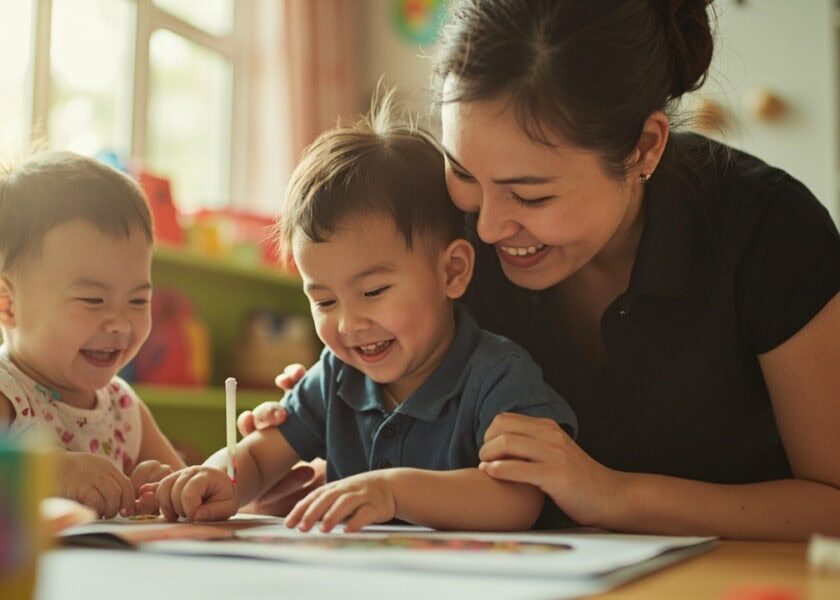
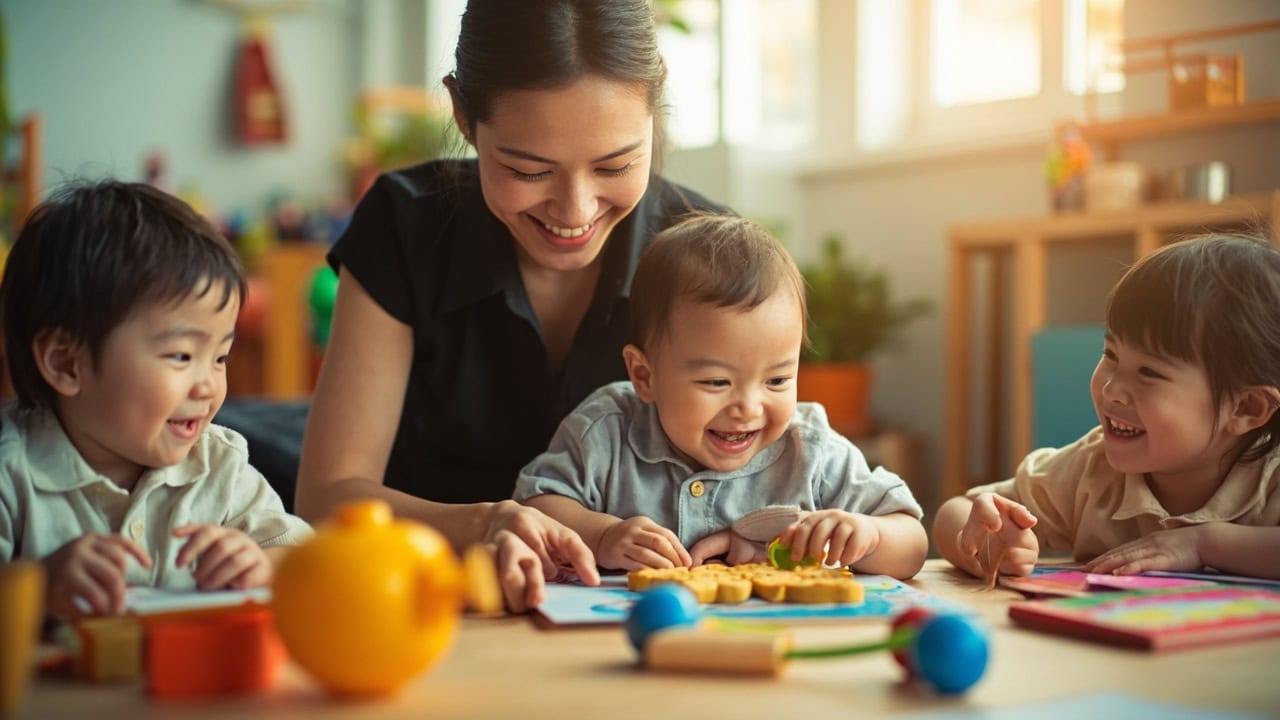
Children in quality childcare are not learning in isolation. They are learning alongside other children. And here the invisible curriculum expands into something even more complex: social competence.
Your child is learning, in the most basic and genuine way, how to be a person among people:
- Sharing — not because a teacher told them to share, but because they want to play with the same truck and they are discovering that this requires negotiation
- Cooperating — building something together, taking turns, noticing when another child is upset
- Conflict resolution — when a disagreement over a book becomes a moment of mediated communication
- Belonging — learning what it means to be part of a group that is not their family, a first circle of peers where they can practice the hardest human skills with safety nets beneath them
Self-Awareness, Autonomy, and Resilience
Your child is also learning who they are. In a quality childcare environment, they are given the space to explore — to climb, to ask questions, to make choices, to say no, to pursue an interest with fierce concentration. They are developing a sense of self that is separate from you, their parent. This is necessary. This is healthy. This is the beginning of autonomy — the child’s own internal compass, their emerging sense of what they want, what they think, who they are in relation to the world.
Every drop-off is a small separation. For many parents in Singapore, those separations are not small at all. They can feel heavy. They can feel guilty. They can feel like a failure, even when you know in your rational mind that they are not.
But here is what the invisible curriculum teaches us about those moments: every separation that is handled with warmth and consistency is a resilience lesson. Your child is learning, each morning, that leaving does not mean abandoning. That you love them and leave them, and love them and return. That people they trust can leave and come back.
Your child is learning that the people who hold them through those separations — who greet them warmly, who ease the transition, who reassure with their presence — are teaching them something essential about the reliability of love.
What Quality Childcare Actually Looks Like
You cannot see what happens in those hours. That is the source of so much parental anxiety — the gap between dropping off and picking up where invisible learning occurs.
The best caregivers in quality childcare are not simply carrying out routines. They are reading your child’s cues with precision. They are adapting their responses to meet your child where they are. They are noticing when a child is on the verge of a developmental leap and creating the conditions for it to happen.
They are, in the truest sense of the word, educators — though their classroom has no walls and their curriculum is written in smiles and tears and the quiet moments of a child’s day.
Trust is not built in crowds. Emotional literacy is not learned in haste. Autonomy is not discovered in a room that is too loud and too busy to allow a child to hear themselves think. For a child under three, the caregiver-to-child ratio is not a bureaucratic detail. It is the condition that makes the invisible curriculum possible.
| Setting Type | Approximate Ratio | What This Means for Your Child |
|---|---|---|
| Large centre-based | 1 caregiver : 8–12 children | Limited individual attention; responses may be standardised |
| Quality home-based (infant programme) | 1 caregiver : up to 3 children | Every cry heard; every milestone noticed; every emotional moment held |
In a Quality Childcare Environment, Your Child:
- Is greeted by name — with genuine warmth that communicates “you belong here”
- Has a primary caregiver — someone who knows their rhythms, their preferences, their particular ways of expressing need
- Experiences consistent routines — predictability that builds security and trust
- Receives emotional attunement — moments where an adult accurately names what the child is feeling and responds with empathy
- Has time and space to explore — without being rushed from activity to activity
- Experiences managed conflicts — where an adult helps negotiate resolution, modelling social skills
- Is included in a small community — where they are known, valued, and have a sense of belonging
Signs That the Invisible Curriculum Is Thriving
How do you know if your child is receiving the kind of care that builds trust, emotional vocabulary, and social competence? Look for these indicators:
- Your child seems genuinely happy to see their caregiver — not just tolerates, but shows real warmth
- Separations have become easier over time, not harder — your child is learning that goodbye is temporary
- Your child uses feeling words — “I mad,” “I sad,” “I scared” — showing they have a vocabulary for their inner life
- Your child shows signs of social interest — wanting to be near other children, attempting interaction
- Your child is developing initiative — choosing activities, expressing preferences, showing independence
- The caregiver speaks about your child specifically — not generic observations, but individualised understanding
Addressing the Concerns Singapore Parents Carry
We understand the anxiety that Singapore parents carry. It is real, and it deserves honest answers.
“Am I abandoning my child by putting them in childcare?”
You are not replacing yourself during those hours. You are extending yourself. Quality childcare does not diminish your role as a parent. It strengthens it.
The best childcare gives your child the experiences they need — trust, social learning, emotional vocabulary, resilience — so that when they come home to you, they are a little more whole, a little more capable, a little more themselves. And you get to build on that. Night after night, weekend after weekend.
The invisible curriculum and the home curriculum working together, each making the other stronger.
“How do I know my child is actually developing, not just being babysat?”
You know by the quality of the relationship between your child and their caregiver. You know by the small things: the way your child runs to greet their caregiver, the feeling-words they bring home, the social games they initiate. You know by the caregiver’s knowledge of your child — not just their schedule, but their temperament, their interests, their particular struggles and strengths.
You also know by the transparency of the programme. Quality care has nothing to hide. Ask questions. Request observations. Look for communication systems that help you understand what is happening in those invisible hours.
“Is the cost worth it?”
This is a question only you can answer. But consider what you are investing in: the architecture of your child’s capacity to trust, to feel, to relate to others, to know themselves. These are not soft outcomes. They are the foundations on which every academic skill, every career achievement, every lasting relationship will be built.
Your Role in the Invisible Curriculum
The invisible curriculum does not end at the childcare door. It continues in your living room, at the dinner table, in the bath. When you ask your child about their day and they say something that reveals, in the smallest and most tender way, that they have been changed by what they experienced while you were apart.
Questions to ask your child’s caregiver:
- How did they seem today? What was their mood like?
- Was there a moment when they seemed frustrated or upset? How did you respond?
- What did they seem interested in today? What caught their attention?
- How did drop-off go? How did they settle?
- Did they have any moments of connection with other children?
These questions help you understand the invisible curriculum your child is living. And your understanding helps you reinforce it at home — naming feelings your child brings back, celebrating social victories, talking about trust and return, building on the foundation that quality care has laid.
Designed for the Invisible Curriculum
Thoughtful childcare arrangements are built around the conditions that allow the invisible curriculum to unfold. When choosing care for your infant or young child, the environment matters profoundly — not just for supervision, but for the relational architecture being built in every interaction.
The best caregivers are not simply carrying out routines. They are reading your child’s cues with precision, adapting their responses, and noticing when a child is on the verge of a developmental leap. They understand that their role is not to replace you, but to partner with you in your child’s development.
What to look for in a quality arrangement:
- Thoughtful caregiver-to-child ratios — because genuine responsiveness requires the capacity to notice and attune to each individual child
- Consistent primary caregivers — someone who knows your child’s rhythms, preferences, and particular ways of expressing need
- Transparent communication — open dialogue about your child’s day, their emotional moments, their discoveries, and their connections
- Partnership with families — a shared understanding between the people who love this child most and those who care for them during the day
When these elements are present, the invisible curriculum has the space to take root. Your child is not simply being minded. They are being seen, held, and guided through the most foundational learning of their lives.
Begin Your Search
For a long time, childcare was seen as a service for working parents. A practical arrangement. A necessary convenience.
But the science of early childhood development has given us a vocabulary we did not have before. We now understand, with an evidence base that is unequivocal, that the first years of life are not a period of waiting until school begins. They are the most intensive period of human development that any person will ever experience.
The child who learns to trust in their first year of quality care will carry that trust into their marriages, their friendships, their ability to lead and to follow. The child who learns to name their feelings will carry that emotional vocabulary into moments of crisis and joy for the rest of their lives. The child who learns, in a small room with small hands, how to share and how to resolve conflict and how to belong — that child is building the social architecture of their entire future.
When you drop off your child tomorrow morning — and you will, because life in Singapore demands it — know that the door closing behind you is not the end of something. It is the beginning of something.
Your child is not being minded. Your child is being made. They are learning what no school can teach them in those hours — who to trust, how to feel, how to be with others, who they are. They are absorbing the invisible curriculum, and it is shaping them in ways that will outlast every report card, every exam, every milestone marker we can think to measure.
You deserve to understand exactly what your child will experience in those invisible hours. When you choose quality care, you are making an investment — in your child’s capacity to trust, to feel, to relate, to become themselves.
Choose wisely. Choose with understanding. And know that in doing so, you are giving your child something that no academic curriculum can provide.
You are teaching them about being human.
EduNanny by BUTLER is a Singapore-based childminding and childcare service committed to thoughtful, development-oriented care for infants and young children. Learn more about our approach or speak with our team to explore whether EduNanny is the right fit for your family.