Quality Sibling Care: Why Two Children Benefit More Than Double in Singapore
The Sibling Effect: Childcare Decisions That Change Everything for Singapore Families
You already know what it feels like.
The morning when your youngest needs you at exactly the same moment your eldest refuses to put on shoes. The afternoon when one child is meltdown-adjacent because they skipped a nap, while the other is performing for an audience of no one in particular. The evening when you realize you have praised one child’s drawing three times and accidentally called the other one by the dog’s name.
Not because you don’t love them equally. Because there are two of them, and you are one of you, and the mathematics of attention were never designed to feel balanced.
If you have two children—or three—in Singapore, you know this feeling in your body. The low-grade hum of triage. The quiet terror that you are doing none of it well because you are trying to do all of it at once.
And now you are making a childcare decision. Not for one child. For two. Maybe three. Perhaps your second child is approaching the age where the question you thought you’d already answered is suddenly urgent again. Perhaps you are weighing whether one programme can hold the weight of your whole family’s mornings, or whether you need to split them across different arrangements.
Here is what no one is telling you, and what we want to say clearly: the childcare decision you make for multiple children is not twice as hard as the one you made for one. It is a categorically different decision. And when made well, it is a decision that serves your family in ways that actually compound—with each child, the value grows.
Where You Actually Are
You are managing three different bedtimes, two different food textures, and a nap schedule that requires more logistics than most corporate project plans. You are also a parent who planned your family carefully.
Singapore has one of the lowest fertility rates in the world, which means that the families here who do have two children—three, in some cases—are making that choice with intention. You are not accidentally here. You chose this complexity because you believed your children would benefit from each other. Siblings. A family. You made that bet.
And then the logistics arrived.
There is a particular exhaustion that belongs to parents of multiple children, and it is different from first-time parent exhaustion, even though outsiders sometimes do not see the difference. First-time parents are exhausted by the newness. You are exhausted by the accumulation.
You have already learned the hard lessons—the sleep training, the food battles, the separation anxiety—and now you are applying them to two different children with two different temperaments, two different schedules, and two entirely different opinions about how the world should work.
The Real Fear About Childcare for Multiple Children
You are afraid that adding a second child to your childcare arrangement will fragment the quality. That attention divides. That relationships dilute. That the warmth and consistency your first child experienced will thin out like butter spread over too much bread when you spread it across two children, two developmental stages, two sets of needs.
You are afraid that the childcare that worked beautifully for one child was designed for one child, and that your family is about to discover the limits of that design.
That fear is not irrational. It is the correct fear to have about the wrong kind of childcare.
Here is what quality sibling care actually looks like—and why it is structurally different from what you are imagining.
It Is a Small Social Ecosystem
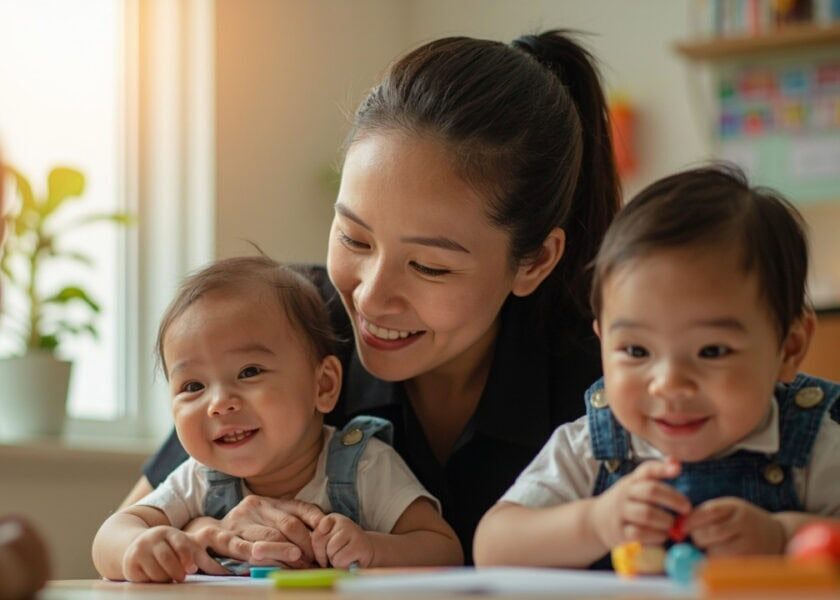
A quality childcare environment with siblings in it is not simply two children receiving the same care. Consider what actually happens in a morning at a well-designed programme.
Your older child watches how your younger child engages with a caregiver—and something models itself inside them. Not because anyone taught it. Because children learn from proximity, from watching someone they trust handle someone they love. Your older child practices patience, nurturance, and a quiet form of leadership, because they are in an environment where those things are visible and relevant.
Your younger child reaches social milestones faster because they have a built-in reference point—an actual human being they love and copy—rather than learning social behavior from scratch in a room full of strangers.
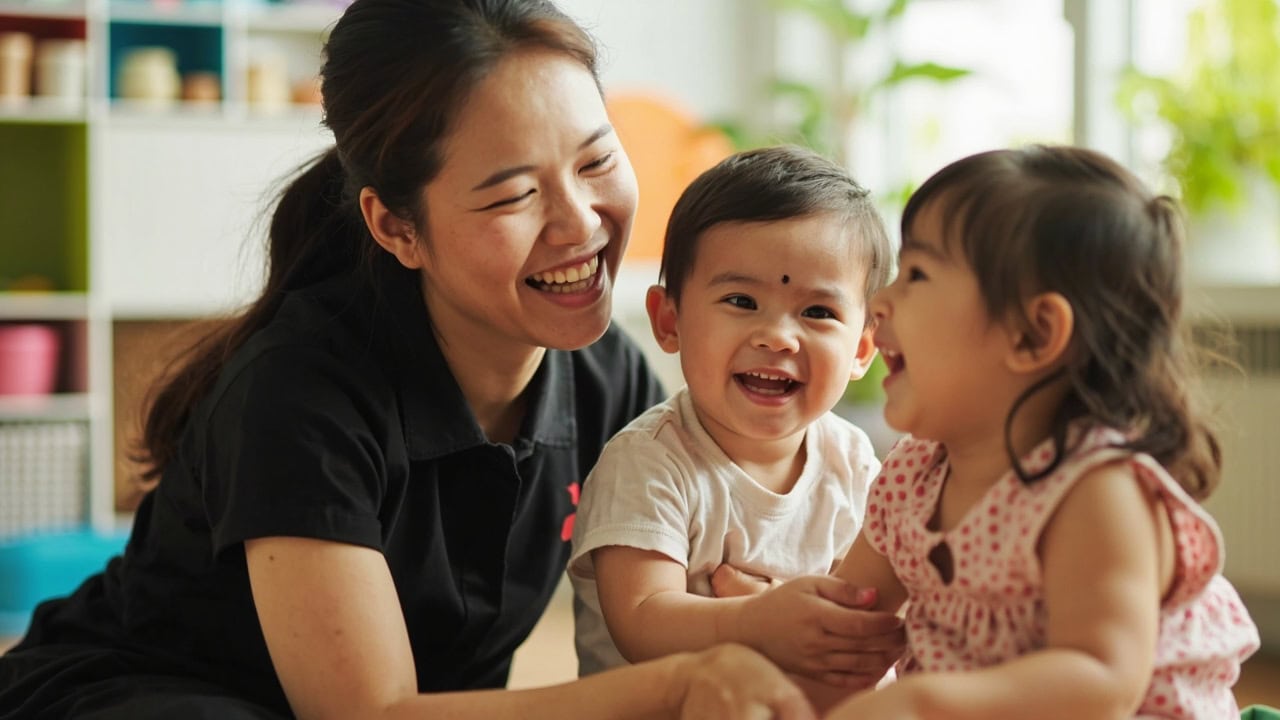
Your children are practicing being siblings in a setting where the conditions are designed for safety and warmth. They are learning each other’s rhythms, negotiating, sharing, competing, forgiving—all of it mediated by caregivers who know both of them well enough to intervene when escalation needs to become a lesson, and to stay out of the way when resolution needs to happen on its own.
Continuity Compounds With Multiple Children
This learning does not happen in a home-based arrangement with a high turnover of caregivers, because continuity is the foundation of everything we are describing.
If your children see a different face every three months, they are not learning sibling dynamics within a trusted framework. They are learning uncertainty. They are learning to adapt to inconsistency, which is a different and harder lesson, and not one you chose for them.
When a consistent caregiver team knows your children across time, they build a layered understanding that is genuinely irreplaceable. They know that your eldest is prickly in the mornings until she has had ten uninterrupted minutes. They know that your youngest decompresses by being held for five minutes before any transition. They know the difference between a tantrum and a communication attempt, because they have seen both children across enough days and contexts to read the signals.
This knowledge does not divide when there are two children. It cross-pollinates. The caregiver who knows your first child deeply understands your second child faster, because they already know the family pattern. They know how your household moves. They know your values because they have watched them live out in two small people over months and years.
Continuity is not twice as important with two children. It is exponentially more important.
Developmental Stage Differentiation in Practice
In practice, developmental stage differentiation means your two-year-old is not doing the same activity as your four-year-old. It means both of them are doing something precisely calibrated to where they are.
Your toddler is developing fine motor skills through pouring water between containers. Your preschooler is developing narrative thinking through storytelling with a caregiver who asks them open-ended questions about what happened first, next, last. Same room, same trusted environment, two entirely appropriate developmental experiences.
And they are watching each other. Your toddler is seeing what the older child does, and wanting to try. Your older child is seeing the younger one master something and feeling the pride of having been that small person once.
This is the hidden curriculum of quality sibling care. It is not taught. It is structural. The architecture of the environment creates it, the same way a well-designed kitchen creates the conditions for cooking.
The Ratio That Actually Matters
In those early, critical months—when your infant is still learning that the world is a trustworthy place, still building the neurological architecture that will support their emotional regulation for the rest of their life—each caregiver is present with a level of attention that allows them to actually see your child. Not manage them. See them. Notice when they are about to spiral. Notice when they need movement, or stillness, or food, or a change of voice.
That ratio is not a bureaucratic number. It is the difference between care that responds and care that reacts.
Apply that ratio to two children who are siblings. You are not getting half the attention. You are getting a caregiver who knows two children in the same family, in the same context, who can calibrate their responses to both simultaneously because they are not stretched across ten.
Your eldest gets the structured challenge appropriate to their stage. Your youngest gets the sensory-rich environment their developing brain needs. These are not competing demands. They are the natural outputs of a well-differentiated programme that takes developmental stages seriously.
The Practical Reality of Sibling Care
There is a practical dimension to sibling care that often gets overlooked in the emotional discussion: the infrastructure of managing multiple enrollments.
If you have one child in a home-based arrangement and one child in a centre-based programme, you are managing two sets of pickup times, two sets of communication channels, two sets of caregiver relationships, and two sets of what-to-pack-in-the-bag mornings.
When a single programme can actually hold all of your children, something shifts. You have one rhythm instead of two. One set of caregiver relationships instead of multiple. One communication channel that scales across your whole family. The morning logistics simplify. The evening debrief consolidates.
For Singapore families, this also means asking the practical questions: Monday to Friday coverage. Whether your Child Development Account (CDA) and Baby Bonus funds can be used across enrollment. How the programme handles the different programme transitions as each child grows—infant care to toddler care, toddler to preschool—and how siblings are supported through those changes together.
The Questions You Actually Have
“What if my children are very different from each other?”
They will be. And that is precisely the point. Quality sibling care does not smooth out differences. It creates a safe space for differences to coexist. Your sensitive, cautious firstborn and your bold, fearless second child are learning from each other that there is more than one way to be in the world—and both ways are valid.
“What if my children fight more because they’re together all day?”
They might. And that is not a sign of failure—it is a sign of normal sibling development. What quality care provides is the mediation that allows fighting to become learning. Siblings who fight and are helped to resolve their conflicts develop better conflict resolution skills than siblings who never fight. The caregiver’s role is not to prevent friction. It is to provide the emotional safety that allows friction to become growth.
“Isn’t it harder on the caregivers when there are multiple siblings?”
Only in poorly designed arrangements. In quality care, siblings are resources, not complications. A caregiver who knows both children can use that knowledge to support each one more effectively. They can read family patterns. They can anticipate triggers. They can see your children as a unit and as individuals simultaneously—which is exactly what you need someone to do when you cannot be there yourself.
Questions to Ask Before Enrolling Multiple Children
Not a checklist—we have both seen too many checklists, and they all blur together. Think of these as the structural questions that reveal whether a childcare arrangement is built for one child or built to scale across a family.
1. Ask About Continuity First
How long do caregivers typically stay in this programme? What are the handoff protocols when a new caregiver joins? Can I speak with families who have been here longer than a year?
Continuity is not a nice-to-have. For a family with two children, it is the load-bearing wall of the whole arrangement. If that wall is weak, everything else will eventually crack.
2. Ask About Ratio—Then Ask What It Looks Like Across Age Groups
If there are infants in the same environment as older children—and there should be, in a well-designed programme—ask how the schedule and space are structured to serve both developmental realities.
A one-to-three infant ratio is meaningful only if the environment understands what infants need versus what toddlers need versus what preschoolers need, and plans the day accordingly.
3. Ask About Sibling Integration
Not “do my children get to see each other,” but: how does the programme think about sibling relationships? Are they factored into grouping decisions? Are there mixed-age activities that deliberately bring siblings into collaborative learning?
If the answer is “they are in separate rooms for most of the day,” that is a structural choice that tells you something. It is not necessarily wrong, but it is a different philosophy than one that sees sibling bonds as a resource for learning.
4. Ask About Communication Systems
You need to know what your children did today—not as a generic daily report, but as meaningful information about their wellbeing, their social development, their moments of struggle and triumph.
If you have two children in a programme, you need communication systems that are efficient enough to give you real information about both children without requiring you to read two separate novels every evening. Ask how they handle that. Good programmes have thought about it.
5. Ask About Flexibility for Multiple Enrollments
This is the practical infrastructure question. What does it actually look like logistically to have all your children in one programme? Monday to Friday coverage. Fund utilization. The daily rhythm of pickups and drop-offs.
These are not secondary concerns. They are the infrastructure that determines whether this decision makes your life more workable or less.
6. Ask About Transition Protocols
Because it will come. Your older child will move from infant care to toddler care. Your younger child will eventually follow. Ask how the programme handles transitions across stages, and how siblings are supported through those changes.
What EduNanny Offers Singapore Families
We want to be specific about what we offer, because vague promises help no one.
EduNanny by BUTLER operates within Singapore’s ECDA Childminding Pilot, and we offer both home-based and centre-based pathways because families are not all the same. Some of you need care in your home, with a caregiver who becomes part of your household rhythm. Some of you need the social ecosystem of a centre, with the structure and peer environment that provides.
Both pathways, in our model, are held to the same standard of caregiver continuity, developmental differentiation, and family partnership.
Our infant ratios—up to one to three—reflect our belief that the first years of life are not a time to optimize for cost savings at the expense of attention. Your infant’s brain is building the architecture for every relationship they will ever have. That process deserves the presence of a caregiver who can actually be present.
Our fee structures are designed to be accessible within the pilot framework, and we actively support families in leveraging their CDA and Baby Bonus arrangements, because we know that the cost of childcare for multiple children is a real and legitimate concern. It should not be a barrier to quality.
We use communication tools—including CCTV measures where deployed—that give parents transparency into the daily experience of their children. We know that for families with two or three children in care, the need for clear, efficient, trustworthy communication is amplified. You do not have the time to decode ambiguous daily logs or wonder what “had a good day” means across two different caregivers. You need real information.
And we have built a Thomas AI Chatbot that serves as a practical layer of support—not to replace the human relationships that matter most, but to help you manage the administrative and informational load of having multiple children in care.
This is what we have built. We are not suggesting it is the only good option available. We are suggesting that it is built with a specific understanding of what families with multiple children actually need, and that understanding comes from listening—not to the childcare market, but to parents like you.
The Foundation You Are Building
You chose this. Not the exhaustion—the complexity. You chose to build a family with more than one child in it, and you did that because you believed that your children would be better for knowing each other. That the sibling relationship was worth investing in, even though it would cost you sleep, and attention, and a significant portion of your emotional and logistical bandwidth.
That belief is not naive. It is one of the most well-supported findings in developmental psychology—that sibling relationships, when they are warm and secure, are among the most enduring influences on a person’s emotional life. More enduring than peer friendships. More enduring than many adult relationships.
The sibling bond is a lifetime project, and the foundations of it are being built right now, in the childcare environment you choose for your children.
Quality childcare for one child is a gift. Quality childcare for siblings, in the right environment, is a multiplier. It takes the sibling relationship that you decided to create and gives it structure, safety, and a daily practice in being together under conditions that make cooperation, empathy, and love more likely than rivalry, comparison, and resentment.
It does this not by managing your children’s relationship, but by creating the conditions in which it can manage itself—with wise, consistent, attentive adults nearby.
You are not fragmented. Your attention is not insufficient. Your love is not too divided to go around.
What is true is that the infrastructure around you needs to be strong enough to carry the weight of your family’s complexity. When it is, you will find that your children are not pulling you in different directions. They are learning to walk together. They are learning, in that carefully designed environment, that the world is a place where people who are different from each other share space, and care for each other, and grow.
That is the thing you chose when you decided to have two children instead of one.
Quality childcare does not make you a better parent. But it makes the conditions around your family worthy of the choice you already made.
You know what matters. You have always known.
Find the programme that knows it too, and trust the rest to the rhythm you build together.
If you are ready to explore what quality sibling care looks like within the ECDA Childminding Pilot, we invite you to speak with our team. Not to make a decision today—but to ask the questions that matter, and see whether the answers feel true.
Connect with EduNanny Singapore
#SiblingChildcareSingapore #MultiChildFamilySingapore #ECDAChildminding #QualityInfantCareSingapore #ChildcareForTwo #SingaporeParentAdvice #EduNannySG #ChildmindingPilot #SiblingBonding #SingaporeChildcare