How Quality Early Care Builds Primary One Readiness in Singapore
When Your Child Walks Into Primary One Ready, It Won’t Be Because You Checked a Box
There is a particular kind of silence that descends in Singapore parenting circles the moment someone mentions Primary One registration. The questions follow predictably—has your child started revision, can she write her name in both scripts, does he know basic addition—and underneath all of them, one quieter question that no one quite asks out loud: Is my child going to be okay?
That question lives in the space between what we want for our children and what we fear they cannot yet do. It is the question that wakes parents up at three in the morning, the question that makes reasonable adults compare enrichment schedules at birthday parties, the question that turns every decision about childcare into a referendum on your worth as a parent.
It is, I want to suggest, the wrong question—or at least, the wrong question at this particular moment.
Here is what years of watching families navigate the transition to Primary One has taught me: the children who walk into their first day of school genuinely ready are almost never the ones whose parents spent those years in a panic. They are the children who have been held, spoken to, played with, challenged, comforted, and allowed to be children—consistently, patiently, and with intention. They are ready because readiness was built into their lives, not because it was added to a checklist somewhere around age five.
This distinction matters more than we realise. And understanding why may be the most important thing I can offer you today.
The Anxiety Is Real—But It Is Pointing You in the Wrong Direction
If you are a parent in Singapore, you have felt it. The weight of knowing that somewhere ahead, your child will walk through the gates of a primary school and be measured—never cruelly, but inevitably—against a system that has expectations. The creeping awareness that other children seem to know more, seem to adapt faster, seem to handle the transition with an ease your own child has not yet shown.
The pamphlets from enrichment centres arrive at exactly the moment you are most vulnerable, promising that their programme will close the gap, accelerate the skills, prepare your child for everything that lies ahead.
I want to name what is happening here, because naming it is the first step toward choosing differently.
The school readiness industry—and it is an industry, make no mistake about that—has a vested interest in your anxiety. Not because anyone involved is malicious, but because fear is a powerful motivator. When parents are afraid their children will not cope, they spend. When they believe preparation must begin early and intensively, they sign up for programmes that may or may not deliver.
But here is the problem with this entire framework: readiness is not a product. It is not a set of skills that can be taught in twelve weekly sessions or developed through an app on a tablet. Readiness is a state of being—a quality that emerges from the slow, patient, deeply human work of early childhood development.
It is the result of thousands of small moments: a caregiver who responds when a baby cries, a toddler who learns that her needs matter, a preschooler who discovers that the world is fascinating and that he is capable of exploring it. These moments cannot be compressed into a curriculum. They cannot be fast-tracked in the final year before Primary One. They can only be built, brick by brick, over years.
The Years Before Primary One Are Not a Countdown—They Are a Foundation
Developmental science tells us that the early years are a period of extraordinary neural plasticity. The brain is building itself at a pace it will never again reach. The circuits that will govern learning, emotional regulation, social behaviour, and resilience are being laid down in ways that will shape a child for decades.
Decades of research across developmental psychology, neuroscience, and early childhood education converge on a single, powerful conclusion: what happens in the first five years matters more than what happens in the five years after.
When a child learns, in infant care, that his cries bring a responsive adult—when he learns that the world is a place where his needs are noticed and met—he is not just being comforted in that moment. He is building a fundamental understanding of security. He is learning that he can trust. And that trust, that sense of security, is the platform from which all future learning will launch.
When a toddler is allowed to struggle with a puzzle, to try and fail and try again, with a caregiver nearby who does not immediately rescue him but stays present and encouraging, he is not just playing. He is building persistence, problem-solving, and the belief that effort leads to mastery. These are not abstract qualities. They are the engines of academic learning.
When a preschooler is in a setting where she must navigate friendships, share toys, manage small disappointments, and experience the complex emotions that arise from being with other children, she is developing the social fluency that will make the transition to Primary One feel natural rather than overwhelming. She is learning that she can belong, that she can adapt, that she can be herself in a group.
These skills are not taught in a classroom. They are caught in the texture of daily life with peers and warm, attentive caregivers.
Why This Changes the Question You Should Be Asking
The question we should be asking is not “Is my child ready for Primary One?” but rather “Is my child developing in a way that will make Primary One readiness feel natural?”
The first question invites anxiety and checklists. The second invites trust—in your child, in the process, and in the people you have chosen to care for your child while you cannot be there yourself.
What Quality Childcare Looks Like in Practice
Let me paint a picture of what good early care looks like, because the abstraction of “quality care” can sometimes feel disconnected from daily reality.
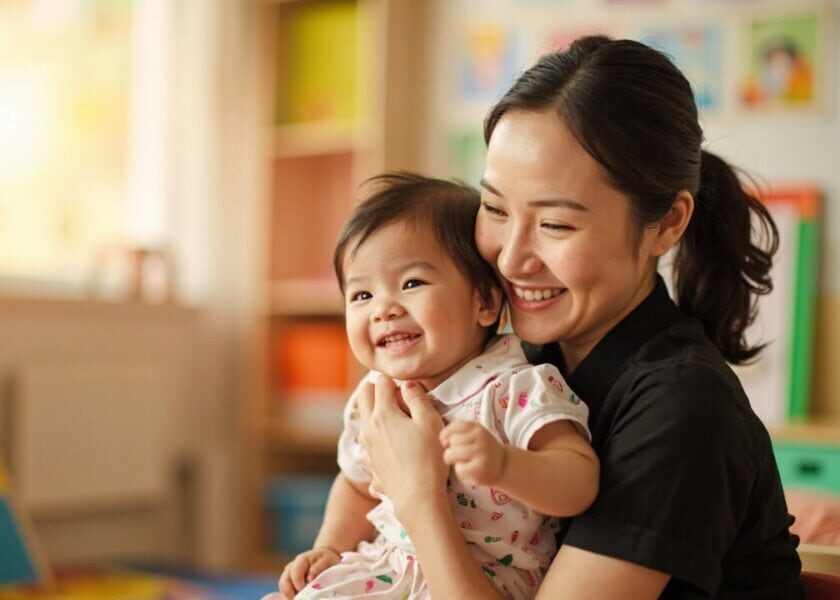
In quality infant care, you will see caregivers on the floor at a baby’s level, responding to coos and babbles before the baby escalates to crying. You will see intentional talking—not baby talk, but real language—describing what is happening as the baby explores a texture, a toy, a face. You will see patience when a baby is tired and irritable, a calm presence that communicates safety even in discomfort.
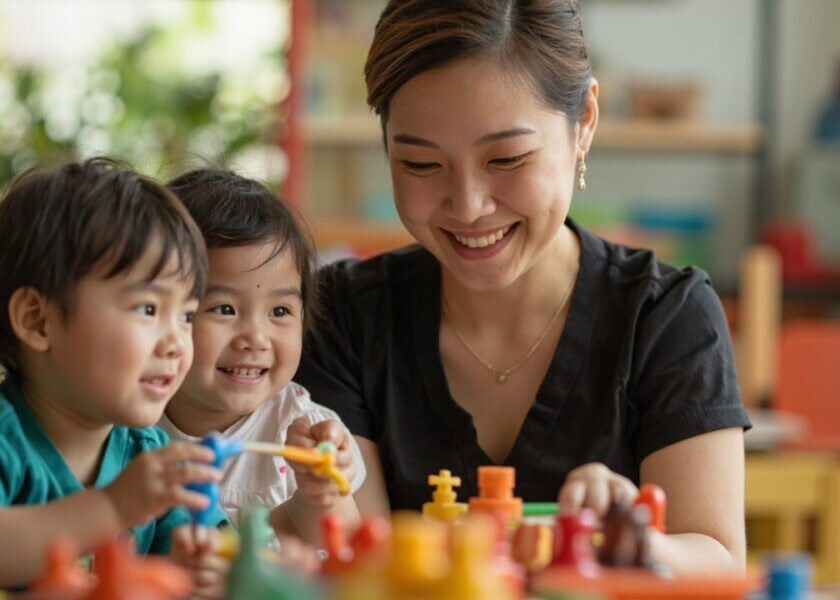
In quality toddler care, you will see children given choices: this toy or that one, sand or water, painting or playdough. You will see caregivers who narrate emotions—”I can see you’re feeling frustrated that the tower fell down”—building the vocabulary that will later allow a child to name and manage their feelings. You will see children encouraged to try again after failure, praised not for outcomes but for effort and persistence.
In quality preschool care, you will see children engaged in sustained pretend play, working out social scenarios with peers, negotiating rules and roles. You will see caregivers stepping back to let children resolve their own conflicts—with support available but not intrusive. You will see a balance of structure and freedom, of learning and play, of challenge and security.
This is what readiness looks like in practice. It is not flashcards or workbooks or vocabulary lists. It is the slow, daily accumulation of security, confidence, and capability that makes a child say, on their first day of Primary One: “I know how to do this.”
The Caregiver Relationship: The Most Powerful Variable
In the early years, children do not learn from curricula. They learn from people. Specifically, they learn from the people who hold them, talk to them, play with them, comfort them, and show them, day after day, what the world is like.
A child whose caregiver is warm, responsive, and consistent develops differently than a child whose caregiver is distant, erratic, or stressed. This is not a judgment on any parent or any caregiver. It is simply what the research shows: the quality of early relationships literally shapes the architecture of the developing brain.
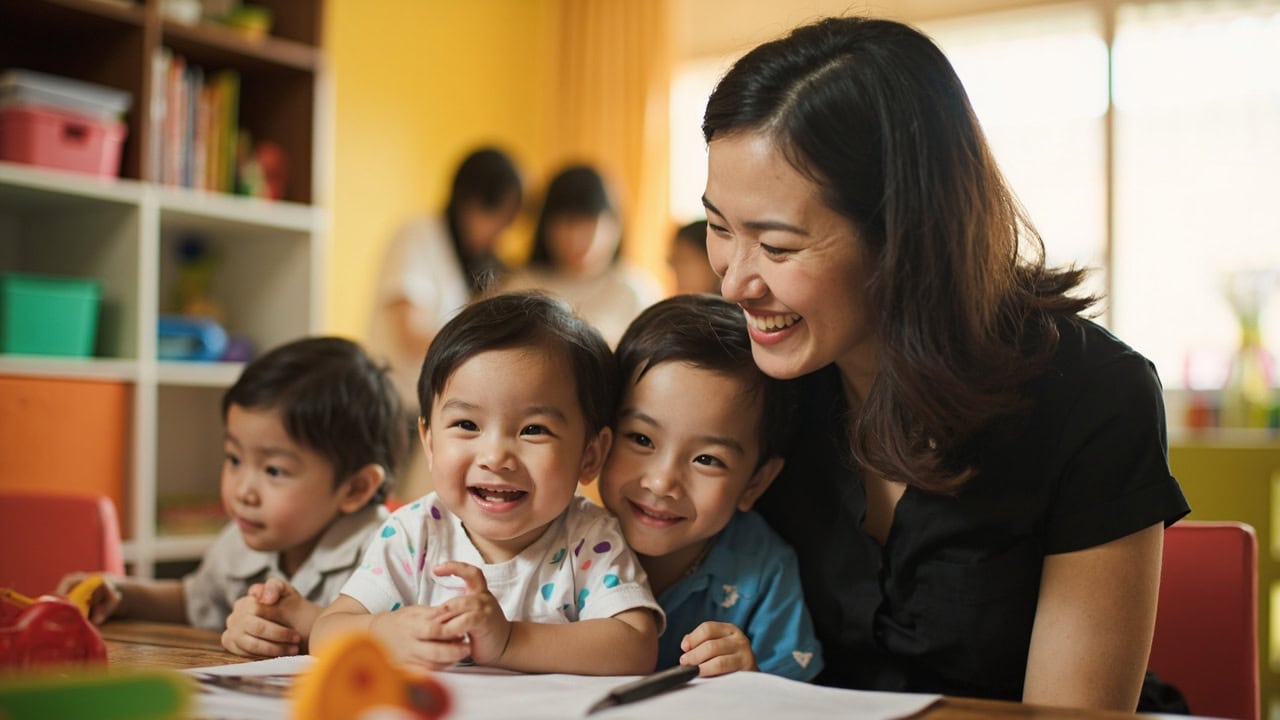
What does this mean for families navigating infant care and childminding in Singapore? It means that choosing who cares for your child is not a logistical decision. It is a developmental decision. The person who holds your baby, who sings to your toddler, who helps your preschooler make sense of big feelings—that person is not just providing a service. They are being a significant figure in your child’s life during the most important developmental window your child will ever have.
This is why EduNanny Singapore approaches childminding not as babysitting, but as a developmental partnership. When we speak about the caregivers in our network, we speak about them as professionals who have been trained, vetted, and supported to provide the kind of care that builds readiness—not because readiness is a checkbox on a form, but because readiness is what happens when a child has been truly seen, truly heard, and truly cared for over time.
EduNanny operates within the ECDA Childminding Pilot, which means our programme is embedded within a regulatory framework designed to protect children and support quality. In an industry where anyone can claim to offer childcare, the fact that EduNanny has been recognised and supported by the Early Childhood Development Agency signals a commitment to standards that matter: background checks, training requirements, ongoing oversight, and a structure that holds caregivers accountable to the families they serve.
Why Ratios Matter
Within the pilot framework, families have access to both home-based and centre-based pathways, depending on what suits their child and their circumstances. When there are only one to three infants for every caregiver, something fundamentally changes. There is time to respond to crying, time to engage in meaningful play, time to notice the small developmental milestones that happen between the dramatic ones. There is patience. There is attention.
These are not luxuries. In the early years, they are necessities.
Addressing Your Real Concerns
What About the Cost?
Singapore is an expensive city, and childcare costs can feel prohibitive. I do not want to minimise that reality. But I also want to be honest about what is at stake. If we treat early childhood care as a luxury expense to be minimised, we are making a category error. The early years are not a period to cut corners because the returns—though they will not appear on a balance sheet for years—are incalculable.
A child who has been well-cared for in the early years is more likely to be confident, curious, and capable. They are less likely to struggle with the transition to formal schooling. They are more likely to develop the resilience that carries them through life’s inevitable challenges.
EduNanny’s participation in the ECDA Childminding Pilot means that fees are structured to be accessible. Additionally, Singapore parents have access to mechanisms designed to make quality childcare more affordable: the Child Development Account, which allows you to use government subsidies and funds for eligible early childhood expenses, and the Baby Bonus Cash Gift, which provides direct financial support for families.
The Fear of Letting Go
When you hand your infant to someone else, there is a vulnerability in that moment that is almost physical. You are trusting another person with the most precious thing in your life. You need to know that your child is safe, that they are being cared for with the same attention and love you would give yourself. This is not weakness. It is the most natural thing in the world.
EduNanny understands this. We know that trust is earned through transparency, communication, and consistency. Where CCTV measures are deployed, they are there not just for safety but for peace of mind—for parents who need to know that they can, if they wish, see what their child’s day looks like. Communication is built into the model: regular updates, sharing of milestones and moments, a relationship between caregiver and family that is collaborative rather than transactional.
Why Consistency Matters
The care operates on structured schedules—Monday to Friday blocks—because consistency is not just a preference in early childhood, it is a requirement. Children thrive on predictability. They need to know what comes next, who will be there, and that the rhythms of their day are reliable.
This predictability is not about rigidity. It is about security. And security, as I have been arguing, is the foundation on which everything else is built.
Practical Guidance: What to Look for When Choosing Childcare
If you are evaluating childcare options in Singapore, here are some questions that research and experience suggest matter most:
- How does the caregiver respond to a distressed child? Look for calm, warm responsiveness—not dismissal, and not over-stimulation. The best caregivers help children learn to regulate their emotions by being calm themselves.
- What does a typical day look like? Quality care balances structured activities with free play, group interactions with individual attention, and active engagement with restful periods.
- How are caregiver-child relationships described? You want a caregiver who speaks about your child as an individual—with warmth, observation, and genuine interest in their development.
- What training and support does the caregiver have? Ongoing professional development matters. Caregivers who are supported by an organisation with standards, oversight, and resources can provide better care than those working in isolation.
- How does the arrangement communicate with families? Regular updates, transparent processes, and collaborative relationships between caregiver and parents are indicators of quality.
- What are the caregiver-to-child ratios? Fewer children per caregiver means more individual attention, more responsiveness, and more opportunities for the kind of meaningful interaction that builds readiness.
These are the questions that matter. Not whether the centre uses a particular curriculum or whether the enrichment programme promises to accelerate your child’s learning. The questions that matter are about relationships, responsiveness, and the quality of attention your child will receive.
Standing at the Gate
I want to close with an image.
It is the first day of Primary One. Your child is standing at the gate. There are other children there too—some clinging to their parents, some already running ahead, some quiet and watchful, some loudly excited. The school year stretches ahead, full of challenges you cannot yet imagine and joys you cannot yet anticipate.
But here is what I want you to know: if you have built the foundation—if you have given your child consistent, warm, responsive care; if you have surrounded them with people who see them and help them grow; if you have trusted the process of development rather than forcing it; if you have loved them, played with them, listened to them, and let them be children—then that child at the gate is ready.
Not because they know more than the others. Not because they have been drilled and prepared and pushed. Because they have within them the confidence to try, the curiosity to learn, the resilience to persist, and the social fluency to belong.
That readiness did not happen overnight. It happened over years. It happened in the moments you may not even have recognised as important—the morning drop-off where your child waved goodbye with confidence, the afternoon pickup where they showed you a painting they were proud of, the evening conversation where they told you about their friend, the night when they cried and you held them and they learned that sadness passes.
Every one of those moments was a brick in the foundation. And by the time your child reaches Primary One, the foundation is strong enough to hold everything that comes next.
EduNanny Singapore was built on this understanding. Not as a slogan or a marketing angle, but as a conviction that grew from watching families struggle with the wrong questions and the wrong frameworks. We believe that the formal recognition of childminding as a legitimate, quality-supported profession is essential to giving families the choices they deserve.
Our caregivers are people who have chosen this work. Not because it is easy, but because they understand what it means. They are not filling in for parents. They are partnering with parents in the most important work that exists: raising the next generation.
When you are ready to explore what a developmental approach to childcare can look like for your family, we invite you to reach out, ask questions, and discover how EduNanny can support your child’s journey.
Ready to learn more? Visit EduNanny Singapore, explore our ECDA Childminding Pilot programme, or get in touch to speak with our team.
#SchoolReadiness #SingaporeParenting #PrimaryOnePrep #ChildcareSingapore #EarlyChildhoodDevelopment