Building the Foundation for Primary 1: A Singapore Parent’s Guide
The Myth of the False Choice
We have been told, in different ways and through different channels, that the early years are about happiness. That childhood should be carefree. That academics can wait.
There is truth in this—but it is an incomplete truth, and an incomplete truth can be as misleading as a lie.
The early years are indeed about happiness. But happiness for a four-year-old is not the same as happiness for a forty-year-old, and the habits, capacities, and dispositions that produce one do not automatically produce the other.
A child who is simply kept happy—who is entertained, distracted, kept safe and clean and fed—may have a pleasant two years. But when Primary 1 begins and the room fills with twenty-five other children, when the teacher asks them to listen before speaking, to wait their turn, to remember three instructions in sequence, to sit with discomfort and try anyway—happiness alone will not be enough.
The children who arrive at Primary 1 ready are not the children who were simply kept happy. They are the children who were helped, patiently and consistently, to develop the capacities that make learning possible.
This is what school readiness means. Not knowing letters or numbers before the teacher teaches them—though that matters too—but the readiness to learn. The readiness to engage with something unfamiliar and not flee from it. The readiness to try, fail, try again, and eventually succeed.
What Primary 1 Actually Requires in Singapore
Let us talk about what Primary 1 actually requires, because concrete is where parents can make better decisions.
Social and Behavioural Expectations
In Singapore’s Ministry of Education curriculum, Primary 1 children are expected to participate in whole-class instruction—sitting attentively while the teacher speaks to the group. This sounds simple. It is, in fact, extraordinarily demanding for a six-year-old who has never been asked to do it before.
Beyond sitting still, Primary 1 children must:
- Follow two and three-step instructions
- Transition between activities, managing the emotions that come with stopping something interesting to begin something new
- Navigate a social environment of twenty-five peers
- Share attention with the teacher
- Take turns and manage minor conflicts independently
- Recognize social cues that indicate when someone is hurt, upset, or being excluded
These are not small expectations. They require capacities that must be developed, not assumed.
Academic Foundations
Singapore’s literacy-heavy curriculum means that children who arrive without foundational language skills find themselves already behind in the first week—not because they are unintelligent, but because the scaffold was not built.
Children who arrive without the vocabulary to understand instructions, without phonological awareness to decode new words, without the fine motor control to hold a pencil correctly—these children are not behind because they lacked opportunity. They are behind because no one built the foundation.
What Developmental Science Tells Us
Decades of research in neuroscience, developmental psychology, and early childhood education tell us exactly what capacities predict school success—not just in Singapore, but across cultures and educational systems.
Executive Function: The Foundation of School Readiness
Executive function sits at the top of this list. It is the suite of mental capacities that allows us to:
- Plan and prioritize
- Focus attention and resist distraction
- Remember instructions and manage multiple pieces of information simultaneously
- Regulate emotional responses
- Inhibit impulses and adjust to changing demands
It is what allows a child to resist the impulse to shout out, to wait their turn, to switch tasks without melting down, to keep working on something difficult without giving up.
These capacities are not fixed at birth. They are developed most effectively through what researchers call sustained shared thinking—the back-and-forth interaction between a responsive adult and a child, where the adult challenges the child just enough to stretch their thinking, responds to their communications with genuine engagement, and creates an environment where trying and failing is safe.
Emotional Security Is the Foundation
Emotional security is not separate from this process. It is the foundation of it.
A child who does not feel secure cannot learn. This is not sentiment—it is neurobiology. The stress response system, when chronically activated, occupies the mental resources needed for thinking, language, and social engagement. A child who is anxious, who does not trust their environment, who has not formed a secure attachment with their primary caregiver, is quite literally less available for learning.
The warm, nurturing environment that all parents want is not a nice extra. It is the precondition for everything else.
The choice between emotional warmth and academic readiness is a false choice. The environment that produces emotional security is the same environment that produces learning readiness. The skills are not traded off against each other. They are built together, in the same interactions, with the same quality of care.
Quality Childcare: Why It Matters and What It Looks Like
Not all childcare is designed to build these capacities. And this is not a criticism of parents—it is a structural reality they are rarely helped to see.
Most childcare decisions in Singapore are made under constraints that have nothing to do with child development:
- Location: A parent who works in town and lives in Jurong needs care near work or home, and options narrow quickly.
- Cost: A parent whose budget is capped cannot simply choose the most developmentally ambitious program if it exceeds their means.
- Availability: A parent whose work schedule does not align with standard operating hours may have no choice at all.
- Ratios: Many centres operate with ratios that make individualized attention structurally difficult.
Under these constraints, the decision becomes: which of the available options is good enough? Which one will keep my child safe, clean, fed, and not miserable?
The consequence of this gap does not show up immediately. Parents drop off a happy toddler and pick up a happy toddler. The deficits are invisible until they meet the demands of formal schooling. And by then, the window for the most efficient development has partially closed.
What is built easily at two is built with effort at six and with real difficulty at ten.
What Quality Actually Looks Like
So what does it look like when childcare is designed around the actual capacities that Primary 1 requires?
It looks like a caregiver who understands child development—not just as a credential, but as a practice embedded in every interaction. Every feeding, every transition, every game is an opportunity to build language, to scaffold cognition, to strengthen attachment.
It looks like language—endless, rich, responsive language. Children who hear more varied vocabulary, who are engaged in genuine conversation rather than directed speech, who are read to interactively rather than passively, arrive at Primary 1 with significantly stronger literacy foundations.
It looks like the deliberate building of executive function through play. Not any play—guided play that introduces increasing complexity, that requires children to remember rules, inhibit impulses, plan their next move, manage the emotions that come with competition or failure.
It looks like the patient management of transitions, of waiting, of frustration—the everyday opportunities that, when handled consistently, build the self-regulation that Primary 1 demands.
And it is only possible when the structure of care—the ratios, the training, the environment, the continuity—makes it possible.
EduNanny: How We Address This
EduNanny was designed to address this gap.
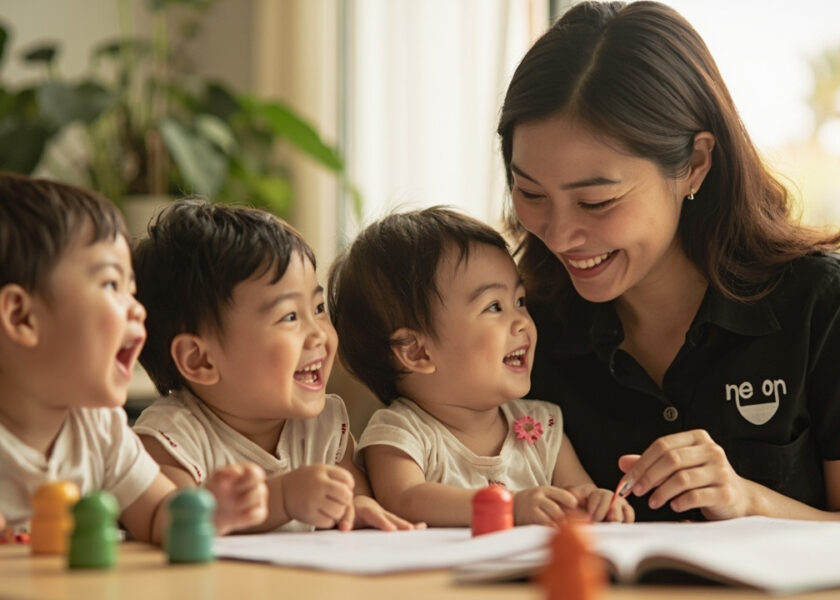
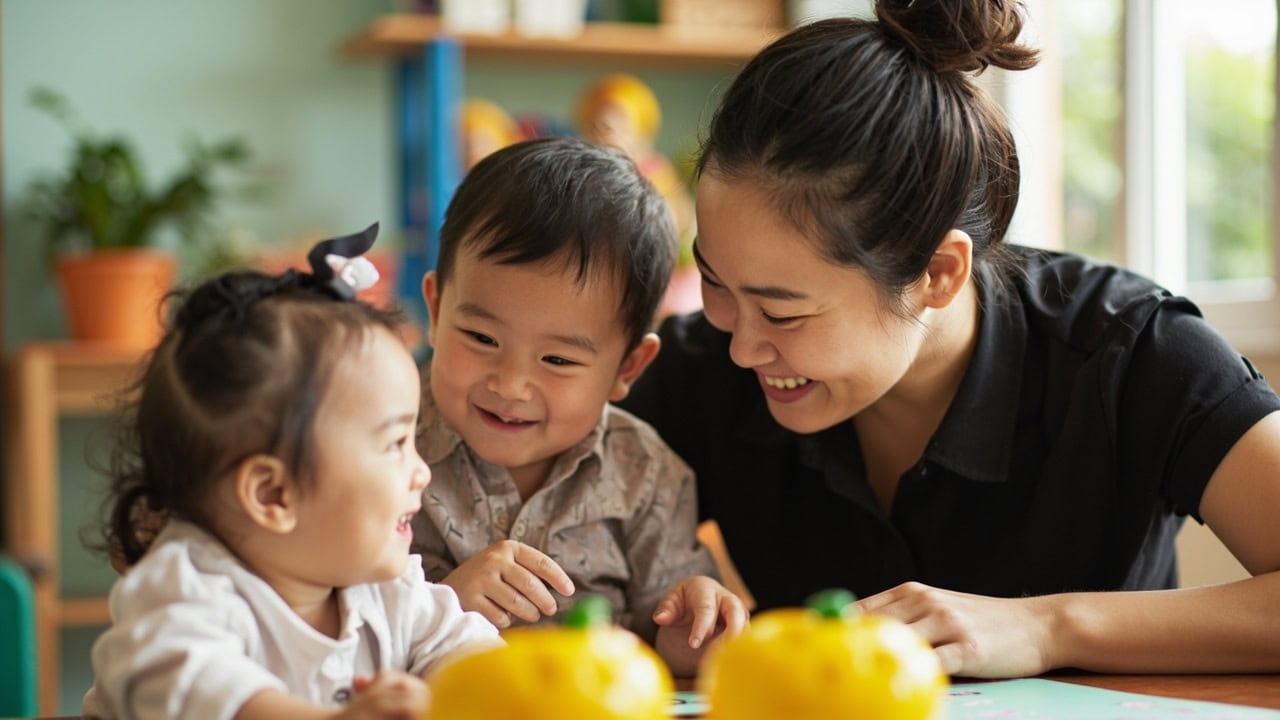
Operating within Singapore’s ECDA Childminding Pilot, EduNanny offers home-based care where ratios make quality possible. With up to one caregiver for three infants, each child can be truly known—not just their schedule and preferences, but their developmental trajectory, their emerging challenges, their individual style of learning and relating.
Each child’s communication, however subtle, is noticed. Each child’s struggle is met with calibrated support. Each child’s curiosity is followed and extended.
EduNanny also offers pathways for families who need centre-based care, recognizing that different families have different constraints. But the commitment to developmental intentionality—to school readiness as a holistic outcome, to the building of executive function and language and social confidence—does not change. It adapts to the setting. It does not dilute.
For families navigating cost, EduNanny’s participation in the Childminding Pilot means care is structured to be accessible. The CDA and Baby Bonus schemes can be applied for eligible families. This is not an afterthought. It reflects a commitment to making quality care available, not just to those who can afford premium pricing, but to families across the income spectrum.
Parents who are not in the same space as their children need more than reassurance. They need visibility. Where deployed, CCTV measures provide transparency. Daily narrative reporting and open communication channels mean parents know—not just what their child ate and slept, but what they explored, what challenged them, what they mastered.
Common Questions Answered
If you are researching childcare in Singapore, you probably have questions. Here are the most common ones.
I want my child to be happy. I don’t want to push them too early.
This concern reflects something important: a genuine understanding that childhood should be protected. But consider what we mean by “happy” in this context.
A child who is chronically bored—who has nothing to explore, no one to talk to meaningfully, no challenges stretched toward—is not truly happy. They are merely unstimulated. The child who is engaged, challenged at the right level, supported through frustration, and celebrated through small victories—that child experiences a deeper, more sustainable happiness.
Quality childcare does not push. It nurtures. It follows the child’s lead while gently extending their reach. This is not academic drilling, and it is not pressure.
Can home-based care really prepare my child as well as a centre?
The answer depends on what you mean by “prepare.” If preparation means exposure to large groups of peers, then a centre may have an advantage. But if preparation means building the foundational capacities that Primary 1 actually requires—attention regulation, language, executive function, social confidence—then a well-designed home-based setting with low ratios often has the edge.
The reason is simple: these capacities are built through responsive, individualized interaction. They are not built in crowds. They are built one child at a time.
How do I know my child is making progress?
You should not have to guess. The caregiver should be able to tell you not just what your child ate and slept, but what they explored, what challenged them, what they mastered, and what they are working toward.
This is the kind of transparency that builds trust and enables genuine partnership between family and caregiver.
What questions should I ask any childcare provider?
When evaluating childcare options in Singapore, these questions matter most for your child’s Primary 1 readiness:
- What is the caregiver-to-child ratio? Lower ratios enable more individualized attention. For infants and toddlers, ratios of 1:2 or 1:3 make sustained shared thinking possible in a way that 1:10 or 1:15 do not.
- What does a typical day look like? Quality care is not just supervised play. Ask how the day balances free play, guided activities, and routine care.
- How is language incorporated into daily care? Language development happens through conversation, narration, and responsive interaction—not just story time.
- How are conflicts and frustrations handled? This is where executive function and social skills are built. Look for caregivers who scaffold conflict resolution and allow productive struggle before stepping in.
- How do you communicate with parents? You should have visibility into your child’s day and developmental progress.
More children does not mean more learning. More toys does not mean more development. More structured curriculum does not mean more school readiness. What matters is quality of interaction, consistency of care, and intentionality.
Choose With Intention
There is something worth pausing on here, because it matters for how we understand what EduNanny is offering and why it is different.
The difference is an understanding—of what children actually need, of what school readiness actually means, of how developmental science translates into daily practice.
It is the understanding that choosing childcare is not choosing a babysitter. It is choosing the environment that will shape your child’s relationship with learning, with authority, with peers, with their own capacity to try and persist and succeed.
Parents in Singapore carry a weight that is often invisible and rarely acknowledged. The weight of knowing that the education system is competitive. That the stakes are real. That the decisions made in early childhood cascade forward in ways that are difficult to reverse.
They are not anxious for nothing. They are anxious because the stakes are high, and they know it.
But anxiety is not the same as clarity.
EduNanny exists to offer clarity—not the clarity of a sales pitch, but the clarity of a framework, a philosophy, and a practice that parents can understand, evaluate, and trust.
The years between now and Primary 1 will pass. This is true regardless of the choices you make. But what those years build inside your child—what capacities they develop, what dispositions they form, what relationship they establish with learning—depends on the quality of the environment you choose.
You can choose childcare based on logistics alone. There is nothing wrong with logistics. They are real, they are constraining, and they deserve to be respected.
But if logistics are the only criterion, you are not choosing. You are settling.
Or you can choose with intention. With clarity. With the understanding that the environment you are selecting will shape your child’s starting point in ways that matter enormously—not just for Primary 1, but for the years beyond.
EduNanny, within Singapore’s ECDA Childminding Pilot, exists for families who want that kind of choice. For families who understand that the early years are not a waiting room. They are a foundation.
And foundations deserve to be built with care.
If this article resonates with you—if you understand that the years before Primary 1 are not just a waiting period, but a building period—we would be glad to help you explore your options.
Visit our website or speak with our team to learn more about what home-based childminding within the ECDA Childminding Pilot could look like for your family. We welcome your questions, and we believe in giving parents the clarity they deserve.
Because your child’s Primary 1 starting point begins today. And it deserves to begin with intention.
Learn more about who we are or explore our approach to childminding within Singapore’s ECDA Childminding Pilot.