The Art of Seeing Your Child Clearly in Singapore’s Parenting Culture
What Quality Childcare Really Means in Singapore
We live in a country where parenting carries enormous weight. The conversation around us is often about preparing children—ready for school, ready for exams, ready for a future we cannot fully imagine. In that context, it is easy to treat childcare as a means to an end. A practical solution while we work. A stepping stone toward something else.
But what if the real measure of quality childcare is not what it prepares your child for, but what it reveals about who your child already is?
Consider what this looks like in practice:
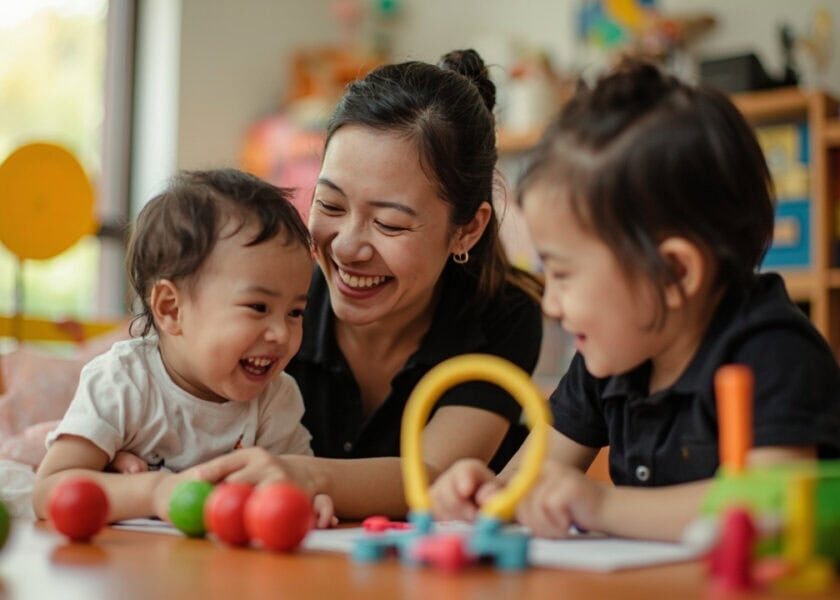
- A caregiver notices your eighteen-month-old gravitating toward water play, spending forty minutes pouring and refilling, her concentration absolute, her face alight with discovery
- She observes your two-year-old narrates everything he sees, building language not through flashcards but through an insatiable need to name and describe his world
- She notes how your infant responds to music, to faces, to the particular rhythm of how she is held
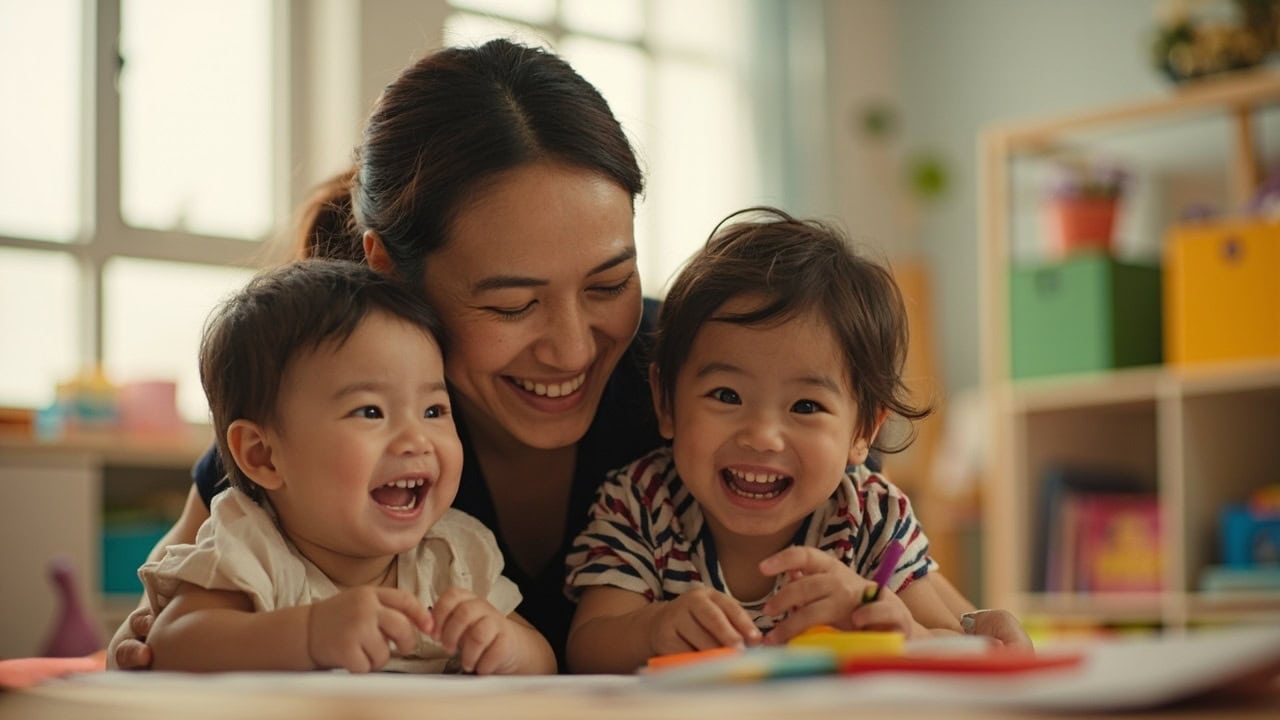
These are not trivial observations. These are signals—the early architecture of who your child is becoming. When a caregiver is trained to notice these patterns, to document them, to reflect on them alongside you as parents, something shifts. The childcare experience stops being a black box. It becomes a window into your child’s development.
The Caregiver’s Eye: What Parents Might Miss
Singapore parents are thoughtful. You read widely. You ask questions. You want your children to grow into curious, confident, capable people—and you already know in your bones that the early years carry weight that is difficult to overstate. You have watched your child learn to walk, learn to speak, learn to feel.
What you may not have considered is what it means to have that development observed and understood by someone outside the family. Not as a replacement for what you know, but as a complement to it. A second set of eyes. A trained perspective.
There are things that caregivers see that parents, in their intimacy and proximity, sometimes miss. Not because parents are not paying attention—but because love can sometimes be too close for clear sight. Because we want so much for our children that we can project onto them what we hope to see.
A caregiver, with gentle professional distance, observes without the same weight of expectation. She notices:
- That your child solves problems by trying again and again, showing a resilience that might not yet have a name
- That your child is more interested in how toys move than in the toys themselves, suggesting a natural curiosity about mechanics and causation
- That your child is consistently calmest when given time to transition between activities, revealing a temperament that thrives on predictability
These observations are not just interesting information. They are actionable insight. When you understand your child’s emerging profile—their strengths, their sensitivities, their particular ways of engaging with the world—you can respond to them more thoughtfully. You can choose books, activities, and interactions that build on who they already are. You can advocate for them more effectively. You can, in the deepest sense, parent them rather than a generic idea of a child.
EduNanny: Built for Genuine Observation
EduNanny was designed to make this kind of knowing possible. Our caregivers are trained within the ECDA Childminding Pilot, a framework that takes the professionalization of childminding seriously. Our ratios are intentionally low—up to one to three for infants, because the youngest children need the most attentive observation.
Parents in our programme receive regular, specific communication about what their child is experiencing, discovering, and becoming. Where CCTV measures are deployed, parents have visibility into daily life. Where documentation practices are in place, parents receive observations that are meaningful and tied to genuine understanding of individual development.
This is not surveillance. It is trust made visible. The assurance that comes from knowing your child is not just safe, but seen.
Support When You Need It
EduNanny also offers Thomas AI—a chatbot that bridges what you observe at home with what is being noticed in care. Raising a child in Singapore today means navigating an enormous amount of information and uncertainty. Thomas helps answer questions, offer guidance, and help parents connect what they see at home with what caregivers observe. It is one more way that EduNanny makes childcare less isolating and more genuinely supportive.
Why This Matters in the Singapore Context
For Singapore parents, quality individual observation matters for reasons beyond the general. Many families here are raising only children. A single child who receives the full weight of parental hope, expectation, and love.
In that context, the temptation can be to over-parent—to fill every moment with enrichment, to measure every experience against standards of future success, to treat the child as a project rather than a person.
Quality individual observation protects against this. When you understand who your child is—really understand, in a way that goes beyond parental intuition—you are less likely to impose on them a shape they do not naturally hold. You can relax into their actual interests rather than forcing interests you believe they should have. You can celebrate their actual temperament rather than wishing they were different. You can let them be who they are, because you can see clearly who that is.
This is not about lowering expectations. It is about aligning them. Understanding your child’s profile does not mean abandoning ambition for their future. It means building that future on the foundation of who they actually are, rather than on a fantasy of who you wish they would become.
Questions to Ask When Choosing Infant Care
If you are researching childcare options in Singapore, look beyond the facility tour and ask specifically about observation and individual recognition.
Find out how caregivers document your child’s emerging interests, strengths, and temperament—not just what they ate and slept. Ask what kind of updates you will receive, and whether those updates will tell you who your child is becoming or simply confirm they were physically present. Enquire about caregiver-to-child ratios, especially for infants, since attentive observation requires time and space.
Understanding your child’s emerging profile is not a luxury. It is the foundation of everything that comes after.
The Radical Act of Letting Your Child Be Who They Are
Raise a child in this city and you will understand the weight of it. A place where opportunity is abundant and competition is real. Where children are offered enrichment from every direction, where weekends are spent ferrying children between activities, where the pressure to optimize can feel relentless.
In that context, what is the most radical thing you can do for your child?
It is this: let them be exactly who they are. See them clearly. Celebrate their actual interests, their actual strengths, their actual temperament. Give them the gift of growing up known.
EduNanny was built around this idea. Not as a slogan or a marketing phrase, but as a philosophy that shapes every interaction, every observation, every conversation between caregiver and parent. The understanding that your child is not a generic small person to be cared for in general terms. Your child is a specific, irreplaceable individual with a unique profile of interests, strengths, temperamental qualities, and ways of making sense of the world.
The first thousand days will pass. The choices you make now will echo across your child’s life—not in the ways brochures promise, not in simple cause and effect, but in subtler registers. Their confidence. Their curiosity. Their sense of self. These are not built through curricula or facilities. They are built through relationships. Through the experience of being known.
You came to this moment carrying hope for your child. The hope that they would be happy, that they would thrive, that they would become whoever they are meant to be. That hope is not naive. It is the most important thing you carry.
Let us help you see them more clearly. Let us notice what you might miss. Let us build, together, an understanding of who your child is and who they are becoming.
This is not just childcare. This is the discovery of your child.
At EduNanny, we believe that every child deserves to be known. Our approach to childminding and childcare is grounded in careful observation, thoughtful care, and genuine partnership with families. If you are looking for a childcare arrangement that sees your child for who they truly are, we would welcome the conversation.