Beyond Supervision: Choosing Childcare That Grows With Your Child
The Gap You Have Probably Noticed
For a long time, the language around childcare has focused on safety, cleanliness, routine, and trust. These are not small things. When you leave your child in someone else’s hands, you need to believe those hands are safe. You need to trust that your child will be fed, rested, and protected from harm. These are the foundations. No responsible parent would settle for less.
But safety and supervision, while necessary, are not sufficient. More and more parents in Singapore are arriving at this same understanding — not because they have read the latest research or attended parenting workshops, but because they have watched their children closely enough to know the difference.
Perhaps you have noticed that your child seems to come home from childcare having been kept, but not challenged. Entertained, but not engaged. The daily reports focus on meals and naps and diaper changes — and while these things matter, something feels incomplete. There is no sense of trajectory. No feeling that each day is building on the last.
These parents are not being difficult or demanding. They are being perceptive.
They have recognized a truth that developmental science has long understood: the early years are not simply a period of waiting until children are old enough to learn. The early years are learning. Every interaction, every response to a child’s curiosity, every moment of guided play is shaping the architecture of a human being.
So the question is not simply who will watch your child. The question is: who will grow with your child?
What Developmental Support Actually Means
Let us be clear about what we mean when we talk about developmental support, because this is where confusion often begins.
Developmental support is not a curriculum. It is not a checklist of activities or a schedule of lessons. It is not the opposite of warmth or spontaneity.
Developmental support is a way of being with your child.
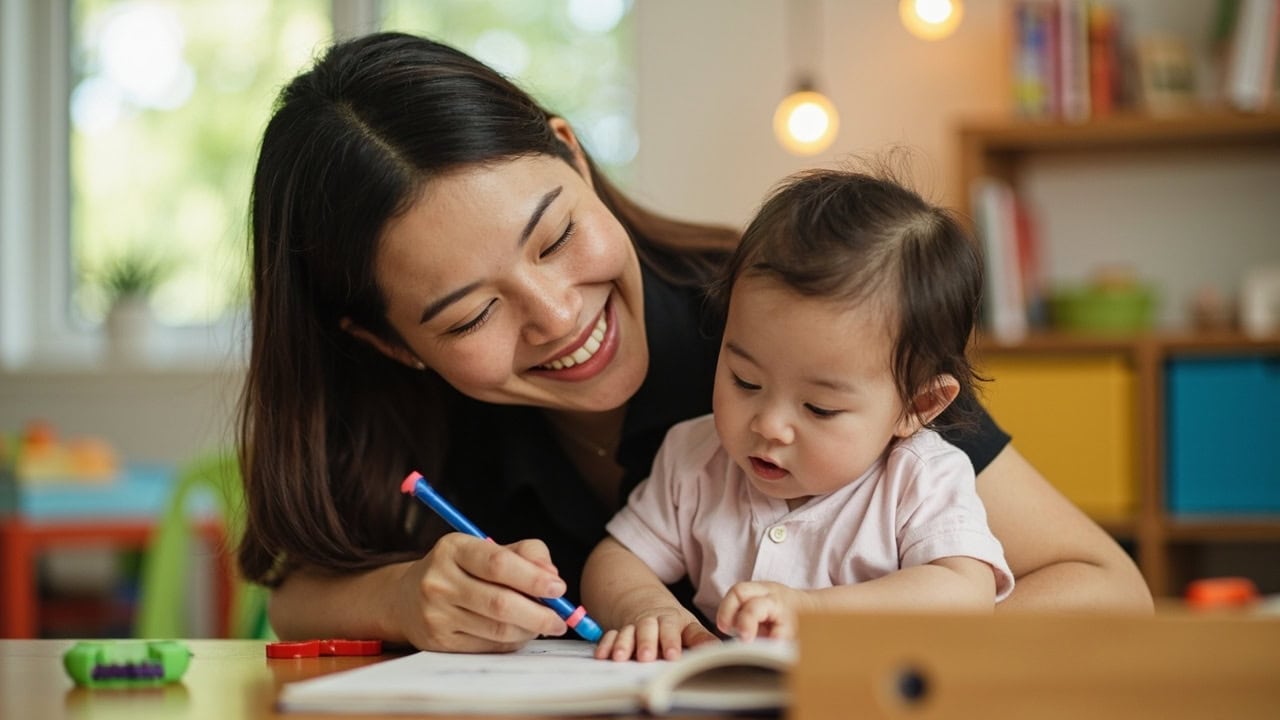
It is the caregiver who notices when a thirteen-month-old is working hard to stack blocks and responds not by doing it for her, but by sitting beside her and asking a question that extends her thinking. It is the childminder who recognizes that a child’s frustration with a shape-sorter is not a problem to be eliminated but an opportunity to be present for — to encourage persistence, to celebrate the small breakthrough when it comes.
It is the difference between a caregiver who fills the day and a caregiver who fills the day with intention.
What It Looks Like in Real Life
- Talking to infants as though their attempts at communication matter. Every coo, every gesture, every babbled syllable is your child reaching out — and responsive caregiving reaches back.
- Reading the signals that a child is ready for something new. Whether that is a more complex toy, a new physical challenge, or a longer stretch of independent play — developmental caregivers notice readiness and respond to it.
- Understanding that social development happens when children are given the chance to be together. Emotional regulation is learned through relationships, not through rules.
- Recognizing that every routine moment is a thread in the fabric of development. Transitions, meals, nap time — these are not gaps between activities. They are opportunities.
This is not about being perfect. It is about being present. It is about understanding that the people who hold those threads need to know what they are weaving.
How to Know If Your Child Is Getting Developmental Support
One of the most important things we can offer you is not just a description of what developmental care looks like, but a framework for recognizing it. Because the truth is, you will not always be in the room. You will not always see what happens in the hours between breakfast and bedtime.
What you need are indicators — observable markers — that tell you whether the care your child is receiving is truly developmental in its approach.
Four Questions to Ask Yourself
- Does your child’s caregiver understand her as an individual?
Do they know her rhythms, her preferences, her emerging interests? Do they speak about her as a person with her own personality, not just a charge to be managed? - Is there evidence of responsiveness?
When your child expresses a need or an interest, does anyone respond in a way that acknowledges it — not just physically, but cognitively? When your toddler points at a butterfly and the caregiver says, “Yes, that’s a butterfly, do you see how its wings are moving?” — that is responsiveness. That is an adult recognizing a learning moment and expanding it. - Do you receive meaningful communication about your child’s day?
Not just that she ate well and slept well, but: did you notice she was really interested in the water table today? She spent twenty minutes pouring and watching. She tried to pour from a small cup to a smaller cup and seemed frustrated when it spilled, but she kept trying. This kind of communication tells you that someone is paying attention. That someone is observing your child with care and thought. - Does your child seem to be progressing, not just being maintained?
There is a difference between a child who is safe and comfortable and a child who is safe and comfortable and also growing. Over weeks and months, you should feel that your child is developing new capabilities, new ways of relating, new skills. If your child seems exactly the same at six months as she did at three months, something may be missing.
These are not absolute criteria. They are guideposts — questions you can carry with you as you evaluate the care your child receives. You deserve to know what is happening in those important hours. You deserve to have language for what you are looking for.
What This Means for Singapore Parents
For many families in Singapore, this conversation raises a practical question: if developmental support is what you want for your child, how do you access it? Where do you find it? And how do you afford it?
Singapore is experiencing a quiet but meaningful shift in how infant and toddler care is understood and delivered. The Early Childhood Development Agency (ECDA) Childminding Pilot reflects a growing recognition that childminding is not merely a backup option — it is a legitimate, high-quality pathway for caring for young children.
This matters for parents because it opens up options that were previously harder to access. Childminding under this framework often operates with small caregiver-to-child ratios — sometimes as favorable as one caregiver to one or two children. That is a fundamentally different experience from centre-based care where ratios are necessarily higher.
What Developmental Childminding Offers
- Small ratios mean more attention. When a caregiver is responsible for fewer children, each child receives more responsive, individualized support throughout the day.
- Home-based environments offer warmth and familiarity. Children can feel secure in a setting that feels less institutional and more like a second home — while still benefiting from structured developmental engagement.
- Centre-based options remain available for families who prefer them. Developmental care should not be limited by geography or personal preference.
Addressing Your Real Concerns
We know these are not abstract questions for you. They are urgent, practical, and deeply personal.
On Affordability
Singapore families work hard. The cost of quality care should not be a barrier to quality care.
Families working with EduNanny Singapore — part of the trusted BUTLER family — can access pilot fee structures designed with accessibility in mind. The team also helps families navigate the use of CDA funds and Baby Bonus where applicable. These are not afterthoughts. They are part of a genuine commitment to making developmental care a real option for the families who need it.
On Transparency and Trust
Leaving your child in someone else’s care requires a level of trust that cannot be taken lightly. You want to know what is happening in those hours. You deserve to know.
Where deployed, CCTV measures give parents peace of mind and the ability to see, if they wish, what their child’s day looks like. But more than surveillance, active communication matters. Daily updates that go beyond the basics. Regular conversations about your child’s progress. Partnership in the truest sense: caregivers are not caring for your child in isolation. They are caring for your child alongside you.
On the Weight of the Decision
It is not easy to entrust your child to someone else. The weight of that decision does not lift entirely with age. Even as your child grows, even as they become more resilient and communicative, you will always carry the awareness that the hours they spend away from you matter.
You want those hours to matter in the right way. You want your child to be growing, not just passing time.
That feeling — that quiet, perceptive sense that something more is possible — is not anxiety. It is insight. And it is leading you toward a better choice for your child.
The Choice That Changes Everything
Choosing childcare is often framed as a logistical decision. Who is available? Who is affordable? Who has the right hours? These things matter, of course.
But beneath the logistics is something larger. It is a statement about what you believe your child is capable of. It is a statement about what you believe childhood is for.
If you choose care that simply supervises, you are sending a message — to yourself and to others — that your child’s early years are a waiting room. A place to be kept until the real learning begins.
If you choose care that actively supports development, you are saying something different. You are saying: my child is learning right now. My child is becoming right now. And the people who spend their days with her should understand that, and honor it, and grow with her.
The first thousand days. The first three years. The years before formal school begins. These are not preparation for the real world. They are the real world.
For your child, this is not a rehearsal. It is the only version of childhood she will ever have. She deserves a childhood that is witnessed. That is supported. That is grown.
Ready to Take the Next Step?
You have already taken the first step by asking the right question. You have recognized that your child deserves more than supervision. You have started looking for language to describe what you sense is possible.
The next step is finding care that matches that understanding — caregivers who see your child as an individual, who respond to her curiosity, who keep the thread of her development in mind throughout every single day.
EduNanny Singapore exists because we believe that Singapore parents deserve partners in their child’s development. We believe that every infant and toddler deserves to be seen, heard, and supported in becoming who they are meant to be.
If this is what you are looking for, we invite you to start a conversation with us. Discover what it means to choose care that truly grows with your child.
Because your child’s early years are not a waiting room. They are the foundation of everything she will become. And she deserves to spend them with people who understand that.
In Summary
- Basic childcare supervision keeps children safe and comfortable — but safety alone is not enough for your child’s development
- Intentional developmental support means caregivers actively contribute to your child’s growth, not just supervise her
- You can recognize developmental care through observable signs: individualized attention, responsive interactions, meaningful updates, and visible progress over time
- Singapore parents have more options than ever, including childminding arrangements that offer small ratios and genuine developmental engagement
- Choosing care that grows with your child is one of the most consequential decisions you will make — and you are already asking the right question
At EduNanny Singapore, we are committed to raising the standard of infant and toddler care in Singapore. Learn more about our ECDA-approved childminding approach or read about our team. You can also visit edunanny.com to explore how we support families across Singapore.