What Your Baby’s Brain Learns When Someone Truly Pays Attention
Quick Summary: What Your Child Experiences at EduNanny
For parents who are short on time but need reassurance, here is what quality infant care at EduNanny actually looks like:
- Arrival that honours emotion: Your child is met with unhurried attention, not rushed transition. A caregiver kneels at their level, waits, and lets them survey the room before any contact.
- An environment built for agency: Low shelves, real objects, materials that behave predictably. Your child can reach, explore, and discover without constant adult mediation.
- Meaningful engagement over entertainment: The programme protects unhurried time for sustained, self-directed play — the work of early childhood that builds deep neural architecture.
- Social learning through real interaction: Peer conflicts are held with respect, giving children the chance to develop empathy and negotiation skills.
- A caregiver as a secure base: Consistent, warm relationships that extend the security your child feels with you — not a replacement, but an extension.
- Transparent communication: Where deployed, parents have real windows into their child’s day, closing the information gap that feeds anxiety.
Keep reading to understand why each of these elements matters — and how they shape your child in ways that last far beyond the childcare years.
The Arrival: Building Trust in the First Moments
You have just left. The room is new, or perhaps familiar now, but still full of its own textures — the particular way the light falls through the windows at this hour, the low hum of other children settling in, the smell of clean wood and something baking, perhaps.
For a moment, your child feels the full weight of your absence. This is real. This matters. We do not minimise it by saying they will be fine. They feel it, and we honour that feeling.
But then something happens.
A voice — warm, unhurried — says their name. Not from across the room, but near. Close enough to be a real voice and not an echo of your own imagination.
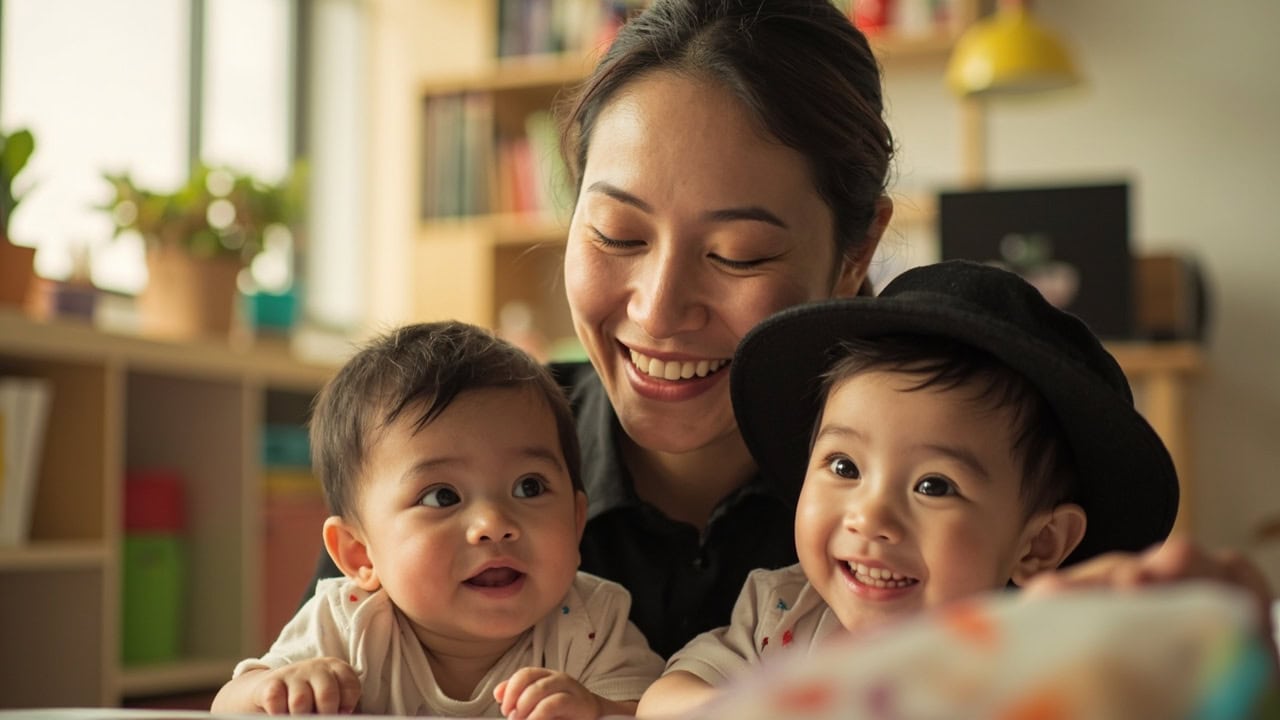
The person kneeling down to your child’s level does not reach for them immediately. They wait. They let your child look. They let the space be surveyed, the face be assessed, the silence be felt before any action is taken.
In those first few seconds, your child is reading the room. They are asking: Is this place safe? Do the people here understand how I feel? Can I trust what happens next?
And the answer that comes back, in posture and voice and unhurried attention, is yes. Not because anyone said the word. But because your child felt it, in the way the morning was held for them.
Your child is not just being minded here. Your child is being seen.
The Environment: How Space and Materials Support Your Child
Let us walk through what this place actually looks like — through your child’s eyes, at their height, in their body.
The space is not loud. It does not overwhelm. There is colour, but it is the colour of a forest after rain — moss and stone and the pale green of new leaves.
The shelves are low, open, and they hold things your child can reach. Not toys that need to be fetched from a high shelf by an adult. Not choices mediated by permission every few minutes.
Real things.
Wooden blocks with a weight that can be felt in the hands. Cloth animals soft enough to be pressed against a cheek. Stacking rings in primary colours that do not require a screen or a battery or an instruction manual.
A child who can reach what they want to explore is a child who is learning agency. A child who encounters objects that behave in predictable, honest ways — blocks that fall when stacked too high, water that spills when poured too fast — is a child who is building a relationship with reality itself.
They are not being entertained. They are being trusted.
And trust, as it turns out, is the soil in which intelligence grows.
The materials are chosen for what they invite rather than what they impress. The space is arranged so that your child can move through it with their whole body — crawling, climbing, carrying, building — because development is not a seated activity. It happens in motion. In mess. In the satisfying frustration of trying again.
The Rhythm of the Morning: Why Unhurried Time Matters
Your child has settled in. The room has become a known world. And now the day begins its rhythm.
There is a moment — you may have seen it described in parenting research, but nothing prepares you for witnessing it — when a young child becomes completely absorbed in something. Not a screen. Not a reward. Something they chose, discovered, and are now following with a focus that looks almost like meditation.
Perhaps it is the way sand feels when it shifts through fingers. Perhaps it is the sound a wooden spoon makes against a metal bowl. Perhaps it is the way another child has stacked blocks in a pattern that seems random but is, to them, the most important structure in the world.
This is not idle time. This is the work of early childhood.
Psychologists call it sustained, self-directed engagement. Neuroscientists call it the state in which the brain is building its deepest architecture. At EduNanny, we simply call it what it is: the moment your child is becoming who they are.
And it happens not in structured lessons, but in the unhurried minutes between planned activities — in the space that many childcare settings rush to fill, but that EduNanny protects fiercely.
There will be group time. There will be songs, and stories, and the particular delight of singing a familiar rhyme and seeing a toddler’s face light up with recognition. There will be sensory play — water, sand, textured fabrics — because young children learn through their senses before they learn through abstraction.
But there will also be stillness. Because a child who never has quiet is a child who never learns to be with themselves. And a child who cannot be with themselves will struggle to be with others.
The Social World: Where Empathy Begins
Your child, even as an infant, is not a solitary creature in a childcare setting. They are watching. They are noticing. They are beginning to understand that other children exist — that these small humans have faces and voices and their own feelings that may or may not align with yours.
This is the beginning of empathy. This is the first page of social intelligence.
And the way EduNanny holds this social world matters enormously.
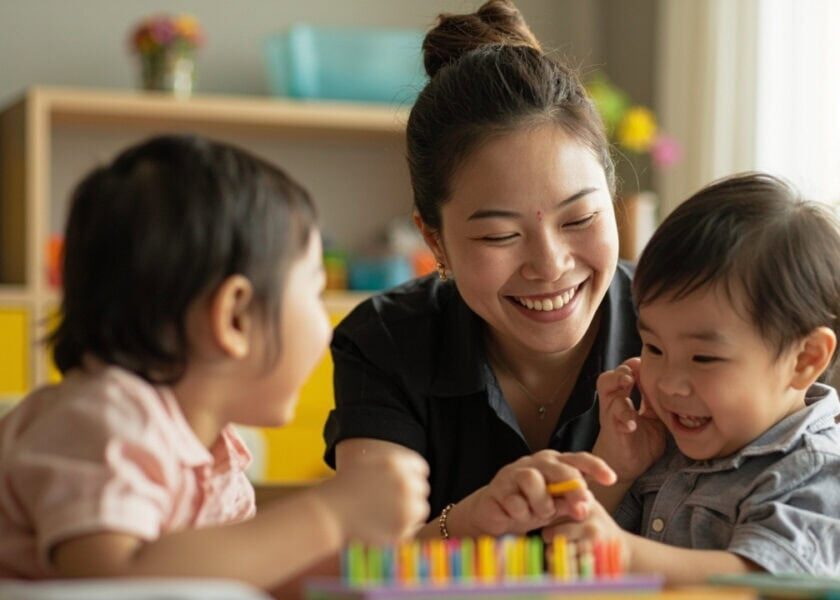
When two toddlers reach for the same toy, a caregiver does not rush in with a quick fix — a second toy, a distracted redirection. Instead, the caregiver sits near. They name what they see.
“You both want the truck. That is a big wanting.”
They wait. They give the children the chance to navigate something small, to discover what negotiation feels like in their bodies, to learn that other people’s desires are real and not just obstacles.
And if the moment needs intervention, it comes with gentleness and clarity, not shame.
Children raised in environments where conflict is managed with respect rather than suppression grow up knowing something essential: that their needs matter and other people’s needs matter too. That conflict is not dangerous. That adults can be fair. That they have a voice, even when they are small.
This is not idealism. This is the documented outcome of quality early care. And it happens not in grand lessons, but in a hundred tiny moments across a thousand ordinary mornings.
The Secure Base: What Quality Care Provides Through Every Moment
Let us be honest about something, because this conversation deserves honesty.
There are hard moments. There are mornings when a child does not want to be left. There are tears — real tears, from real children who genuinely miss their parents and do not yet have the words for it.
No amount of quality care erases the fact that separation is hard for young children, because it should be. Attachment is supposed to be powerful. The fact that your child misses you is not evidence of failure. It is evidence that the bond between you is doing exactly what it should.
What quality care provides in those moments is not the absence of tears. It is the presence of someone who holds your child the way you would — with patience, with warmth, with the specific tenderness that communicates, even to a distressed toddler, that they are safe and they are loved and this feeling will pass.
The caregiver is not a replacement for you. No one can replace you.
But the caregiver can be what developmental research calls a secure base — a person from whom your child can explore the world with confidence, knowing that there will be someone who will catch them if they fall.
And when that caregiver relationship is consistent, warm, and attuned, your child builds something extraordinary: the internal working model of security that will shape how they form relationships for the rest of their lives.
This is not a small claim. This is decades of research in developmental psychology, from John Bowlby to Mary Ainsworth to contemporary attachment scientists, all pointing to the same truth: the relationships children have in their early years literally wire their brains for how they will experience connection, trust, and emotional regulation as adults.
You are not just dropping off your child for care. You are giving them a relational experience that will echo across their lifetime. This is why it matters so much. This is why it is worth getting right.
What Quality Ratio Means for Your Child
| Caregiver Ratio | What Your Child Experiences |
|---|---|
| 1:3 (EduNanny infant programme) | Immediate, attuned response to needs. Tears are met within seconds. Exploration is supported closely. Your child is known as an individual. |
| 1:8 or higher | Longer waits during distress. Less individual attention. Your child learns to wait, to manage alone, to adapt to a pace set by group needs. |
The Structure: How EduNanny Works Within Singapore’s ECDA Framework
You might wonder: is this really happening every day? Is this the kind of attention that my child receives when I am at work, in meetings, caught in the particular intensity of Singapore’s pace?
Here is where clarity matters, because clarity is part of what builds trust.
EduNanny operates within Singapore’s ECDA Childminder Pilot, which means it is not operating in a vacuum of good intentions. It is operating within a structured, quality-assured framework designed to ensure that ratios are meaningful, that caregivers are trained, and that the care your child receives can be measured, observed, and trusted.
In the infant programme, the ratio of caregiver to child is up to one to three. That is not a marketing number. That is a promise held in practice — the difference between a caregiver who can respond to your child within seconds and one who is managing eight or ten at once.
We know that the anxiety parents feel after drop-off is not just emotional. It is rooted in a genuine information gap. When you cannot see what is happening, your imagination fills the void — and imagination, when it is anxious, is rarely kind.
EduNanny addresses this not with promises but with practice. Where deployed, transparency measures including communication protocols and CCTV access give parents a real window into their child’s day.
Not to surveil. But to reassure.
Because when you can see what is happening — the songs and the play and the quiet moments and the caregiver kneeling down at your child’s level — you can rest.
What Your Child Brings Home: The Reunion and Beyond
Somewhere around mid-afternoon, your child begins to change. The play grows quieter. There is more looking toward the door. There is a particular alertness in the posture, a listening quality.
Your child knows you are coming. Not because they have been told, necessarily, but because children are extraordinary readers of rhythm, and yours has been consistent. The door opens at the same time every day. The face on the other side is the same beloved face.
And every single reunion — every hug after hours of separation — is reinforcing the most important lesson a child can learn: that people who love each other can be apart, and still come back.
This is the child who comes home to you.
Not diminished. Not damaged. Not somehow less for having spent the day without you.
Whole. Curious. Quietly enriched by a morning of discovery and connection.
The child who runs toward you is not a child who has forgotten you. They are a child who trusts you so completely that they could spend a day in a world without you, and still choose that world, and still come home to it willingly, because they know — in their body, in their nervous system, in the deep architecture of their developing brain — that they are loved and they are safe.
That is what quality care produces. Not a child who tolerates childcare. A child who thrives in it, and comes home better equipped to thrive in everything else.
Next Steps: Visiting EduNanny
If you are reading this while comparing childcare options, let us acknowledge something: the decision you are making matters enormously, and it is right to take it seriously.
You are not looking for perfect. There is no perfect. You are looking for good enough — and more than good enough. You are looking for a place where your child will be safe, seen, and supported. A place where someone will kneel down at their level. A place where your child will learn that the world can be trusted, and that other people can be relied upon, because that is what they have experienced in the unhurried hours with a caregiver who took the time to notice them.
Schedule a visit to see EduNanny’s infant care environment for yourself.
- Operating hours: Monday to Friday, aligned with the working week that most Singapore families are navigating
- Fee structures: Designed to be accessible, so quality care is not a privilege reserved for the wealthy but a genuine option for families across income levels
- Government support: The Child Development Account and Baby Bonus schemes are usable within the programme
Watch how the morning unfolds. Meet the caregivers who will know your child by name. Ask every question you have been carrying in the quiet moments after drop-off.
There is also Thomas — a question-answering companion designed to help parents navigate everything from developmental milestones to daily care questions, from understanding what you are seeing at home to finding the right approach for a particular stage of your child’s growth. Thomas is not a replacement for human guidance. But it is an always-available resource for those moments — and there are so many of them — when a parent needs a quick, informed, compassionate answer in the middle of a Tuesday evening, and does not know where else to turn.
You deserve to know. And your child deserves for you to know.
EduNanny is honoured to be part of your family’s story. We are honoured to hold your child’s world — not as a service provider, but as partners in the most important work any of us will ever do: raising a human being who is curious, capable, connected, and whole.
Welcome. We have been waiting for you.