Mastering the Art of Observation to Understand Your Child
Quick Summary: Observation as Your Parent Superpower
Before we dive deeper, here is what matters most:
- Observation is a language. Like any language, it has grammar and vocabulary—and you can learn both.
- There are three levels to it. Reading obvious emotions, noticing patterns over time, and catching the subtle cues that most people miss.
- Your childminder is your observation partner. Not a replacement for your intuition, but a complement to it.
- Singapore’s childcare ratios matter. Smaller ratios mean deeper observation, which means your child is truly seen, not just supervised.
- You are already doing this. Every time you wonder about your child’s day, you are practicing the foundations of observation.
Keep reading for the full guide to understanding your child through the art of observation—and how the right childminding partnership can help.
The Reframe That Changes Everything
Let us begin with a distinction that sounds simple but carries enormous weight: observation is not watching.
Watching is passive. It is what we do while our minds are elsewhere—while we scroll through our phones, while we think about dinner or the meeting tomorrow. Watching notices what is obvious. Watching misses everything beneath the surface.
Observation, on the other hand, is an act of intention. It is the disciplined practice of seeing—of noticing not just what your child does, but how, and when, and what changes from one day to the next.
Consider these examples:
- Observation is the difference between knowing your child is tired and understanding that her fatigue follows a specific pattern on days she has had less physical movement.
- Observation is noticing that your toddler’s frustration at being told “no” is not about the word itself but about something deeper—a growing awareness of independence he is not yet able to articulate.
- Observation is watching your baby’s face after a feeding and recognizing the subtle shift from hunger to contentment to fatigue—a sequence that, once noticed, helps you anticipate needs before they become cries.
In child development, this distinction matters enormously. A child who is merely watched may be kept safe. But a child who is truly observed is understood. And a child who is understood is given something invaluable: the experience of mattering, of being known, of being seen not just as a small person requiring care but as a whole human being with internal states worth recognizing.
Why This Feels Countercultural
Here is what most parents discover when they begin to develop their observation skills: it feels unnatural at first. You have to slow down. You have to resist the urge to fix, to intervene, to immediately soothe. You have to learn to hold a question instead of rushing toward an answer.
In a culture that prizes productivity and efficiency, this kind of patience can feel almost countercultural. Singapore parents, in particular, are often juggling demanding careers, long commutes, and the pressure to optimize every aspect of their children’s development. The idea of simply watching—without an agenda, without an app to log the data—can feel indulgent, even wasteful.
But it is in this slowing down that the real work begins. It is where you stop managing your child’s behavior and start understanding it. It is where parenting shifts from reaction to response, from guesswork to genuine insight.
The Three Levels of Observation
The language of observation has its own grammar, and like any language, it develops in stages. Understanding these stages helps you see where you already are—and where you can grow.
Level 1: Reading Obvious Emotional Signals
This is where most parents begin and, often, where they stop. Your child cries, and you respond. Your child laughs, and you delight. Your child has a tantrum, and you manage it.
These responses are important—they are the foundation of secure attachment. But they represent only the most surface layer of what your child is communicating.
- Responding when your baby cries
- Noticing when your toddler is happy
- Managing tantrums when they happen
Level 2: Noticing Behavioral Patterns Over Time
This requires a different kind of attention. Instead of reacting to what is happening in the moment, you begin to track: What is the rhythm of my child’s day? When does she seem most regulated? When does he seem most dysregulated? What has changed in the past week, the past month?
- Noticing that your child sleeps well after outdoor play but poorly after screen time
- Recognizing that morning drop-offs are harder on certain days of the week
- Seeing that your child’s appetite changes before a growth spurt
- Observing that a child who was eager to go to school and now resists may be navigating a social challenge
These patterns are data. They are your child’s way of telling you something about their development, their comfort, their needs.
Level 3: Understanding Subtle Developmental Cues
This is where trained observation becomes transformative. The cues most people miss become visible to you:
- The way a baby’s eyes track a face before they smile—a sign of social awareness developing
- The particular quality of a toddler’s play that signals cognitive leaps
- The micro-expressions that flicker across your child’s face in the seconds before an emotional storm
- The body language that distinguishes genuine fatigue from boredom from overwhelm
- The shift in a toddler’s play from parallel—playing beside others—to cooperative—playing with others
These cues are not mysterious. They are learnable. And once you learn to see them, you cannot unsee them. They become the vocabulary of a new kind of relationship with your child—one built on genuine understanding rather than guesswork.
What is powerful about this three-level framework is that it meets you where you are. You do not need to master all three levels before you begin. You simply need to begin. And you do not need to master them alone.
Your Childminder as Observation Partner
Think about what happens in the best childminding relationships. You bring your child to someone who is trained not just to care for them but to observe them. Someone who knows what developmental milestones look like, who has seen hundreds of children at this age and stage, who can distinguish between typical behavior and the signals that might warrant attention.
That person spends your child’s days in close, consistent observation. They notice what you cannot notice in the hours you are apart. They develop a relationship with your child’s rhythms, your child’s patterns, your child’s particular way of being in the world.
And then, something remarkable becomes possible: a partnership in understanding.
What This Partnership Looks Like
When your childminder shares observations with you—not in clinical reports, but in genuine conversation—you gain access to insights that deepen your own capacity to read your child:
- You learn what your child is like in your absence—how she navigates separation, how he plays with other children
- You learn what soothes her when she is upset, what excites him most, what makes her laugh
- You learn about the patterns that only emerge over time—patterns that reveal your child’s unique temperament and needs
This is not about judgment. It is not about surveillance. It is about giving you a more complete picture of the child you love.
The Two Kinds of Expertise
You are the expert on your child. No one else has the history, the intimacy, the decades of context that you bring to this relationship.
A trained childminder can tell you what she observes during the day. She can tell you patterns, milestones, behaviors. But you are the one who knows what your child’s cry sounds like when it means hunger versus loneliness versus genuine pain. You are the one who has watched your child from the very beginning, who knows the texture of their skin and the rhythm of their breath and the particular way they look at you when they are seeking reassurance.
What professional observation adds is not expertise over yours. It is expertise alongside yours. It fills the gaps that proximity creates. It offers a perspective that is trained, objective, and consistent. And when these two kinds of knowing come together—the parent’s intimate intuition and the caregiver’s professional observation—something powerful happens.
You become, together, the most complete interpreters of your child.
Why Ratios Matter
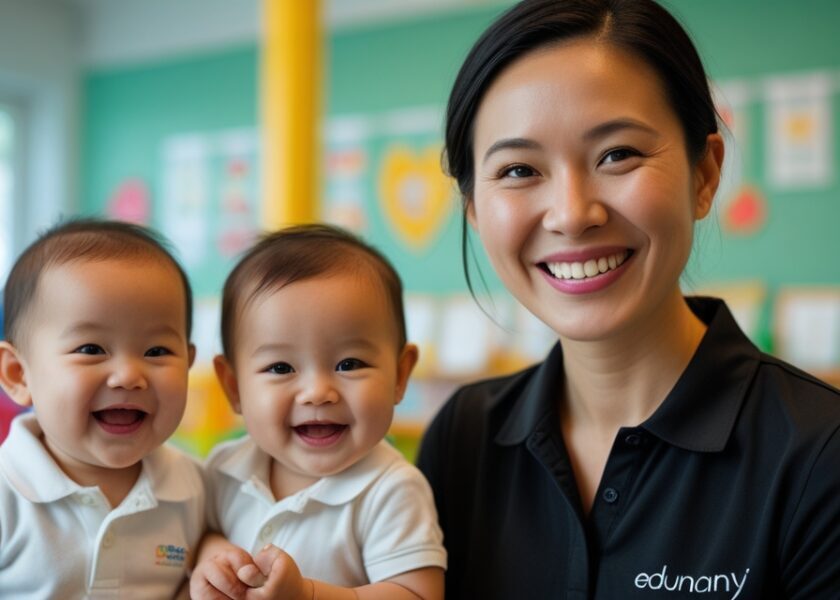
At EduNanny, we maintain ratios of up to one to three infants in our care. This is not a bureaucratic requirement—it is a deliberate choice. Here is why it matters:
- Individual attention: Every child receives the kind of focus that makes deep observation possible.
- Genuine seeing: Our caregivers are not merely supervising; they are genuinely observing.
- Known, not numbered: Your child is not one of many; they are one, known, attended to.
- Pattern recognition: Smaller groups make it possible to notice the subtle shifts that signal development, discomfort, or delight.
What Trained Observation Looks Like in Practice
When a childminder is trained in observation, daily life looks different. Instead of simply keeping children safe and fed, she is:
- Noticing that your baby’s root reflex is changing as she approaches four months—a sign that feeding rhythms may need to evolve
- Observing that your toddler’s frustration with block towers follows a pattern: more frequent when she is hungry, less frequent after physical play
- Catching the moment your child’s parallel play shifts to show signs of interactive play—a developmental milestone
- Documenting not just what happened, but the context around it: the circumstances, the patterns, the small signs that tell a bigger story
And then, crucially, she shares this with you in language that helps you understand—not just as data, but as insight you can use.
Addressing Common Concerns
We know that choosing childcare in Singapore is not a simple decision. It comes with real anxieties, real trade-offs, and real questions. Let us address some of the most common concerns honestly.
“I Feel Guilty About the Hours Apart”
This guilt is real, and it is worth honoring. But here is what we want you to know: the hours apart are not a failure. They are a reality of modern Singapore parenthood.
What matters is not whether you are apart from your child, but what happens during that time—how your child is seen, how they are understood, how their development is nurtured. Quality childminding does not replace your role. It extends it. It ensures that the hours you cannot be present are hours of meaningful observation, not just babysitting.
“How Will I Know What Happened During the Day?”
This is exactly the question good observation answers. When your childminder is trained to observe, she can tell you not just that your child had a good day, but what made it good. She can share patterns you can watch for at home. She can tell you about the moments that mattered—the first time your baby tracked a moving object across the room, the way your toddler navigated sharing a toy, the play that signaled a cognitive leap.
The goal is not to know every second of your child’s day. It is to understand the shape of it—the rhythms, the highlights, the areas of growth and challenge.
“What If My Childminder Doesn’t Notice Something Important?”
This is why training and ratios matter. A childminder who is trained in developmental observation knows what typical development looks like at each stage—and more importantly, she knows what atypical looks like. She can catch the signals that might warrant attention: a regression in skills, a withdrawal from interaction, a persistent distress that has no obvious cause.
This does not mean she replaces your pediatrician or your parental intuition. But it does mean your child has an additional layer of watchful care—people who are trained to see what might otherwise be missed.
“Can I Really Learn to Observe Better?”
Yes. Absolutely. And here is the truth: you are already doing it. Every time you wonder what your child felt today, you are practicing the foundations of observation. Every time you study your child’s face after school pick-up, you are training your capacity to see. Every time you ask your childminder a question about your child’s day, you are participating in the observation partnership that makes everything else possible.
The skill was always there. You simply needed a framework to develop it and a partner to grow alongside it.
Five Observation Techniques to Start Today
You do not need to wait for the perfect childcare arrangement to start developing your observation skills. Here are practical techniques you can begin using immediately:
- The Five-Minute Observation: Once a day, choose a moment to simply watch your child for five minutes without intervening. No phone, no multitasking, no agenda. Just be present and notice. What are they doing? How are they doing it? What expressions cross their face? What sounds do they make?
- The Pattern Journal: Keep a simple record—not a detailed log, just a few notes—about your child’s patterns. When do they seem most regulated? When do they seem dysregulated? What seems to help? Over weeks and months, patterns will emerge that give you insight into your child’s needs.
- The Evening Check-In: When your child is asleep or settled for the night, take a moment to reflect: What stood out about today? What moments felt significant? What questions do I have? This practice trains your mind to notice and to hold questions rather than rushing to answers.
- The Observation Question: When you pick up your child from their caregiver, ask one specific question: “What was the highlight of her day?” or “Did you notice anything interesting about how he played today?” The answers will teach you what to look for—and what matters.
- The Pause Before Response: When your child expresses a strong emotion, pause before responding. Count to five. Notice what is happening in your child’s face, body, and voice before you act. This pause builds your capacity to observe before you react—and models emotional regulation for your child.
The Invitation
Here is what we know to be true. Your child is communicating with you right now. They always have been. Before words, they communicated through cries and coos and the way their small bodies relaxed in your arms. As words emerge, they communicate through the stories they tell you, the questions they ask, the way they move through the world.
Your child is not a mystery waiting to be solved. Your child is a person waiting to be known.
And you—the parent who has been paying attention all along, who has been wondering and worrying and loving with fierce intensity—you are the first and best observer your child has.
You already see more than you realize. You simply need permission to trust that seeing.
At EduNanny, our caregivers are trained in these observation skills as part of the ECDA Childminding Pilot. They do not simply watch your child. They see your child. They document your child’s development with intention. They communicate with you transparently about what they observe. And they invite you into that process as the most important observer your child has.
We are here to be your partner in observation—your bridge between intuition and insight, your support in the beautiful, challenging work of raising a child in this city you love.
We know the pressures you face. We know the hours you work, the compromises you make, the guilt you carry when you should not carry it. We know you want the best for your child. And we know that the best is not about perfection—it is about presence. It is about showing up, again and again, with whatever attention you can bring, and trusting that it matters.
Your child is watching you. Your child is learning from you. And one day, not far from now, your child will look at you and say the words that every parent waits to hear:
You know me. You really know me.
That day is not a destination. It is a direction. And every day you spend learning to observe—learning to slow down, to notice, to ask, to listen—is a day spent walking toward it.
We would be honored to walk part of that road with you.
EduNanny is a development-focused childminding service for families in Singapore. Learn more about our approach or get in touch to discuss what a genuine observation partnership could look like for your family.