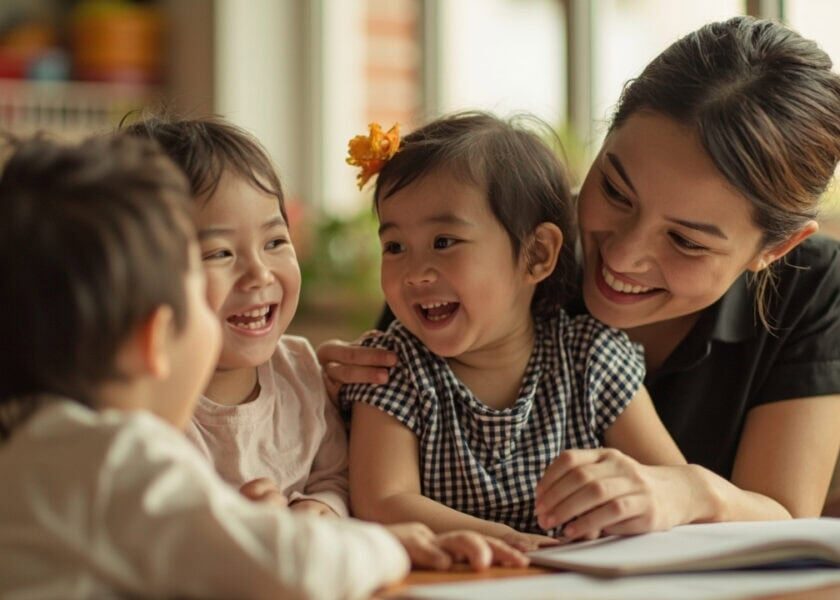
Beyond Either Or: Building Your Family Village in Singapore
The Core Tension Singapore Parents Carry
Singapore has one of the highest rates of multigenerational childcare arrangements in the world. In many households, grandparents have been the primary caregivers for toddlers and infants while parents returned to work—often before the children could form complete sentences.
The sacrifice this entails is immense and often unspoken. Grandparents who postpone their own plans. Who accept physical strain they would rather not discuss. Who immerse themselves in the chaos of early childhood again, knowing they will not have the energy left for their own later years. They do this because they love their children. Because they want to be present for their grandchildren. Because in the calculus of many Singapore families, this is simply what you do.
And then there is the other side of this truth, equally real and equally worthy of acknowledgment. The parent who returns home from work and notices that her two-year-old has developed a habit she does not recognize. The father who realizes his child’s vocabulary is missing words he expected. The couple who gently disagrees with feeding practices, sleep routines, or the way discipline is administered—and finds themselves navigating a minefield of family dynamics where every conversation risks offense, and every silence risks harm.
These parents are not ungrateful. They are not dismissive of tradition. They are simply awake to the fact that raising a child in modern Singapore requires a different kind of intentionality than it did thirty years ago. The research on early childhood development has advanced significantly. We know more now about neural development in the first thousand days than we did a generation ago. We understand how secure attachment in infancy shapes emotional regulation in adolescence. We recognize that the kind of care matters, not just the presence of care.
And so begins the tension that we at EduNanny have made it our purpose to understand.
What Grandparents Offer: The Irreplaceable Gifts
Before exploring how to build a family village, it is worth naming clearly what grandparents bring to a child’s life—because these gifts are genuine, and they cannot be replicated by any curriculum or training program.
Biological and cultural continuity. Grandparents connect children to a story that began before them and will continue after them. They are living links to heritage, language, and family history. A grandfather who walks his granddaughter to the market and names the fruits in Mandarin, who lets her touch the fish at the wet market and returns home exhausted and joyful—this is not childcare in the technical sense. It is inheritance. It is your daughter learning who she comes from.
The perspective of survival. Grandparents have already walked through the sleepless nights, the tantrums, the endless questions. They know, in their bones, that this too shall pass. This perspective—offered without being asked for—can be the most grounding gift a parent receives at two in the morning.
A quality of love that comes from having already raised a child. There is something particular about the tenderness of a grandparent who has already released their own children into the world. They hold infants with a gentleness that carries within it the knowledge of how quickly these years pass.
When grandparents are involved in a child’s life in meaningful ways, the child develops differently. Research consistently shows that children with engaged, loving grandparents have stronger senses of identity, navigate transitions more smoothly, and carry within them a web of relationships that becomes a source of resilience and belonging.
This is why the question is never whether grandparents should be involved. The question is always: how?
What Parents Are Seeking—and Why the Composition Matters
Here is what thoughtful parents increasingly recognize: the kind of care matters, not just the presence of care. This is not a criticism of grandparents. It is simply a recognition that love alone does not automatically produce ideal developmental outcomes.
Parents who seek professional care alongside family involvement are often seeking several things:
- Training in child development. An understanding of developmental milestones, age-appropriate stimulation, and the capacity to identify when a child may need additional support.
- Intentional care practices. Responses to a child’s cues that are consistent, warm, and informed by current research on attachment and early brain development.
- Clear communication. Regular updates that help parents remain connected to their child’s day—not just photographs, but narrative notes that capture the texture of experience.
- Structured environments. Spaces designed for infant safety, with appropriate ratios and professional standards.
None of this diminishes what grandparents offer. But it adds something that thoughtful parents cannot ignore: a recognition that quality care requires specific knowledge, intentional practices, and systems designed to support a child’s development.
The Shift from Replacement to Composition
Here is the shift that changes everything: move from thinking about childcare as a replacement to thinking about it as a composition.
In other words, who are the people—family and professional—who will form the village around your child? And what role should each person play?
When you approach it this way, the conversation changes. Instead of “my mother-in-law versus a childcare professional,” you begin to ask:
- “What does my mother-in-law offer that no one else can?”
- “What does a trained caregiver offer that complements her?”
- “How do we weave these together so our child receives the full richness of both?”
Consider a grandfather who takes your daughter every Saturday morning. He walks her to the market, names the fruits in Mandarin, lets her touch the fish at the wet market, and returns home exhausted and joyful. No trained caregiver could replicate this. No curriculum could capture what happens in those hours.
Now consider the weekday: a professional caregiver in your home, someone trained to engage your daughter in play that builds fine motor skills, who responds to her cries with consistency and warmth, who keeps a daily log you can read each evening, and who works alongside you and your spouse to align feeding schedules and sleep routines.
The Saturday mornings and the weekdays are not in conflict. They are different notes in a larger melody. When designed with intention, they create something richer than any single form of care could offer alone.
A Framework for Designing Your Family Village
The families who navigate multigenerational childcare most successfully tend to do three things consistently:
1. Name the Primary Caregivers Explicitly
Sit down together—not in a moment of crisis, but proactively—and clarify who is responsible for what. Grandparents are not secondary. They are specialized. They have a role, and that role is honored and protected.
When roles are undefined, they become arenas of unspoken expectation and quiet resentment. When roles are defined, each person knows what they contribute and why it matters.
2. Establish Shared Values
Not identical practices, but a common ground of what matters most. Is it safety? Warmth? The preservation of cultural identity? The development of independence?
When a family can articulate what they agree on, the areas of difference become smaller and more manageable. You may disagree about how to respond to a tantrum while agreeing completely that your child should feel emotionally safe. That shared value becomes the foundation for working through specific disagreements.
3. Create Feedback Loops
A grandparent who knows that a parent will listen without judgment is more likely to share concerns. A parent who knows that a grandparent will receive feedback as information rather than criticism is more likely to offer it.
These loops take time to build, but they are what transform a fragmented arrangement into a true village—one where information flows freely, where concerns can be raised before they become conflicts, and where every adult feels genuinely heard.
Speaking to the Guilt You Carry
You have a mother or mother-in-law who wants to help. She has offered, repeatedly, to care for your child. She talks about the children she raised, about the wisdom she has to share, about the joy she felt in those early years. And part of you—maybe a large part—wants to say yes. Because saying yes is easier. Because saying yes honors her. Because saying yes keeps peace in the family.
But you have also done the research. You have thought about what you want for your child’s early years, and it is not simply “watched.” It is nurtured. Guided. Intentionally supported.
Here is what I want you to hear: you are not rejecting your mother when you seek professional care alongside her involvement. You are making a different kind of space for her.
When a grandparent provides full-time care, the role can become a burden. It can strain relationships, exhaust energy, create dependencies that neither generation wanted. The grandparent becomes not just a loving presence but a necessary infrastructure—and infrastructure, over time, cracks under pressure.
When a grandparent provides specialized, chosen involvement—regular hours, defined activities, protected time with the child—something different happens. The care becomes gift rather than obligation. The grandparent is present as a person, not as a function. And the child receives both the irreplaceable presence of family and the professional quality that parents increasingly recognize as essential.
The guilt you feel about wanting more is not a sign that something is wrong with you. It is a sign that you care deeply about both the people you love—your parents and your children—and that you are honest enough to recognize that love does not automatically produce perfect outcomes.
Speaking to Grandparents
If you are here, considering your role in a grandchild’s life, I want you to know something: you are not obsolete. You are not relics of a past that no longer applies. You are offering something that no professional caregiver can replicate, no matter how well-trained or well-intentioned.
Your instincts matter. Your experience matters. The fact that you raised children who became adults who chose to have children—that alone is a kind of wisdom that cannot be taught in a training program.
And when that wisdom is welcomed rather than dismissed, when your role is defined rather than undefined, something remarkable happens. You become not just a caregiver, but a guide. Not just a helper, but a holder of the family’s emotional and cultural life.
We have seen this transformation in families we work with. A grandmother who was anxious about being “replaced” becomes, over time, an enthusiastic partner who notices developmental milestones, shares observations with the EduNanny caregiver, and takes genuine pride in her role as cultural transmitter. A grandfather who felt his contribution was undervalued discovers that he has a specific gift—storytelling, perhaps, or outdoor exploration—that the professional caregivers actively support and incorporate.
Navigating Care Philosophy Differences
The hardest conversations in multigenerational childcare are not about schedules. They are about philosophy. They are about the unspoken assumptions that grandparents and parents bring to the question of how a child should be raised.
A grandparent may believe, based on experience and cultural norms, that children should be fed whenever they cry, that independent play is important, that discipline should be firm and immediate. A parent may have read different research, or simply have different instincts, about responsive feeding, about the importance of co-regulation, about gentle and consistent guidance.
These differences are not failures. They are the natural consequence of different generations, different information environments, different cultural contexts. But when they remain unspoken, they create friction. When a grandparent feels criticized for doing what they believe is right, they withdraw. When a parent feels their choices are being undermined, they become defensive.
And the child, who is exquisitely sensitive to the emotional weather of the adults around her, absorbs this tension like a sponge.
The solution is not to pretend these differences do not exist. It is to create a communication framework that allows them to be discussed without blame. When families understand what high-quality care entails, conversations become easier—and quality care is characterized by responsive relationships, developmentally appropriate practice, caregiver training, transparent communication, and safe, structured environments.
EduNanny’s Approach: A Partner, Not a Replacement
EduNanny was founded on a simple conviction: that Singapore families deserve better than a binary choice. Not this or that. Not family or professional. But family and professional, woven together with intention, care, and respect for what each person brings.
We do not erase the family from a child’s life. We create conditions for the family to be more fully present, in the ways that matter most.
This is why we are part of the ECDA Childminding Pilot. When a family entrusts their child to care, they deserve to know that care meets defined criteria for safety, training, and developmental appropriateness. The pilot structure—with its infant ratios, its emphasis on professional development for caregivers, and its commitment to affordability—represents a recognition that quality care should not be the province of those who can pay anything. It should be accessible. It should be accountable. And it should be designed, always, with the child’s wellbeing at the center.
We know that families need practical support, not just philosophical alignment. That is why we offer:
- Monday to Friday care blocks that align with work schedules
- Home-based and center-based pathways to suit different family preferences
- Flexible use of CDA and Baby Bonus funds to make quality care financially accessible
- Regular communication that keeps parents connected to their child’s day—the texture of experience, not just the facts
- Thomas AI Chatbot, a resource designed to help parents navigate questions about developmental milestones, feeding, sleep, and more—available at two in the morning when no one else is available to call
A Story of Transformation
There is a father in Singapore—we will call him Wei, though that is not his name—who came to us carrying a particular kind of exhaustion.
His mother had cared for his daughter since birth, three days a week, with a love that was genuine and an approach that was, in his words, “from another era.” He felt he could not complain. She had sacrificed so much. And yet, he found himself dreading the Sundays, when he noticed his daughter’s vocabulary falling behind, when he saw behaviors he did not know how to address, when he lay awake wondering whether he was failing as a father by not doing more.
The first conversation we had was difficult. He wept—not dramatically, but quietly, in the way that men weep when they finally allow themselves to feel what they have been carrying.
He said, “I love my mother. I love my daughter. And I feel like I am betraying both of them by wanting something else.”
We worked with his family over several months. Not to replace his mother, but to create a different arrangement. His mother now has protected time with his daughter—two mornings a week, intentionally structured around activities she loves: baking, singing, visits to the park.
The other days, an EduNanny caregiver provides care in their home, with a focus on developmental support and communication. His mother was initially resistant, then cautiously curious, then genuinely pleased to see the caregiver’s notes and observations. She began to see herself not as a primary resource being depleted, but as a specialized presence being honored.
Last month, Wei told us something that I have not forgotten. He said, “For the first time since my daughter was born, I don’t feel like I am choosing between my mother and my child. I feel like they are both getting what they need. And so am I.”
This is what a family village looks like when it works. Not perfect, not without effort, but whole. Coherent. A place where every generation has a role, and every role is valued.
The Village You Are Building
We live in a time when parents are told, on one hand, to trust their instincts and, on the other, to defer to experts. To honor tradition and to pursue innovation. To be grateful for help and to advocate fiercely for their children’s needs. The messages are contradictory, and the contradictions fall hardest on those who care the most.
EduNanny was not built to add to that noise. It was built to offer clarity. To say, simply, that you do not have to choose.
The village that raised children in Singapore for generations was built on instinct, on sacrifice, on the unspoken agreements of people who loved each other and wanted the best for the next generation. That village was beautiful. And it was also incomplete. It did not always have the tools to identify developmental needs early. It did not always have the support to sustain grandparents across the long years of early childhood. It did not always have the communication systems to prevent small misunderstandings from becoming large fractures.
This village, the one we are building together, can be both old and new. It can carry the wisdom of generations and the insight of professional knowledge. It can honor the love of grandparents and the intentionality of trained caregivers. It can be warm and structured, traditional and innovative, family-centered and child-focused.
Your child will not remember the philosophical debates you had about childcare arrangements. But they will remember the quality of presence they received. They will remember feeling held by multiple adults who loved them, who knew them, who contributed different pieces to their understanding of the world.
They will carry within them, as they grow, the sense that they belong not just to a household but to a family—a constellation of relationships that stretches across time and that chose, deliberately and with care, to invest in their becoming.
That is the gift you are building. Not perfect, but real. Not easy, but deeply meaningful.
And it begins, as all meaningful things begin, with a decision to do it with intention.
The village that raised children in Singapore for generations was built on love. The next chapter of that village can be built with intention.
Whether you are just beginning to explore your options or ready to design a care arrangement that honors both your family and your child’s development, we are here to walk alongside you. Start a conversation with EduNanny to learn more about our approach and discover how we can help you build the village you are imagining.