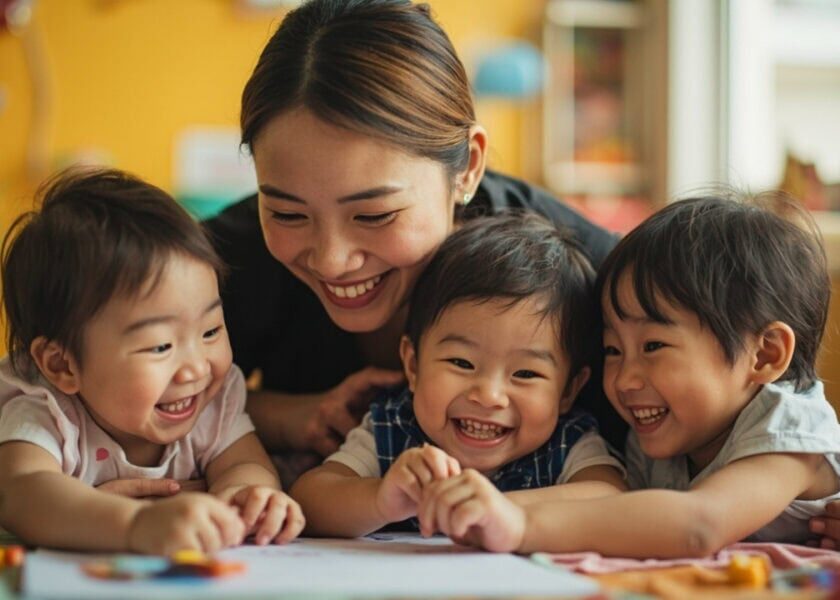
How Singapore Parents Train Their Eyes to Choose Quality Childcare
What Quality Childcare Looks Like: An Observational Framework for Parents
I want to tell you something that I hope will change how you approach this search. You are not lacking judgment. You are not missing some parenting instinct that other parents seem to have and you do not. You are lacking a vocabulary for what you are already observing.
The moment someone gives you the language to describe the difference between a caregiver who is present and a caregiver who is merely occupying space, something clicks. Suddenly you are not guessing anymore. You are reading the room with precision and confidence.
Attentive observation is a skill. It is not a talent that some parents are born with and others are not. When you walk into a childcare setting, your brain is already processing enormous amounts of information: the temperature of the room, the sound levels, the way children are moving, the way adults are positioned, the ratio of voices to silences, the pace at which things happen.
Without a structure to organize it, this remains a diffuse impression rather than a clear reading. The good news is that this structure is learnable, and once you have it, you will be amazed at how much more clearly you can see.
The Five Observable Dimensions of Quality Care
1. Attunement: Reading and Responding to Your Child’s Internal State
Attunement is the caregiver’s ability to be aware of the child’s internal state and to respond in a way that acknowledges that state rather than ignoring it or overriding it.
When a child falls and looks up at a caregiver with a mixture of surprise and distress, an attuned caregiver does not simply say, “You are fine.” An attuned caregiver reads the child’s face, registers the fall as something the child experienced rather than something the child should simply recover from, and responds with an acknowledgment that matches the child’s experience:
“That was quite a tumble. You are okay though, I’m right here.”
You can see attunement in the caregiver’s face, in the way they kneel or crouch to the child’s level, in the timing of their response. Attunement is one of the primary ways that children learn they are understood, that their experiences are valid, and that the world is a place where their feelings and needs will be met.
2. Responsive Versus Reactive Caregiving
A reactive caregiver responds to behavior after it has occurred. They manage problems. They intervene when something goes wrong. This is not inherently bad, but it is fundamentally different from responsive caregiving, which involves an ongoing awareness of the child’s state that allows the caregiver to prevent problems from escalating or to redirect before a situation becomes difficult.
| Reactive Caregiving | Responsive Caregiving |
|---|---|
| Says “no” or “stop” frequently | Redirects gently before escalation |
| Intervenes after incidents occur | Moves toward children proactively |
| Manages through volume and urgency | Manages through calm presence |
| Children seem to need constant correction | Children seem regulated by the environment |
Notice whether caregivers seem to be moving toward children or mostly responding after things happen. Notice whether interventions are calm or hurried. Notice whether children seem to be regulated by the environment or constantly being managed by adults.
3. Genuine Engagement, Not Just Supervision
Every licensed childcare setting in Singapore meets basic supervision requirements. There are ratios, there are protocols, there are systems in place. But supervision is not the same as engagement, and this distinction matters enormously for your child’s development.
Genuine engagement means that a caregiver is not just watching children but is meaningfully present with them. This does not mean a caregiver must be interacting with every child at every moment. Quality caregiving often involves what experts call “parallel play support,” where the caregiver is near a child who is engaged in independent play, available and attentive, but not interrupting or hovering.
What genuine engagement does mean is that when a caregiver is with a child, they are truly with that child. Their attention is there. Their responsiveness is there.
You can observe this in the caregiver’s body language. A caregiver who is genuinely engaged will position themselves at the child’s level, follow the child’s lead in play, narrate what is happening in a way that shows they are tracking the child’s experience. A caregiver who is supervising but not genuinely engaged will be physically present but emotionally and cognitively elsewhere: looking around the room, glancing at a device, talking to other adults while children approach them with something to show.
Here is a concrete example. You visit a classroom and notice a toddler building a tower with blocks.
Scenario A (Supervision): One caregiver passes by and says, “Nice tower.” The child does not look up. The caregiver keeps walking.
Scenario B (Engagement): A different caregiver pauses by the tower, watches for a moment, and says, “You’re working on making it really tall. What do you think will happen if you add one more?” The child looks up, considers the question, and reaches for another block.
That caregiver is not just watching. They are entering the child’s world, extending the play, affirming the child’s agency and curiosity. Over time, these small moments of genuine engagement accumulate into something significant.
4. The Caregiver’s Relationship with Time
Caregivers who are genuinely attuned to children have a different relationship with time than caregivers who are not. They are not rushed. They do not seem to be managing a schedule in their heads. They are present with the children in a way that suggests they understand that the children live in the present moment and that this is where the important work happens.
You can observe this in how caregivers handle transitions. Transitions are notoriously difficult moments in any childcare setting: moving from play to circle time, from one activity to another, from indoor to outdoor.
In settings where caregivers are rushed or time-pressured, transitions become rushed. Children are hurried along. Voices become sharper. The emotional register of the room shifts from calm to chaotic.
In settings where caregivers are attuned, transitions are managed with care:
- Children are given warnings before transitions occur
- They are given time to finish what they are doing
- Gentle redirections replace abrupt commands
- The pace slows even when there are many children to move
Watch how caregivers move through the room during transitions. If children seem anxious, resistant, or overwhelmed, that is information. If they move relatively smoothly with minimal distress, that is also information.
5. Honoring Individual Temperament
Every child is different. Every child has a different threshold for stimulation, a different preferred pace, a different way of processing the world. Quality caregiving means that the caregiver sees and responds to these individual differences rather than treating all children according to a uniform standard.
- A shy child is given space and allowed to warm up at their own pace
- A more active child is given opportunities for movement rather than constantly being asked to sit still
- A child who is struggling emotionally receives individualized attention rather than being simply told to calm down
- Caregivers adapt their approach based on what each child needs in the moment
These are observable moments, and they reveal whether the caregivers are truly seeing your child as an individual or whether they are managing a group according to a predetermined script.
The Framework: Understanding What You See
Think about the quality of caregiving you are evaluating across three interconnected dimensions.
Warmth is the emotional quality of the caregiver’s interactions. Is the caregiver affectionate and kind, or cool and distant? Does the room feel welcoming when you enter?
Structure is the way the environment and day are organized. Is there predictability? Clear routines? Appropriate limits? Children thrive when they know what to expect.
Responsiveness is the caregiver’s ability to notice, acknowledge, and respond to children’s signals and needs in real time.
| Missing Dimension | What You Might Observe |
|---|---|
| Warmth | Organized room but children feel managed rather than loved |
| Structure | Kind environment but children lack consistency and predictability |
| Responsiveness | Warm and structured but children miss moments of being truly understood |
When you visit a childcare setting, pay attention to the children themselves. Are they generally calm and engaged, or anxious and withdrawn? Do they move through the environment with confidence, exploring and playing, or do they seem vigilant, uncertain, watching the adults for cues?
Look for these signs of emotional safety: moments of spontaneous joy and genuine laughter, focused absorption in play, children approaching caregivers with ease, secure exploration of the environment, peer interactions that are curious rather than fearful.
Children in any new setting may be cautious or quiet on a given day, so it is worth observing over multiple visits if possible. But the overall emotional climate of the room, as reflected in the children’s behavior, is one of the most reliable indicators of care quality available to you.
Where Quality Care Meets Families: A Note on Choosing Thoughtfully
Whether your family accesses care through home-based pathways, community settings, or centre-based programs, the principles of quality remain consistent. Attuned caregivers who observe and respond to children’s emotional states. Responsive interactions rather than reactive management. Warm and structured environments that honor individual differences. Individualized attention to each child’s development.
In Singapore, programs like the ECDA Childminding Pilot reflect a broader recognition that the early years matter profoundly. Fee structures have been designed to make quality care more accessible, and many families find that CDA and Baby Bonus schemes can be applied to reduce financial burden in meaningful ways.
At EduNanny Singapore, parents will find a commitment to transparency that reflects genuine respect for families. Communication is not an afterthought. Parents receive regular updates, not just perfunctory notes but meaningful glimpses into their child’s day: the interactions they had, the developmental milestones they reached, the moments of joy and the moments of challenge. Where monitoring measures are in place, they function as an extension of openness, a way of showing parents that they are welcome into the life of the program at any time.
This is what trust looks like in practice: a system of openness that allows parents to see what they have learned to observe.
What You Will Find at EduNanny
- Caregivers who understand attunement is not a soft concept but a concrete skill, something they practice every day with intention and self-awareness
- An infant ratio of up to one to three in the infant care program, a standard that allows for the kind of individual attention that infants require, that makes responsive caregiving possible rather than aspirational
- Caregivers who move at a pace that respects children’s need for time, who manage transitions with gentleness, who create an environment where structure and warmth coexist
- A program built on evidence, informed by the science of early childhood development, but translated into practices that feel human, warm, and right
- Monday to Friday care blocks designed around the realities of Singapore working families, because the best pedagogical approach in the world means little if it cannot be accessed by the families who need it most
Choosing quality childcare does not mean outsourcing the most important work of early parenting. It means finding a partner who speaks the same language you are learning to speak, who sees what you are learning to see, who values what you are learning to value.
When you visit and you observe a caregiver kneeling to a child’s level, narrating the child’s play, responding to distress with patience rather than impatience, you will recognize it. You will have the vocabulary now.
And you will know, with a confidence that does not second-guess itself, that this is what you were looking for.
Your Next Step
There is a quiet recognition emerging in Singapore: the first thousand days of a child’s life are not just a period to be survived or managed but a period of extraordinary opportunity. It is a time when the architecture of the brain is being built, when the foundations of emotional security are being laid, when the capacity for learning and relationship and resilience is being formed.
You are paying attention. You are noticing things. You are developing a sensitivity to quality that will serve you well not only in choosing childcare but in all the years of parenting that follow.
Do not underestimate what you are building in yourself. That parent who can read a room, who can observe a caregiver’s interaction and understand what it means, who can trust their trained eye even when they cannot immediately articulate what they are seeing: that parent is becoming more attuned, more present, more intentional in every setting.
What you are looking for is real. The quality you are learning to recognize is not a fantasy or an ideal that exists only in articles and brochures. It exists. It is here.
When you are ready to see it for yourself, we will be here to show you. Visit EduNanny Singapore to schedule a tour, ask questions, and observe for yourself the quality of care you now know how to recognize.
Your instincts have been waiting for this vocabulary. Give them a chance to confirm what they already know.