How Singapore Parents Learn to Read Quality Childcare After Enrollment
What the Weeks After Enrollment Actually Look Like
Most of what we read about choosing childcare focuses on the decision itself. Checklists for visiting. Questions to ask. Red flags to watch for. And all of that matters—making a thoughtful choice is important. But it stops at the threshold. What no one tells you is that after the decision settles, something else begins.
You are no longer choosing. You are learning to see.
For parents in Singapore navigating infant care or childcare, this period carries real weight. The weeks after enrollment are where the choice either deepens into confidence or quietly erodes into doubt. Not because anything dramatic happens. But because the parent who chose well is left with a question: how do I know that what I hoped for is actually happening during the hours I am not there?
That question is not a sign of doubt. It is a sign of care. And quality childcare knows how to answer it.
What Quality Looks Like After You Enroll
There is something deeply human about this experience. Even when you have complete confidence in your choice, there is an adjustment period that requires patience and attention from both sides. You are learning to read an environment you cannot fully see. You are learning to trust observations that come through second-hand—the child’s behavior at home, the update at pickup, the small traces of the day that accumulate into a picture.
When a child is settling well into quality care, there is a texture to their comfort that you can feel. They may not always be delighted at dropoff—separation is normal and sometimes hard—but there is a difference between a child who is adjusting and a child who is struggling.
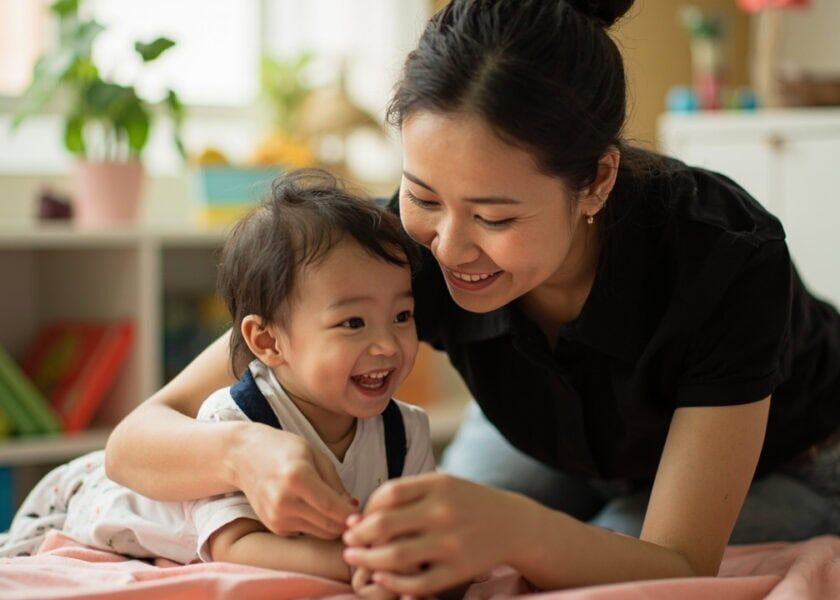
A child who is settling into quality care begins to carry something home with them: a sense of the day’s rhythm, a feeling of being known, a kind of quiet security that shows up in how they play and sleep and connect with you in the evening.
A toddler who starts using phrases from the classroom—”gentle hands,” “big breath,” “wash wash”—is absorbing the language of the environment. A baby who settles more easily into naps because the rhythm is consistent is learning to trust that their needs will be met. These are not just cute observations. They are evidence. They tell you that your child is not just being kept. They are being engaged.
Reading Caregiver Attunement
The caregiver’s attunement becomes visible to you in ways that were harder to see during the visit. When you observe the greeting in the morning—how the caregiver sees your child, how they kneel or crouch to meet their eyes, how they receive the child from you and make the transition feel warm rather than hurried—you are seeing attunement in practice.
It is not a policy or a script. It is a quality of presence that shows up in the small moments.
Over time, you will recognize the difference between a caregiver who is performing warmth and one who genuinely attunes. The one who attunes remembers details. They notice when something is different. They receive your observations about home with the same attention they give to your child during the day.
The Quality of Updates
A caregiver who says, “She was really focused on the water activity today, she watched the ripples for almost ten minutes” is doing something more than reporting. They are showing you that they were paying attention to your child as an individual, that they noticed your child’s particular curiosity, and that they thought it was worth sharing with you.
That kind of specific, attentive observation is one of the clearest signs of quality care. It tells you that your child is known.
Communication That Flows Both Ways
Communication after enrollment should flow both ways. You should feel comfortable asking questions and receiving real answers—not scripted reassurances, but honest, thoughtful responses that reflect a caregiver who is paying close attention.
When you ask about your child’s day and the answer is vague or deflecting, that is information. When you raise a concern and the caregiver listens fully and responds with specificity, that is a sign of partnership.
When a caregiver takes something you share—your child’s new word, a change in sleep pattern, a question your toddler asked—and responds with their own note from the day, linking the two experiences, that is the beginning of something valuable. It tells you that your child’s world is not fragmented between home and care. It is continuous, and the people caring for your child are paying attention to that continuity.
Your Child’s Behavior at Home as Meaningful Data
You will also begin to notice your child’s behavior at home as data. Does your child seem settled in the evening? Do they mention the day with some positive association—friends, activities, a favorite toy? Are they sleeping well?
When your child’s behavior at home is consistent with what you hear from the caregiver—when the update and the behavior align—you are seeing coherence. That coherence is reassuring. It tells you that the environment is stable, that your child is processing the day successfully, and that the two worlds of home and care are connected.
There will be days when something feels off. A child who is usually easy at pickup seems fussy. A nap was shorter than usual. These moments are not failures. They are invitations to ask questions, to share observations, to engage more closely with what is happening. A quality care arrangement welcomes this. When you raise a concern and receive a thoughtful, specific response, you are being welcomed into partnership.
Reading the Environment and the Singapore Context
The physical environment tells its own story. When you visit for pickup or dropoff, notice the transitions. Is the space calm or chaotic? Is the supervision close, especially in infant rooms? Is the environment clean but not sterile, organized but not rigid? Does it feel like a place where children are safe and curious?
Look at the small details—the height of the activities, the condition of the toys, the temperature and lighting, the presence of natural materials. These are not decorative choices. They are the conditions of your child’s day.
Quality Options for Singapore Families
For parents in Singapore, this matters in a particular way. The landscape of childcare here has evolved to meet real family needs. The ECDA Childminding Pilot has created pathways—home-based care that brings the caregiver into a familiar setting for your child, with ratios that allow for close attention, and centre-based care that offers professional structure and community.
These are not compromises or lesser options. They are thoughtful responses to the diversity of Singapore family life. The practical realities matter too: affordable fee structures within the pilot, the ability to use CDA and Baby Bonus funds, the availability of care across weekdays. These are the conditions that make quality care accessible to families across Singapore—and they are not separate from what we have been describing. They are the foundation that allows your child to be known, your observations to be welcomed, and your trust to deepen through real experience.
The Quiet Shift: From Checking to Noticing
As the weeks pass, you will notice a shift in yourself. Early on, you may find yourself checking—looking for signs that you chose well, scanning for evidence of quality. That is natural.
But gradually, if the care is what you hoped for, something changes. The checking becomes noticing. You are no longer searching for reassurance anymore. You are simply observing, and what you observe confirms what you already believed.
The transition from decision trust to experiential trust is quiet. It happens in the accumulation of small moments—the consistent greeting, the specific update, the child who comes home settled and happy, the caregiver who remembers something your child said last week.
This shift is important because it changes your relationship to the care arrangement. You are no longer a parent who chose a service. You are a parent who understands a place. You know what happens during the day. You know the rhythm. You know your child’s caregiver as a person, not just a name.
The observation you are developing—the ability to read your child’s comfort, to notice the quality of caregiver attunement, to gather the evidence of quality that shows up in daily life—this is not just reassurance for you. It is a skill that will serve you throughout your parenting journey. It deepens your relationship with your child. It strengthens your partnership with caregivers. It makes you a more confident, more connected parent.
EduNanny Singapore: Built for Partnership
At EduNanny Singapore, we understand that the weeks after enrollment are as important as the decision itself. We believe that parents who want to understand what is happening during the day are not anxious or difficult—they are exactly the parents whose children benefit most.
Our pathways—home-based and centre-based—are designed to invite that kind of engagement. Our caregivers are trained to communicate not just information but attention. Our environment is arranged to be not just safe but purposeful. Our communication practices are built on the belief that transparency is not just good service—it is part of the care itself.
Whether through our home-based pathways with their intimate, familiar settings, or our centre-based environments designed for engagement and safety, the physical conditions are part of the care itself. We consider ratios carefully—up to three infants in home-based care, which allows for the close attunement that you are learning to recognize. We think about the daily rhythm, the transitions between activities, the balance of rest and engagement. These are not background details. They are the structure within which your child’s day unfolds.
We are proud to be part of the ECDA Childminding Pilot, which represents a meaningful expansion of quality childcare options for Singapore families. This pilot demonstrates what quality looks like when families are genuinely welcomed into partnership, when communication is real, when the child’s experience is held with care by both parent and caregiver.
Because we know that modern parenting comes with questions that arise at all hours, we have developed the Thomas AI Chatbot—a tool that helps you stay connected, answers your questions, and makes the bridge between home and care easier to cross. This is not a replacement for the caregiver’s warmth or the human connection that matters most. It is a support, a resource, a way of keeping communication flowing even when you cannot be there in person.
You Chose With Care. Now Comes the Seeing.
You chose with care. You made a thoughtful decision after doing your homework, visiting, asking questions, and trusting your instincts. That was the first act.
Now comes the second act, the one that happens quietly over weeks and months: the act of seeing. The act of learning what quality looks like in practice. The act of building trust through observation rather than hope alone.
The child in your arms is growing and changing every day. The environment you have chosen is shaping that growth in ways both visible and subtle. And you—through your attention, your questions, your growing ability to read the signs—are becoming an expert on your own child.
That expertise is not in competition with the caregiver’s expertise. It is complementary. Together, you are building something important: a shared understanding of who this child is, what they need, and how they are thriving.
And when you look at your child in the evening, settled and happy, carrying traces of a day that was warm and engaging, when you hear your child mention a name or an activity with positive feeling, when the caregiver shares something specific and attentive about your child’s day—you will know.
Not with certainty that erases all uncertainty, but with the kind of knowing that comes from paying close attention over time. That is experiential trust. That is what the weeks after enrollment are building.
EduNanny Singapore is here for that journey. We are here for the parent who wants to understand. We are here for the caregiver who wants to share. We are here for the child who is at the center of everything, growing, learning, and being known.
You made the decision. Now comes the seeing. And the seeing is where the choice becomes real.
If you are ready to choose a care arrangement that welcomes your observation, invites your questions, and deepens into genuine partnership over time, we invite you to explore what EduNanny Singapore offers—home-based and centre-based pathways within the ECDA Childminding Pilot, designed for the child, built for the family, and ready to be seen.
Learn more about who we are or get in touch to begin the conversation.