What Your Child’s Mind Is Building While You’re Apart
The Silence Between Drop-Off and Homecoming
There is a particular kind of silence that lives between the morning goodbye and the evening return. It is not an empty silence. It is the silence of a parent who has dropped their child at the gate, walked back to the car or the train, and found themselves wondering — quietly, persistently — what is actually happening right now. Not the logistics. Not whether lunch was finished or a nap was taken. Something deeper than that. Something about the quality of your child’s inner experience in the hours you cannot see.
This is the silence we want to speak to today. Because if you are a parent in Singapore navigating infant care or childminding, you live inside this question every single day. You have made a choice — perhaps a necessary one, perhaps a reluctant one, perhaps both — to place your child’s hours in someone else’s hands. And you carry that choice with you. It sits with you in meetings. It surfaces when someone sends a photo mid-morning and your child looks a certain way that you are trying to read something from.
Here is what we believe: the hours between drop-off and homecoming are not simply hours to be managed. They are hours that are actively building your child’s mind. And when you understand what is actually happening inside your child during those hours, something shifts. The worry does not disappear. It is replaced by something more precise, more grounded, more confidence-building. It becomes informed confidence.
The Science Behind Those Invisible Hours
This is not a dramatic claim. It is one of the most studied, most carefully documented truths in developmental science. The first thousand days of life — from roughly the middle of pregnancy through a child’s second birthday and well into the years that follow — represent a period of neural architecture construction that will not be repeated.
The brain is forming connections at a speed it will never reach again. Language circuits are being laid down. Emotional regulation systems are taking shape. The capacity for curiosity, for sustained attention, for secure social engagement — all of this is being actively shaped by the experiences your child has, hour by hour, day by day.
And here is the thing that is so rarely said, and so urgently needed: those experiences do not only happen at home. They happen in quality care.
For Singapore parents, this is both a responsibility and a reassurance. The responsibility is to seek out care environments that understand what they are holding — the cognitive architecture of a young human being being built in their absence. The reassurance is that when you find such an environment, those invisible hours become not a source of anxiety but a continuation of the developmental foundation you are building at home.
What Is Actually Happening Inside Your Child
Let us take a moment to imagine what is happening in a young child’s inner world during a day in quality care.
Consider the toddler who has just been dropped at the gate. She is two and a half, and she has the full weight of a complex emotional life pressing against a vocabulary of perhaps a few hundred words. She does not have the language yet to tell you what she feels when you hand her to someone else and walk away. But the feeling is there. It is real. It is big.
And in a quality care environment, something remarkable can happen in the minutes that follow the goodbye.
The Secure Base: Where Emotional Safety Begins
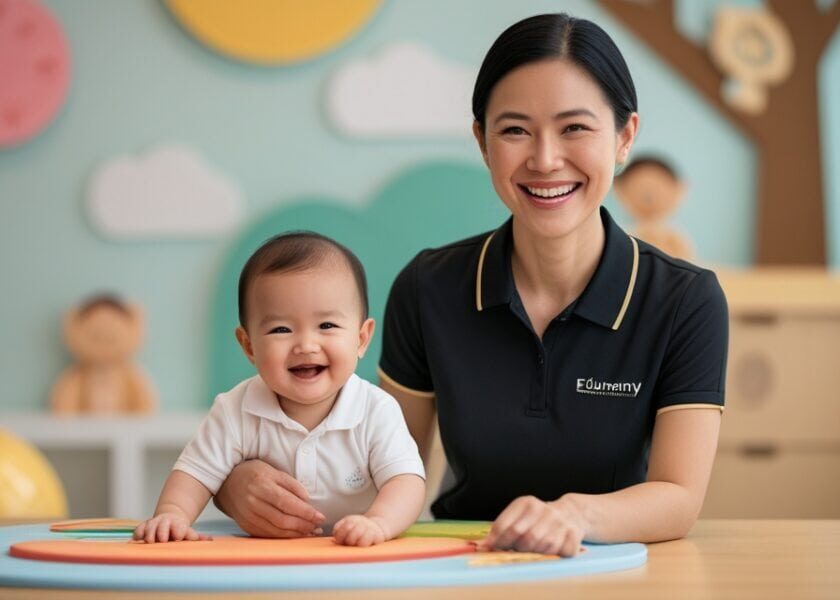
That caregiver — the one who receives your child at the door — is not just a pair of hands. She is a living secure base. This is a concept drawn from attachment science, and it is one of the most beautiful ideas in child development.
A secure base is a person from whom a child can venture outward to explore the world, knowing that they can return to safety at any moment. In the first hours of the morning, the caregiver does not try to replace you. She does something far more sophisticated. She allows your child to feel, for the first time in a new setting, that she is genuinely held — not just physically, but emotionally. That she is seen. That her distress, if it comes, will be met with calm and warmth rather than impatience.
And something shifts. Often within an hour. The child who arrived rigid and clinging begins to look around. She notices the other children. She reaches for a toy. She is, in the language of development, beginning to use the caregiver as a base from which to explore.
Because the child’s brain, when it feels emotionally safe, releases its grip on vigilance. It stops scanning for threat and starts scanning for novelty. It begins to wonder. And wonder — that word we use so casually — is actually a profound cognitive state. It is the brain’s invitation to learn.
Wonder as the Architecture of Learning
When a child in quality care picks up a shell and turns it over in her hands, when she watches a rain of glitter fall during a sensory activity, when she stares at the face of another child and tries to understand what that expression means — these are not idle moments. They are the building blocks of narrative intelligence.
Narrative intelligence is the capacity to make sense of experience — to string together events into a coherent story of what happened and what it means. It is what allows a child, by around age three or four, to recall and recount the day: first we had snack, then we went outside, then the teacher read us a story about a rabbit.
This capacity does not appear fully formed. It is constructed, piece by piece, through thousands of small experiences of having things explained, having routines that make sense, having caregivers who narrate the day aloud.
“Now we are washing our hands. Feel the water? It is warm.”
“That was a sad sound, wasn’t it? The blocks fell down.”
This steady, warm narration of experience is one of the most powerful engines of early cognitive development, and it happens beautifully in environments where caregivers are trained to offer it.
The Reunion: Building the Bridge Between Two Worlds
Consider that same child at the end of the day. She hears your voice in the corridor before she sees you. Her body changes. Her face reorganizes itself. She reaches for you, and you hold her, and there is a reunion that is simultaneously joyful and complicated — because she has been living a full life apart from you, and now there is something to integrate.
What happens in those moments of reunion matters enormously. When a child comes home from a day in quality care and is allowed to show you everything — the painting, the song, the new friend, the small triumph — she is not just sharing information. She is building the bridge between her two worlds. She is constructing the narrative that connects her life with you and her life without you into one coherent story.
And what she needs from you in that moment is not perfection. She needs your genuine curiosity. Your real attention. The message that what she lived while you were apart was worth noticing.
What Quality Childminding Actually Looks Like
In Singapore’s diverse care landscape — spanning home-based, community-based, and centre-based pathways — quality is not uniform. Understanding what to look for can make the difference between anxious uncertainty and informed confidence.
Signs of a Quality Care Environment
- Attuned caregiver-to-child ratios. When a caregiver can genuinely attune to three infants instead of six or eight, she can read the subtle signals — the early stirrings of hunger, the early signs of fatigue, the moment curiosity is about to turn into frustration — and respond in a way that feels like being understood.
- Secure base behavior in practice. Caregivers who understand attachment science do not try to replace you. They create conditions where your child feels held enough to explore.
- Narrative narration throughout the day. You should hear caregivers talking to children about what is happening, what comes next, what things mean.
- Responsive rather than routine-driven. Quality care adapts to the child, not the other way around.
- Transparent communication. You receive real updates about your child’s day — not just that she ate and slept, but the quality of her engagement, the moments of discovery, the small social victories.
Questions to Ask Any Care Provider
- How do you support a child in the first hour after drop-off?
- What does a typical day look like, and how do you adapt when a child is struggling?
- How do you communicate with parents about their child’s emotional experience, not just their physical needs?
- What training have your caregivers received in child development?
- How do you handle separation anxiety, and what does a typical settling-in process look like?
Addressing Your Real Concerns
It means that the question you have been carrying — what is my child doing all day? — is not a question without an answer. It is a question with a rich, evidence-based, deeply human answer.
“Am I failing my child by placing them in care?”
You are not failing your child. You are making a choice that millions of parents in Singapore and around the world make every day — a choice that can be made well or poorly, but that is not in itself a failure. The research on attachment is clear: what matters is the quality of care, not the quantity of parental presence. A child who experiences secure base behavior in quality care, and who returns to a warm, responsive parent at the end of the day, is not being deprived. She is being supported.
“How do I know what is happening during the hours I’m not there?”
You know by asking the right questions, by seeking out providers who communicate proactively about emotional and developmental experience, not just logistics. You know by understanding what quality care makes possible — so that when you see evidence of a child who is curious, socially engaged, and emotionally secure, you recognize what that evidence means. Informed confidence comes from understanding the science, not from constant surveillance.
“What if my child cries every morning at drop-off?”
Morning separation anxiety is developmentally normal and usually temporary. What matters is what happens after you leave. A quality caregiver receives your child’s distress with calm warmth, provides the secure base she needs to settle, and gives her permission to explore. Within weeks, most children develop the trust that allows them to move through the goodbye and into the day. If your child’s distress is prolonged or severe, that is worth discussing with your caregiver — not as a failure, but as information to work with together.
“Will my child love their caregiver more than me?”
Children are remarkably capable of multiple attachments. The love your child has for a trusted caregiver is not a replacement for your bond — it is an extension of it. You remain the primary attachment figure. The caregiver fills a specific, valuable role: a secure base from which your child can explore the world of peers, new experiences, and growing independence. This is healthy development, not a threat to your relationship.
Choosing Infant Care in Singapore: A Practical Guide
Armed with understanding, you can now approach your search with clarity. Here is what to look for, what to ask, and what to trust.
Step 1: Understand the Pathways
Singapore offers several childcare pathways under ECDA regulation:
- Centre-based infant care: Operated from dedicated childcare centres with licensed capacity and trained staff.
- Home-based childminding: Care provided in the caregiver’s home, offering a smaller, more intimate environment.
- Community-based care: A hybrid model combining structured programmes with home-based support.
Each has strengths. The right choice depends on your child’s temperament, your family’s schedule, and your personal values around care environment.
Step 2: Look for These Non-Negotiables
- Caregiver training in early childhood development, not just childcare certification
- Low caregiver-to-child ratios, especially for infants
- Evidence of secure base behavior — how caregivers handle separation and distress
- Active, thoughtful communication about your child’s emotional and developmental experience
- Transparent policies around observation, feedback, and parent involvement
Step 3: Trust Your Observation
Visit unannounced if possible. Watch how caregivers interact with children who are upset, not just content ones. Notice the tone of voice used. Observe whether children seem genuinely at ease, not just compliant. Your instincts are valuable. If something feels off, it is worth investigating. If something feels warm, attentive, and alive — trust that too.
Step 4: Ask About Developmental Philosophy
A quality provider will have a clear answer to the question: What do you believe is happening inside a child’s mind during a day in your care? If the answer is primarily about supervision, safety, and schedule, keep looking. If the answer includes words like curiosity, emotional safety, secure base, narrative development — you have found something worth knowing more about.
EduNanny Singapore: Built on Understanding
This is where the story of EduNanny Singapore begins — not with a list of features, not with a conversation about your anxiety, but with a genuine fascination with what is happening inside the mind of the child in our care.
We believe that the most important thing a parent can be offered is not reassurance. It is understanding.
Our Approach to Early Childhood Care
Part of the ECDA Childminding Pilot, EduNanny operates across home-based and centre-based pathways, holding ourselves to standards that reflect a genuine belief in the developmental importance of these early years.
Our infant ratios — up to one to three in our infant care settings — are not a regulatory floor. They are a commitment to the kind of individual attention that the science tells us young children need. When a caregiver can genuinely attune to three infants instead of six or eight, she can read the subtle signals — the early stirrings of hunger, the first signs of fatigue, the moment curiosity is about to turn into frustration — and respond in a way that feels like being understood.
That attunement is not a luxury. It is the medium through which emotional safety is created. And emotional safety is the precondition for everything else.
Transparency as Partnership
We know that transparency matters to you in a way that goes beyond policy documents. Singapore parents today are sophisticated. You want to know, and you should know. Where CCTV is deployed, you have visibility into the care environment. Where communication is active, you receive real updates about your child’s day — not just that she ate and slept, but the quality of her engagement, the moments of discovery, the small social victories that may never make it onto a formal report.
This is not about surveillance. It is about partnership in the truest sense — a shared understanding of what your child is living.
Accessible Quality
For parents navigating the very real financial pressures of quality care in Singapore, we have worked to ensure that pilot fee structures are accessible, and that your CDA and Baby Bonus funds are usable within our framework.
The cost of infant care should not be a barrier to infant care of genuine quality. That is not a tagline. It is a structural commitment built into how we operate, Monday through Friday, across the pathways we serve.
Support When You Need It
We also know that questions do not only arise during office hours. Our Thomas AI Chatbot is designed to be a real resource for parents — a tool that answers the questions that arise at eight in the evening when you are lying in bed wondering if what your child experienced today was normal, was okay, was enough.
It does not replace the wisdom of trained caregivers or the reassurance of a direct conversation. But it closes the gap between the questions you carry and the answers you need, at the moment you need them.
What We Believe
None of this is really about features. It is about a conviction.
We believe that the people who care for your child during the hours you cannot be there are not babysitters. They are the architects of your child’s inner world during one of the most critical developmental windows imaginable. They deserve to be recognized not merely as service providers but as the skilled, trained, deeply attentive professionals they are.
At EduNanny, we invest in that training because we believe that what a caregiver knows about child development — about secure base behavior, about narrative intelligence formation, about the subtle art of reading a child’s emotional state and responding with warmth and precision — is the single most important variable in the quality of your child’s care experience.
You have trusted someone else with the most precious thing in your life. That trust is not given lightly, and it should not be received lightly. We understand the weight of it. And we meet it every day with the seriousness it deserves.
The Child Who Comes Home
So here is what we want you to carry with you.
The hours between drop-off and homecoming are not lost hours. They are not a gap to be anxiously wondered about. They are hours of active, extraordinary development — hours in which your child’s brain is building the architecture for everything that comes next. Hours in which your child is living a life full of discovery, challenge, small triumphs, social complexity, wonder, and growth.
And when you open the door in the evening, and your child turns toward you with that face — that face that has been busy becoming — you can know, not just hope, that what you are welcoming home is a child who has been seen, and heard, and held with genuine expertise, in the hours that you were apart.
That is what EduNanny Singapore is here for. Not to manage your child’s hours. To honor them.
If you are ready to learn more about how EduNanny Singapore approaches infant care and childminding — with attention to what is happening inside your child’s mind, not just what is happening on the surface — we would be glad to walk you through our approach, answer your questions, and help you understand what quality care can make possible for your child.
Because you deserve to understand. And your child deserves to be understood.
#SingaporeInfantCare #ChildmindingSingapore #EarlyChildhoodDevelopment #EduNannySG #QualityChildcare