How Singapore Parents Can Read Their Child’s Day at Childcare
Where Every Day Begins: Reading Quality at the Gate
The morning drop-off is not merely a routine. You may have experienced it as one—the same route, the same door, the same cheerful greeting that can start to feel automatic over time. But for your child, and for the quality of the care they will receive that day, the drop-off is an emotional gateway. It is the moment where your child’s inner world meets the outer world of the classroom, and something either opens or closes in response.
Reading the Entrance-State
Watch what happens when you arrive. Not just what your child does—any parent can observe behaviour. What I am asking you to notice is something subtler: how does your child enter the space?
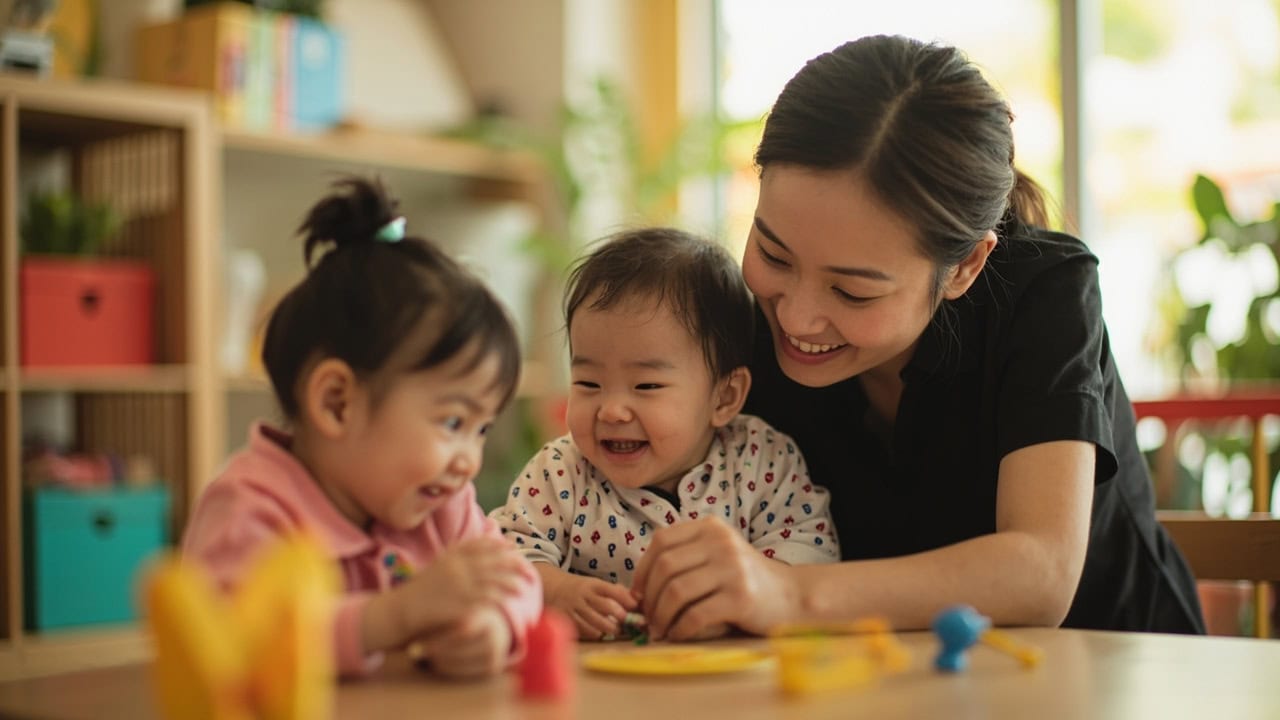
A quality caregiver does not simply greet your child. They read your child. They notice the tension in your toddler’s shoulders or the particular brightness in your infant’s eyes that signals hunger, tiredness, or quiet anxiety beneath a smile. They read the entrance-state because they understand that a child who arrives unsettled carries that unsettledness with them, and a child who arrives bright and curious carries that too.
The entrance-state is the first data point of the day. A good caregiver treats it as important information, not background noise.
A Simple Observation Test
You can test this at your next drop-off. Before you leave, pause for a moment and observe what happens between your child and the person receiving them:
- Is there eye contact at your child’s level?
- Does the caregiver acknowledge your child’s face before they acknowledge you?
- When your child moves toward a toy or a friend, does the caregiver track that movement with their attention?
These small differences in attention are not trivial. They are the difference between a child who is received and a child who is processed.
And here is what matters most: when you witness a caregiver reading your child well at drop-off, you feel something. You feel seen, even though you are the one watching. Because when someone pays that kind of attention to your child, you understand that your child is not one of many to them. They are the one—the particular, specific, irreplaceable one they are caring for today.
The Midday Gap: Rethinking What You Cannot See
But the morning drop-off only tells you so much. There is a gap in the middle of the day that every Singapore parent knows intimately, because it is the gap where uncertainty lives.
You have dropped your child off. You are at work, or in a meeting, or running errands that feel urgent in the moment but will be entirely forgotten by next year. And your child is somewhere else, in a room you cannot see, having a day that you cannot witness.
Reframing the Pause
Here is a shift in how you might think about the midday gap: it is not a void. It is a pause. And the quality of care your child receives during that pause leaves traces—small, observable traces—that will become visible to you at pickup, if you learn to read them.
Consider what actually happens in a quality childcare setting during those hours. There is a rhythm to the day: feeding, playing, resting, learning, moving. In infant care settings with small ratios—and this matters enormously—a caregiver is not managing ten children at once. They are with three infants, or fewer. They notice when one infant grows tired before the others. They notice when a toddler pushes food around the plate instead of eating, and they wonder quietly whether something is off.
They notice, because they have the space to notice.
What You Will See at Pickup
When you arrive, you will not see a report card. You will not receive a detailed account of every moment. But you will see something:
- You will see a room that feels settled rather than chaotic
- You will hear a tone of voice from the caregivers that is calm and present, not strained or performative
- You will notice whether the children in the room seem absorbed in what they are doing—not silent, not perfectly behaved, but genuinely engaged
Engaged children are one of the clearest signs that the hours in between were spent well. The midday gap is not empty. It is filled with small moments that accumulate into your child’s sense of security—and those moments will speak to you at pickup, if you are listening.
The Evening Pickup: Your Daily Diagnostic
This is the diagnostic moment that every parent is quietly searching for at pickup. Not consciously, perhaps. But that is exactly what you are doing when you kneel down, open your arms, and study their face as they run toward you. You are running a diagnostic. You are asking: what kind of day did my child have?
Reading Your Child’s Face, Body, and Voice
First: your child’s face. Not whether they are smiling—children smile even on difficult days, especially for parents they have missed. Look deeper. Do they seem open or guarded? Is there something in their eyes that suggests they were genuinely present during their day, or do they seem to be somewhere else? A child who has been held well, even in your absence, carries a kind of quiet groundedness. It is not a performance. It is a residue.
Second: their body. How do they hold themselves? Are they loose and moving freely, or are they stiff, or clingy in a way that feels anxious rather than affectionate? Some clinginess is normal—every child misses their parent and wants to be close again. But there is a difference between a child who clings because they are relieved to see you and a child who clings because they have been holding themselves together all day. The quality of a child’s body at pickup tells you something about the emotional load they were carrying in your absence.
Third: their voice. Listen to how they speak about the day, if they can. Toddlers and older infants communicate in fragments—a name, a word, a gesture toward a toy or a corner of the room. These fragments are not random. They are the moments that mattered to your child. When a child points to a caregiver and says a name with warmth, you are seeing evidence of attachment. When a child describes an activity with energy and pleasure, you are seeing evidence of engagement.
Reading the Room
Look at the room itself. This is something most parents do not think to do, but it is one of the most reliable indicators of quality available to you.
- It should not feel like a place that has been merely supervised
- It should feel like a place where children have been living—not just staying, but living
- There should be evidence of activity: art on the walls at a child’s eye level, toys arranged with intention, a sense of gentle order that has been produced by thoughtful hands
- The sound should be the sound of a room full of children, yes, but it should not be the sound of chaos
Reading the Caregivers
And look at the caregivers. How do they carry themselves at the end of the day?
A caregiver who is burnt out, under-resourced, or simply going through the motions will look tired in a particular way. Their attention will be scattered. They will be ready for the day to end.
A caregiver who is genuinely present, who has been in relationship with your child all day, will carry a different kind of tiredness—the tiredness of someone who has been paying close attention to small people for many hours. There is a warmth in that tiredness. It is the tiredness of good work.
The Handover: Your Daily Trust Ritual
Observe the handover itself. This is the trust ritual that bookends your day, and it deserves more attention than it usually receives.
When you arrive at pickup, there should be a moment—not a rushed transaction, but a moment—where the caregiver turns their full attention to you and your child. Where information is shared, not just handed over. Where the caregiver tells you something specific about your child’s day: a milestone, a small triumph, a moment of difficulty they navigated together.
This is not a performance. It is the visible evidence of a relationship.
You should be able to ask questions and receive thoughtful answers. Not scripted responses, not deflections. A quality childcare setting welcomes your curiosity because it has nothing to hide.
If your questions are met with resistance or vague reassurances, that is information. If your questions are met with openness and specific detail, that is information too. The quality of the conversation at pickup is one of the clearest windows into the quality of everything that happened before.
Building the Picture
What you are doing, when you read all of these signals together—the room, the caregivers, your child’s face and body and voice, the quality of the handover—is building a picture. Not a perfect picture, because no day is perfect and no child is always thriving in every moment. But a picture that tells you whether your child is being held. Not just supervised. Not just kept safe and fed and changed. Held. Held in the way that you would hold them if you were there.
What Quality Childminding Actually Looks Like
This is what quality childcare looks like in motion. And the remarkable thing is that it leaves traces every single day, in the small moments that are easy to overlook:
- The door that opens with warmth instead of routine
- The caregiver who kneels down to say goodbye to your child by name
- The room that smells like children rather than like cleaning products
- The handover that includes something you did not expect to hear—some small detail that proves your child was seen
These are not luxuries. They are the architecture of quality—the invisible structure that holds your child’s day together and lets them flourish in your absence.
The Ratio That Makes Attention Possible
At the foundation of this architecture is something practical and often overlooked: the caregiver-to-child ratio. Quality attention is not a philosophy. It is a practice, and it requires time.
When an infant care setting maintains small ratios—one caregiver to three infants, or fewer—something becomes possible that is not possible at higher ratios. The caregiver can notice. They can respond. They can hold your child the way you would hold them, because they are not spread thin across too many needs at once.
This is why EduNanny maintains ratios that make real attention possible in our infant care settings. Not because it is easier—it is not. But because it is the only way to deliver on the promise that every parent is carrying when they walk through that gate in the morning.
EduNanny’s Approach: Partnership in the Daily Act
At EduNanny, we understood that Singapore parents are not just looking for a service. They are looking for a partner in their child’s early years—the first thousand days that matter so much, and that feel so fragile when you are living them.
We know that parents need to be able to see quality in the moments they can observe, and to trust it in the moments they cannot. That is why our approach to childminding begins with ratios that make real attention possible. Because attention is not a philosophy. It is a practice, and it requires time.
The ECDA Childminding Pilot
We are proud to be part of the ECDA Childminding Pilot, which reflects our belief that home-based and community-based pathways deserve the same care and intentionality as centre-based settings.
For families navigating these options, we offer clarity:
- Monday to Friday care blocks
- Fee structures designed to be accessible within the pilot framework
- The ability to use CDA and Baby Bonus funds where applicable
Transparency as Foundation
We know that transparency matters. Communication between parent and caregiver is not an add-on—it is the foundation of trust. Our settings incorporate measures that support openness, because parents should never feel they are leaving their child in a place they cannot see into, even when trust has been established.
The daily transitions should feel like a partnership, not a leap.
Your Questions, Answered
Parents carry specific concerns, and they deserve direct answers.
What if my child cries at drop-off every day?
Some separation anxiety is developmentally normal and does not indicate poor quality care. What matters is how the caregiver responds—whether they help your child regulate and transition, or simply manage the crying until your child stops. A quality caregiver will acknowledge the difficulty of the moment while helping your child find their footing in the new environment.
How do I know the midday is going well if I can’t see it?
You cannot see it directly, but you can read it at pickup. A settled room, an engaged child, a caregiver who can tell you something specific about your child’s day—these are the traces of a midday that went well. Over time, you will build a pattern of evidence that either confirms or questions your trust.
What questions should I ask at pickup?
Ask about specifics, not generalities. Instead of “How was her day?”, try: “What was she most interested in today?” or “Did she eat well?” or “How did she seem during rest time?” Specific questions invite specific answers, and specific answers tell you more than vague reassurances ever can.
Is CDA or Baby Bonus funding available?
For families enrolled in the ECDA Childminding Pilot through EduNanny, CDA and Baby Bonus funds can be used where applicable. We encourage families to discuss their specific situation with us to understand what support is available.
Walking Away with Confidence
Here is what I want you to carry with you: every time you walk through that gate at pickup and observe your child running toward you, open and grounded and themselves, you are receiving a message.
The message is that the day was good. Not perfect, but good. Your child was held. Your child was seen. Your child spent their hours in a place that understood what they needed and provided it.
You can know this—not with the certainty of a surveillance camera, but with the deeper certainty that comes from paying attention and finding, consistently, that what you see matches what you hope.
You know what your child’s face looks like when they have been held well. You know what their voice sounds like when they have had a good day. You know the difference between a room that is merely clean and a room that has been tended with care.
All of this knowledge is already yours. You have been reading these signals all along. You simply needed permission to trust that reading—and a framework for understanding what you were seeing.
The Daily Proof
The next time you stand at the childcare gate in the morning, hold your child, and walk away—know that the day has begun well. And when you return in the evening and your child runs toward you with that particular openness in their face, know that you are looking at the evidence.
The evidence that the transitions worked. That the hands were warm. That beneath the surface, the ratios, the attention, the daily rituals of care were doing exactly what they were designed to do.
You can read your child’s day. And what you will read, when you learn to look, is this: your child is in good hands. Not perfect hands. Not hands that will never make mistakes or have difficult days. But hands that are paying close attention. Hands that are held with care. Hands that understand the weight of what they have been trusted with.
That is the daily proof. That is what quality childcare looks like in motion.
And that is what EduNanny is here to offer—not just a service, but a partnership in the daily act of raising a child in this city we all love. A partnership in the thousand small moments that add up to a thousand days, and in the quiet, profound trust that your child is being held the way you would hold them.
Walk toward that gate tonight with confidence. Your child has had a good day. And you are learning, one observation at a time, exactly how to know it.
If you are exploring infant care or childminding options in Singapore and want to see what quality looks like when ratios make real attention possible, we invite you to learn more about EduNanny and our approach to the ECDA Childminding Pilot.
Because you deserve to walk through that gate knowing your child is held. And you deserve a partner who understands why that matters.