Beyond Guilt: How Singapore Parents Are Designing a Better Childcare Village
Understanding the Weight You Carry
There is a question that many Singapore parents carry quietly, sometimes for months, before they ever say it out loud. It does not appear on any checklist. It does not fit neatly into a conversation at a family dinner. But it sits there, in the background of every decision about childcare, shaping choices without ever being named.
The question sounds something like this: If my parents are willing to look after my child, am I allowed to want something different?
You are not alone in asking it. Across Singapore, in HDB flats and private apartments, in WhatsApp family groups and quiet moments before sleep, this question moves through the minds of parents who love their children and love their families, and who feel, for the first time, that these two things might be pulling them in different directions.
Your parents raised you. In most cases, they raised you with love, with sacrifice, and with the conviction that they knew what was best. That conviction was not arrogance. It was devotion. And when they offer to care for your child, that same devotion is at work. They want to be close to this new life. They want to give you the freedom to work, to rest, to build. They may even feel, on some unspoken level, that their value as grandparents is tied to this role.
And so when you feel even a flicker of doubt — when the routines feel mismatched, when your child seems restless in their care, when you yourself return from a long day at work not quite sure whether you handed your child to someone who is fully present — that flicker is immediately buried under a wave of guilt.
Because how could you want more than what your parents are offering? How could you be anything less than grateful?
Here is what you need to hear, as plainly as possible: that guilt is not a sign that you are doing something wrong. It is a sign that you care deeply about everyone involved, and that you are standing in a place where the needs of different people do not automatically align. That is not a failure. That is what it means to be a parent navigating a modern Singapore family.
What Grandparents Bring to Your Child’s Early Years
Before we go further, let us name what is true: there is no substitute for the bond between a grandchild and a grandparent. The ease of it. The warmth. The way a child can be completely themselves in a home that smells like grandmother’s cooking and sounds like grandfather’s television at a familiar volume.
Grandparents bring a kind of presence that is rooted in unconditional love and a deep, earned patience. They bring memory. They bring cultural continuity. They pass down language, stories, the small rituals of a family that no curriculum can replicate. Your child will carry what your parents give them in ways you may not even notice for years.
And for many Singapore families, grandparent care is also practical. It is accessible. It is free, or nearly so. It means your child is in a home, not a centre. It means they are with people who have known them since before they were born.
None of this should be dismissed. The moment we position professional childcare as the superior alternative to grandparent care, we make parents feel they have to choose between their family and their child’s development. And that is not a choice any parent should be forced to make.
The Question Was Never Either/Or
Here is the insight that changes everything: the question was never grandparents or professional care. The question is how you design a village where both thrive as intentional partners.
The village metaphor has become popular in parenting discourse, and rightfully so. But in Singapore, the village is not just a metaphor. It is a multigenerational reality. Your parents are not background characters in your child’s story. They are central figures. And the way to honor that is not to sidestep the conversation but to bring it into the light.
What professional care adds to this village is not a replacement for love. It is something more specific: developmental intentionality.
When you work with a trained childminder, or within a quality programme like the ECDA Childminding Pilot, you are engaging someone whose purpose is singular — to observe, nurture, and support your child’s growth in those critical early years.
What Quality Childminding Actually Looks Like
In the first thousand days of your child’s life, the architecture of their brain is being built faster than it ever will be again. The quality of their sensory environment, the responsiveness of their caregiver, the richness of their interactions — these are not small things. They compound.
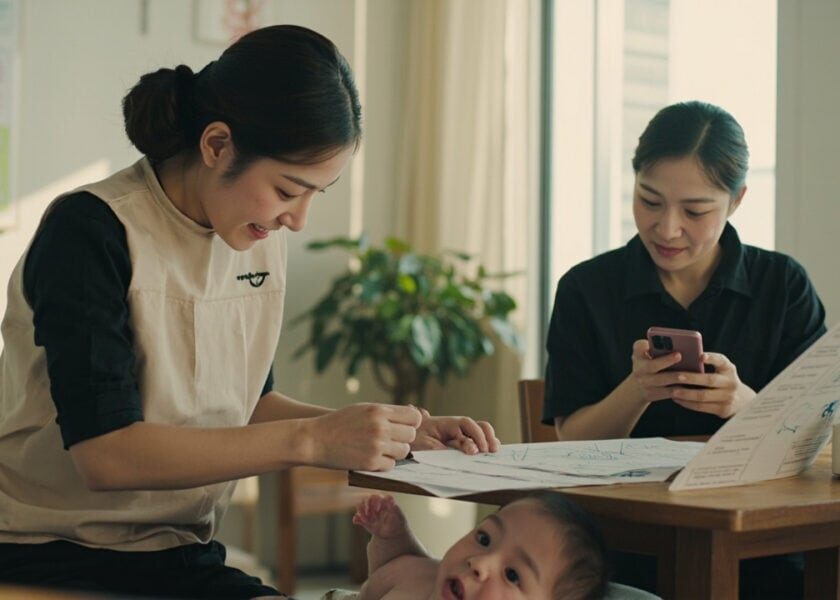
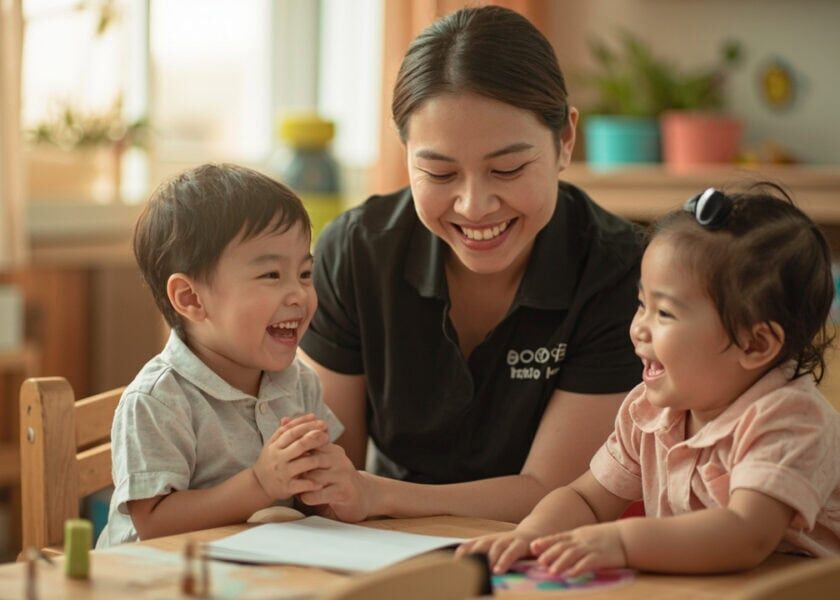
In home-based childminding settings through EduNanny, the care structure allows for ratios of up to one to three infants. That means your child is not one of many in a busy household. They are one of a very few, in an environment designed with them in mind.
Quality care means consistent routines, age-appropriate stimulation, and caregivers who are trained to read cues and respond with warmth. It means your child is in an environment that has been thought through — from the layout of the space to the rhythm of the day — with their development in mind.
The question is not whether your parents love your child. They do. The question is whether the care environment, day after day, is providing the consistent, intentional support that your child deserves.
Navigating Family Dynamics and Expectations
There may be in-law dynamics at play. There may be generational expectations about who makes decisions about the child. There may be a quiet competition that no one acknowledges, or a sense that asking for outside help implies that grandparents were not enough.
These are not imagined tensions. They are the texture of multigenerational Singapore family life, and any honest conversation about childcare must account for them.
The families who navigate this most successfully are the ones who stop trying to solve it alone and start designing it together. They have a conversation — sometimes difficult, sometimes tentative — where the goal is not to convince grandparents that professional care is better, but to share a vision for what they are all building together. A childcare arrangement that serves the child, supports the parents, and honors the grandparents’ role without making it the entire structure.
Discernment Is Not Disloyalty
Choosing to seek professional support alongside grandparent involvement is not a rejection of your parents’ wisdom. In many ways, it is a continuation of it.
Because your parents made choices for you based on the world they knew. And you are making choices for your child based on the world you are living in now. That is not a betrayal. That is inheritance. Your parents built a foundation. You are building on it.
How to Begin the Conversation
If you are wondering how to start this conversation with your parents, you are not alone. Many Singapore parents find themselves stuck at exactly this point — wanting to talk but unsure how to begin without hurting feelings or creating distance.
A conversation might begin with something like this:
“I want our child to grow up knowing how much you love them, and I also want to share with you something I have been learning about early development. I think there might be a way we can both be part of this in a way that feels right for everyone.”
That is not a confrontation. It is an invitation.
Most grandparents, when they hear it that way, will meet you there. Because your parents also want what is best for your child. They may simply have a different understanding of what that looks like. And the more they are included in the conversation, the more they can be partners in the design rather than reluctant bystanders to a decision that feels like it was made without them.
EduNanny Is Part of Your Village
EduNanny by BUTLER is built on this philosophy. We are not here to replace the village. We are here to help you build it with care and with intention.
Our home-based childminding pathways and our community and centre-based options are designed to work alongside family, not apart from it. When we talk about the quality of our care — the trained childminders, the structured developmental environment, the communication and transparency we maintain with families — we are talking about an addition to your village, not a subtraction from it.
We understand that trust is earned, especially when it comes to your child. That is why we participate in the ECDA Childminding Pilot, a framework that sets standards for home-based care in Singapore and ensures that the people who enter your family’s life are qualified, vetted, and supported.
In our centres and home-based settings, we maintain open communication channels so that parents feel connected to what is happening throughout the day. Where applicable, CCTV measures are part of that commitment to transparency — not because we assume anything, but because we know that when parents feel informed, they feel at ease. And a parent who feels at ease is a better parent.
Affordability and Accessibility
Let us speak directly to the financial realities that sit alongside all of this. Singapore parents should not have to choose between quality and affordability.
Through the pilot fee structures available within the ECDA Childminding Pilot, EduNanny’s services are designed to be within reach for families navigating these decisions. Payment options include CDA and Baby Bonus usability, which means the resources your family has already set aside for your child can go directly toward the care you are choosing.
The care blocks run Monday to Friday, offering consistent, reliable coverage that fits within the rhythm of a working family’s week.
Questions Worth Sitting With
Whether you are in Ang Mo Kio or Bukit Timah, Jurong or Tampines, the need for thoughtful, professional infant care is the same. Singapore parents across this island share the same quiet fears, the same love for their children, and the same desire to get this right.
As you consider your options, these questions may help:
- What does a typical day look like for my child right now? Is the environment providing consistent, responsive care?
- What do I wish was different about our current arrangement? What is non-negotiable?
- How can I have an honest conversation with my parents about what I have been learning about early development?
- What would it mean to design a village, rather than default into one arrangement?
You Are Not Tearing Anything Down
Somewhere in this article, I hope you have found something that feels like permission. Permission to want more than one option. Permission to design rather than default. Permission to have a conversation with your parents that is honest and kind and still leads somewhere new.
Permission to build a village that is not a compromise but a creation.
Because that is what you are doing when you make these choices — you are not just arranging childcare. You are designing the world your child will first know. You are choosing who will speak to them in those early months when their brain is building the pathways for everything that comes after. You are deciding what kind of attention they will receive, what kind of language they will hear, what kind of environment will shape their sense of security and curiosity and self.
That is not a small thing. And you are not wrong to feel the weight of it.
What EduNanny offers is not a perfect solution, because no arrangement is perfect. What we offer is a thoughtful one. Trained, intentional care in environments designed for small children. Communication that keeps you close even when you are apart. Flexibility that respects the reality of Singapore family life.
And a philosophy that says: we are part of your village, and we know we are not the whole village, and we are proud to hold our place in it alongside the people who have loved your child since the beginning.
Your parents built something. They built the foundation of your family, the culture you carry, the values you are passing on. You are not tearing that down. You are building on it. You are adding to it. You are designing a village that has room for everyone — for the wisdom of your parents, for the intentionality of trained care, and for the vision you hold for your child that is uniquely yours.
That is not a risk. That is inheritance, too. The best kind. The kind that grows.
If you would like to explore how EduNanny can become part of your family’s village, we invite you to reach out and begin a conversation. No pressure. No obligation. Just an honest discussion about what you are looking for and how we might support you.
EduNanny is a Singapore-based childcare and childminding service. Learn more about our approach or read about our participation in the ECDA Childminding Pilot.