
Fraud Blocker edunanny.com

Category: Childminding

edunanny-066657791eca1b595fdaec6666c53c0c
May 28, 2026

Singapore’s Ambitious Parents Choose Premium Childcare

The Weight Singapore Parents Carry (And Why We’ve Been Asking the Wrong Question)

There is a particular kind of weight that Singapore parents carry, and it rarely gets named aloud. It lives in the moment you check your phone during a meeting and see a photo from your child’s centre—captured mid-laugh, hands stained with paint, utterly unaware that you are simultaneously presenting to a room of executives and wondering whether today they learned their colours, whether they napped well, whether the caregiver noticed the new word they tried to say.

It lives in the 5 AM alarm you set not for yourself but to steal an hour of uninterrupted play before anyone else wakes, because those hours feel like proof that you are still present, still involved, still the parent you intended to be.

This weight is not unique to you. It is the defining tension of a generation of Singapore parents who have been told, implicitly and sometimes explicitly, that they should want both—to build meaningful careers and to be deeply present for their children—and yet somehow manage the impossible: excel at one without sacrificing the other.

The city-state has given us extraordinary infrastructure. MRT lines that run past midnight. World-class schools. Government support that genuinely tries to ease the path. But no infrastructure, however sophisticated, has fully answered the question that sits at the centre of so many Singapore households: How do I pursue the career I worked so hard to build and still be the parent my child deserves?

Here is the reframe that changes everything: we have been asking the wrong question. We ask: “Is childcare a compromise?” The real question is: “How do I build the infrastructure that lets me show up fully everywhere?”

Quality childcare is not your competitor. It is the foundation that makes professional life possible without erosion of what matters most. Secure attachment does not require a single caregiver—children thrive through consistency, responsiveness, and warmth from any qualified adult who provides them. And the families that thrive do not choose between ambition and presence. They build systems that allow both to flourish.


The Honest Truth About the First Thousand Days

The first thousand days of a child’s life—the period from conception through approximately age three—are not merely a warm-up for formal schooling. They are the period during which the architecture of the brain is being built at a speed that will never be matched again.

Neural connections are forming at a rate of more than one million per second. The quality of responsive, nurturing care during this window shapes not just cognitive development but emotional regulation, stress response patterns, and the capacity for secure attachment that will influence relationships for decades to come.

The early years are profoundly consequential. The adults those children become are being shaped now, in moments you cannot get back.

What this means for you as a parent is not that you must be present in every moment. It means that the environments where your child spends time matter more than we have traditionally acknowledged. Investing in quality care is not a distraction from parenting—it is part of the parenting architecture you are building.

The Science That Changes the Conversation

Here is what often gets lost in this discussion: developmental quality does not require a single caregiver who is with the child every waking hour. The science of attachment tells us something remarkable.

Secure attachment—the healthy bond that allows a child to explore the world with confidence, knowing they have a secure base to return to—is built through consistency, responsiveness, and warmth. It is built through the quality of care, not the exclusivity of care.

A child can form multiple secure attachments. A child can thrive in a carefully designed environment with caregivers who are trained, attentive, and present—and still come home to a parent who is fully, joyfully engaged in the hours they share.

The binary we have been operating under—the idea that you must choose between professional contribution and parental presence—is a false one. It serves:

  • Not the parent who sacrifices career ambition and later carries resentment that seeps into family life.
  • Not the parent who sacrifices presence and later wonders whether the distance was worth the corner office.
  • Not the child who deserves a family ecosystem that is sustainable, purposeful, and rich in love from every direction.

What Quality Childminding Actually Looks Like

Singapore has made remarkable progress in understanding what children need in their earliest years. The Early Childhood Development Agency (ECDA) has pioneered new pathways for childminding that recognise this reality: families need flexible, high-quality options that meet them where they are.

Home-based childminding, community-based care, centre-based programmes—these are not competing models. They are different answers to the same fundamental question: How do we create environments where children are safe, nurtured, and given the developmental richness they deserve while their families navigate the realities of modern life?

The Standards That Matter

The ECDA Childminding Pilot has established standards that reflect what developmental research has shown. These translate into real differences for your child:

  • Small caregiver ratios (up to 1:3 for infants) mean a caregiver who can notice when your child is about to fall, respond to a cry within seconds, recognise the subtle shift in mood that signals hunger or tiredness.
  • Trained caregivers know how to scaffold language development through everyday interaction, design an environment that invites purposeful play, and recognise when behaviour is communicating something beyond simple frustration.
  • Consistency and warmth create a predictable environment where your child builds trust—not through the number of hours any one person is present, but through the reliability of care quality over time.

Ratios alone are insufficient. A caregiver can have the best intentions and still lack the knowledge to support developmental milestones. They can be warm and loving and still not know how to support language development or recognise developmental delays. This is why training matters. This is why standards matter.


The Honest Case for Premium Childcare

Let us be clear about what “premium” means and what it does not mean.

Premium childcare is not about luxury. It is not about excess or privilege or unnecessary frills. It is about the difference between:

  • A child spending their days in an environment that merely keeps them safe, versus one that actively contributes to their development.
  • A caregiver who is watching the clock, versus one who is watching the child.
  • A family that is merely coping, versus one that is genuinely thriving.

Premium is developmental richness. It is the trained eye that notices your child’s emerging vocabulary. It is the intentional environment that invites curiosity. It is the caregiver who communicates meaningfully with parents—not surveillance that erodes trust, but updates that let you know your child is thriving.

What This Investment Purchases

This difference has a cost, and we should be honest about that. Premium childcare is an investment that compounds over time:

  • A child who develops strong language skills in their first three years enters school with advantages that are difficult to close.
  • A child who has learned to regulate their emotions in a secure, responsive environment brings that capacity into every classroom, every friendship, every challenge they will face.
  • A parent who is not running on empty—who has the bandwidth to be present when they are present—brings more patience, more creativity, more genuine joy to family life.

The question is not whether premium care is accessible to every family at every income level. It is whether families who can invest in quality care understand what that investment purchases—not just supervision, but developmental support; not just safety, but flourishing.

What Your Child Learns From Watching You

Here is the part that often goes unspoken: a parent who is professionally fulfilled, who is building the career they worked so hard for, who has a sense of professional purpose and contribution—that parent is modelling something invaluable for their child.

Ambition is not a dirty word. Purpose is not incompatible with parenthood.

The child who grows up watching a parent pursue meaningful work, who learns that adults can care deeply about their jobs and their families simultaneously, who sees that life is not a zero-sum game—that child is receiving a lesson that no amount of passive entertainment or unchallenging care can provide.

Your child does not need you to be present in every moment to know they are loved. They need you to be present in the moments that matter—and they need you to be whole enough, fulfilled enough, sustainable enough to be present with joy rather than depletion.


EduNanny: Built for This Moment in Modern Parenting

EduNanny by BUTLER represents a different kind of answer to the childminding question. It is not simply a matching service or a directory. It is a system designed with the understanding that parents need more than a name and a phone number.

They need confidence. They need transparency. They need to know that the person caring for their child is not just available but qualified, not just kind but trained, not just present but present with intention.

What the EduNanny Approach Includes

  • Caregiver standards that go beyond good intentions. Caregivers in the network are supported by structures that allow them to do their best work.
  • Communication that keeps parents connected. Meaningful updates that let you know your child is thriving—not invasive surveillance that erodes trust.
  • Transparency measures (such as CCTV access where deployed) implemented not as surveillance of caregivers but as assurance for parents, creating the foundation of trust that allows everyone—caregiver, parent, and child—to relax into their roles.
  • Care blocks designed around Singapore working life. Monday to Friday. Structured hours that align with professional schedules rather than forcing families into awkward compromises.
  • Fee structures designed for accessibility. Within the pilot framework, making quality care a viable option for families who are simply trying to do right by their children and their futures.

Questions to Ask Any Childminding Service

If you are beginning to explore options, these questions can help you assess quality:

  1. What is the caregiver-to-child ratio? For infants, a ratio of no more than 1:3 allows for the responsiveness that developmental research shows matters most.
  2. What training does the caregiver have? Look beyond warmth to ask about child development knowledge, language scaffolding, and behaviour reading.
  3. How is communication handled? You should receive regular, meaningful updates—not just photos, but observations about your child’s day, mood, and development.
  4. What does a typical day look like? Intentional play environments, language-rich interaction, and age-appropriate activities signal quality beyond supervision.
  5. What flexibility is available? Singapore working life has real demands. Your care arrangement should accommodate that, not fight against it.

Addressing the Concerns You Might Still Have

It would be dishonest to suggest that naming a new framework dissolves the reality of what Singapore parents carry. You still have demanding jobs. You still have long commutes. You still have the occasional morning when dropping your child at their care arrangement feels like a small grief even when you know it is the right choice.

These feelings are not weaknesses to be overcome. They are evidence of how much you care.

Choosing quality childcare is not abandonment. It is the opposite: it is building a team around your child that extends your capacity to love them well. The most engaged parents are often those who have systems that prevent burnout. The most present parents are often those who have invested in support structures that give them energy for presence.


The Family That Thrives

The family that thrives is not the family where one parent sacrifices everything and the other carries the weight alone. It is not the family where professional ambition is treated as betrayal of parental duty, or where parental presence is treated as incompatible with professional contribution.

The family that thrives is the family where systems are in place that allow every member to grow.

Where children develop in rich environments. Where parents pursue their professional purpose without guilt because they know their children are in hands they trust. Where the word “balance” is not a myth but a lived reality—imperfect and evolving, but genuinely possible.

The first thousand days are passing. They are passing now, in the moments between this sentence and the next. Your child’s brain is building connections that will shape who they become. The environments they inhabit are contributing to that architecture.

The question is not whether you can be with them every moment. You cannot. No parent can. The question is whether the moments they spend in care are moments of richness, of responsiveness, of developmental support that complements what you provide at home.

If the answer is yes, then you are doing what every generation of parents has done: making the best choices available with the information and resources at hand. You are not failing. You are building.

The weight you carry is real. It is the weight of love, of responsibility, of wanting to be worthy of the trust your child places in you every day.

Carry it knowingly. Carry it without shame. And let it move you toward choices that support rather than deplete, that build rather than erode, that honour both who you are as a professional and who you are as a parent.

This is not the age of sacrifice. This is the age of strategy. And the families who thrive in it are not the ones who choose between ambition and presence, but the ones who build the infrastructure that allows both to flourish.

EduNanny is that infrastructure. Built for the families who refuse to settle. Designed for the children who deserve the best start. Here for the parents who have worked too hard to accept anything less than what they and their children truly need.

Ready to Explore Your Options?

If you are considering childminding for your child and want to understand how quality care can become part of your family’s infrastructure, EduNanny is here to help you explore what that looks like for your situation.

Not as a backup plan. Not as a compromise. As a partner in building the family you are working so hard to create.

Connect with EduNanny today to learn more about our childminding options, caregiver standards, and how we support Singapore families through the first thousand days and beyond.


At EduNanny, we believe thoughtful, development-oriented childcare and childminding should feel like an extension of the care you provide at home. Explore our approach or learn more about our standards.
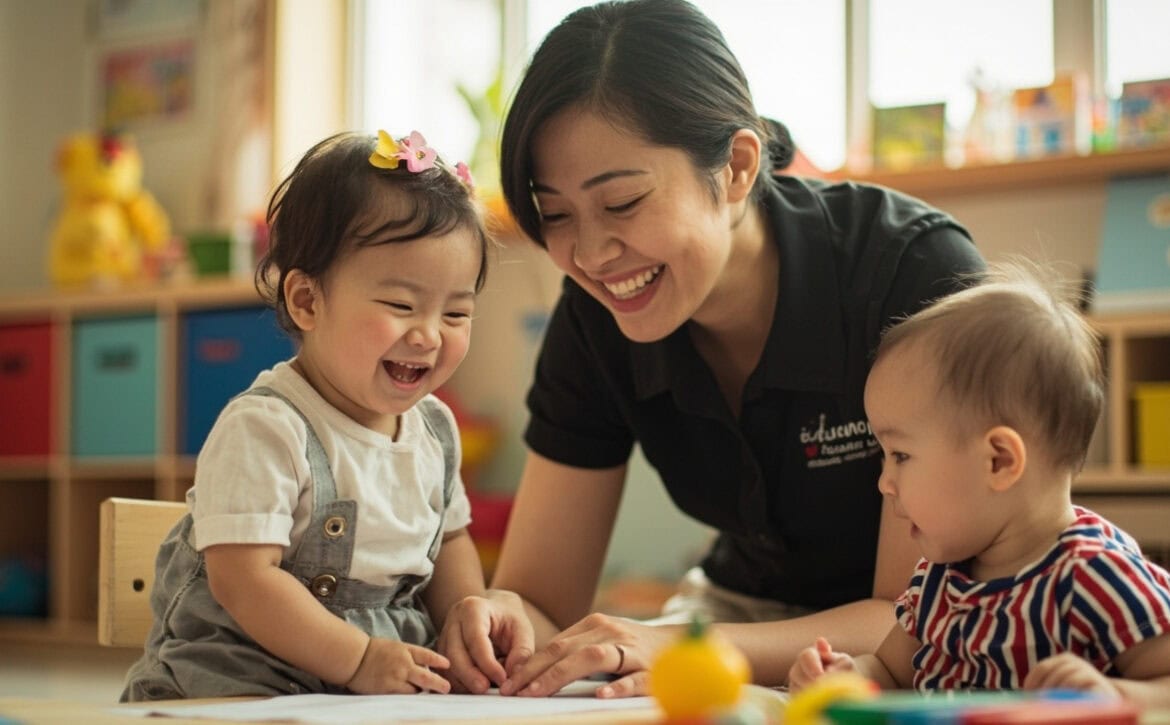

edunanny-0666498990aa79d4fac87e4408ce4cc0
May 28, 2026

The Evening Signals That Tell You If Your Child Is Thriving

The Moment Every Singapore Parent Knows

There is a moment that happens every single day in Singapore — in HDB flats and condominiums, in living rooms and kitchens, at six in the evening or sometimes later. A child walks through the door after childcare, and a parent takes one look — and wonders.

Not with worry, exactly. Not with anxiety. But with that particular, quiet wondering that comes from loving a small person deeply and wanting to understand them fully. Is this child okay? Not just safe, but okay. Not just settled, but thriving. What happened today? What did they learn? Are they growing in ways I cannot always see?

You are not imagining this. And you are not alone.

This article is an invitation to notice what is already there — unfolding in your own child, shaped in ways both visible and subtle by the quality of care they receive. You will learn how to read the signals your child has been sending you all along, and discover how quality childminding creates the conditions for those signals to emerge clearly, confidently, and beautifully.


What Your Child’s Evening Behavior Is Actually Telling You

You pick up your child at the end of the day. Perhaps they are in your arms, perhaps walking beside you, perhaps already running ahead toward the familiar spaces of home. And in that first moment of reunion, something passes across their face.

Excitement, certainly. Relief, maybe. But something else too — a quality of being that tells you, without words, how this day went. Watch for these four signals in the hours after childcare. Each one tells you something real about what happened during your day apart.

Language That Tells a Story

You might notice they are chattier than usual. They want to tell you about something — a song they learned, a friend they played with, a teacher who did something funny. That verbal explosion in the evening car or at the dinner table, the outpouring of language after hours of relative quiet — that is not random. That is your child’s brain processing, integrating, and sharing what mattered to them during the day.

Here is what many parents do not realize: that language does not appear from nowhere. It is cultivated. It grows through specific kinds of interaction — responsive conversation, adults who narrate the world back to a child, who ask open questions, who wait for and truly listen to the answer, even when that answer is two words or a gesture or a pointing finger toward something only they find fascinating.

When a child returns from childcare and is eager to share, when they have words and phrases and stories built up from the day, when they are not just physically present but linguistically alive — this is a window into what happened in those hours. This is evidence of a care environment that understood language as something to be fed, not just managed.

Curiosity That Spills Over

Watch a child who has spent the day in genuinely developmental care, and you will notice something about their curiosity. It is not performed. It is not the result of a structured activity or a scheduled lesson. It emerges naturally, spilling over into the hours after care like water from a vessel that has been filled.

A child who has been in quality care will often come home and reenact what they learned — not because they were taught to, but because learning that is real creates a kind of inner pressure that demands expression. They might line up their toys and narrate a version of circle time. They might ask you to sit down so they can show you the song from school. They might suddenly be interested in something they never noticed before — a bug on the walkway, the texture of a leaf, the way water moves — because their senses have been awakened by a day of rich, guided exploration.

This is the quality to notice: spontaneous, self-generated engagement. Not compliance. Not sitting quietly. But a child who is internally motivated to explore, to ask, to try. This is different from a child who has been kept safe and entertained. A kept child may be happy. A truly engaged child is alive with learning.

Motor Confidence

Watch your child move — not during a structured activity, not on the playground with you hovering nearby, but in the free, unguarded moments. Running through the living room. Climbing onto the sofa. Navigating the familiar terrain of home after a day in care.

A child whose motor skills are being supported through thoughtful, play-based experiences will move with a certain confidence. They will reach and stretch and balance with increasing precision. They will not be afraid of moderate challenges — stepping up onto something, navigating around an obstacle, carrying something slightly heavy. Their bodies will feel like reliable instruments, extensions of their will rather than sources of uncertainty.

This motor confidence is not separate from cognitive and emotional development. It is woven together with them. A child who feels physically capable is building a sense of agency, of self-efficacy, of the pleasure of being able to do things. And this confidence in the body creates the foundation for confidence in all other domains — the willingness to try, to persist, to believe that effort leads to outcome.

The way your child inhabits their body after care is a direct reflection of how their body was used, challenged, and trusted during the hours you were apart.

Social Ease

Notice how your child relates to other people after care. Not to you — that bond is deep and fundamental and does not break easily. But to others. To other children. To unfamiliar adults. To the social world beyond the family.

A child who has experienced secure, high-quality care — where their emotional needs were met consistently, where their communications were responded to with attunement, where they learned that other people can be trusted sources of comfort and joy — this child will often show a particular quality of social ease. They may be shy in new situations, as many children are, but they will recover quickly. They will be curious about other children, drawn to play alongside them, interested in the social world rather than frightened by it.

This social ease does not appear by accident. It is built, day by day, in environments where children had the chance to interact with well-trained caregivers and with peers, under guidance that was warm but not intrusive, supportive but not controlling.


The Gap Between Supervision and Genuine Engagement

The difference between these two experiences — supervision and genuine developmental engagement — is one of the most important things a parent can learn to recognize.

It is not always obvious. A child in either scenario may smile. A child in either scenario may seem content. But over time, with attentive observation, the difference becomes clear. The child in developmental care brings something home: ideas, questions, energy, a desire to share and participate and grow.

A child in a purely supervisory environment may be happy, fed, and safe — and those things matter. But they may also come home without that overflow of language, without that spark of curiosity, without the motor confidence or social ease that signals genuine growth.

What Supervision Looks Like What Developmental Engagement Looks Like
Child is safe, fed, and content Child is safe, engaged, and growing
Activities are primarily entertainment Activities are responsive to child’s interests
Child may appear passive or restless at home Child brings curiosity and language home
Caregiver manages the group Caregiver responds to each child individually
Learning may feel like a checklist Learning emerges through meaningful play

You Are Your Child’s Most Important Observer

The word “development” can feel intimidating. It can feel like something measured by professionals, assessed through standardized tools, reported in graphs and milestone charts.

But here is what I want you to know: you, as your child’s parent, are already their most important developmental observer. Not because you have training, though training can help. But because you have something no professional has: a lifetime of knowing this particular child, an intimacy with their rhythms and patterns, their typical responses and their surprises. You know when something is different. You know when something is missing. You know your child in a way that no checklist can capture.

Parents who learn to recognize these signals in their children are not more anxious. They are more confident. Because anxiety comes from not knowing. Clarity comes from seeing.

When you learn to recognize the signals — language, curiosity, motor confidence, social ease — you are not becoming a clinician. You are becoming more fully yourself as a parent. You are paying attention to what is already there.

Common Concerns, Honest Answers

“How do I know if my child is actually learning, or just being kept busy?”
Learning that is real creates a kind of inner pressure that demands expression. If your child comes home and reenacts something from their day — a song, a routine, a game — this is evidence of genuine learning. True learning does not stay contained within the hours of care. It overflows into the hours at home, expressed through language, curiosity, and the desire to share.

“What if my child seems happy but I don’t see these signals?”
Happiness and development are related but not identical. A child can be happy in a purely supervisory environment. What you are looking for is evidence of engagement — the overflow of language, the spontaneous curiosity, the motor confidence, the social ease. These are signs that your child’s mind and body are being challenged and grown, not just kept content.

“Isn’t it normal for children to be tired or cranky after childcare?”
Some tiredness is normal — children exert themselves physically and socially during the day. But watch for the quality of that tiredness. Is your child tired but still engaged? Still curious? Still willing to share and connect? Or are they listless, restless, and withdrawn? The first kind of tiredness is the tiredness of a child who has been genuinely stimulated. The second may indicate a day of passive entertainment rather than active engagement.

“My child is still young — aren’t I expecting too much?”
You are not expecting too much. You are paying attention. From the earliest months, children are wired for connection, communication, and learning. The signals described in this article — language responsiveness, motor exploration, social interest — are present even in infants, expressed in developmentally appropriate ways. The key is consistency: watching over time, noticing patterns, and trusting what you see.


What Quality Childminding Looks Like in Singapore

Understanding developmental signals is only one part of the picture. The other is knowing what to look for in a care arrangement — and how to distinguish between options that may sound similar but deliver very different experiences.

The ECDA Framework and Why It Matters

In Singapore, the Early Childhood Development Agency (ECDA) has established frameworks designed to raise the standard of home-based and community-based care. When a childminding service operates within this framework, it means the service has been designed with developmental quality as an explicit goal — not just as an aspiration, but as a measurable outcome.

This is significant for parents. It means the service has been reviewed, structured, and supported to deliver experiences that go beyond basic supervision. It means there are standards in place around caregiver training, ratios, and the kinds of activities and interactions children are offered throughout the day.

Why Smaller Ratios Change Everything

One of the most important structural differences between quality care and basic supervision is the ratio of caregivers to children. Research consistently shows that smaller ratios enable more responsive interaction, more language, more attunement. When a caregiver can truly see and hear each child, the quality of engagement is fundamentally different.

For infant care especially, ratios matter enormously. A child is not one of many. A child is one of a few — and that difference is measurable in your child’s behavior, in their language, in the ease they bring home.

Questions to Ask Any Childcare Provider

  • What is the caregiver-to-child ratio?
  • How is a typical day structured? Is there time for free play and guided exploration?
  • How do caregivers respond when a child is upset or seeking attention?
  • How is language encouraged throughout the day — not just during designated “learning” times?
  • What opportunities do children have to move freely and safely?
  • How are children’s social interactions facilitated and supported?
  • What training do caregivers have in child development?

The answers to these questions — and the way the answers are given — will tell you a great deal about whether developmental engagement is truly at the center of the care philosophy, or whether it is a feature mentioned in marketing materials but not embedded in daily practice.


EduNanny Singapore: Built for Developmental Outcomes

EduNanny, by BUTLER, was built with a specific question at its center: How do I know my child is truly well cared for? Not just safe — parents know their children are safe. Not just supervised — parents know that is not enough. But genuinely engaged, supported, and prepared for the world in ways that matter.

EduNanny operates within the ECDA Childminding Pilot, part of a carefully structured system designed to raise the standard of home-based and community-based care across Singapore. This is not a casual arrangement. It is a deliberate framework, built on evidence and shaped by expertise, with the goal of giving parents the confidence that comes from knowing their child’s everyday experience is truly developmental.

EduNanny’s care settings maintain ratios designed for meaningful engagement. For infants, the ratios allow caregivers to respond to each child as an individual — not as one of a large group, but as a specific person with specific needs, interests, and rhythms. When a caregiver can truly attune to each child, the language, curiosity, and social development that follows is not accidental. It is the natural result of being truly seen.

Quality care should not be a privilege available only to those with significant resources. EduNanny accepts CDA funds and Baby Bonus, making it genuinely accessible to families across Singapore — in HDB flats and beyond. Care is available Monday to Friday, in structured blocks designed to fit the rhythms of working families.

EduNanny has built in the kind of transparency that modern parents deserve. Communication tools and even CCTV measures allow parents to stay connected to their child’s day — not in a surveillance sense, but in a partnership sense. You should know what is happening with your child. You should be able to ask, and receive honest answers. This kind of openness is not just a feature. It is an expression of respect for you as a parent.


A Path Forward: Trust What You See

Here is what I have learned, working alongside parents and watching children develop: you already know more than you think you do. Your child is speaking to you every single day. The question is not whether they are telling you something. The question is whether you know how to hear it — and whether the people caring for your child are creating the conditions for that voice to emerge clearly, confidently, and beautifully.

If you are a parent in Singapore researching infant care or childminding, here is what I encourage you to do:

  1. Start with observation. Pay attention to your child in the hours after care. Notice what they bring home — in language, in curiosity, in movement, in social ease. This is your baseline.
  2. Ask specific questions. When evaluating care options, ask about ratios, caregiver training, daily structure, and how language and social development are supported throughout the day.
  3. Look for alignment. Does the care philosophy match what you are hoping to see in your child? Is developmental engagement an explicit goal, or just an implied benefit?
  4. Trust your instincts. You know your child better than anyone. If something feels off, or if the signals you hoped to see are not appearing, take that seriously.
  5. Choose a partner, not just a service. You deserve a care provider that respects your role as your child’s most important observer — one that welcomes your questions, shares openly, and works with you as a partner in your child’s development.

What EduNanny has done — through its philosophy, its structure, its training, its ratios, its commitment to the ECDA framework — is to create the conditions for your child to speak that language fluently and clearly. So that when you pick them up at the end of the day, you see not just a happy child, but a developing child. Not just a safe child, but an engaged one. Not just a supervised child, but a child who is growing in every way that matters.

If you find yourself wondering at the end of the day — is my child okay? — I want you to know that wondering is not weakness. It is love paying attention. And that attention, that noticing, that willingness to ask the question honestly — this is the most important thing you can offer your child.

You are already watching. You are already wondering.

Now you have a framework to understand what you are seeing.

Your child is telling you something every day. EduNanny is here to help ensure that what they are telling you is this: I am growing. I am thriving. I am ready for everything that comes next.

And so, in time, are you.


EduNanny is a Singapore childminding service operating within the ECDA Childminding Pilot, built on the belief that every child deserves thoughtful, development-oriented care. Learn more about the EduNanny approach or get in touch to begin a conversation about your family’s needs.

edunanny-06663b4d8dbbfa78e6e7d85cce817c74
May 27, 2026

Finding the Right Childcare When Every Choice Feels Important

The Weight of the Search — and Why It Matters

There is a particular kind of silence that falls over a parent in Singapore the moment they begin searching for childcare. It is not the silence of peace. It is the silence of a mind running through too many variables at once — safety and stimulation, proximity and pedagogy, cost and curriculum, trust and temperament. It is the silence of someone who loves their child so completely that every decision feels like a referendum on that love.

If you have felt that silence, this is for you.

We want to start by naming something that does not get said often enough: the search itself is hard. Not because parents lack good judgment, but because they feel the stakes of every choice in their bones.

You are not indecisive. You are not anxious for no reason. You are a parent carrying the full weight of what it means to raise a child well, and that weight deserves to be acknowledged, not pathologized.

In Singapore, the landscape of early care has grown more sophisticated, more varied, and more demanding than ever before. Parents today have access to centre-based programmes, home-based arrangements, community pathways, and pilot schemes that were barely imaginable a decade ago.

This is a gift. But it also creates a paradox of abundance — more options, and yet the pressure to choose the right one intensifies. You are not just choosing a service. You are choosing an environment where your child’s first relationships outside the family will take shape. Where language begins. Where social instinct awakens. Where trust is either confirmed or complicated.


Outsourcing Is Not the Same as Expanding

Let us be direct about what EduNanny offers, and what it does not claim to be. We are not a replacement for parental presence. We are not a system designed to do what you do, only cheaper and faster.

We are, at our best, an extension of the care circle you have already begun to draw around your child. A programme built on the recognition that you, as a parent, have already laid the foundation — through thousands of small moments of attunement, through the voice your child already recognises, through the sense of security you have built in those early months.

What we offer is a structured, thoughtfully designed environment where that foundation is respected and built upon, not overwritten.

The guilt that many Singapore parents carry — the sense that choosing external care is somehow a failure of devotion — rests on a false premise. It assumes that the love a parent offers and the care a trained, attentive caregiver offers are in competition. They are not.

A child whose parents have nurtured them through their earliest months, and whose subsequent care environment is warm, consistent, and developmentally rich, has been doubled in their good fortune. That is not a compromise. That is an expansion.


What Quality Actually Looks Like

Understanding what quality looks like matters — not as an abstract ideal, but as something you can observe, ask about, and trust. Here are the elements we believe make the difference.

Genuine Attention Through Thoughtful Ratios

In an environment where a caregiver can give unhurried attention to each infant, the texture of the day is different. There is time to notice when a child’s interest shifts, when fatigue is approaching, when a particular sound or texture is captivating them. There is space for the kind of responsiveness that neuroscience has shown us matters profoundly in the first thousand days — not as theory, but as daily practice.

EduNanny operates within ECDA Childminding Pilot structures that reflect a genuinely different philosophy of infant care. With ratios designed for individual attention, the emphasis is not on managing groups but on attending to individuals.

Communication That Keeps You Connected

We have built transparency into the programme in ways that Singapore parents have long deserved but rarely been offered. Where deployed, digital tools and observation measures allow parents to stay genuinely connected to their child’s day — not through glossy daily reports that say everything is wonderful, but through real, honest windows into what is happening.

When a parent can see, understand, and trust what is happening in their child’s day, something shifts. The invisible wall between home and care environment dissolves. The parent is no longer a peripheral figure receiving secondhand accounts. They are a participant in the story.

The Caregiver as Professional

We believe deeply in the role of the childminder — not as a worker executing a task list, but as a professional whose craft deserves dignity and recognition. The childminder who knows your child’s signals, who understands the difference between a cry of frustration and a cry of overstimulation, who can create a rhythm of the day that feels nurturing rather than mechanical — this person is not a footnote in your child’s development. They are a significant figure in it.

At EduNanny, the caregivers we work alongside are not chosen for availability alone. They are supported, trained, and positioned as the professionals they are — because a system that respects its caregivers is a system that can offer your child the quality of attention that matters.


Making Quality Care Accessible

For many families, the practical dimension of childcare cannot be separated from the emotional one. The cost of quality care in Singapore is a genuine concern, and we do not pretend otherwise.

The ECDA Childminding Pilot structures within which EduNanny operates are designed to make quality care more accessible, with fee structures that reflect a commitment to affordability without compromising on the attention and care your child receives.

For families navigating the complexities of financing early care, several pathways may help bridge the gap:

  • CDA Funds: The Child Development Account can be used for approved childcare and infant care services, reducing immediate out-of-pocket expenses for eligible families.
  • Baby Bonus Scheme: Government contributions and savings grants can provide additional support for families planning their childcare expenditure.
  • Subsidies: Depending on your household situation and programme structure, various subsidies may be applicable to help manage costs.

These are not abstract policy details. For a family sitting around a dining table after the children have slept, trying to make the numbers work without sacrificing the standard of care they want for their child — these mechanisms are real. They are practical acts of recognition that Singapore parents deserve options that do not force them to choose between affordability and excellence.


Your Practical Guide to the Search

The search matters not just as a means to an end, but as a form of education in its own right. When you visit a centre, ask about ratios, and observe how a caregiver responds to a child who is not their own — you are not just gathering data. You are training yourself to recognise quality when you see it.

Every question you ask sharpens your instinct. Every interaction you observe adds a reference point. The parent who leaves a tour with more questions than answers is not failing. They are beginning to see clearly.

Here is what to look for and ask during your visits:

What to Observe

  • How caregivers kneel to meet a child’s eye. This small gesture reveals whether the adults in the room see children as individuals to be met, not managed.
  • How the environment responds to a child who is upset. Watch for calm, unhurried responses that acknowledge the child’s feelings rather than just the behaviour.
  • The texture of the day. Is there a rhythm, or does everything feel reactive? A good care environment has structure without rigidity.
  • How staff speak about children when parents are not listening. The language used when they do not know they are being observed tells you everything.

Questions Worth Asking

  • What is the caregiver-to-infant ratio, and how does it change throughout the day?
  • How do you handle transitions — particularly the morning handoff and afternoon pickup?
  • What does communication with parents look like in practice, not in theory?
  • How are caregivers supported, trained, and evaluated?
  • What happens if my child’s needs on a given day are different from the routine?
  • Can I speak with families currently using this service?

What to Trust

Your instincts matter. If something feels off during a visit — if the warmth does not quite reach the eyes, if the answers feel scripted, if you sense that your questions are an inconvenience — take that seriously. You do not need to explain it away or rationalise it. Your discomfort is data.


What You Are Really Worried About

Parents come to us with specific concerns, and we think it is honest to address some of them directly.

“Will my child feel abandoned?”

Separation anxiety is real, and it is a sign that your child has formed a healthy attachment to you. What matters is how the transition is managed — with patience, consistency, and genuine warmth from the caregiver. A good start does not erase tears, but it does mean that the tears diminish over time as trust builds with the new caregiver.

“What if the caregiver does things differently than I do?”

This is not the goal. You are not looking for someone to replicate your parenting. You are looking for someone whose approach complements yours — someone who respects your role as the primary figure in your child’s life while bringing their own warmth, skill, and consistency.

“What if I change my mind later?”

Flexibility matters. A childcare arrangement that cannot acknowledge that your family’s needs may shift is not truly serving you. Look for providers who understand that your needs on a Wednesday are not necessarily your needs on a Friday, and that your child’s needs this month are not necessarily their needs next month.

“How do I know if this is the right fit?”

When you find the right fit, you will notice it. Your child settles. The caregiver becomes someone you trust. You walk out of a morning handoff feeling not guilt but genuine peace. These are not vague feelings — they are the evidence of a match that works.


You Are Closer to Knowing Than You Think

Let us return to where this began, because the emotional truth of the childcare search is not something to be glossed over in favour of programme details, however important those details are.

You came to this decision not because you wanted to, but because life in Singapore requires it. Because work demands, because family structures evolve, because raising a child in this city means navigating realities that previous generations did not face in the same way.

And yet you are handling it. Not perfectly — no one does — but with a seriousness and a thoughtfulness that we see every day in the parents we work with.

The questions you ask during a visit, the observations you make about how your child responds to a new person, the internal calculations you run about what your family needs versus what it can sustain — these are not the actions of a parent who is failing. These are the actions of a parent who is paying attention. And paying attention is the most important qualification for this work.

By the time you have done the research, visited the centres, asked the hard questions, watched how a caregiver kneels to meet a child’s eye, read the feedback from other parents, and weighed everything against what you know in your bones about your own child — you are closer to knowing than you think.

The doubt you feel is not evidence that you cannot choose well. It is the cost of caring enough to get it right. And that cost, painful as it sometimes is, is also a gift — because it means you will not settle. It means the childcare you choose will have been chosen, not just found.

EduNanny is not for every family, and we would rather you knew that honestly than chose us for the wrong reasons. But for the family that is searching with clear eyes, who wants a care environment that respects their role as the primary figures in their child’s life, who values responsiveness and professional consistency, who wants to feel like a partner in their child’s day rather than a peripheral observer — for that family, we hope you will find in us what we try to be every single day: worthy of the trust you are extending.

Not because we are perfect. No programme is. But because we take seriously the responsibility of standing beside you in this. Because we know that the relationship between a family and their childcare provider is not a transaction. It is a relationship, and like all real relationships, it requires humility, honesty, and a genuine desire to serve something larger than efficiency.


Ready to Begin the Conversation?

If you are searching for infant care or childminding in Singapore, we invite you to connect with EduNanny to learn more about how we support families through the ECDA Childminding Pilot framework — with small ratios, genuine transparency, and a deep respect for the role you play in your child’s life.

Sometimes the hardest part is simply starting the dialogue. We are here to listen, to answer your questions honestly, and to help you think through what you are looking for — whether or not that ends up being us.

edunanny-06662d70136515bb1acc5a1c96810741
May 27, 2026

What Your Gut Already Knows About Finding Quality Childcare in Singapore

The Weight of This Decision

You’ve walked out of the tour. You’ve nodded at the right moments. You’ve admired the colourful classrooms and the carefully arranged learning corners. And now you’re sitting in your car, and something doesn’t feel quite right.

Not because you saw anything alarming — you didn’t. The facilities were impressive. The staff were warm. The curriculum was printed on the wall in clean, confident type. But somewhere beneath all that polish, a question lingers: Is this actually good for my child?

If you know that feeling, I want you to know something else too. You are not missing something. You are not an anxious parent who needs to relax. You are a parent who is asking exactly the right question — and that question deserves a real answer.

Choosing childcare in Singapore is one of the most consequential decisions a family makes. Not because the stakes are dramatic — most centres are safe, most caregivers are well-intentioned — but because of the sheer volume of time your child will spend there during years that shape everything that comes after.

The architecture of language, of emotional regulation, of curiosity and security — these are built in the first thousand days, in the thousands of ordinary hours that make up a young child’s life. Singapore parents understand this. You have read the articles. You have bookmarked the resources. You care deeply, and you want to get this right.

And yet, somehow, the process of choosing childcare does not match the gravity of what it represents. It often feels like a competition of impressions — a polished performance designed to make you feel confident in the moment, and uncertain the moment you leave.


Five Signals of Genuine Quality in Childcare

Most parents begin their search the same way: visiting centres, admiring facilities, nodding along to presentations. It is completely reasonable to do this. It is also, by itself, not enough.

The reason is simple: what you see on a tour is, by definition, a curated version of reality. The staff who greet you are on their best behaviour. The children you see may have been prepared. The classroom you admire was likely tidied before you arrived.

None of this makes any centre dishonest. But it does mean that if you want to find genuine quality, you have to look past the performance to the signal beneath it.

1. Watch the Children Who Are Not Being Watched

The first and most honest data point you will ever get from a tour is what you see in the children who are already there — the ones who are not being managed for your visit.

Observe how they move. Not whether they are sitting neatly, but how they inhabit the space. Are they wandering with a sense of purpose, picking things up, moving from one activity to another with the ease of children who know where they are? Or are they static — parked in front of screens or kept in one spot because movement requires supervision they are not receiving?

Listen to the sound of the room. Not silence — young children at their best are not silent. But what kind of noise fills the space? Is it the purposeful hum of children who are absorbed in what they are doing? Or is it the dull, flat quiet of children who have learned that making noise attracts unwanted attention?

2. How Caregivers Respond to Mild Distress

The meaningful test is subtler than how adults respond to a screaming child — every caregiver will do that. The real signal is how they respond to a child who is hovering at the edge of upset, who needs something small: a comfort, a redirect, a moment of genuine eye contact.

Watch whether caregivers kneel or sit to meet a child’s eye level, or whether they remain standing and speak down. Watch whether they address the underlying need or simply suppress the behaviour. Watch whether the child settles, or whether the same child repeats the same small distress five minutes later because it was never truly met.

That difference — between managing behaviour and meeting need — is the difference between a caregiver who is present and a caregiver who is performing the role of being present. Over time, children know the difference. And so will you, once you learn to look.

3. Read the Transitions

Every centre looks good during a structured activity. Circle time, art, snack time — these are scheduled, visible, designed to demonstrate learning and socialisation.

But transitions — the moments between activities, the shift from free play to group time, the handoff at pickup — are where the culture of a centre lives.

A centre that runs beautifully on a schedule but falls apart in the gaps between activities is not running beautifully. It is running on a script, and the script ends the moment something unexpected happens.

Watch whether there is a rhythm to transitions — a gentle, purposeful movement from one moment to the next, led by a caregiver who clearly knows what comes next and why. Or do children simply drift, waiting for something to happen, guided by a voice that sounds more like crowd control than warmth?

4. Consistency of People

Visit a centre more than once. Visit at different times of day. If you can, return on a different day of the week. Ask yourself:

  • Do I see the same caregivers?
  • Do the children on my second visit look comfortable — not merely quiet, but genuinely at ease — in a way that suggests they know who is looking after them?
  • Or are there new faces each time, a sense that this is a revolving door of temporary supervision?

Children do not develop security from a beautiful room. They develop it from relationships with people who keep showing up.

A 1:3 infant ratio is not just a regulatory metric. It is the structural condition that makes real relationship possible. When a caregiver has three infants rather than eight or ten, she can learn each child’s rhythms, notice each child’s shifting moods, respond to each child’s individual needs. That is not a luxury. That is the mechanism through which security becomes something a child actually feels, rather than a word on a brochure.

5. Communication That Reveals Genuine Attention

When you pick up your child, what do you hear? When you message the centre in the morning, how quickly and personally do they respond?

A quality centre communicates not because they have been reminded to do so by a policy, but because the people working there are genuinely attentive to your child as an individual. They notice things. They remember things.

They tell you not just that your child ate well, but that she was fascinated by a butterfly on the window. They tell you not just that he slept, but that he seemed restless today and they wondered if he might be coming down with something.

That kind of communication does not come from a template. It comes from genuine attentiveness — from a culture that sees children, not just daily schedules. And it is one of the clearest markers of quality you will ever encounter, because it cannot be faked on a tour. Either the people in that room are paying attention, or they are not.


Quality Is Recognised, Not Discovered

All of these signals — the children’s movement, the caregiver’s responsiveness, the quality of transitions, the consistency of relationships, the depth of communication — are what you are really looking for when you walk into a centre, even if you did not have the language for it before.

Which brings me to something I believe deeply, and which is at the heart of what EduNanny Singapore stands for.

Quality in childcare is not discovered. It is recognised.

Discovery means hoping you stumble upon the right centre. Recognition means knowing what you are looking at when you see it. Recognition transforms a parent from someone who is influenced by a polished tour into someone who is guided by genuine understanding.


What EduNanny Brings to This Work

EduNanny is not simply a childcare service. It is a community of practice built around something very specific: what authentic quality actually looks and feels like, refined through thousands of real encounters with real families.

We have seen what works. We have seen what does not. We have been inside centres across Singapore and watched for the signals that matter — and we have built our entire approach around making those signals visible, understandable, and actionable for parents like you.

What sets EduNanny apart is not just that we know what quality looks like. It is that we have been part of creating it.

We are part of the ECDA Childminding Pilot — a programme built on rigorous standards, real oversight, and a genuine commitment to the professionalisation of infant care. We offer both home-based and centre-based pathways, because we know that every family’s situation is different, and the right arrangement is the one that fits your life, your values, and your child’s needs.

Our infant ratios are designed to allow for the responsiveness that genuine care requires. Our caregivers are not interchangeable. They are trained, valued, and supported as the professionals they are.

We build trust not just through philosophy, but through practice. Our communication with families is ongoing, genuine, and purposeful — because we believe you deserve to know what is happening with your child, not just that something happened. Where CCTV is deployed, it is deployed not as surveillance, but as transparency — a signal that we have nothing to hide, because we are proud of what we offer.

Addressing What Singapore Parents Actually Worry About

We understand that childcare in Singapore is a significant commitment, and families have real concerns that deserve honest answers.

On affordability: Our fee structures within the pilot are built to be accessible. CDA and Baby Bonus contributions can be used, which means the financial logistics need not add to the emotional weight of an already demanding decision.

On flexibility: We offer both home-based and centre-based options. The right arrangement is the one that fits your life — not the one that forces your life into a predetermined shape.

On support: When questions come up — at any hour, in any moment of uncertainty — the Thomas AI Chatbot is there as a resource, because we know that the support parents need does not always arrive between nine and five.

Perhaps the most important thing EduNanny offers is something less tangible, and yet, we believe, the most valuable of all. It is the reassurance that comes not from a sales conversation, but from a genuine exchange with people who have walked this road hundreds of times with families who arrived exactly where you are now.

The fear, the second-guessing, the sense that you are making a decision with insufficient information — these are not weaknesses to be allayed. They are the evidence of a parent who cares enormously, and who deserves to be met with real expertise, not a rehearsed pitch.


What You Can Do Starting Today

Whether or not you choose EduNanny, here is what I want you to carry with you:

  1. Visit more than once. Return at different times of day, on different days of the week. First impressions are curated. Second impressions reveal patterns.
  2. Watch the unperformed moments. Notice the children who are not being shown off. How do they move? What does the room sound like when no one is managing it for visitors?
  3. Look for the quiet responses. When a child needs something small — not a crisis, just a moment of attention — notice how caregivers respond. Do they meet the need, or just manage the behaviour?
  4. Read the transitions. How do children move from one activity to the next? Is there rhythm, warmth, and purpose — or drift and crowd control?
  5. Ask about consistency. Who will actually be caring for your child day to day? Will they be the same people, or a rotating cast?
  6. Notice communication. When you pick up your child, what do you hear? Is it transactional, or does it reflect genuine attention to your child’s individual experience that day?

The Clarity That Changes Everything

Choosing childcare is not about finding perfection. It is about finding clarity — the kind that comes from knowing what genuine quality looks and feels like, not just what it says about itself in a brochure.

And once you have that clarity, something remarkable happens. The anxiety does not disappear entirely, because you care too much for that. But it transforms. It becomes the quiet, grounded confidence of a parent who knows what to look for, who trusts their observations, and who can make a decision not from a place of fear or marketing influence, but from a place of genuine understanding.

That is what EduNanny is here for. Not to promise you the impossible. Not to tell you what you want to hear. But to stand beside you in one of the most important decisions you will make, and to help you see what is really there — with clarity, with confidence, and with the deep respect that every Singapore parent deserves.

Because when you know what to look for, you do not just find a centre. You find quality. You find care. You find the people who will hold your child with the same seriousness, the same tenderness, and the same daily commitment that you do.

And that changes everything.


Curious about what genuine quality looks like up close? Connect with EduNanny Singapore to start a conversation — no pressure, no pitch, just an honest exchange with people who understand what you’re going through.

Learn more about EduNanny or read about our approach and values.

edunanny-0666112293b06b7eadecfbdae7260716
May 27, 2026

What Your Child Is Really Telling You After Childcare in Singapore

The Quiet Voice Every Singapore Parent Knows

There is a moment familiar to every parent who has walked through the doors of a childcare centre or welcomed a childminder into their home. The paperwork is signed. The settling visits are underway. The arrangements that once felt abstract and daunting have become woven into the rhythm of your week.

And in that moment, a strange thing happens. A quiet voice inside you begins to ask a different question.

Not: Have we chosen well?

But: How do I know?

How do I know if this is truly right for my child? How do I know if the care my son or daughter receives each day is the kind that will stay with them, shaping them, accompanying them through life? How do I know if I am learning to see what is actually happening, or if I am simply hoping?

This is where the real journey begins. Not in the choosing—that is merely the threshold. The journey lives in the days and weeks and months that follow, when a parent steps into the role of something more than a decision-maker.

You become an observer. A reader of signs. Someone who learns, slowly and sometimes uncertainly, to interpret the language your child speaks without words. And this is exactly what EduNanny Singapore has been designed to walk alongside you through.


Reading Your Child’s Signals After Childcare

Consider, for a moment, what your child brings home each evening. A change of clothes. A tired body. Perhaps a painting, a song learned, a new word picked up from their caregiver. But beneath these surface details, something else is communicating—whether the day was spent in safety or in stress, in engagement or in mere waiting.

Children are extraordinary communicators, even when they cannot yet speak in full sentences.

Signs of Safety and Security

A toddler who returns from quality care will often carry subtle signatures of that experience in their mood, their play, their curiosity, the way they reach for you or move independently around the room. A baby who feels genuinely held and responded to will show it in the quality of their attention, the ease with which they settle, the trust that radiates from their body when a familiar caregiver approaches.

What does a child look like when they feel safe? They explore freely. They are not constantly checking for reassurance. They can lose themselves in play because the world feels predictable, because the adults around them feel reliable, because their nervous system has learned that it can rest.

When your child returns from childcare and plays freely, when they engage in imaginative play that stretches their thinking, when they are curious about the world rather than guarded against it—these are not small things. These are profound signs that the environment is doing what it should.

Signs of Being Valued and Known

What does a child look like when they feel valued? They are more likely to initiate interaction, to show pride in small accomplishments, to seek connection not out of desperation but out of genuine warmth. A child who runs to greet their caregiver in the morning, who waves goodbye with calm rather than distress, who speaks about their day with pleasure rather than vague indifference—these are the communications of a child who knows, at some deep level, that they matter in that place.

In Singapore’s fast-paced environment, where dual-income households are common and reliable childcare is essential, these signs become especially important to watch. The demands on parents are real, but the need to stay attuned to your child’s inner world does not diminish. If anything, it deepens.


Adjustment Versus Genuine Concern: Knowing the Difference

And what about the harder signs? The ones that give a parent pause?

This is where wisdom is needed, because not every moment of hesitation or resistance means something is wrong. Adjustment takes time. Every child moves through transitions differently, and some children are more sensitive to change than others. A first week of tears is not a warning sign. A month of difficulty separating may simply reflect a temperament that needs more time, more consistency, more patient reassurance.

But there is a difference between the normal texture of adjustment and the signal that something is genuinely misaligned.

Signs That May Warrant Closer Attention

  • When a child’s distress does not ease over time despite consistent, warm care
  • When they seem to regress rather than grow into the experience
  • When the joy seems to drain from them week after week rather than slowly return
  • When a child stops speaking about their day entirely
  • When they become withdrawn or aggressive in ways that feel unfamiliar
  • When your caregiver cannot offer clear, honest observations about what they are seeing

These are not moments to ignore. They are moments to trust yourself and to ask harder questions—not in panic, but in purposeful curiosity.


Growing Perceptiveness, Not Anxiety

There is a distinction worth making here, because it is one of the most important things a parent can learn: the difference between growing perceptiveness and growing anxiety.

What Anxiety Looks Like

Anxiety looks inward. It fixates on worst-case scenarios. It interprets ambiguity as danger. It whispers that you are not doing enough, that something is surely wrong, that you cannot trust anyone else with what matters most. Anxiety is exhausting, and it can distort your perception of your child, making you see distress where there is merely normal tiredness, dysfunction where there is simply the ordinary complexity of growing up.

What Perceptiveness Looks Like

Perceptiveness looks outward. It observes your child with curiosity rather than fear. It notices patterns over time rather than reacting to single moments. It holds space for uncertainty without collapsing into panic.

The goal is not to eliminate all uncertainty. The goal is to become someone who can sit with uncertainty and still read clearly. This is the kind of parent EduNanny wants to help you become—not more anxious, but more present. Not more watchful in a way that drains joy, but more attuned in a way that deepens connection.

What Quality Childminding Actually Looks Like

Quality childcare is not just about what happens during the hours of care. It is about the transparency, the communication, the willingness to be a true partner in your child’s wellbeing.

Parents deserve to know not just that their child was fed and slept and played with, but how. What did they enjoy? What challenged them? Who were they today?

  • Consistent, warm updates that go beyond logistics to share genuine observations about your child’s day
  • Honest communication even when it includes challenges or difficulties
  • A caregiver who knows your child as an individual—not just as another child in their care
  • Small ratios that allow for individual attention and genuine attunement
  • Partnership mindset where the caregiver sees themselves as working with you, not for you
  • Respect for your parental insight and willingness to integrate what you share about your child at home

The EduNanny Partnership in Perception

And here is what we have learned from working with families across Singapore: this kind of perceptiveness grows best when it is met with the right kind of partnership.

When you have a childcare arrangement that prioritises honest, consistent communication, you are not left to decode your child’s signals alone. The caregiver becomes a collaborator in understanding. They see your child in contexts you cannot see, and when they share what they observe with genuine care and attention, you are better equipped to integrate those observations with your own knowledge of your child.

The EduNanny by BUTLER approach exists because we understood that Singapore parents need more than a service. They need a relationship—a sustained, trustworthy partnership in which both sides are committed to the child’s flourishing.

Through our ECDA Childminder Pilot Programme, we have created pathways that bring quality care into the home environment or connect families with carefully supported community-based options, always with the infant ratios and safety standards that allow for the kind of individual attention every child deserves.

Our caregivers are not just trained. They are companions in your child’s development, and they understand that their role includes helping you become the perceptive, confident parent you are meant to be.

Skills That Last a Lifetime

There is a wisdom that comes from this kind of sustained attention. It is quiet, unhurried, accumulated through thousands of small observations over months and years. It is the wisdom of a parent who has learned to read not just their child’s behaviour but their child’s inner life, who can sense the difference between a bad day and a difficult season, who knows when to step in and when to trust the process.

This is not a skill that serves you only in the years of childcare. It is a skill that serves you through every phase of your child’s development. When they start school, you will read their social world with the perceptiveness you are building now. When they face challenges, you will trust the attunement you have practiced. When they grow into adolescence and young adulthood, you will have the foundation of a relationship built on genuine understanding, not just assumption.

Quality childcare, when it is done well, does not replace the parent-child bond. It deepens it. It gives your child additional experiences of warm, responsive care that reinforce the attachment style you are building at home. It gives you—the parent—more data, more insight, more opportunities to know your child in their fullness.


Your Next Steps on This Journey

Common Questions Singapore Parents Ask

“Am I relying too much on childcare?”

No. What you are doing is building a village. Quality childcare supplements the love and attention you provide; it does not substitute for it. Children thrive when they have multiple secure relationships to draw from—and parents who stay actively engaged with their child’s care experience develop deeper understanding, not shallower bonds.

“How do I know if I can trust my caregiver’s observations?”

Look for alignment over time. A caregiver who consistently shares thoughtful, detailed observations that ring true with what you know of your child at home is a caregiver you can trust. A caregiver who only tells you positive things, who is vague when asked specific questions, or whose account of your child feels disconnected from the child you know—this is worth paying attention to.

“What if I keep worrying no matter what?”

Some parental vigilance is healthy. But if worry feels constant, draining, or disruptive to your daily life and your relationship with your child, it may be worth speaking with someone—a trusted friend, a parenting support group, or a professional who understands the pressures Singapore parents face. The goal is not to eliminate care but to care with confidence.

Practical Steps for Building Your Perception

  • Observe patterns, not moments. One bad afternoon does not indicate a problem. A consistent pattern over weeks may warrant closer attention.
  • Ask specific questions. “What was she like at snack time?” will tell you more than “Did she have a good day?”
  • Notice the shift toward independence. A child who can separate calmly, who trusts that you will return, who engages with their caregiver—this is healthy development.
  • Trust your instinct, then verify. If something feels off, observe more closely before acting. If the feeling persists, ask your caregiver directly and without accusation.
  • Stay curious about the whole child. Their day, their friendships, their frustrations, their joys—not just whether they ate and slept.

You are already learning. Even now, as you read this, as you think about your child, as you wonder whether you are seeing clearly or merely hoping—you are already developing the perceptiveness that will serve you for the rest of your parenting journey. Every time you observe your child’s mood after a day of care and ask what it means, you are building that capacity.

You do not need to be perfect at this. No one is. But you can be intentional. You can be present. You can be the kind of parent who notices, who asks, who reflects, who grows.

Ready to Explore Your Options?

EduNanny Singapore stands beside you in this journey. Whether your family participates in our home-based childminding pathway, our community-based options, or any of the flexible arrangements we have designed to meet the real lives of Singapore parents—Monday to Friday care blocks, CDA and Baby Bonus usability, accessible pilot fee structures, transparent communication including CCTV measures where deployed—we are here not as a service provider you hire and forget, but as a sustained partner in your child’s development and your own growth as a parent.

We believe in the intelligence of Singapore parents. We believe in your capacity to read your child with depth and wisdom. And we believe that quality childcare, when it is built on trust, communication, and genuine care, does not weaken the parent-child bond—it strengthens it.

The journey you are on is not easy. But it is deeply meaningful. And you are not walking it without guidance. You are not walking it without support.

You are walking it with a growing ability to see your child as they truly are—and that, more than anything else, is an act of love.


To learn more about EduNanny Singapore and how we support families through quality childminding, visit our homepage or read about our ECDA Childminder Pilot Programme. If you have questions about finding the right care arrangement for your family, we welcome you to reach out to us directly.

edunanny-0666039e51051888ad84115b74a8494f
May 27, 2026

The Quiet Work of Sustained Childcare Partnership

The Quiet Reality of Sustained Childcare Partnership

Making a childcare decision ranks among the most consequential choices in early parenthood. You weighed options, trusted your instincts, and enrolled your child. The settling-in period passed, and both of you found your rhythm.

Then something shifts—quietly. The decision is behind you. The settling-in is behind you. What lies ahead demands something different entirely: sustained attention to quality, active participation in your child’s daily experience, and a deepening partnership with the people caring for your child.

This phase receives almost no guidance. Yet it is where the real work of childcare unfolds—in the months and years after enrollment, in the daily homecoming, in the conversations that build understanding, in the quiet moments that accumulate into something lasting.


Homecoming: Your Daily Quality Report Card

The moment your child returns from a day with their caregiver carries more weight than most parents initially recognize. That window of transition—when you pick them up, when they move from the care environment back into your arms—offers genuine insight into their daily experience.

When your child comes home settled, when they settle easily into your arms and then release to play as though no time has passed at all, that is information. When they sleep well and wake hungry. When they are curious and at ease. When they describe their day with the joy and drama children naturally bring to their storytelling—these responses tell you something important.

They are not reporting on what the caregiver performed for observation. They are reporting on the quality of the care they received. A child who is well cared for carries that in their body, in their confidence, in their ease.

Homecoming becomes your daily quality report—not a score or a checklist, but a felt sense that accumulates over weeks and months. Settled behavior, healthy appetite, ease with caregiver separation: all signal positive care experiences. Your child’s behavior is data. And it is one of the most important tools a parent has for evaluating sustained quality.


Reading the Signals: When Something Needs Attention

There will be days when something feels slightly different. A child who resists being brought to the caregiver in the morning. A child who seems flat after a day that was supposedly full of activities. A child who has a sudden burst of difficult behavior at home that seems to come from nowhere.

These moments are not failures. They are signals. The work lies in learning to read them—not to panic at them, but to hold them thoughtfully, to ask the right questions, to distinguish between a child who is having a difficult day and a pattern that deserves deeper attention.

A child who resists mornings may be experiencing separation anxiety, a disrupted routine, or a shift in the care environment. Or they may simply be a normal toddler testing boundaries. The distinction lies in observing over time, in noticing patterns rather than reacting to single moments.

Most days, the routine deserves trust. Children thrive on consistency. Caregivers build rhythms that serve children well. But learn to distinguish between normal variation and signals requiring deeper attention.

Ask more when you notice persistent changes in your child’s behavior:

  • When your child consistently resists mornings or seems unusually flat after supposedly full days
  • When you have a sense that something is off without being able to articulate exactly what
  • When communication feels one-directional
  • When you regularly leave homecoming without a clear sense of what your child’s day was like

Questions worth asking:

  • What did my child’s day typically look like?
  • How do they respond to frustration?
  • Who do they play with most?
  • What seems to interest them most right now?
  • What has been challenging for them recently?

The Partnership That Makes the Difference

After the settling-in period, a strange silence often falls over the parent-caregiver relationship. Parents are unsure how much to engage. They do not want to seem demanding. They show up in the mornings, exchange pleasantries, and leave.

The caregiver, for their part, may have been trained in care but not necessarily in sustained, proactive communication with parents. A relationship that has enormous potential quietly goes underdeveloped. This is one of the greatest missed opportunities in modern childcare.

Because the partnership between a parent and their child’s caregiver is one of the most consequential relationships in a child’s life. It is the bridge between the child’s two worlds—the home and the care environment. And it deserves the same attention, the same intention, the same willingness to grow over time that you bring to any important relationship in your life.

When you ask your caregiver how your child’s day was, you are not being a difficult parent. You are being a partner. When you share something from home—a change in routine, a new phase your child is going through, a concern you have noticed—you are not burdening the caregiver. You are giving them context that makes their care better.

And when a caregiver shares with you what they have noticed across the day—what your child gravitated toward, how they responded to a frustration, whether they seemed particularly connected to another child—you are receiving something invaluable. Not a report. An observation. A piece of the puzzle.

Practical Ways to Build This Partnership

Brief morning exchanges matter more than they might seem. Share one thing about your child’s night, their mood, anything that sets the day up. At homecoming, exchange brief observations—both what the caregiver noticed and what you noticed at home. These small moments compound into genuine understanding over time.

Parents observe their children in ways caregivers cannot. Share what you notice at home, even if it seems small. “She was really interested in the butterflies at the Botanic Gardens today.” “He’s been having trouble sharing at the playground.” These fragments help caregivers understand your child more completely.

When caregivers share observations, receive them with openness before questioning or defending. Caregivers observe children daily across many contexts. They notice patterns and comparisons you may not have. Openness to their perspective builds trust and deepens the partnership.

Use quarterly reviews not as administrative check-ins but as genuine conversations about your child’s development. Ask: What is emerging? What has shifted? Where might additional attention be useful in the coming months? These conversations strengthen the partnership in ways that benefit your child.

When something concerns you, raise it directly and without apology. A good caregiver relationship handles questions and concerns without defensiveness. “I have noticed X at home. Have you seen anything similar?” opens collaborative understanding.


Understanding Quality Development Over Time

Parents often feel uncertain about whether their child is developing the way they should, and whether the care they are receiving is genuinely supporting that development. Developmental milestones are often presented as checklists. At twelve months, your child should be doing this. At eighteen months, they should be doing that.

And while these benchmarks are useful guideposts, they can also create anxiety when parents do not have the context to interpret what they are seeing. Development is not a race. And the signs of healthy development are often more subtle than a checklist can capture.

Healthy development in the context of sustained, quality childcare looks like a child who is increasingly curious about the world. A child who attempts things and tolerates the frustration of not getting them right immediately. A child who is beginning to show genuine interest in other children, who is learning to share space and attention.

There is a meaningful difference between childcare that supervises and childcare that develops. Supervision means the child is safe, fed, changed, entertained. Development means something more intentional—it means the caregiver is designing experiences, structuring environments, building routines that are not just comfortable but genuinely enriching.

Quality care means noticing when a child has outgrown a certain kind of play and offering something slightly more challenging. Celebrating a small triumph with the same sincerity as a major milestone. Understanding that a child’s development is not something that happens on a schedule but something that unfolds in relationship, in response to the quality of attention they receive.

You will not see this in a photo from a centre tour. You will not see it in a first-day settling-in video. You see it when a caregiver has been with a child for months, when they know how that child approaches a problem, what makes them laugh, what makes them anxious, what they are reaching toward in their development.

When you walk into a space where sustained quality is the norm, you feel it. The caregiver who always seems to know what your child needs before they express it. The caregiver who maintains the same warmth on a difficult day as on a calm one. The caregiver who is not just going through the motions but is genuinely present, genuinely engaged, genuinely invested in the children in their care.

These are the signs of sustained quality that only show up months later—in the texture of daily life, in the consistency of care, in the way your child speaks about their day without speaking about it at all.


Moving Forward with Confidence

Quality that shows up over months feels different from initial impressions. You recognize it through accumulated experience rather than single moments.

It feels like your child running to their caregiver in the morning—not from desperation, but from genuine connection. It feels like a caregiver who remembers the small detail your child mentioned weeks ago. It feels like a routine that has become genuinely comforting, not merely organized.

Sustained quality feels like trust built gradually through consistent experience. It feels like conversations that deepen over months and years. It feels like knowing your child is known—not merely supervised, but genuinely understood by people who care.

Engaged parents make better partners. Questions signal that you care, that you are paying attention, that you are invested in your child’s wellbeing. A good caregiver welcomes this engagement. If your questions are received defensively, that itself is information worth noting.

The work ahead is not complicated, but it requires intention. It requires that you show up—not just physically, but attentively. That you ask the questions that matter. That you trust your observations and bring them to your caregiver with confidence. That you receive what your caregiver offers with openness and gratitude.

You bring something irreplaceable to this partnership. Your intimate knowledge of your child’s history, temperament, and needs. Your long-term investment in their wellbeing. Your perspective across time and contexts that no caregiver, however attentive, can fully replicate.

You are not a passive consumer of childcare. You are the most important person in your child’s life. And the months and years ahead are not a waiting period. They are a deepening—a deepening of your relationship with your child, with your caregiver, and with your own instincts as a parent.

Stay curious. Stay engaged. Trust what you observe. Build the partnership that serves your child best. The work is ongoing. And you are ready for it.


For families seeking childcare that values sustained quality, ongoing communication, and genuine developmental partnership, connect with EduNanny to learn more about how thoughtful childminding can support your family’s journey.

edunanny-0665f5150058506bfc4917f7483806df
May 27, 2026

What Your Child’s Homecoming Reveals About Quality Childcare

What Quality Childcare Actually Looks Like

Between the moment your child enters childcare in the morning and the moment you collect them in the afternoon, a great deal is supposed to happen. The ideal involves safe play, educational activities, kind teachers, and happy children. But the ideal is abstract, and what you need is specificity. You need to know what to look for. You need to understand the difference between a child being supervised and a child being genuinely engaged in the kind of developmental experience that justifies your trust and your fees.

The Responsiveness Signal

Watch how the caregiver responds when a child approaches with a question or a need. In genuine early childhood care, this response is immediate and warm. The caregiver kneels or bends to the child’s level, makes eye contact, and repeats back what the child has said — so the child knows they have been heard.

This is not a scripted behavior or a training manual checklist. This is the natural rhythm of an adult who is genuinely attentive to small people.

In contrast, you can observe what happens when responsiveness is absent: children who learn to repeat themselves louder, who learn to interrupt or act out because soft requests did not work the first time, who are in proximity to an adult but emotionally unattended.

The Language Environment

Listen to what is happening in the room. Children in quality care are surrounded by conversation — not just commands like “don’t do that,” “sit here,” or “wait,” but genuine back-and-forth dialogue.

A caregiver who narrates what a child is doing. Who asks open questions. Who introduces new words naturally throughout the day. Research on early language development is consistent: children acquire vocabulary not from passive exposure but from the density and quality of adult interaction.

When you visit or receive updates, listen for language. Is your child being spoken with, or just spoken to?

How Conflict Is Handled

Notice the social dynamics. How do children handle frustration or disappointment? In quality care settings, you will see caregivers guiding children through big emotions rather than simply managing behavior.

A child who takes a toy from another is not simply told to stop. They are helped to understand what they did, what the other child might be feeling, and how to ask for what they want next time. This is emotional regulation support, and it is one of the most important things that happens in early childhood. It is also invisible in photographs and difficult to capture in brief updates.


How to Read Between the Lines of Daily Updates

Most parents in Singapore receive some combination of daily updates: a written note in the communication book, a few photographs sent via an app, an incident report if something went wrong, or a verbal summary at pick-up. These updates are well-intentioned, but they are often incomplete. They tell you what happened without telling you what it meant. They report events without revealing the quality of the environment that produced them.

The Written Update

A daily update that says only “had a good day” is not information. It is an absence of complaint.

Push gently for more. Ask specifically:

  • How did my child respond to group activities?
  • Did she join in easily or hang back?
  • How did the teachers support her when she seemed frustrated?

A quality care setting will welcome these questions. They will have observations to share. They will not make you feel like you are being difficult or distrustful, because transparency is a sign of confidence in their work.

The Photographs

Photographs deserve careful attention. A photo of your child sitting at a table with art materials in front of them tells you that art materials existed. It does not tell you whether your child engaged with them meaningfully, whether a caregiver sat beside her and encouraged her process, whether she expressed pride in what she made or simply completed the activity to finish it.

Look for photos that capture your child’s face, not just the back of her head. Look for images that show interaction — a caregiver pointing at something, a child showing something to another child. These are signs that your child is present in the environment, not just physically located in it.

The Incident Report

Incident reports, when they happen, are actually opportunities for insight. A genuinely professional care setting will document incidents thoroughly and honestly. They will explain what happened, what the immediate response was, and what steps they will take to prevent recurrence. They will not apologize your child away from the story or omit relevant details.

If an incident report feels incomplete or defensive, that is worth noticing. Quality care is accountable, and accountability requires honesty.


What Your Child Brings Home

This is, in many ways, the most honest indicator of how the day went, because young children cannot hide what they feel. They have not yet learned the social performances that adults rely on. When your child walks out of childcare at the end of the day, she is carrying everything that happened inside her body and her behavior, whether she can articulate it or not.

Hungry

This is one of the most common things parents notice, and it is often dismissed. “They should have been fed.” But hunger at the end of the day is not necessarily a failure of feeding. It is often a sign that your child was very busy. Developing brains burn enormous amounts of energy. Active social engagement, new learning, physical play — these are all metabolically expensive.

If your child comes home ready to devour everything in the refrigerator, it may mean the day was full and engaging. The question is not just whether food was offered but whether your child ate well and still needs more.

Tired — But What Kind?

There is a difference between a child who is physically fatigued from running and playing outdoors and a child who seems emotionally drained, flat, or withdrawn. The first is normal and healthy. The second can indicate overstimulation, insufficient emotional support, or a care environment that values activity over rest.

Watch for the quality of tiredness. Is your child physically spent but content? Or does she seem depleted in a way that suggests her emotional cup was not refilled during the day?

Clingy or Independent

Some children come home clingy because they missed you and are glad to be back. Some children come home clingy because the day was hard and they need to reconnect. These can look identical from the outside — the difference lies in the other signals: the hunger, the tiredness, the overall tone.

Other children come home fiercely independent, wanting to do everything themselves, barely acknowledging your arrival. This can be a sign of healthy engagement: they had a good day, they are proud of their autonomy, they are showing you who they are becoming. Or it can be a sign of detachment — a child who has learned not to expect much emotional connection from adults.

Reading the Pattern

What you are developing is not a checklist but a pattern. Over weeks and months, you will learn to read your child’s homecoming like a weather report. Some weather is simply the weather — ordinary fluctuations in mood and energy. But when patterns persist, when your child consistently comes home depleted or distressed or disconnected, that is data. That is your child’s way of telling you something about the environment you cannot see.

And you have every right to ask questions, request observations, and trust what you see.


A Partnership Built on Transparency and Accountability

We understand that you are not just looking for a place to leave your child. You are looking for a partner in your child’s early development — someone who sees what you see, who notices what matters, and who can bridge the gap between your child’s experience in your absence and your own need to understand it.

EduNanny Singapore is part of the ECDA Childminding Pilot — a carefully designed framework that prioritizes exactly the kind of quality and accountability we have been discussing.

What Our Model Looks Like

Our home-based childminding model operates with infant ratios of up to one to three, so every child receives individual attention that larger centre settings simply cannot match. This means fewer children competing for a caregiver’s focus, more responsive interaction, and a day where your child is genuinely at the centre of attentive care.

Our care is structured around Monday to Friday blocks, designed to fit the rhythm of working parents’ lives. And we have worked to ensure that our fees within the pilot structure are affordable, with CDA and Baby Bonus funding options available — because quality care should not be accessible only to families with significant financial resources.

Our Commitment to Transparency

Beyond the structure, what defines quality childminding is a commitment to transparency. When we send you updates, we want them to be meaningful. When we document your child’s day, we want you to be able to read between the lines with confidence, not anxiety.

Some of our settings operate with CCTV measures in place, because we believe parents have a right to see what is happening when they cannot be there. We welcome questions. We expect you to observe and evaluate. We are not threatened by scrutiny; we are confident in the quality we offer.

Caregivers as Intentional Observers

Our caregivers are trained, intentional observers. They notice what matters — not just whether your child ate and slept, but how she played, who she played with, what she was curious about, what frustrated her, what made her laugh. They are not babysitters filling time. They are early childhood professionals who understand that the first thousand days of life are not just a phase to pass through but a foundation to build upon.

Support When You Need It

We know that you, as parents, are navigating the particular pressures of Singapore’s demanding work culture and high cost of living, trying to be present in multiple places at once. We do not judge you for the complexity of your life. We honor it.

That is why we offer the Thomas AI Chatbot — a tool designed to make the relationship between parents and care easier and more responsive. Thomas is available to answer your questions, provide insights into your child’s patterns, help you understand developmental milestones, and support you in the daily work of parenting.

Nothing replaces a caregiver who knows your child’s name, your child’s favorite song, your child’s way of asking for help. But technology can close gaps. It can give you context you would not otherwise have. And in a world where you are trying to be in two places at once, any tool that reduces your anxiety and increases your understanding is worth offering.

Questions Worth Asking

Whether or not EduNanny is right for your family, here are questions that every parent should feel empowered to ask of any childcare provider:

  • How do your caregivers respond when a child is upset or frustrated?
  • What does a typical morning and afternoon look like in terms of activities and rest?
  • How do you handle conflict between children?
  • What will my daily updates include, and can I request more specific observations?
  • How do you support children’s language development throughout the day?
  • What is your caregiver-to-child ratio?
  • Can I observe my child’s care setting, and how often?
  • How are incidents documented and communicated to parents?

A quality care setting will have thoughtful answers to all of these questions. They will not make you feel like you are overstepping by asking.


The Answer You Deserve

That silence around nine in the morning. That question that follows you through your workday. What is actually happening right now?

You deserve an answer to that question. Not a perfect answer, because no child’s day is perfect. But a real answer, an honest answer, an answer that helps you understand what is happening in the hours you cannot witness.

You deserve updates that mean something. You deserve caregivers who notice what matters and can tell you about it. You deserve to pick up your child at the end of the day and feel not just relief but genuine connection — to know her day, to understand how she is, to see in her face whether she is thriving or merely present.

The work of raising a child is profound and relentless, and it is made harder when the systems around you are opaque or defensive. You are not being difficult when you ask questions. You are being a parent. And the care setting that recognizes this — that welcomes your curiosity, that earns your trust through transparency rather than demanding it through reassurance — that is the care setting your child deserves.

EduNanny was built for this moment. For the parent who wants to be excellent at work and excellent at home and cannot figure out how to be both simultaneously without losing pieces of themselves. For the child who deserves consistent, attentive, loving care that supports who she is becoming. For the partnership between home and childminding that makes both possible.

We are here because we believe that your child’s early years matter enormously, that what happens between drop-off and pick-up shapes who your child becomes, and that you have the right to know what that looks like — to read the signs, to understand the signals, to feel genuinely connected to your child’s daily experience even when you are not there.

If you are ready to explore what a genuinely transparent, attentive childminding partnership looks like, we invite you to start a conversation with us. Your child’s early years deserve your attention — and they deserve our very best.


Curious about what sets quality childminding apart? Learn more about EduNanny Singapore and our approach to early childhood care.

edunanny-0665e70dcaf17b75f77368c5f111449c
May 27, 2026

From Silence to Certainty How Singapore Parents Find Quality Childcare

The Silence You Know: Finding Quality Childcare When You Cannot Be There

There is a particular kind of silence that happens when you hand your child to someone else for the first time. It is not dramatic. There are no cinematic tears or clinging moments. It is quieter than that. It is the silence of your mind already running ahead, imagining what is happening in the room you just left, constructing scenarios from fragments—a cry you heard through a door, a hesitation you noticed in a stranger’s face, a thought you cannot quite complete because the alternatives are unthinkable.

You go to work. You answer emails. You sit in meetings. But part of you never leaves that room.

Every parent in Singapore knows this silence. It is the sound of the gap between love and presence—the distance that opens up when your child is somewhere you cannot see, in the care of someone you are still learning to trust. And the ache of that gap is not a sign of weakness. It is a sign of how much you care.

This article walks you through what quality looks like in practice, what to look for during visits, how documentation signals real confidence, and how you can move from wondering to knowing. It ends with what EduNanny was built to offer—and what you can expect when you visit.


What Quality Looks Like: The Morning Handover and Beyond

Let us begin with a morning. Not the idealized morning of a childcare brochure, but the real one—the one where you are running late, where your child is fussier than usual, where you are already rehearsing your apology to your boss for the third time this month.

You bring your child to the centre, or to the childminder’s home, and you hand them over. The caregiver receives your child. What happens next is small and ordinary and, in many ways, everything.

The First Thirty Seconds

A caregiver who is genuinely engaged will be at your child’s level—crouching, kneeling, sometimes sitting on the floor before the child is even fully transferred. Their hands will be open, unhurried. They will speak to your child by name before they speak to you. They will acknowledge the difficulty of the moment without making it a thing.

Notice the difference between this: “Don’t worry, she’s fine” directed at the parent—that is a dismissal dressed as comfort. And this: “I see you this morning, I see you’re a little tired” directed at the child. That is something else. That is the beginning of a relationship.

This is what you cannot manufacture in a centre tour. You cannot manufacture the specific quality of attention that tells a child, in the first thirty seconds of separation, that they have been seen. But you can feel it when it is there, and you can feel when it is not.

Following the Day: For an Infant

A meaningful day looks nothing like a schedule. It looks like responses. It looks like a caregiver who notices the subtle shift from alertness to fatigue before the yawn arrives, and who responds by offering a calm transition to rest—not because the clock says so, but because they are paying attention to this specific child in this specific moment.

In a home-based setting under the ECDA Childminding Pilot, with ratios of up to one caregiver to three infants, that kind of attention is structurally possible. It is not an accident. It is designed into the model.

Following the Day: For a Toddler

A meaningful day looks like purposeful mess. Paint on the table. Water in a tray. Blocks scattered across the floor in configurations that tell a story only the builder understands.

What you want to notice is not whether the activity is happening, but how. A caregiver who stands at the periphery, clipboard in hand, directing traffic from a distance—that is supervision. A caregiver who sits within the activity, who narrates what they see, who responds to a child’s reaching hand with a question rather than a command—that is engagement.

Supervision vs. Engagement

You can learn a great deal by watching how a caregiver handles a conflict. In any group of young children, moments of friction are inevitable—a toy taken, a space invaded, a cry that needs decoding.

How does the adult respond? Consider these contrasts:

  • Do they intervene with a solution, or do they create the conditions for children to find their own resolution with gentle scaffolding?
  • Do they speak to the children as people who are learning to be in the world, or as problems to be managed?
  • Is the language kind? Patient? Does it presume competence, even when the child is struggling?

The language a caregiver uses with children is one of the most honest indicators of their philosophy. Listen for it. Not just the words, but the tone.

These are not abstract qualities. They are observable, recordable, reproducible. They are what separates care from caregiving, and they are what you are looking for.


What to Ask During a Centre Visit

There is a question that every parent should ask during a centre visit, and it is not the question most parents think to ask. They ask about meals, nap times, screen policies, toilet training protocols. These are reasonable questions, and they deserve clear answers.

But the question that will tell you more than all of these combined is this: can I see a regular day, not a performance?

How to See the Real Thing

What you want to witness is unremarkable. You want to see a Tuesday in October, not the showcase visit arranged specifically for your benefit. You want to see how the children move through the environment when no one is performing for a visitor.

This is not always possible—most centres will arrange a visit that is, by definition, somewhat staged. But you can create conditions for authenticity:

  • Arrive slightly early or stay slightly late
  • Ask to observe a feeding or a diaper change, not as an inspection, but as a window into how your child will be treated in the most intimate moments of their day
  • Ask to see how transitions happen, because transitions are where quality either holds or collapses

If a centre resists this kind of access, that itself is information. A confident programme has nothing to hide.

Questions Worth Asking

Beyond the logistics, ask questions that reveal philosophy and practice:

  • How do you handle a child who is having a difficult morning?
  • Can you describe a recent moment when you saw a child make progress in something?
  • What does a typical afternoon look like for a toddler who isn’t interested in the planned activity?
  • How do you communicate with parents about their child’s emotional state?

Listen for specificity. General reassurances are easy. Concrete examples reveal practice.


Why Documentation Signals Real Confidence

Communication systems, daily reporting, documented observations—these are not surveillance tools. They are confidence tools. They signal that an institution believes in what it is doing and wants you to believe in it too.

An organization that keeps careful records of your child’s day is an organization that is paying attention. A caregiver who writes detailed observations of developmental milestones is a caregiver who is watching closely enough to notice.

When you receive a daily report that tells you what your child ate, how long they slept, what they seemed interested in, who they played with, and how they seemed emotionally—that report is telling you that someone was present. That your child was not one of many, but one. That is not a small thing.

A daily report also tells you that the people caring for your child are willing to be known. In a world where childcare is still sometimes treated as a domestic service, where the work of caring for young children is undervalued and invisible, there is dignity in documentation. There is dignity in saying: this is what we did today, this is what we saw, this is what your child was like.


Quality Should Not Be a Luxury

When we talk about quality childcare, we must also talk about who can access it. The pilot fee structures, designed to be affordable, and the usability of CDA and Baby Bonus funds are not administrative details. They are equity commitments.

Quality childcare should not be a privilege reserved for families with resources. Every infant in Singapore deserves a caregiver who sees them, a routine that holds them, and a day that is worth reporting on.


The Shift from Wondering to Knowing

The question you are asking when you drop your child at childcare is not really about the centre. It is about you. It is about whether you are allowed to trust your own judgment, whether you are capable of evaluating what you see, whether the care you are choosing is worthy of the love you have.

And the answer to that question is yes.

You do not need to be a childcare expert to recognize quality. You need to be a parent. You know what it feels like when your child is genuinely engaged versus merely occupied. You know what it feels like when someone is speaking to your child versus speaking about them. You know what it feels like to be in a room where the adults are present, not just supervising.

The shift I want for you is the shift from wondering to knowing. Not because the wondering will ever fully go away—it won’t, and it shouldn’t. But because there is a difference between the anxiety of not knowing and the clarity of informed observation. The first is paralyzing. The second is empowering.

Once you know what to look for, you become a better judge of what you are seeing than any checklist could make you.

What EduNanny Was Built For

EduNanny was not designed for the idealized version of Singapore parenthood, where everything is seamless and support is abundant. It was built for the real version—the one where both parents often work, where extended family is not always nearby, where childcare is not a luxury but a necessity.

The ECDA Childminding Pilot is a recognition that the early years are not a gap to be filled between parental leave and school enrollment. They are a foundational period, and the quality of care during this period leaves marks that do not fade.

Up to a one-to-three infant ratio is not a staffing convenience. It is a statement about what attention looks like. Monday to Friday care blocks are not just about logistics. They are about creating the conditions for genuine routine, which is what young children need to feel secure.

The model builds transparency into its operation—not because transparency is a marketing feature, but because parents who know what is happening are parents who can partner effectively in their child’s care. When you visit, ask questions. When you receive a report, read it. When you pick up your child, notice how they respond to their caregiver, how they initiate or resist the goodbye, how they speak about their day or show it in their play.

You are not an outsider looking in. You are a parent, and your attention is not a disturbance. It is part of the equation.


Your Next Step

There will come a morning when you drop your child and the silence does not follow you. Not because the love has diminished, but because the trust has grown. Because you have seen what you needed to see. Because the daily reports have become a story you recognize. Because when you ask your child how their day was, the answer comes freely, and you can see in their face that there is someone in their life who knows their name, who notices their moods, who celebrates their small victories with genuine delight.

That morning will come. And when it does, you will not feel guilty for leaving. You will feel something closer to peace—the peace of a parent who knows that their child is in a place worthy of the love they carry.

Quality childcare is not a mystery to be uncovered after enrollment. It is visible, observable, and verifiable—in the unhurried hands at drop-off, in the specific language used with children, in the daily reports that arrive with genuine detail, in the way a caregiver speaks about your child as one person rather than one of many.

If you are researching infant care or childminding in Singapore, you now know what to look for. Visit. Ask questions. Watch for the moments that matter most. Trust your judgment—you are not an anxious outsider. You are a parent who loves their child, and that love makes you discerning, not difficult.

EduNanny exists to make quality visible and partnership real. Not as a service transaction, but as a collaboration. Not as a compromise, but as a choice you can feel confident about, every single day.

The promise is kept in the ordinary hours. It is kept in the details. And it is kept for families who need it most.


If you are ready to learn more about the EduNanny approach to infant care and childminding in Singapore, we invite you to schedule a visit and see quality for yourself.

edunanny-0665d8fb7c90f23862030a4f965e2e34
May 27, 2026

What Singapore’s Best Working Parents Know About Choosing Childcare

The Guilt Every Singapore Working Parent Feels (And Why It’s Proof You’re Doing This Right)

There is a moment that almost every working parent in Singapore knows, even if they never speak it aloud.

It happens in the morning, before the door closes behind you. It happens again in the quiet hours of the afternoon, when your mind wanders to what your child might be doing—whether they are reaching for someone who was not there. It happens most of all in the brief window after drop-off, when you sit in your car or on the train or at your desk, and a small voice asks:

Am I doing the right thing?

If you have felt this, I want you to know something. You are not alone. And more than that, what you are feeling is not a warning sign. It is proof of what kind of parent you are.

The very act of questioning whether you are doing enough is itself evidence that you are paying attention. That your child’s wellbeing is not something you take lightly. That the weight you feel is the weight of genuine love and responsibility.

But somewhere along the way, this natural experience of parental doubt has been turned into a weapon against working parents. Messages both spoken and implied suggest that the best parents are the ones who are always present, who never choose work over their children, who do not experience this kind of tension at all.

So parents who feel this doubt begin to wonder if something is wrong with them. If they are doing something shameful. If the choice they have made to work while raising a child is somehow a betrayal of their role as a parent.

I am here to tell you that this is not only wrong—it is backwards.


What Developmental Science Actually Says

The research on child development, on infant attachment, on the neuroscience of early brain growth, tells a story that is remarkably consistent and remarkably reassuring.

What strengthens the bond between a parent and child is not proximity alone. What strengthens that bond is responsiveness, attunement, and consistency. What strengthens it is a child who learns, through thousands of small interactions, that the world is safe, that their needs matter, that there are people who will meet them with care and attention.

Quality childcare does not replace this work. When it is done well, it extends it.

Think about what happens in a quality infant care setting when the caregiver-to-child ratio is intentionally low, when the environment is structured around developmental needs, when every interaction is an opportunity for language, warmth, and the building of neural pathways that will serve that child for their entire life.

That infant is not passively waiting for their parents to return. They are actively learning, growing, and thriving in ways that complement and reinforce what happens at home.

The child who has spent their morning in a quality infant care setting—being spoken to, being held, being responded to when they cry and when they coo, being introduced to the wonder of textures and sounds and faces—comes home to their parent not depleted but enriched. They come home more ready to connect, not less. They come home with more to share, more to explore, more of the security that comes from knowing that the world contains responsive, loving adults who will care for them well.

A child who has a secure base does not love their parent less when that base is widened. They love from a more confident place. They explore from a more grounded place. And they return to their parent not as someone who was abandoned, but as someone who knows, with every cell of their developing body, that they are deeply, profoundly loved.


The Singapore Reality: Choosing vs. Settling

Singapore parents are navigating a childcare landscape that is both remarkably sophisticated and remarkably demanding. The cost of living. The expectations of professional life. The support structures that exist and the gaps that remain. The hours of work and the hours of commute. The ambition to give your child every opportunity while also being present for the moments that matter.

It is a calculus that parents in few other places have to manage with such precision.

Into this already complex picture comes the question of childcare—not as an abstract decision, but as a daily negotiation with guilt, with logistics, with the fear that you are somehow short-changing the most important responsibility of your life.

What I want you to understand is this: the decision to seek quality care for your child while you work is not a compromise from good parenting. It is an expression of it.

The parent who researches, who visits, who asks questions, who cares enough to feel the weight of the decision, who chooses thoughtfully and with intention—this is not a parent who has settled. This is a parent who has chosen.

There is an enormous difference between these two things. Settling is what happens when you do not care enough to look closely. Choosing is what happens when you do.


What Quality Childminding Actually Looks Like

Not all childcare is the same. This matters more than most parents realize when they are first beginning their search. The difference between supervision and care is not semantic—it is developmental.

Here is what to look for:

Low Caregiver-to-Child Ratios

When an infant caregiver is responsible for no more than three infants at a time, something changes. There is space to respond, to observe, to notice the small developments that signal a child is thriving or struggling or simply navigating a new stage. There is time to talk to them, to play with them, to be fully present in a way that mass supervision simply does not allow.

Trained, Attentive Caregivers

The person who cares for your infant during the hours you are at work is not a peripheral figure. They are a developmental partner. They are someone who shapes the environment your child lives in, who responds to their cries and their laughter, who watches them take their first steps in this world and helps them find their footing.

Children whose caregivers are valued, trained, and supported show better outcomes in every measure that matters. This is not sentiment—it is developmental science.

Consistency and Warmth

Your child should be able to form a genuine relationship with their caregiver over time. This means consistency—whoever cares for your child should be a familiar face, not a rotating cast of strangers. It means warmth—the environment should feel safe, not institutional. It means attention to your child’s individual rhythms, preferences, and developmental stage.

Questions to Ask Any Provider

  • What is the caregiver-to-child ratio? For infants, no more than three children per attentive adult.
  • Who will actually be caring for my child day-to-day? Consistency matters—ask about staff turnover and primary caregiver assignment.
  • How do you handle feeding, sleeping, and developmental milestones? The answer should reflect individual attention, not rigid schedules.
  • What does a typical day look like? You want language exposure, sensory play, outdoor time, and responsive interaction—not screens or passive isolation.
  • How do you communicate with parents? Real-time updates, photos, and open dialogue should be standard, not exceptional.
  • What is your training and background? Quality caregivers understand child development, not just basic caregiving.

Addressing the Fears That Stay With You at Night

Even with all the logic in place, even when you understand the research and trust your decision intellectually, the fear can still show up. This is normal. This is human. And it deserves to be addressed honestly.

“What if my child feels abandoned?”

Children are remarkably perceptive. What they feel is not whether you are physically present every moment, but whether they can count on you. Whether the adults in their life are reliable. Whether the world is a safe place.

When your child is in quality care, they are learning that the world has responsive, loving adults in it. This does not make them feel abandoned. It makes them feel held.

“Am I choosing my career over my child?”

You are not choosing your career over your child. You are choosing to be a whole person who can provide for your child, who can model a healthy relationship with work and contribution, who can bring their own richness and perspective into your parenting.

The child who sees a parent who is engaged, fulfilled, and growing is learning something valuable too.

“What if the care isn’t good enough?”

This is exactly why the search matters. Not because your anxiety is telling you something true, but because your care is legitimate. You should research. You should visit. You should ask hard questions. This is what choosing with intention looks like.

The Difference Between Being Away and Being Absent

There is a profound difference between physical absence and emotional absence. Your child can be with someone else during the day and still know, with absolute certainty, that they are loved by you. That they are your priority. That when you are together, you are truly together.

Quality childcare creates the conditions for this. It returns to you a child who is more emotionally available, not less. Who is more confident in your love, not uncertain of it. Who has learned that the world is full of people who can care for them well—including you.


EduNanny by BUTLER: Quality Care Within Reach

EduNanny operates within the ECDA Childminding Pilot, built around a belief that every child deserves to be cared for by people who understand that what they are doing is sacred work. We offer pathways that recognise the reality of modern Singapore families:

  • Home-based childminders who bring consistency, warmth, and professional skill into the environment where your child is most comfortable
  • Centre-based care where infants and young children are held in ratios that allow for genuine attention, not just supervision

Transparency and Trust

We have built transparency into our operations because we know that trust cannot exist without it. Where our services include monitoring systems, they are there not because we doubt our caregivers but because we understand that parents need to feel connected to what is happening in their child’s day. You should be able to know, in real terms, that your child is safe, that they are engaged, that they are cared for.

Accessible Within the Pilot Framework

We have designed our fee structures to be accessible within the pilot framework, recognising that quality care should not be the exclusive domain of families with significant means. Your child’s development should not be determined by your postal code or your salary.

The CDA and Baby Bonus schemes exist precisely so that financial constraints do not force difficult choices. We help families navigate these tools so that the care your child deserves is care you can actually afford.


Choosing Thoughtful Care Is an Act of Conscious Parenting

If you are a working parent in Singapore, and you have felt the guilt, the doubt, the quiet fear that choosing childcare means something is wrong with your parenting, I want you to hear this clearly:

You are not failing. You are not falling short. You are not choosing your career over your child.

You are doing something extraordinarily difficult. Something that requires both courage and compassion. Something that you are clearly approaching with the kind of care and intention that any child would be fortunate to have.

The doubt you feel is not your weakness. It is your love, asking to be sure.

Quality childcare does not diminish the bond between you and your child. When it is done with intention, with skill, with warmth, it strengthens it. It returns to you a child who is more ready to explore, more confident in their security, more available to connect with you in the hours you do share—because they know, deeply and completely, that they are loved.

Choosing thoughtful care for your child while you work is not a compromise from conscious parenting. It is an act of it. It says that you believe your child’s development matters enough to invest in the best possible environment. It says that you understand that raising a child in the modern world requires a village, and that finding the right village is not surrender—it is wisdom.

At EduNanny, we have built our work around this truth. We know that the parent who walks through our doors or invites us into their home is not someone who has given up. They are someone who is paying attention. They are someone who cares enough to question, to research, to choose with intention.

We are honoured to be part of your village. We are honoured to walk alongside you in this work that is at once the most ordinary and the most extraordinary work there is.

Your child comes back to you stronger because of quality care, not despite it. And so do you.


If you are ready to explore what quality, developmentally-informed infant care looks like in Singapore, we invite you to learn more about EduNanny by BUTLER and the ECDA Childminding Pilot. We are here to answer your questions, ease your concerns, and walk alongside you as you make this important decision for your family.

When you have a question at 11pm after a long day, when you need reassurance before a first drop-off, when you want to understand more about your child’s development and what you can do to support it—we are here. As the resource you actually need, in the form that actually serves you.

edunanny-0665cae5597acbbec1e9caab6cde688a
May 27, 2026

Singapore Parents Honoring Family Legacy While Choosing Modern Care

The Moment Every Singapore Parent Recognizes

There is a moment—quiet, private, often unspoken—when a Singapore parent realizes that choosing childcare is not just about finding the right place for their child. It is about navigating something far more complex.

It is about the way a mother-in-law’s expression shifts when she hears you are considering outside care. The way your own mother says, “We raised four children without any of this,” and means it as a fact, not a question. The way you find yourself standing between two worlds, wanting to honor the wisdom that raised you while also knowing, deeply, that you must make a different choice for your own child.

In Singapore, childcare has never been a simple logistical decision. It is a family decision. And in our beautiful, intricate, multi-generational culture—that means many voices enter the room.

This is the moment we want to speak to today.


The Conversation No One Wants to Have

We all know the conversation. Perhaps you have had it yourself, seated across from a parent or grandparent, trying to explain why you are considering something they cannot quite understand.

The extended family that thinks infant care means you are somehow failing. The relatives who believe that family should care for family, and that anything else is a departure from how things should be. The well-meaning opinions that arrive at Chinese New Year reunions and Sunday lunches, each one carrying weight simply because of who is saying it.

And underneath all of this, there is the thing that no one says out loud: the fear of disappointing people you love. The desire to be respected by the generation that came before you. The wish that choosing what is best for your child did not have to feel like choosing against everything your family believes.

For Singapore parents, this is one of the most real pressures you carry.

And yet—here is what we also know—you made the choice to be here, in this moment, thinking carefully about the kind of care your child deserves. That tells us something important. It tells us that you are not reckless or dismissive. You are not abandoning your family’s wisdom.

You are bridging the gap between what was and what is. That is not rebellion. That is evolution.


Understanding Where Both Generations Are Coming From

Let us be honest about what generational childcare philosophy differences really look like. They are not simply about different opinions on feeding schedules or sleep training. They run deeper than that.

The World Your Parents Knew

For many grandparents, the philosophy is rooted in a time when children were raised within dense family networks, when multiple generations shared space and wisdom was passed down directly, when the idea of entrusting your infant to someone outside the family felt—not wrong, exactly, but foreign.

For them, care is synonymous with love. And love, in their understanding, comes from blood and proximity and history. This is not an opinion. It is what they know. It is what worked.

The World You Live In

For many parents today, the philosophy is shaped by different realities:

  • The cost of living in Singapore and the demands of careers that require presence and flexibility
  • The awareness that child development is a field that has evolved significantly—that we now understand more about the first thousand days than any generation before us ever could
  • The understanding that care is not just love, but also expertise, environment, intentionality, and the knowledge that the right stimulation, the right ratios, and the right kind of attention in the earliest years shapes something fundamental about who a child becomes

Neither of these philosophies is wrong. That is what makes this so difficult—and so important to work through together.

Your mother raised you with devotion and succeeded spectacularly. Your mother-in-law’s grandchildren adore her and she loves them fiercely. The generational wisdom is real.

But the world has changed. Singapore has changed. And what we now know about infant brain development, about the impact of early experiences on attachment patterns and language acquisition, and emotional regulation has moved beyond what our parents could have known. This does not diminish their wisdom. It simply means that wisdom, applied today, might look different than it did thirty years ago.


Responding to “We Raised You Fine”

There is a phrase that surfaces in nearly every family conversation about childcare. You know the one.

“We raised you fine.”

It is not said with malice. It is said with genuine bewilderment, sometimes hurt, sometimes a quiet pride that feels almost wounded. And it puts you in an impossible position, because you cannot argue with results. You are the result. You are proof that their way worked.

But here is what you are allowed to say, quietly, to yourself, when you hear those words:

I am raising my child fine, too. I am making a different choice, not a lesser one.

Choosing quality infant care is not an admission that your family failed. It is an acknowledgment that you have access to resources and knowledge that allow you to do something specific for your child—something that adds to the legacy of care your family began, not something that replaces it.

When you choose a service with trained caregivers, appropriate infant-to-caregiver ratios, structured developmental support, and transparent communication, you are not saying that no one else could have done this. You are saying that you want your child to have this, too. In addition to everything else.

That is not a criticism of your parents. That is what love looks like when it moves forward through time.


What Quality Childminding Actually Looks Like

In the first thousand days of your child’s life, the quality of care matters in concrete, measurable ways. Here is what parents in Singapore should look for when evaluating infant care options:

  • Infant-to-caregiver ratios: The number of infants per trained adult directly affects how quickly your child can be responded to. In quality settings, this ratio is kept intentionally low.
  • Caregiver training and selection: Beyond basic certifications, look for caregivers selected for their ability to bond, observe, and communicate. They should understand that they are working alongside your family, not replacing it.
  • Developmental support: Age-appropriate stimulation, safe exploration environments, and structured routines that support attachment and learning.
  • Transparent communication: Daily updates, photographs, open channels for questions. You should know what your child’s day looked like.
  • Family partnership approach: Quality care welcomes involvement from grandparents and extended family. It is not a closed system but an open one.

The EduNanny Approach

EduNanny by BUTLER was built for families navigating exactly this tension—not as a replacement for family, but as a partner in the kind of care that Singapore families are actually looking for.

  • Our infant-to-caregiver ratio of up to one to three means that when your child cries, they are seen. When they reach for something, someone is there. When they are ready to explore, the environment is safe and stimulating enough to let them.
  • Our caregivers are selected for their capacity to bond, observe, and communicate. They understand that they are guests in your family’s story, and they conduct themselves accordingly.
  • You will receive updates. You will feel connected. You will not spend your working hours wondering if your child is okay, because you will know.
  • Fees are structured with affordability in mind. Your Child Development Account can be used. Your Baby Bonus benefits apply. In a city where every dollar is weighed, we want the choice of quality care to be a real one.

This is not about surveillance. It is about partnership. You are still the parent. We are still the support. That relationship, clearly defined, is what makes everything else work.


A Framework for the Conversations That Matter

Here is the question we are asked most often: How do I talk to my parents about this?

Here is the framework we offer, not as a script but as a mindset:

First: Lead with Gratitude

Acknowledge what your family has given you. “I am who I am because of how you raised me.” This is not manipulation—it is truth. They need to hear that you have not forgotten.

Second: Name Your Intention Clearly

“I am choosing this because I want our child to have every opportunity, and I believe this gives them something important.” Make it about adding, not subtracting.

Third: Invite Them In

“I want you to be part of this. I want you to visit, to know the caregivers, to see what happens during the day.” Give them a role, not a rejection.

Fourth: Hold Your Ground with Gentleness

Not every conversation will resolve immediately. And that is okay. You are not responsible for their comfort with your choices. You are responsible for your child’s wellbeing. Sometimes those two things require different timelines.

Reframing the Conversation

What we have found, in working with families across Singapore, is that the parents who navigate these conversations most successfully are the ones who stop trying to win the argument and start reframing the conversation entirely.

Instead of saying… Try saying…
“You don’t understand why I need this.” “I want our child to have every advantage, and this is part of that.”
“Your way is outdated.” “I still want you deeply involved in our child’s life. This is not about replacing you. It is about adding to what we can offer together.”
Defending your choice as better. Inviting participation. Asking grandparents to see the caregivers, to understand the environment, to witness what their grandchild experiences during the day.

This is not manipulation. It is strategy. It is the art of honoring what matters to your family while still making the decision that you know is right.


Your Child Deserves Both Worlds

Here is what often unfolds over time: those same grandparents who were hesitant begin to see something shift. They see their grandchild thriving. They see the communication—the daily updates, the photographs, the transparency that modern care can offer. They see you, still present, still involved, still drawing them into your child’s life in meaningful ways.

And they begin to understand that choosing quality childcare was not a departure from family values. It was an expression of them.

In Singapore, we have a closeness here that is not found everywhere. A web of relationships that holds children up, that surrounds them with multiple generations of love and wisdom and expectation.

Your child will grow up knowing where they come from. They will hear your mother’s voice. They will sit at reunion dinners and learn the traditions. They will carry your family’s story forward, and they will be better for it.

And they will also go to a place where someone—with patience and training and genuine care—will help them take their first steps into the world. Will help them learn words. Will help them understand that they are safe, and loved, and capable of exploring. Will give them a foundation that works alongside everything your family gives them.

That is not a betrayal. That is an expansion. That is what it looks like when love multiplies instead of divides.


Making Your Decision with Clarity

The best childcare decisions are not made in isolation, nor to please everyone. They are made with clarity—clarity about what your child needs, what your family can offer, and what you are choosing to bring in from outside.

EduNanny by BUTLER is what we bring in from outside. We are not your family. We do not pretend to be. What we are is a team of trained, intentional, genuinely caring professionals who have made infant development their life’s work.

We bring expertise. We bring consistency. We bring the kind of structured, attentive care that allows your child to flourish in the way that modern developmental science shows us is possible.

And we bring something else: we bring peace. For you. For your partner. For the grandparents who are watching, perhaps skeptically, perhaps hopefully, and who will see over time that this choice was made out of love, not convenience.

You are not caught between generations. You are bridging them. And in that bridging, you are building something new—something that honors the past and serves the future and holds your child at the center, where they belong.

Your child is ready. Your family is ready. And we are ready, too.

If you would like to learn more about our approach to infant and childminding care in Singapore, we welcome the conversation. Reach out to us anytime.