What Your Child’s Homecoming Reveals About Quality Childcare
What Quality Childcare Actually Looks Like
Between the moment your child enters childcare in the morning and the moment you collect them in the afternoon, a great deal is supposed to happen. The ideal involves safe play, educational activities, kind teachers, and happy children. But the ideal is abstract, and what you need is specificity. You need to know what to look for. You need to understand the difference between a child being supervised and a child being genuinely engaged in the kind of developmental experience that justifies your trust and your fees.
The Responsiveness Signal
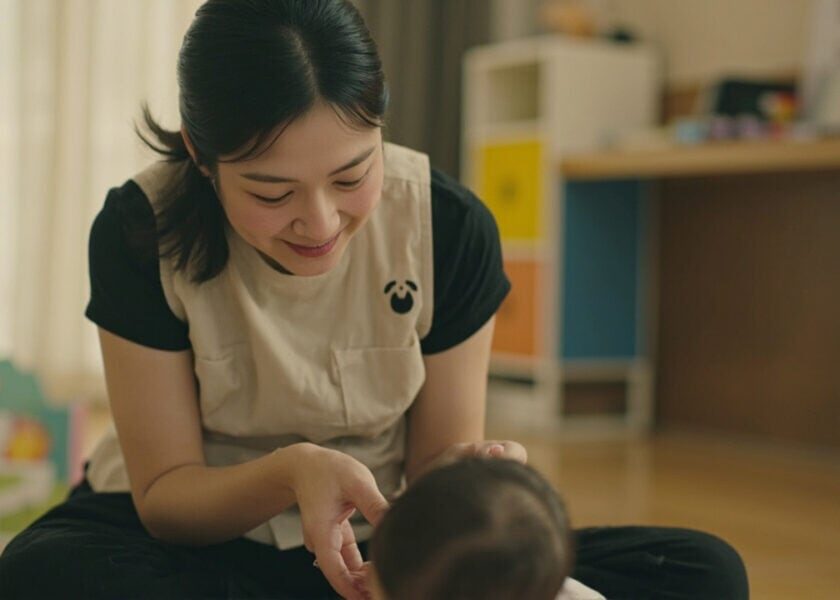
Watch how the caregiver responds when a child approaches with a question or a need. In genuine early childhood care, this response is immediate and warm. The caregiver kneels or bends to the child’s level, makes eye contact, and repeats back what the child has said — so the child knows they have been heard.
This is not a scripted behavior or a training manual checklist. This is the natural rhythm of an adult who is genuinely attentive to small people.
In contrast, you can observe what happens when responsiveness is absent: children who learn to repeat themselves louder, who learn to interrupt or act out because soft requests did not work the first time, who are in proximity to an adult but emotionally unattended.
The Language Environment
Listen to what is happening in the room. Children in quality care are surrounded by conversation — not just commands like “don’t do that,” “sit here,” or “wait,” but genuine back-and-forth dialogue.
A caregiver who narrates what a child is doing. Who asks open questions. Who introduces new words naturally throughout the day. Research on early language development is consistent: children acquire vocabulary not from passive exposure but from the density and quality of adult interaction.
When you visit or receive updates, listen for language. Is your child being spoken with, or just spoken to?
How Conflict Is Handled
Notice the social dynamics. How do children handle frustration or disappointment? In quality care settings, you will see caregivers guiding children through big emotions rather than simply managing behavior.
A child who takes a toy from another is not simply told to stop. They are helped to understand what they did, what the other child might be feeling, and how to ask for what they want next time. This is emotional regulation support, and it is one of the most important things that happens in early childhood. It is also invisible in photographs and difficult to capture in brief updates.
How to Read Between the Lines of Daily Updates
Most parents in Singapore receive some combination of daily updates: a written note in the communication book, a few photographs sent via an app, an incident report if something went wrong, or a verbal summary at pick-up. These updates are well-intentioned, but they are often incomplete. They tell you what happened without telling you what it meant. They report events without revealing the quality of the environment that produced them.
The Written Update
A daily update that says only “had a good day” is not information. It is an absence of complaint.
Push gently for more. Ask specifically:
- How did my child respond to group activities?
- Did she join in easily or hang back?
- How did the teachers support her when she seemed frustrated?
A quality care setting will welcome these questions. They will have observations to share. They will not make you feel like you are being difficult or distrustful, because transparency is a sign of confidence in their work.
The Photographs
Photographs deserve careful attention. A photo of your child sitting at a table with art materials in front of them tells you that art materials existed. It does not tell you whether your child engaged with them meaningfully, whether a caregiver sat beside her and encouraged her process, whether she expressed pride in what she made or simply completed the activity to finish it.
Look for photos that capture your child’s face, not just the back of her head. Look for images that show interaction — a caregiver pointing at something, a child showing something to another child. These are signs that your child is present in the environment, not just physically located in it.
The Incident Report
Incident reports, when they happen, are actually opportunities for insight. A genuinely professional care setting will document incidents thoroughly and honestly. They will explain what happened, what the immediate response was, and what steps they will take to prevent recurrence. They will not apologize your child away from the story or omit relevant details.
If an incident report feels incomplete or defensive, that is worth noticing. Quality care is accountable, and accountability requires honesty.
What Your Child Brings Home
This is, in many ways, the most honest indicator of how the day went, because young children cannot hide what they feel. They have not yet learned the social performances that adults rely on. When your child walks out of childcare at the end of the day, she is carrying everything that happened inside her body and her behavior, whether she can articulate it or not.
Hungry
This is one of the most common things parents notice, and it is often dismissed. “They should have been fed.” But hunger at the end of the day is not necessarily a failure of feeding. It is often a sign that your child was very busy. Developing brains burn enormous amounts of energy. Active social engagement, new learning, physical play — these are all metabolically expensive.
If your child comes home ready to devour everything in the refrigerator, it may mean the day was full and engaging. The question is not just whether food was offered but whether your child ate well and still needs more.
Tired — But What Kind?
There is a difference between a child who is physically fatigued from running and playing outdoors and a child who seems emotionally drained, flat, or withdrawn. The first is normal and healthy. The second can indicate overstimulation, insufficient emotional support, or a care environment that values activity over rest.
Watch for the quality of tiredness. Is your child physically spent but content? Or does she seem depleted in a way that suggests her emotional cup was not refilled during the day?
Clingy or Independent
Some children come home clingy because they missed you and are glad to be back. Some children come home clingy because the day was hard and they need to reconnect. These can look identical from the outside — the difference lies in the other signals: the hunger, the tiredness, the overall tone.
Other children come home fiercely independent, wanting to do everything themselves, barely acknowledging your arrival. This can be a sign of healthy engagement: they had a good day, they are proud of their autonomy, they are showing you who they are becoming. Or it can be a sign of detachment — a child who has learned not to expect much emotional connection from adults.
Reading the Pattern
What you are developing is not a checklist but a pattern. Over weeks and months, you will learn to read your child’s homecoming like a weather report. Some weather is simply the weather — ordinary fluctuations in mood and energy. But when patterns persist, when your child consistently comes home depleted or distressed or disconnected, that is data. That is your child’s way of telling you something about the environment you cannot see.
And you have every right to ask questions, request observations, and trust what you see.
A Partnership Built on Transparency and Accountability
We understand that you are not just looking for a place to leave your child. You are looking for a partner in your child’s early development — someone who sees what you see, who notices what matters, and who can bridge the gap between your child’s experience in your absence and your own need to understand it.
EduNanny Singapore is part of the ECDA Childminding Pilot — a carefully designed framework that prioritizes exactly the kind of quality and accountability we have been discussing.
What Our Model Looks Like
Our home-based childminding model operates with infant ratios of up to one to three, so every child receives individual attention that larger centre settings simply cannot match. This means fewer children competing for a caregiver’s focus, more responsive interaction, and a day where your child is genuinely at the centre of attentive care.
Our care is structured around Monday to Friday blocks, designed to fit the rhythm of working parents’ lives. And we have worked to ensure that our fees within the pilot structure are affordable, with CDA and Baby Bonus funding options available — because quality care should not be accessible only to families with significant financial resources.
Our Commitment to Transparency
Beyond the structure, what defines quality childminding is a commitment to transparency. When we send you updates, we want them to be meaningful. When we document your child’s day, we want you to be able to read between the lines with confidence, not anxiety.
Some of our settings operate with CCTV measures in place, because we believe parents have a right to see what is happening when they cannot be there. We welcome questions. We expect you to observe and evaluate. We are not threatened by scrutiny; we are confident in the quality we offer.
Caregivers as Intentional Observers
Our caregivers are trained, intentional observers. They notice what matters — not just whether your child ate and slept, but how she played, who she played with, what she was curious about, what frustrated her, what made her laugh. They are not babysitters filling time. They are early childhood professionals who understand that the first thousand days of life are not just a phase to pass through but a foundation to build upon.
Support When You Need It
We know that you, as parents, are navigating the particular pressures of Singapore’s demanding work culture and high cost of living, trying to be present in multiple places at once. We do not judge you for the complexity of your life. We honor it.
That is why we offer the Thomas AI Chatbot — a tool designed to make the relationship between parents and care easier and more responsive. Thomas is available to answer your questions, provide insights into your child’s patterns, help you understand developmental milestones, and support you in the daily work of parenting.
Nothing replaces a caregiver who knows your child’s name, your child’s favorite song, your child’s way of asking for help. But technology can close gaps. It can give you context you would not otherwise have. And in a world where you are trying to be in two places at once, any tool that reduces your anxiety and increases your understanding is worth offering.
Questions Worth Asking
Whether or not EduNanny is right for your family, here are questions that every parent should feel empowered to ask of any childcare provider:
- How do your caregivers respond when a child is upset or frustrated?
- What does a typical morning and afternoon look like in terms of activities and rest?
- How do you handle conflict between children?
- What will my daily updates include, and can I request more specific observations?
- How do you support children’s language development throughout the day?
- What is your caregiver-to-child ratio?
- Can I observe my child’s care setting, and how often?
- How are incidents documented and communicated to parents?
A quality care setting will have thoughtful answers to all of these questions. They will not make you feel like you are overstepping by asking.
The Answer You Deserve
That silence around nine in the morning. That question that follows you through your workday. What is actually happening right now?
You deserve an answer to that question. Not a perfect answer, because no child’s day is perfect. But a real answer, an honest answer, an answer that helps you understand what is happening in the hours you cannot witness.
You deserve updates that mean something. You deserve caregivers who notice what matters and can tell you about it. You deserve to pick up your child at the end of the day and feel not just relief but genuine connection — to know her day, to understand how she is, to see in her face whether she is thriving or merely present.
The work of raising a child is profound and relentless, and it is made harder when the systems around you are opaque or defensive. You are not being difficult when you ask questions. You are being a parent. And the care setting that recognizes this — that welcomes your curiosity, that earns your trust through transparency rather than demanding it through reassurance — that is the care setting your child deserves.
EduNanny was built for this moment. For the parent who wants to be excellent at work and excellent at home and cannot figure out how to be both simultaneously without losing pieces of themselves. For the child who deserves consistent, attentive, loving care that supports who she is becoming. For the partnership between home and childminding that makes both possible.
We are here because we believe that your child’s early years matter enormously, that what happens between drop-off and pick-up shapes who your child becomes, and that you have the right to know what that looks like — to read the signs, to understand the signals, to feel genuinely connected to your child’s daily experience even when you are not there.
If you are ready to explore what a genuinely transparent, attentive childminding partnership looks like, we invite you to start a conversation with us. Your child’s early years deserve your attention — and they deserve our very best.
Curious about what sets quality childminding apart? Learn more about EduNanny Singapore and our approach to early childhood care.