Fraud Blocker edunanny.com

Category: Childminding

edunanny-061d700f40ec48b55a99cc4c42f2f338
April 2, 2026

What Quality Infant Care Really Looks Like in the First Thousand Days

A Morning in Quality Care: What Happens Behind the Door

The morning your child arrives, the room has already been awake for a while. Not loudly. Not abruptly. The lights are already calibrated — warm, never harsh, because a child’s nervous system does not need to be jarred awake any more than an adult’s does.

The surfaces your child will touch have been checked, cleaned, considered. The colours on the walls are chosen not for aesthetics alone but for their effect on a young nervous system — soft blues, warm greens, natural wood tones that communicate calm and regulate arousal. A room that breathes, that offers visual rest between moments of stimulation, is quietly teaching a child how to regulate themselves.

The floor plan has been arranged so that the space does not overwhelm. There are open areas and enclosed ones. There are surfaces to pull up on and corners to retreat into. There is a geography of safety, designed not simply to furnish a room but to invite a child who has just walked in carrying the residual weight of a car seat and a commute and a wave and a separation to find something that says, come here, this is for you, without needing a single word.

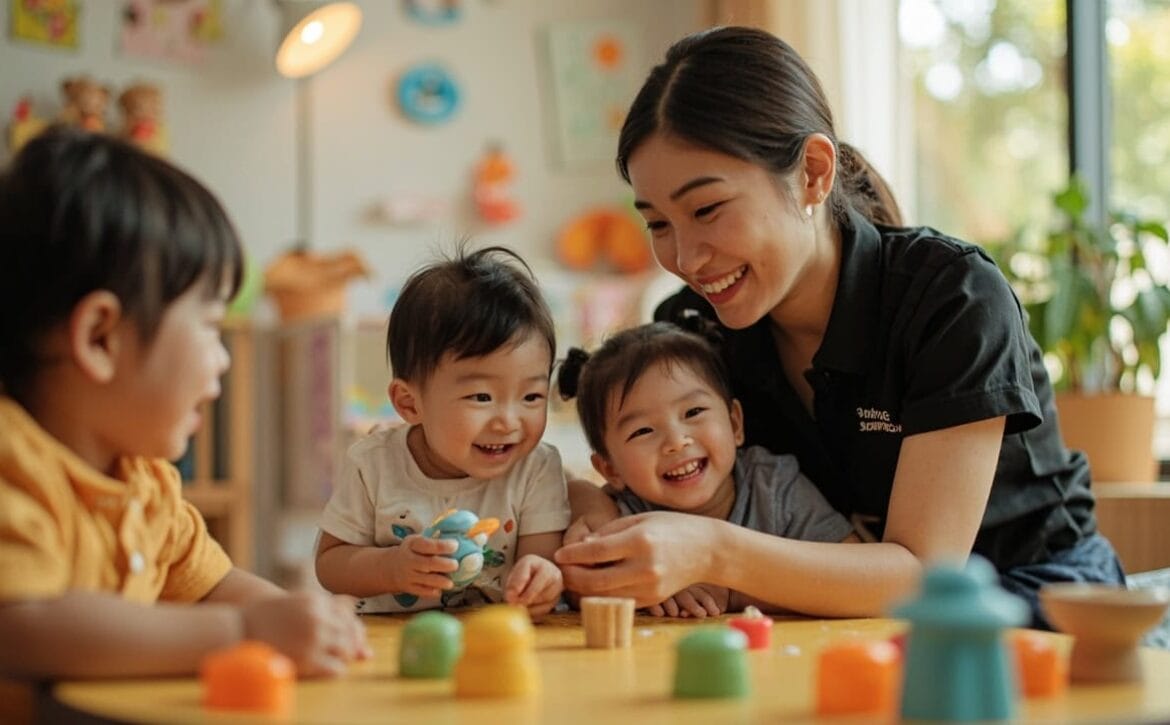
And then the caregiver is there. Crouched down, or kneeling, or sitting low enough that the child is looking at a face, not up at an institution. The greeting is not perfunctory. It is the first communication of the day, and it carries weight — a person who is genuinely glad to see this particular child, who knows their name, their routine, their current obsession, whether it is a fascination with wheels or a need to be held for the first ten minutes.

A trained caregiver reads these things. Because they have been taught to notice, and they know that every child writes a kind of language in the way they move through a room. You are known here.

The Sensory Experiences That Build the Brain

Throughout the morning, the room is alive with intentional sensory experiences. A tray of rice. A bowl of water with floating objects. A basket of fabrics with different textures — smooth silk, rough burlap, soft fleece. These are not activities to fill time. They are experiences through which a child’s brain builds itself.

The neural pathways that form when a child pours water from one container to another, when they squeeze playdough and feel resistance and texture, when they press their fingers into sand and discover that it shifts and slides and escapes between their fingers — these pathways are the building blocks of motor planning, of spatial reasoning, of the architecture of thought.

The soundscape is equally deliberate. The hum of activity, the murmur of voices, the occasional sound of a child discovering that dropping a wooden block makes a satisfying sound on a tile floor and doing it eleven more times. This is the auditory environment of a small community, and it is the environment in which language grows.

What a trained caregiver does in those ordinary moments is speak to your child with the assumption that every utterance matters:

  • You are stacking the blue block on top of the red one — look, it is getting taller.
  • I see you noticed that the water is spilling over the edge.
  • Shall we count how many beads are in the bowl?

This is the natural language of intentional caregiving — the quiet, continuous narration of a morning that says: the world is interesting, and I will help you name it.

Learning From Each Other

There is a boy — perhaps two, perhaps younger — sitting with a set of wooden cylinders. He is concentrating in the way only a young child can, with his whole body. A girl nearby watches him for a moment, then moves closer, not to take, not to interrupt, but to observe. She tilts her head. She leans in slightly. And then she sits beside him and picks up a cylinder and begins to work alongside him.

No words. No negotiation. A small, wordless negotiation of space and companionship that is, in that moment, a lesson in social learning that no adult could teach through instruction alone.

This is what researchers call parallel play evolving into associative play — the early, pre-verbal stages of social competence. And it happens not because a caregiver arranged it but because the environment made it available and the caregiver recognised its value and did not interrupt it with unnecessary intervention.

There is a trained instinct in quality caregivers to know when to step in and when to step back. When a caregiver allows two toddlers to navigate a disagreement over a toy rather than swooping in with a resolution, they are communicating trust in the child’s capacity to learn social negotiation. They are teaching resilience through the act of simply being present and letting the learning happen.

The Rhythm That Signals Safety

Young children are not built for abrupt transitions. A child who is deeply absorbed in a sensory experience and is suddenly told to stop and come to the mat is a child whose nervous system registers that disruption as something close to alarm.

Quality care understands this. Transitions are not disruptions. They are signals: a five-minute notice before the next activity begins; a song that gradually gathers the children together; a caregiver who begins the tidy-up alongside the children rather than issuing commands from across the room.

The shift from one activity to the next is paced, communicated, and made safe — because a child who knows what comes next is a child who feels secure. When the morning snack comes at roughly the same time each day, when the nap routine follows the same sequence — the dimming of lights, the soft music, the familiar words that signal it is time to rest now, and we will be here when you wake — that constant, quiet communication of safety through predictability is what supports the enormous developmental task of learning to trust the world.


The Caregiver and Home Partnership

A trained caregiver in quality infant care is not simply a person who is kind. Kindness is necessary but not sufficient. A trained caregiver understands child development — knows that a six-month-old communicates through crying and that not all crying means the same thing, can distinguish the cry of hunger from the cry of overstimulation from the cry that simply says I need to be held and reminded that I am not alone.

In the ECDA Childminding Pilot pathways, this training is foundational. It is the reason that ratios are kept low — because an adult who is responsible for fewer children can see more, notice more, respond more. When a caregiver is responsible for one, two, three infants at most, every cry is heard, every smile is registered, every developmental milestone is observed and supported. This is not a staffing model born of convenience. It is a pedagogical choice that says: this child’s early experiences matter so much that we will not crowd them out with numbers.

In home-based and community-based pathways — where care is offered in smaller, more domestic settings — there is an intimacy that even the best centre-based care cannot fully replicate. A child in a home-based setting moves through a home. They encounter the ordinary textures of domestic life — the sound of a kettle, the smell of food being prepared, the feeling of being in a space that is also someone’s actual home. This is not lesser care. For many families, it is precisely the right care — small, warm, grounded in the rhythms of an actual household.

Centre-Based Care Home-Based Care
Structured environment with intentional design Domestic intimacy and familiar household rhythms
Peer socialisation and community Smaller group sizes, more individual attention
Consistent routines across the day Flexible, adaptive care arrangements
Trained caregivers with low ratios Caregivers with ECDA pathway training

The Communication That Connects

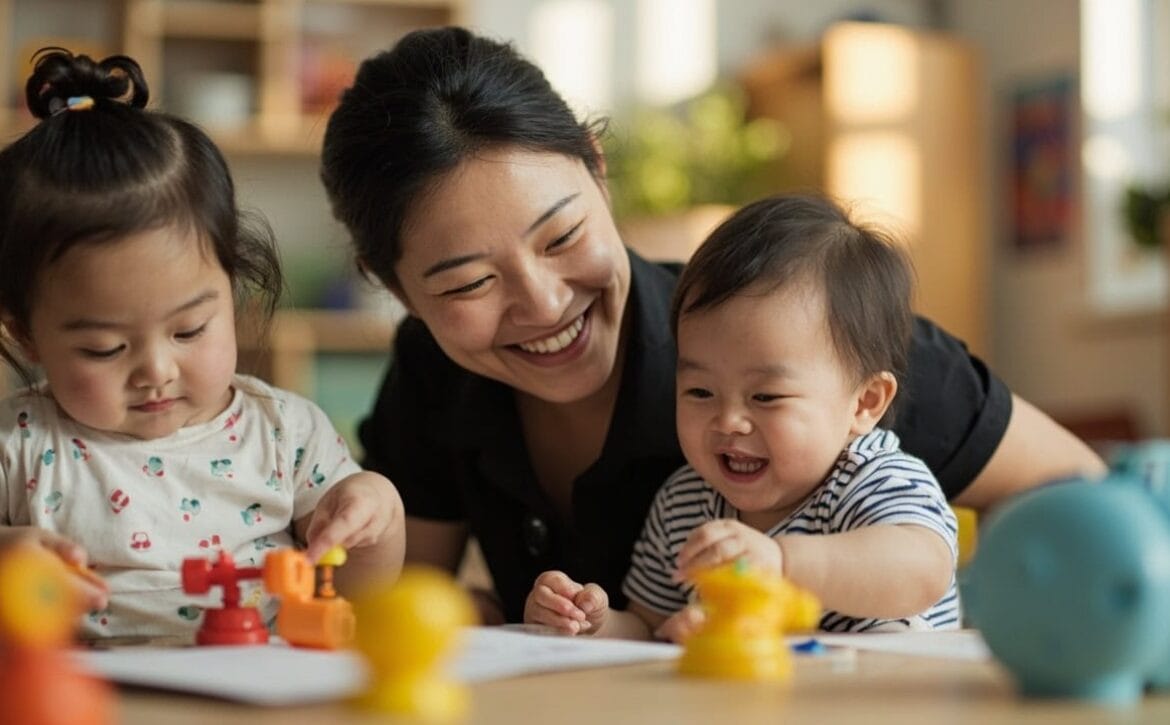
After lunch, after the gentle wind-down, the children are asleep or resting — cots arranged in a quiet room, the low hum of a white noise machine, the particular hush that falls over a room full of sleeping toddlers. And in this hush, the caregiver has a moment to document: that this child ate well today but pushed away the new food; that this child fell asleep quickly but woke after only thirty minutes; that this child used a new word for the first time and said it clearly, reaching for the block play.

These are not administrative details. They are the connective tissue between what happens in the day and what a parent needs to know at pickup. The communication that quality care offers is not a daily report stapled to a folder. It is a living conversation — about your child, about their day, about what they discovered and what they struggled with and what made them laugh.

In centres where technology supports this transparency, parents may receive updates through a platform or app. And when you arrive to pick up your child and see them building a tower with a caregiver who is kneeling beside them, narrating each block with genuine delight — look, we added the big one at the bottom, and it did not fall — that moment is the visible tip of a day that has been full of exactly this: responsive, intentional, developmentally rich care.

What you see at pickup is the ending of a story. What you did not see is the whole story — and when your child looks up at you with the calm, open face of a child who has had a good day, that is not a sign that they did not miss you. It is a sign that they were well. It is a sign that the place you left them was doing exactly what it was designed to do: holding your child with the same seriousness and tenderness you hold them with yourself.


Why Quality Care Is Not a Compromise

Let us be honest about what parenting in Singapore actually looks like. It takes place against a backdrop of dual-income pressure, of rising costs, of a housing market that makes geography unpredictable, of social media that offers a constant feed of expert opinion — much of it contradictory, much of it anxiety-producing.

Parents are exhausted not just by the physical demands of caregiving but by the cognitive load of deciding, constantly, what is right. They are making decisions about childcare with incomplete information, under time pressure, with a child’s wellbeing as the stakes. And the system, for all its strengths, does not always make it easy.

There is a real and understandable anxiety that sits beneath the decision to enrol a child in infant care or childminding. It is not the anxiety of parents who have made a poor choice. It is the anxiety of parents who have made the right choice and still cannot shake the uncertainty of not knowing what happens during the hours apart. The fact that you worry about what your child is experiencing when you are not there is not a sign that you should have chosen differently. It is a sign that you understand, at a deep level, what is at stake.

The First Thousand Days

Here is what research has established about those early years. The first thousand days of a child’s life are not a metaphor. They are a biological fact. The brain is building itself at a rate that will never be repeated. The relationships a child forms in this window — the responsiveness they experience, the safety they feel, the language they hear, the sensory world they are allowed to explore — are not background conditions. They are the conditions themselves.

They are what the child is made of, years from now, when they sit in a classroom and listen, when they manage a frustration, when they form a friendship, when they reach for something they want and manage their disappointment when they do not get it. All of it — every capacity the adult will possess — traces back to these early years, to the quality of care and attention and environmental richness that was available when the building was happening.

Quality infant care and childminding is not a compromise. It is not a concession made by families who have no other option. It is, for many families in Singapore, a choice made from strength: the recognition that children benefit from rich environments, from trained caregivers, from peer socialisation, from the rhythms and structures of a well-designed day.

That a village raises a child is not a sentimental idea. It is an ecological one. Human children were never meant to develop in isolation. They were meant to be held, named, seen, challenged, and comforted by a wide circle of attentive adults. What EduNanny offers is not a replacement for that circle. It is an addition to it — a trusted, trained, intentional addition that works alongside you, that communicates with you, that keeps your child safe and curious and developing in ways that will matter for the rest of their life.


What EduNanny Offers Singapore Families

EduNanny was built with this reality in mind — not to add to the noise but to reduce it. The approach is rooted in a belief that parents deserve clarity: about what their child is experiencing, about the care their child is receiving, about the choices available to them and what each choice means.

This is why EduNanny participates in the ECDA Childminding Pilot, which offers pathways that are not one-size-fits-all but responsive — whether a family needs centre-based care with its structure and community, or home-based care with its intimacy and flexibility.

The pilot fee structures are designed to be accessible, and the use of CDA and Baby Bonus funds means that the financial architecture of childcare — which can feel opaque and burdensome — is simplified and within reach. Monday to Friday care blocks are available, because the reality of Singapore working life is not a nine-to-five abstraction but a daily negotiation of hours, commutes, and obligations.

And because EduNanny is Singapore-wide, this clarity is not available only to families in certain districts or certain income brackets. It is available to any family who is navigating the honest, difficult, beautiful work of raising a child and needs support that is trustworthy, transparent, and designed with genuine understanding of what they are going through.

Support Between Visits

There is also a digital resource developed to sit alongside this care. The Thomas AI Chatbot is not a replacement for human caregiving. It is something else: a tool for parents who have a question at eleven o’clock at night, who are wondering about sleep regression or feeding schedules or how to talk to a toddler about a new sibling, who need reliable, grounded guidance in the moments between visits to the centre. It is the system extending a hand to parents not only when their child is in care but in all the hours in between.


Practical Guidance: Choosing Infant Care in Singapore

If you are a parent in Singapore beginning to explore infant care or childminding options, here are some questions worth asking during your search:

  • What does the environment feel like? — Visit during operating hours if possible. Observe whether the space feels calm, intentional, and designed for children, not just filled with toys.
  • How do caregivers greet children? — Watch for warm, eye-level interactions. Notice whether caregivers kneel, sit, or crouch to speak with children rather than speaking down to them.
  • What is the ratio of caregivers to children? — Lower ratios mean more individual attention, more observation of milestones, more responsive care.
  • How does the day flow? — Ask about transitions. Are they signalled in advance? Is there a predictable rhythm to the day?
  • How is information communicated to parents? — What does pickup communication look like? Is there transparency about what happened during the day?
  • What training do caregivers have? — Ask about ECDA pathway participation, ongoing development, and how the team is supported.
  • What is the financial structure? — Understand how CDA and Baby Bonus funds can be used. Clarify fee structures and what is included.

When you drop your child off tomorrow morning, and you feel that silence in the car, you can let it be a different silence. Not the silence of uncertainty. The silence of a person who knows, because they have been inside the story, what is actually happening on the other side of that door:

  • A warm, structured arrival
  • An intentional environment
  • A caregiver who kneels down to say good morning, I am glad you are here
  • A room that teaches through sensation, that builds through play, that speaks through language
  • Children who discover each other and learn, wordlessly, the grammar of companionship
  • Transitions that signal safety
  • A nap routine that communicates rest, and we will be here
  • A day that ends not with exhaustion but with the quiet satisfaction of having been thoroughly, attentively, lovingly cared for

That is what happens when you are not there. And that is why, when you come to pick your child up, and they do not cry at the sight of you, but look up with the calm, open face of a child who has had a good day — that is not a sign that they did not miss you. It is a sign that they were well.

That is what EduNanny is for. That is what quality childminding is for. And that is what every parent in Singapore who makes this choice — imperfectly, courageously, with love — deserves to know: that they are not alone in this. That the village exists. And that it is, genuinely, a good place to be.


If you are ready to explore what quality infant care and childminding looks like for your family in Singapore, EduNanny is here to answer your questions and help you find the right pathway. Visit EduNanny to learn more about the ECDA Childminding Pilot and the options available to your family. You can also connect with the team directly, or read more about the EduNanny approach to understand how the service is designed around the needs of Singapore families.

edunanny-061d6bce78a398929176e5fc7117c016
April 2, 2026

Building Lasting Connection With Your Child Beyond Proximity

The Bond You Share Is Not Defined by Hours

We have been taught to measure love in hours. In who is there when the tears fall. Who is there when the first steps happen. Who is there to witness the small daily miracles of childhood.

And it is true that presence matters. But the bond between a parent and child is not a container that empties every time you walk out the door. It is something deeper than proximity. It is a thread that runs through time, through memory, through the quality of attention you bring when you are together.

Children do not need perfect parents. They do not need parents who are always there. What they need is good enough parents — parents who are consistently responsive, who repair when they misstep, who show up, again and again, with attention and love and the willingness to learn.

The question is not, will my child still love me?

The question is, how do I stay emotionally present in the time we do have?


What Secure Attachment Actually Looks Like

When a child is born, they enter the world without language, without context, without the ability to tell you what they need. They can only show you. A cry. A reach. A stillness. A turning of the head.

Your job as a parent is not simply to be present. It is to learn to read your child like a language. To develop the attunement that allows you to know, with growing accuracy, whether this cry means hunger or overstimulation, whether this stillness means contentment or distress.

This skill of attunement — of reading cues, of responding with sensitivity — is the foundation of secure attachment. Not time alone. Not hours logged. The quality of your responsiveness.

Here is what many parents do not realise: this skill does not stop developing when you return to work. It continues. It deepens. And paradoxically, quality childcare can sharpen it.


Quality Childcare Can Strengthen Your Bond

When you drop your child at a quality care arrangement, you are not dropping them into a void. You are dropping them into a place where other trained, attentive adults will also be reading your child’s cues.

You will come home to a caregiver who tells you: She was really engaged when we read that book today. Or: He seemed a bit off during the afternoon.

You will notice things differently because you have context. Because you have contrast. Because your child’s behaviour across different environments gives you more data, not less, to understand who she is and what she needs.

This is what we mean when we say that thoughtful childminding is not a service that takes over, but a partnership that informs. Parents are the constant in a child’s life. Caregivers may change. Settings may evolve. But the parent’s role as the primary interpreter of the child’s inner world — the one who knows this child most deeply because you made this child — that never goes away.


Connection Across Every Stage

As your child grows, the texture of connection changes. What works in infancy evolves in toddlerhood and deepens again in the preschool years. Understanding these shifts helps you stay responsive rather than relying on a single approach.

Stage What Connection Looks Like
Infancy (0–12 months) Responding to cues with warmth. Feeding on demand. Offering comfort through touch and voice. Your attunement tells your baby: You exist, and you matter.
Toddlerhood (1–3 years) Honouring big feelings while holding boundaries. Naming emotions together. Slow goodbyes that reassure. Your presence during distress tells your toddler: I can handle your whole self.
Preschool (3–6 years) Listening to their stories with genuine attention. Asking open questions. Playing alongside rather than directing. Your curiosity tells your preschooler: Tell me more about who you are becoming.

No matter the stage, your child needs you to be the steady interpreter of their world, not the most physically present adult in every hour. That role belongs to you, and it grows richer with every interaction you bring awareness to.


The Rituals That Anchor Your Relationship

In Singapore, where the pace of life is relentless, where commutes are long and expectations are high, protecting connection requires intention. It requires you to be deliberate about the small rituals that anchor your relationship.

The Morning

Think about the moments that belong to you and your child — the morning routine, before the day scatters you in different directions. This does not have to be long. It can be ten minutes.

But in those ten minutes, you can be fully present. You can dress your child with attention — narrating what you are doing, making eye contact, smiling. You can share a breakfast together, a small ritual of nourishment that says, We begin this day together.

And then, the moment of handoff. Instead of a hurried drop-off, you can kneel to your child’s level and say, I love you. I will see you soon. That slow goodbye rather than a rushed one matters enormously to a child’s sense of security. It says: Leaving is not abandonment. Coming back is certain.

Bedtime

There is perhaps no more sacred window in a child’s day than the hours before sleep, when the body softens, when the defenses lower, when a child is most open to feeling close.

This is not a luxury. It is a necessity. Even after a long workday, there is time — even if it is brief — to read a book together, to have a quiet conversation about the day, to offer the physical closeness that cements the bond. This is one of the most powerful tools a working parent has.

Weekends

Weekends matter too. They are not just recovery time. They are connection time.

A walk in the park. A meal cooked together. A bath where you splash and laugh. These are the moments your child will remember — not the grand gestures, but the accumulation of small, warm, present moments that say, I am here with you. You are my child. This is us.


Honouring the Complexity of Working Parenthood

There is a grief that comes with working parenthood. A mourning for the days when you could be with your child all day, when the bond felt simpler because proximity was constant.

Many parents feel this grief but do not give themselves permission to name it. They push through, they soldier on, and in doing so, they sometimes disconnect from the very feelings that could help them connect more deeply with their child.

Grief is not weakness. It is the evidence of love.

The parent who can honour that grief — who can sit with the ambivalence of wanting to be present and needing to work, who can be honest about the complexity of modern parenthood — that parent is often the one who is most emotionally available. Because they are not pretending. They are showing up, fully, with all the mess and all the feeling, and their child feels that authenticity.

That is not nothing. That is everything.


What Quality Childminding Looks Like in Practice

Singapore parents deserve to know what they should expect from quality childminding — not just for their peace of mind, but because quality care is what makes the partnership model actually work.

Here is what sets genuinely thoughtful childminding apart:

  • Communication is consistent. You receive regular, meaningful updates about your child’s day — not just that they ate and slept, but how they were, what interested them, what challenged them.
  • Caregivers observe and share cues. Trained caregivers notice the same things you are learning to notice at home — patterns, preferences, shifts in mood. This information flows back to you, deepening your own understanding.
  • The transition is unhurried. Morning handoffs and evening pickups are treated as important moments, not logistical necessities.
  • Your role is central. You are kept in the loop, consulted about routines and changes, and treated as the expert on your own child.
  • The environment is safe and warm. A place where a child can explore and return to a familiar face.

EduNanny’s Approach: Partnership, Not Replacement

At EduNanny, we see ourselves as guardians of your connection, not replacements for it. We are part of your village. But we are not the centre of your child’s world. You are.

Our childminding arrangements operate under the ECDA Childminding Pilot, designed to be accessible with fee structures that allow families to use CDA and Baby Bonus funds. When care is both affordable and excellent, parents can return to work with confidence, knowing their child is in safe, capable, loving hands.

Whether through daily updates, transparent sharing of activities and discoveries, or systems that allow you to feel connected to what happens in your child’s day — we want you to feel like a partner in your child’s care, not a distant observer returning at the end of a long day to ask, What did I miss?


You are already showing up. Every single day. The parent who picks up their child at the end of the day, who puts away the phone, who kneels down to really see that face and ask, How was your day? What did you discover? — that parent is doing the most important thing.

The bond you have with your child is not fragile. It is resilient. It is built on biology, yes. But also on intention. On the thousand small moments of attunement that accumulate into a sense of security. On the trust that grows when a child knows, deep in their bones, that their parent will return.

The hours matter less than the quality of what you bring to the hours you have. That is enough. That has always been enough.


If you are looking for a childminding arrangement in Singapore that treats your family’s bond as its foundation — not its casualty — we would welcome the chance to learn more about your family. Connect with EduNanny to explore our pilot arrangements, fee structures, and how we work alongside parents like you.

Every child deserves to feel held by more than one pair of loving hands. Every parent deserves to know their child is in those hands.

edunanny-061d68e7342dadbb6e05e7ba439063ec
April 2, 2026

What Happens After You Drop Your Child at Childcare

The Morning Goodbye: A Parent’s Unseen Hours

There is a particular kind of morning that most parents in Singapore know well. The one where you walk through the doors of your childcare centre with your child in your arms or holding your hand, and you feel the weight of the day already beginning—the meetings ahead, the commute back, the hours stretching between now and the moment you will see their face again.

You kneel down. You kiss their forehead. You tell them you love them. And then you stand up, and you walk away, and the door closes behind you.

What happens next is the part no one quite prepares you for.

You get on the bus. You open your laptop. You answer emails. And somewhere beneath all of it, your mind keeps returning to one question—the same question that has lived in your chest since the first time you left your child in someone else’s care: What are they doing right now? Are they okay? Are they happy? Are they safe? Are they building something that matters?

You are not a worrier by nature. You trust your childcare choice. You read the reviews, you visited the centre, you felt the warmth of the caregivers, you asked your questions and received thoughtful answers. And yet. There is a gap that sits in the centre of every parent’s day—a space where imagination runs faster than certainty, where love makes room for doubt, where the most capable parent can find themselves suddenly uncertain.

The updates help. The photos help. The daily reports, the teachers’ notes, the quick conversations at pick-up—these are genuine lifelines, small windows that let you know your child ate their lunch and played nicely and didn’t fall. But even as you receive them, you know they are fragments. They are the highlights, the curated moments, the notes that can be written in a sentence or two. They do not tell you what your child actually experienced. They do not show you the texture of the hours.

And so you find yourself doing what parents have always done: you imagine. You fill in the gaps with your love and your worry and your hope that today, in the hours you cannot see, your child is somewhere good, somewhere warm, somewhere that is helping them grow.


The Weight of Not Knowing

Here is what is true about parenting in Singapore today: you are doing something extraordinary while simultaneously feeling uncertain about it. You are building a career, supporting your family, navigating the costs and logistics of raising children in one of the world’s most expensive cities—and you are doing it while leaving your child’s care in someone else’s hands for the bulk of their waking hours.

This is not failure. This is modernity. And it comes with a particular kind of ache that no amount of rational reassurance fully resolves.

The ache is not about whether your child is physically safe. Most parents, after careful research and multiple visits, feel confident about that. The ache is deeper. It is about meaning. It is about whether your child is not just supervised but seen. Not just occupied but enriched. Not just cared for but nurtured in the way you would nurture them yourself if you could be there.

This is the question that sits beneath every childcare decision: What is actually happening in those hours? And today, I want to offer you something rare—not a reassurance that dismisses your concern, but an actual answer.


A Day in Quality Childcare: Hour by Hour

The Arrival: A Greeting That Builds Security

When your child arrives in the morning, the first thing that happens is not about learning or development. The first thing that happens is simpler and more important than that. The first thing that happens is a greeting.

This matters more than it might seem. When a child walks through the door and a caregiver kneels to their level, makes eye contact, says their name, and greets them with warmth, something profound is being communicated. The child is being told: you are seen. You are expected. You belong here. This is a safe place.

For a child who has just said goodbye to their parent, that message is not small. It is the foundation on which the entire day will be built.

At EduNanny Singapore, part of the ECDA Childminding Pilot, this greeting is not left to chance. It is part of the rhythm. The caregiver knows your child’s name. They know their face. They know, from having spent time with them, what they need in the morning—whether it is a moment of quiet with a favourite book, or a boisterous welcome that burns off nervous energy, or simply the comfort of being held before they are ready to play.

This is what consistent caregiver ratios make possible. With up to one caregiver for every three infants, there is space to attune. There is space to notice. There is space to respond as a person, not a function.

You will not see this in a photograph. It happens in seconds, in a look, in the way a caregiver’s voice drops into exactly the right register for exactly this child. But it matters enormously. It is the beginning of the day’s architecture of security.

The Environment: Architecture for the Brain

Once the greeting is complete, your child enters the environment. And this is where I want to pause, because the space itself is doing work.

A quality childcare environment is not simply a room with toys. It is a carefully considered sensory landscape. The colours are warm and calming, not garish. The textures are varied—smooth wood, soft fabric, cool tile, rough brush—giving your child’s skin and hands access to the world in a way that their developing nervous system craves. The sounds are moderated: not silent, but not chaotic. There is music sometimes, and sometimes there is the particular quiet of children absorbed in play.

All of this is not decoration. It is architecture for the brain.

In the early years, a child’s brain is building itself at a speed it will never match again. Every sensation—every texture touched, every colour seen, every sound heard—creates a connection, a neural pathway, a tiny wire that says: this is how the world works.

When a child plays with water, they are not just getting wet. They are learning about volume and temperature and cause and effect. When they roll a ball across the floor, they are developing the spatial awareness that will later help them judge distance and speed. When they hear a caregiver name an object—ball, cup, book, teddy—they are building the architecture of language.

This is why the sensory richness of quality childcare is not a luxury. It is a curriculum written in light and sound and touch and movement, and it is running quietly all day long in the background of your child’s play.

The child will not remember any of this. Neuroscientists tell us that explicit memory for these early years is largely inaccessible to adults. But their body will remember. Their nervous system will remember. The neural pathways laid down in these hours will remain, shaping the kind of person they become in ways they cannot name and you cannot see.

The Rhythm: Predictability as Safety

And then there are the rhythms.

Children, especially in the first thousand days, do not thrive in chaos. They thrive in predictability. They need to know what comes next, not because they fear change, but because predictability is the soil in which security grows.

In quality childcare, the day has a shape. There is arrival, and then there is play, and then there is snack, and then there is circle time or outdoor play, and then there is lunch, and then there is rest. This rhythm repeats, day after day, and the child absorbs it without effort. They begin to anticipate. They begin to relax into the pattern. And in that relaxation, something remarkable happens: they stop spending energy on anxiety and start spending energy on discovery.

You have probably noticed this at home. The child who fights bedtime in an unfamiliar place but sleeps soundly in their own room. The child who melts down in a chaotic supermarket but thrives in the familiar routine of their childcare centre. This is not coincidence. It is the nervous system responding to predictability as a signal of safety.

The caregivers in quality childcare understand this. They do not simply follow a schedule; they embody it. They are consistent. They are patient with the child who needs an extra minute to transition from one activity to the next. They are warm but firm, holding the boundaries of the day with a steadiness that the child experiences as safety.


Learning, Playing, and Growing: What Your Child Is Actually Doing

The Social Classroom

You will not be surprised to hear that children in quality childcare also play with each other. But I want to tell you what that actually means, because it is more than it appears.

When a one-year-old hands a block to another one-year-old, something is happening that did not exist a year ago. The child is engaging in reciprocal social exchange. They are reading another person’s intention. They are experiencing the pleasure of giving, not just taking. They are beginning to understand that other people have wants and needs that matter too.

This is not a lesson that is taught. It is a lesson that is lived.

In the peer interactions of a quality childcare day, children learn what no book and no screen can teach them. They learn to negotiate. They learn to share—not perfectly, not without tears, but they learn. They learn to notice when another child is upset, and they begin, slowly, to respond with something like concern. They learn that they are part of a group, that they have a place among others, that the world contains people who are not their parents and who are nonetheless safe and interesting and worth knowing.

These are not small things. Social competence is built in these early years, brick by brick, in moments of toddler negotiation that look chaotic from the outside but are, in fact, the most sophisticated learning a young human can do.

Building Language: Every Word Counts

Alongside this, language is developing in every conversation, every song, every picture book read aloud, every name spoken and responded to.

Caregivers in quality childcare are not just supervising. They are narrating. They are naming. They are responding to a child’s babble with words, expanding the child’s communication attempt into full sentences, saying yes and I understand and tell me more.

A child’s vocabulary at age three predicts reading ability at age ten and income at age forty. That vocabulary is being built in these hours you cannot see, in the patient back-and-forth of a caregiver who understands that every exchange is an opportunity.

Rest and the Quiet Moments

There is another part of the day that deserves attention. The rest. The nourishment. The moments when children are not doing anything that looks like learning.

Your child will rest in quality childcare. Not perfectly, perhaps—some children nap more easily than others—but they will rest, in a space designed for it, with the conditions that support sleep: dimmed lights, calm voices, the soft hum of a space that understands what rest requires.

Rest is not absence of development. Rest is its own form of growth. The young brain consolidates learning during sleep. The body repairs itself. The nervous system, overstimulated by a day of rich experience, comes back into balance.

Your child will also eat. Not just consume calories, but experience food in a social context—sitting with others, sharing a meal, learning the rhythms of breakfast and lunch that will shape their relationship with food for the rest of their lives. In quality childcare, caregivers model eating. They sit with the children. They talk about what they are eating, where it comes from, what it tastes like. Food is not fuel in quality childcare. Food is an experience.

And then there are the moments I find most beautiful to think about, though they are the hardest to describe. The child who climbs into a caregiver’s lap not because they are upset, but simply because they want to be close. The two children who sit side by side, not speaking, watching the rain through the window. The child who is so absorbed in pouring water from one cup to another that they are entirely, completely, blissfully present.

These moments are not nothing. They are the moments when a child is learning who they are. They are practising the skill of being alone in a group, of finding peace within chaos, of existing as a person with their own inner life.

The child who has experienced these moments has been given something invisible and priceless: the knowledge that their inner life matters, that they can be quiet and still and fully themselves and still be held in the regard of the people around them.


What EduNanny Singapore Offers

If you are researching infant care in Singapore, you deserve to know specifically what quality looks like—not as an abstract ideal, but as a set of practices you can look for and expect.

EduNanny Singapore was built for parents who take their children’s development seriously. As part of the ECDA Childminding Pilot, it operates with trained caregivers, appropriate ratios, and communication systems designed to give parents genuine insight into their child’s day.

Here is what that means in practice:

  • Trained caregivers who understand child development, not just supervision. They read cues, respond to individual temperaments, and create the warm, consistent presence that children need to feel safe.
  • Small ratios (up to one caregiver for every three infants) that allow for genuine attunement. Your child is not a number. They are known.
  • Structured days with rhythms that build security and create space for discovery.
  • Sensory-rich environments designed to support neural development through play.
  • Communication practices that go beyond curated photos—updates that help you understand the texture of your child’s day.

This is not babysitting. It is not a holding pattern until you return. It is a rich, structured, intentional environment designed to support every dimension of your child’s growth—physical, cognitive, social, emotional, linguistic.


Choosing Quality Infant Care in Singapore

Making this decision deserves careful thought. Here are the questions that matter most when you are evaluating your options:

  1. What are the caregiver-to-child ratios? Smaller numbers mean more individual attention. For infants, ratios of 1:3 or better are ideal.
  2. Are the caregivers trained? Not just in basic safety, but in child development. Ask about their qualifications and ongoing learning.
  3. What does a typical day look like? You want rhythm, structure, and intentional activities—not just free play.
  4. How does the environment support sensory and cognitive development? Look for varied textures, warm colours, age-appropriate materials, and spaces designed for exploration.
  5. How do they handle communication with parents? Updates and photos are helpful, but ask how they give you a sense of the texture of the day, not just the highlights.
  6. How do they support separation and adjustment? The transition period matters. Ask about their approach to drop-off routines and building trust with your child.
  7. Do you feel warmth when you visit? This is not something you can measure. But you know it when you see it. Trust your gut.

Common Concerns, Addressed

Am I failing my child by putting them in childcare?

No. You are giving them access to a world of experience they could not have at home alone. You are giving them peers, and trained caregivers, and a structured day, and a rich environment. You are giving them the gift of seeing themselves as part of something larger than their family—a community of learning and growth and belonging.

The research on childcare quality consistently shows that when care is warm, consistent, and developmentally appropriate, children thrive. The question is never whether your child is in care. The question is whether the care is good.

How do I know what is actually happening during the day?

You know by choosing a service designed for transparency. You know by asking questions before you enrol. You know by visiting at different times, not just for a formal tour. You know by noticing whether the caregivers seem warm and present, whether the environment feels calm and intentional, whether the children seem at ease.

And you know by observing what you can see at pick-up time: the way your child runs to you, the new words they say, the way they move through the world with growing confidence.

What if my child doesn’t adjust well?

Adjustment takes time. Separation is hard for children and parents alike. But in quality childcare, caregivers are trained to support this transition with patience and warmth. They understand that a child’s distress during drop-off is not a sign that the care is wrong—it is a sign that the attachment is strong.

Over time, with consistency, the morning greeting becomes a source of security rather than anxiety. The child learns: my parent always comes back, and this place is safe. That learning is itself a developmental milestone—one that quality childcare is specifically designed to support.


The Gift You Have Given

So now I want to come back to you. To the parent who dropped their child off this morning and is carrying that question through their workday. What do I want you to know?

I want you to know that what your child is experiencing right now is not mere babysitting. In the hours you cannot see, your child is being seen. They are being known. They are being responded to by people who have trained for this work and who understand its weight and its importance.

I want you to know that the updates and the photos are not the whole picture. They are invitations to trust what you cannot witness directly. And I want you to know that when you have chosen well—when you have chosen a service with trained caregivers, appropriate ratios, and communication systems that let you know your child is in good hands—you have every reason to trust what you cannot see.

You are not hoping. You are not guessing. You are relying on a system designed with your child’s development at its centre.

This is not naivety. This is earned trust. You vetted the centre. You asked the questions. You looked into the eyes of the people who would be caring for your child, and you saw something there that made you feel it was right. That instinct was not irrational. It was wisdom.

And now, on the days when your mind drifts back to that morning moment, when your child looked up at you with trust as you walked away, I want you to think about what is actually happening.

Your child is playing in a space designed for their development. They are talking to a caregiver who knows their name and responds to their cues. They are building neural pathways with every sensation and every interaction. They are learning to be a person in a group of people. They are safe, and they are well, and they are growing in the way you hoped they would grow.

When you pick your child up at the end of the day, and they run to you with whatever feeling the day has left them with—tired or exhilarated or cranky or glowing—you are receiving a message. You are receiving the residue of those hours. And I want you to notice what you see.

The way they hold a crayon now, more confidently than last month. The new word they say. The way they look at another child and smile. The way they move through the world with a little more certainty, a little more trust, a little more of the person they are becoming.

That is what those hours built. That is what you chose.

And you chose well.

EduNanny Singapore is part of the ECDA Childminding Pilot, offering quality infant and toddler care with trained caregivers and small ratios. If you are looking for childcare that gives you confidence in the unseen hours, learn more about our approach or get in touch to schedule a visit.

edunanny-061d64e475c3ec3d79c3b49ea1379e92
April 2, 2026

Why Your Childcare Search Is Really a System Design Decision

You Are Already Managing a Care System. You Just Need the Right Anchor for It.

Before you compare centre names or read another review, pause for a moment. Think about your calendar last week. The pickups and drop-offs. The messages sent at 7 AM about naptime routines. The mental calculation running quietly in the background, every hour of every day: who is with your child right now, what do they need, and does everyone involved have enough information to respond well?

If that picture feels familiar, you are not struggling with a childcare decision. You are managing something far more intricate. You are coordinating relationships, bridging generations, translating expectations across different people who all love your child in their own way.

You are doing invisible work that no one trained you for, while also showing up at work, sleeping poorly, and wondering if you are making the right choices.

This is the real landscape of modern Singapore parenting. And it is time we talked about it honestly.

  • The hidden complexity behind Singapore’s childcare decisions
  • Why coordinating multiple caregivers is exhausting—and what actually helps
  • How to reframe childcare from a standalone choice to an ecosystem decision
  • What quality childminding looks like in practice
  • How EduNanny fits into your family’s existing care architecture
  • A practical framework for evaluating your options

What Already Exists in Your Home—and Why It Feels Like Too Much

If you pause and really look at the care arrangement surrounding your child right now, you will likely find that it is already a system. There may be a domestic worker who knows your child’s sleep cues and favourite songs better than anyone else. There may be a grandparent who picks up your child on certain afternoons and brings a different kind of warmth, a different set of stories from their own childhood.

There may be a part-time helper, a regular babysitter, a neighbour your child has grown attached to, or a preschool teacher who sees your child for hours each week.

None of this is random. It is your family’s intelligence responding to a genuine need. Singapore parenting has always been a team sport, even when we pretend it is a solo endeavour.

But here is what we rarely say out loud: this web of care does not automatically become a system just because all its parts exist. A web becomes a system when the connections between the parts are intentional, when there is a shared understanding of purpose, when one element has the capacity to anchor and elevate the others.

Right now, you may be managing what is essentially a collection of parallel care relationships. Each operates with different assumptions, different training, different standards, and different levels of awareness about your child’s development.

Your helper approaches the morning routine one way. Your mother-in-law has her own rhythm on weekends. Your child’s preschool teacher follows yet another approach during the day. And somewhere in the middle of all of this is you, trying to hold it together.

The exhaustion most Singapore parents feel around childcare is not about loving their children too much. It is about coordinating too much without the right kind of professional support.

When a friend from your mothers’ group tells you she finally found childcare that “just works,” she is not describing a miracle. She is describing what happens when one element of the care system has enough quality, structure, and intentionality to raise the floor for everything else. She is describing what it feels like to have an anchor.


You Are Not Looking for a Replacement—You Are Looking for an Anchor

You are not looking for the one perfect childcare to replace everything else. You are looking for the element that can serve as the professional developmental anchor of the system you are already building. You are looking for the piece that makes everything else work better.

This is a fundamentally different way of thinking about the search, and it changes everything about what you find.

When childcare is positioned as a replacement, you are always measuring one option against another. You are always wondering if you are choosing correctly, always carrying the weight of a decision that feels like it must do everything on its own.

But when you understand childcare as an architectural element within a larger structure, you start asking better questions. You ask how this care will integrate with your helper’s schedule. You ask how it will complement what your in-laws provide on weekends. You ask what professional standards and developmental intentionality it will bring to a system that may currently have love and commitment but lacks a clear quality benchmark.


What Quality Childminding Actually Looks Like

Before we go further, let us be concrete. What does quality care actually look like when you strip away the marketing language?

Quality childminding is not a luxury add-on. It is a set of practices, training, and environments designed to support your child’s development during the years when the foundations of everything else are being laid.

Here is what that means in practical terms:

Dimension What Quality Care Looks Like
Caregiver Training Professionals who understand infant developmental milestones, know how to respond to cues, and receive ongoing mentorship rather than working in isolation
Developmental Intentionality Care that is purposeful rather than purely reactive—activities, interactions, and environments designed to support growth at every stage
Ratios and Attention Small groups or one-to-three caregiver-to-infant ratios that allow for genuine attention, not just supervision
Communication Systems Structured protocols that keep parents informed without creating anxiety or surveillance—for example, daily updates, observation notes, and transparent reporting
Relational Warmth Caregivers who build consistent, responsive relationships with children over time, not a rotating cast of strangers
Environmental Design Spaces prepared for developmental needs—safe for infants, stimulating for exploration, predictable enough to support attachment

When you find care that meets these dimensions, something shifts. The care stops being a source of worry and starts being a source of stability. It becomes the kind of infrastructure you do not have to think about—until you realise how much it was holding up all along.


How EduNanny Becomes Your Professional Developmental Anchor

EduNanny is not here to replace the grandmother who visits every Thursday. We are not here to make your helper feel redundant or your family’s existing rhythms feel wrong. We are here to be the professional developmental anchor that raises the quality floor of your entire care architecture.

When a caregiver is trained, when she understands infant developmental milestones, when she follows intentional protocols for communication and observation, when she has the time and resources to engage your child in ways that are purposeful rather than reactive—she does not just provide good care in isolation. She sets a standard. She models what intentional caregiving looks like. She creates ripple effects that reach into the rest of your child’s care environment.

The Multiplier Effect

When your child experiences consistent professional care at EduNanny and then returns to a home environment where the standards have subtly shifted, the contrast is not jarring. It is harmonising. The whole system lifts.

Your helper observes the structured, developmentally-informed caregiving up close and her own practice naturally improves. Your own parenting becomes more grounded because you are not carrying the full weight of care alone. Your home environment becomes more harmonious because you are less anxious.

The grandparent who visits on weekends may find themselves adapting their stories and routines to align with the consistent approach they sense is now in place.

You did not add more people to manage. You added a quality anchor that elevated everyone already involved.

Addressing a Real Tension

There is a tension that many Singapore families carry but rarely discuss openly. Many of you have foreign domestic workers who are part of your daily care team. Some of you worry about whether the care your child receives from your helper meets the developmental standards you want. Some of you feel guilty about this. Some of you feel defensive.

Having domestic workers involved in childcare is not a compromise. It is a reality of Singapore family life, and it is one that can work beautifully when the right professional structure is in place.

What EduNanny offers in this context is not a choice between professional quality and home-based convenience. It is the opportunity to have both. When there is a clear professional standard in place, your helper no longer has to guess what “good enough” looks like. She has a reference point. She has observed it in action. She has frameworks for understanding why certain routines matter and how to support your child’s development between EduNanny sessions.

This is not about criticism of your helper. It is about giving her—and your child—the support system everyone deserves.


Why Infrastructure Matters More Than Perfection

This is what we mean when we talk about childcare as infrastructure. Infrastructure is not visible when it works. You do not think about your electricity until the power goes out. You do not think about your plumbing until a pipe bursts.

The best childcare becomes invisible in the same way. It becomes the stable, reliable foundation that everything else rests on, the element that makes the whole family function more smoothly without anyone having to consciously manage it.

But here is what makes this kind of care different from simply hoping things work out: we do not disappear into the background without a trace. We make our presence felt through the results we create—not through daily anxiety and uncertainty, but through the confidence that comes from knowing the foundations are solid.

Our caregivers are supported by ongoing training and professional development. They are part of a program that gives them the tools, the frameworks, and the mentorship to deliver care that is not just adequate but excellent. We maintain ratios that allow for genuine attention to each child, because we know that the early years require a quality of presence that large groups simply cannot provide.


What EduNanny Offers Your Family

EduNanny operates through the ECDA Childminding Pilot, which means our program meets recognised professional standards and has been evaluated by the regulatory framework that exists specifically to protect Singapore’s children. For families, this is not just a credential. It is a commitment we are making to you—a promise backed by the infrastructure of an approved program.

We offer both home-based and centre-based pathways because we know that families are not all the same. Some of you need care that comes to you, that integrates into your home environment. Some of you need a dedicated space where your child can experience a carefully prepared environment designed for developmental growth. Both are valid. Both are available.

Our care operates Monday through Friday, in structured blocks that give you predictability and allow our caregivers to build the kind of consistent, responsive relationships that support healthy development. We know how important routine is for infants, and we know how important planning is for parents. Our schedule reflects both of those realities.

For families navigating the financial landscape of quality care, we have designed our program to be accessible within the pilot fee structures. You can use your Child Development Account and your Baby Bonus contributions, which means the support the government has already provided for your child’s development can be directed toward the care that will matter most in these formative years.

We also know that communication is not optional when it comes to your child. Our program includes structured communication protocols and transparency measures that keep you informed without creating an environment of surveillance. You deserve to know what is happening during the hours your child is in care. You deserve trust and transparency working together.


The Long View: Why These Years Deserve This Attention

The first thousand days of your child’s life are not just a phase to get through. They are the foundation on which everything else is built. The neural pathways that form in these early years, the attachment patterns that become templates for all future relationships, the language development that sets the trajectory for cognitive growth, the sensory experiences that shape how your child understands the world—all of this happens before your child is old enough to remember it consciously, but its effects last a lifetime.

This is not about creating anxiety. It is about creating clarity. The choices you make about care in these years matter, not because you must be perfect, but because you have the opportunity to be intentional. You have the opportunity to build a system that gives your child the best possible starting point.

When you choose a professional anchor for your care ecosystem, you are not just solving for today. You are building a care system that can adapt and evolve as your child grows. The infant who needs gentle, responsive care today will become the toddler who needs different things tomorrow. The toddler will become the preschooler with new developmental needs.

A care program that is anchored in professional training and intentional practice can grow with your child, can respond to her changing needs, can remain a reliable part of your family’s care architecture through every stage.

This is not a short-term solution. It is a long-term partnership.

A Simple Framework for Evaluating Your Childcare Options

You may have spent months or even years searching for the right childcare. If the search has felt exhausting, if it has felt like you were looking for something that did not quite exist, we want to honour that process. Here is a simple framework that may help you evaluate your options with greater clarity:

  1. Ask how it integrates, not just how it stands alone. The best childcare for your family is the one that makes your whole care ecosystem stronger, not the one that pretends to replace everything else.
  2. Look for the multiplier effect. Does this care elevate the quality of everything around it? Does it model intentional practice that others in your care network can learn from?
  3. Assess the training and ratios. Who is caring for my child, and do they have the support, training, and capacity to provide genuine attention?
  4. Consider the communication systems. Will I know what is happening during the hours my child is in care? Will I feel informed without feeling surveilled?
  5. Think about longevity. Can this care grow with my child? Is this a partner I can rely on through multiple stages of development?

You Were Not Looking for a Babysitter

You were looking for infrastructure. You were looking for the professional quality anchor that would make everything else work better. You were looking for a program that understood the full complexity of what you were building. A program that saw your family as a system, not a single relationship. A program that could be the anchor your whole care architecture needed.

We are not the only choice in Singapore’s childcare landscape. But we are the choice for families who understand that good childcare is not a luxury—it is architecture. For families who want more than adequate care, who want care that is intentional, professional, and designed to support their child’s development during the years that matter most. For families who want a partner who sees the whole picture and has the expertise to strengthen every part of it.

The ECDA Childminding Pilot has created a pathway for families like yours to access this kind of care. The program is here. The trained caregivers are here. The professional standards and developmental frameworks are here. What remains is for you to decide whether the care ecosystem you are building deserves this kind of foundation.

Your child is not waiting for a perfect parent. Your child is waiting for a system that works. A network of relationships that are intentional and warm and informed by professional understanding. Your child is waiting for you to build something that holds.

That is what EduNanny helps you build.


If you recognise the picture we have described—the quiet coordination work, the web of relationships, the search for something that anchors it all—we invite you to take the next step.

Speak with us. Learn more about our programme. See how a professional developmental anchor can transform the care ecosystem you have already built with so much love and effort.

This is not the end of your search. This is the beginning of something that can last.

Explore EduNanny Singapore →

edunanny-061d611b7454a0f519127a795c9d680f
April 2, 2026

Beyond the Morning Goodbye: Finding Peace in Singapore Childcare

The Invisible Hours: What Happens When You’re Not There

There is a particular silence that lives in the minutes after you have left your child. It is not the comfortable silence of a quiet afternoon or the familiar hush of night. It is the silence that asks questions you cannot answer: Is she crying? Is he eating enough? Are they being held when they need to be held?

You are already at work. Your phone is in your bag, or on your desk, or in your hand as you pretend to read an email while waiting for the update that may or may not come. Your child is somewhere across the city, in a room you have seen once or twice on a tour, and those hours stretch ahead of you like water filling a space you cannot close.

This is the reality of modern parenthood in Singapore. Not the dramatic crisis of separation anxiety, not the guilt-tripped confession of a working parent, but this: the ordinary, daily, quiet ache of being present in two places at once and fully in neither.

You are not alone in this silence. And what I want to speak with you about today is what happens in those hours you cannot see—because understanding them is the beginning of something important. Not the elimination of that ache, but its transformation into something you can carry with confidence.


The Morning Goodbye and What Follows

The morning goodbye is its own small ritual. The bag is packed, the milk is finished, the diaper is checked one last time. You have kissed that forehead, adjusted that onesie, promised to come back. And then you leave.

Your child may cry or may not. They may wave or look away. Either way, you go, and they stay—and this is the arrangement that makes modern life possible and modern parenthood so particular in its texture.

What you are doing in that moment is not weakness. You are not abandoning your child. You are doing what countless parents in this city do every morning: you are trusting someone else with the most important person in your life. This is not a small thing. It is one of the bravest acts of parenting.

And yet the courage required does not stop the questions. So let me answer some of them.

What Your Child Is Actually Doing

A child in quality care is not merely supervised. They are attended to—not as a task to be completed between meetings, but as a small person whose needs are the primary work of the morning.

  • The child who arrived fussy from the car ride is picked up, not just soothed but engaged
  • The caregiver speaks, or sings, or simply holds
  • The child who slept poorly and wakes reaching is met with warmth before they have finished opening their eyes

These are not extraordinary moments. They are the ordinary fabric of a good morning, and they are happening while you are in a meeting, on a call, or eating lunch at your desk wondering.

You cannot see these moments, but they are there.

Why Small Ratios Change Everything

When there are only three infants for one caregiver, there is time to notice. There is space to respond. There is the slow, patient work of building the kind of familiarity that transforms strangers into trusted figures.

Your child is not in a crowd. Your child is in a room where they are known.

In the ECDA-supported Childminding Pilot model, this quality of attention is not accidental. It is structured. Small ratios mean that a caregiver can truly know each child—not just their schedule, but their temperament, their moods, the way they signal hunger or tiredness or the need for comfort.

Home-Based Care: A Different Kind of Continuity

In home-based or community pathways of the Childminding Pilot, this continuity is even more pronounced. Your child may be in a warm, domestic setting scaled to their size, with the same caregiver each day building the kind of consistent relationship that small children need to thrive.


The Pickup Moment: Reading the Evidence

There is a reason that pickup is so emotionally charged, and it is not just impatience to see your child. Pickup is the moment when the curtain falls on the invisible hours, and you get your first real evidence of what those hours contained.

What you see when you walk through the door matters. Not because you should be analyzing your child for signs of quality, but because children are extraordinary communicators, and the pickup moment is when they tell you everything you need to know—though not always in words.

  • A child who runs to you with open arms is telling you something
  • A child who is playing contentedly and looks up with recognition before returning to their game is telling you something
  • A child who is relaxed, unhurried, comfortable in their skin—this is evidence

It is not proof in the laboratory sense, but it is the kind of evidence that parents have always read: the body language of a child who has been well.

When a caregiver can tell you with specificity how your child’s day went—when they remember the small details, when they speak about your child with genuine affection—you are receiving important information. You are learning that your child has been seen as an individual, not processed as a number.

Quality models build trust through transparency. The more you know about those hours, the less invisible they become. The less invisible they become, the more confidence you can carry into your own working day.


Building Trust Slowly Over the Weeks

The first days of childcare are hard. There is adjustment, there are tears, there is the sense that something fundamental has shifted in your family.

You may question whether you made the right choice. You may wonder if you should quit your job, move closer to family, somehow rearrange the entire architecture of your life to avoid this daily separation.

You do not need to.

What happens in the following weeks is something remarkable, if you let it. Your child begins to settle. The morning goodbye shortens from an ordeal to a ritual to almost nothing. They begin to anticipate pickup, to recognize the caregiver, to treat the childcare room as a familiar place.

And somewhere in this process, something shifts in you too.

You begin to trust. Not blindly. Not without evidence. But trust the way it is meant to be built: slowly, on the foundation of consistent good experience.

You start to notice that your child comes home content. You start to hear from caregivers about the small milestones of the day. You start to feel, in your body, that this arrangement is working—that your child is not merely surviving these hours but thriving in them.


Extension, Not Replacement

Quality childcare is not a replacement for parental presence. It is an extension of it. The care your child receives in those hours is not separate from the care you provide at home. It is connected to it.

The rhythms you establish at home—feeding times, nap times, the way you speak to your child—are echoed, as much as possible, in the childcare setting. The values you hold—the way you want your child to be treated—are reflected in the caregiver’s approach.

In this way, childcare is not a handoff. It is a collaboration.

You remain the most important person in your child’s life. You remain their secure base, the place they return to at the end of every day, the person whose face they look for in a crowded room. But for these hours, there is someone else holding part of the weight.

You are not less of a parent because you are at work. You are not choosing your career over your child. You are providing for your child, yes, but you are also modeling something important: that adults have purpose beyond parenthood, that families function as ecosystems, that love does not require constant physical proximity to be real.

Your child will grow up knowing that their parents worked. They will understand, in time, that you left them in someone’s care not because you wanted to be away but because that is how your family chose to live.

And if that care was good—attentive, warm, consistent—they will carry the memory of being held well by more than just you.


What Quality Childminding Actually Looks Like

If you are researching infant care in Singapore, here is what to look for—and what quality actually means in practice:

  • Ratio matters. Fewer children per caregiver means more attention for your infant. Ask about the adult-to-infant ratio before enrollment.
  • Consistency matters. The same caregiver each day builds familiarity and trust. Frequent turnover undermines everything.
  • Communication matters. You should hear about your child’s day—not just that they ate and slept, but how they were, who they played with, what made them smile.
  • Environment matters. Is it scaled to a child’s size? Is it warm and domestic or institutional? Does it feel like a place a child can thrive?
  • Observation matters. Quality caregivers notice. They track developmental milestones, share observations, and partner with you in understanding your child’s growth.

Questions to Ask During Your Tour

  • What is the caregiver-to-infant ratio?
  • Will my child have the same caregiver each day?
  • How do you communicate with parents during the day?
  • What does a typical day look like for infants?
  • How do you handle feeding, sleeping, and comfort?
  • What training do your caregivers have?

Coming Back to the Doorway

This is what you are paying for, though you will rarely see it: not just supervision. Not just safety. The architecture of a good day for your child, built room by room, moment by moment, by someone who has taken this responsibility as seriously as you have.

In the morning, you leave. You carry the weight of goodbye with you into the world. You work, you function, you perform the many roles that adult life demands. But underneath all of it, there is a thread connecting you to wherever your child is.

You cannot see them. You cannot hear them. But you know they are there, and you trust—because you have chosen carefully, because the evidence at pickup has built slowly, because the communication has been open—that they are being held.

In the afternoon, you return. You walk through that door. You see your child’s face. And in that face, you read the story of their day—contentment or fatigue, joy or crankiness, the whole complicated truth of a small life lived without you for seven or eight hours.

You gather your child in your arms. You take them home.

EduNanny exists for those hours you cannot see. Not to replace what you do, but to hold up their end of the bargain with the same care and seriousness you bring to your own role—built on the standards and structure of the ECDA Childminding Pilot, with trained caregivers who understand that ratios matter and attention is everything.

Your child does not need a perfect childcare arrangement. They need a good one. They need consistency, warmth, responsiveness, safety. They need to be known by the people who care for them.

And they need you—always you—to be waiting at the end of the day with open arms.

That is not a burden. That is the privilege of parenthood, and it belongs to you fully, even on the days when you are apart.

The hours you cannot see are not empty. They are filled with the quiet, essential work of care. And now, when you think of those hours, I hope you can hold them differently—not as a void to worry about, but as a space where your child is safe, seen, and well.

That is what quality childcare offers. That is what EduNanny exists to provide. And that is what I hope you can carry with you, going forward, into every morning goodbye and every afternoon pickup.

Because you are doing this well. And your child knows it.


Ready to explore your options?

If you are currently researching infant care in Singapore and want to understand how EduNanny’s Childminding Pilot approach might work for your family, we invite you to speak with our team.

Every family deserves to feel confident about the care their child receives—not just during the tour, but every morning when they walk out the door.

Learn more about how EduNanny supports working families in Singapore, including availability, pilot fee structures, and how we help families through the adjustment period. We are here for those hours too.

edunanny-061d5da34368552d1d77786e5bf43bb0
April 2, 2026

The Modern Singapore Parent’s Guide to Childcare Without Guilt

The Moment You Hand Your Child Over and Wonder If You Are Enough

There is a moment, and perhaps you know the one. You are sitting in a meeting, your mind drifting to the morning you handed your child to someone else’s arms. There is a small catch in your chest. A flicker of doubt that passes in seconds but leaves something behind — a quiet question you have learned not to say out loud.

Am I doing the right thing?

You are not doing a wrong thing. You need to hear that first, because this article is not about defending your choice. It is about freeing you from the weight of it.

We live in a country where the two-income household is not the exception but the architecture of modern family life. Singapore has built its prosperity on the energy of parents who leave early and return tired, who pack lunches and review reports, who build careers and build homes in the same breath.

And yet somewhere beneath the statistics and the policy discussions, there is an emotional truth we rarely name directly: wanting to work does not mean wanting to leave your child. Wanting ambition does not mean wanting escape. And yet the guilt arrives anyway, uninvited, settling in like it belongs there.

Here is what we want you to carry forward:

  • Your guilt is not a character flaw. It is the sound of two parts of yourself bumping into each other — the professional you have worked hard to build and the parent who wants to be present.
  • Quality childcare is not a replacement for you. It is the infrastructure that lets you be excellent at both — present with your child and invested in your own growth.
  • Children do not need martyrs. They need models. A parent who is whole, curious, and engaged returns home with more to offer than a parent who is depleted.
  • You are allowed to want both. A career and a family, ambition and tenderness, presence and growth — these do not diminish each other. They make each other possible.

Quality Childcare Is Not a Service. It Is Infrastructure.

We usually talk about childcare as a logistical solution — a checkbox on the return-to-work plan. But infrastructure is what it truly is. It is the foundation that lets everything else stand.

When your childcare infrastructure is strong, you can build. You can grow. You can show up as the parent and the professional you intend to be, rather than the exhausted, depleted version of both.

Somewhere along the way, the narrative around parenting became tangled with sacrifice — with the measuring of love by the hours spent in the same room, with the idea that wanting anything outside of your child was a betrayal of your role. But this narrative does not serve your child. It does not serve you.

Children do not need parents who shrink. They need parents who are whole. They need a parent who comes home with stories of the world, with energy that was not spent entirely on managing logistics, with a mind that is still curious, engaged, and alive. Children learn presence not from parents who never leave, but from parents who return fully.

Here is the question worth asking: not whether you can afford quality care for your child — though that matters — but whether you can afford to operate without it.

Can you afford to pour everything into parenthood and have nothing left for the work that sustains your family’s future and your own sense of self? Can you afford the version of yourself that exists when you never advance, never grow, never become the person you were still becoming before you became a parent?

The answer, for most Singapore families, is no. And that is not a failure. It is an honest recognition of what human beings need to thrive.


What Quality Childminding Actually Looks Like in Singapore

In Singapore, parents have access to several childcare pathways — centre-based care, home-based care, and the option of a trained caregiver through initiatives like the ECDA Childminding Pilot. Each has its place. What matters is not the label but the quality of attention your child receives.

When we talk about small caregiver-to-infant ratios — up to one to three infants per caregiver — we are not just describing a number. We are describing the difference between a child who is managed and a child who is known.

At that ratio, a caregiver can observe, respond, and engage — not in the hurried way of an overwhelmed caretaker, but in the attentive way of someone whose attention is a gift. Your infant is not lost in a room of twenty. Your infant is in a space where their cues are heard, their rhythms are respected, and their development is actively supported.

Singapore’s Early Childhood Development Agency (ECDA) has established frameworks that recognise what developmental science has long indicated: the first thousand days of a child’s life matter enormously. Responsive caregiving, consistent attachment figures, and developmentally appropriate stimulation are not luxuries. They are the foundations on which a child’s sense of security and curiosity are built.

Quality childcare does not compete with parental attachment. When done well, it reinforces it. A child who is well-cared-for in your absence returns to you ready to connect, not anxious from neglect. A parent who is not depleted by managing every hour of the day returns home present, not resentful.


The Three Things Singapore Parents Actually Worry About

Can I really trust someone else with my child?

Trust is not abstract when it comes to your child. When you hand your child to someone else — even for a few hours — you are making a vulnerable decision. You want to know that your child is not merely supervised but truly seen. That the person caring for them understands infant development, responds to cues, and holds with intention.

You want communication — not a daily report you have to chase, but a real window into your child’s day, their mood, their small moments of discovery. You want transparency that makes trust possible, not trust that is demanded before it is earned.

When parents have genuine visibility into their child’s day, something shifts. The anxiety eases. The connection remains. You return to your child not with guilt but with presence, because you know the hours apart were not lost hours. They were hours of care, of development, of being held by someone who took the responsibility seriously.

Should quality care require a financial compromise?

For many families, the question of cost sits alongside the question of quality. These should not be in tension. Within supported fee structures — including subsidies available through the Child Development Account and Baby Bonus schemes — quality care can be made genuinely accessible.

When childcare is affordable, it stops being a source of stress and becomes what it should be: a reliable foundation. Care blocks structured around the reality of working parents — Monday to Friday, aligned with the rhythm of the workweek — are not arbitrary details. They are the practical shape that support takes when it is designed with real families in mind.

Who is this person caring for my child?

There is something to be said for the caregiver herself. The caregivers in a quality childminding network are not babysitters filling time. They are trained professionals who understand infant development, who know that the first thousand days are not a marketing phrase but a scientific reality, who hold your child with the same intention you would if you could be in two places at once.

When a caregiver is invested in your child’s development — when they are trained, supported, and held to a standard — they do not replace you. They extend the circle of people who love your child well.

This is not a lesser vocation. It is a profound one.


The EduNanny Approach: Infrastructure That Holds

EduNanny was designed because we understood that parents in Singapore need a different kind of partnership. We did not build a platform to fill a gap in the market. We built it because we believe parents deserve childcare that treats their ambitions and their child with equal seriousness.

Through the ECDA Childminding Pilot, EduNanny offers parents access to home-based care — where a trained caregiver comes to you — and community pathways, depending on what fits your life. The flexibility exists because family life is not uniform, and your care solution should not be either.

EduNanny caregivers are not randomly assigned. They are trained, vetted, and supported within a framework that prioritises your child’s developmental needs. The communication architecture — the transparency measures, the updates, the openness — is designed to give you genuine visibility, not just the appearance of it.

This is the partnership being offered: not a handoff. Not a surrender. A collaboration between people who all have the same goal — a child who thrives and a parent who can breathe.


How to Choose Infant Care: Questions Worth Asking

If you are currently researching childcare options, here are the questions worth bringing to any conversation:

  1. What is the caregiver-to-infant ratio? Smaller ratios mean more individual attention. Ask specifically how many infants each caregiver is responsible for at one time.
  2. How are caregivers trained? Look beyond general statements. What do they understand about infant development, responsive caregiving, and the first thousand days?
  3. What does communication look like? You should not have to chase updates. What is the system for sharing your child’s day with you?
  4. Is there transparency? Can you see what is happening during the hours you are apart? Oversight measures are not about surveillance — they are the architecture of trust.
  5. What are the actual costs and subsidies? Understand what support you are eligible for through the Child Development Account and Baby Bonus. Cost should not force you into low-quality care.
  6. Does the arrangement feel like a partnership? The right care solution should make you feel informed, respected, and confident — not anxious or guilty.

You Are Allowed to Want It All

The parents who choose quality childcare are not parents who do not care. They are parents who care enormously — about their children, yes, but also about the lives they are building, the futures they are creating, the people they are becoming.

They are parents who refuse the false choice. They look at the sacrifice narrative and say, quietly but firmly: that is not the story I want to tell my children.

They want to show their children that ambition and tenderness can coexist, that a career and a family are not opponents but companions, that the measure of a parent is not the hours spent but the love given and the example set.

If you are a parent in Singapore carrying the weight of wanting both — your career and your child, your growth and your presence — we want you to know that the weight is not yours to carry alone.

The right childcare will not ask you to choose. It will hold your child with skill and warmth while you go out into the world and become the person you are still becoming. It will return you to yourself. It will return you to your child with more to offer, not less.

Singapore is not a simple place to raise children. The cost of living, the pace of work, the distance from extended family for many — these are real pressures that previous generations did not face in the same way. We cannot build a village from nothing. But we can build infrastructure that holds. We can create systems that treat your child with the seriousness they deserve and treat your ambitions with the respect they have earned.

EduNanny exists not to take your place, but to stand beside you — holding your child with the same seriousness you do, freeing you to pursue your ambitions without guilt, making room for your whole life.

Choosing quality childcare is not a compromise. It is a declaration of what you believe your family is worth. It is the moment you stop apologising for your own existence and start building the life your child will one day be proud to call their origin story.

You are not a lesser parent for wanting your career. You are not choosing between your child and your future. You are doing what parents have always done, in new ways, with new tools: building a life where love and ambition walk together, where presence and growth are not opponents but companions, where your child grows up watching you live fully — not sacrifice everything.

That is the story worth telling.


Ready to explore what quality childminding looks like for your family?

Connect with EduNanny to learn how our trained caregivers support both your child’s development and your peace of mind.

You can also learn more about EduNanny’s approach and our commitment to thoughtful, development-oriented childcare for families across Singapore.

edunanny-061d5a4ad90a88b1085902802427f651
April 2, 2026

How Singapore Parents Can Honor Their Roots While Choosing Modern Childcare

Understanding the Tension

In Singapore, multigenerational living is not merely a lifestyle choice. It is the architecture of how we have understood family for generations. Grandparents have traditionally played an integral role in raising children—not as occasional visitors, but as primary caregivers, as the safety net that allows parents to work, to build, to contribute to the society we all share.

This is not nothing. This is real. The love that Singapore grandparents carry for their grandchildren is genuine, often profound, shaped by a lifetime of sacrifice and the particular tenderness that comes from knowing how quickly children grow.

What Has Shifted

And yet. Something has shifted. Not in our values, but in our understanding. We now know more about how children’s brains develop in those earliest years than any generation before us. We understand that the first thousand days of life are not simply a period to be survived but a foundation to be built.

We know that the quality of responsiveness, the consistency of care, the richness of early interaction—these are not luxuries. They are the scaffolding upon which everything else rests.

This knowledge creates a new kind of clarity, and with it, a new kind of difficulty.

Because here is what many Singapore parents discover: loving grandparents and excellent professional childcare are not the same thing. They are not interchangeable. And they are not equally suited to every child’s needs at every stage of development.

Why the Difference Matters

This is not a judgment against grandparents. It is an acknowledgment of reality.

Most grandparents are not trained in early childhood development. They are loving, available, and often extraordinarily devoted—but they are also, in many cases, tired. They have already raised their children. They may have health concerns of their own. They may be managing their own pressures, their own aging, their own needs that are not always visible.

The role of grandparent and the role of primary caregiver are fundamentally different. One is a gift of presence and affection, given freely. The other is a responsibility that requires training, energy, and a specific kind of professional dedication.

When we blur these roles—when we expect grandparents to be full-time childcare providers—we are not honoring them. We may, in fact, be placing upon them a burden they did not ask for and may not be equipped to carry.


The Reframe That Changes Everything

Parents caught in the middle feel, on one side, the pull of what their child needs. The research they have read. The gut instinct that will not quiet down. The observation of their own child’s development and what seems, to their parental eye, to be missing or needed.

They feel, on the other side, the weight of cultural expectation—the sense that choosing anything other than grandparental care would be a rejection, a dismissal, a failure of filial piety that cannot be explained without causing pain.

And so they freeze. Or they delay. Or they choose something that feels safe rather than something that feels right, and then spend months or years quietly wondering if they made the decision their child needed them to make.

Choosing Quality Care Is Not Rejection

I want to say something directly to those parents, because I believe what you are feeling is not weakness or selfishness or a lack of love for your family.

I believe what you are feeling is the beginning of a kind of courage that Singapore families need more of—not the courage to abandon tradition, but the courage to evolve it.

Here is the reframe that changes everything: choosing quality professional childcare for your child is not a rejection of your parents. It is an act of love that also honors what your parents genuinely want for your child.

Think about what that is. When your parents look at your child, what do they want? They want that child to be safe. They want that child to be healthy. They want that child to grow into someone capable, confident, secure. They want that child to have opportunities they may not have had, to be equipped in ways they wish they had been equipped.

Your parents want what you want. The disagreement is not about the destination. The disagreement is about the route.

Different Frameworks, Not Different Values

Sometimes the route you know is right is not the one your parents will understand immediately. Sometimes the people who love you most will be the last to understand why you made the choice you made—not because they are wrong or bad or uncaring, but because they are operating from a different framework, shaped by different times and different knowledge.

This is not a failure of love. This is the normal, human difficulty of a family that is growing.


How to Have the Conversation

The question, then, is not whether to have the conversation but how to have it in a way that preserves relationship while honoring your child’s needs. Because the conversation must happen. Avoidance does not protect relationships—it allows resentment to build in silence, and silence is always a form of distance.

Begin by Acknowledging What Is Real

You begin by acknowledging what is real. Not what you think they want to hear, not what will make the moment easiest, but what is actually true.

You can say: I know you love our child. I know you have been looking forward to being part of his or her daily life. That means so much to us, and we do not want to lose that.

You can also say: We have been thinking carefully about what our child needs right now, in this stage of development, and we have decided to pursue a different arrangement. This is not about you. It is about what we believe is best for our child at this time.

Be Clear Without Being Defensive

You do not need to justify yourself with lengthy explanations of attachment theory or brain development research. You do not need to prove that your decision is scientifically correct in order to be allowed to make it. You are the parent. The responsibility and the authority are yours.

What you do need is clarity, and you need to be prepared for the possibility that the first conversation will not go well. That is not failure. That is the natural resistance that comes when expectations meet reality. Many parents report that the second or third conversation is the one where something shifts—where your parents begin to see that you are not pulling away from them, that you are simply making a different choice for different reasons.

Reframe Their Role

Some families find it helpful to frame the new arrangement not as a replacement but as a complement. Grandparents can still be deeply involved. They can visit. They can take your child on outings. They can be the special people in your child’s life who are present not out of obligation but out of joy.

The relationship between grandparent and grandchild does not depend on being the primary caregiver. In many cases, it flourishes when that pressure is removed—when grandparents can show up as grandparents again, as the people who spoil and play and love without the weight of full-time responsibility.

This is not a compromise that diminishes your child’s care. In fact, it may be exactly what grandparents want but have not felt they could ask for.


What Quality Childminding Actually Looks Like

Understanding why quality professional care matters begins with understanding what young children actually need in their earliest years. This is not about finding the most expensive option or the most prestigious name. It is about recognizing what development requires at this specific stage.

For Infants and Toddlers, Size of Care Matters

Infants and toddlers are not smaller versions of older children. They require a different ratio of care, a different kind of attention, a different environment shaped by the science of early development.

When care is properly structured for this age group, it means:

  • Lower caregiver-to-child ratios—so that every interaction can be responsive and individualized
  • Trained caregivers—not just present, but present with intention and understanding of early development
  • Environments shaped by developmental science—where sensory experience, language exposure, and secure attachment are built into every day
  • Consistency and continuity—so the child can form the stable bonds that underlie all future learning

The Difference Between Presence and Professional Care

Love is necessary but not sufficient. Presence is valuable but not complete. What professional childminding offers is the combination of warmth and expertise—the caregiver who not only loves children but understands how learning happens in the earliest years, who can respond to your child’s cues with both affection and accuracy.

This is not a criticism of what grandparents provide. It is simply a recognition that different roles serve different purposes, and that your child’s developmental needs at this particular stage call for something specific.


How EduNanny Singapore Supports Your Family

The emotional navigation, the family conversations, the reframing and the patience—this is real work, and it does not happen in a vacuum. Parents who are already managing the pressure of work, of parenting, of the thousand small decisions that fill every day need support. They need a partner who understands that choosing childcare is not just a logistical decision but a family decision, a developmental decision, an emotional decision all at once.

What EduNanny Offers

EduNanny by BUTLER is part of the ECDA Childminding Pilot—a program designed specifically to address the childcare gap that exists in Singapore for children under three.

We understand that infants and toddlers require a different kind of attention. Our infant ratio is never more than one to three. Our caregivers are not just available but trained, not just present but present with intention.

We also understand that Singapore families are complex. You are not looking for a service that replaces your judgment or overrides your values. You are looking for a service that respects your family’s dynamics while providing the professional care your child deserves.

When you choose EduNanny, you are not choosing to shut your parents out. You are choosing to fill a role that requires training, consistency, and developmental expertise—something that is separate from and complementary to the role of grandparent.

Flexibility, Transparency, and Trust

Our home-based and centre-based pathways give you flexibility. Our Monday to Friday care blocks give you predictability. Our fee structures are designed to be accessible within the pilot framework, and we make it straightforward to use CDA and Baby Bonus funds because raising a child is expensive enough without unnecessary friction.

On the question of trust—which is always present when you are handing your child to someone else—we do not ask you to take our word for it. Where deployed, our CCTV measures give you visibility into your child’s day. Our communication protocols mean you are never wondering what is happening or whether your child is okay. We believe transparency is not a feature—it is a baseline of respect for parents who have already been asked to navigate enough uncertainty in their family lives.

A Bridge, Not a Barrier

We know that choosing EduNanny will not eliminate the conversations you need to have with your parents. You will still need to find the words. You will still need to navigate the emotions, yours and theirs.

What we offer is not a way around that difficulty—we offer a way through it. We offer a service that you can point to, that you can show your parents, that demonstrates professionalism, warmth, and genuine commitment to your child’s development.

We offer to be the bridge. Not the bridge that separates you from your parents. The bridge that allows your family to hold tradition and progress in the same hand. The bridge that says: we know your family is changing, and that change does not have to mean losing what matters. It can mean finding new ways to honor what you have always valued—your child’s wellbeing, your family’s cohesion, the intergenerational bonds that give Singapore families their particular strength—while also embracing what is needed now, in this time, for this child.


Addressing Your Concerns

“Am I being ungrateful?”

No. Recognizing the difference between love and expertise, between presence and professional care, between what grandparents can offer and what developmental science tells us children require—that is not ingratitude. That is clarity. Your parents raised you with the best knowledge they had. You are now raising your child with the best knowledge you have. Both are acts of love.

“How do I explain this without hurting them?”

You may not be able to avoid hurt entirely, and that is important to accept. Sometimes honesty costs something in the short term. The question is whether the alternative—silence, avoidance, choosing what feels safe over what feels right—costs more in the long term. Clear, kind communication respects your parents enough to be honest with them. That is not cruelty. That is a different kind of care.

“What if they never understand?”

Some families do need more time. Sometimes grandparents come around after seeing their grandchildren thrive. Sometimes they don’t—not because the choice was wrong, but because some people find change harder than others. You cannot control whether your parents understand. You can only control whether you chose what your child needed. Your child’s developmental window does not wait for family consensus.

“Will this damage our relationship?”

Honest conversations can strain relationships temporarily. But they can also strengthen them for the long term. What damages relationships is not honesty—it is resentment that builds in silence, choices that feel imposed rather than explained, the sense that one person’s needs are being dismissed. When you communicate with clarity and kindness, you are actually investing in the health of the relationship, not threatening it.

Practical Steps for Choosing with Confidence

If you are ready to move from tension to decision, here are steps that many Singapore parents have found helpful:

  1. Get clear on what you actually believe. Before the conversation with your parents, get clear within yourself. What does your child need? Why do you believe that? You do not need a perfect argument, but you need your own conviction.
  2. Prepare the conversation, not the debate. You are not trying to win your parents over. You are informing them of a decision you have made. Let go of the need to have all the answers to all their questions.
  3. Give them space to react. The first response may not be the final response. People need time to process unexpected news. If the first conversation goes badly, do not assume that is the outcome.
  4. Show, don’t just tell. Once your child is settled in care, let your parents observe their grandchild’s development, the environment, the caregivers. Credibility is built through experience, not argument.
  5. Create a role for them. Explicitly invite your parents into the relationship in a new way. “We want you to be grandparents, not childcare providers. We want you to visit, to play, to be the special people in their life who show up out of love, not obligation.”
  6. Be patient with yourself and with them. Evolution takes time. Trust that the process is working even when you cannot see the outcome yet.

Trusting Yourself to Get This Right

I think often about what it means to honor our parents well. Not the performative version of filial piety—the kind that keeps the peace by never saying difficult things, by always doing what is expected, by confusing obedience with love.

But the deeper version. The kind that says: I respect you enough to be honest with you. I love you enough to do what is best for my child, even when that is hard. I trust our relationship enough to weather a difficult conversation because I believe what we have is strong enough to survive honesty.

That kind of honoring is not easy. It requires vulnerability. It requires courage. It requires believing that the people who raised you are capable of growing alongside you, of adjusting their expectations when they see what you have seen, of choosing love over pride when the moment demands it.

Many Singapore families are discovering that this kind of honoring is possible. That parents and grandparents can find new ground together when the old ground no longer fits. That the next generation does not have to repeat the patterns of the previous one in order to honor them.

If you are a parent who has been carrying this weight alone, I want you to know that you are not wrong for wanting more for your child. You are not ungrateful for recognizing the difference between love and expertise. You are not alone in feeling caught between worlds.

You are doing something profoundly important: you are choosing with clarity rather than drifting with expectation.

You are protecting your child’s developmental window while also working to preserve your family’s relationships. You are holding more than most people will ever know, and you are holding it with more grace than you give yourself credit for.

The first step is simply this: name what you know to be true. Trust that what you have seen, what you have learned, what your parental instincts are telling you—these are valid. They are enough. You do not need permission to choose what your child needs. You do not need your parents to understand immediately for the choice to be right.

What you do need is a partner who will support that choice with professionalism, with warmth, with genuine commitment to your child’s development and your family’s wellbeing. That is what EduNanny offers—not as a replacement for your role as a parent, but as an extension of it. Not as an interruption to your family life, but as a structure that allows your family to evolve.

Your child is counting on you to get this right. And you will. Because the fact that you are thinking about it this carefully, that you are willing to do the difficult emotional work—this tells me everything I need to know about the parent you are and the parent you are becoming.

Trust that. Trust yourself. And know that EduNanny is here, whenever you are ready, to walk this path alongside you.


If you are a Singapore parent exploring childcare options for your child under three and would like to understand how EduNanny can support your family through this transition, we welcome you to reach out. No pressure, no obligation—just a conversation about what your child needs and how we might help.

Connect with EduNanny · Learn about our approach · Return to EduNanny Singapore

#SingaporeChildcare #GrandparentExpectations #InfantCareSingapore #MultigenerationalFamily #EduNannySingapore

edunanny-061d56c17bda84cf4baaed4172c163bf
April 2, 2026

Why Your Child Running to Their Caregiver Is a Sign of Healthy Development

That Moment at the Door: What It Really Means When Your Child Runs to Their Caregiver

There is a moment you may not have expected. You arrive to pick up your child, and before you reach the door, you see it — your child running, arms open, toward their caregiver. Not toward you. Toward her.

And something moves through you in that instant that is difficult to name. Pride, yes. Relief, certainly — because it means your child is happy, safe, settled. But alongside it, something quieter and more complicated. A small, uninvited question that surfaces like a bubble from deep water: Do they love her more?

You are not wrong to feel it. And you are not wrong to examine it closely, because what that moment reveals is one of the most important — and most misunderstood — milestones in your child’s early development.

What you are watching is not a betrayal of your bond. It is the visible evidence of something your child’s brain has been quietly building since the day they were born, and it is happening exactly as it should.


The First Thousand Days: Where It All Begins

Between the moment of conception and your child’s second birthday, the brain builds itself at a speed it will never again reach. Over the course of a thousand days — roughly three years — your child goes from a completely dependent newborn to a walking, talking, emotionally complex little person who can feel joy, frustration, fear, and trust.

What makes that transformation possible is not a curriculum. It is not a facility. It is the quality of the relationships that surround your child during this window.

The brain, at this stage, is not yet ready to think abstractly about the world. It thinks in terms of people. It encodes its understanding of safety, of worthiness, of whether the world is a place where needs are met, through the human beings who hold it, respond to it, and remain consistent across time.

When a caregiver consistently meets a child’s needs — when they respond to a cry within seconds, when they match a child’s emotional state with warmth, when they are present and attuned in the way only a well-trained, deeply present adult can be — they are not simply providing comfort. They are laying the neurodevelopmental infrastructure that your child will carry into every relationship, every classroom, every challenge, and every act of courage they will encounter for the rest of their life.


Secure Attachment: What It Is and Why It Changes Everything

This is what developmental scientists call secure attachment. And it is one of the most powerful predictors of a child’s lifelong resilience, emotional regulation, and capacity for connection.

A child who has built secure attachment has an internal working model — a deep, unconscious understanding — that people are reliable, that they are worthy of care, and that the world is navigable even when it is difficult.

This is not something you can buy. It is not something a certificate guarantees. It is built, interaction by interaction, in the daily rhythms of care.

Here is what makes this both beautiful and, for many parents, quietly unsettling. Secure attachment does not require a single caregiver. It is not a finite resource that depletes when shared.

A child’s brain is designed to form multiple secure attachments — to a mother, to a father, to grandparents, to a trusted caregiver. Each secure bond adds to the child’s relational architecture. Each one builds the same underlying sense of safety and worth.

What matters is not the number of attachments but the quality of each one.

When your child runs to their EduNanny caregiver with open arms, they are not replacing you. They are building a second — or third — foundation of security.

And here is something that is rarely said clearly enough: every secure bond your child forms makes them better equipped to form the next one, including the bond with you. The caregiver is not taking something from you. She is giving your child a richer inner world to come home to you with.


What Intentional Caregiving Actually Looks Like

So what does it look like when a caregiver builds this kind of attachment intentionally? It is not accidental. It is not something that happens because a caregiver happens to be a warm person, though warmth is the foundation. It is a practice. A trained, deliberate, consistent practice.

Responsiveness

It begins with responsiveness — the simple, profound act of responding to a child’s communication, whether that is a cry, a coo, a gesture, or a word, in a way that tells the child: I hear you. I see you. You matter.

A caregiver trained in attachment-informed practice understands that every response is a message to the child’s developing brain. It says, “The world answers when you reach out.”

This is not gentle philosophy. This is neuroscience. The infant brain that receives consistent, warm responsiveness develops stronger neural pathways in the prefrontal cortex — the region responsible for emotional regulation, impulse control, and social cognition.

The infant brain that is inconsistently responded to, or responded to with stress rather than warmth, builds different pathways. Not broken pathways, but different ones — ones more oriented toward vigilance, toward scanning for threat, toward self-protection rather than exploration.

Attunement

It continues with attunement — the caregiver’s ability to read the child’s emotional state and meet them there.

Not to overstimulate a child who is already overwhelmed. Not to withdraw from a child who is reaching out. But to match. To be in rhythm with the child’s inner world in real time.

This is what trained EduNanny caregivers do. They are not managing children. They are in relationship with them. And the difference between those two things is everything.

Consistency

It deepens through consistency. The same caregiver, the same face, the same voice, the same rhythms of feeding, sleeping, playing, and comfort, day after day.

When a child knows who is caring for them and can count on that presence, their brain does not have to spend energy on anxiety and uncertainty. That energy goes somewhere else. It goes toward curiosity. Toward play. Toward the hard, beautiful work of learning what it means to be a person in relationship with other people.

Warmth

And it lives in warmth — the kind that is physical, genuine, and unconditional within the bounds of the caregiving relationship.

A hand on a back. Eyes that crinkle at a child’s first wobbly steps. A voice that softens when a child is tired.

This warmth is not a bonus. It is the medium through which the neurodevelopmental work happens.


Speaking Honestly to That Feeling

I want to speak directly to the feeling that brought many of you here — that complexity of watching your child love someone else and feeling something you cannot quite name in response.

Let me be honest with you, because you deserve honesty. That complexity you feel is real. It is not weakness. It is not irrationality. It is the response of a loving parent who has carried a child inside their body, who has been woken at 3 a.m. by that child’s cry, who has built their entire identity around the act of meeting this small person’s needs.

To watch someone else do that — and do it well — is a profound adjustment. It asks something of you that no one fully prepares you for.

But here is what I want you to understand, not as a comforting platitude but as a developmental fact: the very bond your child is forming with their caregiver is evidence that the system is working.

It is not a threat to your relationship with your child. It is the proof that your child is developing the way they were neurologically designed to develop.

A child who cannot form secure attachment to a caregiver is a child whose development is at risk. A child who forms it easily and visibly is a child whose brain is building exactly what it needs.

And there is something more. That caregiver — the one your child runs to — she is part of your village. Not a replacement for your village, but a member of it. The bond your child forms with her is not separate from your parenting. It is an extension of it.

Because you chose her. Because you made the decision, often with great deliberation and sometimes with great anxiety, to entrust your child to someone’s care. That choice, made thoughtfully, made with research and visits and questions and the kind of vigilance only a parent understands, is itself an act of love.

And it has produced a result: a child who feels safe enough to love widely.


How to Honour and Participate in This Bond

So what is your role now? How do you participate in this bond without guilt, without intrusion, without the sense that you are somehow secondary in your own child’s life?

You begin by asking your caregiver questions. Not surveillance questions — relational questions. What did they enjoy today? What was hard for them? What did they reach for when they were upset?

When you pick up your child and they run to their caregiver first, and you feel that familiar pang, you follow your child into that moment. You do not stand at the edge of it with your arms crossed. You step into it.

You greet your caregiver warmly. You acknowledge the bond.

“It looks like you two had a wonderful morning together.”

You are not pretending it does not affect you. You are naming it, honouring it, and in doing so, you are teaching your child something extraordinary: that love is not a limited resource. That relationships can be shared, not competed over. That a bigger village means a richer life.

You can reinforce this bond further by maintaining open, consistent communication with your caregiver. At EduNanny, this means you are kept genuinely informed — not just about meals and naps, but about your child’s emerging curiosities, their social discoveries, the small moments of delight that make up their day.

When parents and caregivers operate in a transparent, communicative relationship, the child feels it. They feel the ease between the adults who care for them. And that ease — that warmth between your home and your caregiver’s care — is the environment in which secure attachment deepens most powerfully.


EduNanny by BUTLER: Built Around Attachment Science

EduNanny operates within the ECDA Childminding Pilot, which means its caregivers are trained, its practices are structured, and its oversight is real. This is not informal care. This is a deliberate, quality-assured model that recognises what the science tells us — that the relationship between caregiver and child is the single most important element of early care — and builds every element of its service around that truth.

The Ratio That Makes Attachment Possible

Whether care is delivered in a home-based setting or a community or centre-based pathway, EduNanny maintains infant ratios of up to one to three. One caregiver for every three infants.

That is not an administrative detail. That ratio is the condition that makes genuine attunement possible.

You cannot attune to six infants at once. You cannot respond with the speed and quality a developing brain requires if you are managing a ratio designed for an institution rather than a child.

EduNanny’s structure exists because quality caregiving is not an accident. It is organised around the real developmental needs of real infants, with the discipline to keep group sizes small enough that every child is known, seen, and responded to.

Accessibility as a Principle

Fee structures within the pilot are designed with accessibility in mind, so that this quality of care is not available only to families with significant financial resources. Your child’s CDA and Baby Bonus can be used, and care blocks run Monday through Friday, supporting the rhythms of working families across Singapore.

This reflects a belief that secure attachment should not be a privilege reserved for those who can afford premium private arrangements. Every child deserves a caregiver who has been trained to build it.

Support That Meets You Where You Are

EduNanny’s Thomas AI Chatbot speaks to something real about modern parenting. You are juggling a thousand things. You cannot always be present at the door at 6 p.m. You have questions that arise at odd hours, about feeding and sleep and developmental milestones and whether what you are observing is normal.

Thomas is there. It is a tool, not a person, and it does not replace conversation with your caregiver. But it closes the gap between the questions you have and the answers you need. It makes the system more responsive to you — and responsiveness, as we have been discussing, is not just for infants. It is what makes any relationship work.

Questions to Ask When Choosing Infant Care

If you are currently researching your options, here are the questions that actually matter — the ones that get beneath surface-level marketing to the quality of care your child will receive:

  1. What is the caregiver-to-infant ratio? The research is clear: ratios above 1:3 make genuine attunement difficult to sustain throughout a day.
  2. What training have caregivers received? Look for specific mention of attachment-informed practices, not just general childcare certificates.
  3. How is consistency maintained? Will the same caregiver care for your child most days, or will faces change frequently?
  4. How does the service communicate with parents? Is there regular, genuine sharing of your child’s day — not just a log of meals and naps?
  5. What is the observation-to-response pattern? When a child signals a need, how quickly and warmly does the caregiver respond? This is harder to assess but can be observed during visits.
  6. Is the service regulated and quality-assured? In Singapore, the ECDA Childminding Pilot provides structured oversight for participating providers.

The Moment at the Door, Understood

What you witnessed when your child ran to their caregiver with joy and trust was not a moment to worry about. It was a moment to recognise as what it was: a developmental milestone. As significant in its own way as their first steps or first words.

It told you that your child is building the neural architecture they need to navigate the world — not just now, but for the rest of their life. It told you that your choice of caregiver was the right one. And it told you that your child, in their beautiful, instinctive, unselfconscious way, is already learning one of the most important lessons there is: that people can be trusted, that care is reliable, and that love grows when it is shared.

You do not need to feel guilt about this. You do not need to feel displaced. You need to feel what you are already feeling — the tenderness, the complexity, the wonder — and you need to understand it for what it is.

You chose this. You chose a caregiver who has been trained to do this work. You chose a model that keeps ratios low, that invests in caregiver training, that communicates with you honestly and consistently.

And your child is thriving because of that choice, and because of the secure bond they are building with the person who holds them, talks to them, plays with them, and responds to them with the same consistency and warmth that you yourself would provide.

That caregiver is not your replacement. She is your partner. And your child’s love for her is not a threat to your family. It is the sound of your village growing, of your village doing exactly what it was always meant to do: raising your child together with you, not instead of you.

The next time you pick up your child and see that same joy on their face, directed at someone other than you, I want you to do something.

I want you to pause. Not out of anxiety. Out of recognition.

I want you to see, in that moment, the evidence of your child’s healthy development, the proof of your thoughtful choice, and the beginning of a relational life that will carry them through far more than these early years.

That moment is not the end of something. It is the beginning of everything they are becoming.

And you — with your questions and your doubts and your fierce, complicated love — are at the centre of it. You always have been. You always will be.

The caregiver simply walks beside you.


Ready to Explore Care That Understands This?

If this article has resonated with you and you are ready to learn more about how EduNanny structures care around the science of secure attachment, we invite you to reach out.

We welcome your questions. We encourage visits. We believe the right caregiving relationship is one you enter with your eyes open, understanding exactly what you are building and why it matters.

Your village is waiting.

Learn more about EduNanny Singapore or get to know our approach. We are also happy to answer your questions directly.

edunanny-061d52d638a6bd330c3b8419eaaac274
April 2, 2026

What Singapore Parents Actually Look for in Quality Infant Care

The Gap Between Marketing and Reality

Here is what Singapore parents encounter when they begin the search for childcare: language that promises transformation. Promises of love, of care, of a home away from home.

And those words are not wrong. Genuine warmth and affection in childcare settings matter enormously. But parents quickly learn that the childcare market speaks almost exclusively in emotional vocabulary, and they are left holding a decision that requires something else entirely.

It requires a framework. The ability to look at a programme and read it like a text, to understand its logic, to verify its claims.

This article is not about giving you permission to trust your instincts. It is not about reassuring you that you are already making the right choice. It is about giving you something more durable: a way of seeing.


Quick Summary: 6 Signs of Quality Infant Care You Can Observe Today

  • Low caregiver-to-infant ratios that allow individualised attention and responsive interaction
  • Stable caregiver relationships where your child forms consistent attachments over time
  • An environment arranged for development—not just management—with accessible materials and natural elements
  • Specific, documented communication about your child’s day, not just generic photographs
  • Observable engagement where children are actively interested, not passively entertained
  • Calm transitions that show children feel secure in the rhythm of the day

Reading the Room: Your Observations Are Data

When you walk into a childcare environment for the first time, you are absorbing a great deal of information, whether you know it or not.

Your eyes are tracking things your conscious mind has not yet processed. The way the room smells. Whether the light is artificial or natural, and how that affects what you feel walking in. The noise level, and whether it seems chaotic or purposeful. The way the children are moving—rushed and anxious, or settled into the rhythm of the space.

These are not irrational impressions. They are data. The question is whether you have the vocabulary to interpret them.

What the Caregiver-to-Child Ratio Actually Tells You

Start with the caregiver-to-child ratio. This is one of the most concrete, verifiable metrics available, and yet it is frequently mentioned in marketing materials without context or explanation of why it matters.

In infant care, where children are developing foundational trust, language, and motor skills within the first critical years, the ratio determines something fundamental: how much individual attention your child receives in any given hour.

A lower ratio means a caregiver can respond to a child’s distress before it escalates into full crying. It means they can narrate what a child is doing—“You are stacking those blocks, you are working so carefully”—which builds language long before the child can string sentences together. It means they can notice when a child’s energy is flagging and adjust the activity before a meltdown occurs.

At EduNanny Singapore, up to one caregiver to three infants is the standard within the pilot structure. That is not a coincidence. That is a design choice that creates the conditions for responsive, individualised care.

Why Caregiver Continuity Is Non-Negotiable

Now consider caregiver continuity. This is perhaps the single most underappreciated factor in quality infant care, and it is almost never discussed in the language that parents receive when evaluating programmes.

When a child forms an attachment to a caregiver, that attachment is not a soft sentiment. It is a neurological foundation. The child learns from that relationship that the world is predictable, that adults can be relied upon, that their cries will be heard and answered.

When caregivers rotate frequently or staffing is unstable, that foundation cannot be built. The child is in a constant state of recalibration, expending emotional energy on adaptation rather than development.

Ask any programme you are evaluating a simple question: who will be the primary caregiver for my child, and how often does that arrangement change?

The quality of the answer—the specificity, the confidence, the lack of hedging—will tell you a great deal.


What a Developmentally Rich Environment Looks Like

There is another dimension that matters enormously, and it is the one that parents are least equipped to evaluate: the environment itself. Not whether it looks pretty or new, but whether it has been thoughtfully arranged to support development.

A quality infant environment has a logic to it. You can learn to read it.

Space and Its Purpose

Look at how space is used. Are there distinct areas for different kinds of activity—a quiet corner with soft books and cushions, a gross motor space with room to crawl and climb, a sensory area with materials that invite exploration?

When you see a room where everything is arranged in neat rows with little invitation to touch, to explore, to manipulate, you are seeing an environment designed for management, not development.

When you see a room where materials are accessible at the child’s level, where there are natural elements like wood and fabric alongside bright plastic, where the shelves are not decorative but functional, you are seeing a programme that has thought carefully about what infants actually need to learn.

The Materials Speak Volumes

Observe the materials themselves. Are there mirrors at infant eye level? This is not decoration. Mirrors support self-recognition, which is a developmental milestone that emerges in the second year of life.

Are there sensory materials—water play, sand, textured objects—that allow a child to learn through their senses?

Are the toys open-ended rather than electronic and passive? Open-ended materials—a set of wooden blocks, a basket of fabric scarves, a collection of natural shells—invite imagination and problem-solving in a way that a battery-operated toy that does one thing simply cannot.

The environment should feel alive. It should feel like a place where children are doing real work—work that looks nothing like schoolwork but is arguably more important, because it is the work of building a brain.


Communication: Where Marketing Meets Reality

Now let us talk about communication, because this is where the gap between marketing language and operational reality is perhaps most stark.

Every childcare programme will tell you they communicate with parents. What does that actually mean?

What you are looking for is specificity, regularity, and documentation. Not just a photograph sent at the end of the day with a generic caption, but an actual account of what happened: what your child ate, how they slept, what they were interested in, how they interacted with others, what developmental milestone was observed or supported.

At EduNanny, communication is structured into the programme. Parents receive regular updates that are not just pleasant to receive but actually useful for tracking development.

When you receive the same quality of information across weeks and months, you begin to see patterns. You begin to notice your child’s growth in concrete terms, not just the vague sense that they are changing.

You can see, for instance, that three weeks ago your child was not yet pulling to stand, and now they are cruising along furniture with confidence. That is not a feeling. That is documentation of development.

And when documentation exists, accountability exists. When a programme knows it must account for your child’s day in specifics, the programme operates at a higher standard. This is not a soft observation. It is an operational reality.

Access and Affordability for Singapore Families

For families in Singapore, there are practical financial structures that reduce the barrier to accessing quality care. The Child Development Account (CDA) and Baby Bonus schemes are usable with EduNanny’s pilot programme structures.

Care is available across Monday to Friday blocks, which aligns with the working week that most Singapore parents are navigating. The programme is designed to be affordable within pilot fee structures.

These are not afterthoughts. They are part of the intentional design that makes quality infant care accessible rather than a luxury reserved for the most affluent families.


The Observable Signs of Quality

Here is something that parents rarely hear, but that is important to say clearly: the signs of quality childcare are not mysterious. They are observable. You do not need a degree in early childhood education to see them.

You can watch for engagement. A child in a quality programme will be engaged—not passively entertained, but actively interested in what they are doing. They will be involved.

You can watch for the quality of caregiver interaction. When a caregiver speaks to a child, is it conversational? Is it at the child’s level, literally and figuratively? Is the caregiver narrating, describing, asking simple questions, responding to the child’s attempts at communication?

You can watch for how children respond to transitions. A quality programme has a rhythm, a predictable sequence to the day, and children in that programme are generally calm as they move from one activity to the next.

You can watch for the way the caregiver handles distress. Does the caregiver respond with calm, consistent presence? Or does distress get managed quickly and quietly in a way that serves the adult more than the child?

These are not advanced diagnostic criteria. They are the things you would notice if you spent an hour in any quality infant classroom. And that is precisely the point. Quality, when it is genuine, is visible. It does not require insider knowledge. It requires attention.


What Intentionality Looks Like in Practice

What we are describing is a programme that has been designed with intentionality. And that word—intentionality—is worth pausing on, because it distinguishes a programme that has thought through its operations from one that has simply adopted a philosophy or a brand.

Intentionality means that the ratio is what it is because the programme understands what infants require. It means that caregiver continuity is built into the structure because the programme understands attachment. It means that the environment is arranged the way it is because the programme understands how infants learn. It means that communication systems are in place because the programme understands that parents need to be informed participants in their child’s development, not just recipients of pleasant photographs.

Intentionality is visible in details. It is visible in the way a caregiver kneels to speak to an infant rather than towering over them. It is visible in the way a schedule is flexible enough to follow a child’s lead but structured enough to provide security. It is visible in the way a programme responds when something does not go well—not with defensiveness, but with transparency.

What This Means for Your Decision

Singapore parents are often described as demanding. We prefer to describe you as discerning. You research. You compare. You ask questions not because you doubt but because you take your responsibility seriously.

You are making decisions that will shape your child’s earliest experiences of the world—their sense of security, their relationship with learning, their understanding of what adults can be trusted to do.

You deserve more than emotional language. You deserve operational clarity. You deserve to understand what you are buying, what you are investing in, and how you can verify that it is working.

Not on faith. Not on the feeling of the tour or the warmth of the welcome. But on the evidence of daily life, observable over weeks and months.


Questions That Matter Most

When evaluating any infant care programme, here are the questions that matter most:

  1. What is the actual caregiver-to-infant ratio? Ask for specifics, not categories like “small class sizes.”
  2. Who will be my child’s primary caregiver? And how often does that arrangement change?
  3. Can I see an example of the daily communication? What exactly will I receive, and in what format?
  4. What does the environment offer for developmental learning? Ask to see the quiet areas, the sensory materials, the accessible shelves.
  5. How does the programme handle caregiver turnover? What is the actual staff stability?

The quality of the answers you receive—and the way those answers are given—will tell you far more than any brochure.


The Choice That Withstands Scrutiny

EduNanny Singapore was built for parents who think this way. For parents who understand that love in childcare is necessary but not sufficient. For parents who want a programme that can withstand scrutiny, that invites questions, that is proud of its operations because its operations are sound.

The childcare market will continue to speak to you in promises. We would rather speak to you in specifics. We would rather show you the logic behind what we do than ask you simply to trust it.

Because you have thought carefully about this decision. You have earned the right to evaluate with intelligence, not just feeling.

And when you choose childcare the way a discerning parent chooses—when you look for the signals, when you read the room, when you ask the questions that matter—you will find something that may surprise you.

Quality, genuine quality, is not as rare as the industry wants you to believe. It is just not always easy to identify.

If you are researching infant care options in Singapore and want to understand what a programme looks like when it has been designed with intentionality, we invite you to take the next step.

Ask the questions that matter. Visit the environment. Watch how the caregivers interact with the children. Request a sample of the communication you would receive.

You have done the work to understand what quality looks like. Now find a programme that is ready to show it to you.


To learn more about EduNanny Singapore’s approach to quality infant care and childminding, visit our homepage or read about our ECDA-approved childminding pilot programme. We welcome questions from discerning parents who are looking for clarity, not just promises.

edunanny-061d4f8b410eccd276a8de7589a9dce9
April 2, 2026

The Invisible Work of Building Your Child’s First Belonging Community

What Your Child Is Actually Doing in Those Hours

We have built an entire industry around answering the questions parents ask. Is the centre accredited? What is the teacher-to-child ratio? Is there CCTV? What do the walls look like?

These are not the wrong questions. But they measure what parents can see. And the most important thing that happens in quality childcare is invisible.

It happens in the space between a child and a caregiver who is not their parent. It happens in the tentative reach of a sixteen-month-old toward another child who has a toy they want. It happens in the small, hard-fought decision of a two-year-old to trust that the caregiver will come back, that the goodbye was not permanent, that the world is still safe even when mother is not in the room.

Quality childcare is your child’s first community beyond your family. And what your child builds there—in the hours you are not there to see—will shape how they relate to the world for years to come.


The Caregiver as Bridge, Not Just Caretaker

Let us be clear about what we mean when we say community. A community is not a place where people simply exist in proximity. It is a place where people belong. Where they are known. Where they matter. Where they learn, through daily experience, that they are part of something larger than themselves.

For your child, this begins with a single person. Not a teacher, not yet. A bridge.

Someone who is not you, but who holds your child with the same attentiveness. Someone who notices when your toddler is tired before they begin to cry, who knows that your baby needs to be held in a particular way to settle, who reads the small signals of a child’s needs and responds with consistency, warmth, and patience.

In strong childcare environments, the caregiver does not merely supervise. They attune. They observe. They learn the particular rhythms of each child in their care—their fears, their joys, the things that calm them and the things that overwhelm them.

Over time, they become a figure of genuine trust. Not a replacement for you. Not a substitute for home. A bridge. A person your child knows they can return to when the world feels too big.

This is not sentiment. This is the architecture of emotional security. A child who has a trusted adult outside their family—someone consistent, warm, responsive—develops what psychologists call internal working models. They learn, at a cellular level, that the world contains people who can be relied upon. That relationships are safe. That they are worthy of attention and care.

In Singapore’s context, where extended family often lives across borders and parents juggle demanding work schedules, this consistency matters even more. A child needs stable, predictable relationships to build that internal working model. It cannot be built by rotating staff or overloaded classrooms. It is grown slowly, day by day, by the same caring face returning again and again.


What Peers Teach That Adults Cannot

But the caregiver is only the first chapter of the story. The next chapter is where it becomes truly remarkable.

Somewhere between the second month and the second year of regular childcare, something begins to shift. Your child starts to notice the other children. Not as background. As people.

Watch closely, and you will see it:

  • The eleven-month-old who watches another baby reach for a block and then reaches herself, inspired by what she witnessed
  • The eighteen-month-old who offers a cracker to a peer, unprompted, for the first time
  • The two-year-old who runs to greet a familiar face at drop-off—not a caregiver, but a child

These are not random social gestures. They are your child’s first experiments with peer relationships. And they are teaching your child things that no adult, however attentive, can teach.

Equality

In the caregiver relationship, the child is always the smaller one, the one who receives, the one who is protected. But in peer relationships, your child meets other small people who are also learning, also frustrated, also figuring out how to be human.

Negotiation

Your child discovers that they are not the only person in the world with needs. That other children also want the red truck. That sharing is hard. That saying sorry matters. That sometimes people do not want to play the game you want to play.

Empathy

The discovery that other people’s feelings are real and separate from your own.

This is what developmental psychologists mean when they talk about social-emotional learning in the early years. It is not a curriculum. It is a lived experience, repeated day after day, in the company of other young children who are on the same bewildering journey.


Belonging: What It Actually Looks Like

Now let us talk about what belonging actually looks like. Because it is not what we usually think it is.

Belonging is not attendance. A child can go to childcare every day for two years and never feel they belong. They can be present in body but not in spirit. They can spend their days waiting to be collected, their whole inner life oriented toward the moment when you walk through the door.

This is not failure. For many children in their early months of childcare, this is the normal experience. Separation is hard. Home is where the security is.

But somewhere in the months that follow, something can change. If the environment is right. If the caregiver is consistent. If the peer group is stable. If the rhythms are predictable and the emotional climate is warm. The child stops merely attending. They start inhabiting.

Signs Your Child Is Belonging

  • Walks through the door and immediately moves toward a familiar toy or activity
  • Waves goodbye to you with ease because their attention has already shifted to what is ahead
  • Talks about another child by name
  • Asks if their friend will be there tomorrow
  • Has begun to build a mental map of the social world that is theirs

This is belonging. This is your child understanding, in their bones, that they have a place in the world beyond your family. That there are people who know them. That they matter to others. That they are capable of connection.

The child who belongs is the child who can learn. The child who trusts the social world is the child who can take intellectual risks, who can ask questions, who can fail and try again.

Belonging is not soft. Belonging is foundational.


What Quality Childcare Looks Like in Singapore

Understanding these principles, how do you recognise quality when you are evaluating childcare options? Here is what to look for—not just on paper, but in the lived experience of the children there.

Small, Consistent Groups

Children build belonging in small communities. In home-based settings under Singapore’s ECDA Childminding Pilot, ratios of up to one caregiver for every three infants allow for genuine attunement. Consistent faces, day after day. The kind of relationship that cannot be built by rotating staff or overloaded classrooms.

Caregivers Who Attune, Not Just Supervise

Watch how caregivers interact with children—not just when parents are observing, but in the quieter moments. Do they kneel to a child’s level? Do they notice when a toddler is about to melt down before it happens? Do they respond to children’s cues with patience rather than efficiency?

Environments That Invite, Not Just Contain

Quality childcare spaces feel warm. They are not sterile or institutional. They have areas for quiet, for active play, for messy exploration. The layout allows children to move between activities while remaining within a caregiver’s warm, watchful presence.

Routines That Build Security

Predictable daily rhythms help children feel safe. When a child knows what comes next—what happens after circle time, what signals snack time—they can relax into exploration rather than spending energy on anxiety about the unknown.

Communication That Builds Trust

Regular updates about your child’s day—photos, notes, brief conversations—matter not because parents need surveillance, but because trust is built through transparency. When you feel connected to what is happening, you can let go more easily at drop-off. And when you let go with confidence, your child feels it.


Your Questions, Honestly Answered

“How do I know if my child is actually belonging?”

You will not always know. Some of your child’s experience will remain private, theirs alone. This is healthy. Children need spaces beyond parental view where they can grow into their own autonomy.

But there are textures to watch for:

  • Your child settles more easily each morning at drop-off
  • Your child talks about a caregiver with warmth
  • Your child mentions other children by name
  • Your child seems to carry a sense of security into the world rather than just anxiety about separation
  • Your child begins to say “we” when they talk about their childcare world: We did this. We played this. We are a group.

When you see these signs, you will know that your child’s first community is doing its work.

“Am I failing my child by choosing childcare?”

No. This is one of the most important things we can tell you.

Children are remarkably adaptable. They are built to form attachments beyond their immediate family. What they need is not necessarily more time with parents—they need quality relationships, consistent care, and environments where they can safely practice belonging.

The guilt you feel is real and understandable. But it is not information. It is a cultural weight placed on parents, particularly mothers, who dare to share their child care with others. Let it go. Your child needs you to trust the process, not to punish yourself for using it.

“How do I choose between home-based and centre-based care?”

Both can offer quality. Both can offer belonging. The difference is in the texture of the community:

Home-Based Childminding Centre-Based Care
Small, intimate group (typically 3–4 infants with one caregiver) Larger group with multiple caregivers and children
Caregiver develops deep knowledge of your child individually More structured routines and programming
Home environment may feel more familiar and relaxed More resources and spaces designed for child development
Parent develops close relationship with caregiver Parent may have less one-to-one contact with caregivers
May offer more flexibility for infant care needs May offer more consistent hours and structured schedules

Neither is inherently better. What matters is whether the specific environment has the qualities we have discussed: consistent caregivers, small ratios, warm attunement, and the conditions for belonging.

“What about separation anxiety? How long will it take?”

Every child is different. Some settle within weeks. Others take months. This is normal. Separation anxiety is not a sign that childcare is wrong for your child—it is a sign that your child has a healthy attachment to you.

What matters is the direction of travel. Is your child gradually, over weeks and months, beginning to trust the environment more? Are the signs of belonging we described appearing, even slowly?

If separation anxiety persists for months without any movement toward comfort, that is worth discussing with your childcare provider—and perhaps reconsidering whether this particular environment is the right fit.


Practical Guidance for Choosing Infant Care in Singapore

  1. Visit more than once, at different times of day. The tour is staged. Return during regular hours. Watch how caregivers interact with children when they are not performing for visitors.
  2. Ask about caregiver consistency. How often do caregivers change? What happens when someone is sick? Consistent faces are non-negotiable for building trust.
  3. Observe the children. Are they engaged? Do they seem at ease? Do caregivers kneel down to children’s level, or do they stay at adult height?
  4. Ask about daily rhythms. Predictability matters. What does a typical day look like? How does the schedule support emotional security?
  5. Trust your instincts. You know your child. If something feels off, keep looking. If something feels warm and right, pay attention to that too.
  6. Consider communication practices. How will you know what is happening in your child’s day? What level of transparency can you expect?
  7. Think about your child’s temperament. Some children thrive in smaller, quieter home settings. Others are energised by more activity and peer interaction. There is no right answer—only what is right for your child.

You Are Not Abandoning Your Child

Let us come back to that moment at the door. The moment you let go.

You are not abandoning your child when you hand them over. You are trusting them to a process. You are trusting them to build something you cannot build for them. You are trusting the remarkable, resilient, adaptable capacity of a young human being to reach out and find their place in the world.

And you are trusting the environment you have chosen. Not blindly. You have done the work of choosing. You have looked at ratios and credentials and ECDA approvals. You have asked your questions.

Now we ask you to trust something else. The process itself. The slow, invisible, profound process by which your child is becoming a social being. By which they are learning that the world contains other people who matter. By which they are practicing the hardest and most important skills of all: how to connect, how to belong, how to trust.

The measure of quality childcare is not what you feel when you pick your child up at the end of the day. It is what your child carries inside themselves. The belief, quietly rooted, that they belong. That they are capable of connection. That the world is a place where people know them and welcome them and will hold them when they need holding.

This is what EduNanny is here to build. Through the ECDA Childminding Pilot, EduNanny offers pathways that prioritise your child’s social-emotional development—not just their supervision.

  • Small ratios that allow caregivers to attune to each child’s individual rhythms, needs, and emerging trust
  • Consistent caregivers who become the bridge your child crosses from home into the wider world
  • Environments designed for relationship—where peer interaction is supported, not just tolerated
  • Communication that builds parental trust—so you can let go with confidence, and your child can feel that confidence

Because your child is not just growing. They are becoming someone who belongs.

And that is the most important work of all.


If you would like to explore what EduNanny can offer your family, we would be glad to hear from you. Learn more about our approach and the standards we hold ourselves to.