Building Lasting Connection With Your Child Beyond Proximity
The Bond You Share Is Not Defined by Hours
We have been taught to measure love in hours. In who is there when the tears fall. Who is there when the first steps happen. Who is there to witness the small daily miracles of childhood.
And it is true that presence matters. But the bond between a parent and child is not a container that empties every time you walk out the door. It is something deeper than proximity. It is a thread that runs through time, through memory, through the quality of attention you bring when you are together.
Children do not need perfect parents. They do not need parents who are always there. What they need is good enough parents — parents who are consistently responsive, who repair when they misstep, who show up, again and again, with attention and love and the willingness to learn.
The question is not, will my child still love me?
The question is, how do I stay emotionally present in the time we do have?
What Secure Attachment Actually Looks Like
When a child is born, they enter the world without language, without context, without the ability to tell you what they need. They can only show you. A cry. A reach. A stillness. A turning of the head.
Your job as a parent is not simply to be present. It is to learn to read your child like a language. To develop the attunement that allows you to know, with growing accuracy, whether this cry means hunger or overstimulation, whether this stillness means contentment or distress.
This skill of attunement — of reading cues, of responding with sensitivity — is the foundation of secure attachment. Not time alone. Not hours logged. The quality of your responsiveness.
Here is what many parents do not realise: this skill does not stop developing when you return to work. It continues. It deepens. And paradoxically, quality childcare can sharpen it.
Quality Childcare Can Strengthen Your Bond
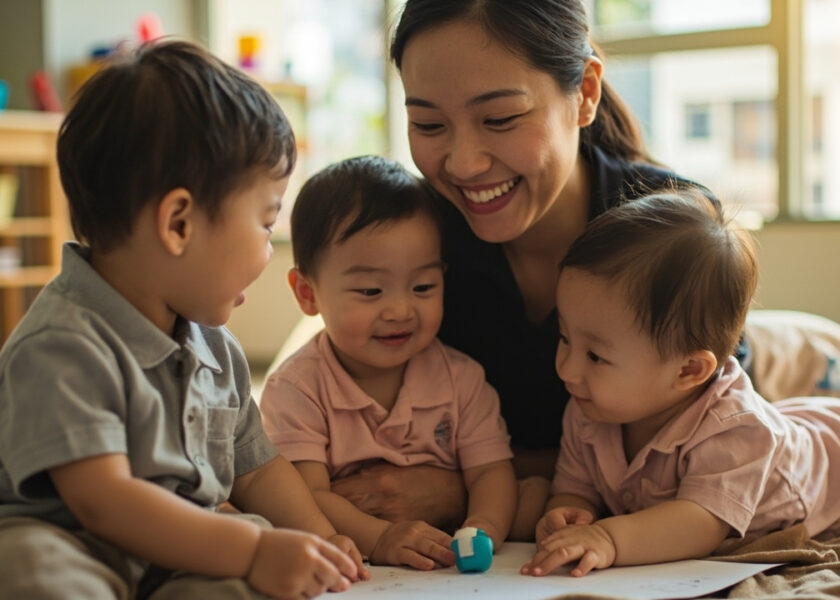
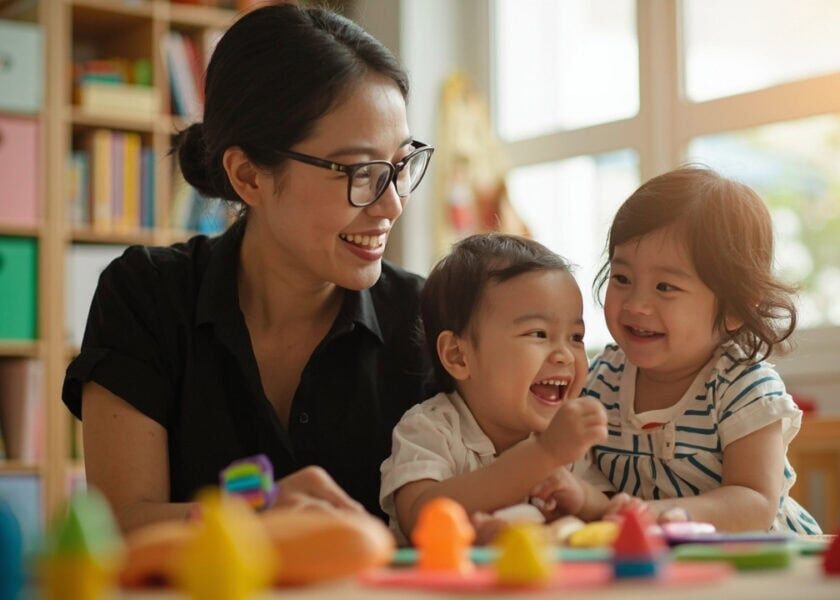
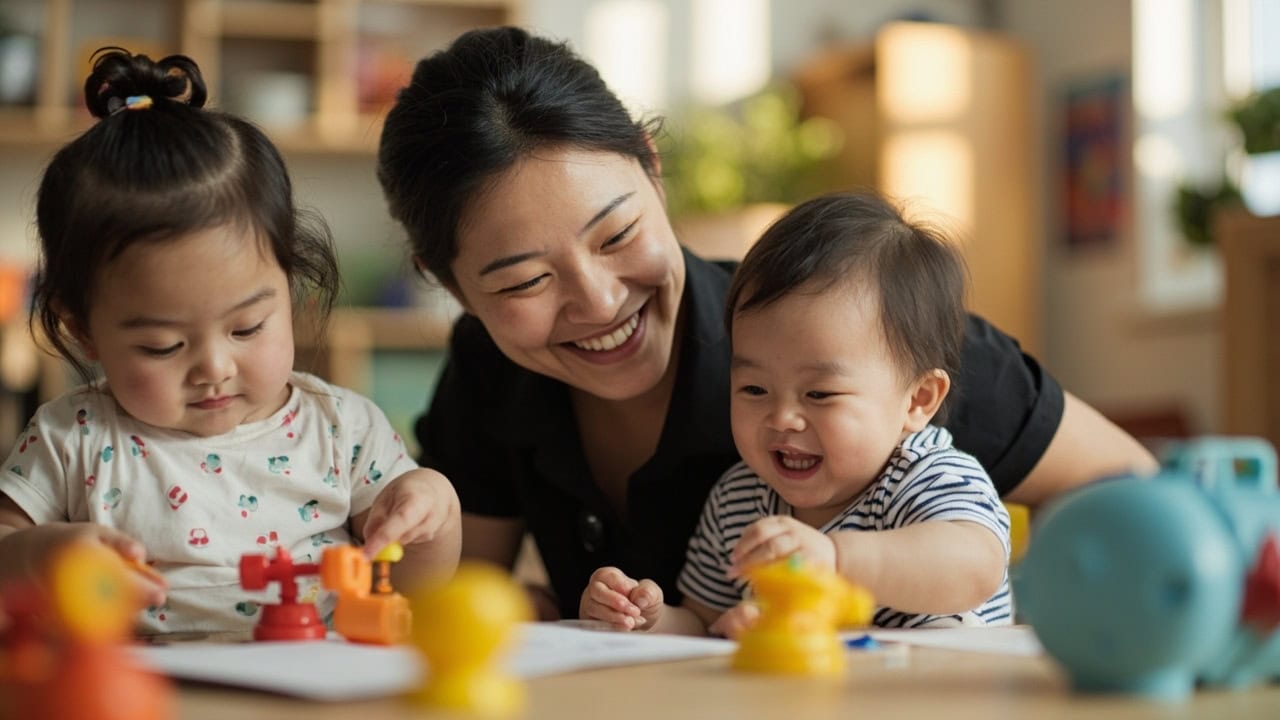
When you drop your child at a quality care arrangement, you are not dropping them into a void. You are dropping them into a place where other trained, attentive adults will also be reading your child’s cues.
You will come home to a caregiver who tells you: She was really engaged when we read that book today. Or: He seemed a bit off during the afternoon.
You will notice things differently because you have context. Because you have contrast. Because your child’s behaviour across different environments gives you more data, not less, to understand who she is and what she needs.
This is what we mean when we say that thoughtful childminding is not a service that takes over, but a partnership that informs. Parents are the constant in a child’s life. Caregivers may change. Settings may evolve. But the parent’s role as the primary interpreter of the child’s inner world — the one who knows this child most deeply because you made this child — that never goes away.
Connection Across Every Stage
As your child grows, the texture of connection changes. What works in infancy evolves in toddlerhood and deepens again in the preschool years. Understanding these shifts helps you stay responsive rather than relying on a single approach.
| Stage | What Connection Looks Like |
|---|---|
| Infancy (0–12 months) | Responding to cues with warmth. Feeding on demand. Offering comfort through touch and voice. Your attunement tells your baby: You exist, and you matter. |
| Toddlerhood (1–3 years) | Honouring big feelings while holding boundaries. Naming emotions together. Slow goodbyes that reassure. Your presence during distress tells your toddler: I can handle your whole self. |
| Preschool (3–6 years) | Listening to their stories with genuine attention. Asking open questions. Playing alongside rather than directing. Your curiosity tells your preschooler: Tell me more about who you are becoming. |
No matter the stage, your child needs you to be the steady interpreter of their world, not the most physically present adult in every hour. That role belongs to you, and it grows richer with every interaction you bring awareness to.
The Rituals That Anchor Your Relationship
In Singapore, where the pace of life is relentless, where commutes are long and expectations are high, protecting connection requires intention. It requires you to be deliberate about the small rituals that anchor your relationship.
The Morning
Think about the moments that belong to you and your child — the morning routine, before the day scatters you in different directions. This does not have to be long. It can be ten minutes.
But in those ten minutes, you can be fully present. You can dress your child with attention — narrating what you are doing, making eye contact, smiling. You can share a breakfast together, a small ritual of nourishment that says, We begin this day together.
And then, the moment of handoff. Instead of a hurried drop-off, you can kneel to your child’s level and say, I love you. I will see you soon. That slow goodbye rather than a rushed one matters enormously to a child’s sense of security. It says: Leaving is not abandonment. Coming back is certain.
Bedtime
There is perhaps no more sacred window in a child’s day than the hours before sleep, when the body softens, when the defenses lower, when a child is most open to feeling close.
This is not a luxury. It is a necessity. Even after a long workday, there is time — even if it is brief — to read a book together, to have a quiet conversation about the day, to offer the physical closeness that cements the bond. This is one of the most powerful tools a working parent has.
Weekends
Weekends matter too. They are not just recovery time. They are connection time.
A walk in the park. A meal cooked together. A bath where you splash and laugh. These are the moments your child will remember — not the grand gestures, but the accumulation of small, warm, present moments that say, I am here with you. You are my child. This is us.
Honouring the Complexity of Working Parenthood
There is a grief that comes with working parenthood. A mourning for the days when you could be with your child all day, when the bond felt simpler because proximity was constant.
Many parents feel this grief but do not give themselves permission to name it. They push through, they soldier on, and in doing so, they sometimes disconnect from the very feelings that could help them connect more deeply with their child.
Grief is not weakness. It is the evidence of love.
The parent who can honour that grief — who can sit with the ambivalence of wanting to be present and needing to work, who can be honest about the complexity of modern parenthood — that parent is often the one who is most emotionally available. Because they are not pretending. They are showing up, fully, with all the mess and all the feeling, and their child feels that authenticity.
That is not nothing. That is everything.
What Quality Childminding Looks Like in Practice
Singapore parents deserve to know what they should expect from quality childminding — not just for their peace of mind, but because quality care is what makes the partnership model actually work.
Here is what sets genuinely thoughtful childminding apart:
- Communication is consistent. You receive regular, meaningful updates about your child’s day — not just that they ate and slept, but how they were, what interested them, what challenged them.
- Caregivers observe and share cues. Trained caregivers notice the same things you are learning to notice at home — patterns, preferences, shifts in mood. This information flows back to you, deepening your own understanding.
- The transition is unhurried. Morning handoffs and evening pickups are treated as important moments, not logistical necessities.
- Your role is central. You are kept in the loop, consulted about routines and changes, and treated as the expert on your own child.
- The environment is safe and warm. A place where a child can explore and return to a familiar face.
EduNanny’s Approach: Partnership, Not Replacement
At EduNanny, we see ourselves as guardians of your connection, not replacements for it. We are part of your village. But we are not the centre of your child’s world. You are.
Our childminding arrangements operate under the ECDA Childminding Pilot, designed to be accessible with fee structures that allow families to use CDA and Baby Bonus funds. When care is both affordable and excellent, parents can return to work with confidence, knowing their child is in safe, capable, loving hands.
Whether through daily updates, transparent sharing of activities and discoveries, or systems that allow you to feel connected to what happens in your child’s day — we want you to feel like a partner in your child’s care, not a distant observer returning at the end of a long day to ask, What did I miss?
You are already showing up. Every single day. The parent who picks up their child at the end of the day, who puts away the phone, who kneels down to really see that face and ask, How was your day? What did you discover? — that parent is doing the most important thing.
The bond you have with your child is not fragile. It is resilient. It is built on biology, yes. But also on intention. On the thousand small moments of attunement that accumulate into a sense of security. On the trust that grows when a child knows, deep in their bones, that their parent will return.
The hours matter less than the quality of what you bring to the hours you have. That is enough. That has always been enough.
If you are looking for a childminding arrangement in Singapore that treats your family’s bond as its foundation — not its casualty — we would welcome the chance to learn more about your family. Connect with EduNanny to explore our pilot arrangements, fee structures, and how we work alongside parents like you.
Every child deserves to feel held by more than one pair of loving hands. Every parent deserves to know their child is in those hands.