Beyond the Morning Goodbye: Finding Peace in Singapore Childcare
The Invisible Hours: What Happens When You’re Not There
There is a particular silence that lives in the minutes after you have left your child. It is not the comfortable silence of a quiet afternoon or the familiar hush of night. It is the silence that asks questions you cannot answer: Is she crying? Is he eating enough? Are they being held when they need to be held?
You are already at work. Your phone is in your bag, or on your desk, or in your hand as you pretend to read an email while waiting for the update that may or may not come. Your child is somewhere across the city, in a room you have seen once or twice on a tour, and those hours stretch ahead of you like water filling a space you cannot close.
This is the reality of modern parenthood in Singapore. Not the dramatic crisis of separation anxiety, not the guilt-tripped confession of a working parent, but this: the ordinary, daily, quiet ache of being present in two places at once and fully in neither.
You are not alone in this silence. And what I want to speak with you about today is what happens in those hours you cannot see—because understanding them is the beginning of something important. Not the elimination of that ache, but its transformation into something you can carry with confidence.
The Morning Goodbye and What Follows
The morning goodbye is its own small ritual. The bag is packed, the milk is finished, the diaper is checked one last time. You have kissed that forehead, adjusted that onesie, promised to come back. And then you leave.
Your child may cry or may not. They may wave or look away. Either way, you go, and they stay—and this is the arrangement that makes modern life possible and modern parenthood so particular in its texture.
What you are doing in that moment is not weakness. You are not abandoning your child. You are doing what countless parents in this city do every morning: you are trusting someone else with the most important person in your life. This is not a small thing. It is one of the bravest acts of parenting.
And yet the courage required does not stop the questions. So let me answer some of them.
What Your Child Is Actually Doing
A child in quality care is not merely supervised. They are attended to—not as a task to be completed between meetings, but as a small person whose needs are the primary work of the morning.
- The child who arrived fussy from the car ride is picked up, not just soothed but engaged
- The caregiver speaks, or sings, or simply holds
- The child who slept poorly and wakes reaching is met with warmth before they have finished opening their eyes
These are not extraordinary moments. They are the ordinary fabric of a good morning, and they are happening while you are in a meeting, on a call, or eating lunch at your desk wondering.
You cannot see these moments, but they are there.
Why Small Ratios Change Everything
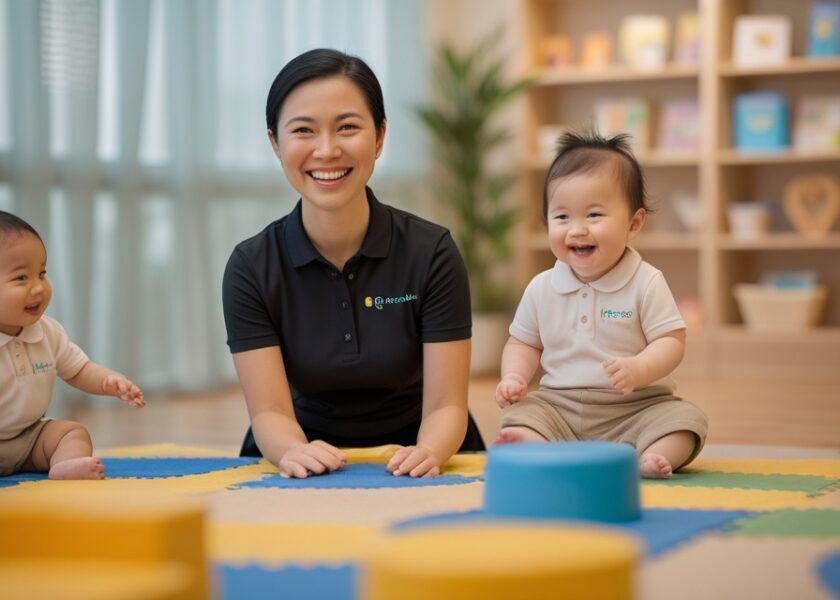
When there are only three infants for one caregiver, there is time to notice. There is space to respond. There is the slow, patient work of building the kind of familiarity that transforms strangers into trusted figures.
Your child is not in a crowd. Your child is in a room where they are known.
In the ECDA-supported Childminding Pilot model, this quality of attention is not accidental. It is structured. Small ratios mean that a caregiver can truly know each child—not just their schedule, but their temperament, their moods, the way they signal hunger or tiredness or the need for comfort.
Home-Based Care: A Different Kind of Continuity
In home-based or community pathways of the Childminding Pilot, this continuity is even more pronounced. Your child may be in a warm, domestic setting scaled to their size, with the same caregiver each day building the kind of consistent relationship that small children need to thrive.
The Pickup Moment: Reading the Evidence
There is a reason that pickup is so emotionally charged, and it is not just impatience to see your child. Pickup is the moment when the curtain falls on the invisible hours, and you get your first real evidence of what those hours contained.
What you see when you walk through the door matters. Not because you should be analyzing your child for signs of quality, but because children are extraordinary communicators, and the pickup moment is when they tell you everything you need to know—though not always in words.
- A child who runs to you with open arms is telling you something
- A child who is playing contentedly and looks up with recognition before returning to their game is telling you something
- A child who is relaxed, unhurried, comfortable in their skin—this is evidence
It is not proof in the laboratory sense, but it is the kind of evidence that parents have always read: the body language of a child who has been well.
When a caregiver can tell you with specificity how your child’s day went—when they remember the small details, when they speak about your child with genuine affection—you are receiving important information. You are learning that your child has been seen as an individual, not processed as a number.
Quality models build trust through transparency. The more you know about those hours, the less invisible they become. The less invisible they become, the more confidence you can carry into your own working day.
Building Trust Slowly Over the Weeks
The first days of childcare are hard. There is adjustment, there are tears, there is the sense that something fundamental has shifted in your family.
You may question whether you made the right choice. You may wonder if you should quit your job, move closer to family, somehow rearrange the entire architecture of your life to avoid this daily separation.
You do not need to.
What happens in the following weeks is something remarkable, if you let it. Your child begins to settle. The morning goodbye shortens from an ordeal to a ritual to almost nothing. They begin to anticipate pickup, to recognize the caregiver, to treat the childcare room as a familiar place.
And somewhere in this process, something shifts in you too.
You begin to trust. Not blindly. Not without evidence. But trust the way it is meant to be built: slowly, on the foundation of consistent good experience.
You start to notice that your child comes home content. You start to hear from caregivers about the small milestones of the day. You start to feel, in your body, that this arrangement is working—that your child is not merely surviving these hours but thriving in them.
Extension, Not Replacement
Quality childcare is not a replacement for parental presence. It is an extension of it. The care your child receives in those hours is not separate from the care you provide at home. It is connected to it.
The rhythms you establish at home—feeding times, nap times, the way you speak to your child—are echoed, as much as possible, in the childcare setting. The values you hold—the way you want your child to be treated—are reflected in the caregiver’s approach.
In this way, childcare is not a handoff. It is a collaboration.
You remain the most important person in your child’s life. You remain their secure base, the place they return to at the end of every day, the person whose face they look for in a crowded room. But for these hours, there is someone else holding part of the weight.
You are not less of a parent because you are at work. You are not choosing your career over your child. You are providing for your child, yes, but you are also modeling something important: that adults have purpose beyond parenthood, that families function as ecosystems, that love does not require constant physical proximity to be real.
Your child will grow up knowing that their parents worked. They will understand, in time, that you left them in someone’s care not because you wanted to be away but because that is how your family chose to live.
And if that care was good—attentive, warm, consistent—they will carry the memory of being held well by more than just you.
What Quality Childminding Actually Looks Like
If you are researching infant care in Singapore, here is what to look for—and what quality actually means in practice:
- Ratio matters. Fewer children per caregiver means more attention for your infant. Ask about the adult-to-infant ratio before enrollment.
- Consistency matters. The same caregiver each day builds familiarity and trust. Frequent turnover undermines everything.
- Communication matters. You should hear about your child’s day—not just that they ate and slept, but how they were, who they played with, what made them smile.
- Environment matters. Is it scaled to a child’s size? Is it warm and domestic or institutional? Does it feel like a place a child can thrive?
- Observation matters. Quality caregivers notice. They track developmental milestones, share observations, and partner with you in understanding your child’s growth.
Questions to Ask During Your Tour
- What is the caregiver-to-infant ratio?
- Will my child have the same caregiver each day?
- How do you communicate with parents during the day?
- What does a typical day look like for infants?
- How do you handle feeding, sleeping, and comfort?
- What training do your caregivers have?
Coming Back to the Doorway
This is what you are paying for, though you will rarely see it: not just supervision. Not just safety. The architecture of a good day for your child, built room by room, moment by moment, by someone who has taken this responsibility as seriously as you have.
In the morning, you leave. You carry the weight of goodbye with you into the world. You work, you function, you perform the many roles that adult life demands. But underneath all of it, there is a thread connecting you to wherever your child is.
You cannot see them. You cannot hear them. But you know they are there, and you trust—because you have chosen carefully, because the evidence at pickup has built slowly, because the communication has been open—that they are being held.
In the afternoon, you return. You walk through that door. You see your child’s face. And in that face, you read the story of their day—contentment or fatigue, joy or crankiness, the whole complicated truth of a small life lived without you for seven or eight hours.
You gather your child in your arms. You take them home.
EduNanny exists for those hours you cannot see. Not to replace what you do, but to hold up their end of the bargain with the same care and seriousness you bring to your own role—built on the standards and structure of the ECDA Childminding Pilot, with trained caregivers who understand that ratios matter and attention is everything.
Your child does not need a perfect childcare arrangement. They need a good one. They need consistency, warmth, responsiveness, safety. They need to be known by the people who care for them.
And they need you—always you—to be waiting at the end of the day with open arms.
That is not a burden. That is the privilege of parenthood, and it belongs to you fully, even on the days when you are apart.
The hours you cannot see are not empty. They are filled with the quiet, essential work of care. And now, when you think of those hours, I hope you can hold them differently—not as a void to worry about, but as a space where your child is safe, seen, and well.
That is what quality childcare offers. That is what EduNanny exists to provide. And that is what I hope you can carry with you, going forward, into every morning goodbye and every afternoon pickup.
Because you are doing this well. And your child knows it.
Ready to explore your options?
If you are currently researching infant care in Singapore and want to understand how EduNanny’s Childminding Pilot approach might work for your family, we invite you to speak with our team.
Every family deserves to feel confident about the care their child receives—not just during the tour, but every morning when they walk out the door.
Learn more about how EduNanny supports working families in Singapore, including availability, pilot fee structures, and how we help families through the adjustment period. We are here for those hours too.