**Quality Childcare Means Your Child Is Truly Known**
What Quality Childcare Actually Does
For parents researching their options, here is what matters most:
- It observes, not just supervises. Caregivers trained in attunement read your child’s signals — not to manage behaviour, but to understand it.
- Small ratios matter. Fewer children per caregiver means more space for noticing, for reading faces before a cry begins, for genuine knowing.
- Technology documents. Attunement understands. Apps, logs, and photo updates tell you what happened. They cannot tell you who your child is becoming.
- The parent-caregiver relationship is a partnership. You know your child at home. Caregivers know your child in the social world. Together, you build a fuller picture.
- EduNanny embeds these principles within the ECDA Childminding Pilot, with ratios designed to protect genuine attunement and communication structures that keep you connected.
The Difference Between Watching and Witnessing
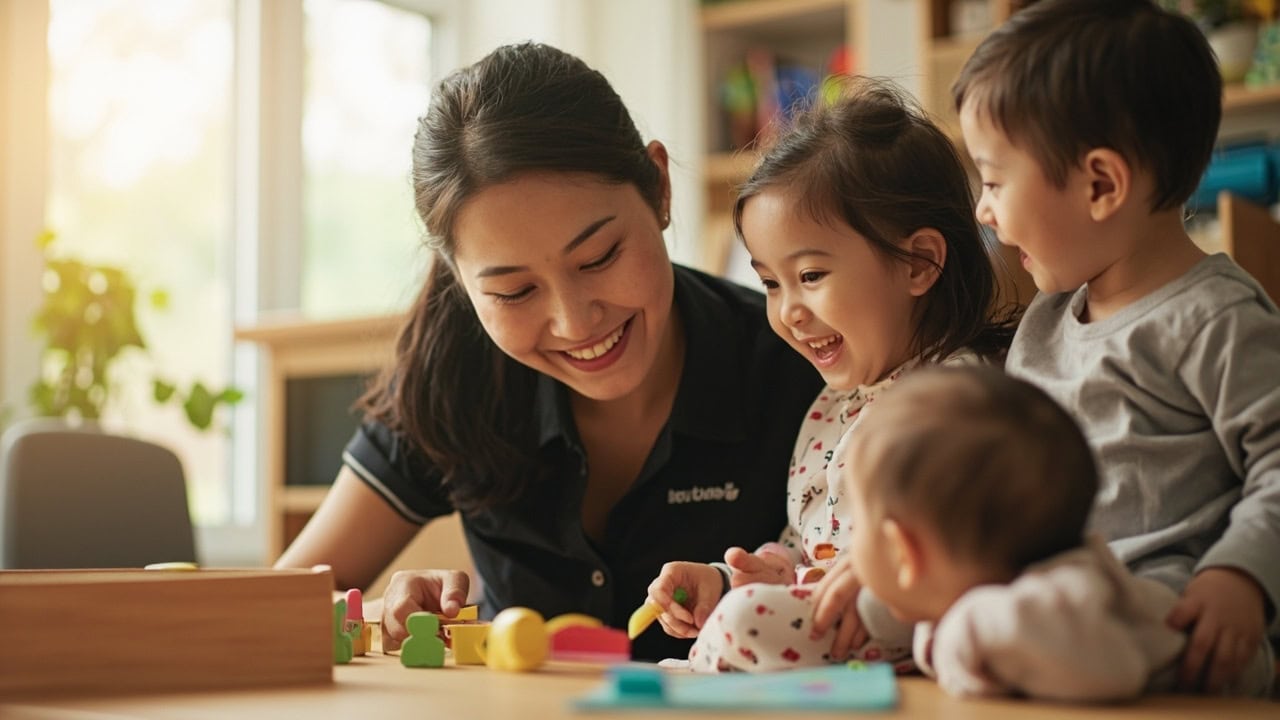
When you walk through the doors of a quality infant care setting, what is happening may not look dramatic from the outside. A caregiver sits on the floor. A child approaches with a block in hand. The caregiver watches — not with a distracted glance, but with the particular quality of attention that comes from training and from genuine interest.
This is the difference between observation and supervision, between watching and witnessing. Supervision keeps children safe. Observation, the kind that matters, keeps children understood.
What Attunement Actually Means
There is a concept in early childhood education that speaks directly to this — attunement. It is the caregiver’s capacity to read a child’s signals, to interpret their behaviour not as noise to be managed but as language to be understood.
It is the practiced art of noticing that one child grows calmer when given space to observe before joining, while another brightens immediately at the invitation to move. It is understanding that a particular frown before lunch is not defiance but hunger, and that the child who suddenly becomes still is not being good but is signalling something that needs gentle attention.
Attunement is the invisible architecture of quality care. It is built slowly, through thousands of small observations gathered over weeks and months.
The Internal Map
The attuned caregiver builds something over time — an internal map of each child in their care. This map is drawn from patterns: the rhythm of a child’s sleep, the foods they approach eagerly and the ones they approach cautiously, the way they greet other children, the sensory experiences that soothe them and the ones that overstimulate.
It is knowing that one child needs a quiet corner after a busy morning, while another is soothed precisely by the energy of a group. This internal map is not filed away in a report or captured in a photograph. It lives in the caregiver’s awareness and informs every interaction — the way a question is posed, the timing of a transition, the tone used when offering comfort.
This is what separates quality from adequacy. Adequate care ensures that children are fed, changed, kept safe. Quality care goes further — it reads the child and responds in a way that says, I see you. I understand you. Your inner experience matters to me.
What Your Child’s Play Is Telling You
Consider play. When your child builds a tower and knocks it down, they are not simply amusing themselves. They are working through something — the pleasure of creation and destruction, the physics of cause and effect, perhaps a tension they felt earlier in the morning when you left.
When a caregiver watches this play with an attuned eye, they are reading a kind of language that your child speaks before words are fully formed. They notice that this child always returns to stacking after moments of transition, that another child’s play grows more elaborate when they feel secure, that a third child uses dolls to rehearse the goodbyes they encounter daily.
For many families in Singapore, the morning drop-off is a significant moment. A child who hesitates at the door is not simply being difficult — they may be processing a real emotion that deserves acknowledgment. A caregiver who understands this does not rush the moment or dismiss it. They recognise it, name it gently, and offer the reassurance that return is inevitable and that the hours ahead will hold good things.
Observation vs Supervision: What Actually Changes
| Supervision (Watching) | Observation (Witnessing) |
|---|---|
| Ensures physical safety | Understands emotional and developmental signals |
| Counts children, manages groups | Notices individual patterns and temperaments |
| Responds to incidents | Anticipates needs before they become urgent |
| Documents for compliance | Notices for understanding |
| Maintains order | Reads the child behind the behaviour |
Can Technology Replace Attunement?
There is a question that often arises, and it is worth naming directly: can technology serve this function? Can an app, a daily log, a photograph, a video update tell you what you need to know about your child’s day?
These tools have their place. Transparency matters. Knowing that your child ate well, that they napped on schedule, that they played outside — this offers genuine reassurance, and quality care providers understand this. A commitment to open communication, including measures such as CCTV where deployed, reflects a respect for the parent’s need to feel connected to their child’s day.
But here is what an app cannot do: it cannot catch the moment when your child’s play shifts from hesitant to confident. It cannot notice the way their shoulders drop when they finally relax into the morning. It cannot read the quality of their engagement with another child and wonder what that interaction is teaching them about friendship.
Technology can document. It cannot attune.
Documentation captures data. Attunement creates understanding. One tells you what happened. The other tells you who your child is becoming in your absence.
The Parent-Caregiver Partnership and Why the Early Years Matter
The relationship between parent and caregiver matters deeply, and it should be understood not as a handover of responsibility but as a partnership. The parent knows the child at home — their particular rhythms, their fears, their joys, the way they sleep, the foods they love. The caregiver knows the child in the social world — how they engage with peers, how they respond to new situations, how they grow when they are among other children.
Neither knowledge is complete without the other. When these two sources of understanding are shared respectfully and regularly, they form something powerful: a co-authored understanding of the child. You bring the home story. The caregiver brings the group story. Together, you build a fuller picture than either could create alone.
When it works well, parents report something remarkable — they feel not that they have handed over their child to strangers, but that they have gained an ally in understanding their child. They return from a day’s work to a caregiver who speaks of their child with genuine familiarity, who notices the same things they notice, who cares about the same small victories and worries about the same small struggles.
What the Early Years Actually Need
What happens in the first thousand days of a child’s life shapes the architecture of who they will become. Neural pathways are formed at a remarkable pace. Social capacities are emerging. The child’s understanding of safety, of trust, of their own worth, is being written in real time.
In this context, infant care is not a placeholder between parental leaves. It is a formative environment, and the quality of attention within it matters profoundly. When a caregiver is attuned — when they respond to a child’s signals consistently, when they create an environment that feels safe enough for exploration, when they celebrate a child’s small discoveries with genuine delight — they are contributing something essential to the child’s development.
They are teaching the child, through repeated experience, that they are worthy of attention, that their communications matter, that the world can be trusted to respond to them. This is not a small thing. It is the foundation upon which a child’s confidence and curiosity will rest.
How EduNanny Approaches Quality Care
For parents in Singapore navigating these decisions, the landscape can feel overwhelming. There are centre-based options and home-based arrangements. There are government-supported programmes, such as the ECDA Childminding Pilot, which offer pathways designed to make quality care more accessible and affordable. There are fee structures that can feel puzzling, and funding mechanisms that require understanding to navigate.
The practical realities of childcare in Singapore are real, and they deserve thoughtful consideration. But beneath the logistics, the question remains the same: Where will my child be known?
What EduNanny Offers
EduNanny has built its approach around this question. Within the ECDA Childminding Pilot, EduNanny offers home-based care with small ratios — up to one to three infants in childminding settings — that protect the conditions for genuine attunement. This is not incidental. It reflects a conviction that knowing a child well requires the conditions that make knowing possible: time, space, and the absence of crowding.
EduNanny offers both home-based and centre-based pathways, understanding that different families have different needs and that the best care is one that fits the rhythms of a particular family’s life. The Monday to Friday care blocks align with the reality of working parents, and the fee structures within the pilot have been designed with accessibility in mind.
The Culture Behind the Structure
Beyond the structure, what EduNanny has sought to build is a culture of care — one where caregivers are not just trained in safety protocols and developmental milestones, but in the art of paying attention. Where communication with parents is not an afterthought but a commitment. Where the child’s inner experience is treated as something worthy of careful observation and gentle response.
This is what sets quality apart. Not the brochure, not the facilities, not the promises — but the daily, quiet, sustained attention that a caregiver brings to knowing the particular child in front of them.
What to Look For When Choosing Infant Care
If you are evaluating infant care options in Singapore, here are the questions that matter most:
- How many children are in the caregiver’s care at one time? Small ratios create space for noticing. Ask about infant-to-caregiver ratios and understand what they mean in practice.
- How does the caregiver describe your child? After a settling period, the right caregiver should speak about your child with specificity — particular details that show they are truly seeing your child.
- What does the communication look like? Transparency matters, but ask what it looks like beyond logs and photographs. How do they share observations? How do they invite your input?
- How does the caregiver handle transitions? Morning drop-offs, nap times, and pickups are revealing moments. Notice how the caregiver relates to your child during these times.
- Does the approach feel relational or transactional? Quality care feels like a partnership. You should feel like an expert on your child, not like a client being served.
The Promise
When a caregiver truly attunes to a child, they are doing something that extends beyond professional competence. They are saying, with every careful observation and responsive interaction: You are not one of many to me. You are this one. I see your particular way of being in the world, and it matters.
This is what children need most — to be known, to be seen, to have their inner experience reflected back to them as something real and valuable.
And for parents, this is the deepest answer to the question that wakes you in the night, the question that lingers at drop-off, the question you may not even have fully articulated: Is my child okay? Is my child known?
Yes. In quality care, the answer is yes. Not perfectly, not completely — children remain mysterious, and caregiving remains human — but yes in the ways that matter. Your child is being read, not just watched. Your child is being understood, not just managed.
So if you are standing at that threshold, in that morning moment, feeling the weight of what you are entrusting — know this: the right care will not replace you. It will stand beside you. It will watch your child with the same attention you bring at home. It will notice the same things, celebrate the same small victories, and hold the same tender concern for the same small struggles.
Your child will be seen. Your child will be known. And you, as their parent, will never be alone in the work of raising them.
If you would like to learn more about how EduNanny approaches quality childminding and the pathways available through the ECDA Childminding Pilot, we welcome the opportunity to speak with you. You can also read more about our approach and what we believe about the work of caring for young children.