Fraud Blocker edunanny.com

Category: Childminding

edunanny-063f222f0cdc985ee9c9c852d5c32eb2
April 28, 2026

Beyond the Brochure: How Singapore Parents Read a Childcare Centre

“`html

The Gap Between What You See and What You Need to Know

You walk into a childcare centre in Singapore. Everything looks right. The walls are bright. The children are smiling. The teacher greets you at the door with a warm smile and a printed brochure. She walks you through the curriculum chart, the activity schedule, the safety certifications on the wall. She shows you the reading corner, the play area, the clean cot room. She tells you about their philosophy — words like holistic, nurturing, child-centred.

You nod. You smile. You take notes.

And then you step back into your car, and you realise you still do not know.

This is the moment many Singapore parents know well. Not because you did anything wrong — you did not. It is because the childcare visit has become an experience designed to reassure. And reassurance, as any parent who has sat through five centre tours can tell you, is not the same as information.


What to Look For: Five Quality Signals That Matter

Signal 1: Watch the Room Behind You

You are standing in a classroom. The teacher is explaining the daily routine, pointing to the schedule on the wall. She is warm, articulate, engaging. You are nodding. You are impressed.

But what you should be watching — if you want to know the truth of this place — is not her. It is the room behind you.

When the teacher is presenting to you, who is managing the children?

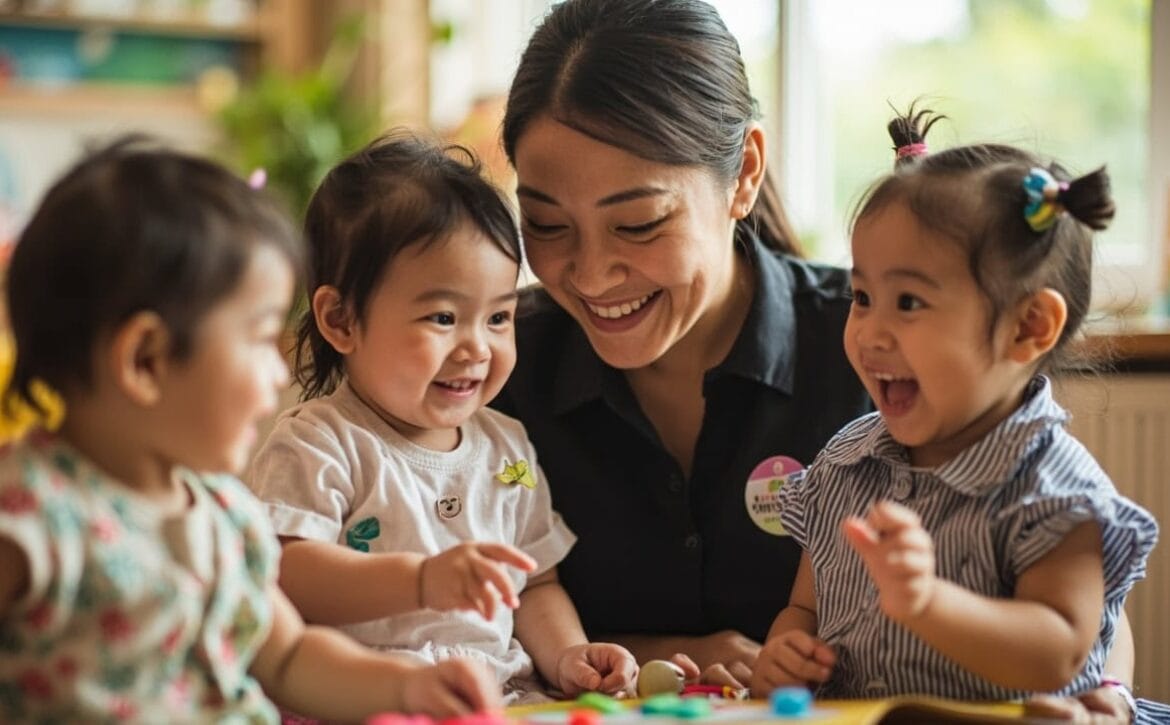
In a quality centre, the children are engaged in something meaningful. The other teacher in the room — because good centres have more than one adult — is with the children, talking to them, responding to them, not just watching them. In a centre that is more focused on presentation than practice, the children may be watching a screen. They may be sitting quietly waiting. They may be in an activity that does not require much from the adult because the adult’s attention is on you.

Watch the room when no one is performing for you. This is the first quality signal. The moment the presentation attention shifts — even for thirty seconds — is when you see what the centre actually believes about children.

Does it believe children deserve engaged attention even when no one is evaluating the centre? Or does it believe children can wait, can be managed, can be occupied, as long as the parent in the lobby is being taken care of?

Signal 2: Child-Led or Routine-Driven?

Here is a distinction that will change how you see every classroom you walk into. There is a difference between child-led activity and routine-driven activity, and the difference matters more than any curriculum chart on the wall.

Child-led activity looks like this: You walk into a room. Children are playing. One is building with blocks. One is drawing. One is sitting with a teacher, and they are engaged in something together — maybe the teacher is naming what the child is doing, maybe she is asking a question, maybe she is simply present, attentive, following the child’s lead. There is a quality of attention there. The children look like they have some agency. They are not all doing the same thing at the same time.

Routine-driven activity looks different: You walk into a room and everyone is doing the same thing. They are all singing the same song. They are all doing the same craft. They are all seated at the same time, standing at the same time, moving at the same time.

This is not inherently wrong — young children do need rhythm and routine. But when routine becomes the only structure, when every moment is scripted and synchronised, something important is missing. Children are not being seen as individuals with their own interests, their own tempo, their own way of learning. They are being managed as a group.

The test: When you observe a classroom, ask yourself whether the children seem like individuals or like a cohort. Both can be well-run. Only one is child-centred.

Signal 3: The Teacher’s Two Voices

Notice how the teacher speaks to the children when she knows you are listening. Then notice how she speaks to the children when she forgets you are there. These are often two different voices.

When a teacher knows parents are present, the voice becomes warmer, more deliberate, more performance-ready. She narrates what she is doing. She makes eye contact with the children. She uses gentle, intentional language. This is real. But it is also partial.

The more revealing moment is when the teacher is not performing. She is correcting a child. She is redirecting behaviour. She is speaking to a colleague. Watch what happens.

Does her voice change? Does the warmth disappear? Does she speak to the child the way she would speak to the child if you were not there? Or does she switch registers the moment she remembers you?

The children know the difference. They have already learned, in just a few months or weeks of being in this room, which teachers are genuinely warm and which teachers are warm when it counts. Children are not fooled by presentations. They respond to what is real.

Signal 4: The Emotional Temperature of the Room

Ask yourself a simple question as you walk through any centre: Do the children here seem relaxed with the adults? Do they approach teachers naturally? Do they seek them out, or do they avoid them?

The physical ease of the children in the presence of their caregivers is one of the truest signals of quality you will ever observe. Watch where the children position themselves in relation to the adults. Watch who they go to when they need something. Watch whether they look settled or watchful.

In a room where attunement is real, children do not need to monitor the adults. They are not on guard. They can explore, focus, play — because they trust that someone is present and attuned when they need them.

In a room where supervision has replaced attunement, children may look well-behaved but there is a tension underneath. They are managing themselves because the adults are not quite attuned enough to help them regulate.

Signal 5: Transitions — The Counter-Intuitive Window

There is one more observation that most parents miss, and it is the most counter-intuitive: pay close attention to transitions.

Every centre has them. Arrival. Pickup. Moving from one activity to another. End of snack time. These are the moments when the structure of the day bends, when children are not fully occupied, when the adult-to-child ratio matters most and is often most strained.

In a centre with genuine attunement culture: Transitions are handled with care. Children are prepared. There is a verbal cue. There is a transition song or ritual. The teacher bends down to the child’s level. The handoff from parent to caregiver at arrival is smooth, warm, human. The children do not flood from one activity to the next like water through a gate.

In a centre where supervision has replaced attunement: Transitions reveal it. Children are rushed. Voices rise. The teacher is managing logistics rather than children. You might see a child crying and no adult responding immediately — not because they do not care, but because there are too many children and not enough attuned attention at that moment.

If you want to know what this centre will feel like on a regular Tuesday, when there is no parent tour and no performance, watch a transition. That is where the culture lives.


Questions That Reveal More Than Answers

Every centre has a presenting self and a real self. This is not unique to childcare — it is how institutions work. The lobby is designed. The tour is scripted. The teacher walking you through knows which moments to show you and which moments to keep you away from. This is not cynical. It is human. They want you to see their best.

But here is the paradox: the moment you are not being shown something is often the most important moment of the visit.

Observation alone is incomplete. There are things you can ask that will tell you almost as much as what you see.

What happens when a child is distressed?

Listen to the answer. Is it procedural — a protocol, a checklist, a sequence of steps? Or is it responsive? Do the teachers adapt to what the individual child needs? Does the answer include language about the child’s specific signals, the way teachers learn to read crying as communication, the way they match their response to what the child is expressing?

Procedural care is not the same as attuned care. Both can be safe. Both can be competent. But only one sees your child.

How do you handle children at different developmental stages?

This is particularly relevant for infant and toddler rooms. A good centre has thought carefully about how to meet the needs of children who are six months apart in ways that are developmentally appropriate for each.

If the answer is a one-size-fits-all routine, that tells you something. If the answer involves flexible grouping, individual planning, differentiated activities — that tells you something else.

Who will be with my child day to day?

How long do your teachers stay? High turnover is not just inconvenient — it is disruptive to the attachment security that young children need to thrive. A centre that has thought about this, that has built a culture where teachers stay, is a centre that has understood something fundamental about early childhood.


What Quality Care Actually Looks Like — and Why It Matters

You spent the first year or two of your child’s life learning to read them — their hunger cues, their tired signals, the particular cry that means discomfort versus the one that means loneliness. You learned to read your child because your child’s life depended on your understanding.

You can learn to read a centre the same way.

Quality in early care is not about square footage or curriculum charts or the number of learning corners in a room. It is about attunement. It is about whether the adult in the room has the capacity and the culture to notice your child — really notice them — and respond accordingly.

This is not a soft idea. It has measurable consequences for your child’s development. When children are consistently met with attuned attention, they develop what researchers call a secure base — a foundation from which they can explore, learn, and grow. When children are consistently supervised but not attuned to, they learn to manage themselves in ways that are effortful and stressful, even when they look calm on the surface.

You cannot always see attunement on a tour. But you can see its effects: the emotional temperature of the room, the ease of the children, the way teachers speak to children when they think no one is listening.

The question is not whether a centre looks good. The question is whether your child will feel seen there.

Am I being too picky?
You are not. The early years are not a rehearsal. Your child’s brain is developing at a speed it never will again. The quality of care in these years matters — not in a crunchy, idealistic way, but in measurable ways that researchers have documented across decades of study.

What if I cannot afford the premium centres?
Premium pricing does not guarantee premium attunement. A centre with expensive branding and a large group of children may still not see your child the way a smaller, more thoughtfully structured programme can. Look for quality signals, not price tags.

How do I know if the warmth I see is real?
Watch what happens when the warmth is not being observed. Use the five signals in this article. Ask the hard questions. Trust the ones that give you real answers, not just smooth ones.

What if I choose wrong?
You will not find perfect. No such place exists. But you can choose with clarity instead of guessing. You can walk out of a centre visit knowing what you saw. And if you see the right things — the ease of the children, the genuine warmth of the teachers, the gentle transitions, the child-led moments — you will know. You will know because you will have the eyes to see it.


Why EduNanny Was Built Differently

When we designed the EduNanny childminding programme under the ECDA Childminding Pilot, we started with a question that most childcare discussions skip past: what do Singapore parents actually need?

Not just a place that is safe. Not just a place that is certified. A place where their child will be seen.

The childminding model we developed — home-based, small group, with a ratio of up to one caregiver to three infants — was built around a conviction that has become a founding principle. Small ratios are not just a nice feature. They are the structural prerequisite for genuine attunement. When a caregiver has three infants instead of fifteen, every moment of distress can be noticed. Every signal can be read. Every child’s individual rhythm can be respected.

That is why EduNanny’s approach is different. It is not just a different model of care. It is a different relationship with parents. We believe you should not have to trust blindly. We believe you should be able to see clearly. And we believe that the best way to earn your trust is to give you the tools to evaluate — us and everyone else.

That is why everything we do at EduNanny is built around transparency. Parents in the pilot have access to regular updates, open communication, and where deployed, CCTV measures — not because we have something to hide, but because we believe you have the right to see what is happening in your child’s day. We want you to be able to observe. We want you to ask the hard questions. We want your visits to be moments of reassurance that come from genuine understanding, not polished performance.

Our caregivers are trained not just in safety and development but in the culture of attunement — how to speak to a child, how to wait for a child’s response, how to let a child’s lead guide the interaction. Our small ratios mean that when your child looks up, there is someone there. Our home-based setting means your child is not one of thirty in a room. They are one of two or three, in a space that feels like care, not institution.

We have also made the programme accessible. The pilot fee structure is designed to be affordable. CDA and Baby Bonus funds are usable. Monday to Friday blocks cover the working day. This is not an afterthought — it is a commitment. Every Singapore family deserves access to quality care, not just the families who can afford premium pricing.

And we have built something else that we hope you will find useful: our Thomas AI Chatbot. Because we know that parenting in Singapore is demanding, that schedules are tight, that questions do not only arise during office hours. Thomas is there — a resource, a guide, a way to get thoughtful answers when you need them. Not a replacement for human care, but a complement to it.


Your Next Centre Visit: A Framework for Clarity

Before you walk into your next centre, remember this:

  • The childcare visit is not a performance you sit through. It is a data-collection exercise.
  • You are training your eye. The same way you learned to read your child’s first smiles, their first reaches, their first signals — you can learn to read a centre.
  • Watch for what happens when they forget you are there. This is where the truth lives.
  • Ask questions that reveal culture, not just policy. How teachers respond to distress tells you more than any curriculum chart.
  • Trust the emotional temperature. If something feels off, give it a name. If something feels right, know why.

The parent who walks out of a centre visit and says something feels off — that parent is not wrong. They are seeing something they do not yet have language for. This article has been about giving you that language.

And when you do find a centre where the children are at ease, where the teachers’ warmth does not switch off when they are not being watched, where the transitions are gentle and the activity is child-led, where you can ask a hard question and get a real answer — you will know. You will know because you will have the eyes to see it.

That is what EduNanny stands for. Not just quality care. The capacity to recognise quality care. Because you should never have to choose with your fingers crossed. You should be able to choose with clarity.

If you are ready to explore what attentive, small-group childminding looks like in Singapore — or if you simply want to learn more about evaluating any childcare option with greater confidence — we welcome you to start a conversation with us.

Your child’s early years deserve more than reassurance. They deserve your clearest judgment. And we are here to help you find it.


EduNanny is a Singapore childminding service operating under the ECDA Childminding Pilot. Learn more about who we are or explore our approach to thoughtful, development-oriented childcare.

“`

edunanny-063f1eee7dcf88d73f602f6fe096a0d2
April 28, 2026

Beyond Supervision: Finding Infant Care That Sees Your Baby

The Collision No One Names

Singapore gives you sixteen weeks. That is the official maternity leave entitlement—four months, depending on your employment terms and whether your employer offers any enhancement. Four months to recover from birth, to establish feeding, to learn your baby’s cries, to begin the slow work of understanding this small person who has changed everything.

But biology is not following the Employment Act.

In the first year of life, your baby’s brain is developing at a speed it will never match again. Synapses are forming at a rate of more than one million per second. The architecture of the prefrontal cortex—the part that will eventually allow for impulse control, reasoned decision-making, and the capacity to see beyond the immediate moment—is being constructed. And woven through all of this construction is something that neuroscience has been studying for decades with increasingly clear findings: the quality of your baby’s early relationships.

This is not a metaphor. When a caregiver consistently responds to an infant’s distress—when the baby cries and someone comes, when the baby reaches and someone reaches back, when the baby looks at a face and the face looks back with attention and warmth—the infant’s developing brain learns something fundamental. It learns that the world is a place where needs are met. It learns that people are reliable. It learns, on a cellular level, that relationships can be trusted.

This is the science of attachment. And here is what is critical for you to understand: the attachment system is most sensitive, most malleable, most open to being shaped in precisely the first twelve months of life. Not in the toddler years. Not in preschool. In the first year, when your baby cannot speak, cannot reason, cannot ask for what she needs.

So when Singapore policy asks you to return to work at sixteen weeks, it is asking you to navigate a collision. On one side: a biological reality that demands consistency, attunement, and responsive care for your infant’s healthy development. On the other: an economic and professional reality that requires most families to have two working parents.

This is not a problem we are going to solve with reassurance. This is a genuine tension, and it deserves to be named honestly. You are not wrong to feel the weight of it. You are not overthinking it. You are, in fact, thinking about exactly the right things.


What Quality Infant Care Actually Means

We know how to talk about quality for toddlers. We can ask children what they did today. We can observe their social behaviors, their language development, their ability to share and negotiate. We can watch them run to a caregiver and see whether the greeting is warm.

But infants are different. Infants cannot report on their experience. They cannot tell you that Mrs. Lim noticed they were getting fussy twenty minutes before a meltdown and offered a quiet change of scenery. They cannot tell you that when they reached up with grabby hands, someone picked them up—not because they were crying yet, but because someone was watching closely enough to notice the reaching before it became need.

Supervision Is Not Attunement

For pre-verbal children, quality care lives in the space before distress. It lives in the caregiver’s ability to read the subtle cues—the slight stiffening, the averted gaze, the change in breathing—that signal a baby is beginning to dysregulate. It lives in the consistency of presence, the familiarity of voice, the way a caregiver speaks to a three-month-old as though the baby is a person worth speaking to.

This is what developmental scientists call attunement. And it is not the same as supervision.

  • Supervision means a baby is safe.
  • Attunement means a baby is known.

When you are evaluating infant care arrangements, the question is not only “Will my baby be safe?” The question is “Will my baby be seen?”

Will the person caring for my child notice when she is hungry before she cries? Will she recognize that my baby’s cry when tired sounds different from her cry when in pain? Will she understand that this particular baby needs a few extra minutes of holding after a bottle before being put down—not because the schedule says so, but because she has learned this baby, and this baby needs that time?

This is the standard that the first year demands. Not just oversight. Not just the absence of harm. Genuine attunement to a human being who cannot ask for it.


Your Guilt and Your Grief

I want to pause here because I know what many of you are feeling.

There is guilt. It may sit in your chest like a stone. It may surface when you drop your baby at a care arrangement for the first time, or the fifth time, or every morning. It may arrive in the form of a question you cannot stop asking yourself: Am I doing damage?

Your guilt is not evidence of failure. Your guilt is evidence of investment.

The parents who feel no guilt are often not the parents who are paying attention. The fact that you are here, reading an article about infant attachment science, tells me something important about you. It tells me that you care about getting this right. And caring about getting it right is the first prerequisite for doing so.

Developmental research has never claimed that parental employment is harmful to children. What it has shown, consistently, is that the quality of alternative care matters. Children whose parents work but who receive high-quality responsive care do not show worse developmental outcomes than children with stay-at-home parents.

The variable is not maternal employment. The variable is the quality of the relationship and care the child experiences.

The Experience Fathers Deserve to Name

The conversation about infant care and maternal guilt is well established. But fathers experience this transition too, and often without the vocabulary or the permission to name what they are feeling.

When a father drops his infant at care for the first time, or when he returns to work while his partner is on extended leave, there can be a peculiar kind of grief. The feeling that time is passing too quickly. The sense of missing something irreplaceable. The worry that his infant will not know him, will not prefer him, will not develop the same easy intimacy that other fathers seem to have.

Fathers form attachments too. And fathers’ participation in early infant care—even when that care is shared with a formal arrangement—matters for the infant’s developing sense that relationships with men are safe and rewarding.

Fathers, too, need to be part of this conversation. You are not secondary figures in your baby’s first year. You are not supporting your partner’s work with the baby—you are doing the work.

If you are a father navigating the return to work while your infant is in care, know that your anxiety is not weakness. It is not less legitimate because society talks about it less. You are making a significant transition, and you deserve support that takes your experience seriously.


What to Look For: Evaluating Infant Care

When you visit an infant care arrangement, pay attention to what the caregivers do when a baby is not crying. This is the crucial test. Anyone can respond to crying. The question is whether the caregiver is engaged when the baby is calm.

Watch

  • Do the caregivers speak to the infants, even when the infants cannot respond?
  • Is there eye contact?
  • Is there the kind of animated, almost exaggerated facial expression that infants find engaging?
  • Is the caregiver moving through the space in a way that is alert rather than distracted?

Listen

  • How do the caregivers describe the babies in their care?
  • A caregiver who says “the babies are fine” is giving you information about how closely they are watching.
  • A caregiver who says “oh, she is working on rolling over, she gets frustrated because she almost has it” is showing you that she sees your baby as an individual with her own ongoing developmental story.

Ask

  • What is the ratio? In infant care, ratios matter enormously. When a caregiver is responsible for fewer babies, each baby can be known more deeply.
  • How will you know what happened in your baby’s day? For infants, who cannot bring home artwork or recount their lunch, parents are entirely dependent on caregiver reporting. What systems are in place for transparency?
  • What is the transition process? How will your baby be introduced to the care arrangement? The way a care arrangement receives your baby in those first weeks tells you something important about their values.

The Ratio Question: Why It Matters

Caregiver-to-Infant Ratio What It Means for Your Baby
1:3 or lower Caregiver can learn each baby’s cues, rhythms, and preferences. Attunement becomes possible.
1:4 to 1:6 Caregiver must prioritize. Some babies will be known more deeply than others. Cues may be missed.
1:8 or higher Supervision is maintained. Attunement becomes difficult to sustain consistently.

In infant care, ratios matter. When a caregiver is responsible for fewer babies, each baby has a better chance of being seen the way she deserves to be seen.


When to Start Looking: The Singapore Reality

In Singapore, infant care placements are limited. This is not a secret. The demand for quality infant care consistently outstrips supply. If you are planning to return to work at four months and hoping to find care that meets the standard we have been describing, you cannot afford to wait.

  • If possible, begin looking before your baby is born. Start conversations with providers when you are still pregnant, when you have time to visit without the pressure of a deadline.
  • Ask about waiting lists. Many quality infant care arrangements have queues that span months.
  • Confirm the actual caregiver-to-infant ratio. Do not assume—ask specifically what the ratio will be.
  • Ask about transitions. The best infant care providers do not just open their doors and hope for the best. They have transition protocols. The providers who have thought carefully about transitions are likely to have thought carefully about everything else.

Finding Care That Meets the First Year Standard

EduNanny exists because someone looked at the landscape of infant care in Singapore and recognized that parents needed more than options—they needed guidance. They needed someone to help them understand what they were looking at, what questions to ask, what to prioritize.

EduNanny by BUTLER is built on a conviction that infant care is not a compromise parents make when they have no other choice. It is a developmental partnership—one that acknowledges the weight of the first year, the genuine stakes of attachment, the real science of what infants need.

The ECDA Childminding Pilot creates pathways for home-based and community care that give families options beyond traditional center-based arrangements. The ratios are designed with infants’ needs in mind. The fee structures are crafted to be accessible. CDA and Baby Bonus funds can be used, because this care should not be available only to families who can pay premium prices.

Communication structures—including practical measures like CCTV where deployed—are designed not as surveillance but as partnership, giving parents the visibility they need to trust and the documentation that helps caregivers reflect on their own practice.

And when you have questions—the 2 a.m. questions, the ones that come when you are nursing and wondering if you are doing enough—EduNanny’s Thomas AI Chatbot offers a resource that listens, that answers, that helps you think through what you are experiencing without judgment.

This is not a sales pitch. This is an invitation.


You Are Not Failing. You Are Navigating.

You are navigating one of the most significant challenges of early parenthood: finding care for your baby that meets the standard that developmental science tells us infants require. You are doing it under conditions that are structurally constrained—limited leave, high costs, limited availability. You are doing it with a heart that is fully invested and a mind that is trying to think clearly.

EduNanny was built for parents like you. Not because the answers are simple, but because the questions deserve better than silence.

In a moment, you will close this page. You will return to your life, to your baby, to whatever transition you are in the middle of. And somewhere in that return, I want you to carry this with you:

You are not failing. You are navigating. You are making a decision that millions of parents make every year, under conditions that no parent would choose, because love for your child is expressed not only in staying home but in building a life where your child can thrive even when you are not the one holding them every moment.

Find the best care you can. Ask the questions we have discussed. Trust that your anxiety about this is the same thing as your commitment to getting it right. And know that you are not alone.

The first year of your baby’s life is a thousand days that will never come again. The biology is real. The stakes are high. And the choice you are making, with all its complexity, is an act of love.

EduNanny is here to help you make it with clarity, with confidence, and with the recognition that what you are doing—caring for a baby who cannot yet speak, in a world that does not always make it easy—is one of the most important acts of parenting there is.


Ready to explore your infant care options?

Understanding what quality infant care looks like is the first step. The second step is finding care that meets that standard for your specific baby. Speak with us today to learn more about how EduNanny can support your family through this important decision.

You can also learn more about EduNanny and our approach to thoughtful, development-oriented childminding in Singapore.

edunanny-063f1b5767f759fd10aeb40080829676
April 28, 2026

Beyond Logistics: What Real Partnership Looks Like in Singapore Childcare

The Real Tension Singapore Parents Carry

Let me be direct about what we see in Singapore today, because parents deserve that honesty. The pressure on families here is extraordinary. Expectations begin before a child is even born—developmental milestones to track, enrichment programmes to consider, schools to think about years in advance.

Parents in Singapore are not simply raising children. They are curating early lives with a level of intention and investment that is, frankly, remarkable.

And into this already intense landscape, most families introduce something else entirely: the need for someone else to care for their child while they work. For infants and toddlers—children in their first thousand days—this is not a small thing. The research on early brain development is unambiguous. The quality of care a child receives in these early years shapes neural architecture, emotional regulation, language acquisition, and the foundational patterns of trust that will influence relationships for a lifetime.

Every parent knows this. You have read about it. You have worried about it. You carry it with you in ways that no one fully sees.

So when a Singapore family entrusts their infant to a caregiver, they are not making a logistical decision. They are making a developmental one. And the quiet truth is that most childcare models were never designed to honour that depth. They were designed to provide care—reliable, safe, adequate care. And that is not nothing. But it is not enough for parents who have poured everything into the first months and years of their child’s life and who do not want to step back from that investment the moment they return to work.

This is the tension, and it is a legitimate one. You need support. You need someone you can trust with the person you love most. And at the same time, you want to remain the primary influence in your child’s growth. You want to know that the hours apart are not hours lost. You want to believe—and more than believe, you want to know—that your child’s caregiver is working with you, not instead of you.

EduNanny was built for exactly this tension.


What Partnership Actually Means

Let me tell you what we mean when we use the word partnership. Because it is a word that gets used freely in the childcare world, and it often amounts to very little.

Partnership can mean a daily app with a checklist of meals and naps. It can mean a monthly progress report. It can mean a parent-teacher meeting twice a year. And while none of those things are wrong, none of them are what we are talking about either.

What we are talking about is something more sustained, more intimate, and more demanding—for us and for the caregivers who represent EduNanny.

It Begins with Observation

Partnership begins with observation. But not just any observation. It begins with a caregiver who is trained to see what parents see, and crucially, to see what parents miss.

A parent knows their child better than anyone. They know the particular way their infant tilts their head when they are curious. They know the difference between a tired cry and a frustrated one. But a skilled caregiver, working in sustained partnership with that family over weeks and months, begins to see additional layers.

They notice patterns that emerge in the group setting that may not be visible at home. They observe social cues, developmental shifts, sensory preferences, and emerging interests that inform how best to support that specific child.

And here is where partnership becomes real: the caregiver does not keep those observations to themselves. They build a shared language around them.

What That Looks Like in Practice

It means that when a parent asks, “How was her day?” the answer is not “She had a good day.”

The answer reflects a genuine exchange of insight—what the caregiver noticed, what the parent has observed at home, where those observations align, and where they diverge in ways that might be worth exploring together.

It means that over time, a caregiver and a family develop a shorthand. They learn to read the same child together. When that happens, the quality of care deepens precisely because the caregiver is no longer working from general best practices alone. They are working from a co-created understanding of this particular child—shaped by the family, enriched by the caregiver’s daily presence, and held in ongoing dialogue.

This is not administrative communication. This is developmental partnership in motion.


The Caregiver as Extension, Not Replacement

There is a version of the parent-caregiver relationship that some families experience—and that you may have feared—where the caregiver gradually becomes the person the child turns to first, where the parent begins to feel like a visitor in their own child’s emotional life, where the bond of trust that should exist between family and caregiver begins to feel like a subtle competition for the child’s attachment.

That is not partnership. That is what happens when a caregiver replaces rather than extends.

And I want to be clear about the distinction, because it is at the heart of what EduNanny believes. We do not train our caregivers to be secondary parents. We train them to be specialists in your child’s development who operate in deep collaboration with you.

The caregiver is not positioned at the centre of your child’s world. You are. The caregiver is a trusted, deeply valued extension of the developmental circle your family creates—someone whose expertise, presence, and daily care complement what you do at home, not replace it.

The Gift of a Second Trusted Adult

Here is what this looks like in practice. When a caregiver shares an observation—say, that your toddler has been gravitating toward the water table whenever given free play—that is not the caregiver claiming discovery. That is the caregiver inviting you into a shared understanding.

And it opens a conversation. What do you see at home? Has she been fascinated by the tap, by rain, by pouring? Together, you begin to build a richer picture of your child’s interests and emerging preferences.

The caregiver then has context for supporting that interest in the care setting. You have context for nurturing it at home. Your child moves through their day with a sense that the adults in their life are connected—that they speak the same language, that they see the same child, that the world of home and the world of care are not separate universes but two expressions of the same attentive love.

The Caregivers Themselves

In Singapore, as in many places, the work of infant care has not always received the respect it deserves. There is an old and unhelpful hierarchy that places academic achievement above emotional attunement, that assumes a university degree signals competence in ways that dedicated, years-long childcare experience somehow does not.

This is wrong.

The person who spends their days reading cues from a twelve-month-old—who can calm a distressed infant through presence alone, who notices the moment a child’s interest shifts from one activity to another, who has the patience and skill to support a toddler through the overwhelming frustration of not yet having words—that person is doing work of enormous complexity and enormous dignity.

Our caregivers are not staff members executing a protocol. They are trained developmental partners who bring skill, dedication, and genuine care to the children in their charge. Under the ECDA Childminding Pilot, they receive structured training and ongoing support that affirms the professionalism of what they do.

Because here is the truth that too many childcare models miss: you cannot engineer partnership. You can only create the conditions for it. And those conditions start with caregivers who are themselves valued, supported, and treated as professionals—not as interchangeable hands.


How Partnership Deepens Over Time

Most families experience a childcare arrangement that is, by necessity, somewhat transactional. You enrol. The centre provides care. You receive updates. The relationship has a functional quality to it—it works, and it serves its purpose, but it does not necessarily deepen.

We think this misses something important. The partnership we are describing is not static. It is alive. It grows. And it is most rewarding—for parents, for caregivers, and most importantly, for children—when it is allowed to develop over months and years.

The First Three Months

There is necessarily a period of adjustment. The family is learning to trust. The caregiver is learning the child’s rhythms, preferences, and temperament. Communication is careful, deliberate, sometimes a little formal. This is natural. It is the beginning.

By Month Six

The caregiver has observed the child’s developmental milestones in context. She has noticed the emergence of stranger anxiety and how it has gradually eased. She has seen the child take their first independent steps in the play area. She has watched how the child reacts to group play, to shared meals, to the experience of being comforted by someone other than a parent.

She knows things about your child’s social world that you, working full time, have not had the opportunity to witness directly. And she is telling you. She is inviting you into those moments.

By Year Two

By this point, the caregiver and the family are genuinely co-creating your child’s development. The communication is not top-down—it is not the centre reporting to the parent. It is a two-way dialogue.

A parent mentions at pickup that their child has become fascinated by construction trucks. The caregiver says, “That’s interesting—we’ve been building towers with cardboard blocks this week, and she’s started arranging them in rows, almost like a road.”

The parent goes home and buys a small set of wooden blocks. The caregiver notices the next day that the child brings something to the play that wasn’t there before—a new kind of purposeful arranging, a shared language between home and care.

This is development being shaped by attentive adults who are talking to each other, not past each other.

What This Means for Your Child

A child who knows that the adults in their life are aligned, who does not have to perform different selves in different settings, who experiences a seamless continuity of care and attention—that child is building security on a foundation that no amount of screen time or toy-based enrichment can replicate.


What EduNanny Looks Like Day to Day

Partnership without structure is sentiment. And you deserve both. So let me speak to the practical questions that are likely on your mind.

The Regulatory Foundation

EduNanny operates within the ECDA Childminding Pilot, which means our model is grounded in established regulatory standards and designed for sustainability. For families, this has concrete implications.

Care Pathways

Home-based care is available alongside community and centre-based pathways, giving you the option that best fits your family’s circumstances.

  • Home-based care: A caregiver comes to your home or your child is cared for in the caregiver’s home environment, with ratios of up to one to three infants
  • Community and centre-based: Small group settings with carefully considered caregiver ratios designed for meaningful observation

Financial Considerations

The pilot fee structures are designed to be affordable, and for many families, CDA funds and Baby Bonus payments can be used toward care costs. The financial logistics, while never simple, are manageable and—importantly—clearly communicated.

Hours and Communication

Care operates Monday through Friday, in structured blocks that give families the predictability they need while ensuring our caregivers can deliver the quality of attention that genuine partnership requires.

Communication is transparent—and yes, where CCTV measures are deployed, they are deployed not as surveillance but as reassurance. We know that trust must be built and, in some cases, actively supported by the kind of visible accountability that gives parents peace of mind.

Thomas AI Chatbot

EduNanny also offers the Thomas AI Chatbot—a tool designed to make the partnership easier to navigate day to day. Whether you have a quick question about your child’s in-care routine or you want guidance on a developmental question between conversations with your caregiver, Thomas provides responsive, informed support.

We built it because we know that modern parenting is demanding in ways that do not stop at the school gate. Our caregivers are your primary developmental partners. Thomas is the layer of ongoing accessibility that makes the relationship easier to maintain, not a replacement for it.


Addressing Your Real Concerns

“Will my child bond more with the caregiver than with me?”

This fear is understandable, and it is real. But it is also based on a misconception about how attachment works. Children are not dividing a fixed amount of love between adults. They are building the capacity for trust itself. A child who has multiple trusted adults in their life—adults who communicate with each other, who align in their care, who present a consistent emotional world—does not love their parents less. They love more easily. They trust more readily. They have more, not less.

“What if the caregiver and I disagree about how to handle something?”

This is where the shared language of observation becomes essential. When you and your caregiver are genuinely reading the same child together, disagreements become conversations rather than conflicts. You are not two people with competing philosophies. You are two people with complementary perspectives, both seeking to understand and support the same child. That is a fundamentally different dynamic.

“How do I know if this is working?”

You will know because you will feel it—and because your child will show you. When your child greets their caregiver with recognition rather than distress, that is healthy attachment. When your child returns home and is still deeply connected to you, still eager to share what they have been doing, still secure in your presence—that is the outcome of a partnership working correctly. The caregiver adds to your child’s world. They do not subtract from yours.


The Parent Who Steps Forward

Every parent made a choice. You chose to invest in your child’s earliest years. Not because anyone forced you to, but because you understood, instinctively and then intellectually, that the first thousand days are not a rehearsal. They are the performance. And the people who surround your child during those days matter in ways that are profound and lasting.

So when you chose EduNanny—when you enrolled your child in our care—you were not simply outsourcing a logistical need. You were extending an invitation. You were saying, in effect: I am inviting someone into the most important work I will ever do, and I need to know that they will honour that trust.

We understand that. We take it seriously every day.

The caregiver who welcomes your child each morning is not doing a job. She is holding a responsibility that you have placed in her hands, and she knows it. The observations she records, the conversations she initiates, the way she positions herself not as a replacement for you but as a complement to you—these are not features of a service. They are expressions of a relationship that we have built our entire model around.

Because here is what we believe, and what I hope you will carry with you: the parent who chooses their childcare provider wisely is not the parent who steps back. They are the parent who steps forward—into a partnership that makes their child’s world richer, more consistent, and more secure than any single adult could provide alone.

The caregiver who joins your family through EduNanny is not a stranger with credentials. She is a skilled, devoted professional who will come to know your child the way you do—and who will use that knowledge not to claim your child’s heart, but to expand it. To give your child the experience of being truly seen by more than one person. To give your child the extraordinary gift of a second trusted adult who works in perfect harmony with the first.

That is what partnership looks like. That is what EduNanny is. And that is why we are here.


Ready to Learn More?

If this vision of developmental partnership resonates with you—if you are looking for a childcare model designed around the relationship, not just the routine—we invite you to learn more about what EduNanny offers for Singapore families.

Every child deserves to be known. Every parent deserves a partner in that knowing.


Discover how EduNanny supports Singapore families through the ECDA Childminding Pilot, or get in touch to begin a conversation about your child’s care.

edunanny-063f17a6185e80e09b88d2a4244ea730
April 28, 2026

The Morning Goodbye That Changes Everything for Singapore Children

The Moment Every Singapore Parent Knows (And Almost No One Talks About)

It happens somewhere between the car seat and the childcare door. Your child is still warm from the drive. You are already running through the mental arithmetic of your day — the meeting you cannot be late for, the email you should have sent last night, the quiet dread that somehow you are not doing any of this right.

And then there is your child, looking up at you, asking in a hundred different ways not yet formed: Are you sure about this?

You are already walking through the door.

The morning drop-off. It is the most emotionally loaded three to seven minutes of the parenting day, and it is also the least examined. We have written endlessly about the afternoon — the reunion, the pickup, the body-reading after school. We have written about choosing a caregiver, about trust and instinct, about what happens after the children sleep.

But the morning itself sits in a strange silence, as if it is merely a logistical preamble to the real business of childcare. As if the goodbye is just something to get through.

It is not.

The morning drop-off is not a preamble. It is a complete emotional event — a daily rite of separation that, when handled with intention and attunement, becomes one of the most powerful developmental moments in your child’s day.


Why the Morning Goodbye Is Developmentally Important

Most of us were never taught what a good goodbye looks like. We learned by doing it, often under pressure — held to the clock by a commute, by Singapore traffic, by a workplace that does not account for the fact that a three-year-old is having a feeling at the exact moment you need to leave.

And so the goodbye becomes rushed. It becomes a little too quick, a little too cheerful, a little too “You’ll be fine, Daddy’s got to go.” It is not that we do not love our children. It is that we are frightened by what we see in their faces, and so we exit quickly, hoping that speed will reduce the pain.

But the child does not experience speed as comfort. The child experiences it as abandonment without explanation — not because you abandoned them, but because the goodbye did not give them what they needed to believe that you would come back.

Here is the thing that changes everything when you understand it: the quality of the morning goodbye is not about length. It is not about whether you linger for five minutes or fifteen. It is about what the child receives in the moment of separation.

A goodbye that says, I see you, I know this is hard, I am leaving but not from you — that goodbye is a regulatory event. It regulates the child’s nervous system. It gives them an internal anchor that carries them through the hours until you return.

A goodbye that is hurried, or anxious, or colored by your own fear — that goodbye leaves the child untethered. They spend the morning trying to find their footing in an emotional environment that should have been settled at the door.

This is why the morning drop-off is developmental. Not in the abstract, neuroscience way that sounds impressive but does not translate to Tuesday morning. In the most concrete, observable way: a child who is received with attunement at the drop-off settles. Not immediately — some settling takes time — but genuinely, visibly settles.

And a child who is received with efficiency, or impatience, or mere routine, does not settle in the same way. They manage. They cope. But the underlying anxiety does not fully release.

What the Research Tells Us

  • The quality of your morning goodbye predicts how your child settles during care hours.
  • Children do not read your performance — they read your nervous system.
  • The first thirty seconds after handover is your most important observation window.
  • Your own regulation before entering the childcare door shapes your child’s experience.
  • A well-attuned caregiver absorbs the anxiety you could not fully manage so that your child is not left to carry it alone.

What Attunement Looks Like: A Thirty-Second Observation

You can see it. This is what we want you to know, because it gives you something concrete to observe, and observation is power.

When you arrive at drop-off — whether at a centre, a home-based setting, or through a childminder in the ECDA Childminding Pilot — watch what happens in the first thirty seconds after your child leaves your arms. Not after ten minutes. After thirty seconds. That is your data. That is the window that tells you what your child received.

Signs of Genuine Attunement

  • The caregiver’s attention shifts to your child — not to the register, not to the next parent in line, not to their phone.
  • The caregiver bends down, kneels, or picks up your child in a way that acknowledges the weight of what just happened.
  • There is verbal or tonal acknowledgment: something that says, I know you just did something hard, and I am here.
  • Your child may cry — that is normal and expected and not the signal.
  • What matters is what happens next: the caregiver gently redirects, comforts, and settles the child.
  • Within a few minutes, your child re-engages with the space, the toys, the other children.
  • The settling deepens rather than just pauses.

Signs Worth a Conversation

  • A child handed off and immediately redirected without acknowledgment.
  • A caregiver who accepts the child while already turned toward the next task.
  • A drop-off process smooth on logistics but empty of warmth.
  • Your child goes quiet not because they are settled but because they have learned to withdraw.

These are not disqualifiers; they are conversations worth having. But they are worth naming, because most parents never get the language for what they are noticing.


Your Nervous System at the Door

The truth is that your child’s anxiety at drop-off and your own anxiety at drop-off are not two different problems. They are the same nervous system event, experienced from two different bodies.

When your child feels the separation, your own nervous system fires. You feel it in your chest, your shoulders, your throat. And your instinct is to suppress it — to put on the brave face, the cheerful voice, the Off you go, be good! — because you believe that if you show your child that you are calm, they will be calm.

But children are not reading your performance. They are reading your nervous system. They feel the tightness in your hug before you let go. They hear the slight lift in your voice that is trying too hard to sound normal. They are exquisitely calibrated to detect the gap between what you say and what you feel, and that gap is terrifying for them — because if you are not being honest about your own feelings, how can they be honest about theirs?

A Simple Practice Before You Walk Through the Door

  • Take one breath — a real one, not the half-breath you take while multi-tasking.
  • Feel your feet on the ground.
  • Name, silently, what you are feeling: I am feeling anxious. I am feeling guilty. I am feeling rushed.
  • Name it without judgment — naming it is how you metabolize it.
  • From that slightly more regulated place, walk in with your child.

You are not trying to be fearless. You are trying to be honest.

A calm, honest goodbye — even if your child cries — is worth more than a tense, performed cheerful one. Because the honest goodbye says: This is hard for me too, and we can both handle it.

That is the message your child’s nervous system needs to hear. Not reassurance theater. Realness.

What If You Cannot Always Be Calm?

No. Your child does not need a perfect parent. They need an honest one. The occasional rushed or anxious goodbye will not harm your child — especially if the overall pattern is one of genuine attunement. What matters is the quality of the receiving environment when you leave. A well-attuned caregiver absorbs the anxiety you could not fully manage so that your child is not left to carry it alone.


Why Singapore Mornings Make This Harder — and How the Right Care Partner Helps

Singapore mornings are uniquely pressurized. The commute from Woodlands to town. The school runs that overlap with peak-hour traffic. The office that starts at nine but the childcare that closes its doors at eight-thirty. The calendar that does not flex for the three-year-old who suddenly refuses to put on shoes.

When you are running late, the drop-off becomes collateral damage. You speed through the goodbye because you have to. You skip the pause at the door because the meeting is in twenty minutes and the MRT is delayed. You do what you have to do, and you carry the guilt home.

But here is what we want you to understand: the childcare arrangement you choose can either add to this pressure or help absorb it. A childcare partner who receives your child with attunement does not require you to be perfectly regulated every morning. They understand that some mornings you will arrive already frayed. They meet your child where they are — and they meet you where you are too.

That is not a luxury. That is what quality care actually looks like.

The Ratio That Makes Attunement Possible

There is a structural reason why attunement is possible in some settings and not others. A caregiver responsible for too many children cannot receive any of them properly. This is why EduNanny maintains attentive ratios in infant care — because that ratio is not a bureaucratic specification. It is the condition that makes genuine attunement achievable on a Tuesday morning when your child is having a hard time and you need to leave.

Elements of Quality Morning Care

  • Dedicated attention at handover: Your child is not one of seven being signed in simultaneously. The caregiver is fully present to the child in front of them.
  • Verbal acknowledgment of the transition: The caregiver names what happened — I can see that was hard to say goodbye — so your child feels witnessed, not just managed.
  • Warm physical reception: Age-appropriate warmth that helps your child feel held, literally and emotionally.
  • Gradual redirection: The caregiver gently shifts your child’s attention to the environment, the toys, the other children — without dismissing the feeling that just occurred.
  • Parent transparency: You know what your child’s morning looks like when you are not there to see it.

What EduNanny’s Approach to Morning Drop-Off Looks Like

EduNanny Singapore’s approach to the morning handoff reflects something deeper than good manners or customer service. It reflects an understanding that the drop-off is the opening chapter of your child’s day — and like any opening chapter, it shapes everything that follows.

When a caregiver receives your child with presence, with calm, with genuine acknowledgment of the transition your child just made — that is not a nice-to-have. That is the foundation on which the entire care day is built.

  • Our caregivers are trained to recognize the morning drop-off as a distinct emotional event, not a logistical item to tick off.
  • Communication with parents is ongoing and direct — you know how your child’s morning unfolded.
  • We operate within the ECDA Childminding Pilot framework, which was designed to expand quality home-based and community-based childcare pathways.
  • Where monitoring measures are deployed, they serve as assurance, not surveillance — because you deserve to know what your child’s morning looks like.
  • You may use available funding options for eligible care — because the financial architecture of childcare should not be yet another source of morning anxiety.

Common Questions From Parents

“What if my child cries every morning?”

Some crying at drop-off is developmentally normal and expected. What matters is not whether your child cries, but what happens after. A child who cries at drop-off and is received with attunement will typically settle within minutes. A child who has learned to suppress the crying without being settled is not actually okay — they have simply learned not to show it.

“How do I know if the caregiver is genuinely attuned?”

Use your thirty-second window. Watch the moment after handover. Ask yourself: Is the caregiver fully present to my child, or already moving to the next task? Does my child feel witnessed? Does the settling deepen over time, or does it just pause?

“Is home-based care really as good as centre-based care for my child’s development?”

The quality of the caregiver-child relationship matters more than the setting. A home-based environment with attentive ratios, trained caregivers, and intentional morning routines offers developmental advantages that many larger centres cannot match — precisely because the smaller scale allows for genuine attunement rather than efficient management.


The Morning Goodbye Your Child Carries With Them

There is a moment every Singapore parent knows, and almost no one talks about. It happens between the car seat and the door. It is the most emotionally compressed moment of your day. And it is also the moment where your child’s sense of security for the next nine hours is either fortified or quietly undermined.

You cannot eliminate the difficulty of that goodbye. You should not try to. Your child is supposed to feel something when you leave — that is the proof that the bond is real and that separation has meaning.

What you can do — what you can learn to do, and what the right childcare partner can help you do — is make that goodbye one that your child carries with them. One that says, I love you. I am going. You are safe here. I will come back.

When that goodbye works — when your child is received with attunement, settles into the morning with a sense that the world is reliable, and you drive away or walk away or take the MRT to your meeting feeling that something important just happened — that is not a small thing.

That is the entire day being anchored correctly.

That is your child playing with curiosity instead of anxiety.

That is your child eating lunch and resting because the nervous system is calm enough to do both.

That is your child greeting you at pickup not with the residue of unresolved morning grief but with the solid, joyful evidence that the world held them while you were gone.

The morning drop-off has been overlooked for too long. EduNanny Singapore is here to change that — one goodbye at a time. Not to replace you. Not to supplement you. To receive your child at the door the way you would if you could be there all day — with attention, with warmth, with a full understanding that what looks like a simple morning hello is actually one of the most important moments in your child’s development.

If you are researching infant care or childminding in Singapore and want to understand how a quality morning transition feels — for your child and for you — we would welcome the conversation.


Learn more about EduNanny Singapore’s infant care and childminding services, or read about our approach to quality childcare.

edunanny-063f10a6355d62fb265e04541d31c8f4
April 28, 2026

What Singapore Families Should Know About Sibling Childcare

The Sibling Question: What Every Parent With Multiple Children Faces

There is a moment that every parent with more than one child eventually recognizes. You arrive at pickup, and before you can even call out, your older child spots you first—and in that split second, glances toward your younger one. A look passes between them. Relief. Recognition. The quiet confirmation that yes, this is the same world, the same people, the same rhythm they have been sharing all day.

Or perhaps it is not relief at all. Perhaps it is the subtle recalibration that happens when a younger sibling’s presence has shaped an older child’s entire day—the way one child’s nap disrupted another’s play, the way a shared caregiver meant both children were seen, but perhaps not always in the way each of them needed.

These moments are small. They happen in the transition between car seat buckles and the walk to the gate. But they carry something larger. They are evidence that siblings in childcare are not simply sharing a space. They are learning from each other, competing with each other, growing alongside each other in ways that no amount of parental planning can fully anticipate.

And somewhere in that learning and growing, every parent with multiple children has asked the same quiet question: Should my children share the same caregiver, or should they be in separate arrangements?

This is the sibling question. And it is one of the most honest, most lived-in tensions that Singapore families face when making childcare decisions.


The Case for Keeping Siblings Together in Care

When your children share a caregiver, something interesting happens to their relationship. It evolves in ways that are both beautiful and complicated.

The older child learns to share attention. The younger child learns to exist alongside someone who was here first, who knows the routines, who has a claim on this space that is older than their own. In the best arrangements, this creates a bond that deepens because of shared experience. They walk in together. They hear the same songs. They learn, in parallel, what it feels like to be away from home and still feel held.

Consistency of relationship is developmentally significant. Children who share a caregiver learn to navigate difference within closeness—a skill that will serve them throughout their lives. They learn that love is not a finite resource, that a caregiver can care for more than one child, and that they can share the adults they trust with someone else they love.

There is also something to be said for logistics—not just the convenience of a single drop-off and pickup, but the deeper convenience of a family rhythm that coheres. When both children are in the same place, family life has a center. Meals, stories, the small exchanges of a shared day—these feel more possible when both children have been in the same world.

When Separate Arrangements Might Serve Better

But here is what the childcare industry rarely discusses: the same arrangement that builds that bond can also strain it.

When siblings share a caregiver, they are not only siblings. They are also, in some ways, competitors—for attention, for comfort, for the caregiver’s limited hours of patience and warmth.

The older child may regress because the younger child receives more of what they once received. The younger child may struggle to find their own identity in an environment where their older sibling has already written the rules.

Some children need their own space to become themselves. An older child who has always been the oldest in the childcare room may benefit enormously from an environment where they are simply themselves—not someone’s brother or sister first. A younger child who has always followed may surprise you with capabilities that never had room to emerge when an older sibling was always there to show the way.

The answer lives in the specific children, the specific arrangement, and the specific caregiver. It lives in watching what actually happens when your children are together in care—and having the confidence to act on what you see.


What Parents Overlook: The System of Relationships

Here is what many parents overlook when they have multiple children in childcare: they are not just managing childcare. They are managing a system of relationships that extends well beyond their immediate family.

  • There is the relationship each child has with their caregiver.
  • There is the relationship the caregiver has with both children.
  • There is the relationship between the children themselves, which shifts depending on where they are.
  • There is your relationship with the caregiver, which becomes more complex with every additional child you place.

When siblings share a caregiver, your relationship with that person is multiplied. You are not only trusting them with one child’s day. You are trusting them with the texture of your children’s bond. You are trusting them to notice when one child is affecting another, and to respond with wisdom. You are trusting them to give each child what they need, even when what they need is different.

That is a significant ask. And not every arrangement is built to meet it.

What does it look like when an arrangement is built to meet these needs? It looks like:

  • A caregiver who knows your children as individuals, not just as a pair
  • Communication that flows both ways—where the caregiver tells you not only what your children did, but how they were together
  • Ratios that allow for meaningful attention, not just supervision
  • An organization that understands that supporting siblings means supporting the whole family, not just the children in isolation

How to Evaluate If Your Childcare Arrangement Serves Both Children

Quality childcare understands that sibling relationships are not static. They shift with development, with environment, with stress, and with time. What served your children last year may not serve them this year.

What worked when your second child was an infant may need to be reconsidered now that they are mobile, verbal, and beginning to have opinions about where they want to be.

Ask yourself these questions honestly:

  • How is my older child responding to the younger one’s presence in care? Are there signs of regression, increased clinginess, or behavioral changes that coincide with time spent with their sibling?
  • How is my younger child developing their own identity? Do they have moments that are entirely their own, or is every experience filtered through their sibling’s presence?
  • How does the caregiver speak about my children? Do they see them as individuals with distinct needs, or as a pair to be managed together?
  • How do my children talk about their time in care? Do they have separate stories, or does one child’s experience seem to dominate the narrative?
  • Has anything changed recently? A new stage of development, a family transition, or even a shift in the caregiver’s availability can alter what siblings need from their arrangement.

Good childcare is not a single decision. It is an ongoing conversation about what your children need, and whether the arrangement is still meeting those needs.


The EduNanny Approach: Seeing the Whole Family

This is where EduNanny by BUTLER takes a different approach. We are not simply matching children to caregivers. We are thinking about the family as a living system, where every decision ripples outward.

When you bring your children to us, we are not asking you to choose between keeping them together and keeping them apart. We are asking you to think about what your children need, individually, and whether a shared arrangement can meet those needs—or whether you need pathways that allow each child to be held in a space that is truly their own.

This is not a question we answer for you. It is a question we help you ask better.

What EduNanny Offers in Practice

Our ECDA Childminding Pilot offers structures designed to hold sibling dynamics well:

  • Attentive ratios—up to one caregiver to three infants, so your child is not one face in a crowded room
  • Pathway flexibility—home-based pathways and community or centre-based pathways that can flex to your family’s specific needs
  • Consistent rhythm—Monday to Friday care blocks designed around how Singapore families actually live
  • Financial clarity—transparent fee structures, with CDA and Baby Bonus utilization options, so the financial side of this decision does not become yet another source of friction

Common Questions Parents Ask

“Will my children feel abandoned if they’re in separate care?”
For some children, separation from a sibling triggers genuine anxiety. For others, it creates space for growth they couldn’t access before. The answer depends on your specific children—which is why we work with you to observe and understand what your children actually need, rather than applying a blanket rule.

“Isn’t it easier to manage one caregiver relationship instead of two?”
Yes, logistically. But childcare is not only a logistics exercise. The deeper convenience of a coherent family rhythm matters—but it matters less than whether your children are actually thriving. If managing one relationship means both children are subtly struggling, that convenience has real costs.

“How will I even know what’s happening with both children?”
You deserve honest, regular communication—not just a daily report of meals and naps, but real insight into how your children are together. Our communication and transparency measures, including CCTV where deployed, are not about surveillance. They are about creating the conditions for honest partnership between families and caregivers. When you know what is happening in your children’s day, you can make better decisions about your family.

“What if the arrangement that worked last year stops working this year?”
This is not a failure. This is normal. Children change. Families change. What served you when your youngest was an infant may genuinely not serve you now. The willingness to revisit and revise is not indecision—it is attentive parenting.


Practical Guidance for Singapore Families

If you are currently navigating this decision—or reconsidering an arrangement you already have—here is where to start:

  1. Observe without judgment. Spend a week simply noticing how your children are together in care. How do they greet each other at pickup? How do they talk about their day? What do you notice that you hadn’t noticed before?
  2. Ask for honest feedback. Speak with your caregiver openly. Ask them specifically: How are my children together? Does one seem to be affecting the other? What do you observe that I might not see?
  3. Consider each child individually. If you imagine one child in care without the other, what comes to mind? What might they gain? What might they lose? Do this for each child separately before comparing notes.
  4. Think about the caregiver relationship. Is your current caregiver equipped to hold both children well? Do they have the support, training, and ratios they need? This matters as much as the children’s needs.
  5. Give yourself permission to change course. The arrangement you choose today does not have to be permanent. What matters is that it serves your children now—and that you stay attentive enough to recognize when that changes.

Growing Together: A Conclusion

There is an emotional logic to choosing childcare that sees each child individually, even when they share an arrangement. It goes like this: Your children are not a unit. They are people. Each of them is becoming someone. The older one is working out who they are in relation to their sibling, their peers, and the adults who care for them. The younger one is doing the same, but from a different vantage point, with different fears and different wonders.

When your childcare arrangement sees them as individuals, it gives them something precious. It gives them the experience of being known for who they are—not just for whose sibling they are.

We believe that siblings in the right childcare arrangement do not just grow up. They grow together. They learn from each other, challenge each other, and eventually become the kind of people who can turn to each other across the long years of their lives.

That is not a small thing. That is one of the most important outcomes any family can hope for. And it is something that quality childcare can protect, nurture, and support.

If you are a family in Singapore navigating this question—if you are thinking about whether to keep your children together in care, or whether to find separate pathways, or whether the arrangement you have is still serving both of your children as well as it should—know that you are not alone in that thinking.

The fact that you are asking the question at all means you are already doing what the best parents do. You are paying attention. You are refusing to accept a simple answer when the reality is complex. And you are willing to change course when the evidence tells you to.

EduNanny by BUTLER was built for parents like you. We are here to walk alongside you in that thinking—not with a sales pitch or a predetermined answer, but with experience, with insight, and with a genuine commitment to seeing your whole family as it truly is.

Because the sibling question is not really a question about childcare. It is a question about what kind of family you are building.

And that is a question worth thinking about together.


If you are ready to explore what the right arrangement looks like for your family, we welcome the conversation. Speak with our team about your specific situation—and let us help you ask the question more clearly.

Learn more about who we are and the standards that guide our approach to childcare.

edunanny-063f0d378b5c28f06a1b9416b6313af6
April 28, 2026

The Seven Hours That Shape Your Child

What Does Your Child Actually Do for Seven Hours? A Day Inside Quality Childcare

There is a particular quality of silence that settles over a parent in the car park outside a childcare setting. You have buckled your child into the car seat. You have wiped the remnants of breakfast from the corner of their mouth. You have promised, as you always do, that you will come back.

And in the moment between walking them to the door and turning to leave, there is a question that most parents in Singapore carry quietly and do not often say aloud.

It is not is my child safe here. That question has a binary answer, and the binary has already been satisfied by the licence on the wall and the ratios on the register.

The question that actually lives beneath the surface of every drop-off is this: what is my child doing for the seven or eight hours that I am not there? Not the activity schedule. Not the weekly theme. What is actually happening inside those hours? What is my child experiencing, feeling, learning, becoming?

You only ever see the before and the after. In the morning, a small person who may or may not be fully awake, cooperative, or in a good mood. In the evening, a different small person — perhaps tired, perhaps revved up, perhaps somewhere in between — who has been through an entire day without you.

And in between, there is a gap. Not a void — there is a building, there are people, there are activities. But the gap is one of understanding. You drop your child into a world you cannot see, and you are asked to trust that world.

Trust is important. But trust built on transparency is a different kind of trust than trust built on faith alone. And for a generation of Singapore parents who research stroller specifications and compare milk formulas and read paediatrics on their commute, faith alone is not the kind of trust that holds.


A Quick Orientation: What Quality Childcare Actually Looks Like

  • A quality childcare day is an intentional architecture, not a sequence of loosely supervised activities
  • Caregiver ratios matter because they enable real attunement — reading and responding to each child as an individual
  • Developmental opportunities live in ordinary moments — meals, rest, transitions — not just structured activities
  • Trained caregivers understand child development neuroscience, not just milestones
  • Communication should give you real insight into your child’s day, not just documentation
  • In Singapore, quality childcare exists within the ECDA Childminding Pilot framework, with accessible fee structures and CDA funding options

The Architecture of a Quality Day

Arrival: Where Trust Begins

You arrive on a Monday morning. The door opens, and your child — who may have been quietly apprehensive, or who may have been bright-eyed and ready, depending on the child, depending on the morning, depending on the phase — is greeted by name.

Not a generic good morning, come in. By name, by a caregiver who knows that this particular child has been working on stacking blocks with more precision lately, and who will, within the first twenty minutes, offer a tower-building challenge at just the right height of difficulty — not so easy it bores, not so hard it frustrates.

This is not accidental. This is the caregiver reading the child. This is the beginning of what developmental psychologists call attunement, and what parents might more simply describe as knowing your child.

The ratio matters here, and it matters in a way that is worth explaining rather than asserting. An infant ratio of up to one to three means that in those early morning minutes, when your child is transitioning from the world of home into the world of the centre, there is attention available. Real attention. Not the attention of someone glancing over while managing four other children, but the kind of attention that notices:

  • Your child needs a moment before joining the group
  • A particular toy on the shelf is the one that will settle them fastest
  • The temperature of the room matters
  • A gentle hand on the shoulder is what this particular child needs rather than a verbal greeting

The ratio is not a compliance number. It is the foundation of attunement. Without it, quality caregiving becomes a matter of luck. With it, it becomes a matter of design.

The Morning Meal: A Masterclass in Opportunity

Consider the morning snack. A plate of fruit, perhaps some rice crackers. Your child sits at a low table alongside two or three others. It looks like snack time.

What it actually is — when done with intention — is a masterclass in developmental opportunity.

The caregiver sits with the children, not above them, not at a distance, but with them. She models language: this is banana, do you want more? You ate it all, that was a big bite.

She notices when a child is turning food over in their fingers instead of eating and gently names what she sees — you’re looking at the colour, aren’t you? It’s yellow inside too.

She watches for the child who is overwhelmed by the group and creates just enough space, just enough calm, without isolating them. She watches for the child who is wolfing food and slows the rhythm gently, not with a command but with a pause, a sip of water, a question about what they’re eating.

This is not babysitting. This is responsive caregiving, and it is occurring not in a dedicated lesson or a structured activity but in the most ordinary, human moment of the day. The child is learning language, social regulation, bodily awareness, the sensation of being seen and known by an adult who is genuinely present.

Morning Play: Curriculum Without a Lesson

Then comes the morning block — what many settings call free play, but which at its best is anything but free in the sense of aimless. The environment has been prepared.

The toys are arranged at accessible heights. There is a sensorial table with water and floating objects, a book corner with carefully chosen books rotated based on the children’s current interests, a block area with pieces that challenge current developmental levels, a drawing station stocked with thick crayons that fit small hands properly.

Your child moves through the room. The caregiver moves with them — not hovering, not directing every choice, but present.

She narrates what she sees: you’re putting the blue one on top. That’s the same colour as your shirt.

She asks questions at the edge of a child’s capability — not so easy it offers nothing, not so hard it shuts down curiosity. She follows the child’s lead while subtly expanding it.

When your child tires of the water table, she notices and introduces the blocks — not because it is time on the schedule, but because she read the shift in engagement and responded.

This is the difference between supervision and curriculum. Supervision says: the children are playing, the caregiver is watching. Curriculum says: every moment of play is a window into the child’s development, and a trained caregiver knows how to open that window wider.

Rest: A Carefully Held Transition

A quality childcare day does not skip the parts that are inconvenient for the schedule.

Rest is not a period of time when the caregiver catches up on documentation. It is a carefully held transition.

For infants, it is rhythm — a predictable sequence of changing, dimming lights, a song, a familiar position. For toddlers, it is a calm period that may or may not involve sleep, because some children at certain ages simply do not nap on demand, and a trained caregiver knows the difference between a child who needs help settling and a child whose body is simply not ready for sleep and who can be given quiet, restorative alternatives.

The room is not silent in the way that an empty room is silent. It is quiet in the way that a room full of trust is quiet.

And the difference between those two kinds of quiet is the entire foundation of early attachment theory — the understanding that a child’s ability to rest, to be still, to let go of vigilance, depends entirely on whether they feel held by the environment. That is what the caregiver builds every morning before rest becomes necessary.

The Afternoon: Where Enrichment Breathes

The energy in the room has shifted. After rest, children return to the world with a kind of renewed curiosity, as though the break has reset something essential.

The afternoon is when enrichment breathes.

Music — not the passive kind where a speaker plays nursery rhymes in the background, but the active kind, where children are invited to shake an instrument and hear the difference between a shake and a tap, to listen to a pause in a rhythm and learn that silence is also part of the music, to feel the vibration of a drum through their palms.

Art — not the cutting-and-pasting of a finished product for parents to take home, but the process art of smearing paint and feeling its texture, of tearing paper and noticing that it makes a sound, of discovering that mark-making on paper is a form of expression that adults treat as significant.

The caregiver is there, facilitating, extending, asking open questions that do not have right answers: What does this colour remind you of? Tell me about what you made.

This is language development at its most natural. This is cognitive exploration without the performance.

Pickup: What the Closing Moment Tells You

The afternoon closes. There is a routine — songs that signal the end of the day, a wind-down activity, the caregiver beginning to pack away materials in a visible way so that the children can see the transition coming and prepare for it rather than being ambushed by it.

The children know what comes next because the rhythm of the day has taught them to trust the sequence. This is predictability as a form of love. It is not rigidity. It is the child learning that the world is orderly, that transitions are manageable, that adults can be relied upon to prepare you for what comes next.

And then — the door opens.

You are here. You have come back, as you promised.

And your child — your particular, specific, irreplaceable child — comes running, or walks carefully, or clings, or waves, or cries, or smiles.

The caregiver does not hand you a laminated daily report with ticks in boxes, because a child’s day cannot be captured in ticks and boxes. She tells you something real. Something specific.

She tells you about the tower your child built this morning, and how it fell, and how your child said oh no and rebuilt it without asking for help. She tells you about the moment at lunch when your child shared a piece of fruit with another child, unprompted, and the caregiver chose not to make a big deal of it because she did not want to turn a spontaneous act of generosity into a performance. She tells you that your child was a little out of sorts in the late afternoon, probably because of the heat or the length of the day, and that she held them for ten minutes and read a book, and that your child settled.

She tells you what your child was like today. Not what your child did according to the lesson plan. What your child was like.


The Science and Heart of Quality Caregiving

Throughout the entire day, running beneath every activity like a current, there is the emotional architecture. The caregiver narrating conflict rather than resolving it immediately — I see both of you want the truck. Can we find another way?

She validates feelings without amplifying them — You’re sad that it’s time to stop playing with the sand. Sand is really fun. I understand. Let’s say goodbye to the sand together.

She creates moments of genuine delight — a spontaneous dance, a silly face, a whispered secret about a butterfly outside the window — because emotional warmth is not a soft skill bolted onto the curriculum. It is the curriculum.

But this emotional attunement is not guesswork. It is trained practice. When your child’s face shifts during group play — a microexpression lasting less than a second — a trained caregiver registers it, because she has been taught to read the language that precedes the language.

When a toddler escalates from calm to meltdown in a matter of moments, the caregiver does not react with equal escalation, because she understands the neuroscience of the young child’s nervous system — she knows that a child’s prefrontal cortex is not yet online enough to self-regulate on command, and that the regulation must come from the relationship, from the calm, from the presence of an adult who does not panic.

She understands developmental milestones not as checkpoints but as windows:

  • There is a window of sensitivity for language acquisition between twelve and thirty-six months
  • The neural pathways for social-emotional regulation are being pruned and strengthened during this exact period
  • The child standing in the corner of the room not playing with others is not failing to socialise but is doing the crucial work of parallel play — a prerequisite, not a deviation

The capacity to feel secure, to trust adults outside the family, to believe that the world is a place where people are kind and attentive and responsive to your needs — that is not a byproduct of good childcare. That is the point. Everything else — the language development, the motor skills, the cognitive milestones, the social competence — grows from that root.


Why Singapore Parents Deserve More Than Minimum Standards

Singapore parents are not looking for a space to park their children while they work. Singapore parents are some of the most thoughtful, invested, and hardworking parents in the world.

They navigate the demands of dual-career households, the logistics of peak-hour traffic, the academic expectations of a society that begins preparing children for selection before they can hold a pencil correctly.

And in the middle of all of that, they are expected to make one of the most consequential decisions of their child’s early life: who will care for their child during the hours they cannot.

The guilt is real. The second-guessing is real. The exhaustion of wanting to be present for every milestone while also needing to provide for the family is not a metaphor — it is the daily lived experience of thousands of Singapore parents.

The system has not always made it easy for them to feel confident in their choice. There are centre-based settings that treat their ratios as minimums rather than standards. There are home-based arrangements that offer warmth but lack the professional infrastructure to support it. And there are parents caught between options who deserve better than to choose between the familiar and the excellent.

What matters most is not whether care takes place in a centre or a home, but how it is delivered — the intentionality, the training, the ratio, the responsiveness, the warmth. The ECDA Childminding Pilot framework acknowledges that families need options and that those options should be held to a professional standard regardless of setting.

Monday to Friday care blocks, with fee structures designed to be affordable within the pilot framework and the ability to draw on CDA funds and Baby Bonus where applicable, mean that the conversation for parents does not have to begin and end with cost. It can move to something more important: what does my child actually need, and where can I find people who understand what that looks like.


What to Look For: A Practical Guide for Parents

When researching childcare, look beyond the tour and the facilities checklist. Ask to understand:

What to Ask What It Reveals
How do you handle a child who is struggling to settle? Whether staff understand developmental regulation, not just compliance
What does a typical morning actually look like? Whether the day has genuine structure or just scheduled activities
How will I know what my child did today? Whether communication is meaningful or just administrative
What training have your caregivers received? Whether child development knowledge is expected or optional
What does rest time look like for children who do not sleep? Whether individual needs are accommodated or the schedule rules

The best childcare settings will answer these questions with specifics, not reassurances. They will welcome your questions because they know that curious, engaged parents are exactly the partners they need.


Why Every Hour in the First Thousand Days Matters

We live in a city where parents are asked to produce results at work while producing something far more consequential at home. Where the pressure to perform, to optimise, to choose the right everything — the right school, the right enrichment, the right childcare — can feel relentless.

And in that pressure, it is easy to lose sight of something simple. Children do not need perfect parents. They do not need perfect childcare. They need consistent, attuned, warm, responsive care — care that sees them as they are, that meets them where they are, and that builds, one day at a time, the kind of foundation that will hold them for the rest of their lives.

The first thousand days of a child’s life are not a marketing phrase. They are a neurological fact. The neural architecture being built in these years — the pathways for language, for emotional regulation, for curiosity, for trust — is the architecture that everything else will be built upon.

Every hour matters. Every interaction matters. Every moment of genuine attunement leaves a mark that research can measure and that parents can feel long before any research confirms it.

Quality childcare does not replace the family. It works alongside it, extending the web of secure attachment into the hours that parents cannot be present — and doing so with the same attention, the same respect, the same warmth that parents would bring themselves if they could.

When you know what happens there, you do not have to wonder anymore. You know.

And that knowledge — that quiet, confident, grounded knowledge — is the greatest gift you can give yourself as a parent. Not the absence of doubt, because doubt is part of thoughtful parenting. But the presence of understanding.

Understanding changes everything.


At EduNanny, we believe that professional childminding is not a stopgap measure for families who cannot be together. It is a legitimate, dignified, and profoundly important pathway for child development. If you would like to learn more about what quality childminding looks like within the ECDA Childminding Pilot and what it could mean for your family, we welcome the opportunity to start a conversation.

Learn more about EduNanny →

edunanny-063f09bd79533643931b1bfd77e50aa2
April 28, 2026

The First Week of Childcare Changes Everything

The First Drop-Off: What Happens at the Door

Let us begin where every parent in Singapore begins, whether they choose a centre-based programme or a home-based arrangement through the ECDA Childminding Pilot: at the door.

The morning of the first drop-off arrives with its own strange momentum. You have prepared everything — the bags, the milk, the comfort object you have read somewhere might help. You have rehearsed the goodbye in your mind, because you have heard that an uncertain parting makes everything harder. You have told yourself, probably multiple times, that this is good for your child, that you have done the research, that the arrangement is sound.

And then the moment comes, and your child cries, or clings, or looks at you with an expression that has no name but somehow breaks something open in your chest. And you pry those small fingers off your neck, and you smile, and you say the words you practiced, and you walk away.

What happens next is what nobody prepares you for.

You get into your car or onto the train or simply keep walking, and the world looks exactly the same as it did yesterday. The hawker centre is still there. The traffic light still changes. The same advertisement plays on the same screen. But everything has shifted. You are moving through a world in which your child is somewhere else, in the care of someone else, and you have chosen this.

The urge to turn back is almost physical. And so is the urge to call. To check. To ask, how is she? Is she crying? Did she eat? Can I come back in for just a minute?

This is not weakness. This is not doubt. This is your attachment system responding to a real and significant change. You are not a nervous parent failing to trust your decision. You are a parent in the middle of an adjustment — and the adjustment belongs to you as much as it belongs to your child.

The Question That Changes Everything

Here is what most parents in Singapore do not know, or do not allow themselves to believe: the first week is not a test of whether you made the right choice. It is information. It is data about how your child responds to new people, new routines, new sounds and spaces. It is data about how you respond too.

If your child cries at drop-off, that is not evidence that the arrangement is wrong. It is evidence that your child knows the difference between you and everyone else — and that is, actually, a very good sign.

The question is not whether your child cries. The question is what happens after.


The Hours Between: Reclaiming Time and What It Stirs

Between drop-off and pick-up, there are hours. And those hours carry their own texture that varies from parent to parent.

For some, there is work — and the strange, disorienting experience of sitting at your desk with a mind that cannot quite engage. You are present in body, but some essential part of you is still standing at the childcare door, still hearing the echo of that cry. You try to focus. You send an email. You forget what you wrote. You check your phone. Nothing yet.

For others, there is a different experience entirely: the sudden, vertiginous awareness of time that belongs to you. Your hands are empty. Your schedule is your own. And instead of freedom, you feel the uncanny sensation of a room that is too quiet, a coffee that goes cold because you keep looking at the door, waiting for a child who is not there.

Both experiences are true. Both belong to the first week.

Quality childcare does not diminish your role as a parent. It restores you as a person. And that restoration is not a betrayal of your child. It is a gift to your child, because a parent who has been allowed to breathe, to work, to think, to be — that parent returns at the end of the day with something more to give.


Pick-Up: Watching Your Child Expand

Then comes pick-up.

There is no moment in this entire transition quite like the first time you see your child at the end of a care day and something has shifted. It is not always dramatic. Sometimes it is simply this: she did not cry when you walked in. Or she ran to you with more energy than she had on Monday. Or he looked at his teacher and waved goodbye — actually waved goodbye — and something in your chest unlocked.

This is the moment that begins to change the story.

You are watching your child in a new way now. You are watching her in a space that is not yours, among people who are not you, learning things you did not teach her. And what you see is not damage. What you see is expansion.

She is reaching for toys with both hands. She is watching the other children. She is responding to a name that someone else gave her. She is becoming someone who exists in the world, not only in your home.

The conversations at the dinner table change. The morning routine changes. The way you describe your child’s day — his teacher, her friends, the song they learned, the painting he brought home — becomes richer, because it is now part of a larger story.

You are still the author of your family’s life. But the story has more characters, more settings, more texture. And that is growth, even when it does not feel like it.


The Guilt That Changes Shape

Let me be honest about something that many parents feel but few are given permission to name: the guilt does not disappear. It changes shape.

In the first days, it arrives loudly — the raw, anxious guilt of the morning drop-off, the grief of parting, the worry that you are somehow abandoning your child in a moment of need. That guilt, if it is met with reassurance, with evidence, with time, gradually softens. But it is replaced by something else, something quieter and more complex.

There is the guilt of the working parent who wonders if she is present enough. The guilt of the parent who sometimes, in an unguarded moment, is grateful for the break. The guilt of wanting more than one kind of life and trying, imperfectly, to live all of them at once.

This guilt is not irrational. It is the cost of loving deeply in a world that asks us to be many things. But it is also, often, unfounded — because the evidence from decades of research is clear: children do not suffer from quality childcare. They benefit from it. They benefit from parents who are less depleted, less resentful, less stretched beyond their limits. They benefit from the social world that quality care provides. And they benefit, profoundly, from the bond with a parent who has been given the space to come back whole.

Your guilt is not a sign that something is wrong. It is a sign that you care. And caring is not the problem. The question is what you do with that caring — whether you let it drain you, or whether you find a structure, a support, a care arrangement that allows your care to flow both ways.


What Quality Childminding Actually Looks Like

If you are researching infant care in Singapore, you will encounter many options. Understanding what distinguishes quality care from adequate care matters — not because perfection is required, but because the right support makes the difference between an anxious adjustment and a confident one.

Small Ratios Mean Real Attention

One of the clearest indicators of quality in infant care is the ratio of caregivers to children. In home-based childminding arrangements through the ECDA Childminding Pilot, ratios of up to one caregiver to three infants mean that every cry can be heard, every need can be met, every moment of distress can be met with genuine attention rather than logistical triage.

When your child is in a small group, she is not one of many. She is seen.

Communication as Evidence

Quality care communicates. Not occasionally, not only when something goes wrong — but consistently, transparently, every day.

When you receive a message mid-morning that says your child has settled in, or that she smiled when she saw the fish at the sensory corner, or that he ate better than yesterday — those messages are doing something profound. They are giving you evidence. Not proof that nothing will ever be hard, but evidence that the people caring for your child are paying attention.

Trained Caregivers Who Understand Development

Quality childminders are not just warm and well-meaning. They understand infant development. They know the difference between a cry of frustration and a cry of pain. They respond not with frustration but with curiosity — what is this child telling me? What does she need?

This is not a luxury. This is the foundation of care that allows both your child and you to thrive.

Trust-Building, Not Surveillance

Where deployed, transparency measures such as regular updates, open communication channels, and even visual access where appropriate are not surveillance features. They are trust-building tools. They are the evidence your anxious mind needs to begin believing what your rational mind already knows: that your child is safe, that she is loved, that the people caring for her are worthy of that trust.


Advice for Parents: Trusting the Process

If you are in the process of researching childcare options in Singapore, here is what I want you to carry with you:

Trust the Question, Not the Answer

Do not look for certainty. Look for a caregiver or centre that helps you feel, over time, that you can trust your own judgment. The right arrangement will not eliminate all anxiety — it will help you feel confident enough to tolerate the anxiety that remains.

Look for Evidence, Not Reassurance

The best childcare arrangements do not tell you to stop worrying. They give you reasons to worry less — daily updates, visible engagement, a caregiver who remembers details about your child and shares them with you naturally.

Give the First Week Time

The first week of childcare is not a verdict. It is a beginning. If your child cries at drop-off on Monday, do not conclude that the arrangement is wrong. Watch for what happens by Wednesday. Notice how your child responds at pick-up. Look for the small signs of settling — and trust that settling takes time.

Be Patient With Yourself

Your adjustment matters as much as your child’s. If you feel relief, that is not betrayal. If you feel grief, that is not weakness. If you feel both in the same hour, that is not confusion — that is the full reality of loving someone and letting them grow.

Choose for the Long Term, Not Just the First Week

The first days will be hard. Choose an arrangement you can imagine trusting for months and years, not just survive the first drop-off. Ask yourself: do I believe in the people caring for my child? Do I feel respected as a parent? Do I trust that my child’s needs will be met with attention and care?


What You and Your Child Are Learning

Here is what I want you to carry with you.

The first week of childcare is not about whether you are a good parent. It is about the kind of parent you are becoming — one who is willing to let go of control in order to give your child something you alone cannot provide. Not because you are failing. Because you are expanding.

Every time you walk through that door in the morning, you are making a declaration: I believe my child can do more than I sometimes give her credit for. I believe the world has something to offer her that I, however much I love her, cannot offer alone. I believe that the bond between us is strong enough to survive distance, and wise enough to grow from it.

That declaration is not easy. It requires you to sit with uncertainty. It requires you to tolerate your own discomfort alongside your child’s. It requires you to trust a process that you cannot fully see or control.

Your child is not just adapting to a new routine. She is developing the capacity to trust new people. He is building the resilience to navigate a world that will always contain separations, new faces, unfamiliar rooms. She is learning, in the smallest and most fundamental way, that the world is not only Mummy, not only Daddy — and that this is survivable, even good.

And you are learning something too. That your child belongs to more than just you. That your love does not shrink when it is shared but expands to fill the space it creates. That the hours apart give you back something you did not know you were losing — yourself, your work, your capacity to be present when you are together.

Quality childcare does not take your place in your child’s life. It restores you so that the place you hold can be deeper, wider, more fully yours.


EduNanny Singapore: Built for This Transition

EduNanny Singapore was built for this moment. Not the moment of crisis, but the moment of choice — the moment when a parent decides that she is ready to trust someone else with the most important thing in her life.

Through the ECDA Childminding Pilot, EduNanny offers pathways that are as varied as Singapore’s families:

  • Home-based care that brings qualified childminders into the family’s own space, where the child can remain in familiar surroundings while the parent returns to work with confidence.
  • Community and centre-based care where infants and toddlers are held in small, intimate groups with ratios that ensure every need is seen and met.
  • Monday to Friday care blocks designed around the rhythms of working families.
  • Affordable fee structures within the pilot that make quality care accessible rather than aspirational.
  • Usability of CDA and Baby Bonus funds that Singapore has thoughtfully made available, because the government, too, understands that the early years are not a place to economise.

EduNanny’s childminders are not just caregivers but partners in your child’s development — people who have been trained, who are supported, who understand infant development, who communicate with you not because it is policy but because they understand that your trust is earned, one day at a time.

You are not alone in the silence that follows drop-off. That silence is shared by every parent who has walked this path before you. And on the other side of it, there is a moment — it will come sooner than you think — when you will see your child at pick-up and recognise, with a clarity that surprises you, that she is not just okay. She is thriving.

That recognition is not a gift from EduNanny. It is a gift from your child — and from the choice you had the courage to make.

Walk toward it.


#firstweekchildcare #singaporeinfantcare #childmindingSG #ECDAchildmindingpilot #EduNannySingapore

edunanny-063f064bc139ee908f3cce96a6f36fcb
April 28, 2026

When Your Child Runs to Another Caregiver First

The Moment at Pickup

There is a moment that happens quietly, without announcement, and yet it can undo a parent completely.

It is the moment at pickup — when your child spots their caregiver across the room and runs to them first. Or the afternoon when your three-year-old mentions their nanny with the same easy warmth they mention you, and you feel something shift in your chest that you cannot quite name.

It is not anger. It is not even surprise. It is something closer to grief, mixed with confusion, mixed with a question you may not have dared to ask out loud:

Does this mean I am being replaced?


What You Are Feeling Is Real — and It Is Not What You Think

I want to tell you something that may feel counterintuitive, something that runs against the current of every instinct pulling at you right now.

That moment — when your child runs to someone else first, when your child has built a genuine, warm, safe bond with another adult — that moment is not evidence that something is wrong. It is evidence that something is profoundly, beautifully right.

You are not losing your child. Your child is learning how to love more than one person safely.

And that learning is one of the greatest gifts you will ever give them.

Let me say this clearly, because I know how easy it is to let the worry win: what you are feeling is real, and it deserves to be taken seriously.

The ache of that moment. The quiet guilt that follows. These are not weaknesses. They are signs of a parent who cares deeply, who wants to get this right, who entered into this arrangement hoping it would work and now finds themselves ambushed by an emotion they did not expect.

In Singapore, that feeling carries extra weight. You know this. We live in a city where dual-income families are not the exception but the norm, where grandparents often step in with love and with expectations, where there is an unspoken script about what good parenting looks like and who should be doing it.

There is a particular form of guilt that lives here — the guilt of the parent who returns to work not because they want to but because they must, who feels the weight of multigenerational opinions, who wonders whether choosing childcare means choosing to be less present, less important, less of a parent.

That guilt is not a warning. It is a compass. It tells you how much your child matters to you — and it is pointing you not toward doubt but toward the kind of care that takes courage to find.


The Research Behind Secure Attachment

Here is what the evidence tells us, and I share this not to silence your feelings but to expand them.

Children who form multiple secure attachments — who know, genuinely know, that more than one person in this world is safe — do not split their love like a diminishing pie. They do not love you less because someone else holds them well. They love you more, and they love themselves more, because they have learned that the world contains people who can be trusted.

  • A child with one secure bond has one safe harbor.
  • A child with two or three has a whole coast.

They learn that love is not a finite resource that someone else depletes. They learn that relationships can be deep and still make room for more. They learn, at the most fundamental level of their being, that they are worth caring for — not just by you, but by others who choose to show up for them.

That learning makes them more available, not less. More emotionally regulated. More confident in their own worth. More capable of building relationships later — not in spite of the bond they have with you, but because of it.

Because you have shown them, by choosing quality care and by staying present in your own way, that love is something that grows.


Quality Childcare Does Not Compete — It Supports

So let me say this plainly: quality childcare does not compete with the parent-child bond. It witnesses it. It supports it. It gives your child a reference point outside of you that actually makes your relationship more meaningful, not less.

When your child runs to their caregiver at pickup and then looks back for you a moment later, they are not choosing between two people. They are learning that both choices are safe. They are building a map of the emotional world, and you are its center — not because you are the only point on it, but because you are the one who made the map possible.

You are the architect of a world large enough for your child to thrive in multiple trusted relationships.

That is not a diminished role. That is an enormous one.

A secure world is not a small one. It is not a world with one room and one person. It is a world with rooms that open into other rooms, with trusted adults who greet your child by name, with routines that feel safe even when you are not the one enforcing them.

That is what you are building. That is what choosing quality care with intention means.


What Quality Childminding Looks Like in Singapore

I know what some of you are thinking. You are thinking about the specific logistics. You are thinking about Singapore, about what it actually looks like to find care you can trust, about the practical maze of options, about affordability, about whether what I am describing is philosophy or something you can actually access.

These are not small concerns. They are the concerns of a responsible parent. And they deserve real answers, not reassurance.

The ECDA Childminding Pilot

EduNanny by BUTLER is part of the ECDA Childminding Pilot — a government-supported initiative designed to make quality childminding a realistic option for Singapore families.

There are two pathways available:

  • Home-based pathway: Qualified childminders come into your own home. This can be especially meaningful in those early months when your infant’s world is small and familiar.
  • Community or centre-based pathway: Care in licensed settings that meet ECDA standards, with infant-to-caregiver ratios of up to one to three — meaning your child receives attentive, responsive care that supports genuine bonding.

Making Care Accessible

The pilot fee structures are designed to be affordable. Many families can use their Child Development Account and Baby Bonus funds, which removes at least one layer of financial uncertainty from the equation.

Care is available across Monday to Friday blocks, aligning with the rhythm of most working families in this city.

Communication and Transparency

Communication and transparency are built into how EduNanny operates. Where deployed, CCTV measures are in place not as surveillance but as trust infrastructure — a way of showing you that you are welcome in your child’s day even when you are not physically present.

Daily updates, open channels, honest conversation — these are not extras. They are part of the promise.


Who Stands Alongside You

EduNanny by BUTLER was built with this specific vision: not to replace you, but to stand alongside you. To be the second safe place your child deserves. To hold the daily rhythms — feeding, playing, soothing, sleeping — with the same attentiveness you would bring yourself, because that is what your child needs and that is what you deserve to trust.

The caregivers are not anonymous staff. They are trained, vetted, supported professionals who understand infant development, who know how to read a baby’s cues, who respond with consistency and warmth. They are not substitutes for you. They are collaborators in your child’s security.

Support Beyond Daytime Hours

Here is something that speaks to the modern reality of parenting in Singapore: EduNanny also offers the Thomas AI Chatbot, a smart parenting assistant designed to make your day a little lighter.

Whether you have a question about your child’s development, a concern about routines, or simply need thoughtful guidance at 11 p.m. when the house is quiet and your mind is racing — Thomas is there.

It is one more layer of support, practical and immediate, built into a service that understands parenting is not only daytime logistics. It is also 3 a.m. uncertainty. It is also the questions you do not want to feel silly for asking.


Addressing Your Concerns

Will my child feel abandoned or confused?

When care is introduced with consistency, warmth, and clear communication, children adapt remarkably well. What they need is not one caregiver — they need predictable, responsive relationships. A good childminding arrangement provides exactly that.

How do I know the caregiver is right for my family?

Look for alignment on values, communication style, and approach to daily routines. Ask about their training, their experience with infants, and how they handle the transitions that matter most. EduNanny’s vetting process is designed to surface caregivers who can genuinely collaborate with parents, not just fill a role.

What if my family has multigenerational dynamics at play?

This is one of the most common realities of Singapore family life, and it is one that good childminding services are equipped to navigate. Grandparents, domestic helpers, and professional caregivers can coexist in a child’s world — what matters most is that each relationship is characterized by consistency and safety. Quality care does not compete with family; it complements the broader village your child is growing up in.

How do I manage my own guilt so I can show up fully for my child?

Start by naming it. Guilt is not evidence that you are doing something wrong — it is evidence that you care. Then, instead of trying to be everything, focus on being present in the moments that matter most: the morning goodbye, the evening reunion, the bedtime routine, the weekend rituals. Quality childcare allows you to be more present in those moments because you are less depleted by trying to do everything else.


When That Moment Comes — A Different Way to See It

So when that moment comes at pickup — and it may come more than once — I want you to try something.

Instead of letting the ache pull you inward, try this:

  • Watch your child run.
  • Watch the ease in their body, the confidence in their stride.
  • Watch the caregiver crouch down with open arms, and watch your child fold into that embrace with complete trust.
  • And then notice what your child does next — if they turn back, if they look for you, if they carry something from that moment home to you.

That is your child living in a world you made secure.

That is your child thriving in multiple trusted relationships because you had the courage and the love to make that possible.

Every time your child comes home from a day with their caregiver and tells you something new they learned, shows you a song they were taught, reaches for you with the easy confidence of someone who knows they are completely safe — that is your child telling you something without words.

They are saying: I know what home feels like. I know what you feel like. And now I also know that this other kind of safety exists, and it makes me even more sure about the first one.

You are not losing your place. You are being revealed as the parent your child trusts most of all — the one whose love was strong enough to make room for more.


Ready to Build This Together

EduNanny by BUTLER exists because we believe this: Singapore parents deserve care that does not ask them to choose between their careers and their children. Children deserve to be held by more than one pair of safe hands. The family — in all its modern, multigenerational, dual-income, beautifully complicated Singaporean reality — can be supported without being overshadowed.

We are part of the ECDA Childminding Pilot because we believe in structure, in standards, in the kind of accountability that lets you breathe easier when you walk into the office in the morning. We are here because we know that trust is not given. It is built — slowly, through daily consistency, through honest communication, through caregivers who stay and who care and who understand that every small moment in your child’s day is part of something larger.

This is not childcare as a service transaction. This is childcare as partnership.

This is us saying to you: we see what you are carrying. We know the weight of that. And we are here to help carry it — not to take it from you, but to hold it alongside you until you are ready to pick it up again.

If you are standing at the edge of this decision, wondering whether it is right, whether you are ready, whether your child will be okay, whether you will be okay — know this:

The parent who grows is the one who does not pretend the fear does not exist. The parent who grows is the one who feels the ache at pickup and still chooses to trust. The parent who grows is the one who understands that letting your child love another trusted adult is not a betrayal of your role.

It is one of the most generous acts of parenting you will ever perform.

Your child does not need a parent who is everything. Your child needs a parent who is present, and who is brave enough to make room for others who are present too.

That is the parent your child already knows you are. That is the parent EduNanny by BUTLER is here to walk beside.

You are not choosing between your child and your life. You are choosing to give your child a world large enough to grow in.

And that is something only a parent who loves enormously would do.


Ready to explore what quality childminding looks like for your family? Speak with the EduNanny team to learn about the ECDA Childminding Pilot and how it can support your child’s secure world — starting with you at its center.

edunanny-063f02ad82c6d79a5e4750ccb3227bcc
April 28, 2026

The Question Every Singapore Parent Asks at the Childcare Door

The Question Every Parent Asks at the Childcare Door

There is a quiet tension that lives in the mind of almost every parent in Singapore who has stood at the door of a childcare centre, holding their child’s hand, and asked themselves a question they rarely say out loud.

The question is not whether this place will keep my child safe. Most parents have already answered that one, logically, carefully, after weeks of research.

The question is smaller, sharper, and harder to shake.

Am I allowed to need this for myself?

Not for the mortgage. Not because your job demands it. Not because someone else says you should. But for you. Because you are a person who existed before you became a parent, and that person still breathes, still dreams, still wants to build something with their life—and she is running out of room.

If you have felt that question, you are not selfish. You are not failing. You are experiencing one of the most honest, fundamental tensions of modern parenthood—and it is time to reframe it entirely.

What This Article Covers

  • Why childcare decisions get framed wrong, and who they leave out
  • What parents actually reclaim when care is designed for the whole family
  • How quality childcare benefits children through the quality of parental presence
  • What home-based infant care offers that traditional models may not
  • What EduNanny was built to do—and why it matters for Singapore families

What We Get Wrong About Childcare

In Singapore, we have spent a great deal of time talking about what childcare gives children. Their development. Their socialisation. Their readiness for school. We have explored the science of infant attachment, the architecture of early learning, the importance of caregiver ratios. All of it matters. All of it is true.

But we have rarely talked about what happens to you—the parent—when you have the right support. What you recover. What you reclaim. What becomes possible when the system is built for your child and for the whole family, including you.

When a parent makes the decision to enrol their child in childcare, they approach it almost exclusively through the lens of the child’s needs. Is this environment stimulating enough? Is the caregiver warm and attentive? Is the curriculum age-appropriate?

These are the right questions. But they are not the only questions.

Because somewhere beneath that decision, often unspoken, is a parent who is exhausted. A parent who has been running on fumes, trying to be everything at once—present, patient, productive—and quietly losing themselves in the process. A parent who knows, with painful clarity, that they cannot pour from an empty cup. And yet feels guilty for admitting the cup is running low.

The Hidden Pressure No One Talks About

We have built an expectation that parents, and mothers especially, should give endlessly without replenishing. That needing something for yourself—to work, to rest, to remember who you were before tiny hands took over your life—is a betrayal of the role.

Singapore compounds this pressure in specific ways. The pace is relentless. The expectations are high. And for many parents, the first few years of their child’s life become a fork in the road. They are asked, implicitly and sometimes explicitly, to choose between the career they have worked for and the child they have loved.

And when they make that choice, something quietly erodes. Not just their seniority or their income, though those matter. Something deeper. Their sense of self. Their confidence. The belief that they are more than the role of parent—that they can still contribute, still grow, still matter in the world beyond their home.

A parent who is whole is not a parent who has taken something away from their child. A parent who is restored, energised, professionally alive, emotionally available—that parent is the greatest gift a child can have.

This is the truth we must speak plainly: quality childcare is not the compromise. It is the infrastructure that makes that parent possible.


What Parents Reclaim With the Right Care

When a parent has access to reliable, quality infant care, they do not just gain a few hours of logistics solved. They gain something far more significant: themselves, returned.

Specifically, they reclaim:

  • Cognitive space. The capacity to think clearly about their work, their decisions, their future.
  • Emotional bandwidth. The ability to respond to a toddler’s meltdown with patience instead of snapping.
  • Evening energy. The capacity to cook a real dinner, sit at the table together, and be truly present.
  • Professional vitality. The ability to remain current, connected, and growing during years that are often treated as a professional dead zone.

This is not sentiment. This is systems thinking. When you invest in childcare for the whole family, you are not subtracting from your child’s care. You are adding to the quality of every interaction you have with your child when you are together.

Research across developmental psychology consistently shows that children benefit not from the quantity of parental presence but from the quality of it. A parent who is rested, restored, and mentally well is a parent who can attune, can engage, can truly show up.

The Cascade Effect

  1. Childcare restores the parent.
  2. The restored parent shows up better at home.
  3. The child benefits more from those hours of connection than they would from a parent who is physically present but depleted, distracted, or half-alive.

We have been asking the wrong question for too long. We have been asking, “Will my child be okay while I’m away?” when we should be asking: Who will I be for my child when I come home?

The Relationship Benefits, Too

Consider what quality childcare means for the relationship with your partner. The one that existed before you became parents. The one built on conversation, connection, shared meals, unhurried evenings—and that now often feels like two exhausted people crossing paths in the kitchen at midnight, too tired to speak.

The couple relationship is perhaps the most overlooked beneficiary of quality childcare. When parents have reliable, trustworthy care, they get something back that cannot be scheduled or manufactured: time. Time to be adults together. Time to remember why they chose each other. Time to breathe, to talk, to touch, to be human in ways that have nothing to do with parenting.

When childcare restores the couple relationship, it restores the child’s world.

Children thrive not just in response to individual parental wellbeing, but in response to the quality of the home environment, the warmth between the adults who raise them, the stability of the family system. Quality childcare, built for the whole family, invests in the partnership, too.


What Quality Home-Based Care Actually Looks Like

In Singapore, the ECDA Childminding Pilot offers pathways that include home-based care, community-based care, and centre-based care—giving families the flexibility to choose what fits their life.

For parents seeking something different from traditional centre-based models, home-based care offers distinct advantages worth understanding:

  • Lower ratios. Up to one caregiver to three infants means your child receives genuine, individual attention—the kind that is only possible when the numbers allow it.
  • Home environment. A residential setting can feel more personal, more homelike, and more adaptable to individual infant routines.
  • Consistent caregiver. Unlike centres where children may interact with multiple staff members, home-based care typically means your child builds a relationship with one primary caregiver.
  • Family integration. The setting naturally mirrors a home rather than an institution, which can ease transition for young infants.

On costs: the pilot structure is designed to be accessible, with fee structures that reflect the Singapore reality of what families can sustain. For those with young children, CDA and Baby Bonus funds can often be applied, making quality care more accessible than it might first appear.


How EduNanny Is Different

Most childcare services frame their value around what they do for the child while the parent is away. EduNanny was built on a different premise: that the parent is not just the gatekeeper to the child, but a person with intrinsic worth, with needs, with a life that matters beyond the role of caregiver.

The ECDA Childminding Pilot, under which EduNanny operates, is not just a regulatory framework. It is a philosophy made tangible. It is a recognition that home-based care, with ratios designed for genuine attention, allows for a quality of personalisation that serves the whole family—not just the child in care.

When your child is in an EduNanny home setting, they are not just cared for. They are held by someone who is trained, vetted, and supported by a system that values transparency. When you drop your child off and head to work, you are not hoping for the best. You are trusting a structure designed with rigour, equipped with communication practices that keep you informed and connected throughout the day.

This is what separates a genuinely empowering childcare experience from one that merely resolves logistics. You are not just leaving your child. You are partnering with a team that sees you as a whole person, respects your need for reliable care, and designs its service to give you back your capacity.

What EduNanny Offers

Dimension What Parents Gain
Care Model Home-based infant care with low ratios designed for genuine attention
Trust Vetted, trained caregivers with transparent communication practices
Accessibility CDA and Baby Bonus fund options for eligible families
Philosophy Childcare designed for the whole family, not just the child

Addressing Common Concerns

“Am I being selfish for wanting this?”

No. Choosing childcare that invests in your wellbeing is not taking something away from your child. It is investing in the resource your child depends on most: you. A depleted, stretched, professionally constrained parent is not the gift. A whole, restored, present parent is.

“How do I know I can really trust someone with my infant?”

This is not an abstract concern. When you hand your infant to someone else, you need to know that trust is earned, not assumed. EduNanny operates with communication practices and transparency measures that give parents the assurance they need to breathe through their workday. You should not spend your hours wondering. You should know.

“Is this going to cost more than we can sustain?”

Quality care is an investment, and Singapore’s pilot structures are designed to be more accessible than many parents expect. CDA and Baby Bonus funds can be applied. The question to ask is not just “Can we afford this?” but “Can we afford not to invest in the parent who is showing up for our child every single day?”

“What if my child struggles with the transition?”

Adjustment takes time, and every child is different. What matters is that you are choosing a setting with the ratios, training, and environment to handle that transition with care. Low-ratio, home-based settings are often better equipped to provide the individualised attention that eases separation anxiety—both yours and your child’s.


You Are Allowed to Need This

Let me return to that question at the door. The quiet one that most parents never voice.

Am I allowed to need this for myself?

Here is the answer, and I want you to hear it clearly: You are not just allowed. You are necessary. Your wellbeing is not a distraction from your parenting. It is a prerequisite for it. Your energy, your clarity, your professional vitality, your emotional health—these are not yours to sacrifice on the altar of parenthood. They are assets. They are the resources your child depends on, not just while they are young, but for the next two decades of their life.

When you choose childcare that invests in the whole family—child, parent, partnership—you are not making a compromise. You are making a strategic decision. You are choosing to protect the entire system that your child needs to thrive. You are refusing to accept the false binary that says you must lose yourself to gain your child.

You can have both. In fact, you must have both. Because the parent your child deserves is not a depleted one. It is a whole one.

And it is time we built the childcare infrastructure to make that possible—for Singapore parents navigating some of the world’s most demanding professional pressures, and for the children who need their people to be well.

EduNanny was created for this moment. For parents in Singapore who are tired of choosing. Who are ready to demand more from the systems around them. Who understand that raising a child and building a life are not mutually exclusive, and who refuse to accept the false trade-offs that have defined parenting for too long.

We see you. The full you. The person who wants to excel at work and be present at home. The person who remembers who you were before, and wants to find your way back to that version of yourself—not in spite of your child, but alongside them.

That is what EduNanny offers. Not just care for your child. Care for your family. Care that restores you, invests in you, and gives you back what you have poured into this role.

The right childcare does not take you away from your child. It gives you back to them.

And when you are whole, when you are restored, when you have the capacity to be fully present—the difference you make in your child’s life will be immeasurable.

That is not a promise. That is a certainty. And it begins with a decision. A decision to choose childcare that sees you. That invests in the whole family. That makes you a better version of yourself—not just for your sake, but for everyone you love.

You are allowed to need this. In fact, you deserve it.


EduNanny is a home-based infant care and childminding service operating under the ECDA Childminding Pilot. To learn more about our approach to thoughtful, development-oriented care for Singapore families, visit our homepage or read about our story. If you have questions about whether EduNanny might be right for your family, we would be glad to hear from you.

edunanny-063eff23f95ea8caac0ffa6ceccc1f2d
April 28, 2026

Reading Your Child: A Skill Singapore Parents Are Honing

The Question Every Singapore Parent Asks on the Drive Home

There is a moment that almost every parent in Singapore knows. It happens on the drive home from childcare, in that quiet stretch between the centre gate and your own doorstep. Your child is in the back seat, quiet or fussy or staring out the window with that faraway look that three-year-olds get.

And you find yourself wondering not what they had for snack or whether they napped, but something deeper: what did this day actually feel like from the inside? What passed through them while you were apart?

And more uncertain still: am I reading this correctly?

That question—am I reading this correctly?—is one of the most honest, most important questions a parent can ask. And yet it is a question that our culture of parenting advice rarely takes seriously. We are told to trust our instincts. We are told to look for evidence. We are told to communicate with caregivers. All of this is valuable.

But what we are rarely told is that the ability to read your child is itself a skill. A skill that deepens. A skill that rewards attention. A skill that has nothing to do with whether you were born with some mystical parental intuition and everything to do with whether you have been given the right framework, the right partnership, and the permission to grow.

This is what we want to explore with you today. Not how to evaluate your childcare. Not how to decode your child’s body language as a diagnostic tool. But how you—exactly as you are, in the middle of your busy, sometimes exhausting, deeply loving Singapore parenting life—can develop the eyes to understand your child with growing confidence and clarity.

Reading your child is not something you are born knowing. It is a skill that develops through sensory observation, developmental knowledge, emotional attunement, and caregiver partnership. The doubt you feel after pickup is not evidence of inadequacy. It is the discomfort of learning—and learning, when supported by the right childcare partner, becomes growing competence.


What We Mean When We Say “Reading Your Child”

It is not a single act of perception. It is layered. It is cumulative. It happens across sensory observation—what you see and hear and sense in your child’s body—but also across developmental knowledge, which gives that observation meaning.

It lives in emotional attunement, which is simply the willingness to stay present with what your child is feeling without rushing to fix it. And it lives in caregiver communication, which is not just information exchange but a form of triangulation: your perception, their perception, and the truth of your child somewhere in between.

The Four Layers of Parent Perception

  • Sensory observation: You notice your toddler is unusually quiet at pickup. You see your infant’s body tense before a cry. These are the raw signals—but raw signals without context can feel like noise.
  • Developmental knowledge: You understand that hitting between eighteen months and three years is a developmentally normal expression of frustration, because the prefrontal cortex is not yet equipped to regulate big emotions the way an adult’s can. Now that quietness or that tension has meaning—not panic, but meaning.
  • Emotional attunement: You can sit with your child’s discomfort without immediately trying to solve it. You offer presence rather than distraction. This is harder than it sounds, especially at the end of a long workday.
  • Caregiver partnership: You bring your observation to the caregiver not as accusation but as collaboration. You ask: “I noticed she seemed tired today. Was that your sense too?” Their answer, combined with yours, builds a more complete picture than either could achieve alone.

How This Skill Grows Over Time

Here is what many parents discover only later than they should: these layers do not arrive fully formed at birth. They grow.

A new parent may notice that their infant seems unsettled but not know why. A more experienced parent—one who has spent months learning that particular kind of cry, that particular arch of the back, that particular stillness before a meltdown—begins to read the same infant with growing precision.

The infant has not changed. The parent has.

And that growth in the parent is not instinct. It is skill. It is the product of attention, repetition, reflection, and the right kind of support.

Consider the parent who watches their toddler arrive at pickup slightly withdrawn, less effusive than usual. The instinct might be to worry. Did something happen? Is something wrong at childcare?

But the parent who has been building observational skill—through reading, through conversation with caregivers, through paying attention over months and years—will hold that observation differently. They will notice the context. Was there a disrupted nap? A big morning activity? A growth spurt that made the morning harder than it looked?

They will ask the caregiver not with panic but with genuine curiosity. They will notice their child’s recovery over the next hour at home. And slowly, over time, they will build an internal map of what normal variation looks like for this particular child in this particular season.

That map is what we mean by perceptual competence. It is not perfection. It is accumulated understanding.

When we reframe reading your child as something you are developing rather than something you should already possess, the anxiety that lives inside the drive home transforms. It is no longer a test you are failing. It is a practice you are deepening. The doubt you feel is not evidence of inadequacy. It is the discomfort of learning—and learning requires exactly that: being in a place of not-yet-knowing while you grow toward knowing.


Developmental Literacy: Turning Observation Into Understanding

Observation without knowledge is just anxiety with a window. You see your child hitting and you panic. You see them withdrawing and you catastrophize. But when you understand what is typical for their age and stage—when you know this not as abstract science but as grounded, practical understanding—then observation becomes meaningful.

Developmental literacy means knowing, for example:

  • That separation anxiety typically peaks between eight and fourteen months, and that a fussy handover does not mean your child is unhappy all day
  • That aggression between eighteen months and three years is often frustration-driven, not malice, and that the prefrontal cortex simply cannot regulate big emotions the way an adult’s can
  • That regression—a potty-trained child having accidents, a verbal child going quiet—is often a normal response to stress, transition, or developmental leap
  • That sleep regression, growth spurts, and social milestones all create temporary disruption that resolves on its own

When you know these patterns, you can respond rather than react. You can notice patterns rather than catastrophizing isolated moments. You can distinguish between what is typical for the developmental stage and what genuinely warrants attention. This is the difference between watching your child with fear and watching your child with growing clarity.


The Partnership Between Parent and Caregiver

The combination of parent perception and caregiver insight is where understanding becomes truly powerful.

Your understanding of your child at home—across mornings and evenings and weekends—is irreplaceable. You know the texture of their moods, the rhythm of their hunger, the particular way they show affection versus overwhelm. You see them in their most unguarded moments. You are the baseline.

But the caregiver sees your child in a different light. A different context. In relation to peers. Navigating the social world of childcare for hours each day. Learning how to share, how to wait, how to be part of a group.

This perspective is not better or worse than yours. It is simply different. Neither perspective is complete. Both are valuable. The skill lies in integrating them.

It might be the parent who notices their child coming home more clingy than usual and raises it with the caregiver, only to discover that a new child joined the class that week and there has been some disruption to the routine. The parent’s observation and the caregiver’s context combine to form a picture neither could have seen alone.

It might be the caregiver who flags that a child seems particularly tired in the mornings and, together with the parent, identifies that an earlier bedtime resolves the pattern over the following weeks.

It is a conversation. A triangulation. A shared commitment to understanding the whole child.

And it requires a childcare partner who values your perception as much as their own—who sees your questions not as doubt but as collaboration. Who does not dismiss your observation with a casual “she was fine” but takes your concern seriously and responds with genuine attention.


What Quality Childminding Actually Looks Like

When you are evaluating infant care or childminding options in Singapore, it can be tempting to focus on tangible markers: the facility, the ratios, the curriculum, the food. These matter. But they are not the whole story.

Quality childminding is, at its heart, a relationship. It is about whether your child is known—truly known—by the adults caring for them during the hours you are apart. It is about whether those adults are paying attention to the same things you are learning to notice at home: the moods, the patterns, the subtle shifts that signal something is building or something is resolving.

It is also about whether that relationship extends to you. A quality childminding service does not replace your role as the primary knower of your child. It enhances your capacity to understand them. It keeps you included. It communicates not just what happened but what it might mean.

Some questions worth asking when you evaluate a childcare partner:

  • Do caregivers describe my child’s day in narrative or just in checklist format?
  • Do they notice and mention patterns over time, or only report incidents?
  • Do they invite my observations and treat them as meaningful data?
  • Do they seem to know my child as an individual, not just as a student in a class?
  • Is communication two-way? Can I raise a question and expect a thoughtful response?

The answers to these questions tell you far more about the quality of care than the square footage of the playroom.


Choosing Infant Care in Singapore: A Practical Framework

If you are in the process of evaluating infant care or childminding options, here is a framework that goes beyond the checklist and focuses on what actually matters for your child’s development—and for your own growing confidence as a parent.

1. Start With the Relationship, Not the Facility

Ask yourself: does this place feel like it knows children? Not just as a category of occupant, but as individuals with distinct temperaments, preferences, and rhythms? A childcare centre with gleaming facilities but caregivers who see your child as one of many is worth less than a smaller setting where your child is genuinely known.

2. Evaluate Communication Before You Enroll

Ask the caregiver or centre director how they communicate with parents. Ask whether they share observations, patterns, and insights—not just schedules and menus. Ask whether they welcome questions. The way they answer tells you whether they see you as a collaborator or a client.

3. Notice Whether They Ask About Your Child

A quality childminding partner wants to know your child in context. They will ask about sleep patterns, feeding rhythms, recent changes at home. They will incorporate what you share into how they care for your child. This is a sign that they understand knowing a child as a shared responsibility.

4. Trust Your Gut on the Caregiver

You will be spending years in relationship with whoever cares for your child. You do not need to be best friends, but you need to feel respected. You need to feel that your perception matters. If something feels off in the first conversation, pay attention to that signal. The right fit is important.

5. Plan for Your Own Growth

Choose a childcare partner that makes you a better reader of your own child, not a more anxious one. The right partner should leave you feeling more competent at the end of each week, not less. If the communication you receive consistently leaves you uncertain or panicked, something is wrong—not with you, but with the partnership.


Growing These Eyes: The Emotional Reward

There is something worth pausing on here. The skill of reading your child is not merely practical. It is emotional.

It is the difference between feeling like a competent parent and feeling like you are always guessing. When you grow in your ability to notice what your child needs, to interpret their signals with confidence, to distinguish between normal variation and genuine cause for concern, something happens inside you.

The anxiety that lives in the drive home begins to quiet. Not because the uncertainty disappears—it never fully does, nor should it—but because you develop trust in your own process. You learn that you are capable of perceiving your child accurately over time. You learn that the doubt is not your enemy but your teacher, pointing you toward the next layer of understanding.

You learn that good parenting is not about certainty. It is about showing up, again and again, with enough humility to learn and enough confidence to act.

Singapore parents carry a particular weight. Demanding careers, extended family expectations, the constant hum of comparison that social media enables. And underneath it all, the quiet grief of not being present in your child’s day.

You are there for the mornings, the evenings, the weekends. But the bulk of your child’s waking hours happen elsewhere. And if you are not careful, that distance can calcify into a kind of helplessness—the sense that you are a visitor in your own child’s daily life, gleaning meaning from fragments you cannot fully interpret.

We want to speak to that honestly: you are not a lesser parent because you work. You are not less connected because you are not in the room. The question is not whether you are there enough. The question is whether the partner you choose is helping you see your child more clearly or obscuring your view.

When you find a childcare partner that respects and strengthens your willingness to learn—when you find caregivers who see your questions as the beginning of collaboration rather than the end of trust—you are not just outsourcing your child’s care. You are building a team that has your child’s whole development at its centre, including your own.

The question you are asking on that drive home is not a sign that something is wrong. It is a sign that you are paying attention. And that attention—supported by the right partner—will grow into the most important skill you ever develop as a parent.


Begin the Conversation

Where a childcare partner truly understands this philosophy, the experience changes. EduNanny by BUTLER was built on a simple but considered premise: that the parent’s capacity to understand their child should be supported and enhanced, not replaced or undermined.

When you enrol your child in EduNanny care, you gain a partner who extends your eyes and ears during the hours you are apart. The caregiver communicates not just what happened but what it might mean. They notice what you would notice if you were there—and they share that noticing with you in a way that deepens your understanding rather than substituting for it.

They ask questions about your child’s behaviour at home because they understand that your observations are part of the picture. They see your doubt as the beginning of a conversation, not as an intrusion on their expertise.

The ECDA Childminding Pilot framework that EduNanny operates within is designed around this philosophy. Small ratios—sometimes as intimate as one infant to one caregiver—allow for genuine attunement and genuine reporting. With home-based care options and community pathways, with care blocks that fit the rhythm of working Singapore families, with transparent communication practices and measures that support trust, the model is built around legibility. You are not guessing what is happening. You are being included in the understanding.

And when you are included—when your caregiver sees you as a partner in perceiving the child rather than a client receiving a service—something shifts. You start to trust your own observations more. You start to notice patterns you would have missed. You start to feel competent in a role that the first months and years of parenting can make you doubt.

Accessibility matters here. The Baby Bonus and CDA usability that makes EduNanny available within pilot fee structures is not just a financial consideration—it is a statement of values. Infant care and childminding should not be accessible only to families with significant means. The skill of knowing your child should not depend on your income bracket. EduNanny was designed to be within reach, and that reach was deliberate.

If you are researching infant care or childminding in Singapore and you want a partner who will help you understand your child—not just update you about them—we would be glad to hear from you.

Not to give you answers. But to help you grow the eyes to ask better questions—and, in time, to trust that you already know more than you think.


To learn more about EduNanny’s approach to thoughtful, development-oriented childminding for Singapore families, visit eduNanny.sg.