When Your Child Runs to Another Caregiver First
The Moment at Pickup
There is a moment that happens quietly, without announcement, and yet it can undo a parent completely.
It is the moment at pickup — when your child spots their caregiver across the room and runs to them first. Or the afternoon when your three-year-old mentions their nanny with the same easy warmth they mention you, and you feel something shift in your chest that you cannot quite name.
It is not anger. It is not even surprise. It is something closer to grief, mixed with confusion, mixed with a question you may not have dared to ask out loud:
Does this mean I am being replaced?
What You Are Feeling Is Real — and It Is Not What You Think
I want to tell you something that may feel counterintuitive, something that runs against the current of every instinct pulling at you right now.
That moment — when your child runs to someone else first, when your child has built a genuine, warm, safe bond with another adult — that moment is not evidence that something is wrong. It is evidence that something is profoundly, beautifully right.
You are not losing your child. Your child is learning how to love more than one person safely.
And that learning is one of the greatest gifts you will ever give them.
Let me say this clearly, because I know how easy it is to let the worry win: what you are feeling is real, and it deserves to be taken seriously.
The ache of that moment. The quiet guilt that follows. These are not weaknesses. They are signs of a parent who cares deeply, who wants to get this right, who entered into this arrangement hoping it would work and now finds themselves ambushed by an emotion they did not expect.
In Singapore, that feeling carries extra weight. You know this. We live in a city where dual-income families are not the exception but the norm, where grandparents often step in with love and with expectations, where there is an unspoken script about what good parenting looks like and who should be doing it.
There is a particular form of guilt that lives here — the guilt of the parent who returns to work not because they want to but because they must, who feels the weight of multigenerational opinions, who wonders whether choosing childcare means choosing to be less present, less important, less of a parent.
That guilt is not a warning. It is a compass. It tells you how much your child matters to you — and it is pointing you not toward doubt but toward the kind of care that takes courage to find.
The Research Behind Secure Attachment
Here is what the evidence tells us, and I share this not to silence your feelings but to expand them.
Children who form multiple secure attachments — who know, genuinely know, that more than one person in this world is safe — do not split their love like a diminishing pie. They do not love you less because someone else holds them well. They love you more, and they love themselves more, because they have learned that the world contains people who can be trusted.
- A child with one secure bond has one safe harbor.
- A child with two or three has a whole coast.
They learn that love is not a finite resource that someone else depletes. They learn that relationships can be deep and still make room for more. They learn, at the most fundamental level of their being, that they are worth caring for — not just by you, but by others who choose to show up for them.
That learning makes them more available, not less. More emotionally regulated. More confident in their own worth. More capable of building relationships later — not in spite of the bond they have with you, but because of it.
Because you have shown them, by choosing quality care and by staying present in your own way, that love is something that grows.
Quality Childcare Does Not Compete — It Supports
So let me say this plainly: quality childcare does not compete with the parent-child bond. It witnesses it. It supports it. It gives your child a reference point outside of you that actually makes your relationship more meaningful, not less.
When your child runs to their caregiver at pickup and then looks back for you a moment later, they are not choosing between two people. They are learning that both choices are safe. They are building a map of the emotional world, and you are its center — not because you are the only point on it, but because you are the one who made the map possible.
You are the architect of a world large enough for your child to thrive in multiple trusted relationships.
That is not a diminished role. That is an enormous one.
A secure world is not a small one. It is not a world with one room and one person. It is a world with rooms that open into other rooms, with trusted adults who greet your child by name, with routines that feel safe even when you are not the one enforcing them.
That is what you are building. That is what choosing quality care with intention means.
What Quality Childminding Looks Like in Singapore
I know what some of you are thinking. You are thinking about the specific logistics. You are thinking about Singapore, about what it actually looks like to find care you can trust, about the practical maze of options, about affordability, about whether what I am describing is philosophy or something you can actually access.
These are not small concerns. They are the concerns of a responsible parent. And they deserve real answers, not reassurance.
The ECDA Childminding Pilot
EduNanny by BUTLER is part of the ECDA Childminding Pilot — a government-supported initiative designed to make quality childminding a realistic option for Singapore families.
There are two pathways available:
- Home-based pathway: Qualified childminders come into your own home. This can be especially meaningful in those early months when your infant’s world is small and familiar.
- Community or centre-based pathway: Care in licensed settings that meet ECDA standards, with infant-to-caregiver ratios of up to one to three — meaning your child receives attentive, responsive care that supports genuine bonding.
Making Care Accessible
The pilot fee structures are designed to be affordable. Many families can use their Child Development Account and Baby Bonus funds, which removes at least one layer of financial uncertainty from the equation.
Care is available across Monday to Friday blocks, aligning with the rhythm of most working families in this city.
Communication and Transparency
Communication and transparency are built into how EduNanny operates. Where deployed, CCTV measures are in place not as surveillance but as trust infrastructure — a way of showing you that you are welcome in your child’s day even when you are not physically present.
Daily updates, open channels, honest conversation — these are not extras. They are part of the promise.
Who Stands Alongside You
EduNanny by BUTLER was built with this specific vision: not to replace you, but to stand alongside you. To be the second safe place your child deserves. To hold the daily rhythms — feeding, playing, soothing, sleeping — with the same attentiveness you would bring yourself, because that is what your child needs and that is what you deserve to trust.
The caregivers are not anonymous staff. They are trained, vetted, supported professionals who understand infant development, who know how to read a baby’s cues, who respond with consistency and warmth. They are not substitutes for you. They are collaborators in your child’s security.
Support Beyond Daytime Hours
Here is something that speaks to the modern reality of parenting in Singapore: EduNanny also offers the Thomas AI Chatbot, a smart parenting assistant designed to make your day a little lighter.
Whether you have a question about your child’s development, a concern about routines, or simply need thoughtful guidance at 11 p.m. when the house is quiet and your mind is racing — Thomas is there.
It is one more layer of support, practical and immediate, built into a service that understands parenting is not only daytime logistics. It is also 3 a.m. uncertainty. It is also the questions you do not want to feel silly for asking.
Addressing Your Concerns
Will my child feel abandoned or confused?
When care is introduced with consistency, warmth, and clear communication, children adapt remarkably well. What they need is not one caregiver — they need predictable, responsive relationships. A good childminding arrangement provides exactly that.
How do I know the caregiver is right for my family?
Look for alignment on values, communication style, and approach to daily routines. Ask about their training, their experience with infants, and how they handle the transitions that matter most. EduNanny’s vetting process is designed to surface caregivers who can genuinely collaborate with parents, not just fill a role.
What if my family has multigenerational dynamics at play?
This is one of the most common realities of Singapore family life, and it is one that good childminding services are equipped to navigate. Grandparents, domestic helpers, and professional caregivers can coexist in a child’s world — what matters most is that each relationship is characterized by consistency and safety. Quality care does not compete with family; it complements the broader village your child is growing up in.
How do I manage my own guilt so I can show up fully for my child?
Start by naming it. Guilt is not evidence that you are doing something wrong — it is evidence that you care. Then, instead of trying to be everything, focus on being present in the moments that matter most: the morning goodbye, the evening reunion, the bedtime routine, the weekend rituals. Quality childcare allows you to be more present in those moments because you are less depleted by trying to do everything else.
When That Moment Comes — A Different Way to See It
So when that moment comes at pickup — and it may come more than once — I want you to try something.
Instead of letting the ache pull you inward, try this:
- Watch your child run.
- Watch the ease in their body, the confidence in their stride.
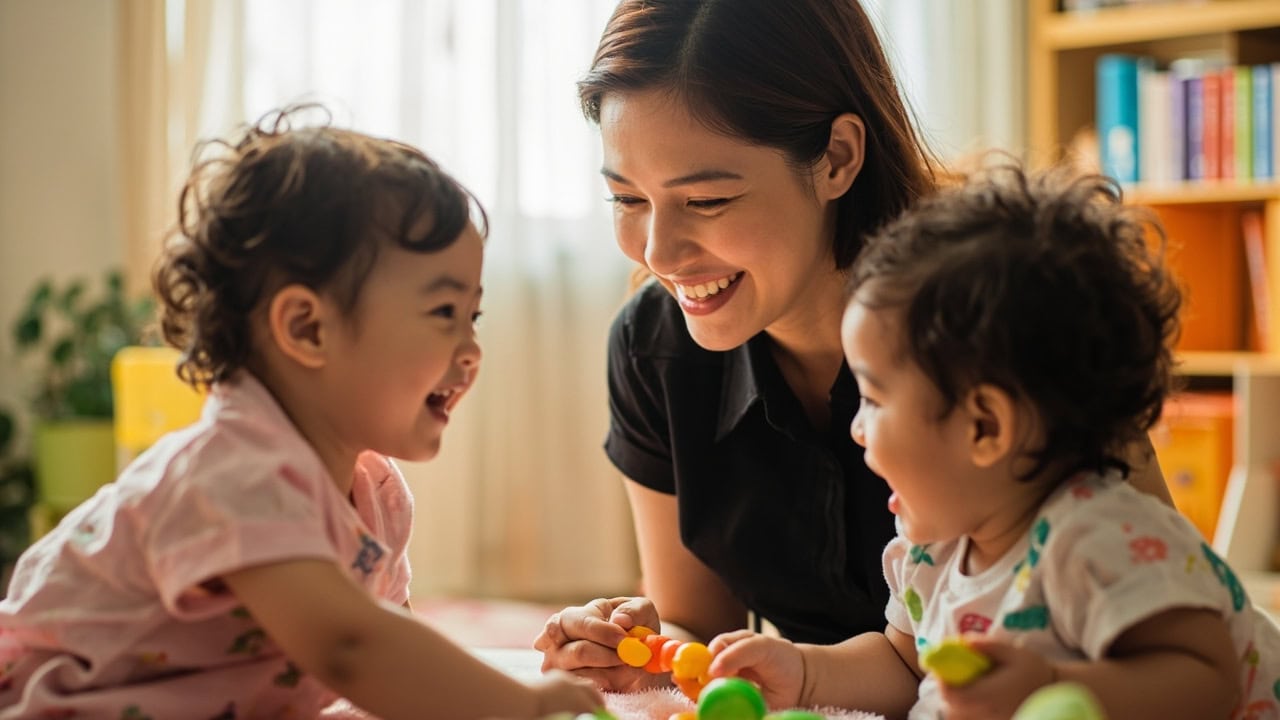
- Watch the caregiver crouch down with open arms, and watch your child fold into that embrace with complete trust.
- And then notice what your child does next — if they turn back, if they look for you, if they carry something from that moment home to you.
That is your child living in a world you made secure.
That is your child thriving in multiple trusted relationships because you had the courage and the love to make that possible.
Every time your child comes home from a day with their caregiver and tells you something new they learned, shows you a song they were taught, reaches for you with the easy confidence of someone who knows they are completely safe — that is your child telling you something without words.
They are saying: I know what home feels like. I know what you feel like. And now I also know that this other kind of safety exists, and it makes me even more sure about the first one.
You are not losing your place. You are being revealed as the parent your child trusts most of all — the one whose love was strong enough to make room for more.
Ready to Build This Together
EduNanny by BUTLER exists because we believe this: Singapore parents deserve care that does not ask them to choose between their careers and their children. Children deserve to be held by more than one pair of safe hands. The family — in all its modern, multigenerational, dual-income, beautifully complicated Singaporean reality — can be supported without being overshadowed.
We are part of the ECDA Childminding Pilot because we believe in structure, in standards, in the kind of accountability that lets you breathe easier when you walk into the office in the morning. We are here because we know that trust is not given. It is built — slowly, through daily consistency, through honest communication, through caregivers who stay and who care and who understand that every small moment in your child’s day is part of something larger.
This is not childcare as a service transaction. This is childcare as partnership.
This is us saying to you: we see what you are carrying. We know the weight of that. And we are here to help carry it — not to take it from you, but to hold it alongside you until you are ready to pick it up again.
If you are standing at the edge of this decision, wondering whether it is right, whether you are ready, whether your child will be okay, whether you will be okay — know this:
The parent who grows is the one who does not pretend the fear does not exist. The parent who grows is the one who feels the ache at pickup and still chooses to trust. The parent who grows is the one who understands that letting your child love another trusted adult is not a betrayal of your role.
It is one of the most generous acts of parenting you will ever perform.
Your child does not need a parent who is everything. Your child needs a parent who is present, and who is brave enough to make room for others who are present too.
That is the parent your child already knows you are. That is the parent EduNanny by BUTLER is here to walk beside.
You are not choosing between your child and your life. You are choosing to give your child a world large enough to grow in.
And that is something only a parent who loves enormously would do.
Ready to explore what quality childminding looks like for your family? Speak with the EduNanny team to learn about the ECDA Childminding Pilot and how it can support your child’s secure world — starting with you at its center.