Beyond the Decision: Building Childcare Partnerships That Grow With Your Child
The Question Nobody Asks
Not at the decision. Not at the tearful morning or the triumphant first week. But at the moment after all of that, when the real work and the real relationship start.
When childcare stops being an event and becomes a rhythm. When you realize you are not just dropping off a child at a service. You are entering into something that will evolve, sometimes in ways you cannot predict, as your child grows from a baby who needs to be held into a toddler with opinions, into a preschooler with questions, into a small person who will come home and tell you what they learned today and expect you to know what it means.
The question most parenting content never asks is this: what happens next?
- What does it look like to stay close to your child’s care experience across months and years?
- How do you build a real partnership with the people caring for your child, rather than simply arriving, exchanging pleasantries, and leaving?
- How does that partnership change as your child’s needs shift, as your family’s rhythm changes, as your own confidence as a parent deepens or wavers or gets rebuilt?
What Singapore Parents Actually Need
There is a quieter anxiety that many Singapore parents carry without always having the language for it. It is the feeling of wanting to be an active participant in your child’s development, not a passenger. It is the desire to be heard by the people who spend their weekdays with your child. It is the sense that there is a relationship forming that you are not fully inside, and that you would like to be.
This is not a failure of parenting. This is what parenting actually feels like when you care deeply about getting it right.
Most families who come to EduNanny arrive after a process that has been both exhausting and clarifying. They have toured centres. They have weighed options. They have read reviews and asked friends and tried to imagine the future from a photograph and a conversation.
What they are looking for is not simply a place that will keep their child safe, though of course that is the foundation. They are looking for something harder to name. A sense that the people caring for their child will see them. Will listen. Will communicate with honesty and warmth about what is happening across the days and weeks and years. Will notice when something changes and bring it to the family rather than waiting to be asked.
The Difference Between Transactional and Relational Care
Think about what happens between a child’s second birthday and their third. The baby who once needed every comfort brought to them is now a walking, talking, fierce little person who wants to do things themselves. Who says no before you have finished the sentence. Who is learning to play with other children and to manage the enormous frustration of things not working the way they imagined.
The care that was perfect at eighteen months is not the care that is needed at thirty months. The rhythm, the communication style, the activities, the way the caregiver responds to a child in conflict with another child over a toy—all of these things need to evolve.
- In a transactional childcare arrangement, this evolution happens if there is space for it, if the caregiver notices, if the family asks the right questions at the right time.
- In a relational partnership, it is built into the model. It is something the caregiver is tracking. It is something the family is part of, because the communication line is open and active and designed for exactly this kind of shared observation.
The ECDA Childminding Pilot: Structure That Enables Partnership
EduNanny operates within the ECDA Childminding Pilot, which means it is part of a deliberate, structured effort to offer Singapore families a credible, supported alternative for infant and young child care.
That matters. It means the model is not improvised. It is intentional. It is resourced. It is accountable to standards that have been thought through by people who understand child development and who understand what Singapore families are actually navigating.
What the Pilot Makes Possible
- Home-based and community pathways that create conditions for individual attention
- Monday to Friday care blocks that are structured and consistent
- Fee structures designed to be affordable within the pilot framework
- Access to CDA and Baby Bonus funds to help manage costs
These are not incidental details. They are the conditions that make it possible for families to sustain a childcare relationship over months and years without financial strain becoming a reason to pull back or compromise on quality.
What Quality Childminding Actually Looks Like
EduNanny works with infant ratios of up to one to three. That is not a marketing figure. That is a design principle.
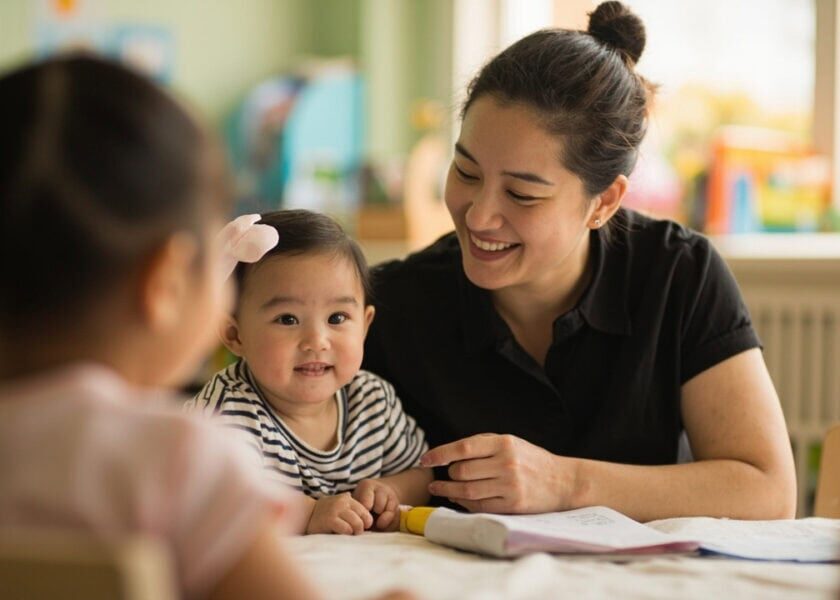
It means that caregivers can actually see each child. Can notice the subtle shift in mood that precedes a developmental leap. Can remember that this child is going through a phase of not wanting to sleep after lunch and that it started the same week a new baby arrived at home.
It means that when a parent asks, “How was her day?” the answer is not a polite “She was fine” but something real. Something that reflects a genuine knowledge of the child accumulated across weeks and months of consistent, attentive care.
The Things That Actually Matter
- Caregivers who notice patterns, not just incidents
- Communication that goes beyond daily logs to genuine observation
- Developmental conversations that happen proactively, not just when parents ask
- A caregiver who can tell you what makes this particular child light up, what soothes them, what frustrates them
- Care that adapts as the child changes rather than staying static
This is where trust actually comes from. Not from promises made at enrollment, not from glossy materials or an impressive facility. Trust comes from the slow, accumulating evidence that the people caring for your child are paying attention. That they are watching. That they care about the same things you care about, and that they will tell you what they see.
How EduNanny Grows With Your Family
When families can afford to stay in a care arrangement that is working, they do. And when they stay, something remarkable happens.
- The relationship deepens.
- The caregiver learns the child’s rhythms, preferences, the specific thing that always soothes them, the topic that makes them light up.
- The parent learns to trust that knowledge, to lean into the partnership rather than second-guessing it.
- And the child, who is the centre of all of this, benefits enormously from the stability and consistency of a care relationship that is not disrupted by anxiety or change.
This is the longitudinal partnership. It is not a feature. It is not a promise. It is a way of working that rewards time.
The Preschool Years
Parents sometimes worry that as their child gets older, the childcare relationship becomes less important. That once the infant stage passes, they can step back, become less engaged.
The opposite is true.
The preschool years are when children are doing some of the most demanding developmental work of their lives. Language is exploding. Social cognition is forming. Emotional regulation is being learned, mostly through the experience of being with others.
The quality of care during these years matters enormously, and the partnership between parent and caregiver becomes more important, not less. The conversations you have with your child’s caregiver about what is happening developmentally, about what is challenging at home or in the group, about what is working and what needs adjusting—these are not administrative check-ins. They are the ongoing collaborative work of raising a human being.
What Parents Can Expect
- Honest, ongoing communication about their child’s day and development
- Proactive sharing of observations and concerns
- Developmental conversations that happen regularly, not just at scheduled reviews
- Transparency measures that allow parents to feel connected without needing to be there
- A caregiver who will tell you what they see, even when it’s not what you want to hear
Addressing Common Concerns
“How do I know if the care is actually good?”
Parents sometimes ask whether they will know if the care is good. Whether they can trust what they are hearing. Whether the caregiver is really doing what they say they are doing.
These are legitimate questions, and EduNanny takes them seriously. The transparency measures in place, including communication practices and visibility where deployed, are there because trust should be verifiable, not just asserted.
“Will childcare add to my stress or reduce it?”
Singapore parents carry real pressures. The cost of living, the demands of work, the cultural expectations around academic achievement, the sheer logistical complexity of managing two careers and a young family in one of the densest cities in the world.
These pressures do not make parents less capable. They make the support systems around them more important.
A childcare arrangement that adds to parental anxiety, that makes families feel like they need to manage the childcare relationship on top of everything else, is not serving anyone. A childcare arrangement that reduces anxiety, that gives families confidence that their child is genuinely well cared for, that frees them to be present at work and at home because they trust the care—that is something genuinely valuable.
“What if my child’s needs change?”
The EduNanny model is built for change. The consistency of Monday to Friday care blocks, the affordability within the pilot structure, the caregiver quality that comes from operating within a supported, structured programme—these are not separate features. They are pieces of a coherent philosophy:
- Childcare should make family life more possible, not less
- It should build parental confidence, not undermine it
- It should be a relationship the family can count on, season after season
The Choice That Matters
The early years of a child’s life are not a phase to be managed. They are the foundation on which everything else is built. The attachment patterns, the language development, the social skills, the sense of security and self—all of these are being formed in the environments where children spend their waking hours.
For most Singapore families, the most significant of those environments, outside the home, is their childcare arrangement.
This is not a peripheral fact. It is the central fact.
What EduNanny is offering Singapore families is not a childcare service in the conventional sense. It is a developmental companion for the early years. It is a relationship that begins at enrollment and that is designed, in its structure and its culture, to deepen over time.
It is the childcare partnership that parents wish they had known to ask for, and that Singapore families deserve to have.
And it says: we know you want to be involved. We know you want to understand what is happening in your child’s day. We are not going to make you feel like a visitor in your own child’s life. We are going to make you a partner.
What the Right Partnership Offers
- Not perfection, because no childcare arrangement is perfect, and any service that promises perfection is not being honest with you
- A genuine, sustained, professionally supported partnership that grows with your family
- A relationship from the first enrollment through the infant and toddler years into the preschool stage and beyond
- A partnership in which you are not a customer dropping off a child but a parent whose voice matters, whose observations are valued, whose partnership is essential
Ready to Begin
The choice of childcare is not the end of the journey. It is the beginning of one.
And the question worth asking is not just where will my child go, but who will walk this path with us.
- Who will see my child as they are, not just as they are today but as they are becoming?
- Who will tell me what they see?
- Who will grow alongside us?
EduNanny Singapore is here for that. For the full arc. For the years that matter most. For the families who are ready to move beyond the decision and into the relationship.
That is what this is. That is what it has always been about.
And we would be honored to walk it with you.
Ready to explore what a sustained childcare partnership could look like for your family?
Learn more about EduNanny Singapore and the ECDA Childminding Pilot, or schedule a conversation to discuss your family’s needs.