Why Belonging Is the Most Important Lesson in Early Childcare
What Your Child Learns in the Right Childcare Setting
Before a child learns to read or count or write their name, they are already learning something far more consequential: they are learning whether the world is a place where people respond to them. They are learning whether their smiles bring smiles back, whether the children around them are interested in them, whether the adults in the room understand what they need before they have the words to ask.
There is a moment, familiar to many parents in Singapore, when you realise that the decision you are making about childcare is not really about childcare at all. You are choosing the first world your child will inhabit without you. The first friends. The first rivals. The first community that belongs not to you, but to them.
Here is what you need to know:
- The social skills your child develops in their first five years are foundational. Empathy, cooperation, conflict resolution, and emotional regulation are built during this period—and quality childcare is where much of this learning happens.
- Belonging is an active skill your child learns through experience, not by being present in a group, but by navigating real social moments with responsive adults and peers.
- The caregiver matters enormously. A trained caregiver reads the social landscape of the room, notices the withdrawn child, and intervenes with teaching rather than control.
- Social confidence is the platform on which academic readiness is built. A child who trusts adults outside their family and understands their own emotions enters primary school with a different kind of inner foundation.
- When choosing childcare, you are choosing the quality of the first community your child belongs to.
Before They Learn to Read, They Learn to Belong
In Singapore, where many families rely on some form of formal childcare while parents return to work, this early social learning happens largely outside the family home. That is not a compromise. It is simply the reality of how modern childhood unfolds—and it is one that, when navigated thoughtfully, can be profoundly enriching.
The first years of life are a period of rapid social architecture in the brain. Neural pathways governing empathy, cooperation, conflict resolution, and emotional regulation are being laid down like foundations for a city. The experiences a child has during these years, particularly in the company of other children and responsive adults, do not simply pass through them. They become part of the architecture itself.
Belonging is not simply being present in a group. It is an active, ongoing process of learning how to be with others.
A child learns belonging by experiencing it:
- By having adults who notice when they are upset and help them name what they feel
- By having peers who reach out to play—and peers who do not—and learning that both are part of life
- By discovering that sharing a toy can lead to a game, and that a disagreement does not mean the end of friendship
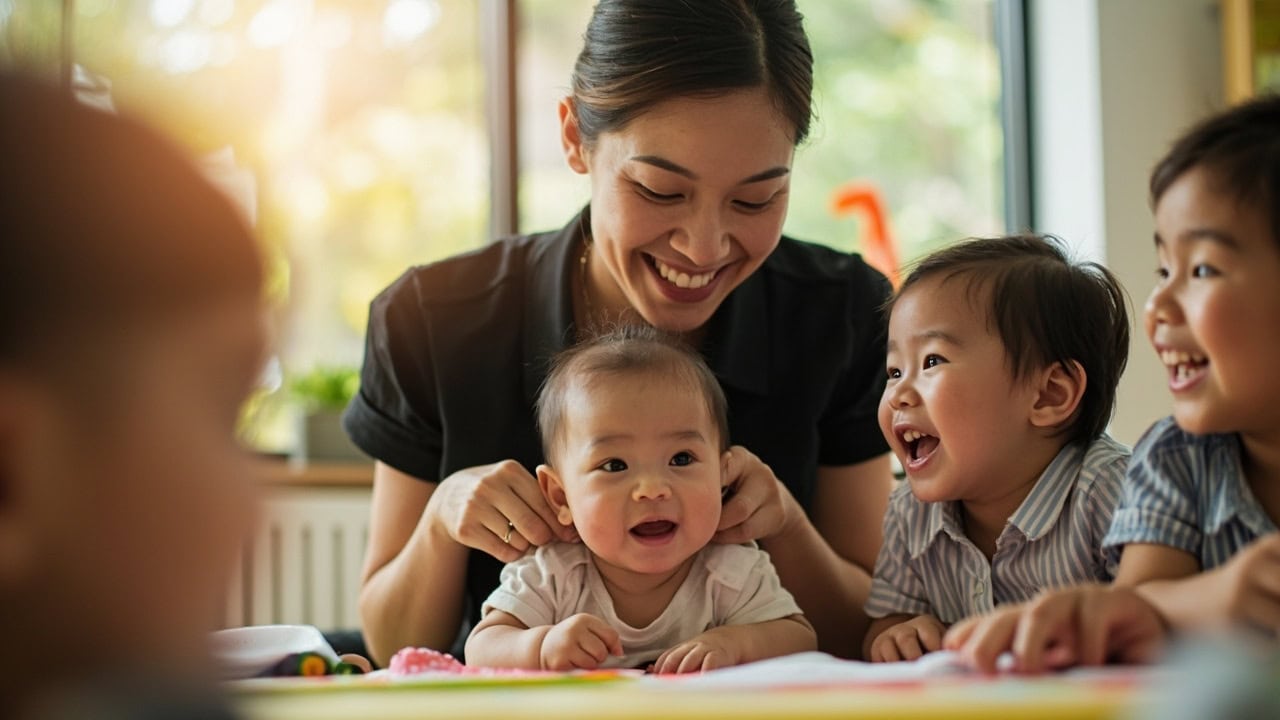
In a quality childcare environment, this learning is happening all the time—whether or not it looks like learning. It is happening when a caregiver gently redirects a toddler who is hitting to express frustration, and helps them find words instead. It is happening when a small group of children are building with blocks and one of them knocks another’s structure down, and the caregiver sits beside them and helps them navigate what comes next.
It is happening in the thousand small moments of social negotiation that fill a morning: who sits next to whom, who gets the red cup, who wants to be held, who is watching from the corner, who is ready to join the group.
This is the hidden social curriculum. It does not appear on any checklist of school readiness skills. But it is the most important thing your child is learning in those hours away from you.
What Quality Childcare Actually Looks Like
For parents navigating the choices available in Singapore, understanding what quality looks like in practice can make an overwhelming decision more manageable.
Signs of a Quality Social Environment
- Genuine engagement, not just occupation. Children are not simply kept busy—they are engaged with each other and with the adults around them. You should see back-and-forth interaction, not just parallel play without adult connection.
- Caregivers who are curious about your child. They ask questions about your child’s personality, preferences, and who they are as a person—not just their sleep schedule or eating habits. They want to know your child, not just manage them.
- A warm, unhurried rhythm. There is time for the moments that do not fit neatly into a schedule: the child who needs an extra few minutes of comfort, the spontaneous game that becomes a lesson in sharing, the quiet conversation between caregiver and child that changes something.
- Transparency about your child’s day. Open communication about how your child is developing—not just a photograph to show they were present, but genuine observation about who they are becoming.
- Ratios that allow your child to be known. In an environment where a caregiver is responsible for too many children, something has to give. Usually it is the quiet child in the corner. Usually it is the nuanced social observation. Usually it is the moment of connection that would have mattered most.
The Role of the Caregiver
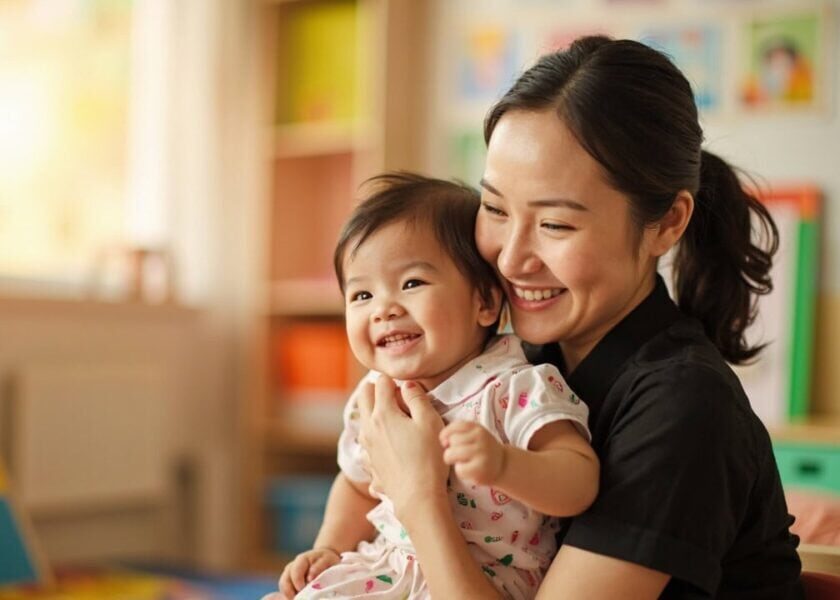
A trained caregiver in a quality setting is not simply supervising children. They are reading the social landscape of the group constantly. They are noticing which child is withdrawn and thinking about what that child might need. They are seeing the early signs of social conflict before it escalates, and intervening in ways that teach rather than control.
They are modelling what it looks like to be a calm, responsive adult in the midst of a room full of small people with big feelings. They are helping children learn that their emotions are acceptable, even when their behaviour needs to change.
This is skilled, intentional, emotionally demanding work—and it matters enormously.
Questions Singapore Parents Often Ask
Navigating this choice is not easy. The logistics alone can feel overwhelming, and beneath the logistics there is something more tender: the recognition that entrusting your child to someone else, even for a few hours, is an act of profound trust.
Can I trust someone else with my child’s social development?
You know your child best, and no one can replace your role in their life. But a quality childcare environment is not a replacement. It is an extension—a community your child belongs to alongside you, not instead of you. The goal is not to hand over your child’s social world but to expand it thoughtfully, with skilled partners who support what you are already building at home.
How do I know if my child is really benefiting socially?
Look for settings that offer genuine observation sharing, not just daily logs. Ask to hear about your child’s social moments—their interactions, their friendships forming, the way they navigate challenges. A quality setting will have stories to share, because they are paying attention to who your child is becoming.
What if my child struggles to adapt?
Peer adaptation takes time, and some children warm to group settings more quickly than others. A quality caregiver notices this and responds with patience—not pushing too fast, but creating opportunities for connection that feel safe. Ask how the setting supports children who need more time to find their footing in the social world.
Is quality care accessible to our family?
Affordability matters, and it should not be a barrier. Explore what fee structures are available, and ask about how government schemes such as CDA and Baby Bonus funds can be used. The social world your child builds should not depend on how much you earn.
The Choice That Shapes Their First Community
You cannot be in that world for them. No parent can. But you can choose it with care. You can choose it with intention. You can choose it with the same love and seriousness you bring to everything else that matters in your child’s life.
When you are choosing a childcare environment for your child, you are not just choosing a place where they will be looked after. You are choosing the social world they will learn to inhabit. You are choosing the quality of the adults who will help them navigate that world. You are choosing the first community they will belong to.
That is a significant choice. It deserves more than a checklist and a tour. It deserves the kind of thoughtful consideration you bring to everything that truly matters.
Your child’s social world is beginning. It begins in your hands, in the choice you make today.
If you are exploring infant care or childminding options in Singapore and would like to learn more about how EduNanny Singapore approaches the social world your child is learning to belong in, we would be glad to hear from you. Find out more about our approach or get in touch to discuss your family’s needs.