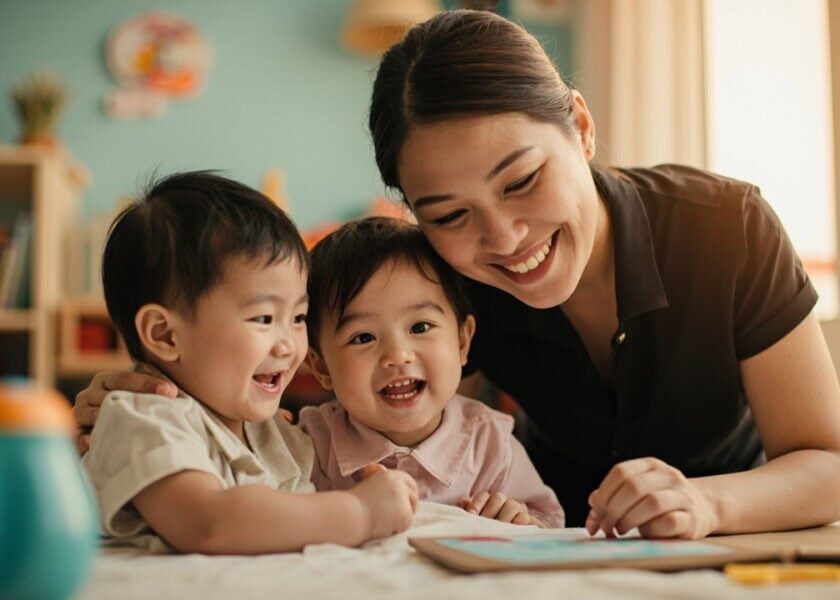
The Gift You Give Three Times Over: Rethinking the Morning Goodbye
Why This Moment Feels So Hard (And Why That Difficulty Is a Sign of Love)
Most conversations about childcare begin after the decision has been made. They focus on reassurance — whether you chose correctly, whether your child will settle, the timelines for adaptation.
These are valuable conversations. But they address a question that, for many parents, is no longer the living question.
The living question is not whether you have chosen well. The living question is what to do with the feeling that rises in you every single morning, at the precise moment you must leave.
Here is what that feeling is: it is love. It is love pressed into a particular shape by the circumstances of modern parenting in Singapore — by the hours we work, by the distance we travel, by the particular architecture of a city that asks so much of young families.
That tightness in your chest is not irrational. It is not a relic of outdated maternal instinct or a failure to have properly processed your child’s growing autonomy. It is a reasonable response to a profound act.
You are, each morning, entrusting your most precious possession to someone else’s care. That is not a small thing. It is never a small thing. And the fact that it costs you something emotionally is not a sign that you are doing it poorly. It is a sign that you understand what you are doing.
The question is not how to feel nothing. The question is what to do with what you feel.
The Goodbye as a Gift You Give Three Times Over
You are not abandoning your child. You are not outsourcing your parenting. You are not failing at some ideal of continuous presence that was never realistic and was never required.
You are giving a gift.
Think about it for a moment. When you kneel to your child’s level, when you steady their shoulders or smooth their hair before releasing them, you are not simply performing a transition ritual. You are transferring something. You are handing over your trust — not just in the institution, not just in the caregiver, but in your child themselves.
You are saying, with every deliberate morning departure: I believe you can do this. I believe you are capable of this world beyond me. I believe the person I am leaving you with will treat you well, will see you clearly, will help you grow.
That is not a small thing to give. It is, in fact, one of the most generous acts of parenting. And it is one of the hardest.
The goodbye is not a failure to bond. It is the moment you discover the depth of the bond — because it is a bond strong enough to survive your leaving.
Your child will be okay. Not because they do not need you — they do, profoundly — but because they are learning that the world contains more than one safe person. That love is not a finite resource that depletes in your absence. That they can be held and seen and known by someone else, and still come home to you at the end of the day knowing who they are and whose they are.
This is what your child is learning when you leave. And this is what you are teaching them, every morning, by the simple fact of walking out the door.
The Unexpected Reality: Your Anxiety and Your Child’s Experience Are Often Not the Same Thing
Here is where I want to slow down, because there is something important to name. What you feel at drop-off and what your child feels are not always the same thing.
This is one of the most counterintuitive discoveries of early parenthood, and it catches nearly every parent off guard. You walk away with a heaviness in your chest. You spend the next twenty minutes checking your phone, waiting for the morning photo or the update, bracing yourself for the report of tears or distress.
And then the message arrives: your child is fine. Your child is playing. Your child barely looked back.
You feel relieved. And you also feel something strange — a little hurt, maybe, or a little confused. Where did all that worry go? Why was your goodbye so much harder than theirs?
This is not a sign that your child does not love you. It is a sign that your child trusts you. It is a sign that, through the consistent work of your care and your presence in their early months and years, you have built a foundation of security so solid that your child can venture out from it with confidence.
The securely attached child does not cling because they know, at some deep cellular level, that you will return. They can afford to be curious. They can afford to engage. They can afford to glance back at you with a casual wave because they are not afraid that the wave will be the last thing they ever see of you.
Your anxiety at the door is not wrong. It is just not always about your child. Sometimes it is about you. And that is not a criticism — it is an invitation. An invitation to notice that your child may be more capable than your fear is willing to admit. An invitation to trust what you have already built. An invitation to see that the goodbye, for all its difficulty, is working exactly as it should.
What Quality Childminding Actually Looks Like (And What to Look For in Singapore)
The caregiver who receives your child each morning is not just filling a role. They are inheriting a trust. And not every caregiver receives that trust with the gravity it deserves.
When you hand your child to someone at drop-off, you are doing something vulnerable. You are trusting that this person will see your child the way you do — not as a charge or a task or a set of developmental milestones to be met, but as a full human being with preferences and fears and joys that are entirely their own.
You are trusting that this person will notice when your child is tired, or hungry, or overwhelmed, or quietly thrilled by something only they find fascinating. You are trusting that this person will hold your child with the same quality of attention you would if you were there.
This is a significant ask. And it is one that deserves a significant response.
Signs of Quality Infant Care
- Unhurried attention: Caregivers who have the time to observe, not just manage. They notice the small things — the way your child’s face changes when they are about to tire, the food they push aside when they are coming down with something.
- Responsive interaction: Not just supervision, but genuine engagement. Your child is not just watched; they are with someone.
- Transparent communication: You receive regular, meaningful updates — not just photographs of smiles, but real glimpses into your child’s day.
- Consistent relationships: Your child knows who will be there. The faces do not rotate constantly. Your child can form a real attachment to their caregiver.
- Respect for your child’s pace: Transitions are handled with patience. Your child’s resistance is not dismissed, but nor is it reinforced. They are met where they are.
The Ratio Question
In any discussion of quality infant care, the caregiver-to-child ratio matters. With more children per caregiver, attention becomes diluted. With fewer, there is space for genuine attunement — time to notice, to respond, to understand not just what your child needs on a given morning, but who your child is becoming.
This is not an abstract concern. It is the difference between care that simply keeps your child safe and care that actively supports their development.
The ECDA Childminding Pilot and What It Means for Your Family
The Early Childhood Development Agency (ECDA) Childminding Pilot reflects a deliberate choice to prioritize relationship and responsiveness over scale. It recognizes that families need options — real options, not just the choices that scale easily or the ones that fit neatly into institutional boxes.
Home-based care. Community pathways. Centre-based arrangements that maintain intimacy and ratios that make genuine attunement possible. These are not compromises. They are thoughtful alternatives designed for the diverse range of family needs in Singapore.
For families navigating the financial logistics of early childcare, CDA and Baby Bonus funds are usable for eligible arrangements. This means the trust you are building with your child each morning is not made harder by unnecessary financial strain. The system, where it can, steps in to help.
How EduNanny Fits Within This Framework
EduNanny by BUTLER operates within the ECDA Childminding Pilot, and this matters for reasons beyond policy. The pilot structure reflects a commitment to relationship and responsiveness that aligns with how quality childminding actually works.
In a home-based setting — or across community pathways that maintain that intimate, relational quality — your child does not disappear into a crowd. With ratios that allow for genuine attunement, there is space for a caregiver to understand not just what your child needs on a given morning, but who your child is becoming.
Trust is not built on philosophy alone. Trust is built on evidence — on the daily accumulation of small reassurances that add up, over time, to something you can actually lean on.
When your child is in quality care, you know it. Not in an anxious, hypervigilant way, but in the quiet, steady way that allows you to focus on your own work and your own life, knowing that the thread between you and your child is not fraying.
Updates. Photographs. The small ordinary records of a day in care. These are not luxuries. For many parents, they are the difference between a day spent partially present and a day spent fully there.
Questions Parents Actually Ask (With Honest Answers)
“What if my child cries every morning?”
Some mornings will be harder than others. There will be days when your child clings and you feel like the worst parent in the world. There will be days when your child barely looks up from the block tower they are building and you feel, somehow, both relieved and bereft.
Both of these are normal. Both are fine. Both are part of what it means to love someone in a way that requires letting go.
The question is not whether there will be tears. The question is how the tears are met. Quality caregivers do not ignore distress — they respond to it with patience and consistency, so that over time, your child learns that separation is temporary and reunion is certain.
“What if my child doesn’t bond with their caregiver?”
Your child’s ability to bond with a caregiver is actually a sign of healthy attachment. It means they have internalized the security you have provided and can extend it to others. This is development, not betrayal. Your child having another trusted adult in their life does not diminish your role — it expands your child’s world while keeping you at the center of it.
“How do I know I chose the right arrangement?”
There is no perfect choice — only a thoughtful one. The right arrangement for your family is one where:
- Your child shows signs of security and engagement over time
- You receive consistent, meaningful communication
- The caregiver demonstrates genuine attunement to your child as an individual
- The ratios and structure allow for real relationship, not just supervision
- You feel, gradually, a growing confidence at drop-off — even when the feeling is not gone
Practical Advice for Evaluating Infant Care in Singapore
If you are in the research phase, here is what to look for and ask about:
- Visit at drop-off time. Observe how transitions are handled. Watch the caregiver’s face when a child arrives — is it a warm greeting or a routine acknowledgment? Notice whether the caregiver kneels to the child’s level or stays standing.
- Ask about ratios. How many infants per caregiver? What is the maximum group size? These numbers directly affect the quality of attention your child receives.
- Ask about communication. What does a typical update look like? How often will you hear from them? How do they handle your questions or concerns?
- Ask about caregiver consistency. Will the same person care for your child each day? How is handover handled?
- Trust your observation over their marketing. Natural light and child-height artwork are nice. Warm, responsive, consistent caregivers are essential.
- Check eligibility for financial support. Understand what CDA and Baby Bonus funds can be used for within the ECDA framework.
Walking Through That Door Tomorrow
You are going to walk through a door tomorrow morning. You are going to kneel down to your child’s level. You are going to say the words you always say — the ones that have become a ritual, a liturgy, a small private language between the two of you.
And then you are going to stand up, and hand your child to someone who has prepared for this, who has chosen this work, who understands what it means to receive what you are giving. And you are going to walk away.
It will still be hard. Some mornings it will be harder than others.
But here is what I want you to know: the goodbye you give is a gift. To your child, who is learning, day by day, that the world is safe and that you return. To the caregiver, who receives it with the seriousness it deserves. And to yourself — to the parent you are becoming, the one who can hold uncertainty and still act with love, who can feel afraid and still choose trust.
The parents who bring their children to quality childminding arrangements, who walk through the door each morning with their hearts in their throats and their chins up, who have made a thoughtful and considered choice and are living with its daily reality — these parents are doing something remarkable.
They are loving their children enough to let them go, in small measured doses, so that their children can learn what it means to belong to more than one person.
Not because the feeling goes away. But because you will learn what it means. And you will keep showing up anyway.
That is what good parenting looks like — not the absence of doubt, but the presence of love that persists through it.
Your child will run toward you at the end of the day with a picture they made and a story they cannot quite tell you — and the unmistakable evidence that they are more than fine. They are growing. And so are you.
For families exploring trusted, development-oriented childminding options in Singapore, EduNanny offers arrangements that honor the trust you bring every morning.