Beyond Enrichment: How Singapore Parents Build Real Primary 1 Readiness
The Key Insight for Singapore Parents
Here is what matters most:
- Education begins long before Primary 1 — in the first thousand days of life
- What P1 teachers look for is not academic content — it is foundational capacities like attention, resilience, curiosity, and social confidence
- These capacities are developed through quality responsive care, not worksheets or enrichment drills
- Your childcare choice is your first educational investment — and not all childcare builds these capacities equally
What Primary 1 Teachers Actually Look For
Let me be specific, because specificity is what separates insight from sentiment — and you deserve both.
When your child steps into Primary 1, the teacher does not begin by assessing whether they can write their name or count to a hundred. She begins by watching.
She watches who can sit and attend when she speaks, even when the child next to them fidgets. She watches who can manage the small frustration of a pencil that will not work, without falling apart. She watches who can take turns, who can share, who can ask for help, who can recover when something goes wrong.
She watches who is curious — who looks around the room with interest, who asks what a word means, who wants to know why the leaves are changing colour on their field trip to the Botanic Gardens. She watches who has the fine motor control to hold a pencil properly, who has the language to express themselves clearly, who has the social confidence to make a friend on the first day.
These are the things that tell a Primary 1 teacher whether a child is ready to learn. Not whether they have memorized sight words. Not whether they can count to a hundred.
Those things matter, and they will come. But the capacity to learn — the underlying readiness that makes everything else possible — this is what the best teachers look for first.
Here is what is most important for you to understand: these capacities are not born in a classroom. They are born in the first thousand days. They are born in the quality of care your child receives when no one is testing them, when they are simply playing, simply exploring, simply being a small person in a world that is still very new.
The First Thousand Days: Where Readiness Actually Begins
Research in child development has been consistent for decades: the first thousand days — from conception to approximately age three — represent a window of unparalleled sensitivity. During this period, the brain develops at a speed it never will again. Neural pathways are being laid down at a rate that will never be repeated.
For Singapore parents, this is not abstract. It is deeply practical. Every interaction your child has with their caregiver in these early years is building something — either the foundations of school readiness, or gaps that will need to be bridged later, often with significant effort.
Language: More Than Just Words
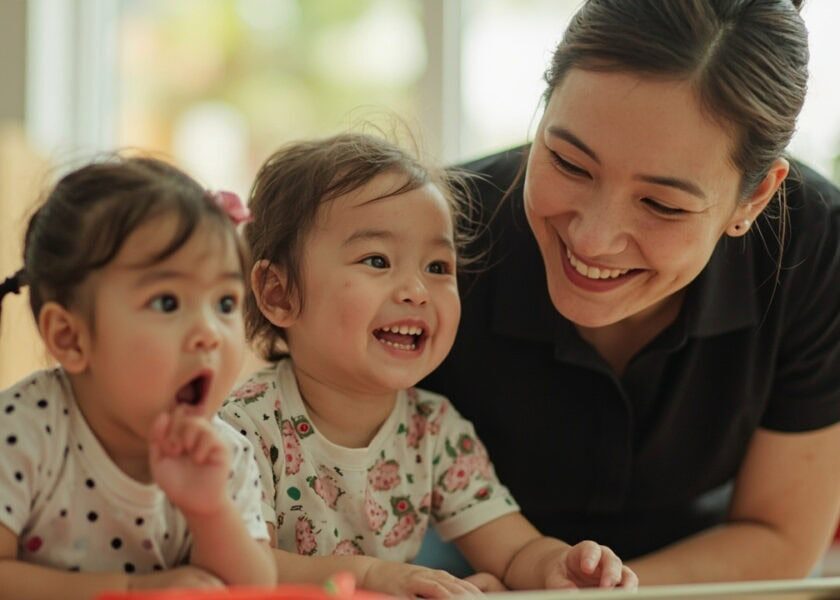
When your baby reaches for a toy and a responsive caregiver names it — “yes, that is a ball, a red ball” — something extraordinary happens in that child’s brain. Language pathways are being laid down at a rate that will never be repeated.
The child who hears rich, responsive language in their first two years arrives at Primary 1 with a measurably larger vocabulary, with the neural infrastructure to learn new words more easily, with the confidence to speak up in class because speaking has always been a positive experience.
This is not about exposing babies to flashcards or “baby Einstein” videos. It is about the quality of conversational exchange — the back-and-forth, the turn-taking, the caregiver who narrates what is happening, who responds to coos as if they are real communication.
Emotional Resilience: The Capacity to Keep Trying
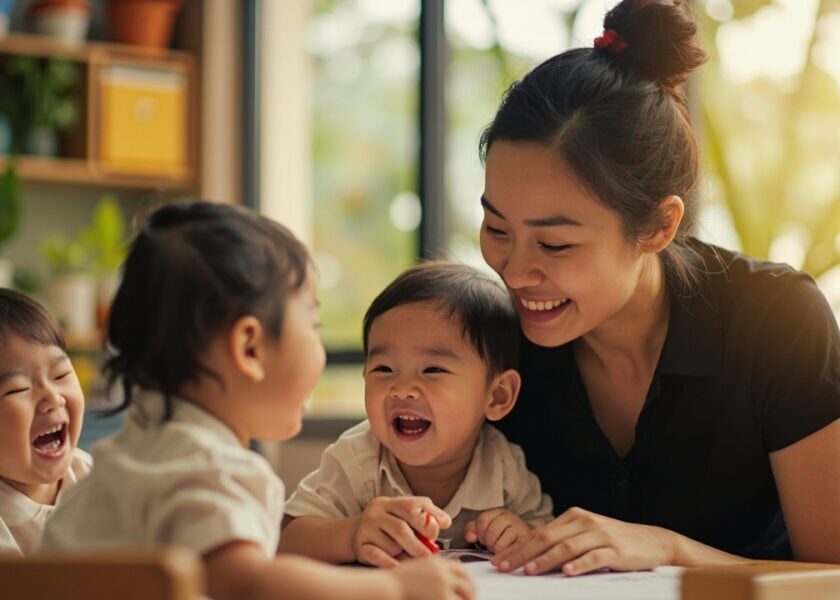
When your toddler is building a tower of blocks and it falls, and a caregiver notices — “oh, it fell! Shall we try again?” — rather than quickly rebuilding it for them, that child is learning something that no worksheet can teach.
They are learning that frustration is survivable. That effort leads to improvement. That failure is not the end of the story.
This is emotional resilience, and it is one of the single greatest predictors of how a child will navigate the social and academic demands of Primary 1. In a classroom of thirty children, with one teacher and multiple demands on her attention, the child who can self-regulate, who can manage disappointment without falling apart — that child is positioned to learn.
Social Problem-Solving: The Classroom Skill No One Talks About
When your three-year-old is playing with others and a conflict arises over who gets the toy truck, and a trained caregiver does not rush in to resolve it but stays close, warm, and ready — guiding without taking over — that child is learning social problem-solving.
They are learning to negotiate, to read cues, to understand that other people have feelings too.
These are not soft skills. These are the skills that determine whether a child thrives in a classroom of thirty, or spends the year overwhelmed and acting out because they do not know how to manage the social world they have been dropped into.
Physical Confidence: The Body as Learning Tool
When your child is allowed to pour their own water, to cut their own fruit at snack time, to climb and jump and run in an environment that is safe but not over-structured, they are developing fine motor control, proprioception, and body awareness.
These physical capacities are what make holding a pencil and writing in a notebook feel natural rather than frustrating. Children who have had the freedom to explore physically arrive at Primary 1 with the body awareness to sit comfortably, to manage their materials, to participate fully — not because they were drilled, but because they were allowed to move.
Intrinsic Curiosity: The Love of Learning Itself
When your child is allowed to lead their own play — to choose what to build, what story to tell, what question to pursue — they are developing the intrinsic curiosity that makes learning feel like adventure rather than obligation.
In a system that demands excellence, the children who flourish are not always the ones who arrived knowing the most. They are the ones who arrived loving to learn. That love is forged in environments that protect it — not environments that rush to fill every moment with content.
What Quality Childcare Actually Looks Like
You may be wondering: what does this mean in practice? How do I know if the care my child is receiving is building these capacities — or missing them?
Quality early care is not about impressive facilities or expensive toys. It is about the quality of responsiveness in the relationship between caregiver and child.
What to Look For
- Responsive interaction: Caregivers who respond to your child’s communications — even before they can speak — as if they are meaningful. Who narrate the world back to them. Who engage in back-and-forth exchange, not just directive speech.
- Supported independence: Environments where children are allowed to try things — to pour, to climb, to attempt buttons — even when it would be faster for the caregiver to do it for them. Where “Let me help you do it yourself” replaces “Let me do it for you.”
- Facilitated conflict: Social conflicts are not immediately resolved by adults. Caregivers are nearby, warm, ready to guide — but they allow children the space to practice negotiation, with support available when needed.
- Child-led play: Time and space for children to pursue their own interests, follow their own curiosity, direct their own play. This is not idle time; it is the most important learning time there is.
- Attentive observation: Caregivers who are studying your child, not just watching them. Who notice patterns of curiosity, moments of frustration, emerging interests — and who use those observations to calibrate their support.
Questions to Ask Any Provider
- What is the caregiver-to-child ratio, especially for infants and toddlers?
- How do caregivers respond to children’s communications before they can speak?
- What does a typical day look like? Is there time for child-led play?
- How are social conflicts handled? Do caregivers step in immediately, or guide children to solve problems themselves?
- How do caregivers support children through transitions and frustration?
- Is child development training part of how caregivers are prepared?
- How do you communicate with parents about their child’s development?
Signs of Quality to Observe
- Caregivers who narrate, comment, and respond to what children are doing — not just direct them
- Environments where children attempt tasks independently, even when it takes longer
- Caregivers who stay near during play, available for support but not hovering
- Children who appear engaged, curious, and comfortable — not just occupied
- Communication that shares observations about development and interests, not just daily logs
The EduNanny Approach: Observation-Based Care as Educational Foundation
In Singapore, the childcare landscape is vast and varied. There are centre-based options, home-based arrangements, family support, and everything in between. No single model fits every family — and the right fit matters enormously. But what matters most is not the label on the door. What matters is what happens inside the room.
The question to ask is not only: is my child safe? That is the floor, not the ceiling. The question is: does this environment develop the capacities my child will need in Primary 1 and beyond?
Does the person caring for my child understand child development — not just as theory, but as a living practice of observation, responsiveness, and careful facilitation? Is my child being seen as a learner, not just a toddler to be minded?
These are the questions that guided the design of EduNanny by BUTLER — as a foundational philosophy that shapes every decision about how care is delivered.
Grounded in a Government-Recognised Framework
EduNanny operates as part of the ECDA Childminding Pilot, which means it is grounded in a framework that takes infant and early childhood care seriously — as education, not just as supervision. This is not a boutique experiment. It is a structured approach aligned with Singapore’s own recognition that the early years matter educationally, not just socially.
Attention Ratios That Allow for Quality
For infants, EduNanny maintains a ratio of up to one to three. This figure sounds administrative until you understand what it means in practice. It means that when your baby reaches for something, there is someone there to name it. It means that when your toddler needs comfort, there is someone present who is not managing twelve other children at the same time.
Pathways Designed Around Family Needs
EduNanny offers both home-based pathways and community or centre-based options, because families are different and the right fit matters. Some children thrive in a home environment, where a consistent caregiver becomes a trusted extended family figure. Others benefit from the rich peer interaction of a community setting. What matters is not the model itself but the quality within it — and EduNanny has designed both pathways with the same developmental care principles at their core.
Caregivers Trained to Observe, Not Just Mind
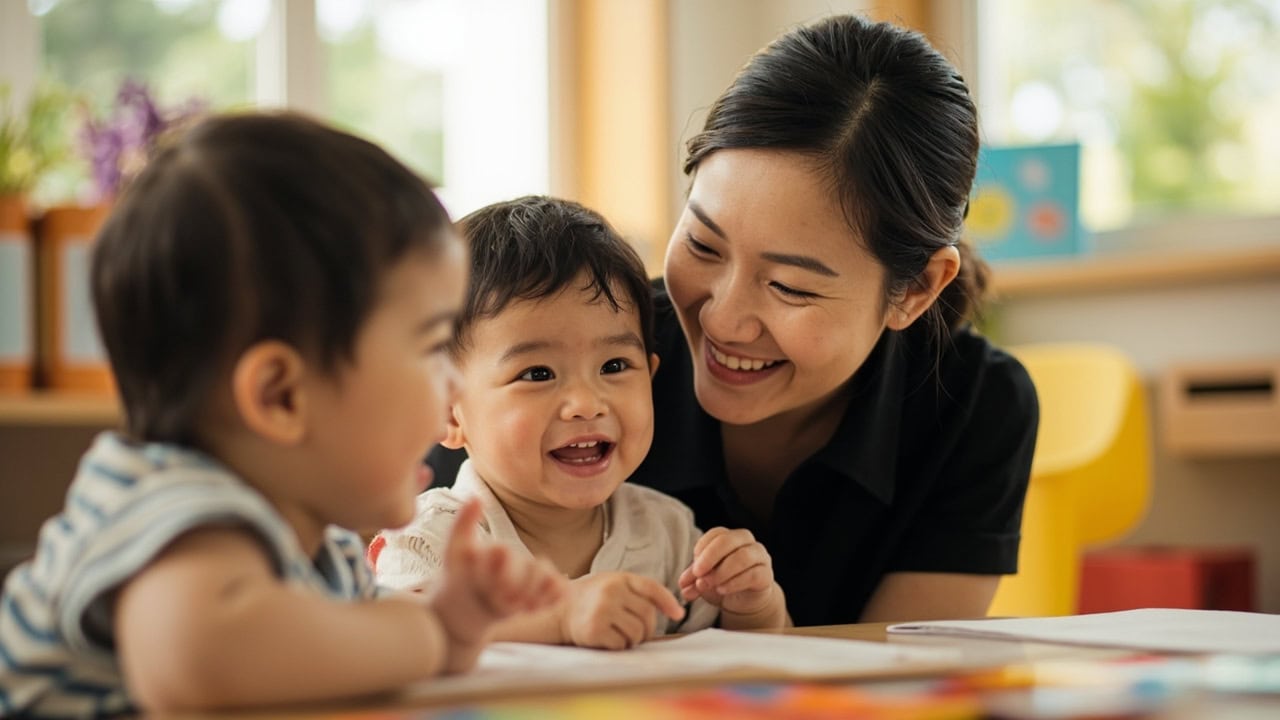
In EduNanny’s model, caregivers are trained in observation-based care. They are not just watching your child; they are studying your child. They notice patterns of curiosity, moments of frustration, topics that capture attention, social styles that are emerging.
They document and reflect — not to produce reports for parents, but to understand each child so deeply that they can create an environment precisely calibrated to that child’s development.
This is the mechanism. This is how quality care produces school readiness — not by adding more content to a child’s day, but by creating the conditions in which a child’s innate capacities are seen, supported, and stretched at exactly the right moment.
A caregiver who observes that a child is developing intense interest in how things fit together can introduce materials that extend that curiosity. A caregiver who notices that a child struggles with transitions can prepare them gently, building the flexibility they will need when the Primary 1 bell rings and the day shifts from one activity to another.
Transparency, Trust, and Accessibility
Where CCTV measures are deployed, they are deployed not as surveillance but as reassurance — for parents, for caregivers, and ultimately for children, because accountability at every level creates the safety that quality care requires.
Regular communication, transparent sharing of observations, and an open door policy are part of how EduNanny earns the right to be your partner in your child’s first thousand days.
The fee structures within the pilot are designed to be accessible — not a luxury service reserved for those who can pay premium prices. CDA and Baby Bonus funds can be used, which means the financial planning you have already done for your child can be directed toward this foundational care without additional strain.
Building Readiness: Your Child’s First Thousand Days Begin Now
Understanding that the first thousand days are educationally definitive is not another burden. It is a liberation.
It tells you that you do not need to be doing flashcards with your two-year-old. You do not need to be racing them through worksheets before they can hold a pencil properly. You do not need to turn your home into a classroom, your relationship with your child into a curriculum, your weekends into enrichment schedules that leave everyone exhausted.
What you need to do — and what EduNanny is here to help you do — is to choose an environment where your child is seen, where they are responded to, where their development is understood as a whole and not just a collection of milestones to check off.
The education that matters most in the first thousand days is not content. It is capacity. It is the foundational architecture of who your child will become as a learner.
When you choose that kind of care, you are not choosing between quality bonding and academic preparation. You are choosing the thing that makes both possible, because they are not separate. They never were.
Imagine your child on their first day of Primary 1. The uniform is crisp. The school bag is heavy with new books. You have done everything you could to prepare them. And now they are standing at the door, and something in their face tells you they are ready.
Not because they are not nervous — they may be, and that is fine. But because beneath the nervousness, there is something else. There is confidence. There is curiosity. There is the quiet assurance that they can handle what comes next, because they have always been able to handle what comes next — with the right support, in the right environment, with people who saw them clearly and loved them well.
That readiness was not built in the weeks before school. It was not built in the last enrichment class or the last workbook. It was built in the first thousand days, in the quality of care that your child received when they were too young to remember it — but not too young to be shaped by it.
You are making the choice that builds that readiness right now. Every day, every decision, every relationship you choose for your child in these early years is a vote for who they will become.
That is not a burden. That is a privilege.
The education has already started. Let us build it together.
If you are looking for childcare that takes the first thousand days seriously — that understands school readiness as a product of responsive care, not enrichment content — we would be glad to hear from you. Learn more about who we are and the framework that guides our approach.