The Inner World Your Child Lives In Shapes Who They Become
The Inner World Your Child Lives In
Consider for a moment what it means to be a young child in a new care environment. You have limited words. You have no framework for understanding why the person you are most attached to leaves you somewhere unfamiliar each day. You feel big emotions that arrive without warning and have nowhere to go except out through your body, your tears, your refusals.
And then, slowly, if the environment is the right one, something begins to shift.
Your child starts to notice that the adults here are calm even when they are not. That they do not dismiss what they feel. That they stay close when they are upset and give space when they need to find their own way through. They begin to trust that the world can hold their big feelings without breaking.
That is not a small thing. That is the beginning of everything we call emotional regulation, and it happens not through teaching but through experience. Through being met, repeatedly, by someone who understands what they are going through and does not abandon them in the middle of it.
This is the slow, invisible construction of a felt sense that the world is basically trustworthy. That other people can be relied upon. That they are capable of surviving discomfort and coming out the other side. These are not abstract ideas your child will one day be able to articulate. They are embedded in their nervous system, in the architecture of how they will respond to stress, to disappointment, to the inevitable hard moments of growing up.
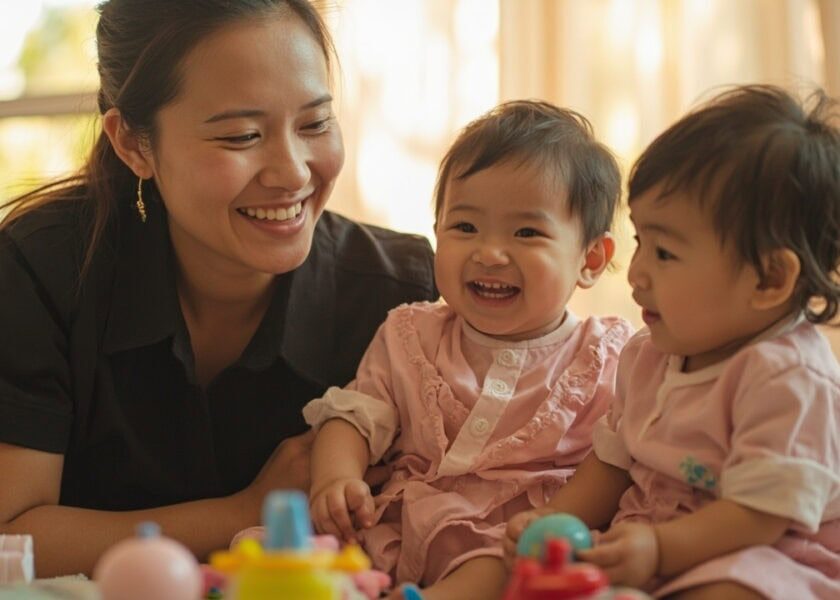
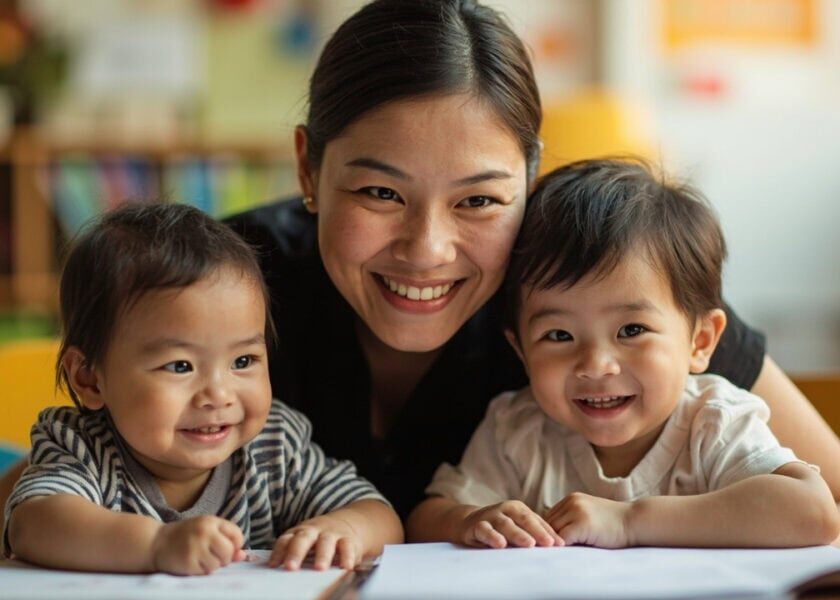
In quality childcare, your child encounters mirrors. They hear their name spoken with warmth. They see themselves reflected in the responses of attentive adults. They begin to understand that they are a person with preferences, with opinions, with a place in a group.
This sounds simple, but it is the foundation of everything we call self-concept, self-worth, the internal sense that I matter and I belong. A child who feels seen develops a different relationship with the world than a child who feels like a task to be managed. They walk into a school with a different posture, literally and figuratively. They raise their hand because they believe their thoughts are worth hearing.
These are the foundations of a whole life. And they are built not in the dramatic moments but in the quiet ones.
How Quality Care Expands Your Child’s World
When your child is in a quality environment with attentive, well-trained caregivers, something happens that is almost impossible to replicate at home, even with the most devoted parent. They encounter a wider world.
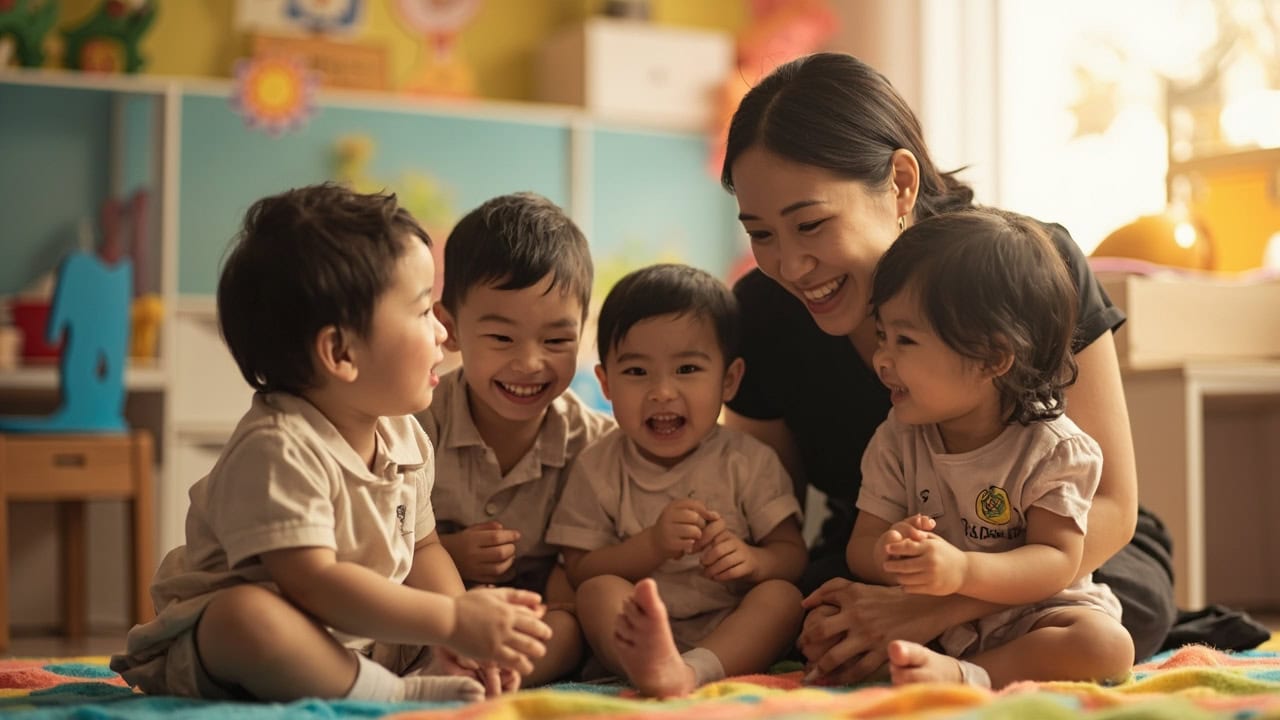
They meet other children who are different from them. Different temperaments, different ways of playing, different ways of expressing need. And in that encounter, your child begins to learn something that cannot be taught through explanation: that other people exist with their own desires and feelings, and that the world does not revolve solely around them.
That is not a diminishing experience. It is an expanding one. It is where empathy begins. It is where the capacity to belong to something larger than your immediate family takes root.
Quality care also means challenge at the right scale. Caregivers read your child’s readiness and provide just enough difficulty to stretch them without overwhelming them:
- A toy that is slightly out of reach, inviting them to reach further
- A social moment that requires negotiation, building conflict resolution
- A caregiver who does not immediately solve the problem but stays close while the child figures it out
These are not dramatic events. They are quiet. They are almost invisible. But they are where confidence is born. Not from being told you are capable, but from the experience of discovering, again and again, that you can handle more than you thought.
What School Readiness Really Looks Like
Not the ability to recite letters or count to twenty. School readiness is a child who feels secure enough to explore. Who is curious rather than afraid. Who has the emotional reserves to sit still, to listen, to try something hard without collapsing when it does not work.
School readiness is:
- Knowing how to be part of a group
- Trusting that adults are on their side
- Feeling brave enough to raise your hand
- Having the inner security to make mistakes
These are the qualities that predict long-term academic and social success, not because of any particular worksheet or curriculum, but because they are the qualities that make learning possible.
Signs Your Child Is Thriving, Not Just Coping
You may watch your child walk into a centre or greet a caregiver and wonder what is happening behind their eyes when they are out of your sight. This is not an irrational worry. It is the mark of a thoughtful parent. And it deserves a real answer.
What you are looking for is evidence of inner growth. Here are signs to watch for:
Language of belonging. Notice how your child talks about their care environment. Do they mention other children by name? Do they talk about their caregiver with warmth? Do they use words like “we” and “my friends” and “teacher”? That language of belonging is one of the clearest signs that your child has found their footing in that environment.
Emotional capacity at home. Notice how they handle frustration in the hours after care. A child who is in a nurturing environment all day often has more, not less, emotional capacity available at home, because they have been emotionally regulated by attuned caregivers and are now in the presence of the people who make them feel most safe.
Conversely, a child who seems constantly on edge, constantly dysregulated, may be spending their days in an environment that is not meeting their emotional needs, even if they seem physically fine.
A positive relationship with self. Notice your child’s relationship with themselves. Do they speak about themselves positively? Do they have preferences they express confidently? Do they show curiosity about the world? These are not things that develop in a vacuum. They grow in soil that is carefully tended.
If these signs are present, you can breathe a little easier. Your child is not just being watched. They are being shaped. And the shaping is going in a direction you can feel good about.
What Excellence Really Means in Childcare
The difference between adequate and excellent care comes down to a few things, and they are not complicated, but they are demanding.
| Factor | Why It Matters |
|---|---|
| Child-to-Caregiver Ratio | A child cannot form a secure attachment, cannot feel truly seen, cannot have their emotional world attended to meaningfully if there are too many other children competing for the same attention |
| Caregiver Warmth and Training | No programme or curriculum can substitute for a person who genuinely loves children and understands how they think and feel |
| Continuity of Care | A child who is passed from stranger to stranger cannot build the trust that is the foundation of all growth |
| Environment Designed for the Inner Life | A space where children can explore safely, rest when they need to, and feel a sense of ownership and belonging |
The early childhood years are not a warm-up for life. They are life, for your child, right now. And the quality of the care they receive during these years leaves marks that are genuinely difficult to undo later.
The EduNanny Singapore Approach
EduNanny Singapore was built with these principles at its centre. We are part of the ECDA Childminding Pilot, and we offer both home-based and centre-based pathways because we understand that families have different needs and different circumstances.
In our home-based care, your child receives attentive, personalized attention in the familiarity of their own environment, with caregivers who become trusted extensions of your family. This approach works especially well for infants and young toddlers who thrive in predictable, intimate settings.
Our centre-based options provide rich social environments where your child learns to belong to a group, to navigate peer relationships, and to thrive in a community of learners.
In our infant care settings, we maintain ratios of up to one caregiver to three infants. We know that in the earliest years, the difference between one caregiver and three infants versus one caregiver and six is the difference between connection and mere supervision.
Our caregivers are not just trained. They are selected for their warmth, their attunement, and their understanding of child development. They are supported by ongoing professional development, and they operate within a framework that places your child’s emotional security above everything else.
We believe that a child who feels safe does not just cope with challenges. They seek them out. They grow through them. They become the kind of learner and person you want them to become.
Transparency and Accessibility for Singapore Families
Singapore parents should never have to wonder what is happening in their child’s care environment. That is why we have communication protocols designed to keep you connected to your child’s day, and CCTV measures deployed where appropriate, so that you can feel the confidence that comes from knowing your child is in a space where their wellbeing is visible and accountable.
We also know that modern parenting comes with an endless stream of questions, concerns, and moments of uncertainty. Our Thomas AI Chatbot is available to support you with practical guidance, developmental insights, and answers to the everyday questions that arise between the significant moments. It is not a substitute for human connection, but it is a resource that acknowledges the reality of parenting in a busy, demanding world.
We are committed to making quality care accessible for families across Singapore. Our pilot fee structures are designed with affordability in mind, and we integrate seamlessly with CDA and Baby Bonus schemes so that financial considerations do not stand in the way of your child’s early development.
Monday to Friday care blocks are structured to meet the realities of working parents, because we know that your time is not infinitely flexible and that you need a care arrangement that fits the shape of your actual life.
Choosing With Confidence
You are choosing, every day, what kind of world your child enters. That is not a light thing. It is one of the most consequential decisions you will make.
When you choose quality, when you choose care that takes the inner life of your child seriously, you are not just solving a logistical problem. You are investing in the person your child will become. You are telling them, in the only language they can fully understand at this age, that they matter. That their feelings are important. That their growth, the real growth, the kind that no one can see from the outside, is worth protecting and nurturing and celebrating.
EduNanny Singapore stands with you in that work. We see the child behind the behaviour. We understand that the invisible world inside your child is the most important world there is. And we are here, every day, to tend to it with care, with skill, and with genuine love for the extraordinary task it is to help a small person become who they are meant to be.
Thank you for trusting us with that task. It is one we do not take lightly, and it is one we are deeply honoured to share with you.
To learn more about how EduNanny Singapore nurtures your child’s inner world, we invite you to explore our care options or speak with our team.