Beyond Flashcards What Your Singapore Child Actually Needs for Primary 1
The Question Every Singapore Parent Asks
Every parent in Singapore knows the feeling. It arrives somewhere around your child turning four—or perhaps earlier—whispered at birthday parties and dinner tables: Is your child ready for Primary 1?
It is one of the most common questions we ask each other, and one of the most quietly terrifying. You watch your child playing in the sandpit and wonder whether they will sit still in a classroom. You notice they still cry when another child takes their toy and you think, how will they manage in school? You hear other parents mention assessments and enrichment, and suddenly the horizon of Primary 1 looms like something you should have been preparing for all along.
The anxiety is real. It is understandable. And it is, in many ways, built on a misunderstanding.
What this article explains: Why the readiness skills that predict your child’s confidence and success in Primary 1 are not primarily academic—and why quality daily care builds these skills invisibly, over time, through thousands of ordinary moments.
What Singapore Parents Get Wrong About School Readiness
Here is what we imagine readiness to be: a six-year-old sitting for their first assessment, wondering whether all those years of childcare made the difference.
We picture it as a light switch. Either your child is ready or they are not. We search for the checklist—can they recognize letters? Count to twenty? Write their name?—and we believe that if we can check enough boxes, our child will be prepared for the demands of formal education.
These are the visible skills. The ones that show up on assessments. The ones that grandparents ask about at Chinese New Year. And there is nothing wrong with wanting your child to encounter letters and numbers in their daily environment. These experiences build cognitive foundations that matter.
But the research tells a different story. The skills that predict long-term academic success and genuine school confidence are not primarily academic. They are social. They are emotional. They are the capacities that allow a child to:
- Enter a new environment and feel they belong there
- Manage the disappointment of not being chosen first
- Ask for help without shame
- Sit with the discomfort of not knowing something yet and trust that they will learn it
These are the readiness skills that matter most—and they cannot be crammable into six months. They grow the way children grow: slowly, through repetition, through safe environments where they are given the time and space to practice being human.
Academic preparation without emotional and social readiness is like teaching someone to swim by showing them technique on dry land. They may know everything about swimming—and still drown when they enter the water.
The Compound Effect: Why Every Ordinary Day Counts
When your child spends their days in a thoughtful, intentional childcare environment, they are not being passively looked after. They are in a daily laboratory of human development.
Every interaction with a skilled caregiver. Every moment of sharing a toy and learning it will come back. Every experience of frustration followed by comfort. Every time they try something hard and discover they can do it.
These are the building blocks of readiness. And they are invisible. They do not show up on a readiness checklist. But they are there, compounding quietly over months and years, until one day your child walks into Primary 1 and the world notices that something is different about them.
They are calm. They are curious. They know how to be a student.
The Five Domains That Quality Care Builds
Research identifies five interconnected domains that quality daily care strengthens naturally:
- Emotional regulation — the capacity to manage frustration, to understand that big feelings pass, to survive disappointment and know another turn will come.
- Social confidence — the ability to enter new environments and feel they belong, to read others’ faces, to navigate the give-and-take of peer relationships.
- Motor independence — the physical foundations that support cognitive learning. Children who climb, balance, pour, and manipulate objects are building neurological pathways that serve reading and mathematics.
- Cognitive curiosity — the disposition to see themselves as capable of figuring things out. A love of learning itself, developed in environments where curiosity is valued and questions are welcomed.
- Communication readiness — language skills built through daily immersion in conversation, not flashcards. The ability to express needs, ask questions, and engage with the language of the classroom.
Consider the Singapore parent who watches their four-year-old struggle with sharing at a playdate and wonders if this means they will fail Primary 1. That struggle is not a warning sign. It is the work. What looks like developmental delay is often progress being made invisibly.
What Quality Childminding Actually Looks Like
In Singapore’s childcare landscape, it can be difficult to distinguish between supervision and development. You may have visited centres with impressive facilities and structured lesson plans. These things have value. But they are not the same as quality care.
Quality childminding looks like:
- A caregiver who notices — who sees when a child is becoming frustrated before the frustration escalates, and responds with language, not just control.
- Time built into the day — for free movement, for unstructured play, for the kind of exploration that builds problem-solving skills without worksheets.
- Consistent relationships — the same caregiver, day after day, so the child can form a secure base from which to explore and practice social negotiations.
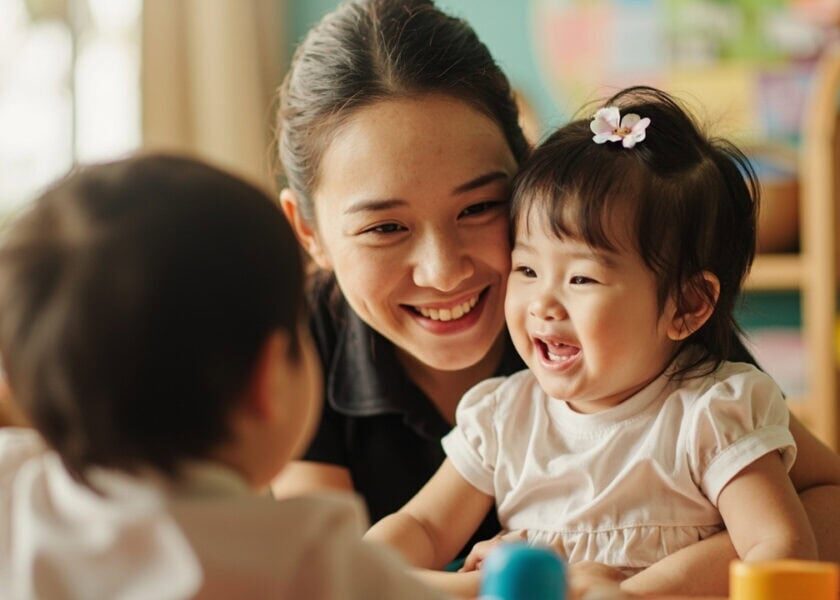
- Responsive interaction — caregivers who narrate the world to infants learning language, who get down on the floor with toddlers solving physical puzzles, who treat every ordinary moment as an opportunity for connection.
What to Look For When Evaluating Care Options
Research on early childhood development consistently shows that consistency is not just preferable—it is essential. The skills that build school readiness compound through daily rhythm, through the reliable experience of a stable, responsive environment.
When you are evaluating infant care or childminding options in Singapore, look beyond the marketing materials:
- Observe the caregiver-child interactions. Are they responsive? Warm? Do caregivers get down to the child’s level? Do they narrate, question, and engage—or simply direct?
- Notice the rhythm of the day. Is there time for free movement, for unstructured play, for the kind of learning that cannot be scheduled?
- Ask about ratios. How many children per caregiver, especially for infants? Smaller numbers mean more responsive attention.
- Consider consistency. Will your child have the same caregiver most days? Will the environment be predictable enough to build security?
- Trust your instincts. If something feels off—if the environment seems more focused on appearing impressive than on actually nurturing development—it probably is.
Addressing the Concerns You Actually Have
You are not short-changing your child. You are doing something harder and more important. You are trusting the process—believing that a child who is emotionally secure, socially capable, physically confident, cognitively curious, and communicatively ready will not only survive Primary 1 but thrive through it and beyond.
Choosing a daily care environment that prioritizes development over drilling is not a compromise. It is a strategy backed by decades of developmental research.
The academic skills will come. A six-year-old who has spent their early years in quality care will learn to read and count and write. But a six-year-old who has not developed the emotional regulation to sit in a classroom, the social confidence to make friends, the curiosity to engage with learning—that child will struggle even with excellent academic instruction.
Readiness is not one thing. It is a whole child, prepared to learn.
You are enough. The love you carry for your child lives in the choices you make for them. Choosing quality daily care, choosing a partner who will give your child what you cannot give them in the hours you are away, choosing an environment where your child will be known and responded to and developed—that is not a failure of love. That is love in action.
Your child does not need you to be their only teacher, their only caregiver, their only source of developmental opportunity. They need you to be their parent, and they need you to make wise decisions about the village that surrounds them.
The Two Children Every Teacher Recognizes
There is a moment that every educator recognizes. It is the child who arrives at Primary 1 with perfect academic preparation and no idea how to sit still, how to share, how to recover from a mistake, how to make a friend.
That child may pass their first assessments. But they will struggle in ways that no checklist could have predicted, because the readiness that matters most was never built.
And there is another child. The one who knows how to wait. Who knows how to try again. Who walks into a room full of strangers and smiles, because they have learned that new places can hold new friends. Who knows that learning is something they do, not something that happens to them.
That child did not get there by being read a thousand flashcards. That child got there by living, daily, in an environment that understood what they needed to become.
That child is what we are building, one ordinary day at a time.
EduNanny Singapore: Built on This Understanding
EduNanny exists because we believe in this understanding of readiness. We believe that the first years of your child’s life are not a waiting period before real education begins. They are the foundation on which everything else is built.
EduNanny is part of the ECDA Childminding Pilot, and we say that with pride because it means we are part of a deliberate effort to expand what quality childcare can look like in Singapore. It means we are committed to standards that put your child’s development first, not just their supervision.
Our ratios reflect this commitment. With up to one to three infants in our care, we ensure that every child receives the responsive attention that developmental science tells us matters most in the early years. Your baby is not one of fifteen. Your infant is known.
Transparency and communication are built in. When you leave your child in someone else’s care, you need more than good intentions. You need to stay connected to your child’s day. In our pilot arrangements, we provide the channels that let you do that—because we understand that a parent who feels informed is a parent who can relax, and a parent who can relax is a parent who brings better energy home at the end of the day.
Affordability is part of the design. The ECDA Childminding Pilot has been designed to make quality care accessible. CDA and Baby Bonus can be utilized within our pilot structures, because we believe that developmental readiness should not be a privilege reserved for families with significant financial resources.
Ready to Take the Next Step?
It is understandable to feel uncertain in a city that celebrates academic achievement and measures success in examination results. The pressure is real. Well-meaning relatives ask about Chinese tuition. Other parents seem to have their children on accelerated learning tracks before nursery is even finished.
It is easier to believe in what you can measure, what you can see on paper, what another parent can confirm over coffee. It is harder to trust the invisible compounds of daily care, the slow accumulation of social confidence, the quiet growth of emotional regulation.
But this is what the evidence tells us. The children who thrive in Primary 1 and beyond are not necessarily the children who arrived with the most academic preparation. They are the children who arrived ready to learn, ready to belong, ready to be students in the fullest sense of that word.
Readiness is not something you do to your child. It is something you build with them, over time, in partnership with those you trust to share in that work.
EduNanny is ready to be that partner. Connect with us to learn more about our approach to childminding and infant care, and how we support the developmental foundations that help children flourish—not just in Primary 1, but in everything that follows.