Fraud Blocker edunanny.com
edunanny-06190a3cb4f92afc06bf6b099e0de4e3
March 30, 2026

What Singapore Parents Learn to See on a Childcare Centre Visit

You Have Done Everything Right. And You Still Feel Uncertain.

You have asked friends for recommendations. You have joined WhatsApp groups and scrolled through online reviews. You have shortlisted three or four centres and now you are standing in one of them — looking around at the colours on the walls, the small tables, the children moving through the room. You have your phone out, or your mental checklist. You have a list of questions prepared.

And still, somewhere beneath all that preparation, there is a quiet uncertainty you almost do not want to admit.

You are not sure how to tell whether what you are seeing right now — in this thirty-minute visit, with the director smiling, with the children behaving, with everything looking fine — is actually fine. Or truly good. Or something you would choose with full confidence.

That feeling is not a failure of preparation. It is the most honest thing about the entire process.

Because here is the truth: most of the guidance available to Singapore parents tells them what quality looks like in theory — warm interactions, trained staff, a safe environment — without ever showing them what those things actually look like when you are standing in a room with twenty children and trying to read the signals for yourself.

This article is about closing that gap. Not by giving you a longer checklist, but by helping you see what trained observers see. So that when you walk through the door of a childcare centre, you are not relying on presentation alone. You are reading the room the way someone who truly understands early childhood does.


Reading the Room: What Trained Observers Look For

When you arrive at a childcare centre — any centre — there is a performance element that is hard to avoid. The director wants you to see the best version of the programme. The children may be on their best behaviour because strangers are in the room. The caregiver you are introduced to may be the most articulate, the most polished.

This is not dishonesty. It is human nature. And it is precisely why a thirty-minute visit can feel both informative and deeply inconclusive at the same time.

What you need, then, is not a longer list of things to ask. It is a sharper set of eyes for what is already in front of you. Because quality in childcare is not a secret code. When it is present, it leaves traces. And when it is absent, it leaves those too.

Caregiver Responsiveness

Here is the first thing experienced observers notice: the quality of responsiveness between caregiver and child.

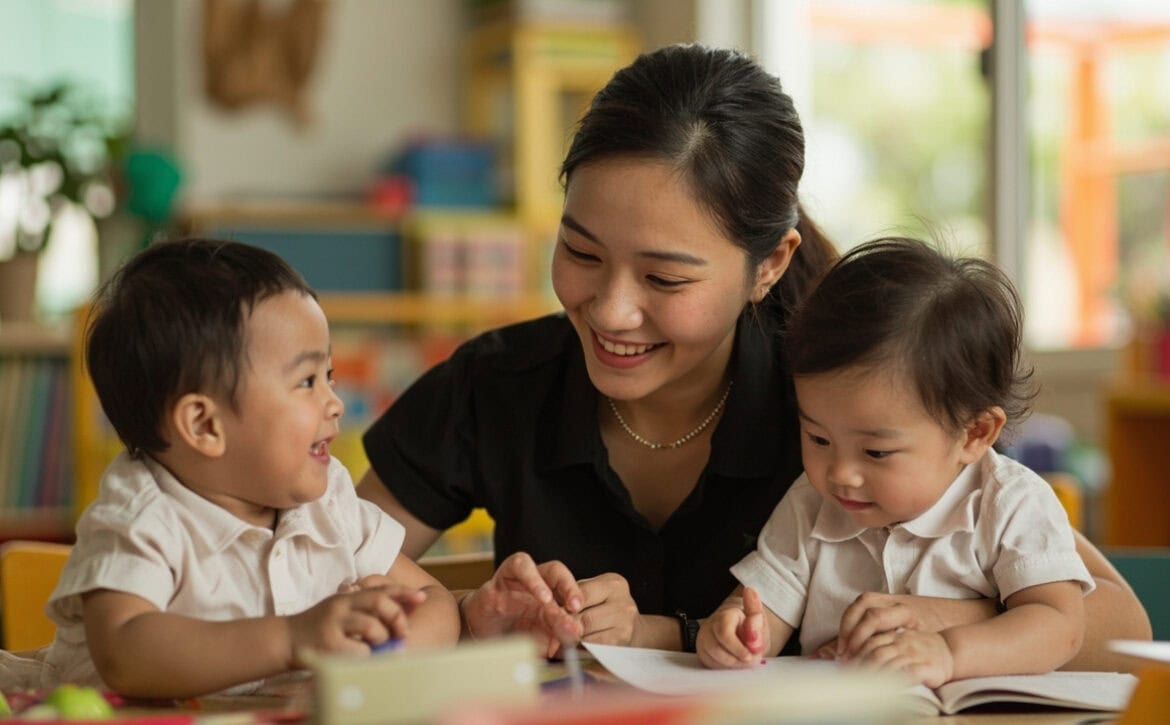
Watch what happens when a child approaches a caregiver during your visit — not when the caregiver is speaking to you, but when they are with the children. Does the caregiver pause what they are doing, crouch down to the child’s level, and respond to what the child is communicating — whether with words, a gesture, or simply a look?

Or does the child approach and the caregiver give a quick, distracted answer while their attention stays elsewhere?

Responsiveness is not about grand gestures. It is about the micro-moment — the split second when a child reaches out and the caregiver is actually there, fully present, in that exchange.

A child approaches a caregiver holding a toy truck she cannot figure out. The caregiver notices. She does not take the truck and fix it. She does not say “let me show you.” She crouches down, meets the child’s eyes, and waits. She lets the child show her what is happening. Then she mirrors it back — “You pushed that wheel and it spun the other way — that is confusing, isn’t it?” The child nods. The child tries again. The caregiver stays.

That thirty-second exchange is what trained observers are watching for. Not because it is dramatic, but because it is ordinary — and that is exactly why it matters. It happens dozens of times a day in quality care, and it is easy to miss if you are not looking for it.

What the Children Are Actually Doing

Now look at the children. Not at whether they are sitting quietly or behaving well for a visitor, but at what they are doing when no one is directing them.

Ask yourself: how do the children move through the space? Are they engaged with materials — genuinely engaged, exploring, testing, figuring things out? Or are they waiting — waiting for the next instruction, waiting for the next transition, waiting for someone to tell them what to do?

A room full of children who are occupied is not the same as a room full of children who are learning through play. Quality shows up in the difference between those two things.

The Ambient Warmth of the Room

Watch also for what we might call the ambient warmth of the room — and this is something that no amount of beautiful furniture or colourful wall displays can manufacture. It is the tone of the space.

Is it a place where children seem comfortable being themselves? Do you hear child-initiated conversation — children talking to each other, talking to caregivers, not because they have been told to, but because that is what the environment invites?

Or does the room feel managed, directed, oriented primarily around compliance and routine?

Neither of these is automatically wrong, but they represent very different philosophies about what early childhood should look like. And the way a room feels when you walk in — not what it looks like, but how it feels — is often the most honest indicator of the culture inside it.


The Questions That Reveal the Real Programme

This is where we come to one of the most practical questions a parent can ask during a tour: how does a typical day unfold here?

Not the ideal day, not the brochure day — the actual day.

  • What time is breakfast? What happens if a child is not hungry?
  • What does nap time look like, and what do caregivers do while children rest?
  • When a child is upset — genuinely upset, not just briefly fussy — what is the response?
  • What does outdoor time look like, and how is it supervised?

These questions sound straightforward, and they are. But they reveal something important: whether the programme is built around the needs of the children or the convenience of the schedule.

A quality childcare environment adapts. It has structure, yes, because children need predictability and routine. But within that structure, there is responsiveness. There is room for the child who is not hungry at 8 a.m. to be welcomed to the table later. There is a plan for the child who fights sleep. There is a considered answer for what happens when a child is hurt or overwhelmed, and it goes beyond calling the parent.

Transitions: A Revealing Indicator

In Singapore, where childcare centres can be large and group sizes significant, the way children move from one activity to another — from indoor play to outdoor time, from snack to nap — is one of the most revealing indicators of programme quality.

Watch for whether transitions are calm and purposeful or hurried and tense. Watch for whether caregivers are guiding children through them with warmth or simply managing them with efficiency.

A well-designed programme treats transitions as learning moments, not as obstacles to get past.

Asking Without Feeling Awkward

You might wonder whether it is fair to ask these questions. Whether asking about nap time or what happens when a child is upset might seem confrontational.

Here is what you should understand: any programme worth your child’s time should be able to answer these questions with clarity and without hesitation.

The willingness to talk about the ordinary, unglamorous realities of daily care — that is itself a transparency signal. A programme that becomes vague or defensive when asked about routines is telling you something.


Safety, Caregivers, and the Culture of Reflection

Now let us talk about something that parents often feel awkward evaluating but that matters enormously: safety. Not just the obvious safety — the locked gates, the childproofed sockets, the first aid certification on the wall. Those things matter, and you should see them.

But there is a deeper layer of safety that is harder to photograph and easier to observe.

How Caregivers Handle Conflict

Watch how caregivers handle conflict between children. When two children want the same toy, what does the response look like?

Is it swift and punitive — stop that, share, say sorry? Or is it something more thoughtful — helping each child name what they are feeling, guiding them toward a resolution rather than imposing one?

This distinction is not trivial. It reflects whether caregivers are trained to understand child development or simply trained to maintain order.

The first keeps children safe emotionally. The second keeps them quiet. And while quiet can look like safety, it is not the same thing.

Staff Ratios: The Margin That Matters

Look also at how the environment itself responds to children. When you are evaluating any centre or home-based option, ask about ratios — and not just the legally required minimum.

Ask what the actual ratio looks like on a typical day, during peak hours, during outdoor play.

The answer tells you whether the programme has built in margin for quality, or whether it is running at the edge of what the regulations allow. Margin matters. Margin is where responsiveness lives.

Meeting the Caregivers Who Will Actually Be There

The quality of the caregivers who will actually be with your child every day matters more than any curriculum framework on the wall.

Not the director. Not the programme philosophy. Not the marketing materials. The people. The ones who will be there at 7 in the morning when your child is tired and clingy. Who will be there at naptime when your child is crying for you. Who will notice when your child’s mood shifts because something at home is different.

During your visit, ask to meet the caregivers. Not just the senior staff, not the programme coordinator — the caregivers who will be with your child.

Ask them what they love about their work. Ask them what they do when a child is having a difficult morning. Their answers — not their qualifications alone, though those matter, but the quality of their thinking, the warmth in their voice, the way they talk about the children — will tell you more than any certificate on the wall.

Observation and the Culture of Reflection

Something most parents do not know to look for is the difference between a programme that observes children and one that uses that observation.

In quality childcare, what caregivers notice about your child — their rhythms, their preferences, their social style, their emerging interests, the things that frustrate them and the things that light them up — becomes the basis for how they plan the next day, the next week, the next month.

Observation is not passive watching. It is active, intentional, developmental thinking. It is what turns routine childcare into something that genuinely supports the early years.

Ask a caregiver what they know about your child after a week in the programme. If they can tell you something specific — not just that your child is sweet or active, but something real and particular — you are watching a programme that observes with purpose.

When Things Are Not Perfect

There will be moments — in any programme — when things are not perfect. Children have hard days. Transitions are sometimes rushed. A caregiver may be handling a difficult moment and you happen to arrive at the wrong time.

What distinguishes a quality programme is not the absence of imperfection. It is the culture of reflection behind it.

Ask: when something goes wrong, what happens? Is there a process for communication, for learning, for adjustment?

A programme that can answer that question thoughtfully — not defensively — is a programme that is serious about its work.


Seeing Quality in Practice

When you evaluate home-based and centre-based options side by side, you may notice something worth paying attention to: in smaller settings, the kind of responsiveness we have been describing — the micro-moments, the attunement, the warmth — tends to be more visible. Not because large centres cannot provide quality, but because the ratios in smaller environments make it easier to observe.

At EduNanny Singapore, our home-based childminding pathway is designed around ratios of up to one to three infants. Our caregivers are part of the ECDA Childminding Pilot, trained not only in the technical requirements of infant and early childhood care but in the everyday craft of responsiveness, observation, and attuned caregiving.

What you see during an EduNanny visit is not a performance. It is the natural result of a programme built around small numbers, trained caregivers, and the belief that quality in the early years is visible — in the room, in the interactions, in the way a child moves through their day feeling held and known.

Whether you ultimately choose EduNanny or another provider, we encourage you to ask these questions during any visit:

  • How does payment work? Is CDA and Baby Bonus usable?
  • What does the Monday-to-Friday care block look like, and does it fit a working family’s schedule?
  • How will you know what your child did today? What does daily communication look like?
  • Will you feel connected to the home or centre even when you are not there?
  • Where systems like CCTV are deployed, what is the philosophy behind their use?

Communication and transparency are not extras. They are how quality care operates.


A Framework for Your Next Visit

Let us bring this together into something you can use the next time you walk through a childcare door.

During the Tour

  • Watch caregiver-child interactions when no one is performing for you
  • Notice whether children are occupied or genuinely engaged
  • Sense the ambient warmth of the room — how it feels, not just how it looks
  • Watch transitions — calm and guided or hurried and managed
  • Observe how caregivers respond to conflict between children

Questions to Ask

  • How does a typical day actually unfold? (Probe for the real day, not the ideal day)
  • What happens when a child is genuinely upset — not briefly fussy, but distressed?
  • What is the caregiver-to-child ratio on a typical day, during peak hours?
  • Can I meet the caregivers who will actually be with my child?
  • What happens when something goes wrong? What is the reflection process?
  • How will I know what my child did and how they were today?

Red Flags to Notice

  • Caregivers who do not crouch to children’s level or give distracted responses
  • Children who are largely waiting for instructions rather than engaged
  • A room that feels managed and compliance-focused rather than warm
  • Staff who become vague or defensive when asked about routines
  • A programme that cannot articulate its philosophy behind daily care

You Already Know More Than You Think

Choosing childcare in Singapore is not simply a logistics decision. It is one of the most intimate choices a family makes. You are entrusting someone with the part of your life that you cannot be present for. You are trusting that the hours you are away — the meals shared, the conflicts resolved, the words spoken, the comfort given — will be shaped by people who understand what your child needs and who care enough to provide it.

That is not a small thing. It is enormous.

And yet, too often, parents are asked to make this choice with less information than they deserve. They are offered tours that show them beautiful rooms and told to trust their gut. They are handed brochures full of philosophy and asked to take it on faith.

But trust — real trust, the kind that lets you walk out the door in the morning and focus on your workday — should not require faith alone. It should be built on clarity. On the ability to see what quality looks like, to ask the right questions, to read the room the way someone who truly knows early childhood would read it.

If you are evaluating childcare options right now, we invite you to bring those eyes to EduNanny.

Walk through the door. Ask your questions. Watch the interactions. Notice how the children move, how the caregivers respond, how the environment feels.

We are part of the ECDA Childminding Pilot, and we believe in what we do. But more than that, we believe you deserve to see it clearly for yourself.

We are not asking you to trust us on instinct. We are asking you to look — and to know what you are looking at.

Because when parents can see quality clearly, they choose better. And when children are in the care of parents who chose with clarity and confidence, something important shifts — not just for the family, but for the whole ecosystem of early childhood in Singapore.

You have always had the ability to notice what matters. You developed it the day your child was born, and you have been sharpening it ever since.

All we have done is give you a framework for directing it.

Now, when you walk through the door of a childcare centre, you are not just a visitor. You are someone who knows what to see.

And that is exactly the kind of parent your child needs you to be.

Ready to see quality for yourself? Schedule a visit to EduNanny and trust what you observe.

edunanny-061906c17b7cd1a4a6252633c4748ec4
March 30, 2026

Partner, Not Observer: A Singapore Parent’s Childcare Guide

“`html

The Quiet After the Decision

There is a particular kind of quiet that settles into a home in the weeks after a child begins childcare. It is not the silence of worry, not exactly. It is something more subtle. The decision has been made. The arrangements are in place. The mornings now have a new shape, a different rhythm.

And yet, somewhere beneath the relief of having chosen well, there is a question that many parents find difficult to name. It lives in the pause between dropping your child at the gate and the moment your phone stays suspiciously still. It surfaces in the small hours when you wonder whether the day was good, whether there was comfort, whether the right word was said at the right moment.

The decision is made. But the uncertainty does not simply dissolve.

This is the space I want to speak to today. Not because the uncertainty signals a failure. Not because something has gone wrong. But because this quiet question represents something most parenting content never addresses: what it means to be a parent once someone else is also caring for your child during the hours that matter most.


The Informed Observer

We have built an entire landscape of guidance around the moment of choosing childcare. We talk about trust, instincts, reading reviews, visiting centres, and making the right call for your family. That preparation matters.

But it leaves a significant portion of the parent experience unspoken for. What happens after? How do you know if it is working, and what exactly is your role now that someone else is caring for your child?

Here is what I have come to understand about this space. When a child enters a quality childcare arrangement, the parent does not step back from parenting. The parent steps into a new kind of parenting.

One that requires a different kind of attention. Not the hands-on, moment-to-moment responsiveness of a full day with your child, but something equally important: the capacity to observe, to interpret, to stay connected to your child’s experience from a slight distance, and to bring your own deep knowledge of your child into a collaborative relationship with the people who care for your child alongside you.

This is what we might call the parent as informed observer. Not passive. Not merely waiting for updates. But actively, thoughtfully engaged with what is happening in your child’s day and what it means.

Two Eyes on the Same Child

The trained eye and the parent’s eye see the same child differently, and this difference is not a problem to solve. It is a resource to honour.

When a caregiver observes your child across an entire morning of play, learning, eating, and socialising, they develop a pattern of reference that is invaluable. They know how your child’s behaviour compares to other children the same age. They notice when a child who typically engages happily with others is more withdrawn, when appetite shifts, when a developmental leap seems to be happening.

But you, the parent, bring something the caregiver does not have. You bring the long view of your child’s life. You know what the crying meant last month when the teething was at its worst. You know that your child slept poorly because of a change in routine at home, not because of anything at the centre. You know your child’s particular sensitivities, the textures that bother them, the songs that calm them, the way they need to be held differently when they are overtired.

This knowledge is not sentimental. It is specific. It is data. And it is irreplaceable.

The partnership works when both of these perspectives are treated as legitimate, when communication flows not as a one-way report but as a genuine exchange of observations.


Observation in Practice

Informed observation begins with noticing your child’s behaviour without immediately interpreting it through anxiety. When your child comes home and is clingier than usual, or quieter, or more wound up, the instinct might be to ask a hundred questions or to assume the worst.

Instead, try pausing. Notice the behaviour as data, not as a verdict. Consider the range of possible explanations:

  • A big developmental day at the centre
  • A growth spurt affecting sleep
  • A minor adjustment in routine
  • Simply the natural rhythm of a child’s week

Hold the observation lightly while you gather more information.

Reading Caregiver Reports with Confidence

Read caregiver reports not as updates to be evaluated for red flags, but as communication from partners who are invested in your child’s wellbeing. When a report mentions that your child shared a toy beautifully today, or that lunchtime was a challenge, or that a particular activity seemed to capture their imagination, these are invitations to conversation, not scores to be assessed.

The report is not evidence of success or failure. It is a snapshot from one perspective, offered to you so that you can build a fuller picture.

In Singapore’s busy dual-income households, where parents may have limited time at pickup, these reports become especially valuable. A brief, thoughtful note from a caregiver who knows your child well is worth more than a detailed log that treats every moment as requiring documentation.


Engaged Partnership vs. Over-Monitoring

There is a meaningful difference between engaged partnership and over-monitoring. Engaged partnership is curiosity. It is asking a thoughtful question about your child’s day because you genuinely want to understand what they are experiencing. It is trusting that when something matters, you will be told. It is giving the caregiver space to do their work while staying genuinely present as a parent who cares deeply.

Over-monitoring is a different impulse. It is the need to know everything, to manage every detail, to treat the childcare relationship as something that must be controlled rather than cultivated.

Here is a truth that may feel counterintuitive: over-monitoring does not make your child safer or better cared for. It actually undermines the very partnership you are trying to build. Because partnership requires trust, and trust requires the willingness to let someone else hold part of your child’s world without your direct supervision in every moment.

The shift is from monitoring to meaning-making. From watching to wondering alongside.

  • Asking a caregiver what your child’s favourite activity was this week and really listening to the answer is worth more than ten requests for minute-by-minute updates
  • Noticing that your child seems particularly energised after school and asking what kind of movement they engaged in is more valuable than checking CCTV for reassurance
  • The quality of your engagement matters more than the quantity of your oversight

When to Intervene vs. When to Trust

So how do you know when something warrants intervention versus when you should trust the system? The answer is not a formula, but it is also not mysterious.

Intervention is warranted when:

  • There is a pattern that concerns you
  • Something feels genuinely off in a way that persists across multiple days
  • You have received communication that does not align with what you are seeing at home
  • Your instinct is telling you, with specificity, that something is not right

Gut instinct is not irrational. It is your brain processing a vast amount of information that you may not be able to articulate in the moment. Honour it. Ask questions. Seek clarity. That is what a healthy partnership looks like.

Trust is warranted when:

  • Your child, who could not speak in sentences last month, now comes home using new words and clearly had a full and engaging day
  • The caregiver shares a small, specific detail about your child’s day that reveals they were truly paying attention
  • You see evidence of a relationship forming, a comfort level developing, a familiarity that only comes from consistent, attentive care
  • Your child shows recognition and warmth toward their caregiver

Understanding the Adjustment Period

There is an adjustment period for this. I want to name that plainly.

It takes time for the parent to find their footing in this new role. It takes time for the child to settle into the new rhythm. It takes time for the caregiver and the family to develop the shorthand and mutual understanding that makes a partnership feel natural.

This adjustment is not a warning sign. It is a normal phase of a healthy beginning. And it deserves to be normalised rather than pathologised.

Some days will feel effortless. You will drop your child at the door, receive a warm update at pickup, and sense that everything aligned. Other days will feel uncertain. Your child may seem off, the report may be brief, and you may leave the centre with more questions than answers.

Both kinds of days are part of it. Both belong to the reality of partnership. The goal is not to eliminate the uncertain days. The goal is to build enough trust, enough communication, and enough mutual respect that the uncertain days become opportunities for conversation rather than sources of anxiety.


What Quality Childcare Looks Like

In Singapore’s diverse childcare landscape, quality indicators can sometimes feel abstract. Here is what to look for in practice:

  • Consistent caregiver relationships: Your child is known by name, by routine, by temperament. The caregiver remembers the small details from previous days.
  • Transparent communication: Updates feel like genuine sharing, not obligation. You leave pickup knowing something meaningful about your child’s day.
  • Respect for your role: The caregiver invites your observations and treats your knowledge of your child as essential, not intrusive.
  • Comfort indicators: Your child shows recognition and warmth toward their caregiver. There is no sustained distress that goes unaddressed.
  • Developmental awareness: The caregiver notices and shares moments of growth, not just incidents.

The EduNanny Approach

At EduNanny Singapore, this philosophy of partnership is not an aspiration. It is a structural commitment.

As part of the ECDA Childminding Pilot, EduNanny was built on the belief that parents and caregivers are not parallel tracks that happen to intersect. They are one integrated system, and the child’s wellbeing depends on the health of that system.

Our approach reflects this. With up to a one-to-three infant ratio, our caregivers have the capacity to truly know each child in their care, to notice what matters, to communicate with intention, and to build the kind of consistent, responsive relationships that young children need to thrive. Whether care takes place in a home-based setting or within our community and centre-based pathways, the same principles apply: quality attention, transparent communication, and genuine respect for the parent’s role.

Monday to Friday care blocks provide the consistency that children thrive on and that parents can rely on. Where CCTV measures are deployed, they are shared with families not as surveillance tools but as extensions of our commitment to visibility. EduNanny was designed to be accessible within pilot fee structures, and families can use CDA and Baby Bonus funds, making quality childcare a practical reality for more households across Singapore.

Common Concerns, Addressed

“What if something happens and I don’t know about it?”
Quality childcare is designed so that you do not have to monitor every moment to know your child is safe. When something significant happens, you will be told. When something routine happens, you will receive updates that help you understand your child’s day without requiring constant reassurance.

“How do I know the caregiver really knows my child?”
Look for specificity. A caregiver who knows your child will share details that could only come from attentive observation: the way your child prefers to be soothed, the activity that captured their imagination, the small social moment that revealed something about their personality.

“What if I disagree with something the caregiver observed?”
This is exactly what partnership looks like. If you see something at home that does not align with what is being shared, bring it forward. Ask about it. Your observation is valid, and together you can build a more complete picture.

“Is it normal to feel guilty about returning to work?”
The decision to enrol your child in childcare is made out of love, not out of neglect. You are not abandoning your role as parent. You are stepping into a new way of fulfilling it. The guilt, when it surfaces, is often the echo of a cultural story that says only one kind of parenting is real. Quality childcare partnership is real parenting.


Your Role in This Partnership

Here is what I want you to hear most clearly. You are not a passive consumer of childcare services. You are not someone who has outsourced the hard work of raising your child and now simply hopes for the best.

You are the most important interpreter of your child’s experience. You are the person who holds the through-line of your child’s life across all the different environments and relationships they encounter.

The caregiver sees your child in context. You see your child in context and in continuity. When you bring that perspective into the partnership, when you share what you observe at home with what is being shared from the centre, you create the most complete picture of your child’s development and wellbeing that is possible.

This is not a burden. This is a purpose. And it is one that only you can fulfil.


The Quiet Confidence of Good Parents

Good parents do not stop being parents at the childcare gate. They become partners in their child’s growth. They bring their knowledge, their love, their specific understanding of who this small person is, and they offer it as a contribution to a relationship that is larger than any one person can hold alone.

So the next time you find yourself in that quiet moment after the drop-off, when the day stretches ahead and the questions surface unbidden, I want you to remember something.

The uncertainty you feel is not a sign that you chose poorly. It is a sign that you are paying attention. That you care about the quality of your child’s life in your absence. That you are still very much a parent, just one who has found a way to be present even when you are not in the room.

You are not on the sidelines. You never were.

You are at the centre, holding the thread that connects all the pieces of your child’s world together.

And that is exactly where you are meant to be.


If you are researching infant care and childminding in Singapore and want to explore a partnership model built on genuine communication, informed observation, and mutual respect, we invite you to learn more about EduNanny Singapore. You are also welcome to reach out to us directly with any questions about your family’s childcare journey.

Learn more about EduNanny’s approach to quality childminding

“`

edunanny-061902ef3bd08e099da6c9ff29d5787e
March 30, 2026

Releasing the Guilt of Choosing Professional Childcare in Singapore

Understanding the Tension You Feel

In Singapore, we have built an extraordinary culture around family. Our parents sacrificed enormously to give us opportunities they never had. Our grandparents often rearranged their lives, their retirement, their well-earned rest, to step in and help with grandchildren. There is something beautiful in this. Something that binds us across generations.

And yet, beneath that beauty, there is a tension that we rarely speak about honestly:

  • The tension of wanting your child to have the best possible care.
  • The tension of knowing that quality early childhood development matters in ways we are only beginning to fully understand.
  • The tension of wanting professional, trained support while fearing that seeking it somehow diminishes the role of family.
  • The tension of loving your own parents deeply while wondering whether the way they cared for you is the same as what your child needs today.

There is also a particular pressure that comes when grandparents offer to help. It often arrives with deep love but also with deep expectation. The way things were done becomes the way things should be done. And if you want something different—if you want updated safety standards, caregivers trained in early childhood development, an environment designed specifically for infant growth—there can be a sense that you are rejecting not just the arrangement but the person.

This tension is not a sign of weakness. It is a sign that you care deeply. It is evidence that you are a parent thinking carefully about what your family needs.


Reframing the Choice Between Family and Professional Care

Here is what I want you to hear: in Singapore, we often speak about childcare in binary terms. Family care versus external care. Grandparents versus caregivers. As if these are forces in competition, and choosing one means losing the other.

But this framing misses something essential about how strong families actually function.

Strong families are not defined by who spends the most hours with a child. Strong families are defined by:

  • The quality of presence they bring when they are together.
  • The safety and security a child feels knowing they are loved by many.
  • The grandparents who can simply be grandparents, and parents who can simply be parents—rather than everyone trying to be everything to everyone, all the time.

Quality professional care does not replace family. It creates space for family to be family. When a grandparent’s role shifts from being the primary caregiver to being the grandparent, something beautiful happens:

  • The bedtime stories become more present because they are not tangled up with exhaustion.
  • The weekend visits become quality time rather than catch-up time.
  • The spoiling, the indulgence, the joy of loving a grandchild without the weight of full responsibility—all of that becomes possible.

I think of a grandfather I spoke with last year. He had been caring for his granddaughter three days a week while his daughter returned to work. He loved that child completely. But he also told me, quietly, that he was tired in a way he had forgotten he could be tired. That he sometimes felt like he was not quite doing things the right way anymore.

When his daughter made the decision to transition to professional care, he told me he felt something he had not expected: relief. Not because he loved his granddaughter any less. But because he was now free to love her as a grandfather again.


What Trained Caregivers and Grandparents Each Bring

This is what we mean when we talk about complementary roles. The trained caregiver brings consistency, developmental expertise, and a fresh presence every day. The grandparent brings history, family identity, and a love that is irreplaceable. These are not competing forces. They are forces that, when understood and respected, make each other stronger.

What Trained Caregivers Bring What Grandparents Bring
Consistent daily routines and structure Family history and cultural continuity
Developmental expertise and milestone tracking Deep, unconditional emotional connection
Age-appropriate environments and activities Multi-generational family bonds
Professional training in infant care Stories, traditions, and family identity
Fresh energy and focused attention The joy of spoiling without full responsibility

Quality childcare is about more than supervision. It is about:

  • Understanding how infants learn and how their brains develop.
  • Knowing how attachment works in the early years.
  • Creating environments that support exploration without compromising safety.
  • Having the training to recognize developmental milestones and the wisdom to know when something needs attention.

This is why the ECDA Childminding Pilot matters. It represents a recognition that Singapore families need real options—grounded in proper training, appropriate ratios, and frameworks designed to support both the child and the broader family system.


Releasing the Guilt That Does Not Serve You

Let me be clear about something. I am not here to tell you that any childcare arrangement is right for your family. That is not my place.

What I am here to tell you is this: when you choose professional care with intention and care, you are not diminishing your family. You are not rejecting your parents. You are not failing as a parent. You are making a choice about what kind of environment you want your child to grow in, and what kind of family you want your family to be.

There is guilt that is worth listening to. The guilt that tells you that you are not paying attention to your child. That you are rushing. That you are disconnected. That kind of guilt is worth attending to, because it points to something real.

But there is another kind of guilt that I want to suggest you release:

  • The guilt that says choosing professional care means you do not love your child enough.
  • The guilt that says involving a caregiver means your family is not enough.
  • The guilt that says wanting support is a failure of your own parents or your own capabilities.

That guilt is not pointing to truth. It is pointing to a story about family and childcare that was never actually true.


Answering the Questions on Your Mind

“Will my child feel abandoned?”

Children are remarkably perceptive. What they feel is not whether a caregiver is present, but whether the people who love them are secure and well-supported. When parents are running on empty, children feel it. When parents are grounded and supported, children feel that too. Quality care is not an absence in your child’s life. It is infrastructure that allows your family system to function well.

“Will my parents feel rejected?”

This depends on how the conversation is approached. Many grandparents, when offered the chance to simply be grandparents, feel profound relief. They may not have known how to ask for help themselves. When you frame professional care as something you are doing for the whole family—including them—the conversation shifts from rejection to care.

“Is professional care really better than family care?”

This is the wrong question. The right question is: what does my specific child need at this specific stage, and who is best placed to provide that? For infants and toddlers, developmental expertise genuinely matters in ways that family love alone cannot address. This is not a criticism of grandparents. It is simply a recognition that early childhood development has evolved as a field, and trained caregivers have knowledge that even the most loving grandparents were not taught.

“Can we afford quality childcare?”

This is a real concern, and it deserves a real answer. The ECDA Childminding Pilot was designed with affordability in mind, with structures that allow CDA and Baby Bonus to be used in practical ways. Options that work with Monday to Friday care blocks and real schedules that real parents have. Quality should not be the exclusive domain of families with unlimited budgets.


What to Look for When Choosing Childcare

Making this choice well matters enormously. Here is what to look for when you are researching your options:

  • Training and credentials: Ask about early childhood development training, not just general caregiving experience. Understanding how infants learn and grow is different from being a warm, capable person.
  • Ratios that allow responsiveness: One caregiver to how many children? The numbers matter. Quality care requires the capacity to respond, not just supervise.
  • Communication systems: You need to know what is happening with your child. Daily updates, transparent channels, and genuine partnership—not a black box arrangement.
  • Reliability and continuity: The person caring for your child should not disappear without warning. Consistency is foundational to infant security.
  • Flexibility that works with real life: Monday to Friday care blocks, scheduling that aligns with actual work arrangements, structures that do not add to your logistical burden.
  • A partnership mindset: You are not surrendering your role as a parent. You are gaining support that allows you to be a more present, more grounded version of that parent.

Building Something That Lasts

The best families I know are not the ones who do everything themselves. They are the ones who are honest about what they need, who build structures that support everyone involved, who choose quality not as an act of replacement but as an act of love.

They understand that letting someone else handle the daily rhythms of care with expertise does not diminish family. It deepens it.

  • Because it means that when grandparents visit, they can simply love.
  • Because it means that when parents come home, they can be fully present.
  • Because it means that the child is held by a network that is sustainable, not by people who are running on empty.

When you choose quality childcare, you are choosing to build the kind of family system that can sustain love over time. You are choosing to protect the relationships that matter most by not asking them to carry more than they were designed to carry.

And you are making this choice—because you love your child and your family and your parents and yourself enough to be honest about what you all need.

That is not guilt. That is care. That is clarity. That is the kind of love that holds up over years and generations.

So if you have been carrying this tension quietly, if you have been wondering whether wanting help makes you less of a parent or less of a daughter or less of a son: it does not. It makes you human. And it makes you ready to build something sustainable.

EduNanny exists because we believe that families in Singapore deserve to have this conversation honestly. Without shame. Without the weight of false choices. Without the silence that keeps parents isolated in a tension they never asked for.

We are here to walk alongside you. To be the kind of support that strengthens what you are already building. To bring training and care and transparency and genuine partnership to a space that has for too long been either idealized beyond reality or criticized without understanding.

If you are ready to explore what a supported family system could look like for your family, we would be honored to have that conversation with you. No judgment. No pressure. Just an honest discussion about what you need and whether we might be part of the solution.


At EduNanny, we understand that choosing the right childcare arrangement is one of the most personal decisions a family can make. Our approach is grounded in the ECDA Childminding Pilot framework, designed to provide Singapore families with trustworthy, development-focused childminding that works alongside—not instead of—your family. Learn more about our approach.

Have questions or ready to start a conversation? We would love to hear from you.

edunanny-0618fc5b4756c40f3e22f9682c1d7dc4
March 30, 2026

How the Evening Reveals the Truth About Your Childcare Choice

The Evening Rhythm Gap: What No One Tells You About Childcare Quality

There is a moment that happens every weekday in Singapore—in HDB living rooms and condominiums and terrace houses across the island. The car door opens. The child unbuckles. The caregiver hands over the bag with the art project and the spare clothes and the daily update. You smile, you thank them, you drive home.

And in that drive home, something happens that most parents do not have words for, but all of them feel.

The child’s energy shifts. The ease of the afternoon fades. By the time you walk through your own front door, the child who was regulated and content twenty minutes ago is somehow falling apart. Hungry, yes. Tired, absolutely. But also something else—something that has been building all day, waiting for the moment when safety arrives and the walls come down.

The child needs you to catch them. And you have just come from eight or nine or ten hours of your own work, your own depletion, and you are supposed to be the container for all of that feeling—with dinner to make, baths to run, a house that needs attention, and a morning that will come too soon.

This is the moment where most families live. Five nights a week, give or take. And it is also the moment that almost no one talks about when they are making the childcare decision.

We talk about drop-off. We talk about whether the child cried, whether the environment looked right, whether the caregivers seemed warm and qualified. We talk about the morning goodbye, the anxiety of those first weeks, the relief when the child settles in.

But we rarely talk about what happens when the gate closes behind you and the car pulls away—when the whole question of childcare, who chose it, whether it was the right choice, what the child did and learned and felt all day, becomes invisible. Until the evening. Until you see your child again and something becomes clear that you cannot quite articulate but that tells you everything.

The truth is this: the evening hours between pickup and bedtime are the real quality test for any childcare arrangement. Not because the daytime hours do not matter—they matter enormously—but because those hours are where the effects of daytime care become visible. They are where you see whether your child is coming home ready to connect or ready to collapse.

The Evening Rhythm That Changes Everything

  • The hours after pickup reveal whether your childcare is truly working—not the morning drop-off
  • Quality daytime care builds the neurological conditions for calm evenings, but only if you know how to receive them
  • The three hours after pickup have a natural architecture: decompression, connection and nourishment, transition to sleep
  • Children who arrive home regulated need a container for that regulation—a rhythm that holds them
  • Your presence matters more than your duration—quality of attention beats quantity of hours
  • The compound effect of daily evening connection reshapes your child’s sense of family

The Gap Between What Childcare Makes Possible and What Your Evenings Deliver

Here is what most families experience but almost no one names: the gap between what childcare makes possible in theory and what it delivers in practice—in the specific hours where your family actually lives.

I have seen parents who chose excellent childcare feel bewildered by evenings that felt harder than they should. I have seen children who thrived at school or at the centre come home and fall apart in ways that seemed disproportionate, leaving parents wondering what was wrong. I have seen couples who felt like they were failing at parenting when they were actually failing at evening rhythm—not from lack of love but from lack of structure, from not understanding that the hours after pickup have their own architecture, their own needs, their own logic.

Because here is what most of us were never taught: quality childcare does not just care for your child during the day. When it is truly excellent, it builds the neurological and emotional conditions that make good evenings possible. A child who has been in a warm, responsive, stimulating environment all day arrives home with a particular quality of readiness. They have been fed attention. They have been supported in their development. They have had their needs met in ways that build their sense of security and their capacity for regulation.

That child, when they walk through the door, is bringing something home to you. They are bringing the residue of a day that went well—the internal experience of being held in mind by capable, caring people.

But here is what most parents do not realize: that readiness needs somewhere to land. If the evening is chaotic, rushed, disconnected, that readiness dissipates. It does not get used. It does not become connection. It becomes frustration instead—a child who has the capacity for good connection but no container for it, no rhythm to hold it, and so it spills out as neediness or aggression or tears that seem endless but are actually, in their own way, a desperate reaching.

Your child is saying: I have all this feeling inside me, and I need you to help me land it.


The Three-Hour Architecture: What Your Evenings Are Missing

The hours after pickup have three natural phases. When families understand this, something shifts. The first is decompression. The second is connection and nourishment. The third is transition to sleep. Each of these phases has its own needs, its own timing, its own quality of attention required.

Phase One: Decompression

This is the phase most families skip without realizing it. You come home. There is food to prepare, bags to unpack, messages to check. The child wants something. You redirect them to a screen because you need five minutes.

And in those five minutes, the child’s nervous system—which has been processing a full day of stimulation, learning, social demands, separation from you—does not get the support it needs to settle. Instead of decompression, what happens is continued activation. The child is still running on the same frequency they were on at pickup, and so the energy that should be moving downward into calm instead moves sideways into agitation, or collapses into a tantrum that seems to come from nowhere but has been building since you walked through the door.

What quality childcare does—and this is worth paying attention to when you evaluate your options—is it gives your child the experience of being regulated by someone else. It teaches them, through repetition, that there is a way to come down from high energy. That there are rhythms for settling. That when you have been up all day, there is a way to come back down.

When your child comes home from good childcare, they often do need a period of what looks like nothing—lying on the carpet, wandering, not engaging with anything in particular. Parents often interpret this as laziness or boredom. It is not. It is the nervous system doing what it needs to do. It is decompression happening, if you let it.

Phase Two: Connection and Nourishment

There is a difference between supervision and connection, and I have seen this confusion hurt families.

Supervision is making sure your child is safe, is fed, is clean. Connection is being present with your child. Supervision says: eat your dinner. Connection says: tell me about your day. Supervision says: it is time for a bath. Connection says: I see that you worked hard today, and I am glad we are together.

Both matter. But they are not the same thing, and families that only achieve supervision during the week are families that feel the strain.

The interesting thing—and this is something that quality childcare actually makes visible—is that children who receive high-quality connection during the day are often more available for connection in the evening, not less. There is a kind of child who has been starved of attention all day, and that child needs you to be their only source of connection, which is an enormous and exhausting demand.

And there is a kind of child who has been well-connected to capable caregivers all day, and that child arrives home with something to share rather than something to demand. They have the internal experience of connection already, so what they want is not to be filled up but to include you in what is already full.

This is one of the most counterintuitive things about quality childcare: it does not replace parental presence. It builds the conditions that make parental presence more effective. A child who has been regulated well all day can receive your attention in the evening. A child who has been dysregulated all day cannot. That is the gift that excellent daytime care gives you—not time away from your child, but quality of time with your child.

Dinner is where this becomes most visible. We are busy. We are tired. We want to feed our children something quickly so we can move on to the next thing. But the meal is not just nutrition. The meal is connection. When you sit with your child and eat together, when you ask them about their day, when you let them see you eating and enjoying food, you are building something that goes far beyond the table. You are teaching them that meals are a place where family gathers.

Phase Three: Transition to Sleep

The quality of your child’s daytime care affects the quality of their sleep. Not because of anything magical, but because of nervous system regulation.

A child who has been dysregulated all day has a dysregulated nervous system at bedtime. They cannot settle. They cannot let go. They stay in a state of low-grade activation that makes sleep difficult or restless or full of anxiety.

But a child who has been well-regulated—who has had responsive caregivers, predictable rhythms, a supportive environment—all day arrives home with a nervous system that is capable of winding down. Bedtime is not a battle because bedtime is not fighting against the day. It is the natural completion of a day that went well.


Quality of Presence Versus Duration of Presence

We live in a culture that measures parental presence by duration. How much time are you spending with your child? Are you there for dinner? Are you there for bath? Are you there for story? We celebrate parents who are present for every moment and feel guilty about parents who are not.

But duration is a poor measure of what children need. What children need is not more of you. What they need is a particular quality of you.

There is a father I know who works long hours, who is not home until after seven most nights. His children run to the door when he arrives. They have been waiting for him, and when he comes in, something in the house changes. The energy shifts. There is laughter. There is roughness and tenderness and a kind of aliveness that was not there before.

And then there is dinner and bath and story and bed, and he is present for all of it—not with his phone in his hand, not half in and half out, but actually there. When his children talk about their father, they talk about him being there for them. And he is. But he is not there for the six hours that other fathers are there. He is there for the three.

Quality of presence is not about hours. It is about the capacity to be with your child when you are with your child. It is about the ability to land in the evening and meet them where they are. It is about the rhythm you build that tells your child: no matter how tired I am, no matter what happened today, when I come home, I am yours.

This is the thing that transforms the post-pickup hours from survival to connection. Not more time. Better use of the time you have.


The Evening Rhythm Blueprint: First Thirty Minutes to Bedtime

The research and the experience both tell us: the compound effect of daily evening connection is enormous, and so is the compound effect of daily evening disconnection.

What you do tonight matters. What you do tomorrow night matters. These are not isolated moments. They are the texture of your child’s childhood, and they are building something—either connection or distance, either the expectation that evening is a time of presence or the expectation that evening is a time when everyone is too tired to really be together.

Most parents are not failing. Most parents are doing the best they can with a map that does not show them where they are. They are driving without navigation, improvising every evening, reacting instead of anticipating.

Here is the map you need:

The First Thirty Minutes After Pickup: Decompression

Slow down. Be less. Your child needs to land, and if you come home and immediately start a checklist—dinner, bath, homework, bedtime—the landing does not happen. The nervous system stays elevated. The child who could have been calm in forty-five minutes becomes the child who is wired until ten.

Give them ten minutes of nothing. Give them the space to transition from outside to inside, from school self to home self. A glass of water. A moment on the carpet. You sitting with them while they decompress. This is not wasted time. This is the foundation for everything that follows.

The Dinner Hour: Connection and Nourishment

Make dinner a place where you are actually present, where you ask questions and listen to answers and let the meal be more than fuel. A child who arrives home regulated can receive your attention. They can be at the table rather than just consuming.

A child who has been fed well and regularly during the day arrives home without the desperation of hunger. They can sit at the table and be present because they are not in survival mode. They can taste their food because they are not frantic. They can talk because they are not just trying to consume. This is what good daytime care does for your dinner table.

The Final Hour: Transition to Sleep

Build the bedtime rhythm that helps your child’s nervous system let go of the day. Consistency tells their body what is coming. Predictability creates safety. The work you do at bedtime is built on the foundation of everything that came before—the decompression that was allowed, the connection that was offered, the evening rhythm that held everyone.


How to Evaluate Childcare by Its Evening Impact

I think we have been asking the wrong question when we evaluate childcare. We ask: is my child happy at drop-off? Is the environment clean? Do I like the caregivers? These are not wrong questions, but they are incomplete.

The question that will tell you whether your childcare is truly working is this: what is my child like when they come home? And: what is our evening like as a result?

If your child arrives home falling apart, ask why. Not to blame yourself or your caregiver, but to understand:

  • Is the child not being fed enough during the day?
  • Are the days too long?
  • Is the environment overstimulating without enough downtime?
  • Is your child trying to process separation all day and arriving home with nothing left?

These are solvable problems, and they are often invisible until you start looking at the evening.

If your child arrives home regulated and ready to connect, that is information too. That tells you that something is working. That the daytime care is building what it should be building. That you have a foundation to work with in the evening hours.

What Evening-Ready Childcare Actually Looks Like

Quality childcare thinks about the whole day, not just the care hours. It understands that the work done during daytime hours either makes the evening possible or makes it harder.

When daytime care is truly excellent, it gives your child the experience of being regulated by someone else. It teaches them, through repetition, that there is a way to come down from high energy. That there are rhythms for settling. That when you have been up all day, there is a way to come back down.

That means caregivers who read a child’s signals and respond before small escalations become big ones. It means predictable rhythms that build internal regulation rather than external control. It means feeding schedules that ensure children arrive home hungry but not desperate, ready to eat but not frantic. It means appropriate stimulation—not so much that the nervous system stays activated, not so little that development stalls.

Small ratios matter here. A caregiver who can truly attune to your child can notice when they are approaching overload and intervene before the dysregulation takes hold. When there are too many children and not enough attention, that moment is missed, and the child arrives home carrying the residue of a day they never fully recovered from.

Every child needs to be seen and held in mind during the day so they can come home ready to be held in mind by you.


What EduNanny Does Differently

At EduNanny, this is the question we are always asking: what does our work during the day make possible in the evening? We think about childcare not just as daytime care but as the beginning of the evening experience. We know that a child who has been well-cared for all day arrives home ready for family life.

This is why we are part of the ECDA Childminding Pilot—a commitment to trained caregivers who understand infant development, who know how to read a child’s signals, who can support regulation in ways that pay dividends hours later at your dinner table.

We maintain small ratios so that every child receives the attention they need to arrive home ready, not depleted. We are transparent about what we do during the day, because we want you to understand the connection between the morning and the evening. Some of our centres have CCTV, and we do not see this as surveillance. We see it as transparency. We see it as trust. Because you are trusting us with your child’s day, and we believe you have a right to see into that trust.

We support families in using CDA and Baby Bonus funds, because we believe that quality childcare should be accessible, not only for those who can afford premium pricing. We offer both home-based and centre-based pathways, because different families need different solutions.

And we have built communication into everything we do. When you drop your child in the morning, you should know what kind of day they had. When you pick them up, you should have information that helps you understand why they are who they are in those evening hours. The art project in the bag, the daily update, the caregiver’s notes about meals and naps and moods—these are not administrative extras. They are the bridge between our care and your connection.


Real Concerns From Real Parents

“I’m already doing everything I can. How can I add more?”

I am not telling you this to add to your anxiety. I have too much respect for what Singapore parents are already carrying—the hours worked, the commutes, the pressure, the way this city runs on intensity and effort.

The evening rhythm that you build for your family is yours. No one else can build it for you, and no one else should. But understanding the architecture is not about adding tasks. It is about understanding why the things you are already doing matter—and what happens when you do them in a different order or with a different quality of attention.

Slowing down in the first ten minutes is not more work. It is different work. And it often means less work later, because a child who has decompressed properly can eat dinner without falling apart, can transition to bath without a tantrum, can settle into sleep without a battle.

“My child seems to fall apart every single evening. Is something wrong with them?”

No. Your child is not broken. They are doing exactly what a child does when they finally feel safe enough to let go.

After a full day of being regulated, being appropriate, being the child the caregivers needed them to be, your child arrives in the one place where they do not have to hold it together anymore. And so it comes out. The tears, the neediness, the aggression that seems disproportionate—these are not signs that something is wrong with your child. They are signs that your child trusts you enough to fall apart in front of you.

The question is not how to stop this. The question is how to hold it. How to be the container that lets it move through rather than escalate. How to be present with the falling apart until the falling apart becomes something else—connection, finally, after all that waiting.

“I’m too tired to be present in the evenings. I just need to survive until bedtime.”

This is honest, and I believe it. The depletion you carry home from your own workday is real, and it is not small.

But here is what I have seen: the fathers and mothers who are most present in the evening are not the ones with the most energy. They are the ones who have learned to land—to walk through the door and leave their workday at the threshold, to arrive in the evening as the parent their child needs rather than the depleted version of themselves.

This is a practice. It gets easier. And it starts with understanding that your child does not need you to be perfect. They need you to be there—not perfectly, but consistently. Not with endless energy, but with the willingness to show up again, every evening, and be present for whatever shows up.


The Promise of a Different Kind of Evening

Once you see the connection between the morning and the evening, everything changes. Once you understand that the three hours after pickup are not a void to be survived but a space to be shaped, you begin to shape them.

You begin to slow down when you walk through the door. You begin to sit with your child while they decompress. You begin to make dinner a place where you are actually present, where you ask questions and listen to answers and let the meal be more than fuel. You begin to build the bedtime rhythm that helps your child’s nervous system let go of the day.

And something shifts. Not immediately, not perfectly, but gradually. The chaos becomes less. The connection becomes more. The evenings that felt like survival start to feel like the thing you were doing all day to come home to.

You realize that the childcare decision was never just about who would watch your child while you worked. It was about who would help you build the evenings you wanted to live in.

The hours between pickup and bedtime are where your child learns what family feels like. They are where your marriage or partnership either strengthens or frays. They are where the parent you want to be either becomes visible or disappears under the weight of exhaustion and distraction. They are the hours that determine whether, when your children look back on their childhood, they remember feeling held—or feeling like everyone in the house was just trying to survive.

You are not broken. You are not failing. You are in a gap—a gap between what your childcare is doing during the day and what your evenings could be if you understood the connection between them.

That is the work. And that is what we believe you are already capable of building.


What we offer at EduNanny is not just childcare. It is a partnership in your family’s evening. It is the understanding that the hours after pickup are where childcare is tested and where family life is built. It is a commitment to doing the daytime work so well that the evening work becomes possible.

To learn more about how we think about quality care and what it can mean for your family, we invite you to explore our approach or connect with us directly. Let us show you what a difference the right start makes to the hours that matter most.

edunanny-0618f88cc7770ed0378e12a47c5c9a2f
March 30, 2026

What Trained Caregivers Notice That Parents Miss

The Singapore Reality: Making Decisions Under Pressure

Singapore has built an extraordinary environment for raising children — with infrastructure, support systems, and educational pathways that many other countries genuinely admire. But with that comes a pace of life, an expectation of productivity, and a cultural orientation toward excellence that begins earlier than most parents ever imagined it would.

We return to work when our children are still learning to walk. We make decisions about childcare arrangements that will shape our child’s earliest experiences of the world — often with incomplete information, often under pressure, and always with the weight of wanting to get it right.

You have toured centers. You have asked about ratios, checked credentials, read reviews. You have stood in bright, colorful rooms and tried to imagine your baby in that space, trying to feel whether this could be right.

That process matters. But it is worth being honest about a limitation that no tour can overcome: you cannot see what trained eyes catch. And that invisible difference is the architecture of everything that matters in your child’s early development.


Seeing vs. Watching: What Caregivers Notice That Parents Cannot

A parent watching their child in a room notices what is visible and immediate. They notice if the child is crying or laughing. They notice if the child seems upset or content. They notice the big moments, the milestones, the dramatic expressions of need.

This is not a criticism of parents. It is simply a recognition that parents are emotionally embedded in what they observe. You are not watching your child — you are experiencing your child. And that fierce protective investment, that love, is the most important thing in your child’s life.

But it also means that certain kinds of seeing become harder when you are the one who carried this small person, who knows every sound they make when they are tired versus when they are hungry versus when they are simply seeking attention.

Now consider what a professional caregiver with genuine training and experience observes.

She notices the quality of play before a developmental shift. She notices that a child who typically engages confidently with other children has, for the past several days, been hanging back slightly — watching rather than participating. She notices that a child who usually eats well has begun leaving certain textures untouched. She notices that a toddler who was mastering a new physical skill seems to have regressed slightly, holding back in a way that might indicate a growth spurt, a change in sleep, or a minor discomfort that has not yet become visible to the untrained eye.

This is not passive watching. It is disciplined observation informed by training, by developmental frameworks, by hundreds of hours of knowing what typical development looks like and what variations within typical development can look like.

It is the same kind of trained perception that allows a musician to hear a slightly flat note in an orchestra when most listeners hear harmony — or that allows a seasoned physician to notice something in a patient’s gait that suggests an underlying condition. The trained eye does not see more things. It sees the same things differently.

And that difference is everything when we are talking about your child’s development in the years when the brain is forming at its most rapid rate, when patterns are being established that will influence everything from emotional regulation to social confidence to the relationship your child will have with learning itself.


What Trained Observation Actually Looks Like

Sensory Patterns

Consider the sensory world of an infant and toddler. Children process the world through their senses in ways that are still being mapped and refined.

A trained caregiver notices whether a child is consistently seeking intense sensory input — rolling and pushing and pulling — or whether a child consistently retreats from sensory stimulation, withdrawing from noise or avoiding certain textures.

These are not behaviors to be judged. They are information.

A child who is seeking heavy sensory input may be regulating their nervous system through movement and pressure. A caregiver who understands this can provide appropriate sensory experiences throughout the day, helping that child feel more settled and regulated. A child who is retreating may be showing signs of sensory sensitivity that, if understood and accommodated, becomes manageable rather than overwhelming.

Without trained observation, these patterns often become invisible or are misread as behavioral problems or personality traits. They are neither. They are signals. And signals require someone who knows how to read them.

Social-Emotional Cues

A child who bites another child in a toddler room is not simply being aggressive. A trained caregiver will observe the context carefully:

  • Was this child tired or hungry?
  • Was there a transition in routine that created stress?
  • Was this a child who has been seeking connection but lacks the language or social skills to initiate appropriately?

The bite is visible. The causation is invisible.

What the caregiver does next — how she responds, how she helps both children process the moment, how she adjusts her observation going forward to prevent recurrence — all of this depends on understanding what she saw beneath the surface behavior.

The goal is not to stop the biting through punishment or isolation. The goal is to understand the child who bit and the child who was bitten, and to help both children develop more sophisticated ways of navigating their social world.

Attachment Signals

In the early years, children are building internal working models of what relationships feel like, what they can expect from caregivers, and how they can communicate their needs.

A trained caregiver observes attachment behaviors not to label or judge, but to understand how a particular child experiences closeness and separation. She notices whether a child has a consistent pattern of seeking comfort when distressed, or whether distress seems to leave the child without a clear path back to regulation. She notices whether a child uses the caregiver as a secure base from which to explore, or whether exploration seems tentative and anxiety-laden.

These observations are not clinical assessments. They are the foundation of responsive, individualized care. When a caregiver truly knows how your child seeks connection and comfort, she can provide care that feels right to your child — that meets them where they are, rather than imposing a one-size-fits-all approach that may leave some children unsettled without anyone understanding why.


Observation in Practice: From Seeing to Partnership

Observation at this depth is not a mental note taken occasionally. It is a systematic, disciplined practice that shapes every interaction throughout the day.

It begins with knowing each child as an individual — their rhythms, their preferences, their typical responses to different situations. It involves tracking developmental progress over time, watching for patterns and trends rather than reacting to isolated moments. And it requires the time and space to simply be present with children, which is why ratios matter. You cannot observe well when you are simply managing a room.

Where patterns emerge, they are recorded. A developmental concern is not ignored or hoped away. A shift in behavior is tracked across days and weeks to determine whether it is transient or significant. An emerging interest is noted and built upon. This is how responsive care actually works — not by following a rigid curriculum, but by letting the child guide the observation, and the observation guide the care.

One of the most powerful elements of quality childcare is what happens when observation findings are shared with parents.

When a caregiver sits with you at the end of a day or a week and tells you, with specificity and care, what she noticed about your child, something shifts. You begin to see your child through professional eyes, and that perspective complements your own parental knowing in ways that are genuinely illuminating:

  • You may hear that your child has become fascinated by how things fit inside other things — stacking and nesting with intense concentration. This tells you something about a cognitive leap that is happening.
  • You may hear that your child has been showing a strong preference for one caregiver over others, and together you can think about what this means and how to support the transition.
  • You may hear that your child seems to need more physical play before settling for naps, and this information helps you adjust routines at home in ways that reduce struggle and conflict.

This is not surveillance. It is not reporting. It is professional knowing offered in the spirit of partnership.

And it builds a different kind of trust than the trust that comes from simply being reassured that everything is fine. Because everything is not always fine. Children have difficult days, developmental challenges, periods of transition. The question is not whether difficulties will arise. The question is whether the people caring for your child are noticing what is actually happening — not just what is superficially visible.


How to Evaluate Observation Quality

Here is a practical question worth asking: how do you evaluate whether a childcare arrangement has genuine professional observation practices in place, or whether observation is something claimed on a website but not actually lived out in daily practice?

The checklist of ratios and credentials matters — but it does not tell the whole story. Here are questions that move beyond the surface:

  1. How are observations recorded? Is there a systematic approach to developmental tracking? You are not looking for bureaucratic paperwork. You are looking for evidence that someone is paying attention with discipline and intentionality.
  2. How are observations shared with parents? Is there a regular communication practice — not just the daily report of meals and naps, but genuine narrative exchange about how the child is developing and behaving?
  3. What happens when a caregiver notices something unusual? Is there a process for tracking, discussing, and deciding when to bring something to a parent’s attention?
  4. How are caregivers trained in observation? Is it part of their initial preparation, or is it something they learn on the job without formal frameworks?
  5. What are the caregiver-to-child ratios, and why do they matter? Observation at the depth described here requires time and space. You cannot truly know each child in your care if you are managing too many at once.

These questions will not give you a simple yes or no answer. But they will give you a sense of whether observation is a living practice or an aspirational claim.

You might also wonder: what if something goes wrong — will I be told? Professional observation is precisely what makes early intervention possible. The trained caregiver is not waiting for problems to become obvious. She is noticing shifts, patterns, and signals in real time. When observation reveals something worth attending to, there should be a clear process for tracking it, discussing it internally, and bringing it to your attention appropriately.


The EduNanny Approach: Where Observation Becomes Partnership

At EduNanny, professional observation is not an add-on to childcare. It is the foundation.

We participate in the ECDA Childminding Pilot, which reflects our commitment to regulated, quality care that meets national standards and goes beyond them. Our caregivers are trained to observe systematically, to track development thoughtfully, and to share their findings with parents in ways that build genuine partnership rather than one-way reporting.

We maintain ratios that allow for individualized attention, because observation at the depth described requires time and space. You cannot observe well when you are simply managing a room. You observe well when you truly know the children in your care — and that requires numbers that allow for presence.

We understand the financial realities that Singapore families face. CDA and Baby Bonus funds can be used, and we help families navigate these options without confusion or pressure.

We offer Monday to Friday care blocks designed to support families navigating the realities of work and parenting in Singapore. Our home-based approach, where applicable, allows observation to happen in the context of your child’s actual living environment — which provides its own kind of valuable information. Where community or centre-based pathways are available, we apply the same observation frameworks with the same intentionality.


The Invisible Architecture of Excellent Care

The best childcare is invisible because it is working.

When your child is in an environment where trained observation is guiding responsive care, where developmental tracking is happening systematically, where sensory patterns and social cues and behavioral shifts are being noticed and understood — the experience for you as a parent can feel almost disappointingly uneventful. Your child comes home happy. The day was fine. Nothing dramatic happened.

And you may wonder whether you are getting what you are paying for.

Here is what you need to know: this uneventfulness is the point. It is the evidence of care that is working.

  • The developmental challenges that would have emerged into crisis are being noticed earlier.
  • The sensory needs that would have created persistent discomfort are being understood and met.
  • The social-emotional patterns that would have become problematic are being supported with skill and patience.

The invisible architecture of professional observation is doing its work quietly, constantly, and effectively.

What you want, ultimately, is for your child to be known. Not just supervised. Not just kept safe and entertained. Known. Understood. Seen for who they are, with all their particular patterns, preferences, strengths, and challenges.

The first years of your child’s life are not a period to be gotten through. They are a foundational chapter being written in real time, with real consequences for everything that follows.

The caregiver who observes your child with trained attention is not simply filling a gap while you work. She is contributing to the most important developmental project of your child’s life. She is noticing what matters. She is sharing what she sees. She is building the knowledge base that allows for care to be truly responsive rather than merely routine.

This is why professional observation is not a luxury or a marketing claim. It is a necessity — the invisible architecture that makes all other quality in childcare possible.

When you find a care arrangement where this is happening, where you can feel the depth of knowing even when you cannot see it directly, you have found something rare and valuable. Not just a service. A partnership. A shared commitment to your child’s development, built on professional expertise and genuine care, offered with the respect and seriousness that your child’s early years deserve.

And when you find it, we hope you will recognize it not by the drama it prevents, but by the quiet confidence it gives you — the confidence that comes from knowing that someone with trained eyes is watching, noticing, understanding, and caring for the person you love most in the world.


A Quick Summary

  • Professional caregiver observation is a trained discipline, not passive watching — it catches developmental shifts before they become concerns
  • Trained caregivers notice sensory patterns, social cues, behavioral shifts, and attachment signals that parents, who are emotionally embedded in their child’s life, cannot see clearly
  • The best childcare is invisible precisely because it is working — the absence of drama is the evidence of quality
  • When caregivers systematically share observations with parents, it builds a genuine developmental partnership, not one-way reporting
  • Evaluating observation quality means asking the right questions — not just checking ratios and credentials

If you are navigating childcare decisions in Singapore and want to learn more about how EduNanny brings professional observation into every day of your child’s care, we welcome the conversation. Get in touch to discuss what your family needs.

You can also learn more about who we are and our approach to quality childminding in Singapore.

edunanny-0618f4cafd5d67b500adeff16261df87
March 30, 2026

What Your Child’s Caregiver Notices and Why It Matters

Believing and Understanding Are Not the Same Thing

We want to believe that the people caring for our children are watching with the same attention we bring home every night. We want to believe that when they share an observation, it is because they are paying attention to the things we cannot always see.

And mostly, we do believe this.

But believing and understanding are not the same thing. Somewhere in the gap between those two words, a quiet anxiety takes root.

Family members may offer different interpretations. A grandmother recalls that her own child did the same thing at this age and turned out perfectly fine. A friend suggests that certain behaviours always mean certain things. Meanwhile, your caregiver is noting patterns with professional precision, and you find yourself caught between the wisdom of experience and the clarity of trained observation.

Neither source is wrong. But they speak different languages. And as a parent, you are trying to translate both into something that helps you make good decisions.

This is often where parents feel most alone.


What Professional Observation Actually Is

Let us reframe this clearly.

Professional observation is not surveillance. It is not oversight. It is not a quiet suggestion that you are not doing enough. When a trained caregiver shares what she notices about your child, she is extending your sight. She is giving you information that you could not have gathered alone, because you cannot be in two places at once, and your child is not the same person in every room.

Think about what trained eyes actually do. A caregiver who has seen hundreds of children, who understands developmental stages across months and years, who knows what is common and what is notable, will notice things that are invisible to you.

Not because you are not paying attention. Because familiarity can narrow what we see. You know your child in the context of your family, your routines, your home. A caregiver sees your child alongside dozens of peers, with a broader frame of reference for what children at this age are capable of and interested in.

She sees where your child fits within that broader picture, and where your child deviates from it, and whether those deviations are meaningful or simply normal variation.

This is not about who knows your child better. It is about the different kinds of knowing that matter.


The Difference Between Signal and Noise

Here is what most parents in Singapore never learn: most of what caregivers observe is not a red flag. It is information.

A child who is quieter than usual for a week. A child who is testing boundaries more assertively. A child who has developed a strong preference for one toy over another. A child who is suddenly clingy after a period of independence.

These are not warnings. They are data points. They are the ordinary, beautiful texture of development.

The skill is not in panicking every time something changes. The skill is in understanding the difference between a signal that deserves attention and noise that simply reflects the natural variation of childhood.

It starts with a simple reframe. When your caregiver shares something, ask yourself not whether to worry, but what question to ask.

A concerned report is not an emergency. It is an invitation to understand more.

The difference between a red flag and normal variation often comes down to three things:

  • Context: Is this happening across different settings, or only in one environment?
  • Duration: Is this new, or has it been persistent over weeks?
  • Pattern: Is this isolated, or accompanied by other shifts?

When these three factors align in concerning ways, that is when professional guidance matters. When they do not, you are likely looking at ordinary developmental variation.

What if you hear something that concerns you? Ask for more context. Ask about duration and pattern. Ask what this observation looks like compared to other children the same age. The answer is rarely alarming when you understand the framework.

What if family advice contradicts what the caregiver says? Family wisdom and professional observation serve different purposes. Grandparents raised children in a different context, with different benchmarks. Caregivers observe your child alongside hundreds of peers, with current developmental frameworks. Neither is wrong. But when they seem to conflict, ask the caregiver to explain the context.

What if your child behaves differently at home than at childcare? This is one of the most important things trained observation reveals. Children are not the same person in every room. They may be more reserved in group settings, more assertive at home, more exploratory in one environment than another. This is not inconsistency. It is responsiveness to different contexts. And it is exactly what caregivers are trained to notice and interpret.


What Quality Childminding Looks Like

In Singapore, parents navigating infant care and childminding have real choices. Home-based and centre-based pathways both exist within the ecosystem, and understanding what quality looks like is the first step toward building confidence in your choice.

Quality childminding is not just about supervision. It is about attention. It is about trained eyes that know what they are looking at, tracking development across time rather than just documenting moments.

It looks like caregivers who communicate clearly about what they observe, using language that helps parents understand rather than simply reporting. It looks like communication that keeps parents informed not just of milestones, but of the everyday texture of their child’s day.

It looks like transparency that goes beyond what is required. Honest institutions do not hide from oversight. They welcome it, because it builds the kind of trust that actually lasts.

And it looks like ratios that make genuine attention possible. When one caregiver is responsible for too many children, observation becomes supervision. When ratios allow for real attention, observation becomes understanding.


The EduNanny Approach

EduNanny by BUTLER operates within the ECDA Childminding Pilot, and that context matters. What they are building is not simply a business offering. It is part of a deliberate national effort to give Singapore families real choices in how their children are cared for in those early years.

Monday to Friday care blocks. Infant ratios that allow for genuine attention. Fee structures designed with accessibility in mind, within the pilot framework. CDA and Baby Bonus usability is part of the design, not an afterthought.

The caregiver to infant ratio of up to one to three is not a marketing point. It is a promise that your child will be seen. Every day. By someone whose job is to pay attention.

The caregivers at EduNanny are trained to communicate clearly about developmental distinctions. They are not there to diagnose or to alarm. They are there to observe with professional clarity and share what they see with the parents who love the children they are watching.

When they tell you something, they are telling you because it matters, not because it is alarming. Learning to hear that distinction—to trust that the person sharing the information has the training to know the difference—is one of the most important skills you can develop as a parent in partnership with professional care.

The Thomas AI Chatbot, part of the EduNanny ecosystem, is designed not to replace the human relationship but to support it. It gives parents tools to ask questions, to track patterns, to engage with the observation process rather than simply receiving it.

The goal is never to make parents dependent on the institution. The goal is to make them more capable, more informed, more confident in their own understanding of their child.

The best institutions do not ask you to trust them blindly. They give you the framework to trust intelligently. They share what they see and help you learn to see it too.


Building the Partnership That Protects Your Child

Children do not just need one set of attentive eyes. They need a village of them. They need people who are paying attention in different ways, from different angles, with different expertise.

They need parents who are present and caregivers who are trained and an ecosystem that supports both.

The trust that grows between parents and caregivers over time is not the trust of certainty. It is the trust of honesty. The trust of people who are watching the same child and wanting the same things, and willing to have the difficult, clarifying conversations when something needs to be understood.

Learning to trust your caregiver’s training without surrendering your own judgment is a skill. It develops over time. You learn to distinguish the ordinary from the notable. You learn to trust the process while knowing when to ask deeper questions.

When parents feel respected, heard, and included in the observation, they do not feel managed or monitored. They feel like partners. They feel like the people whose judgment ultimately matters most for their child.

Over time, something shifts. The anxiety that lived in the gap between what you were told and what you could interpret begins to quiet. Not because the questions stop, but because you develop the skill to ask them well.

You learn to see that the professional eyes watching your child are not a replacement for your eyes. They are an extension of them.


Your Next Step

You came into this not knowing how to interpret what you would be told. But you are learning. That is enough. That is exactly the right instinct, moving in the right direction.

What you are looking for is not a caregiver who will tell you what you want to hear. You are looking for a caregiver who will tell you what you need to know, in language you can understand, with the patience to answer your questions, with the training to distinguish ordinary from notable, with the honesty to welcome your involvement.

You are looking for a practice of trust.

To learn more about how EduNanny supports Singapore families through the ECDA Childminding Pilot—with trained caregivers, transparent communication, and ratios designed for genuine attention—reach out to schedule a conversation. No pressure. Just an honest discussion about whether this is the right fit for your family.

Because the best partnerships begin with clarity, not commitment.


Learn more about EduNanny by BUTLER and how thoughtful, development-oriented childminding can support your family, or explore our story and approach.

edunanny-0618f18920edafd3519d025138d2d3de
March 30, 2026

Understanding Your Baby in the First Thousand Days

The First Thousand Days: Why This Moment Matters More Than You Think

The first year of life is, by any measure, the most rapid and consequential period of human development. In twelve months, a helpless newborn transforms into a mobile, communicative, emotionally complex little person.

They learn to regulate their nervous systems. They form their first attachments. They discover that their actions have effects. They express needs and preferences with growing clarity. Every interaction, every sensory experience, every moment of co-regulation with a caregiver leaves an imprint on the architecture of their developing brain.

Neuroscientists call this the first thousand days — a window of extraordinary plasticity when the brain is forming connections at a speed it will never match again. What happens in these days matters not just for immediate development, but for the patterns that will shape how a person relates to the world for the rest of their life.

The attachment security formed in infancy, the sensory processing pathways being laid down with every touch and sound and texture, the early templates for trust and communication — these are not abstract concepts. They are living realities that your infant is experiencing right now, whether you are in the room or not.

This is why infant care is not a minor decision. It is a foundational one. And it is why the question you are asking matters so much.


What You Are Actually Worried About

Let us be honest about the worry that lives in the small hours of the night — the one that logic does not easily quiet.

You know, logically, that returning to work is necessary. You know that your child is in capable hands, or will be. You know that love is not measured in hours. But there is a part of you that still wonders: what will I miss? What will I not understand about my own child because I was not there when it happened?

Here is the voice that sometimes follows: I should be the one noticing these things. If someone else notices them, does that mean I am not enough?

I want to tell you that this voice — the one that equates parental importance with parental exclusivity — is not serving you. And it is certainly not serving your child.

Your infant does not need you to be the only person who understands them. They need you to understand them well. And understanding well is not diminished by support. It is enriched by it.

The musician who learns from a teacher does not lose their talent to the teacher’s knowledge. They gain a new framework for it. When a parent receives insight about their child from a trained caregiver, the caregiver’s observation does not replace the parent’s intuition. It refines it. Every piece of information you receive about your infant’s day gives you a new data point, a new context, a new way of understanding the behavior you see at home.

Your intuition was not wrong. But it now has more to work with.


Supervision vs. Genuine Infant Care: The Difference That Matters

Not all infant care is the same. This distinction matters more than any marketing claim you will read.

Supervision is the baseline: your child is fed, changed, kept safe, entertained. These are necessary things. They are not sufficient things.

Genuine infant care is something different. It is attention that is trained, intentional, and shared — caregivers who know what to look for in the first year of life, who can read the micro-signals that reveal not just what a baby can do, but how they are processing the world.

The difference between supervision and genuine care is the difference between a holding ground and a foundation. Your child deserves more than supervision. They deserve insight.

What Trained Caregivers Actually Notice

Let me take you inside a moment that caregivers in quality infant care settings see every day — a moment that most parents never witness but that tells us everything about a child’s development.

A seven-month-old is sitting on a play mat, surrounded by soft blocks and textured rings. She picks up a block, looks at it, mouths it, then sets it down. She reaches for another block, holds it differently this time, with more precision. She drops the first block and it makes a sound against the floor. She pauses. She looks at the space where the block fell.

She is not yet able to retrieve it, but she is beginning to understand object permanence — the idea that things exist even when she cannot see them. This is a milestone that typically emerges around eight months, and in this moment, she is right on the edge of it.

A trained caregiver notices this. But not just notices it. They notice how she noticed it — the pause, the orientation of her eyes, the way her body settled before she acted. These are the micro-signals that reveal not just what a baby can do, but how they are processing the world.

Here is what most parents do not realize: you are already noticing these things too. In the bath, at three in the morning, in the ordinary chaos of your day. You see your baby’s face when a new person enters the room. You notice how they stiffen or soften. You register the moment they turn to look for you instead of toward a toy. You are, without any formal training, reading your infant with extraordinary precision.

What a trained caregiver does is give you a language for what you are already seeing — the developmental context to understand why your baby responded that way, and the connection between the observation in a care setting and the moment at home when your baby reached for you with such insistence.

The caregiver becomes, in the truest sense, a mirror.


The Partnership Model: How Observation Deepens Your Understanding

At EduNanny Singapore, we think of the relationship between parent, infant, and caregiver not as a hierarchy but as a triangle of attunement — each point informing the others.

When the caregiver observes, when that observation is shared with the parent, when the parent integrates it into their understanding, the infant benefits. The infant is seen more clearly, responded to more precisely, supported more fully. Everyone in the triangle grows in their capacity to understand and meet the needs of the developing child.

This is what we mean when we talk about infant observation. We are not just watching your child. We are watching them in a way that gives you back something — a clearer picture of who they are becoming.

When an infant is fussing and a caregiver responds not with quick fixes but with a calm, quiet presence that matches the infant’s distress without amplifying it, something profound is happening. The infant is learning that big feelings can be survived. That someone is attuned to them. That the world is, on balance, a place where needs get met.

This is the beginning of secure attachment, and it does not happen by accident. It happens because a trained caregiver knows what to look for and how to respond.

How Attachment Patterns Reveal Themselves in Quality Care

The attachment patterns that emerge in the first year are often more visible in quality care settings than they are at home. A parent, however attentive, is also emotionally invested in ways that can sometimes blur perception.

A trained caregiver brings what we might call trained objectivity — not coldness, but clarity. They see your baby’s behavior in a broader context, across multiple interactions, across time, and they can help you see it too. The infant who reaches for faces during feeding. The one who makes more eye contact during play. The one who seems to be showing early signs of a developmental leap. These observations, shared daily, give you windows into your child’s inner life that you might otherwise miss.


What EduNanny Singapore Offers

EduNanny Singapore operates through the ECDA Childminding Pilot, offering Singapore parents two pathways for quality infant care:

Home-Based Childminding

A trained caregiver comes to your home, becoming a familiar presence in your child’s daily life while you work. This pathway offers continuity of environment and one-on-one attention in the setting where your child feels most comfortable.

Community-Based Care

Care in a small group setting, with ratios of up to one caregiver to three infants. This ensures that every child receives individual attention throughout the day, with each infant’s development tracked and shared.

Both pathways share the same foundation: trained observation, responsive caregiving, and transparent communication. Both offer daily notes, milestone tracking, and developmental context that helps you understand what you are seeing at home.

Both are designed to be genuinely affordable within the pilot fee structures, with CDA and Baby Bonus funding usable to offset costs. Both operate Monday through Friday in care blocks that align with the realities of working parents’ schedules.

Where CCTV measures are deployed, they are deployed not as surveillance but as reassurance — a layer of transparency that supports the partnership rather than replacing human connection with technology.

How Daily Observation Works

Our caregivers keep daily observations not as a bureaucratic requirement, but as a gift to you. When we tell you that your baby has been reaching for faces during feeding, that they have been making more eye contact during play, that they seem to be showing early signs of a particular developmental leap — we are giving you a window into your child’s day.

We are giving you information that deepens your understanding of who they are and who they are becoming. We are saying: here is what we saw. Here is what we noticed. Here is what you might look for tonight when you are home together.


Questions to Ask When Choosing Infant Care

If you are comparing options in Singapore, here are the questions that will help you distinguish genuine infant care from mere supervision:

  1. How do caregivers track and share observations? Look for daily notes, milestone tracking, and face-to-face communication at pickup — not just app updates.
  2. What training do caregivers have in infant development? Not just basic childcare certification, but specific training in infant observation, attachment, and developmental science.
  3. What are the caregiver-to-infant ratios? In community-based care, ratios of one caregiver to three infants or fewer allow for genuine observation. Higher ratios mean your child is more likely to be managed than understood.
  4. How is the transition process handled? Quality care settings will have a thoughtful onboarding period that helps your baby adjust and helps you build trust with the caregiver.
  5. How do caregivers support sleep, feeding, and sensory regulation? These daily rhythms reveal a great deal about whether care is responsive or routine-based.
  6. Can I speak with other parents whose children are in care? First-hand experiences will tell you what the setting is really like.

Common Concerns, Honest Answers

“Will my baby form an attachment to the caregiver instead of me?”
Attachment is not a zero-sum game. Infants are capable of forming multiple meaningful attachments. What matters for healthy development is not that you are the only attachment figure, but that the attachment figures in your baby’s life are consistent, responsive, and attuned. A quality caregiver becomes a secondary attachment figure who supports — rather than competes with — the bond you are building with your child.

“I should be the one noticing these things about my own baby.”
You are noticing them. You have always been noticing them. A trained caregiver simply gives you the developmental language and context to understand what you are already seeing. They do not replace your observation. They refine it. Think of it as adding a lens to your own natural vision, not swapping it out for someone else’s.

“How do I know the caregiver is really paying attention?”
Ask specifically about observation practices. How do they track developmental milestones? What does a typical daily note include? How do they communicate observations to parents? Quality care will have clear, specific answers to these questions. Be wary of settings where communication is sporadic or vague.

“What if something goes wrong emotionally for my baby and I do not know?”
This is a legitimate concern, and it is exactly why daily observation and open communication matter. When caregivers are trained to notice emotional shifts, behavioral changes, and signs of distress or overstimulation, they can flag these to parents before small issues become bigger ones. The triangle of attunement means more eyes on your child’s emotional wellbeing, not fewer.


The Choice You Are Actually Making

When you choose infant care, you are not just choosing a place to leave your child while you work. You are choosing a relationship that will shape how you come to understand your baby. You are choosing whether the hours apart will leave you feeling connected or disconnected, informed or in the dark, confident or uncertain.

You are choosing whether professional expertise will sit in opposition to your parental intuition, or whether it will be placed in service of it.

At EduNanny Singapore, we have built our approach around one central conviction: that the relationship between a parent and their infant is not diminished by professional support. It is deepened by it. This conviction shapes everything from our caregiver training to our communication practices, from the ratio of caregivers to infants in our care to the way we structure our daily observations.

Our caregivers are trained in the science of infant development, not just the logistics of infant care. They know how to read the cues that indicate overstimulation versus under-stimulation. They know how to support the transition from wakefulness to sleep and back again. They know how to mirror an infant’s emotional state in a way that helps the infant learn to regulate. And they know how to share what they see with you, in language that builds your understanding rather than replacing it.

If you are reading this while holding a baby who is four months old, wondering if you will understand this child well enough, wondering if professional care will mean missing something irreplaceable, wondering if love given by other hands might somehow dilute the love you give — here is what I want you to know:

You will understand your child. Not because you are with them every moment, but because you will learn to read them with increasing precision, with deepening empathy, with the kind of attunement that cannot be outsourced but that can be supported.

And when you choose infant care that is designed around observation and insight, when you choose caregivers who are trained not just to manage but to notice, when you choose a model that places professional expertise in service of your relationship with your child, something remarkable happens.

The distance you feared becomes a bridge. The hours apart become hours of your child’s life being held by someone who takes that responsibility with the same seriousness you do. And when you come home, when you pick up your baby and they reach for you with that particular grip, that particular look, you will know them better than you did before. Because someone helped you see them.

In the first thousand days, so much is being written. So much is being shaped. The child you are raising will carry the imprint of these days into every relationship they ever have, every challenge they ever face, every moment of connection and trust they will build in their own lifetime.

That is why we have built something worthy of that importance. And that is why we invite you to begin the conversation with us.

You are not giving up time with your child. You are expanding your capacity to understand them.

And you do not have to do it alone.


If this article has resonated with you, we would be glad to hear from you. At EduNanny Singapore, we believe that every family deserves infant care that is worthy of the first thousand days. Learn more about our approach or read about who we are.

edunanny-0618edff047ca9150c598bc3a06aef5e
March 30, 2026

How Singapore Parents Learn to See Quality Childcare

The Gap Between Looking and Seeing

This is the gap that EduNanny was built to close. Not by replacing your judgment, but by developing it. Not by telling you what to decide, but by teaching you how to see.

There is a difference, and it matters more than most parenting resources acknowledge. Anyone can look at a childcare environment. Looking requires only that your eyes are open. Seeing requires that you understand what you are witnessing.

A trained caregiver does not simply watch children play. She notices the micro-moment when a toddler reaches for a puzzle piece and hesitates, and she gives the child a few more seconds to solve the problem independently before stepping in. She notices whether a baby’s cry peaks and subsides naturally, or whether it escalates until the child learns that crying louder is the only way to be heard. She notices the quality of eye contact, the pitch of voice, the pace of movement, and what each signal tells her about the child’s internal state.

These are not instinctual observations. They are learned skills, refined through training and sustained attention. Through our work with families across Singapore, we have come to understand something important: parents can learn them too. Not to the same degree or with the same daily practice, but enough to become meaningful observers of their own child’s experience. Enough to stop relying solely on how a room looks and start understanding how a child feels.


What Quality Caregivers Actually Notice

When you begin to understand what trained eyes look for, the childcare tour transforms from a confusing checklist into something more purposeful. Here is what attentive caregivers observe throughout their day:

Responsiveness to Distress

How quickly does a caregiver respond when a child signals need? A baby who is hungry, tired, or uncomfortable will show it before they can articulate it. The quality of care is revealed not in whether distress occurs, but in how it is met. Does the caregiver observe the early signals of frustration, or only respond when crying escalates? Does the child learn that their communication leads to response, building trust in the world around them?

Independent Problem-Solving

A skilled caregiver walks a careful line. They are present and supportive, but they also know when to step back. When a toddler struggles with a puzzle piece, do they solve it for the child immediately, or do they offer just enough space for the child to experience the satisfaction of working it out? These small moments, repeated across hundreds of interactions, shape a child’s sense of capability and confidence.

The Quality of Language Environment

Children in quality care are spoken to, not at. They are included in conversations, even before they can contribute words. A caregiver who narrates what they are doing, who names objects and emotions, who responds to a baby’s coos as if they are meaningful contributions, creates an environment where language grows naturally. You will not see flashcards or drilling. You will see conversation.

Emotional Regulation Support

Toddlers do not arrive knowing how to manage big feelings. They learn through co-regulation: when a caregiver stays calm during a meltdown, names the emotion the child is feeling, and offers comfort without dismissing their experience. Over time, children in responsive care begin to develop their own capacity to settle. You can see this in how they recover from frustration, how they seek comfort appropriately, and how their emotional vocabulary grows.


How Children Reveal Quality Over Time

Children reveal the quality of their care in ways that are small, specific, and slow. This is what most parents are not prepared for.

We live in an era of instant feedback. We check ratings, read reviews, and expect immediate clarity. But quality childcare does not announce itself on the first visit. It accumulates. It shows up in the gradual softening of a child’s morning goodbye. It appears in the new words that emerge after a few weeks, the songs they hum without being taught, the way they start to walk a little taller into a room they have come to recognize as theirs.

It reveals itself in the way they speak to their caregiver not with fear or mechanical politeness, but with the easy familiarity of someone who has been genuinely heard.

These behavioral signals follow patterns that trained eyes can identify and articulate:

  • Increased comfort with separation: A child in responsive, quality care will often show reduced separation anxiety over time, not because they have been told to stop crying, but because they have learned to trust that their caregiver will return.
  • Greater emotional regulation: A child in settings where emotional regulation is supported will gradually demonstrate greater capacity to manage frustration without collapsing.
  • Accelerated language development: A child who is spoken to with respect and frequency will show language growth, not through flashcard drills, but through the simple accumulation of being included in conversation.
  • Growing confidence and independence: Children who are given appropriate challenges and supported through struggle begin to approach new situations with curiosity rather than fear.

The question is not whether these changes are happening. The question is whether you know how to look for them.


Questions That Reveal True Quality

When you begin to see quality in childcare, you also begin to ask better questions. Not the generic questions you find on parenting forums, but questions that emerge from genuine observation of your own child.

When visiting a potential caregiver or childcare setting, consider asking:

  • What does my child do when he first arrives? How does he transition from us to your care?
  • How does she respond when she is frustrated? What does that look like, and how do you respond?
  • What has he been talking about at home? What seems to capture his interest here?
  • What surprised you about her today?
  • How do you handle moments when a child is struggling emotionally?
  • Can you tell me about a time when you gave a child space to solve a problem before stepping in?

These are the questions that reveal whether a caregiver truly knows your child, and whether the care being provided is calibrated to who they are as an individual. They are also the questions that keep the partnership between parent and caregiver alive, because they communicate that you are paying attention, that you are invested, and that you expect your child to be seen as more than a slot in a schedule.


EduNanny: Your Partner in Learning to See

This is where we believe EduNanny serves families most meaningfully. Our caregivers are trained to observe, but we do not keep that knowledge to ourselves. We share it.

We make it a practice to help parents understand what they are seeing when they pick up their child at the end of the day. We talk about the small moments, the incremental progress, the subtle shifts that add up over weeks and months into something parents can recognize and name. We do this because we believe the parent is not a passive recipient of childcare. The parent is the child’s first and most important interpreter, and when we help parents develop their observational capacity, we are not diminishing their role in the family. We are honoring it.

Grounded in Professional Standards

EduNanny’s approach is grounded in the recognition that this kind of attentive care requires structure and support. We operate within the ECDA Childminding Pilot framework, which means our caregivers are trained to standards that meet Singapore’s requirements for professional childminding.

Our ratios are designed to allow genuine responsiveness to each infant and toddler in our care. Not the ratios of a crowded centre, but the ratios that make it possible to notice when a child’s face changes, when their mood shifts, when they need something before they have learned the words to ask for it.

Pathways That Fit Family Life

We offer both home-based and community-based pathways, because families are not uniform in their needs. Some children thrive in the intimacy of a home environment, with familiar faces and a predictable rhythm. Others benefit from the social texture of a centre setting, with peers and structured activities that broaden their world. Whatever the pathway, the principle is the same: the quality of the caregiver’s attention is what matters most.

Transparency as a Foundation of Trust

We believe that transparency builds trust, and trust builds peace of mind. Where our services include communication tools, parents receive regular updates about their child’s day. Where CCTV measures are in place, they are there not as surveillance, but as reassurance. A way of saying to parents: we have nothing to hide, because we are proud of what we offer.

We understand that leaving your infant in someone else’s care is one of the most emotionally complex decisions a parent will make, and we do not take that trust lightly.

You Are Qualified to Judge Quality

You might wonder whether you are qualified to assess professional care. The answer is yes, with the right support. You do not need to become a child development expert. You need to learn to pay closer attention to your own child and to recognize the signals that matter. This is a learnable skill, and it grows naturally when you are partnered with caregivers who can guide your observations.

Uncertainty after a tour is not a failure. It is an honest response to an incomplete picture. Quality reveals itself over time, not in a single visit. We encourage parents to approach the first weeks of care as a continued assessment. Watch how your child responds at pickup. Notice changes in behavior, language, and mood. Ask questions. A good childcare relationship welcomes this ongoing evaluation, because it leads to better care for your child.

Affordability matters. The Childminding Pilot is structured to be accessible to families who need reliable, quality care without facing prohibitive costs. CDA and Baby Bonus funds can be used where applicable, and our Monday to Friday care blocks are designed around the rhythms of working families in Singapore. This is not charity. It is a belief that every child deserves attentive care, and that good intentions must be matched by good access.


A Practical Path Forward for Singapore Parents

If you are researching infant care or childminding in Singapore, here is what we suggest as your next step:

  1. Visit with curiosity, not judgment. Approach your childcare tours as the beginning of a learning process, not a final exam. You are there to observe, ask questions, and start building your framework for quality.
  2. Ask specific questions about daily life. Rather than focusing on credentials or curriculum, ask caregivers how a typical day feels for a child. How do they handle transitions? What does rest time look like? How do they support a child who is struggling?
  3. Observe your child before and after care. Notice how your child responds to arrival and pickup. Watch for subtle changes in mood, language, and behavior over the first weeks. These signals tell you more than any tour checklist.
  4. Build a relationship with questions. The quality of your ongoing conversations with your caregiver matters. Ask about your child’s day. Share what you notice at home. A good caregiver welcomes this partnership.
  5. Give yourself permission to learn. You will not feel confident immediately. That is fine. The fact that you are thinking seriously about what your child needs is itself a form of care. That is attention. That is the beginning of seeing.

Begin Your Journey

Some parents arrive already fluent in the language of child development, with strong frameworks for understanding what they see. Others arrive with nothing but love and worry, uncertain whether they are qualified to judge anything at all.

For both, the path is the same: watch closely, ask often, and give yourself permission to learn.

What we are really offering goes beyond practical arrangements. What we are offering is a partnership in which your understanding of your child deepens over time. We want you to leave EduNanny not just with a satisfied feeling that your child was well cared for, but with a genuine growth in your own capacity to read quality, to ask the right questions, to trust your instincts because they have been informed by observation.

We want the childcare tour to be the beginning of your education, not the end of your search.

EduNanny was founded on the belief that raising a child well is not something parents do alone. It takes a village, and in our modern world, the village sometimes needs structure, training, and professional support. But it also takes parents who are present, curious, and willing to grow alongside their children.

We are here to walk that path with you. We are here to be the trained eyes when yours are still developing. We are here to help you recognize quality not because we want you to choose us forever, but because we want you to choose what is best for your child, and to know why.

And if you do choose us, we will earn that trust every day. Not with promises, but with presence. Not with marketing, but with the small, daily acts of noticing your child and helping you notice them too.

Your child is worth watching closely. So are you.

And in learning to see, you will discover something that no childcare tour can teach you in an hour: you already know more than you think. You simply need the right guide to help you trust it.

That is what EduNanny is for.


If you are ready to begin this journey, we invite you to speak with our team about how EduNanny can support your family. Every child deserves attentive care, and every parent deserves to feel confident in their choices.

Learn more about who we are and the standards that guide our work, or explore our full range of services for families across Singapore.

edunanny-0618ea66e033e4f1b084767d5345ca0c
March 30, 2026

What Your Child Is Really Telling You Before They Can Speak

The Ache of Loving Someone You Cannot Observe

There is a particular kind of ache that comes with being a parent who returns to work. It is not the guilt that popular culture loves to dramatize—the performative guilt that appears in advertisements and anxiety-inducing parenting articles. No. It is something quieter and more profound. It is the ache of loving someone so completely that you feel their experiences in your body, while simultaneously being unable to witness those experiences firsthand.

You drop your child at childcare in the morning. For the next eight or nine hours, you are separated by distance but bound together by an invisible thread of worry, hope, and fierce protective love.

And then your child comes home, and something is different.

Perhaps they are clingier than usual, resisting the transition from your arms to the caregiver’s. Perhaps they have not eaten as well at lunch as they did last week. Perhaps they fell asleep easily but woke in the night, restless and unsettled. Perhaps they have been playing in ways that feel off—not quite their usual self.

In that moment, you feel it: the terrible gap between what you know and what you need to know.

You cannot see what happened today. You cannot ask your two-year-old to describe their lunch, their morning, or the moment when another child reached for their toy. You can only observe the aftermath—the residue of their day written in small behavioral shifts that you are not trained to read.

This is not weakness. This is not failure. This is the fundamental condition of parenting in the modern world, and it is something we have spent a great deal of time thinking about—not just for the children in our care, but for the parents who love them and trust us to bridge that gap between presence and observation.


Before Children Can Speak, They Communicate

Before children can speak, they communicate. They do so through the architecture of their bodies, the rhythms of their sleep, the texture of their appetite, the quality of their play, the way they reach for you or turn away from others, the pitch of their cries and the silence of their contentment.

Every child is sending signals. Every single day. These signals are not noise to be filtered or problems to be managed. They are a language—your child’s behavioral vocabulary that they are already fluent in and learning to speak more clearly with each passing week.

Your child’s behavior is not separate from their experience. It is their experience, translated into observable form.

When a child begins childcare, enters a new environment, or when their routine shifts and their primary attachment figures change across the course of a day—these are profound adaptations. Not traumas, necessarily. Not failures. But adaptations. And adaptations produce data. Behavioral data. Signals that indicate how a child is processing change, where they are finding comfort, where they may need additional support, and where they are flourishing in ways that surprise even the most attentive caregiver.

  • A child who sleeps differently after starting childcare is not broken. They are adapting. Their sleep architecture—those precious cycles of deep rest and dream and waking—is recalibrating to a new environment, a new schedule, perhaps new sensory inputs.
  • A child who eats less at lunch but more at breakfast is not failing to thrive. They are finding their rhythm in a new eating context.
  • A child who is clingier in the evenings after a week of separation is not regressing. They are processing accumulated feelings of longing and security that they cannot yet articulate.

These are not problems to solve. These are communications to understand.


The Five Behavioral Signal Domains

At EduNanny Singapore, our caregivers are trained to observe across five primary domains of behavioral signaling. These are not arbitrary categories. They are the domains that decades of developmental research, combined with the practical wisdom of experienced infant educators, have identified as the most reliable indicators of a child’s adaptation, comfort, and well-being.

Domain What We Observe What Variations Might Mean
Sleep Architecture Settling ease, micro-wakenings, depth and quality of rest, dream patterns Fragmented sleep may signal nervous system alertness to a new environment; normalization often follows successful adaptation
Appetite and Feeding Volume, eagerness, food relationship, texture comfort, hunger patterns Reduced appetite may indicate developing illness OR social excitement; patterns over days reveal true meaning
Emotional Regulation Recovery time from disappointment, sootheability, dysregulation triggers Patterns in triggers—separation, sharing, fatigue, sensory overwhelm—reveal current emotional landscape
Social Engagement Connection-seeking with caregivers, peer approach patterns, relationship comfort Shifts in social behavior reveal internal working models of relationships; most visible during adaptation
Play Quality Imaginative depth, physical activity level, vocalization, solitary vs. group play Retreat to repetitive play may signal processing needs; increased confidence shows healthy adaptation

What Trained Observation Looks Like

Here is the distinction that matters most: the difference between watching a child and understanding a child.

Anyone can watch a child. Watching is passive. It notes that a child fell asleep at eleven and woke at eleven-thirty.

Understanding is recognizing that the child who fell asleep at eleven had been engaged in particularly vigorous physical play for twenty minutes prior, that they had been social and expansive in their morning, and that the brief sleep may have been sufficient to restore them—but that the pattern of fragmented rest suggests a child whose nervous system is still alert to the newness of their environment.

Understanding is what makes observation actionable. It transforms raw data into meaningful insight.

In the domain of sleep, our caregivers do not simply record when a child sleeps and wakes. They observe the texture of that sleep. Is the child settling easily or fighting rest? Are there frequent micro-wakenings that suggest anxiety? Is the child sleeping deeply, or is their sleep restless and fragmented?

In the domain of appetite, we track not just volume but relationship to food. Is a child who once ate eagerly becoming avoidant? Is a child who resisted certain textures in their first weeks now approaching new foods with curiosity? Changes in appetite are among the most sensitive indicators of a child’s overall stress response—and among the most commonly misinterpreted.

In the domain of emotional regulation, we observe how children manage the ordinary frustrations and overwhelming feelings that are part of daily life. How quickly does a child recover from disappointment? Can they be soothed by a caregiver’s voice, or do they require physical comfort? Are there patterns in what triggers dysregulation—separation, sharing, fatigue, sensory overwhelm?

In the domain of social engagement, we watch how your child relates to adults and children. Is your child seeking connection with their caregiver, or avoiding it? Are they approaching peers with curiosity, with wariness, with aggression born of frustration?

In the domain of play, we observe not just whether a child is playing, but how. A child who was playing imaginatively last week and has retreated to repetitive, solitary play this week is communicating something. A child who has become more physically active, more vocal, more confident in their play is communicating something else.


The Communication Partnership

Observation is only as valuable as the communication that follows. When you pick up your child at the end of the day, or when you receive updates through our communication channels, you should expect more than “your child had a good day.” You should expect specifics—information about sleep patterns, eating, mood, social interactions, and play that gives you real insight into your child’s experience.

You should expect us to tell you not just what happened, but what it might mean—and to be honest about the limits of our interpretation. Because observation is not diagnosis. Observation is a conversation that we are having together, caregivers and parents, about what your child is saying in the only language they currently have.

Questions That Reveal Quality Care

Not all childcare arrangements are created equal. When evaluating your options, here are the questions that matter:

  • How does my child sleep during the day? Do you track sleep quality, not just duration?
  • What did my child eat today, and how was their relationship with food?
  • How did my child manage big feelings today? What seemed to trigger frustration or sadness?
  • Who did my child spend time with? Were they seeking connection with caregivers or peers?
  • How did my child play today? What kind of play seemed to engage them most?

A quality childcare provider will not deflect these questions. They will welcome them. They will have answers that reflect genuine observation, not vague reassurances.

Developing Your Own Observational Fluency

Beyond the reassurance of knowing your child is in trained and attentive hands, here is what else we want for you: we want you to develop this observational fluency yourself. The ability to read your child’s behavioral vocabulary is not a mysterious gift bestowed on a fortunate few. It is attention, cultivated over time. It is pattern recognition built through sustained observation.

When you pick up your child, before you ask questions they cannot yet answer coherently—pause and observe.

  • What is their face telling you? Not the social performance of their face—the face they offer because they have learned that this expression gets certain responses—but the unguarded texture of their expression in the moments when they are simply being.
  • How are they holding their body? Relaxed or tense?
  • Where are their eyes resting?
  • What does their energy level seem to be?
  • Are they reaching for you, or maintaining some distance?

Then ask the questions that matter. Not “did you have fun?” but “how was rest time today?” Not “did you eat your lunch?” but “what did you notice about lunch today?” Not “was the caregiver nice to you?” but “when you felt upset today, who helped you feel better?”


When to Distinguish Normal Adjustment From Genuine Concern

Most of the time, when your child’s behavior shifts after starting or changing childcare, nothing is wrong. Your child is not failing. Your family is not failing. Your child is doing exactly what human beings have always done when they adapt to new environments—they adjust their patterns, they test their boundaries, they find their new equilibrium.

The sleep that was disrupted will often settle. The appetite that was variable will often normalize. The clinginess that felt alarming will often resolve into a new, secure baseline of attachment that includes both you and your caregiver as trusted figures.

But here is what trained observation is for: when something is genuinely wrong—when the behavioral signals persist, or intensify, or suggest something beyond the ordinary range of adjustment—the partnership between you and your caregiver is designed to catch it.

Because neither of you is watching alone. You are watching together, with complementary perspectives, and together you form a more complete picture of your child’s experience than either of you could form in isolation.


The Permission You Deserve

You are allowed to not know. You are allowed to be in the middle of learning. You are allowed to look at your child and feel uncertain and recognize that uncertainty is not failure—it is the honest state of every parent who has ever lived, in every era, in every culture, before the invention of parenting books and developmental milestone charts and expert advice columns.

You are allowed to not understand your child sometimes. You are allowed to feel, when they come home from childcare with a changed sleep pattern or a reduced appetite or a new fear they cannot explain, a flash of panic that says something is wrong.

That panic is your love speaking. It is not your inadequacy. It is the intensity of your investment in this small human being, and it is beautiful, even when it is inconvenient.

The ability to read your child’s behavioral vocabulary compounds over time. Each observation builds on the last. Each conversation with your caregiver adds context. Each day of paying attention deepens your fluency until, eventually, you know your child not perfectly, but profoundly—not omnisciently, but with the kind of knowledge that only parents earn through sustained, loving attention.


What EduNanny Singapore Offers

EduNanny Singapore is built to bridge the gap between parental love and observational knowledge. Not to replace you. Not to supersede your role as your child’s first and most important teacher, caregiver, and protector. But to stand alongside you, to be your eyes when you cannot be present, to share what we see so that together, we can give your child the one thing every child deserves: to be known.

Our caregivers are trained in the ECDA Childminding framework. They operate with infant ratios that allow for genuine attention—for noticing the small things that large-group settings simply cannot accommodate. In our home-based pathways, your child is cared for in a domestic environment that feels genuinely like a home, not an institution. In our community and centre-based pathways, we maintain the same principles of attentive, relationship-based care.

We maintain transparent communication practices, including CCTV measures where deployed, because we believe that trust is built through openness, not privacy. We keep our fees within pilot structures and support the use of CDA and Baby Bonus funds because we believe that quality care should not be a privilege reserved for families who can afford premium private arrangements.

What we offer is not just a place where your child is safe—though safety is foundational and non-negotiable. Not just a place where your child is supervised—though supervision is a minimum standard that every childcare arrangement should meet.

It is a place where your child is seen. A place where the small signals of their adaptation and well-being are tracked with care, shared with honesty, and interpreted with the humility that working with young children demands.


Your Child Is Speaking. Learn to Hear It.

There will always be moments that happen in the gap—experiences that occur beyond your direct perception, small wonders and small struggles that you learn about only in translation. That is the nature of parenting in the modern world. It does not go away entirely.

But what we can offer is the reduction of that ache. Not its elimination, because that would be a false promise, and we do not trade in those.

But its transformation. What was once a source of anxiety can become a source of wonder. What was once the territory of unknowable worry can become the shared project of careful observation, mutual understanding, and growing fluency in your child’s behavioral vocabulary.

Your child is speaking. Every moment of every day, they are speaking. They are saying:

I am tired. I am hungry. I am curious. I am overwhelmed. I need comfort. I am processing. I am adapting. I am okay. I am more than okay. I am learning to be a person in this world, and you are my anchor and my home.

Learn to hear it. We will help you.

If you are researching infant care or childminding in Singapore, we invite you to visit an EduNanny location, meet our caregivers, and experience the difference that systematic, relationship-based observation makes. Ask us about our training approach, our communication practices, our ratios, and our observation methods.

The ache of loving someone you cannot observe does not have to be a source of constant anxiety. With the right support, it can become something else: the foundation of a deeper, more informed, more trusting relationship with your child and with the caregivers who stand alongside you in raising them.

We are ready to walk this path with you.


To learn more about EduNanny Singapore and our approach to developmental childminding, please visit our about us page or explore our full range of services.

edunanny-0618e6fc815a3d072adcae76bc971825
March 30, 2026

The Childcare Decision That Becomes a Mirror for Your Family’s Values

That Moment at the Gate: What Your Childcare Choice Is Really Telling You

There is a moment—perhaps you have lived it—when you find yourself standing in a childcare space. Perhaps at the gate of a centre. Perhaps in someone’s home that has been carefully prepared for children. You are there with your list, your questions prepared, your research complete. And yet something shifts inside you.

It is not the logistics that catch in your throat. Not the colour of the walls or the size of the play area. It is something else. You feel, for a moment, that you are seeing yourself. Not your child. Not the caregiver standing nearby. You. And the family you are quietly, perhaps unconsciously, designing.

That moment is not a coincidence. It is not sentiment. It is the truest kind of intelligence speaking—the wisdom of a parent who has arrived, without fully knowing it, at one of the most honest conversations they will ever have about who they are and what they want for the people they love most.

This is what we want to speak with you about today. Not childcare as a system. Not childcare as a checklist. Childcare as a mirror—and what it means to choose with that understanding.

What This Article Explores

  • Why the childcare decision feels heavier than it should—and what that weight is really telling you
  • What your childcare choice reveals about your values, your vision of family, and the parent you are becoming
  • What quality home-based childminding actually looks like in practice
  • How to choose with clarity instead of just information

Singapore Takes This Seriously—And So Should You

Singapore is a city that takes decisions seriously. We are a city of plans, of projections, of doing the research and doing it well. When it comes to our children, this care multiplies. We read, we visit, we compare, we ask questions we never knew we needed to ask. We become, in the space of a few weeks or months, impromptu experts in developmental pedagogy, regulatory frameworks, staff qualifications, and safety protocols.

We approach the childcare decision the way we approach any consequential decision—with rigour, with intention, with the full weight of parental responsibility on our shoulders. And this is exactly right. The choosing of who will care for your infant, your toddler, your child during the hours when you are not there—this is not a decision to be made lightly.

But here is what is less often spoken about: beneath all that rigour, beneath the research and the visits and the careful evaluation, there is something else moving. Something that the lists do not capture. Something that the comparison spreadsheets cannot weigh.

There is a vision of family life embedded in every childcare choice.


What Your Childcare Choice Reveals About You

Every choice you make about who will walk alongside your child in those first years is revealing something—not just about the provider you are considering, but about you. About the parent you are becoming. About the family you are quietly, deliberately building.

This is not a soft observation. It is a genuine discovery that many parents only come to recognise in hindsight. They look back on the choice they made—the home-based arrangement they preferred over the centre, the smaller ratio they insisted upon, the caregiver whose warmth they felt before they could articulate why—and they realise what they were truly choosing was not merely a childcare arrangement. They were choosing a vision of what their family would feel like. They were choosing, in a very real sense, an expression of their own values made tangible in the world.

So we want to ask a different kind of question. Not “What is the best childcare option for my child?”—that question has its place. But before that, we want to ask: “What is my childcare choice revealing about me?”

This is the question that changes everything. Because once you begin to see the childcare decision as a moment of self-revelation—as a window into your own parental instincts, your own aspirations, your own vision of family life—something shifts. The anxiety does not disappear entirely. It never does with matters this important. But it transforms. It becomes something more like clarity.

There are three things that the childcare decision tends to reveal about the families who make it with intention.

1. What You Most Deeply Want for Your Child

Not the abstract answer—the safety, the learning, the stimulation—that comes easily in conversation. But the deeper answer. The one that surfaces when you are honest with yourself.

Is it freedom? Is it connection? Is it the space to become whoever they will become? Is it the guarantee that someone will notice when they are struggling and respond with patience? Is it a childhood that feels, in some essential way, like a childhood should feel?

The childcare choice you make will tell you what you believe about what children need. And once you see that belief clearly, you can choose in alignment with it. That is not a small thing. That is the beginning of parenting with conviction.

2. What Your Family Values Most in a Relationship

Families who choose home-based care are often families who value intimacy over scale. Who believe that a child thrives in a consistent, known environment with a consistent, known person. Who feel, in their bones, that small and warm is better than large and efficient.

Families who choose centre-based care are often families who value community, social exposure, the richness of many perspectives and relationships. Who believe that their child will be shaped by a wider world, and that this shaping is a gift.

Neither is right or wrong. Both are revelations. Both tell you something true about the family you are building. The question is not which is better in the abstract. The question is which is more true to you.

3. Where You Are Growing as a Parent

The parent who chooses a childcare arrangement that requires trust—trust in a caregiver, trust in a process, trust in their own ability to let go and still believe that everything will be well—is a parent who is growing in their capacity for trust.

The parent who chooses a childcare arrangement that prioritises transparency and communication is a parent who is growing in their willingness to stay present, to ask questions, to remain engaged even when they are not in the room.

The parent who chooses a childcare arrangement that aligns with their deepest values, even when it is not the easiest or the most convenient, is a parent who is growing in their courage to live by those values.

Every choice is a mirror. And every mirror shows you where you are becoming more fully yourself.


What Quality Childminding Actually Looks Like

When we talk about choosing with intention, it helps to be clear about what “quality” actually means—not as a buzzword, but as a set of qualities you can observe and feel.

In a quality childminding arrangement, you will notice:

  • Attention that is unhurried. The caregiver is not managing a group that prevents genuine presence. They can notice the small moments—a child’s frustration before it becomes a tantrum, a question that signals curiosity, a fatigue that needs rest rather than stimulation.
  • Consistency of relationship. Your child is not navigating a rotating cast of caregivers. They have the comfort of a known person who knows their rhythms, their preferences, their particular way of being in the world.
  • Communication that goes beyond updates. You are not simply receiving a log of meals and naps. You are receiving insights—observations about who your child is becoming, moments that seemed significant, patterns that might inform how you parent at home.
  • An environment that feels like a home, not an institution. Not because it lacks structure or routine, but because the structure serves the child, not the system.
  • A partnership with you, not a replacement of you. The caregiver sees themselves as working alongside you, not taking your place. They honour your instincts, your routines, your values—not to replicate them exactly, but to ensure your child experiences coherence between the world of care and the world of home.

The EduNanny Approach: A Developmental Partnership

We are part of the ECDA Childminding Pilot, operating in Singapore under the name EduNanny by BUTLER. We offer both home-based childminding and pathways through community and centre-based care. Our ratios are intentionally small—up to one to three infants in our home-based settings—because we believe that attention is not a luxury. It is the foundation.

When a caregiver can truly see the child in front of them, everything changes: the responsiveness, the warmth, the ability to notice the small moments that tell you something important about how a child is feeling, growing, learning.

What this means for your family:

  • We are committed to affordability within the pilot fee structures
  • CDA and Baby Bonus are usable with us, because financial considerations should not be a barrier to quality care
  • Our care runs Monday to Friday, in blocks that reflect the realities of working family life in Singapore
  • CCTV measures are deployed where they serve the purpose of trust—because we know that trust is built by systems that make transparency real
  • We communicate. We share. We make ourselves accountable—not because we are required to, but because the families who entrust their children to us deserve nothing less

But here is what we most want you to know about EduNanny: we are not simply a childcare provider. We are a developmental partner.

That word—partner—is one we use with care, because we mean it. We believe that the relationship between a family and their child’s caregiver should be one of genuine collaboration. We believe that your instincts as a parent matter—not just as something to be respected, but as something to be explored, deepened, and trusted.

We believe that childcare, done well, is not a service transaction. It is a shared act of attention. It is two sets of eyes—yours and ours—watching the same child and asking the same question: Who are you becoming, and how can we best support that becoming?

When you choose EduNanny, you are not choosing a checklist of features. You are choosing a way of being with families. A way that begins not when you walk through our door, but before—when you are still in that space of not-yet-knowing, still standing at the threshold of the decision that will tell you something true about who you are.

Questions You May Be Carrying

We know the concerns you carry because we walk alongside families in Singapore every day. Let us speak to some of them directly.

“How do I know I can trust someone else with my infant?”
Trust is not built by words alone. It is built by systems that make transparency real—by caregivers who welcome your questions, who share observations freely, who understand that your trust is earned through consistent, genuine presence over time. We cannot give you trust. But we can create the conditions in which trust becomes possible.

“What if I choose wrong?”
The fear of choosing wrong is real, and we do not dismiss it. But here is what we have observed: parents who choose with self-awareness—who understand what their choice is revealing about their values and their vision for their family—rarely feel they have chosen wrong. They may encounter challenges. But they do not experience the decision itself as a betrayal of who they are. The question is not whether your choice will be perfect. It is whether your choice will be true.

“How do I know what I actually want when everything feels overwhelming?”
This is exactly where we want to meet you. When everything feels overwhelming, the answer is not more information. It is more self-listening. What feels good in your body when you walk into a space? What feels off, even when you cannot articulate why? What do you find yourself hoping for when you imagine your child in care? Those responses are not distractions from the decision. They are the decision.

“Will I feel connected to my child’s caregiver?”
Connection is not automatic, but it is cultivable. It grows through shared attention to your child, through communication that goes beyond logistics, through a caregiver who is genuinely curious about who your child is and who your family is becoming.

A Note on Thomas: Support When You Need It

We have developed the Thomas AI Chatbot because we know that questions do not only arise during office hours. They arise at 9pm after a long day, when you need a thoughtful, grounded response. They arise when you are wondering about developmental milestones, about feeding rhythms, about how to talk to your child about starting care.

Thomas is there when you need something practical and find yourself needing something human. Thomas does not replace the human relationship. It supports it. It ensures that the partnership between you and EduNanny is always within reach, always one conversation away.


Five Questions to Ask Before You Choose

If you are beginning to explore infant care options in Singapore, here are five questions we suggest you sit with—not to answer quickly, but to carry with you as you visit spaces, speak with providers, and observe your own responses.

  1. When I imagine my child in care, what feeling arises?
    Not what I think should arise, but what actually arises. Let that feeling speak.
  2. What do I want for my child that I have not yet said out loud?
    The deeper want—the one that sits beneath safety and learning—may be the truest guide.
  3. What kind of environment feels like an extension of our home?
    Not identical to it, but an extension. A place where who you are as a family is welcomed, not adjusted for.
  4. What kind of relationship do I want with the person caring for my child?
    Transactional? Collaborative? Something else? The answer will tell you what to look for.
  5. Where am I being asked to grow in this decision?
    If the answer is “nowhere,” you may be choosing what is familiar. If the answer is something specific—trust, letting go, communication—you are likely choosing with intention.

The Beginning of a New Chapter

And so we return to where we began. To that moment. To the parent standing in a space—centre or home, it does not matter—and feeling something shift. Feeling, for the first time perhaps, that they are not just choosing a service. They are choosing a statement about their family. They are choosing to live, in the daily reality of childcare, the values they hold most deeply. They are choosing, with intention, who they want to become.

That is the choice we invite you to make. Not with us specifically—we believe there are many good choices available to Singapore families—but with honesty. With the willingness to look at what you want and ask yourself where it comes from. With the courage to choose not what is easiest or most familiar, but what is truest to the family you are building.

And if, in that process, you find yourself drawn to what we offer at EduNanny Singapore, we will welcome you not as a client, but as a partner. We will walk this path alongside you. We will observe your child with care, yes—but we will also observe you. We will notice what you notice. We will ask what you are asking. We will help you see what you cannot yet see about yourself, and about the family that is already taking shape around you, shaped by the choices you make with love.

This is why the childcare decision matters so much. It is not the end of your journey as a parent. It is the beginning of a new chapter—one in which you choose not just who will care for your child, but who you will be as a family.

We will be there, at the beginning of that chapter, ready to walk with you.

The choice is already revealing something to you. Listen to it. Trust it. And know that wherever this path leads, you do not walk it alone.

If you are ready to explore what EduNanny Singapore can offer your family, we invite you to begin a conversation with us. Not to make a decision today, but to listen to what is arising in you—and to discover, perhaps, what that is already telling you about the family you are building.