Fraud Blocker edunanny.com
edunanny-063f6c201c4efc0320b6e88668c03312
April 28, 2026

The First Three Years When Your Child’s Brain Is Built

The Window That Does Not Stay Open Forever

Let us start with what science has quietly, persistently revealed over three decades of developmental neuroscience. The early years of life are not simply a phase that precedes the real work of growing up. They are, in the most literal sense, the time when the architecture of your child’s entire learning system is being constructed.

Inside your baby’s skull, an extraordinary process is underway. Neural connections are forming at a rate that will never be repeated. Between birth and age three, the brain creates approximately one million new neural connections every second—a pace so furious and consequential that neuroscientists sometimes struggle to find adequate analogies.

By the time your child is three, they have already established the foundational circuitry for how they will think, how they will regulate emotion, how they will relate to others, and how they will approach learning for the rest of their lives.

This is not a belief. This is not a philosophy. This is the finding of developmental neurobiology, confirmed across cultures, across methodologies, across decades of careful research.

Understanding Neuroplasticity in Practical Terms

The technical term for this phenomenon is neuroplasticity—the brain’s remarkable capacity to change and adapt in response to experience. During the early years, the brain is not merely plastic. It is extraordinarily, singularly plastic. The circuits being formed now are more easily shaped, more deeply embedded, and more consequential than those that will form later.

There are critical periods in development when specific capacities require specific inputs to develop properly. Language acquisition follows a trajectory that, once passed, cannot be fully recaptured. The neural pathways for processing the sounds of one’s native language, for understanding grammar intuitively, for reading social cues and emotional expressions—these are being established now, in the daily interactions of infancy and toddlerhood.

That biology is not a burden. It is an invitation. It means that what you do, what you choose, what environment you create for your child in these years has an efficacy that later efforts simply cannot match.


What Quality Care Actually Builds

Neuroplasticity tells us why the early years matter. But what does quality caregiving actually build in your child’s developing brain? Understanding this transforms how we think about childcare—not as supervision, but as developmental work.

Emotional Regulation: The Architecture of Resilience

When a young child is in an environment of responsive, attuned caregiving—when a caregiver notices a child’s distress, names it, and responds with consistency—something measurable happens in that child’s brain. The neural pathways associated with emotional regulation are being strengthened.

The architecture for managing stress, for bouncing back from disappointment, for tolerating frustration without becoming dysregulated—these are being built in real time, through real interactions, over and over again.

Children who experience this kind of responsive care in their early years show measurable differences in stress hormone regulation. Their cortisol patterns are more adaptive. They are better able to recover from challenging moments, not because they have been taught to manage their emotions in some didactic sense, but because the emotional regulation circuitry in their brains has been properly established through thousands of small, consistent experiences of being soothed and understood.

Language Development: More Than Vocabulary

The same principle applies to language development. A child’s vocabulary at age three is one of the strongest predictors of later reading ability, academic success, and even lifelong earning potential. But vocabulary is not simply absorbed passively. It develops through back-and-forth interaction—the caregiver who narrates what the child is looking at, who expands on the child’s sounds and gestures, who enters into genuine conversational exchange even before words emerge.

These exchanges, researchers estimate, number in the thousands over the course of a year. And each one is shaping the language circuitry of the developing brain.

Attachment: The Foundation of Relationship

The quality of the early attachment relationship—whether a child experiences their caregivers as a secure base from which to explore the world—profoundly influences how that child will relate to others throughout their life. Securely attached children tend to have stronger peer relationships, more collaborative learning styles, and greater resilience in the face of challenges.

Here is what I want you to understand: the science does not suggest that parents who cannot provide perfect, full-time responsive care are damaging their children irreparably. What the science reveals is that the interactions themselves are what matter. When quality caregiving occurs—when a child has consistent, attuned, knowledgeable caregivers who respond to their needs and support their development—that developmental work is happening, regardless of who provides it.

This is the insight that transforms how we think about childcare. The question is not whether your child will develop well if you return to work. The question is whether the environment where your child spends their hours is one that actively builds their brain or merely supervises it.


From Invisible to Observable: What Quality Looks Like

Understanding developmental neuroscience is important. But you should not need a neuroscience degree to evaluate childcare. You can learn to observe what quality looks like in action, and in doing so, you can make choices from a place of knowledge rather than uncertainty.

Watch for Reciprocity

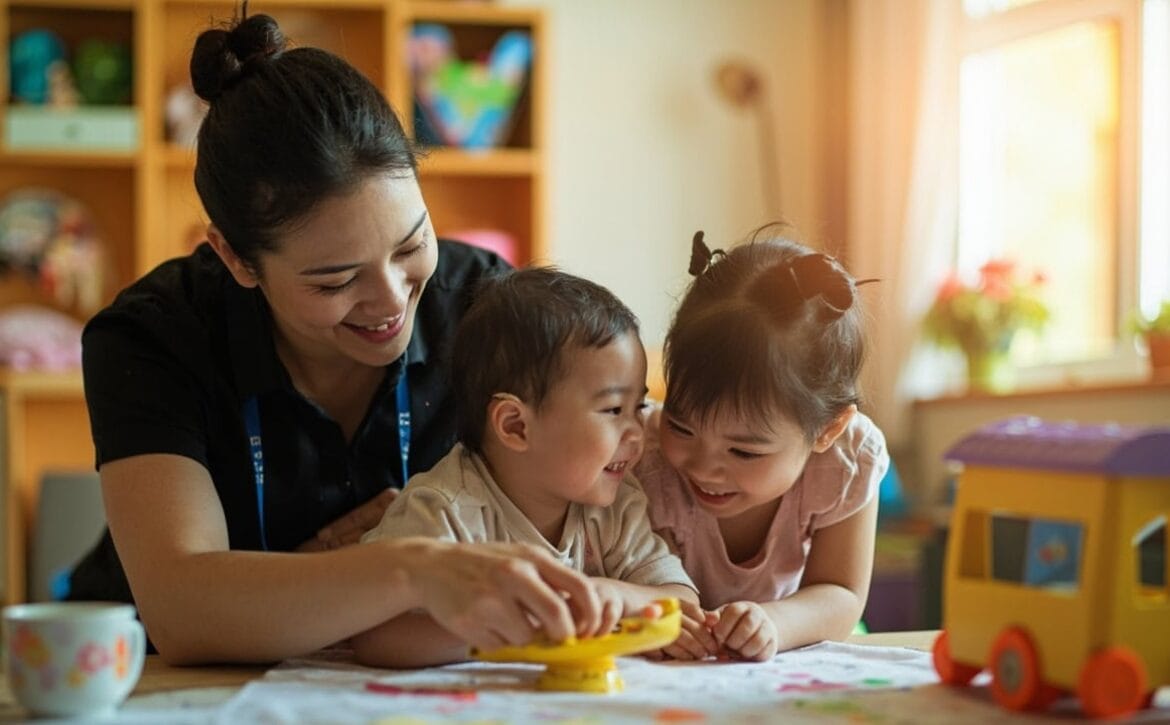
In quality care, you will see genuine back-and-forth interaction—not just a caregiver directing a child, but the caregiver responding to what the child is doing, mirroring, narrating, building on the child’s focus and interest.

A child points at a bird outside the window; the caregiver follows that gaze, names the bird, asks what the child thinks about it. A baby makes a sound; the caregiver responds with a corresponding sound, then waits. This waiting matters. The pause, the turn-taking, the attunement—this is the micro-interaction pattern that is building your child’s neural pathways for communication and connection.

Observe Emotional Climate

Notice how the space feels. Is there tension? Rushed interactions? A sense that children are being managed rather than supported? Or do caregivers seem genuinely present, warm, engaged with genuine pleasure in their work?

This emotional climate is not a soft, optional quality. It is the environment in which your child’s stress regulation systems are being either strengthened or compromised.

Notice How Distress Is Handled

When a child becomes upset—and they will—how do caregivers respond? Do they redirect quickly and move on? Or do they slow down, acknowledge the distress, help the child name and move through the feeling?

This second approach takes more skill, more patience, more training. It is also the approach that builds emotional regulation rather than suppressing it.

Look for Individualized Attention

In infant care especially, the ratio of caregivers to children matters enormously. When an infant’s caregiver can be attentive to their specific rhythms, their particular cues, their emerging needs, that infant receives the kind of focused attunement that developmental science tells us is essential.

Up to one-to-three ratios in infant care are not a luxury. They are the practical requirement for this kind of individualized interaction to be possible.

Consider Language Richness

Listen to the language in the room. Not just instructions or corrections, but genuine conversation—commentary on what children are doing, narration of the environment, questions that invite thought. Language exposure in the early years is directly tied to the development of the neural circuits that will support reading, reasoning, and communication throughout life.

Signs of Developmentally Supportive Care

  • Genuine back-and-forth interaction between caregivers and children
  • Caregivers who follow the child’s lead and build on their interests
  • A warm, unhurried emotional atmosphere
  • Distress met with attunement rather than redirection
  • Caregiver-to-infant ratios that allow for individual attention
  • Rich, conversational language throughout the environment
  • Caregivers who appear engaged, not just present
  • Visible evidence of purposeful activity and learning

The Accumulation That Shapes Development

Singapore parents understand accumulation. You understand that compound interest works, that small daily habits produce large outcomes over time, that what you do consistently matters more than what you do occasionally.

The same principle applies to early childhood. A child in full-time quality care from infancy through age five experiences thousands upon thousands of developmental interactions. The language they hear, the social problem-solving they observe and practice, the emotional regulation they learn through attuned caregiving, the cognitive challenges they navigate with knowledgeable support—these experiences are cumulative. They build on each other. They create depth and complexity in the neural architecture that is forming.

This is not an argument against part-time care, or for children never being at home. It is simply a recognition that the hours matter, and that choosing an environment where those hours are developmentally productive is one of the most consequential decisions a family can make.

The Paradox of Engaged Parenting

There is something almost paradoxical here. Parents who agonize over childcare choices, who research developmental science, who visit multiple centres and ask careful questions—they are doing exactly what good parents should do.

That care, that attention, that commitment to getting it right? That is also part of what your child needs. Children are not only shaped by the care they receive in childcare. They are shaped by observing their parents, by experiencing the emotional atmosphere of a home, by witnessing the values that their family embodies.

A parent who is confident, informed, and at peace with their choices—who trusts that they have made a thoughtful decision based on real understanding—is providing something of profound developmental value. Children are exquisitely sensitive to parental stress and uncertainty. When you can make childcare decisions from a place of clarity rather than anxiety, that clarity itself becomes a gift to your child.


EduNanny: Where Science Meets Care

Understanding the principles of early childhood development is one thing. Finding an environment that actually embodies them is another. This is where EduNanny by BUTLER offers something worth understanding.

Structured, Supported Childcare

EduNanny operates as part of the ECDA Childminding Pilot, integrated into Singapore’s broader effort to support families through quality, accessible childcare options. This is not an informal arrangement or a casual service. It is a structured, supported pathway for families who need reliable, professional childminding.

Depending on what works best for your family, options include home-based childminding—where trained caregivers bring their expertise into your familiar environment—and community or centre-based arrangements that offer flexibility during different stages of your child’s development.

The Ratio That Makes Quality Possible

One of the most significant features of infant care through EduNanny is the ratio. With up to one caregiver for every three infants, the kind of individualized attunement that developmental science identifies as essential becomes genuinely possible.

In environments where caregivers are responsible for six, eight, or ten infants at once, the quality of individual interaction necessarily suffers. A caregiver managing multiple children cannot provide the focused, responsive attention that builds emotional regulation and language development. EduNanny’s structure makes responsive care a practical reality, not just an aspiration.

Affordability and Accessibility

The pilot fee structures are designed to be accessible, recognizing that quality childcare should not be limited to families with significant financial resources. Additionally, EduNanny’s fees can be paid using the Child Development Account and Baby Bonus funds—meaning families can access the subsidies and support that Singapore’s government has thoughtfully provided.

Transparency as Partnership

Communication and transparency are integral to how EduNanny operates. Parents receive regular updates about their child’s day, development, and experiences. In settings where visibility measures are in place, families have ongoing insight into the daily environment.

This is not surveillance—it is partnership. When parents can see what is happening, trust is built. When caregivers and families communicate regularly, the child’s experience becomes coherent across home and care settings.

Professional Caregivers, Professional Care

The caregivers themselves are trained, supported, and treated as the professionals they are. Childminding is not easy work. It requires patience, knowledge, skill, and genuine love for children. EduNanny recognizes this, and the caregivers who work within this framework are not just babysitters—they are developmental partners in your child’s early years.

Monday to Friday care blocks provide the consistency that developing brains need. Irregular, unpredictable care schedules create stress for young children and interfere with the routine-based learning that supports development. EduNanny’s structure supports regularity, which supports development.

Support for the Whole Family

EduNanny’s recognition that parenting does not end when you drop your child at childcare extends into practical support. The Thomas AI Chatbot is a resource designed to help parents navigate the questions, concerns, and decisions that arise in raising young children.

Whether you are wondering about developmental milestones, looking for guidance on a specific challenge, or simply want to understand more about what your child is experiencing at each stage, Thomas offers thoughtful, accessible support. This is technology in service of connection—extending the expertise and support that EduNanny provides into your daily life as a parent.


Evaluating Childcare: Your Practical Framework

Armed with an understanding of what quality looks like, here is a framework for making your assessment concrete:

Before the Visit

  • Know your non-negotiables based on what you now understand about development
  • Prepare questions about ratios, caregiver training, daily routines
  • Research ECDA licensing and what it signifies

During the Visit

  • Arrive unannounced if possible, or ask to see a typical day
  • Observe interactions before any tour begins
  • Watch how caregivers speak to children—not just what they say, but how
  • Notice whether children seem settled, curious, engaged
  • Ask caregivers what they would do if a child were upset
  • Pay attention to whether your questions are welcomed or deflected

After the Visit

  • Trust your gut feeling about the emotional climate
  • Consider whether you would feel comfortable communicating with these caregivers daily
  • Ask yourself: would I want my child’s stress response system developing in this environment?
  • Remember: you are evaluating whether this is a developmental environment, not just a safe one

Common Questions Parents Ask

“Am I letting someone else raise my child?” No. You are choosing a partner in your child’s development. Quality childcare does not replace parental influence. Children are shaped by their entire ecosystem—their home, their childcare environment, their community. When that ecosystem is coherent and quality-focused, your child benefits from multiple sources of developmental support, not less.

“What if the caregiver doesn’t love my child the way I do?” Attachment research tells us that children can form multiple secure attachments. What matters is the quality of responsiveness, not the identity of the caregiver. A trained, supported caregiver who provides consistent, attuned care is building the same neural architecture that you would be building if you were present. The love looks different, but the developmental impact is real.

“Is it too late to make a different choice?” The brain remains plastic throughout life. But the early years are a singular window of extraordinary plasticity. If your current arrangement is not serving your child’s developmental needs, making a change now—in infancy or toddlerhood—can still make a profound difference. The architecture being built now is foundational, but it is not irreversible. Better late than never, and never too late to start.


The Permission You Already Have

Let me close with something I want you to take away from this.

Choosing childcare is not a failure of parenthood. Choosing quality developmental care is not a luxury. It is not guilt-driven overcompensation. It is not a substitute for something you should be doing yourself.

It is a mature, thoughtful, science-informed decision about how to meet your child’s developmental needs in a context where you are not the only capable, loving adult in their life.

The neuroscience tells us that children develop best when they receive responsive, attuned, developmentally supportive care. When that care comes from a trained, supported, genuinely loving caregiver who creates the conditions for language growth, emotional regulation, secure attachment, and cognitive exploration—that care is building your child’s brain. It is not babysitting. It is not supervision. It is the work of early development, and it is happening whether we recognize it or not.

Your job, as a parent, is not to do this work alone. It is to find the environment where it can happen well, to trust that environment, and to trust yourself for having found it.

The quiet question you carry—”am I making the right choice?”—deserves an answer that is more than reassurance. It deserves understanding. Now you have it.

You know what your child’s brain needs in these years. You know what quality looks like when you see it. You know that choosing an environment where trained caregivers provide attentive, developmentally-informed care is not a compromise but a decision that aligns with how children are biologically wired to grow.

That is not a small thing. That is a foundation. Everything else—the language that will emerge, the emotional regulation that will develop, the curiosity that will unfold, the relationships that will form—all of it is being built right now, in the daily architecture of these early years.

EduNanny is part of that architecture. And so are you.

Trust what you know. Trust what you have chosen. Trust that the work you are doing as a parent—working, researching, visiting, asking questions, loving your child enough to worry about whether you are getting it right—this is exactly what good parenting looks like.

The biology of early childhood is not a burden. It is an invitation. And you are answering it.


If you are ready to explore what neurobiologically-informed childcare looks like in practice, EduNanny by BUTLER invites you to learn more about their ECDA-supported childminding options, infant care ratios, and how they translate developmental science into daily caregiving practice.

You are not alone in this. And you do not have to choose between science and love—they are the same thing, working together in the early years that matter most.



About EduNanny · Get in Touch

April 28, 2026

Questions Smart Singapore Parents Ask About Childcare

Why Singapore’s Childcare Landscape Feels So Overwhelming

I want to start by naming what is real: this is hard. Not because you are doing it badly, but because it is genuinely hard. Singapore parents navigate a childcare landscape more layered than almost anywhere else — filled with acronyms, subsidy structures, centre types, programme philosophies, and well-meaning advice that contradicts itself.

You are not overwhelmed because you lack judgment. You are overwhelmed because the system is overwhelming. And that is a very different thing.

Within weeks of starting your search, you are likely encountering three or four different pathways. Centre-based programmes, both full-day and half-day. Home-based arrangements, including pilot schemes that bring childcare into more intimate settings. Infant care programmes attached to larger centres. More informal arrangements that still require careful navigation.

Alongside this, you are calculating subsidies you are not sure you qualify for, understanding how CDA accounts work, figuring out whether Baby Bonus can stretch further in one direction or another, and trying to translate what Monday to Friday care blocks actually mean for your work schedule.

And underneath all of this administrative complexity is a deeper question — not just which option is affordable or convenient, but which one will actually care for your child in the way your child needs.


Beyond Gut Instinct: What You Are Actually Evaluating

What most content tells you is: trust yourself, follow your gut, you know your child best. Those things are not wrong. But they are incomplete.

Gut instinct is valuable — but it is not a framework. It is not a set of questions you can ask when every centre looks clean, every teacher smiles, and every brochure uses the word holistic. Gut instinct helps when the signal is clear. But in the research phase, when everything is polished and full of potential, and you are comparing options that all seem fine, instinct alone can leave you spinning.

What you actually need is a clearer way of thinking. Not a checklist that promises certainty — because no such thing exists — but a structure for evaluating what you are seeing, asking what truly matters, and making a choice you can stand behind. Not because it eliminates all risk, but because it is the right fit for your specific child and your specific family.

What the Tour Tells You (and What It Does Not)

The tour is designed to show you the best version of the space. The toys are arranged. The children are engaged, or at least settled. The teachers are warm. The director is articulate and confident. Everything is clean, organized, and probably smells faintly of hand sanitizer and something pleasant.

Here is the truth nobody tells you plainly: the tour is not where you learn the most important things. It is where you confirm baseline conditions and eliminate obvious mismatches. The real evaluation happens in the questions you ask, the answers that are given or not given, and the specifics you notice when the performance relaxes.

When a centre tells you they follow an enquiry-based learning approach, ask what that looks like on a Tuesday morning when half the children are tired and the other half are running in circles. When a centre tells you they prioritise holistic development, ask how they track and communicate your child’s progress, in what format, and how often. When a centre tells you their teachers are experienced and trained, ask what ongoing development looks like, how they handle it when a teacher is struggling, and whether you can speak directly with the caregiver who would be working with your infant.

These are not aggressive questions. They are honest ones. And the answers you receive — not just the words, but the ease or hesitation behind them — tell you something real.

The Questions That Reveal Depth

What you are actually assessing is not the brochure. You are assessing depth. You are asking: does this centre know what it believes, and can it articulate that belief in specific, practical terms? Or is it performing a philosophy it has borrowed from a curriculum document?

There is a meaningful difference between a centre that says it values attachment and one that can describe exactly how its daily rhythm is built around predictable transitions, how teachers are encouraged to form consistent one-to-one bonds with infants, and how they handle the weeks when a child is separating. The first is a value statement. The second is a programme. You want to understand both, but you especially want to understand the second.

  • How does a typical Tuesday morning unfold when things are not going smoothly?
  • How do you track and communicate my child’s development, and how often?
  • What does ongoing teacher training look like, and how do you support teachers who are struggling?
  • Can I speak directly with the caregiver who would be working with my infant?
  • What does your settling protocol look like, and how long should I expect it to take?
  • How do you handle a child who is advanced in some areas and slower in others?
  • What does a typical day look like from my child’s perspective?

The answers are where you find the difference between a centre that is genuinely excellent and one that is simply excellent at showing itself.


Cosmetic Signals Versus Substantive Signals

One of the most practical things you can do is separate cosmetic signals from substantive signals. Cosmetic signals are the things that look good, feel good in the moment, and do not actually predict much about quality. Substantive signals are the things that reflect real practice, real training, and real attention to how young children develop and what they need.

Cosmetic Signals to Look Past

  • A brand new, beautifully designed space with natural wood and soft lighting — it tells you the centre invested in aesthetics, which is fine, but it does not tell you whether the teachers know how to read a fussy infant
  • A warm, articulate director who makes you feel immediately comfortable — it tells you the centre invested in communication and first impressions, which matters, but it does not tell you whether the same warmth extends to the classroom on a difficult Tuesday afternoon
  • Polished brochures with sophisticated educational terminology
  • Recent awards, certifications displayed prominently, or social media presence

Substantive Signals Worth Your Attention

Staff-to-Child Ratios. This matters especially in infant care. When a centre can genuinely offer ratios of up to one caregiver to three infants, that is not a marketing line. It is a structural condition that enables real responsiveness. You cannot nurture an infant through a difficult separation if you are simultaneously managing four others who also need attention. Ratio is a prerequisite for quality, not a guarantee of it, but it is a prerequisite worth noting.

Communication Culture. How does the centre keep parents informed? Is there a daily update, or a weekly summary? Are there digital channels for quick check-ins? Are there transparency measures that you can reference if needed — not as surveillance, but as visibility? These are practical questions with practical answers, and the way a centre answers them tells you how comfortable they are with openness.

The Settling Period. This is where many parents experience the sharpest anxiety, and where the difference between a centre that understands attachment and one that just manages logistics becomes visible. A thoughtful centre will not rush separation. It will have a clear, flexible settling protocol, a named primary caregiver who forms the first relationship, and realistic expectations about the weeks it may take for an infant to truly settle.

Developmental Milestone Approach. Not in theory, but in practice. How do they observe and track development? How do they share what they observe with you? What happens if your child is ahead in some areas and behind in others — how do they communicate that, and how do they adapt?


No Centre Is Perfect: Accepting Trade-offs and Finding Alignment

Now let me be honest about something that is rarely said plainly: no centre is perfect. This is not pessimism. It is realism, and it is liberating once you accept it.

Every centre has trade-offs. One may have an extraordinary programme but a waiting list that means you cannot get in for six months. Another may have the most responsive caregivers but a less structured curriculum. A third may be ideal for your first child but not well-suited for your second, whose temperament is entirely different.

The question is not: is this centre flawless? The question is: does this centre align with what matters most for my child at this stage, and for my family in this season?

That reframing changes everything. It means you are not searching for perfection — you are searching for fit. And fit is something you can evaluate. It means you can make a confident decision even when uncertainty remains, because confidence is not the absence of doubt. It is the presence of a thoughtful process.

There are families for whom infant care means a warm, home-based setting with small ratios and an intimate community feel. There are families for whom centre-based infant care with a structured developmental programme is exactly the right environment. There are families for whom the priority is language exposure, outdoor time, or cultural alignment. None of these choices are wrong. They are different, because families are different.

The deeper question — which one will actually care for my child in the way my child needs — that is the question worth sitting with. And the answer is not the same for every family. It never has been. That means you are not searching for the objectively perfect centre — that does not exist. You are searching for alignment. And alignment is something you can evaluate, ask about, observe, and test. That is far more actionable than chasing an abstract ideal.


How EduNanny Approaches This Differently

EduNanny by BUTLER operates within Singapore’s ECDA Childminding Pilot, and we designed it with a specific conviction: that the decision-making process parents go through should not feel like a leap into the unknown. It should feel like a supported, guided process that respects your intelligence and holds space for your real concerns.

Pathways That Fit Your Family

EduNanny offers home-based and community-based pathways, because infant care is not one-size-fits-all. Some children thrive in the intimate, home-like setting of a small group. Some families need the flexibility that comes with a different structure. The right setting is the one that fits your child and your circumstances, and we have designed our programme to offer real choices rather than presenting one option as the default.

Ratios That Enable Responsiveness

Our caregiver-to-infant ratios in the pilot are structured to allow genuine responsiveness. Up to one to three infants means that when your child is tired, or fussy, or having a hard day, the caregiver is actually available to meet that need. It is not a selling point. It is a structural commitment that shapes everything else.

Affordability Without Hidden Stress

We designed our pilot fee structures with the real cost pressures Singapore families face in mind. CDA and Baby Bonus can be used where applicable, and we will help you understand how the financial pieces fit together without making you navigate it alone. This should not be a source of hidden stress. It should be clear, upfront, and manageable.

Communication That Gives You Real Information

We built this programme with the understanding that parents need to know what is happening with their child — not in vague generalities but in specifics you can hold onto. How was the nap? Did they eat? What did they seem interested in today? These are not small things. They are the texture of your child’s day, and you deserve to know it.

Where deployed, transparency measures are part of our commitment — not to imply anything is wrong, but because we believe parents should have access to the same visibility they would have if they were in the room themselves. That is the level of trust we operate from.

A Thinking Partner for Everyday Questions

Parenting and childminding in Singapore comes with a constant low-grade pressure of questions — Is this normal? What should I expect? How do I handle this? The Thomas AI Chatbot is an always-available thinking partner for the small, everyday uncertainties that come up between formal conversations with your caregiver or programme coordinator. It is there when you need it, grounded in the same philosophy that shapes everything else we do.


Addressing What You Are Really Worried About

What if I get this wrong?

The first thousand days of a child’s life are not a cliché. They are a developmental window that does not repeat. But here is what we have seen after working with many families: the parents who agonise over this decision, who ask the hard questions, who refuse to settle for surface-level answers — those parents tend to make good choices. Not because they are perfect, but because they are paying attention. That is what your child needs to see: a parent who shows up, who pays attention, who chooses thoughtfully, and who keeps learning.

What about family opinions and conflicting advice?

Your mother has opinions. Your partner has different instincts. Well-meaning parents who went through this five or ten years ago have advice that is occasionally outdated. This is normal. The framework we have described — asking substantive questions, looking for depth, accepting trade-offs, searching for alignment rather than perfection — this applies to evaluating advice too. Not all guidance is relevant to your situation. The goal is not to satisfy everyone. The goal is to make a choice you can stand behind with confidence.

What if I still feel uncertain after all this?

Uncertainty is not failure. It is the appropriate response to a decision with real stakes and incomplete information. What changes everything is having a clear way of thinking, a set of questions that matter, and the trust that comes from having done the work honestly. That is a different kind of confidence. It is grounded in process rather than in promises. And it is the kind of confidence that lasts.


Ready to Explore Your Options?

If you are in the middle of this decision right now, feeling the weight of it, uncertain where to start, overwhelmed by the options and the opinions and the well-meaning advice — you are exactly where you should be. This is hard. You are not failing at it. You are doing the hard, important work of being a thoughtful parent.

EduNanny is here to ask the questions with you, help you see clearly, and be the partner who walks this road beside you — not with promises of perfection, but with honesty about what we offer and genuine commitment to doing it well. We would be honoured to walk it with you.

If you would like to learn more about how EduNanny approaches infant care through the ECDA Childminding Pilot, or if you have questions about whether our programme might be the right fit for your family, we invite you to reach out to us directly. You can also read more about our approach and our team whenever you are ready.

edunanny-063f65077add38d0f39bdf02334540e8
April 28, 2026

How to Know If Your Child Is Growing in Singapore Childcare

The Neuroscience Is Clear: Environment Shapes Everything

Let us begin with what we know to be true about the first years of life.

The brain does not develop at a steady, measured pace. It builds itself in waves—and the most significant waves occur before a child turns three. Neural connections form at a speed that will never be matched again. Language acquisition happens almost as if by spontaneous generation: one day a child has no words, and then suddenly they have dozens, and then sentences, and then questions that stop you in your tracks.

Motor skills, social awareness, emotional regulation, the capacity for sustained attention, the ability to play imaginatively—these emerge not in isolation but in relationship, in response to the environment, in direct proportion to the quality of stimulation and care a child receives.

This is why the question of whether your child is growing matters so deeply. It is not an abstract concern. It is a neurological and developmental reality. The environments, the relationships, and the interactions your child experiences in these years are not incidental to their development. They are, in a very real sense, building it.


The Gap Between Reassurance and Evidence

And yet, most parents are given no framework for understanding what this looks like in practice. Updates say had a good day and played well and ate all his lunch. These messages are reassuring. But they do not answer the question that lingers in that car silence. They do not tell you whether your child is learning to communicate, to collaborate, to solve problems, to regulate their emotions, to persist at something difficult, to create something new.

The question of quality in childcare is often framed as a binary: either the care is good, or it is not. Either you trust it, or you do not. But this framing obscures a more useful and more honest question:

How do I know whether my child is developing here, and what should I look for to find out?

We live in a culture that tells new parents to trust their instincts—and while this advice is well-intentioned, it is incomplete. Instinct tells you when something feels wrong. It does not tell you what right looks like when everything feels fine but you cannot quite see the growth. Instinct tells you to protect. It does not always tell you what to look for when you are trying to evaluate whether protection has been accompanied by genuine investment in your child’s development.

What parents need—and what quality childcare should provide—is not permission to feel, but a language for seeing. This is the gap that EduNanny Singapore was designed to bridge.


Six Areas Where Growth Becomes Visible

The following six domains represent the key areas where genuine development becomes visible in quality childcare. You do not need to become a developmental specialist. But learning to observe with intention will change the way you read those daily updates, those app photos, and those pickup moments.

1. Language and Communication: Beyond Vocabulary

In a quality childcare setting, you will begin to notice changes that extend beyond the acquisition of new words.

A child who has been enrolled for a few weeks begins to use language differently. They do not simply label objects—they begin to narrate. They say I want and help me and look what I did. They understand that language is a tool for negotiation, for connection, for making their needs known and their ideas understood.

You may notice this in small moments. Your child comes home and points to a picture of a dog and says dog—but they also point to a picture of a horse and say no, horse, as if they are already beginning to sort the world into categories. They hear a new sound during circle time and come home attempting to replicate it.

What to look for: Not a child who is reciting vocabulary, but a child who is communicating—who is using the language they have to do something in the world.

2. Social-Emotional Development: The Least Visible, Most Important Domain

In quality childcare, children are learning to be in relationship with others who are not their parents. This is not a simple thing. It requires learning to share space, to wait, to tolerate frustration, to read the faces and bodies of other children who do not yet have words for what they feel.

What this looks like in practice:

  • Your child begins to show awareness of other children. They look at another child who is crying and pause, as if processing.
  • They may offer something—a toy, a touch, a word.
  • They begin to understand the concept of mine and yours and the negotiations that follow.
  • They seek out certain children, and resist others.
  • They begin to express opinions, to test boundaries not out of defiance but out of a dawning understanding that they are a person with agency in a world full of other people with agency.

A quality caregiver does not just manage these moments. They coach them. They help children name what they feel. They model how to ask for something you want, how to wait when waiting is hard, how to say I don’t like that without hitting. They create an environment where big emotions are not suppressed but guided.

3. Motor Skill Progression: Body as Problem-Solver

This domain is perhaps the most immediately visible to parents, because motor skills often translate into achievements that parents love to celebrate—the first time a baby sits up without support, the first steps, the first time a toddler climbs something new or uses a spoon with increasing coordination.

In a quality childcare environment, motor development is supported not through contrived exercises but through an environment that invites movement:

  • Open spaces for crawling and walking
  • Materials that invite grasping, stacking, pulling, pushing
  • Outdoor time where children can run, climb, and explore different surfaces
  • Art activities that involve tearing, squeezing, spreading
  • Music and movement sessions that develop body awareness and coordination

What to observe over time: A child whose body is becoming more capable, more intentional, more expressive. They are not just moving randomly—they are solving problems with their bodies. How do I get to the top of this? How do I open this? How do I make this mark on paper?

If you are picking up your child after months of care and they seem physically the same—same posture, same range of motion, same hesitation—this is worth noting. Children this age grow and develop at remarkable speed. The absence of observable change in physical confidence is itself a signal worth exploring.

4. Play Complexity: Where the Mind Reveals Itself

This is where you will see your child’s mind at work.

Early play begins with objects—a baby shakes a rattle, drops it, watches it fall, picks it up again. This is not random behavior. This is the scientific method in miniature. The baby is forming hypotheses and testing them.

As children develop, their play becomes more complex:

  • They begin to use objects symbolically—a block becomes a car, a banana becomes a telephone
  • They begin to engage in parallel play, then cooperative play
  • They begin to create scenarios, to assign roles, to follow rules they have invented or agreed upon
  • They begin to return to play again and again, extending and elaborating each time

In a quality childcare setting, caregivers do not just watch play. They document it. They notice which children gravitate toward which materials, which kinds of play emerge spontaneously, which children are beginning to move from parallel play to true collaboration. They take notes, they share observations, they track the progression.

This documentation is not bureaucratic. It is one of the most important tools a parent can have. When a caregiver tells you, I noticed your child has started initiating pretend play—this is a new development we have been observing, that is not small talk. That is your child’s mind revealing itself.

5. Caregiver Responsiveness: The Foundation of Everything

This may be the most important indicator of all, because it undergirds every other domain of development.

When you observe your child’s caregiver, notice how they respond to your child’s cues:

  • Do they notice when a child is frustrated and intervene before the frustration escalates?
  • Do they get down to the child’s level, making eye contact, matching their tone?
  • When a child points at something, does the caregiver follow the child’s lead, naming and engaging with what the child is attending to?

Responsive caregiving is the foundation upon which all development is built. A child who is responded to promptly and appropriately learns that they matter, that their communications have power, that the world is a place where their needs will be met and their interests will be honored. This is not softness. This is the most sophisticated form of education there is.

What to look for: A caregiver who gets down on the floor and meets your child where they are—not just watching, but engaging. Not just supervising, but nurturing.

6. What Your Child Brings Home

This is where the framework comes full circle. A child who is genuinely developing in a quality childcare environment will show it—not only in what happens at the centre, but in what happens when they are with you.

  • They may come home and attempt to recreate something they did during the day—a song, a game, a routine
  • They may use words or phrases they have picked up and apply them in new contexts
  • They may show increased confidence in their physical abilities, their social interactions, their willingness to try new things
  • They may reference the caregiver by name, and describe something that happened with a specificity that tells you they were paying attention—that the time was meaningful to them

This is the evidence you are looking for. Not just that your child was safe, or happy, or busy. But that something happened during those hours that is now part of who they are becoming.


What Quality Childminding Actually Looks Like

In an infant care setting with a low caregiver-to-child ratio, this kind of development is not left to chance. Caregivers narrate actions throughout the day. They name emotions before children can name them themselves. They repeat back approximations of words with delight, modeling the back-and-forth rhythm of true conversation. They read books not as a ritual to check off, but as an invitation into a world of language.

At EduNanny Singapore, caregiver responsiveness is not assumed. It is trained, observed, and continuously refined. In the ECDA Childminding Pilot framework that EduNanny participates in, caregivers are supported with structured guidance, regular reflection, and peer observation. The result is a consistency of care that allows children to form the secure attachments that research consistently shows are essential for healthy development.

EduNanny Singapore was built on the understanding that Singapore parents deserve more than a place that keeps their children safe. They deserve a place that invests in their children’s development—and that gives them the tools and transparency to see that investment for themselves.

This is why EduNanny maintains low caregiver-to-infant ratios, supports its caregivers through the ECDA Childminding Pilot framework, and creates multiple pathways for care—whether in a home-based setting, a community environment, or a dedicated centre. Communication is built into the model: regular updates, structured observations, and where deployed, transparent measures that allow parents to feel connected to what their child is experiencing throughout the day.


Evaluating Quality Beyond the First Visit

Many parents make their childcare decision based on the visit day—a clean facility, a friendly staff member, a warm greeting. These things matter. But they are not enough to answer the question you are really asking.

Quality reveals itself over time. Here is what to look for beyond the initial impression:

  • Consistency of caregiver relationship: Does the same person care for your child most days, or does turnover feel high?
  • Communication that goes beyond logistics: Do updates tell you something about your child’s day that you could not have guessed? Do they reference specific moments, preferences, discoveries?
  • Responsiveness to your questions: When you ask about your child’s development, do you get more than a general answer? Can the caregiver tell you something specific?
  • Documentation: Are observations being recorded and shared? Is there a system for tracking milestones?
  • Your child’s reaction over time: Is your child forming an attachment to the caregiver? Do they seem comfortable, or does each drop-off feel traumatic weeks later?

The best childcare does not resist parental scrutiny. It welcomes it—because the work being done is real, and it can withstand examination.


Partnership, Not Surveillance

When a parent asks, How do I know my child is growing here? the answer is not a vague reassurance. The answer is:

Let me show you.

Let me show you the observations we have documented. Let me show you the milestones we have tracked. Let me show you the difference between what your child could do three months ago and what they can do now.

You are asking the right questions. The fact that you have read this far suggests you are not looking for permission to stop wondering. You are looking for a way to know.

So ask the question. Learn to see. Look for language that is being used, not just heard. Look for social awareness that is emerging. Look for motor confidence that is growing. Look for play that is deepening. Look for a caregiver who gets down on the floor and meets your child where they are. Look for your child to come home carrying something new—not just in their backpack, but in themselves.

And when you find a place where all of this is happening—where the caregivers are not just watching but nurturing, not just feeding but documenting, not just supervising but genuinely investing in your child’s development—hold onto it.

The first thousand days of your child’s life are happening now. They are not practice. They are not a rehearsal. They are the foundation upon which everything else will be built.

You deserve the right answers. And there are places, like EduNanny Singapore, where those answers are ready to be given—not because they have to be, but because the work has already been done.

Your child is growing. And now, you can see it.


Ready to explore what quality developmental care looks like? Speak with EduNanny Singapore to learn how our caregivers are trained to observe, document, and share your child’s growth every step of the way.

At EduNanny, we believe that every parent deserves to see their child’s development unfold with clarity and confidence. Learn more about our approach to developmental childcare or get to know our team.

edunanny-063f61b0e752c9ddbd58b569f7431971
April 28, 2026

What Your Child Really Does at Singapore Childcare

The Question Every Singapore Parent Carries After Drop-Off

There is a moment every parent in Singapore knows. It happens after the enrolment forms are signed, after the centre tour on a quiet Tuesday afternoon when everything looked clean and bright, after you asked your questions and received your answers. It happens on the first Monday morning when you hand your child to someone new and walk away.

You wonder what happens next.

Not in an abstract, philosophical way. Not in the way you wonder about distant things. You wonder with a specific, persistent urgency. You wonder what your child’s face looks like in the minutes after you leave. Whether the smile she gave the teacher was real or performed. What she is doing right now, this very moment, while you are sitting in your office or standing on the MRT or trying to focus through a meeting.

You wonder if she is happy. If she is safe. If she is being seen for who she is and not just managed as a small person in a room full of small people.

This is not doubt. This is not distrust in your choice. This is something more honest than that. This is the gap that exists between signing a form and truly knowing. Between trusting what you were shown and understanding what actually happens. Between believing your child is in good hands and actually witnessing those hands at work.

EduNanny Singapore was built with full awareness of this gap. Not to dismiss it, but to answer it. Because we believe that a childcare choice should not require faith alone. A childcare choice should come with clarity, with access, with the kind of transparency that lets you picture your child’s day as vividly as you picture your own.

So let us tell you what that day actually looks like.

Quick Summary: What Matters Most in a Quality Childcare Day

  • Quality childcare is structured, not scheduled. It moves with intentional rhythm—active exploration and guided activities balanced with quiet moments for processing.
  • Skilled caregivers read children in real time. They decide in seconds whether to intervene or observe, support or step back.
  • Activities designed for development differ from activities designed for engagement. Real learning asks something of your child—not just occupies her.
  • Sensory environments are foundational. Infants learn through their bodies before language. A quality room offers textured materials, natural light, varied sounds, and purposeful spaces.
  • Asking what your child does all day is not a sign of doubt. It is a sign of love. Any childcare provider worth your trust should be ready to answer that question in full.

Inside a Quality Childcare Day: The Architecture of Intention

When you walk into a well-designed infant room in Singapore, the first thing you notice is not the toys or the colourful walls or the child-sized furniture. The first thing you notice is the rhythm. There is a pulse to the room, a structure that moves like breath.

A quality childcare day is not a series of disconnected activities strung together to fill hours. It is an architecture of intention, every transition and quiet moment placed there with purpose.

The Prepared Environment

In the morning, before nine o’clock, your child enters an environment that has already been prepared. Not just cleaned and arranged, but thoughtfully calibrated. The lighting softened. The space between activities clear. A sensorial invitation already waiting: a tray of water and floating objects at the water table, or a basket of fabric scraps sorted by texture, or a small mirror angled toward where morning light will catch it and make the room feel larger, more interesting.

This preparation matters because infants read environments the way adults read rooms. They notice what is available. They are drawn to what is purposeful. A room that has been prepared shows a child that someone expected them. That their presence here is not an afterthought.

Balancing Freedom and Guidance

Your child moves through the morning in blocks that balance freedom and guidance.

There is open exploration time, when the room belongs to her and she chooses where to go, what to touch, how to move. This is not idleness. Research in early childhood development consistently shows that freely chosen exploration is where infants build the neural pathways for problem-solving, for creativity, for the ability to self-regulate. When a child chooses to pour water from one container to another twenty times in a row, she is not bored. She is learning. She is mastering. She is becoming.

And there is guided activity time, when the caregiver introduces something specific. A circle time with nursery rhymes and gentle movement. A sensory bin with safe materials to explore. A reading moment where your child sits close to a caregiver and hears language in its richest form—not as commands or corrections but as story, as rhythm, as the music of human connection.

What separates these two kinds of time is not accident. It is design. The best childcare days breathe between activity and stillness, between guidance and freedom, between social moments and solo discovery. A skilled caregiver does not fill every minute with stimulation. She understands that a child’s mind grows in the quiet spaces too, in the moments between when she is left to process what she has seen and felt and learned.


Intentional Caregiving: What It Looks Like in Real Time

A parent visiting a childcare centre might look for happy children, clean surfaces, a warm atmosphere. These things matter. But the deeper indicator of quality lies in what is harder to see: the micro-moments between caregiver and child, the constant low-level assessment happening in the background of a skilled teacher’s mind, the decisions made in seconds about whether to intervene or observe, to redirect or allow, to speak or stay silent.

Consider this scene: A child falls while learning to walk. A skilled caregiver is already moving, but not toward rescue. She moves to a position where she can spot the child, where her presence communicates safety, where she can read whether this is a tumble that builds confidence or a moment that needs gentle assistance.

She does not rush in because rushing in teaches a child that falling is failure. She waits with readiness. She trusts the child to try again. She celebrates the effort, not just the success.

This is what we mean when we talk about intentional caregiving. It is not a curriculum on a wall or a schedule posted by the door, though those things have their place. Intentional caregiving is a mode of attention. It is the trained ability to read a child’s cues in real time, to respond to distress without creating dependence, to support development without taking over, to see every routine moment as an opportunity for growth.

Routines as Curriculum

In infant care, intentional caregiving looks like routines that become learning moments:

  • Nappy changes that become conversations about body parts and gentle touch and the dignity of being cared for
  • Mealtimes that model social eating, that introduce new textures with patience, that never rush a child’s own pace of learning to self-feed
  • Rest times that are not simply waiting for children to sleep but a carefully curated transition from active to quiet—with dimmed lights, soft music, and a caregiver’s voice reading a story from across the room

Every routine, in quality care, is a curriculum. Not a formal one. Not a worksheet or a test. But a sequence of experiences designed with developmental purpose, connecting your child’s sensory world to the larger world of meaning and relationship.


The Difference That Matters: Engagement vs Development

Here is something that distinguishes the thinking behind quality childcare: the difference between activities designed for engagement and activities designed for development.

These are not the same thing.

An activity designed for engagement keeps a child busy. Occupied. Entertained. A tablet with educational games. A screen playing nursery rhymes. A toy that lights up and makes sounds when pressed. These things hold attention. They can make a room seem quiet, manageable, under control.

An activity designed for development asks something of the child. It presents a challenge that is just beyond what the child can do alone, so that with a little support—with a guiding hand or a timely word—the child reaches further than she knew she could.

It might look simpler, quieter, less spectacular. A basket of wooden blocks and a child experimenting with balance. A piece of play dough and a child discovering that it changes shape under pressure. A sensory bin with rice and small containers and a child learning about quantity and transfer and cause and effect through her own hands.

The difference is not always visible to an untrained eye. That is why understanding this distinction matters. Because when you know the difference, everything changes. You stop evaluating childcare by how occupied your child seems and start evaluating it by how challenged she is.

Happiness is important. Growth is the point.


Sensory Environments: A Quality Signal You Can Observe

A child’s first years of life are fundamentally sensory. She learns through her body before she learns through language. She understands the world through what she feels, hears, sees, smells, and tastes. A quality infant environment takes this seriously. It offers rich sensory experience not as decoration but as pedagogy.

Walk into a well-designed infant room and notice what is available to the senses:

  • Natural light, where possible
  • Materials with varied textures, weights, and temperatures
  • Sounds that are purposeful, not just background noise
  • A mix of enclosed and open spaces that give a child choices about where to be and what to experience

This is not luxury. This is science, applied thoughtfully. When a baby crawls toward a textured mat, when a toddler runs her fingers along a rough surface, when a one-year-old shakes a maraca and listens to the sound it makes—she is building the neural foundations for later cognitive work. Her brain is encoding the physical properties of the world. Her sensory experiences are becoming the substrate for thought.

At EduNanny Singapore, sensory-rich environments are not an add-on. They are a foundation. We design our spaces to invite exploration through the senses, to give children meaningful material to work with, to surround them with an environment that says: the world is interesting, come and discover it.

We want you to see this. We want you to walk into our spaces and understand what you are looking at. Because parents who understand quality are parents who can advocate for it. Parents who know what to look for are parents who make better choices for their children. Transparency is not a marketing strategy for us. It is an ethic.


What You Can Actually Look For: A Parent’s Evaluation Guide

The market is crowded. Every centre will tell you they are quality. Every centre will show you their credentials, their ratios, their beautiful photographs. What most centres will not give you is the tools to verify quality on your own terms.

Observe, Don’t Just Tour

  • How do the children move through the space? Are they free to explore within safe boundaries, or are they confined to specific areas, managed into stillness?
  • How do caregivers speak to children? Is the language rich and varied, or is it mostly commands and corrections?
  • How do transitions happen? Are they abrupt and rushed, or are they narrated, explained, made sense of?
  • Are children engaged with materials or simply near them? There is a difference between a child holding a block and a child exploring what a block can do.

Ask the Right Questions

Ask to see a typical day. Not a special event day, not a tour day, but an ordinary day. Watch the rhythm. Notice if there is a balance of activity and rest, of guided experience and free play, of social time and solo time.

Ask about the ratio. This is non-negotiable. In infant care, the number of caregivers to children is not a technical detail. It is a quality determinant.

Care Setting What to Expect
Centre-based infant programme Up to 1:3 caregiver-to-infant ratio for quality care
Home-based childminding Even lower ratios, often 1:2 or 1:1, allowing for deeply individual attention

Ask about communication. How will you know what your child did today? Will you receive updates, photographs, observations? Will you be able to ask questions and receive thoughtful answers?

At EduNanny Singapore, transparency is built into our operations. We use communication tools that give you real insight into your child’s day, and where deployed, CCTV access so you can see for yourself. Not because we have anything to hide, but because we have everything to show.


Real Choices for Singapore Families

We want to be honest about something. Not every family in Singapore needs the same solution. Not every situation calls for the same approach. And we believe that good childcare means offering real choices.

Centre-Based Care

For some families, centre-based care is the right fit. A structured environment with dedicated spaces, peer interaction, and a programme designed for group learning. Centre-based care offers consistency of environment, built-in social opportunities, and a team approach to care.

Home-Based Childminding

For other families, home-based care offers something different: a smaller, more intimate setting, often in the caregiver’s home, with a ratio that allows for deeply individual attention and a family-like atmosphere. Home-based care can feel less institutional, more personal, and can ease transitions for children who find large groups overwhelming.

EduNanny Singapore: Both Pathways

EduNanny Singapore operates across both pathways. As part of the ECDA Childminding Pilot, we offer families access to quality childminding options that were previously harder to find in Singapore. Our home-based pathway connects families with trained, vetted caregivers who provide care in a domestic setting. Our centre-based and community pathways offer structured environments with the same developmental intentionality, the same attention to quality, the same commitment to transparency.

We are proud to be part of the ECDA Childminding Pilot because we believe in what it represents: the recognition that Singapore families deserve options. That quality childminding is not a compromise but a choice, and that choice should be supported, not stigmatised.

The pilot also makes quality more accessible. Within its fee structures, childcare becomes more affordable for more families. Where applicable, CDA and Baby Bonus funds can be used, reducing the financial weight that so many Singapore parents carry. Monday to Friday care blocks are available to match working life, because we know that the reality of employment in Singapore is not flexible, and childcare should not demand flexibility parents do not have.


The People Behind Your Child’s Day

The caregivers who work with young children are not interchangeable. They are not functions or roles or ratios on a page. They are people who have chosen to dedicate their professional lives to the care and development of other people’s children. This is not a small thing. It is an enormous thing.

At EduNanny Singapore, we take the selection and training of our caregivers seriously. We look not just for qualifications but for disposition. For patience. For the kind of attentiveness that cannot be taught, only nurtured. We invest in ongoing development because quality is not a destination but a practice, something that grows stronger with attention.

We believe that when caregivers are treated as professionals, respected for their expertise and supported in their growth, children benefit. This is not idealism. It is the logic of how care works.

  • A caregiver who feels valued brings warmth and presence to her work.
  • A caregiver who is continuously learning brings the latest understanding of child development to every interaction.
  • A caregiver who is supported by a strong organisation brings consistency and reliability to the families she serves.

The childminder in Singapore has not always been seen clearly. She has been seen as a support, a convenience, a gap-filler. We want to see her as what she is: a professional doing essential developmental work, standing alongside parents in the daily labour of raising young children.


You Deserve to Know

Let us come back to where we started.

You dropped your child at childcare this morning. You watched her walk through the door, or you watched her be carried in, or you watched her fall asleep in the carrier as you handed her to the caregiver. You walked away. You went to work. And in the hours between, you carried that small weight of not knowing—that persistent question: What is happening with my child right now?

We cannot eliminate that weight entirely. It comes with love. It comes with the territory of being a parent in a world that asks you to be in two places at once.

But we can answer that question. We can show you what is happening. We can give you the kind of access and insight that turns uncertainty into understanding, that turns trust into knowledge, that turns a childcare choice from a leap of faith into a confident decision backed by evidence.

That is what EduNanny Singapore offers. Not just a service. Not just a programme. An open door. A commitment to showing you, every day, that your child’s day is being spent well.

Here is what we have learned from working with families across Singapore: parents who know what quality looks like choose quality. Parents who can see inside the day feel confident in their choices. Parents who are given real information become partners in their children’s development rather than observers on the outside.

And that is what your child deserves. Parents who are present, even when they are not there. Parents who are informed, even when they are apart. Parents who have made a choice they can stand behind with their eyes open.

The question you are asking is not a sign of doubt. It is a sign of love. It is a sign that you are paying attention, that you care about the details, that you understand that the early years matter enormously and that the people who care for your child during those years are shaping more than you can see.

We welcome your questions. We welcome your scrutiny. We welcome the parent who walks in and asks to see a typical day, who notices the rhythm of the room, who watches how caregivers respond to children and takes notes. We believe that parents who ask these questions are the parents we want to serve.

EduNanny Singapore was built for families like yours. For parents who want answers, not just reassurances. For parents who want to see, not just trust. For parents who understand that the early years are not a waiting room but a classroom, and that every day your child spends in quality care is a day she is learning how to be in the world.

We are proud to walk this journey with you. We are proud to show you what we do. And we are proud to be part of the answer to the question you have been carrying since you signed that form and walked away on the first morning.

Because you deserve to know what your child does all day. And we are here to show you.


Ready to see what a quality childcare day actually looks like? Connect with EduNanny Singapore to schedule a visit or learn more about our programmes. Ask to see a typical day. Watch the rhythm. Notice the details. We will be proud to show you everything.

Learn more about EduNanny’s participation in the ECDA Childminding Pilot and explore home-based childminding options for your family.

edunanny-063f5e1fb3504cdf1217758d4a75ac34
April 28, 2026

Beyond the Guilt: How Singapore Parents Can Choose Childcare with Clarity

Understanding Your Guilt: What It Is and Where It Comes From

Here is what we have learned from listening to Singapore parents: guilt is not the problem. Guilt is a symptom of something much deeper — and until we separate the two, until we name what guilt actually is in this context, it will keep you in a loop of research, of second-guessing, of walking up to enrollment and then stepping back.

Not because you do not know what is right for your child. But because you have been made to feel that knowing is not enough.

Your conscience is the quiet voice that says, I want to do better. It is forward-facing. It is purposeful. It points toward your child and asks, What do they need, and how can I give it? Your conscience is a parent’s most reliable compass.

But guilt — the guilt that sits in your chest when you walk away at the childcare door — that is your inner critic borrowing your conscience’s voice. And here is the distinction that changes everything: guilt is not wiser than you. Guilt is not more loving than you. Guilt is simply louder — amplified by every message you have ever received about what a good parent should look like, what sacrifice means, what presence requires. Guilt has history behind it. It has generations of expectation stacked on top of it.

Your conscience knows your child. The guilt knows only a story.

Guilt is not your conscience. Choosing quality childcare is not an act of absence — it is an act of love that says, I know what you need beyond what I alone can give. And the guilt loop can close: not by choosing differently, but by choosing well — and by choosing a care setting you can stand behind with your whole chest.


The Singapore Reality: Why This Feels Harder Here

Singapore parents carry a particular weight. We are a culture that values family deeply, that celebrates the extended network of grandparents, uncles, and aunts who pour themselves into children. We are also a society where both parents increasingly work — not because they want to escape their children, but because the math of modern life requires it.

These two truths create a friction that is almost impossible to name without feeling like you are choosing one over the other.

You are not. But the feeling is real, and it deserves to be met honestly.

There is a myth that has quietly shaped how many Singapore parents experience this decision: a good parent is a present parent. The one who is there — in the mornings, in the afternoons, at every milestone, at every scraped knee. The good parent does not leave. The good parent stays.

This myth is old, and it is appealing, and it is incomplete.

Here is what it misses: children do not only receive love from continuous physical presence. They receive love from the quality of attention they receive when attention is given. They receive love from the security of knowing they are held — not just in arms, but in a web of care that includes their family and extends into the world. They receive love from a parent who is whole — who has work that fulfills them, who has rest that restores them, who has enough left in the tank at the end of the day to be fully present in the hours that matter most.


What Good Parenting Actually Requires

The parent who chooses quality childcare — not out of resignation, not out of neglect, but out of a clear-eyed assessment of what their child needs and what they themselves need to be the parent they want to be — that parent is not choosing presence over absence.

That parent is choosing a new kind of presence. One that is sustainable. One that is intentional. One that says, I know what I can give you myself, and I know what you deserve beyond what I can give, and I trust myself enough to make that choice.

That is not the voice of a parent who has given up. That is the voice of a parent who has understood what love actually requires.

Children receive this. They receive the message that their parent is trustworthy — not just in word but in action. They learn, in those first critical years, that their parent makes decisions based on what is best, not based on what feels easiest. They learn that love is not about clinging, but about giving someone the right environment to grow.

Children of parents who have made this choice with clarity tend to be more secure, not less. Because they sense that their parent is at peace. And children are extraordinary receivers — they feel what you feel before they understand what you feel.

If you walk away at the childcare door carrying the weight of a decision you have not yet made peace with, your child will feel that weight. But if you walk away — even with a flutter of sadness, which is entirely human — knowing this is right, this is good, this is what we need — your child will feel that too.

The resolution of the guilt is not a favor you do yourself. It is a gift you give your family.


The Real Cost of Unresolved Guilt — And How to Move Through It

Unresolved guilt does not just sit in the back of your mind. It travels with you. It changes the texture of your interactions with your child — because when you are carrying shame about a decision, part of your energy goes toward managing that shame rather than being present with your child.

It can make the last hour of the workday feel frantic rather than purposeful. It can make the drive home feel heavier than it should. It can create a tension in the household that children feel but cannot name — a subtle undercurrent of parental anxiety that colors even the most ordinary moments.

When you resolve the guilt — not by pretending it does not exist, but by working through it, by arriving at a place where the decision makes sense and you can stand behind it — something shifts. The guilt does not have to disappear entirely. Some flutter of emotion at the childcare door is human and will probably always be there. But the loop breaks. The decision is made. And now your energy, your attention, your love can flow in one direction instead of two.

Here is what helps: know, clearly, why you have made the choice you have made. When you know — really know, in your bones — the reasoning behind your decision, the social pressure does not disappear, but it stops being fatal. You can nod. You can say, I hear you, and I understand why you feel that way, and here is why we have chosen what we have chosen. You do not need everyone to agree with you. You need yourself to be clear.

You can love your extended family and still make a different choice. You can honor your parents’ way of raising you and still recognize that the world your child is growing into is not the same world. You can hold space for someone else’s concern without letting that concern make your decision for you.


Making the Decision: Questions to Ask and Signs to Trust

Not all childcare is created equal, and part of resolving the guilt loop is knowing, clearly, what you are looking for. When you can articulate why a particular setting is the right choice, the decision stops feeling like a compromise and starts feeling like what it actually is: a thoughtful act of love.

Before you evaluate any care setting, get clear on your non-negotiables. What matters most to you? Consistency? Transparency? Developmental focus? Small ratios? When you know what you need, you can recognize it when you see it.

Here is what quality care provides for infants and young children:

  • Responsive, consistent caregiving — the kind where your child is known, not just watched. Attachment forms in those first years, and consistency matters.
  • Appropriate ratios — small group sizes mean more attention per child, more responsiveness per moment, more safety per hour.
  • Stimulating environments — not just childcare, but developmental care. Spaces where children are challenged, supported, and allowed to grow.
  • Transparency — regular updates, open communication, the ability to see what your child’s day actually looks like. Trust requires visibility.
  • Alignment with family values — the care setting should feel like an extension of your home, not a departure from it.

When evaluating a setting, visit with questions, not just observations. Ask about caregiver training, ratio policies, how they handle feeding and sleep schedules, how they communicate with parents. The answers will tell you more than the tour.

Trust the feeling you have when you are there. If something feels off, take it seriously. If something feels right — really right, in your gut — pay attention to that too.

And finally, give yourself permission to decide. You have done the research. You have sat with the guilt. Now give yourself permission to choose — and to trust that choice.


How EduNanny Understands This

EduNanny by BUTLER was built by people who understand this guilt. Not from the outside, looking in. From the inside, where it sits.

We understand that you are not just looking for someone to watch your child. You are looking for a place where your child will be safe, stimulated, loved — and where you will feel that your decision was the right one. We understand that the childcare you choose has to work on two levels simultaneously: it has to be excellent for your child, and it has to be something you can stand behind with your whole chest.

EduNanny operates within the ECDA Childminding Pilot, a carefully structured framework designed to provide quality home-based and community-based care that addresses what Singapore families actually need. We maintain up to a one-to-three infant ratio in our infant care spaces — a ratio built around what children need in those first crucial years, when attachment is forming and every interaction is teaching the body and brain what the world is like.

We also know that you need to trust what you cannot see. Where deployed, CCTV measures are in place so that you can see — not just imagine — what your child’s day looks like. We communicate regularly. We share updates, milestones, small moments that might otherwise get lost in the transition from care to home. We do this not because we have to, but because we know that the door between your world and ours has to stay open, even when your child is on our side of it.

Our care blocks run Monday through Friday, aligned with the rhythms of working families in Singapore. The pilot fee structures are designed to be accessible — not because we compromise on quality, but because we believe good infant care should not require a compromise on your family’s financial wellbeing. Where applicable, CDA and Baby Bonus funds can be used, because the systems exist and they should work for you, not against you.


Walking Through the Right Door

This is what EduNanny offers your family beneath all the details that make us different: we offer you the chance to close the loop.

The loop that starts when you feel guilt at the childcare door, loops through research and hesitation and second-guessing, and never quite arrives anywhere. We want to be the place where that loop closes — not because we sell you on something, but because when you see what we offer, the decision becomes clear. And when the decision is clear, the guilt does not have anywhere to live anymore.

Your child does not need you to be present in every moment. Your child needs you to be at peace in the moments when you are present. And when that peace is there — when you have made a choice you can stand behind — everything changes.

The mornings get easier. The goodbyes get shorter. The homecoming gets sweeter. And the bond between you and your child, which guilt was quietly straining without your permission, begins to breathe again.

EduNanny exists because someone, somewhere, sat with this guilt long enough to understand it — and then built something that resolves it. We are not here to tell you that your feelings are wrong. We are here to meet them with understanding and then give you a place where the understanding becomes unnecessary, because the decision itself is enough.

That is what EduNanny offers your family. Not just childcare. A restoration.

Walk through the door that is right for your child, and leave the guilt at the door. We will take it from there.


Ready to explore what confident, guilt-free childminding looks like?

Connect with our team at EduNanny to learn more about our approach to thoughtful, development-oriented childcare for Singapore families.

edunanny-063f5a9f0ac0cff4c953cd0ba9355f36
April 28, 2026

What Your Child Is Learning at Childcare Right Now and Why It Matters for Singapore Parents

The Quiet Moments That Reveal Everything

There is a moment I want you to picture.

Your child is playing on the living room floor when her tower of blocks finally, inevitably, collapses. For a younger child, this might mean tears. But yours pauses, takes a breath, and says, “Oh no, my tower fell down.” And then she rebuilds. She does not need you to fix it. She does not need you to swoop in and rescue her from the frustration. She has found a way to hold that feeling herself.

Or perhaps you have seen this: it is pickup time at childcare, and your usually reserved three-year-old walks up to a child he has never met before and says, “Do you want to play trucks with me?” He has read the room. He has sensed the other child’s hesitation and offered something specific, something that might make connection easier.

Or maybe it is smaller than that. Your child watches another child fall and cry on the playground, and she stops. She looks. She walks over and says, “Are you okay?” And she means it.

These moments feel quiet. They feel ordinary. But if you are a parent who has been watching for them, you know they are not ordinary at all. You know they represent something that has been quietly, carefully, built over months and years.

The answer lies in the quality of childcare your child receives.


The Invisible Curriculum of Quality Childcare

Not the childcare that merely keeps your child safe. Not the childcare that simply fills the hours between drop-off and pickup. I mean the childcare that understands, with precision and intention, that every single day your child is building something inside themselves that will matter for the rest of their lives.

Something invisible to most people who walk through the door. Something that cannot be photographed for the parent app or summarized in a daily report. But something real, something measurable, and something that, when you learn to recognize it, will tell you everything you need to know about the quality of care your child is receiving.

That something is emotional intelligence.

We live in a world where Singapore parents have more information than ever before. We research schools, compare curricula, read reviews, and ask trusted friends for recommendations. We want the best for our children, and we are willing to work extraordinarily hard to provide it.

But when it comes to evaluating childcare specifically, many of us are still using the wrong framework. We ask, “Is my child safe? Is my child happy? Do the caregivers seem kind?”

These are not wrong questions. But they are incomplete. They tell us about the surface of care. They do not tell us what is happening beneath.

What is happening beneath is the construction of a human being’s emotional architecture.

How Emotional Intelligence Is Built

Here is what research and the lived experience of excellent early childhood practice tells us: a child’s emotional intelligence is not born. It is built. It is built through thousands of micro-interactions with responsive, attuned adults who:

  • Mirror feelings back to the child
  • Name emotions out loud
  • Stay calm when a child is falling apart
  • Model what it looks like to recover from disappointment
  • Extend kindness to others consistently

This does not happen by accident. It happens when caregivers are trained to notice, to respond, and to create an environment where a child’s inner life is treated as important as their outer safety.

What This Looks Like in Practice

When a caregiver notices that a child is beginning to escalate before they reach a full meltdown, and gently intervenes by naming what is happening — “I can see you’re feeling really frustrated that the puzzle piece won’t fit” — that is not just soothing. That is teaching. That child is learning that feelings have names, that they can be survived, and that another person can help them through without taking over. That is self-regulation, one of the most important skills a human being can develop.

When a caregiver helps a toddler find words for the big, overwhelming feeling she is having instead of hitting the child next to her, that is not just managing behavior. That is building emotional vocabulary. That child is learning that she has options when she is angry. She can use words. She can ask for help. She does not have to be controlled by her feelings because her feelings are no longer a mystery to her.

When a caregiver sits with a child who is grieving the absence of a parent and says, “I know you miss Mama. That feeling is called sad. Sad can feel very big, but it will get smaller,” that child is learning that her inner world is seen and valid. That child is building emotional security, the foundation upon which all healthy relationships are built.

These moments may last only seconds. But they accumulate. They become the architecture of a child’s emotional life.

Why You Cannot Fake Attunement

You can decorate a classroom with letters and numbers and call it early enrichment. You can claim to teach infants Mandarin or music or mindfulness in ways that sound impressive in a brochure. But you cannot fake a caregiver who is genuinely attuned to a child’s emotional states, who responds with consistency and warmth, who helps a child build the inner resources they will carry into every classroom, every friendship, every family relationship, and every challenge they will ever face.

Emotional intelligence is observable. It emerges in real time, in real interactions, and it tells the truth.

This is why I am asking you to think differently about what you are really evaluating when you choose childcare. You are not just choosing a place that will keep your child safe while you work. You are choosing an environment that will shape how your child relates to their own feelings, to other people, and to the inevitable challenges of growing up.


What Emotionally Intelligent Children Look Like at Different Ages

Here is the most remarkable thing: you can see this happening. You do not need a psychology degree or years of training. Here is what to look for:

At Twelve Months

An infant in attuned care will show signs of emotional security that go beyond basic attachment. She will explore her environment with confidence, checking in periodically with her caregiver not because she doubts her safety but because she has internalized that connection. She knows she is not alone. She can venture out and return.

At Eighteen Months

A toddler will begin to show the first stirrings of empathy. She may offer a stuffed animal to a crying peer. She may pat a caregiver’s face when she senses sadness. These are not learned behaviors in the traditional sense. They are responses to an environment where emotions are acknowledged and handled with care.

At Two and Three Years

Children in emotionally rich childcare settings begin to negotiate, to compromise, to use words instead of actions, to apologize, to comfort. They develop what educators call social-emotional competence. They can read other people’s faces. They can sense when someone needs space or when someone needs connection.

These are the skills that will determine whether your child thrives in a school environment, makes friends, handles conflict, and eventually becomes a capable and compassionate adult.


The Three Cs: A Framework for Recognizing Emotional Growth

Here is a simple framework for recognizing emotional growth. Use it when you are evaluating childcare options or observing your own child at the end of the day.

Signal What It Looks Like Why It Matters
Connection Does your child seek connection with caregivers and peers? Does she look to others for comfort, for shared joy, for help? Does she show interest in other children’s feelings? The foundation of social-emotional health
Composure Can your child recover from disappointment, frustration, or fear without falling apart entirely? Can she accept comfort when it is offered? Does she have strategies, even simple ones, for managing big feelings? The capacity for self-regulation — one of the most important gifts you can give your child
Contribution Does your child show care for others? Does she share, help, comfort, include? Does she notice when someone is left out and take action? The outward expression of empathy — one of the clearest signs that emotional intelligence is taking root

These three Cs are not just milestones. They are evidence. They are proof that the invisible curriculum of quality childcare is working.


What to Ask When Choosing Childcare in Singapore

When you choose childcare, look for these signs. Ask the hard questions:

  • How do caregivers respond to a child who is upset?
  • How do they help children negotiate conflicts?
  • What happens when a child is struggling emotionally?
  • How do they build emotional vocabulary through everyday interactions?
  • What does a typical day look like in terms of caregiver-child interaction?

If the answers you receive are vague or evasive, that tells you something important. If the answers are specific, thoughtful, and grounded in a genuine understanding of emotional development, that tells you something equally important.

What Research Tells Us

Research consistently shows that the first thousand days, and indeed the years that follow, are when the architecture of emotional intelligence is most malleable. What happens in these years shapes not just childhood but adulthood. A child’s capacity for relationship health, for emotional resilience, for empathy, for self-awareness — these are not soft skills that emerge on their own. They are built or they are not built.

And the people who build them are the caregivers you entrust with your child’s hours, days, and years.


How EduNanny Approaches Emotional Development

This is what we have built at EduNanny by BUTLER.

EduNanny is part of the ECDA Childminding Pilot, and we have designed our approach around a simple but radical conviction: that every interaction with a young child is an opportunity to build emotional intelligence.

Our caregivers are trained not just in safety and caregiving fundamentals, but in the art and science of attunement. They understand:

  • How to read a child’s emotional cues
  • How to co-regulate when a child is overwhelmed
  • How to build emotional vocabulary through everyday conversation
  • How to create an environment where children feel secure enough to explore, to struggle, to learn, and to grow

Practical Features That Support Emotional Development

Our home-based and centre-based pathways are designed to meet the realities of Singapore families:

  • Monday to Friday care blocks that align with the rhythms of working parents
  • Low infant ratios, up to one to three in infant care, because attunement cannot happen at scale. It requires presence, attention, and the space to respond to a child’s individual needs in real time
  • Transparent communication practices and, where deployed, CCTV measures that allow you to feel connected to your child’s day
  • Affordable pathways through the ECDA Childminder Pilot — your CDA and Baby Bonus can be used, making quality emotional caregiving accessible within a framework that works for Singapore families across the income spectrum

What Makes EduNanny Different

The practical elements — the ratios, the communication tools, the pilot fee structures — these are the infrastructure of care. They are necessary. They are not sufficient.

What makes EduNanny different is our understanding that the work we are doing with your child is not babysitting. It is not supervision. It is the construction of a human being’s capacity to feel, to understand, to connect, and to navigate the complexity of being alive.

We take that responsibility seriously. We train for it. We observe it. We track emotional milestones and social development, not because paperwork matters, but because what gets observed gets nurtured.

When we notice that a child is ready to move from parallel play to cooperative play, we know how to support that transition. When we see a child struggling with a specific emotional challenge, we have the expertise to respond in ways that build resilience rather than simply managing behavior.

What We Have Seen

We have seen the reserved toddler who learns to approach other children with confidence because a caregiver consistently modeled social curiosity and created safe opportunities for connection.

We have seen the explosive three-year-old who begins, slowly, to find words instead of fists because someone taught him that his feelings had names and that asking for help was not weakness.

We have seen children leave our care and enter primary school with something that cannot be measured on a test but that teachers and peers immediately recognize: the capacity to be present, to be kind, to be steady.


Choosing With Confidence: Your Next Steps

You have been given, as a parent, one of the most extraordinary gifts and one of the most profound responsibilities: the shaping of another human being. You cannot do this alone, nor should you have to. That is why childcare matters.

Not just any childcare. Not childcare that merely passes the time. But childcare that understands what is really at stake and rises to meet it.

When you drop your child at EduNanny, we receive not just a child in our care, but a future. A future friend, a future student, a future colleague, a future partner, a future parent. Someone who will navigate disappointment and find resilience. Someone who will read a room, extend kindness, build bridges, and hold space for the people she loves.

We do not take that lightly. We show up every day ready to do the work, because we know what we are building.

Frequently Asked Questions

“How will I know if my child is actually developing emotionally?”

You will see it. Not in a report or a checklist, but in the way your child handles frustration, in the way she talks about her feelings, in the way she approaches other children at the playground. These are not mysterious milestones that only experts can assess. They are observable, real, and profoundly meaningful.

“Isn’t this something that just happens as children grow?”

Emotional intelligence is not like height or eye color. It does not simply emerge with time. It requires responsive environments where feelings are acknowledged, named, and met with consistent understanding. Without this, children can grow taller but remain emotionally under-resourced.

“What if my child has special emotional needs?”

Every child has emotional needs. Attuned caregiving means seeing your child as an individual and responding to their specific temperament, triggers, and growth edges. This is why our low ratios matter — because attunement cannot happen when caregivers are stretched across too many children.

“Why should I trust childcare with something this important?”

You should not trust any childcare automatically. You should evaluate. Ask the hard questions. Observe. Look for evidence of the Three Cs. And choose a programme where emotional development is not an afterthought but the foundation of their practice.

Ready to Learn More?

  • Schedule a visit to see our environment in person
  • Ask our caregivers directly about their approach to emotional development
  • Observe whether children appear calm, curious, and connected
  • Review how we track and communicate social-emotional milestones

We believe the best decision is an informed one. And we believe that when you see what intentional emotional care looks like, you will recognize it immediately.

Your child’s emotional architecture is being built right now, one interaction at a time. Choose an environment where every interaction counts.

We would be honored to build it alongside you.


At EduNanny, we are committed to thoughtful, development-oriented childcare that treats every interaction as an opportunity to nurture emotional intelligence. Learn more about our approach or get in touch to explore how we can support your family.

edunanny-063f53a82e6a217f266922452e1709f4
April 28, 2026

Beyond the Village: Why Singapore Children Need More Than Family Care

The Singapore Village Is Real—and It Matters

We live in a country where the word “village” is not a metaphor. In Singapore, grandparents are not occasional visitors to a child’s life. They are woven into its daily fabric. Family research across Asia consistently shows Singapore among the highest rates of grandparent involvement in childcare on the continent.

This is not a cultural quirk. It is a legacy—how families have functioned for generations, with mothers returning to work, grandparents stepping in, and households holding their shape through collective effort rather than contracted services.

The grandparents who wake early to prepare breakfast. The grandfather who memorises bus routes for childcare pickup. The way a child grows up knowing three generations of voices, three generations of hands, three generations of love folded into one small life.

This is real. This matters. We are not here to diminish it.


The Silence Beneath the Arrangement

But here is what also deserves to be named: the silence that sometimes lives beneath this arrangement.

The quiet guilt a parent carries when they watch their child spend most waking hours with grandparents, and yet something in their development feels like it is quietly waiting. The parent who notices speech milestones slipping and hesitates to mention it because it might sound like criticism. The parent who watches their child be adored, doted upon, and yet somehow understimulated, and feels they cannot say so without dishonouring the very people who are giving so much.

If this sounds familiar, know this: this is not failure. This is honesty. And it is time we talked about it clearly.


Why Love Alone Is Not Enough: What Children Need in the Early Years

The decision to seek quality childcare in Singapore is rarely simple. It is tangled in love, in duty, in the particular way Asian families carry their obligations to parents and ancestors. We are raised to honour our elders. We are raised to be grateful. And somewhere in that upbringing, many of us learned that expressing a need—even a need that might seem to criticise or replace family—is a form of ingratitude.

So we stay quiet. We delay. We tell ourselves our child is fine, that the love is enough, that we are being too demanding.

But here is what developmental science, experienced educators, and the lived observations of countless parents have quietly confirmed: love is necessary but not sufficient.

The First Thousand Days Are Not Just About Bonding

The early years of a child’s life are not simply a period of bonding and warmth. They are the foundation upon which language, cognition, social regulation, and emotional resilience will be built. The brain is not merely growing during these years. It is being shaped.

The experiences a child has during this window matter enormously:

  • The conversations they overhear
  • The sensory environments they explore
  • The back-and-forth interactions that stretch, challenge, and delight them

These are not luxuries. They are the architecture.

What Grandparents Can and Cannot Provide

This does not mean grandparents are doing anything wrong. Most grandparents are doing exactly what they believe is right: keeping a child safe, fed, and loved.

But developmental care—the kind that intentionally responds to emerging needs, scaffolds language acquisition, introduces age-appropriate challenge, and supports the full spectrum of early learning—requires something specific. It requires training. It requires time. It requires an environment structured around the child’s evolving needs rather than the household’s existing rhythms.

A grandparent who has not had access to early childhood education pedagogy, who is navigating their own energy levels and perhaps managing a household, who loves deeply but is not equipped to design a day around the specific windows of learning a child is experiencing—that grandparent is not failing. They are simply not resourced for a role that was never designed for them.


Complementarity, Not Replacement: Reframing the Decision

Choosing quality childcare is not a rejection of grandparents. It is not a statement that family love is inadequate. It is the recognition that children can belong to a whole family and still need more than any single caregiver—however loving—can provide.

The child who attends a quality infant care programme is not being taken from the grandmother who knits her booties. She is being given a second thread in her life—one woven with different skills, different rhythms, different possibilities.

The child who is read to by a trained caregiver in a language-rich environment is not being deprived of the grandfather who tells stories of Singapore fifty years ago. He is receiving both—the heritage of family and the scaffolding of development—and he is richer for it.

This is complementarity, not replacement. This is expansion, not erasure.

How to Have the Conversation

Knowing this intellectually does not make the family talk easier. There is a moment every parent in this position eventually faces: the conversation with grandparents where you explain why you have chosen something other than what they expected.

Here is language that holds both sides with honesty:

“We know how much you love this child. And that is exactly why we are being so careful about this decision. We want your relationship with our child to be about joy, not about the pressure of being the primary caregiver. We want you to be grandparents—to spoil, to play, to share what you know—without the weight of responsibility that can slowly take the pleasure out of it.”

“We need more than one kind of care for our child. We need the care of family and the care of professionals who are trained to support everything your grandchild is becoming. We are not choosing between you and quality. We are choosing for both.”

“This is not about trusting you less. It is about being honest about what our child needs most—and what we, as parents, need too. We need to work. We need to know our child is developing well. And we need you to still be our parents, not our replacements.”

When we frame it that way—with respect for what grandparents offer and clarity about what children need—the resistance often softens. Not always. Not immediately. But often, over time, as grandparents see the child’s development thrive and experience the relief of being family again rather than full-time caregivers, the choice begins to make sense.


What Quality Actually Looks Like: A Framework for Parents

Now that we have addressed the emotional landscape, let us speak about what quality means in concrete terms. Because this is where the conversation must become practical.

Caregiver-to-Child Ratios

Quality developmental infant care means small ratios—few infants per trained caregiver, so each child receives responsive attention rather than being managed as part of a crowd. In quality programmes, this ratio is often one to three, sometimes lower for the youngest infants. This is not a luxury. It is a basic condition for safety, for bonding, and for the kind of attunement that allows a caregiver to notice when a child’s curiosity is being sparked or when a developmental milestone is approaching.

Environments Designed for Infants

Quality means environments designed for infants—not just cots and high chairs, but spaces that stimulate sensory development, offer safe challenges, and are organised around the child’s emerging capabilities rather than the convenience of the adult.

Trained and Observant Caregivers

Quality means caregivers who are trained not only to feed and soothe, but to observe, to document, to understand what a child’s cry is communicating, to extend a child’s play in ways that build language and cognition without interrupting the child’s own agency.

Communication and Partnership

Quality means communication. Parents receive regular, thoughtful updates—not just photographs of meals and nap times, but genuine information about their child’s development:

  • What were they exploring today?
  • What language are they picking up?
  • Where do they seem to be growing?

This is not performative transparency. It is partnership—parents and caregivers on the same team, working toward the same child.

Safety Standards

Quality means safety. In programmes operating within ECDA-approved frameworks, parents can expect standards that have been reviewed, caregivers who have been vetted, and monitoring measures that provide additional reassurance. This is not about distrust. It is about recognising that parents deserve to leave their children somewhere each day with confidence, not anxiety.


EduNanny by BUTLER: Quality Care Within Singapore’s Landscape

This is where EduNanny by BUTLER fits into this conversation—and why it matters in Singapore’s specific context.

Operating Within Standards

EduNanny is not another agency that places a warm body in your home and wishes you well. It is part of the ECDA Childminding Pilot, which means it is operating within a framework of standards designed to elevate the quality of care available to Singapore families.

Coverage and Flexibility

The care is available across Singapore, in both home-based settings and community or centre-based pathways, with Monday to Friday coverage that gives parents the support they need for work—and for peace of mind.

Intentional Ratios and Trained Caregivers

The infant ratios—up to one to three in appropriate settings—are designed to ensure that each child is known, not just managed. The caregivers are not randomly assigned. They are selected, trained, and supported in a model that treats their work as skilled rather than instinctive.

Communication and Accessibility

The communication with parents is structured around transparency: updates that help you understand your child’s day, your child’s development, your child’s voice.

For families navigating cost concerns—and this is real, we know—EduNanny’s pilot fee structures are designed to be accessible. CDA funds can be used. Baby Bonus contributions can be applied. The intention is not to offer quality care at premium prices for those who can afford it. The intention is to make quality care an option for families across the income spectrum, because the children of Singapore deserve developmental support regardless of their parents’ pay grade.


You Are Not Failing Anyone: Permission to Choose

There is something else worth naming in this conversation about guilt and family and choosing against expectations.

When you place your child in quality care, you are giving yourself something you may not have known you needed: the freedom to be a parent without the weight of every moment’s supervision falling on you. You are giving your relationship with your child a different quality—not the frantic, exhausted quality of someone who has been “on” all day, but the present, engaged quality of someone who has had a few hours to be themselves, and can now arrive home as the parent they want to be.

Grandparents, too, are given something: the gift of relationship without responsibility. The chance to show up for a grandchild as the people they were always meant to be—the ones who play, who spoil, who tell stories, who offer wisdom without exhaustion.

A Word for the Parent Still Sitting with the Guilt

We want to speak directly to the parent who is still sitting with the weight of this decision.

You are not a bad child for wanting more for your child than what family can provide alone.

You are not ungrateful for recognising that love, while essential, is not a complete developmental programme.

You are not failing anyone by acknowledging that your child needs more than one kind of care to flourish.

What you are doing—sitting with this complexity, weighing the genuine goods on both sides, choosing with care and conscience—this is what it means to be a thoughtful parent in a complicated world.

The grandmother who offers to raise your child is offering something real. The grandfather who hopes to be the one to mind her is offering something real. And the part of you that wants to say yes—to preserve harmony, to honour their sacrifice, to give them what they believe they are owed—that part of you is not wrong. It is loving. It is filial. It is deeply human.

But the part of you that whispers what about my child—that is loving too. That is parental. That is the voice that will not quiet until you give it its due.

The Child’s Voice in a Room of Adults

At the centre of this decision is a voice that is rarely heard: the child’s.

We make decisions about childcare as adults. We negotiate with grandparents, weigh our professional needs, manage our finances, and navigate our emotional landscape. And somewhere in all of that, the child—who is the whole reason any of this exists—is often the quietest voice in the room.

The child does not yet know what she needs. She cannot articulate that she is hungry for more language, more stimulation, more interaction beyond what any single adult—however loving—can provide in a day. She simply feels it. The restlessness. The understimulation. The hunger for a world that challenges her in the ways she is ready to be challenged.

When we choose for her—when we make the difficult decision, have the hard conversation, step into the fees and the morning routines and the adjustment period—we are giving her something she cannot ask for. We are giving her a voice in a room where she is not yet present. We are saying, through our actions, that we see her needs even when she cannot name them. That we will carry the discomfort so she does not have to.

This is not a small act of love. This is parenting at its most consequential.

Choosing Is Itself a Form of Respect

When we choose for our children, even when it costs us, even when it strains relationships, even when it asks us to be brave in ways we did not know we could be—we are not abandoning our families. We are growing them.

We are teaching them, gently, that love can take new forms. That the village can expand. That honour is not about doing what was always done, but about doing what this child, in this time, in this family, actually needs.

EduNanny exists to walk beside you in that choice. Not to replace the village, but to be part of it. Not to tell you that your parents were wrong, but to offer what they could not: trained care, intentional development, and the quiet confidence that your child is in hands that understand what she is becoming.

You do not need to apologise for wanting that.

You only need to trust that choosing it is itself a form of respect—for your child, for your parents, and for the family you are all, together, becoming.


Ready to Explore Your Options?

If you are a Singapore parent navigating this decision, EduNanny by BUTLER is here to answer your questions with honesty and without pressure. We understand the complexity of what you are carrying. We are not here to judge your choice or rush your decision.

We are here to walk beside you as you build a village that can hold your child well.

Connect with EduNanny to learn more →

Learn more about EduNanny · About EduNanny by BUTLER · The ECDA Childminding Pilot

edunanny-063f50296de1e4e9c42ff2770a4263c4
April 28, 2026

The Science Behind Sibling Closeness in Singapore Childcare Settings

Will My Children Be Close? The Question Singapore Parents Rarely Ask Out Loud

There is a question that lives quietly beneath the surface of every decision Singapore parents make about childcare. It is not about curriculum or credentials. It is not about schedules or costs. It is simpler and more tender than that.

It is this: Will my children be close?

When a family welcomes a second child, or when a firstborn begins spending their days in someone else’s care, parents feel something they often struggle to name. There is hope—deep and fierce—that their children will grow up to be allies. That the sibling bond will be a source of comfort, a lifelong anchor, a connection that holds meaning across decades.

And alongside that hope, there is a shadow. A quiet worry that shared care might create rivalry instead of closeness. That children who spend their days in the same room might grow up as strangers. That the very arrangement designed to help them might somehow distance them from each other.

This is the tension that most childcare conversations never touch. We talk endlessly about individual development—how children learn, grow, and thrive as individuals. But the sibling relationship, one of the most significant bonds a child will ever form, remains largely invisible in how we discuss and design early care. Parents navigate this terrain without maps, relying on instinct where they deserve guidance.


The Hidden Sibling Curriculum: What Quality Care Actually Teaches

When children share a caregiver, they share something far more profound than supervision. They share a reference point—a common world in which their earliest social experiences are shaped. In quality childcare, this shared world becomes a curriculum of its own. It is what can be thought of as the hidden sibling curriculum, and it operates in ways that are both visible and quietly profound.

Consider what happens when two children who trust their caregiver begin to trust each other. A secure child is a curious child. A child who feels safe enough to explore is a child who can turn that attention outward—toward another person, toward a brother or sister who is learning the same lessons of safety and connection.

In an attuned care environment, children watch each other. They watch how their sibling responds to a caregiver’s voice, to a gentle redirection, to a moment of frustration followed by comfort. They learn through modeling that big feelings pass. That relationships recover. That another person can be a source of joy rather than threat.

Co-Regulation: Learning to Read Each Other

When siblings learn to read each other’s emotional cues in a setting where their own emotions have been witnessed and responded to, they develop what researchers call dyadic capacity—the ability to attune to another person, to adjust, to respond with sensitivity. This capacity, once formed, travels with them. It shapes how they play together, how they fight, and how they make up. It is the foundation of a sibling relationship that can weather the ordinary storms of family life.

In quality childcare, parallel play becomes cooperative play. Two children who might ignore each other at home, or compete for attention, begin to discover each other in the shared space of care. They build towers together. They negotiate over toys with a caregiver nearby who does not intervene but holds the safety of the room. They learn the rhythm of each other’s play—the way one child likes to lead and another prefers to follow, the way a younger sibling gazes at an older one with something close to admiration, the way an older child begins to show off, not with cruelty, but with the pure joy of being seen and imitated.

In Singapore’s home-based childcare settings, these moments unfold naturally. Small group sizes mean caregivers notice the small but significant—the way an older child’s expression shifts when a younger sibling enters the room, the way play unfolds between children who know each other’s rhythms. These are not managed interactions. They are witnessed ones, and that witnessing matters.


The Firstborn’s Transition: What the Family Gains

There is a moment in every family that expands when the firstborn’s world shifts. It happens differently in every household, but the emotional texture is familiar. A child who has been the center of attention suddenly finds that attention divided. A child who has had a caregiver’s complete focus now shares that focus with a new, demanding, endlessly fascinating addition to the family.

Parents worry about this transition. They should. It matters.

But here is what gets lost in that worry: the firstborn does not only lose in this transition. The family system gains. In quality childcare, this gaining is made visible.

When a second child enters a care relationship that is already established, something remarkable can happen. The firstborn becomes a guide—not the caregiver, but a bridge. Someone who knows the routines, the language, the unwritten rules of this world that the new arrival does not yet understand.

A child of two or three can show a baby where the water cups are kept. They can demonstrate how to sit on the mat for circle time. They can offer comfort that, though imperfect, comes from a place of genuine connection rather than obligation.

In attuned care environments, caregivers understand this dynamic. They do not sideline the firstborn; they elevate them. They recognize that the older sibling’s role is not diminished by the addition but actually enriched. The child who was once the newest member of the care family becomes a veteran, a mentor, a source of pride.

And the younger sibling, watching this confident figure navigate the world of care, begins to understand something essential: I belong here because my brother or sister belongs here. We belong together.


What Quality Childminding Actually Looks Like

For parents researching infant care in Singapore, it helps to understand what separates a care environment that supports sibling bonds from one that merely supervises children. The difference lies not in the activities on offer, but in how adults respond to children’s emotional lives.

Quality childminding means:

  • Small group sizes — enough to allow genuine attention to each child’s emotional state, not just their physical needs
  • Attuned caregivers — adults who notice when a child’s frustration is escalating and help them find words before it becomes a full conflict with a sibling
  • Consistent relationships — the same caregiver day after day, which means siblings and their carer build a shared language and routine together
  • A home-like setting — spaces where children can move freely, explore together, and discover each other without the rigidity of institutional schedules
  • Non-intrusive observation — a caregiver who holds the safety of the room without stepping into every minor negotiation between siblings

Parents in Singapore also rightly ask about cost and trust. Quality care should be accessible—and Singapore has thoughtfully provided tools like the Child Development Account and Baby Bonus to support families at moments like this. Trust, however, is built on transparency: open communication, regular updates, and where applicable, measures that allow parents to feel connected to their children’s day rather than distant from it.

In settings where these elements come together, children learn that conflict is not the end of connection. They learn that repair is always possible. They learn that another person’s presence can expand their world rather than shrink it. These are the lessons that travel home with children, and that parents can build on once they understand what has been happening in care.


How EduNanny Singapore Approaches Sibling Relationship Development

At EduNanny Singapore, this understanding shapes everything we do. As part of the ECDA Childminding Pilot, we offer a home-based pathway alongside our community and centre-based options—a model designed around something we believe is essential: that infants and young children need environments where they are truly seen.

Our home-based approach allows us to offer something rare—a ratio of up to one caregiver to three infants, in a setting that feels like home rather than institution. This is not a convenience feature. It is a philosophy made tangible.

It means that when two siblings are in our care, each child receives the attention that makes co-regulation possible, that makes parallel play evolve into cooperative play, that makes the hidden sibling curriculum a reality rather than a hope.

A skilled caregiver notices when a younger child imitates an older one and amplifies that moment with gentle encouragement. A skilled caregiver gives an older child the words to express frustration at a younger one rather than letting that frustration calcify into resentment. A skilled caregiver creates a micro-culture in which siblinghood is valued, practiced, and deepened.

This is what we mean when we say that EduNanny Singapore understands the whole family system. We are not just caring for children. We are caring for the relationships between children—the bonds that will shape how they move through the world long after their years in our care are over.


What Parents Can Do to Strengthen Sibling Bonds at Home

Quality childcare builds a foundation. But there are things parents can do at home to reinforce and nurture the sibling bond that care has helped develop.

Talk about the care relationship at home. Ask your children about their day with a sibling in it. Who did your brother play with today? Who sat next to your sister at snack time? These questions may seem small, but they signal something significant: that what happens in care matters to you, that the sibling bond formed there is worth your attention, that you are invested in what they are building together.

Create unstructured time together. Siblings need time without a parent in the middle—time to negotiate, to cooperate, to bore each other, to make up, to discover what it feels like to be allied rather than competing. You do not need to orchestrate this. You need only to step back and let it happen. A twenty-minute window each day where children are in the same room without structured activity can do more for their relationship than many planned outings.

Resist the urge to arbitrate every conflict. When siblings fight—and they will, because siblings are human and conflict is part of every human relationship—resist stepping in immediately. A child who learns that conflict with a sibling can be navigated, that repair is possible, that love survives disagreement has learned something essential about relationship. This is what quality childcare teaches, and it travels home with children like a gift. Your role is not to eliminate conflict but to model that conflict does not end connection.


The Sibling Bond Is Not Luck. It Is Built.

Let us return to that quiet question.

Will my children be close?

It is the question that lives beneath the decisions Singapore parents make every day—the choice of childcare, the addition of a second or third child, the countless small surrenders and compromises that family life requires. It is a question that deserves a real answer, not reassurance without substance, not promises without foundation.

The answer is this: The sibling bond is not luck. It is not something that happens to some families and not to others. It is built, day by day, in environments where children feel safe enough to turn toward each other, where they are seen and responded to, where they learn that another person can be a source of joy and comfort and shared meaning.

Quality childcare does not guarantee that siblings will be close. Nothing can guarantee that. But it creates the conditions in which that bond can flourish—in which children learn, in the earliest and most formative years, what it means to be brothers and sisters.

At EduNanny Singapore, we take this responsibility seriously. We understand that when we care for your children, we are also caring for the relationship between them. Every shared meal, every moment of parallel play becoming cooperative play, every instance where an older sibling shows a younger one the way—these are threads in a bond that will outlast childhood.

This is why we do what we do. Not just to give parents peace of mind, but to give children something they carry with them always: the knowledge that they are not alone, that there is another person in this world who shares their earliest world, who knows the same songs, the same caregiver, the same rhythms of care that made childhood feel safe.

That knowledge is a gift. And it is one that the right childcare can help you give.

If you are a parent in Singapore thinking about childcare for one child—or already navigating care for two—we would welcome a conversation. There are no obligations, only questions answered and options explored. Every family deserves to understand what their childcare choices actually mean for the relationship between their children.

We believe the bonds children form in the earliest years matter. That is the foundation we work from.


EduNanny Singapore is part of the ECDA Childminding Pilot, offering home-based, community, and centre-based childcare options designed around the whole family. Learn more about our approach.

edunanny-063f45d6e69def3b5b7fa3cc6cd3c46c
April 28, 2026

What Quality Childcare Actually Builds for Your Child

The Invisible Hours: What Quality Childcare Actually Builds When You’re Not There

There is a particular silence that exists in the hours between dropping your child at childcare and the moment you pick them up again. It is not the silence of neglect or indifference. It is the silence of absence—yours—and in that silence, your imagination runs freely.

You wonder what they are doing. Whether they are crying. Whether they are happy. Whether they have eaten enough, slept enough, been held enough. Whether the person caring for them truly sees them, truly knows them, truly responds to who they are in this moment and not just who they were when you left them at the door.

This is the invisible tension that every working parent carries. You made a decision. You researched, you visited, you trusted your instincts and chose a place that felt right. But the decision was made in daylight, in the observation room, with everything arranged and intentional-looking. And then the real hours arrived—the ordinary, unobserved, unphotographed hours—and you handed over the most precious thing in your world and walked out the door.

You are not there. And in that not-being-there, something uncomfortable lives. Not guilt, necessarily—you know this is necessary, you know this is good—but a kind of open question that persists: What is actually happening in those hours?

This article is for everyone who has sat in that silence. It is an invitation to understand what quality care actually builds during those hours—not as a tour of logistics, not as a list of activities, but as an architecture of intention that shapes your child’s development in ways you may not yet have language for.


How Young Children Experience Time: The Foundation of Understanding

Let us begin with a simple truth that early childhood science has confirmed again and again: young children do not experience time the way adults do. An hour for a two-year-old is not a measured interval on a clock. It is an experience of presence and absence, of connection and waiting, of the body’s state and the room’s rhythm.

When you drop your child in the morning, they are not calculating when you will return. They are feeling whether the world is safe right now, whether the people here are attuned to them, whether this place has a texture they can trust.

This understanding reshapes everything about how we should evaluate childcare. It is not about keeping children entertained or occupied. It is about creating an environment that functions as a reliable emotional habitat—one where a child can settle, explore, rest, and return to themselves because the structure holds them even when you cannot.

The Architecture of a Quality Childcare Day: Rhythm as a Gift

Consider rhythm. When a childcare day has a clear, predictable flow—not rigid, but reliable—children develop something profound: felt safety. They learn, through repetition, that after circle time comes snack time, that after outdoor play comes rest, that the sequence of the day becomes as comforting as the content.

This is not micromanagement. It is the opposite. Rhythm is a gift of predictability that frees a child’s nervous system from the exhausting work of constant anticipation. A child in a rhythmically coherent environment can actually play. They can actually learn. They can actually rest, because they do not need to stay vigilant for what comes next.

In quality infant care, this rhythm is designed with extraordinary care:

  • The lighting shifts gently from active to calm periods
  • The noise level is modulated to match the activity
  • Transitions between activities are prepared—not announced abruptly, but eased, so a child finishing play can begin to anticipate the next thing before it arrives
  • Meals, sleep, diaper changes, and outdoor time are arranged to respect natural infant development cycles

These are not random occurrences. They are the bones of the day, arranged to honor your child’s biology—the cortisol cycles that make certain hours better for active engagement, the digestive patterns that shape feeding times, the sleep architecture that requires protected rest periods, not just nap time as an afterthought.

This is the first layer of what quality looks like. Not a schedule pinned to the wall, but a living structure that serves the children’s biological and emotional needs.


The Caregiver: Reading the Whole Child

In any childcare setting—whether home-based, community-based, or centre-based—the caregiver is not merely a supervisor. They are the primary relational figure during the hours you are absent, and their role is both demanding and deeply consequential.

To read a young child’s state is an art form informed by science. When an infant is fussy, it is not always obvious why. The caregiver must read the whole child—the body tension, the facial expression, the eye contact or its absence, the pitch and pattern of crying, the way the child holds themselves in the caregiver’s arms.

Is this fatigue? Hunger? Overstimulation? Discomfort? A simple need for movement?

The ability to distinguish between these states, often within seconds, and respond appropriately—that is attunement in practice.

Why Ratio Matters: Attunement Cannot Be Scaled

This is why the caregiver-to-child ratio matters so profoundly. In quality infant care settings, the ratio is kept deliberately low—up to one to three infants in some configurations—because attunement cannot be scaled. A caregiver cannot read the subtle cues of six infants simultaneously with the precision required for true attunement.

It is not a question of love or intention. It is a question of cognitive bandwidth.

When there are fewer children, the caregiver can notice:

  • The infant who is about to fall asleep and needs the room quieted
  • The toddler whose play is beginning to frustrate and needs a gentle redirect
  • The child who has been watching others but is ready for their first attempt at the climbing structure

These are not grand interventions. They are small, continuous calibrations that happen dozens of times a day—and they require the conditions that allow them to happen.

Being Minded Versus Being Known

There is a phrase that distinguishes good care from excellent care: being minded versus being known.

Being minded means your child’s basic needs are met. They are fed, changed, kept safe, entertained. This is not nothing—it is the baseline, and it is what many children receive.

But being known means something different. It means that the caregiver understands your child’s temperament—that this child is cautious and needs time to warm up, that child is bold and needs boundaries held firmly, this one is sensitive to noise, that one craves movement. It means that care is not generic but tailored, that the caregiver has built a mental model of who this individual child is and adjusts their approach accordingly.

A caregiver who knows a child will recognize that the child’s meltdown over a block tower falling is not really about the blocks—it is about the child’s developing sense of mastery and the frustration of imperfect control. The response is not “it’s okay, it’s just a tower.” It is “I see you worked so hard on that. Let’s build it again together.”

The caregiver is reflecting back what the child is feeling, validating it, and offering co-regulation—doing with the child what the child cannot yet do alone. This is the attunement cycle. It happens dozens of times a day. And when it happens consistently, it builds something invisible but permanent: a child’s sense that their emotional experience is coherent, that someone understands them, that they are not alone even when they are.


The Invisible Curriculum: Ordinary Moments with Extraordinary Weight

Many parents imagine that the childcare day is either chaotic—children crying, caregivers overwhelmed, routines collapsing—or else it is a series of structured activities: circle time, art time, music time, learning time. The reality in quality care is neither. The most developmentally rich moments happen in the ordinary caregiving tasks—the ones that might seem routine.

The Diaper Change as Foundation

A diaper change is not just hygiene. It is a moment of eye contact, of gentle conversation, of the caregiver narrating what is happening (“I’m going to clean you up now, let’s lift your legs”), of the child’s body becoming a site of respectful interaction. This is where body autonomy is learned. This is where a child first experiences being handled with care and consent.

Feeding as the Beginning of Interoception

In quality infant care, feeding is responsive. The caregiver watches the infant’s cues—turning away, losing interest, rooting again—and follows. This teaches the infant that their internal signals drive the external response. This is the beginning of interoception: the sense of one’s own body.

For older toddlers, shared meals are social laboratories. They watch how others eat, they learn table manners not through instruction but through modeling, they experience the pleasure of communal eating.

Rest as Co-Regulation

When a caregiver settles a child for sleep—singing softly, offering a consistent comfort object, speaking in a regulated voice—they are teaching the child how to transition from alert states to rest states. The caregiver’s calm nervous system acts as a regulating presence for the child’s still-developing one.

Over time, with enough repetition, the child begins to internalize this capacity. They learn to self-soothe not because they were left to cry it out, but because they were soothed alongside until they could do it themselves.

Language Development in Every Interaction

Developmental support is not a separate curriculum. It is woven into every interaction:

  • The caregiver who speaks in full sentences to an infant is building language
  • The caregiver who narrates a child’s play—”I see you’re putting the red block on top of the blue one”—is building cognition and confirmation of the child’s agency
  • The caregiver who holds a crying child with steady arms and a regulated voice is building emotional architecture

There is no moment in the day that is not, if the caregiver is attuned, an opportunity for growth.


The Sensory Environment: The Room Your Child Inhabits

The environment your child inhabits is not a neutral container. It is a sensory landscape that shapes their experience profoundly.

Lighting, Sound, and Space

Harsh fluorescent lights create a different nervous system state than soft, natural light or warm lamp light. In quality infant care, the lighting is often layered—bright enough for safety and caregiving tasks, dimmed for rest periods, adjusted throughout the day to match the rhythm of the children.

The noise level in a room of infants and toddlers is not random. Quality environments are designed with acoustic considerations—soft furnishings absorb sound, materials are chosen for their texture and their noise impact, the number of children is calibrated so that the room is not overstimulatingly loud.

In a well-designed infant care environment, there are distinct zones:

  • A calm corner for quiet play or emotional regulation
  • An active area for gross motor movement
  • A cozy nook for reading or one-on-one caregiver interaction
  • A sleep area with protected rest conditions

These zones are not separated by walls but by environmental cues: different floor textures, different lighting, different material palettes. A child learns to read these cues and adjust their behavior accordingly. This is implicit learning, and it is foundational for later executive function—the ability to navigate different social contexts appropriately.

Texture, Color, and Smell

Color, texture, smell—all of these register in a young child’s developing nervous system. A room that smells of cleaning chemicals is physiologically different from a room that smells of wood, natural fibers, and mild natural scents. A room with hard plastic toys feels different from a room with open-ended wooden materials, natural fabrics, and living elements like plants.

Quality care attends to the sensory environment because the sensory environment is not aesthetic—it is developmental.


Recognizing Quality: A Language for Parents

We have been describing something you cannot see. This is the challenge. The evidence of quality care is largely invisible. It lives in the attunement cycles, in the co-regulation moments, in the environmental attunement, in the relational responsiveness. It is not captured in a daily report of “ate well, slept well, had fun.” It is the texture underneath those facts.

And yet—parents deserve to understand this. Not because they should become critics of their childcare provider, but because understanding is the antidote to the invisible anxiety we began with. When you know what quality looks like, you can recognize it. You can ask better questions. You can notice when something is present and when it is absent.

You Recognize It in the Transition

How does your child settle when you arrive at pickup?

  • If they are deeply engaged in play, it may take a moment to disengage—this is a good sign. It means the environment is compelling enough to hold their attention, which is not boredom but absorption.
  • If they come to you with a caregiver’s warm handoff—”She had a great morning, she tried the sandpit for the first time”—this is a sign of communication that goes beyond logistics.
  • If your child seems genuinely happy to see you but also seems to have been okay without you, that is healthy attachment in action.

You Recognize It in Your Child’s Behavior After Pickup

Not as evidence of a good or bad day in simple terms, but as information. A child who is dysregulated after pickup—unusually clingy, aggressive, or withdrawn—may be carrying something from the day that was not well-managed.

This is not failure. It is data. Bring it to the caregiver as a question: “I’ve noticed X, does that match anything you observed?” A quality caregiver will engage with this, will reflect, will adjust where possible. A caregiver who becomes defensive has already told you something.

You Recognize It in the Caregiver’s Knowledge

When the caregiver can tell you something specific—”She loves the texture of the water table, she kept trying to pour with both hands today”—that is evidence of individual attention. When the caregiver remembers a preference or a fear from days or weeks ago, that is evidence of relationship.

You Recognize It in the Environment Itself

Is there a rhythm you can perceive? Are transitions gentle? Is there a range of materials available? Does the room feel calm even when children are active? Does it smell and sound and feel like a place designed for young humans, not just a space where children happen to be?

You Recognize It in the Transparency

Quality care does not need to hide. When a service welcomes your questions, when they show you what happens in the day without being asked, when they communicate proactively about both triumphs and challenges—this is confidence. And confidence in care comes from knowing that what happens in those hours is worth showing.


What EduNanny Offers: Partnership, Not Just Supervision

EduNanny was built on this premise. Not as a marketing strategy, but as a founding philosophy: that parents deserve to understand what is being built during the hours they cannot be present, and that this understanding is itself a form of respect for both parent and child.

EduNanny operates within the ECDA Childminding Pilot, which means it is part of a deliberate effort to expand the pathways available to Singapore families for quality infant care. Whether through home-based arrangements or community or centre-based settings, EduNanny’s structure reflects the same principles: intentional ratios, attuned caregiving, rhythmic architecture, and an environment designed for the developmental realities of early childhood.

The service is structured to be accessible. Monday through Friday care blocks, with fee structures designed to be affordable within the pilot framework, and the flexibility to use CDA and Baby Bonus where applicable. This is not incidental. Making quality care accessible is part of the mission. When cost barriers exclude families from the kind of care that shapes neural development, we create a tiered system where the children who most need attuned caregiving are least likely to receive it.

Communication is a cornerstone of the service. Parents receive regular updates—not just perfunctory daily logs, but meaningful information about their child’s experience. Where deployed, tools like CCTV and real-time updates offer additional transparency. This is not about surveillance. It is about partnership.

When parents feel connected to the day’s events, they can extend the care at home. They can ask their child questions that matter. They can reinforce what the caregiver noticed. The family and the caregiver become aligned figures in the child’s life, not separate worlds with a wall between them.

EduNanny also offers tools like the Thomas AI Chatbot for those navigating the complexities of childcare decisions—support available for parents seeking informed answers without navigating a call center. Early childhood care is complex. The decisions families make are consequential. The more information is available, the better those decisions can be.


Addressing Your Real Concerns

“How do I know my child is really okay during the day?”

Your child is more resilient than anxiety allows you to believe—and also more sensitive to quality than you might realize. Children with attuned caregivers show secure attachment behaviors: they can separate from you without prolonged distress, they can engage in play, they can rest. If your child seems genuinely okay at pickup—available to connection but not desperately clingy—that is meaningful data about the quality of their experience.

“What if my child cries when I leave?”

Separation distress is developmentally normal and can actually be a sign that your child has formed a secure attachment with you—they know what they are missing. What matters is what happens after you leave. A quality caregiver will comfort your child, offer consistency, and help them settle. The goal is not that your child never feels distress, but that they learn the world can hold them even when you cannot.

“Is my child being seen as an individual or just one of many?”

This is the question at the heart of quality. Ask the caregiver about your child’s specific day—not “did they have fun?” but “what did they gravitate toward today?” Pay attention to whether the caregiver can tell you something individual about your child. If they can, that is evidence of the attention ratio that allows for true knowing.

“How do I evaluate this without being intrusive?”

You are not being intrusive by asking questions about your child. You are being a parent. Quality care welcomes this attention because it comes from the same place the care comes from: love for the child. Ask about your child’s day with genuine curiosity, not suspicion. Observe your child’s behavior and share what you notice. A good caregiver will receive this as partnership, not criticism.

A Note on What Quality Cannot Guarantee

Quality care does not promise perfection. Childhood is messy. Development is nonlinear. Children get tired, hungry, frustrated, and overwhelmed—they are human beings with full emotional lives, and no caregiver can prevent every difficult moment.

What quality offers is not an absence of struggle, but a context of attunement in which struggle can be held. When a child falls down, they are more likely to be comforted than scolded. When a child melts down, they are more likely to be understood than punished. When a child needs extra help settling, they are more likely to receive patient presence than frustrated efficiency.

This is what quality means: not a perfect day every day, but a consistent relational presence that holds the child through the imperfect days too.


The Hours Are Not Empty

There is a particular trust that parents extend when they hand their child to a caregiver. It is not the trust of certainty—no one can promise that every moment will be perfect. It is the trust of confidence: that the place they chose is intentional, that the people there are skilled and attuned, that what happens in those hours is building something worthwhile even if they cannot see it.

If you are a parent carrying the invisible tension of not being present, we want you to know that this tension is not a failure of trust. It is evidence of your love and your attention.

And it is also a clue: if the anxiety about the unobserved hours feels unbearable, that is worth examining. Because in quality care, the hours become less invisible, not through surveillance, but through understanding. When you know what to look for, the evidence is everywhere—in how your child settles, in how the caregiver speaks about them, in the way the room feels when you enter, in the rhythm of the day that you begin to perceive even as an outsider.

EduNanny invites this kind of attention. It is confident in what happens in those hours—not because perfection is guaranteed, but because the architecture is intentional. The caregivers are trained and attuned. The environment is designed. The communication is open. The service is structured around real families with real constraints, and it is committed to being a partner in your child’s development, not just a provider of supervision.

The hours between drop-off and pickup are not empty. They are filled with intention, with responsiveness, with the slow and profound work of building a human being. Your child is not merely being minded during those hours. They are being known. They are being seen. They are being held in a web of attuned attention that makes the world safe enough for them to grow.

That is what quality childcare builds.

Ready to explore EduNanny for your family? Reach out to learn about availability, fees, and how our approach to infant care aligns with what you’ve read here.


Curious about EduNanny’s approach to quality infant care in Singapore? Learn more about our team and philosophy, or get in touch to discuss your family’s needs.

edunanny-063f41dc72bf60b31de8a8ea90458a80
April 28, 2026

What Quality Infant Care Really Means for Your Baby’s Brain

The Science Behind Quality Infant Care

When you drop your child at a quality infant care environment, the next several hours unfold according to principles that neuroscientists have spent decades understanding.

A trained caregiver enters into what researchers call serve-and-return interaction. Your child looks at a toy, reaches for it, vocalizes something that is not yet a word. The caregiver notices. She names what the child is looking at. She expands on the child’s sound, repeating it back with warmth, adding a word or two that extend the idea.

Oh, you want the red ball. Yes, this is the red ball. It is round. It rolls.

The child, who cannot yet speak, is absorbing something far more valuable than a vocabulary word. She is learning that her communication attempts matter. That the world responds to her. That language is a bridge between herself and others.

This happens dozens of times in a single morning. In a single week. In a single year.

What the Research Shows

Studies consistently demonstrate that children who experience this kind of responsive interaction arrive at primary school with significantly larger vocabularies, stronger grammar, and better early literacy skills. Not because they were taught to read—but because someone spoke to them consistently, responsively, and with intention throughout their early years.

By age three, a child who has experienced quality responsive interaction has heard millions more words directed at her, and thousands more back-and-forth exchanges, than a child in a setting where care is attentive but interaction is not intentionally structured. This vocabulary gap is significant. It emerges not from any formal lesson, but from the quality of human connection in those unseen hours.


What Quality Interaction Looks Like in Practice

Neuroscience can sound abstract, but the practical moments are concrete and observable.

In a quality infant care setting, a caregiver might sit on the floor with a child and describe what she is doing while doing it:

I am stacking these blocks. This one is on top. Oh, it fell. Let us try again.

The child is not yet two, cannot stack blocks herself, but she is absorbing the language of cause and effect, the concept of trying again, the vocabulary of spatial relationships. When the child later attempts to stack blocks herself—months from now—the neural pathways for that action are already partially prepared by the language exposure she received earlier.

Or consider a caregiver who narrates a walk outdoors. She points to a bird on a branch. She says bird. She makes the sound. She says it again when the bird flies away.

That bird flew away. It was sitting there, and now it is gone.

The child’s brain is absorbing these constructions, storing them, building the grammatical foundations that will later support complex sentence formation.

Consider a caregiver who notices a child’s emerging interest. A child points to a passing truck through the window. The caregiver pauses. She names it. She expands.

You see the truck! It is a big truck. It is carrying things. The wheels go round and round.

This moment of cognitive readiness—a state of curiosity—has been noticed and fed. The neural pathway for that interest is being strengthened. This is the work of quality infant care: building minds in the quiet hours.


Supervision Versus Developmental Partnership

Here is the distinction that matters more than any activity schedule or curriculum poster could convey.

There is a profound difference between a childcare setting that provides supervision and one that provides intellectual engagement. The first keeps children comfortable and safe. The second actively builds the neural pathways that underlie thinking, language, problem-solving, and emotional regulation.

The first is acceptable. The second is what produces measurably different outcomes in school readiness, social confidence, and the ability to focus and persist with challenges.

When we talk about cognitive development in the first thousand days, we are not speaking in abstractions. We are describing the most rapid period of brain growth in the entire human lifespan. Between birth and age three, the brain forms more than one million new neural connections every second.

The experiences a child has during this period do not simply influence development. They actively determine the architecture of the brain itself. Which connections strengthen. Which wither. Which pathways become efficient and which remain underdeveloped. This is not metaphor. It is the biology of early childhood.

Why Caregiver Ratio Matters

There is a practical reason why the ratio of caregivers to infants matters so profoundly.

In a setting where one caregiver is responsible for four or five children simultaneously, even with the best intentions, the quantity and quality of individual interaction necessarily decreases. There is only so much serve-and-return that one person can sustain across multiple children at once.

In an environment where the ratio is one caregiver to three infants—or lower—there is time and attention available for each child:

  • Time to notice when a child is entering a state of cognitive readiness
  • Time to recognize a moment of curiosity, a developmental window that only remains open temporarily
  • Time to respond in the way that builds neural pathways rather than simply filling time

The ratios within a childcare setting are not administrative details. They are the conditions that determine whether quality interaction is possible.


What to Look For: Recognizing Quality Care

Singapore parents are increasingly aware of this research. They read the studies, ask the questions, visit multiple infant care options, and try to discern what is really happening behind the classroom doors.

How do you know, when you visit a childcare setting, whether what you are seeing represents genuine developmental intentionality or simply a pleasant environment with attentive staff?

Watch for these observable signs of quality:

  • Conversation. Caregivers talking with children, not just at them. Not just directions or comfort, but genuine dialogue.
  • Language expansion. The caregiver takes what a child says or points to and builds on it. Not just acknowledgment, but extension.
  • Following the child’s lead. The caregiver allows the child to initiate at times, rather than always directing the interaction.
  • Responsiveness. The caregiver notices when a child is working on something—even something small—and pauses to attend when a child signals a need or interest.
  • Play as work. In a quality setting, play is not downtime between activities. It is the vehicle for language, social skill-building, and executive function development.

These are the micro-moments that build cognitive architecture. When you visit a setting, stay a while. Observe beyond the first impression. What you see in the small, unobserved moments will tell you more than any tour can.

A Framework for Evaluating Your Options

Dimension Supervision Mindset Developmental Partnership Mindset
What to look for Clean, safe environment Quality interaction, not just safety
Caregiver role Attentive, warm, responsive to needs Intellectually engaged, following the child’s lead, expanding language
Play Entertainment and safety during downtime The work of childhood—building neural pathways through guided experience
Language Directions and comfort Responsive conversation, language expansion, narrative
Communication to parents Daily updates, photographs Insight into developmental progress and growth moments

EduNanny Singapore: Your Cognitive Development Partner

EduNanny by BUTLER was designed with developmental intentionality at its center. As part of the ECDA Childminding Pilot, it is built on a framework that values quality interaction as much as quality care. The pilot structure supports both home-based and community-based pathways, giving Singapore families options that suit their circumstances while maintaining standards that go beyond mere supervision.

What does this mean in practice?

  • Caregivers trained in responsive interaction—not just safety protocols, but the science and art of building minds through everyday conversation and play
  • Ratios designed to allow genuine individual attention—the conditions that make quality interaction possible
  • Communication systems that give parents real visibility—not just a photograph, but an understanding of what their child is working on developmentally, what skills they are practicing, what moments of growth occurred in the hours parents were not there
  • Where deployed, transparency measures including CCTV access—giving parents additional assurance that aligns with the openness they deserve

Addressing Common Concerns

If you are a parent in Singapore navigating the decision of infant care, you may have questions that feel too important to ask aloud, or too obvious to voice.

“Am I being overcautious by wanting both emotional safety and cognitive growth for my child?”

No. These are not separate desires in tension. They are both essential, and they are both achievable in the right environment. Quality infant care that understands its developmental purpose creates the conditions for both. It provides the safety and warmth your child needs to explore confidently. And it provides the language, the interaction, the responsive engagement that builds the neural architecture your child will carry forward.

“How do I know what is really happening when I cannot see?”

You ask the right questions. You observe during visits—not just the planned activities, but the in-between moments. You look for the signs of intentional interaction. And you choose a partner whose communication systems give you ongoing visibility into your child’s developmental journey.

“Is this really about brain development, or is that an exaggeration?”

The first thousand days are not a marketing phrase. They are the scientifically-defined period when neural architecture is most plastic, most responsive to experience, most shaped by the quality of human interaction a child receives. Every day of quality interaction compounds. Every day of missed opportunity also compounds, in the opposite direction.


The Quiet Hours Matter More Than They Appear

In those hours you cannot witness, your child is absorbing the foundations of everything that will follow. The conversations they hear when you are not there are building the vocabulary they will use for a lifetime. The play experiences in those hours are developing skills that will help them persist through challenges in school and beyond.

The quality of human connection in infant care is not a soft nice-to-have. It is the foundation on which everything else is built.

When you choose a childcare arrangement for your infant, you are not simply buying supervision. You are selecting the primary developmental environment your child will experience during the most critical window of brain formation.

That is not an overstatement. It is a reframe of what is actually at stake.

Choose accordingly. Choose intentionally. Choose a childcare partner that understands what is actually happening in those quiet hours—and is committed to making them count.


Your Next Step

EduNanny Singapore exists for parents who want more than a safe place for their children. We offer a cognitive development partnership for the first critical years: caregivers who understand the science and the art of early childhood development, environments structured to allow for the interaction quality that produces measurable outcomes, and a commitment to transparency and communication that gives you the confidence to trust what is happening in the hours you cannot see.

The practical dimensions of this commitment matter for Singapore families. Monday to Friday care blocks are designed around the rhythms of working parents. The pilot fee structures are designed to be accessible, and the use of CDA and Baby Bonus funds provides pathways for families to manage costs without compromising on quality.

If you are exploring infant care or childminding options in Singapore, we welcome the conversation. Because the first thousand days are not just a phase. They are the phase that shapes all the phases that follow.


Learn more about EduNanny Singapore and our approach to developmentally intentional childminding. You can also reach out to our team or read more about our story.

#InfantCareSingapore #ChildmindingSG #EarlyChildhoodDevelopment #QualityChildcare #FirstThousandDays