The Unexpected Emotion Every Singapore Parent Feels at Pickup
The Moment Nobody Warns You About
Most writing for parents tells you that this moment should feel wonderful. And part of it does. Part of you beams at the ease on your child’s face, at the warmth in that greeting, at the evidence that your child is happy, safe, flourishing in this place you chose with such care.
But part of you — the part that no one has given words to — feels something quieter and more complicated move through your chest. A small, tender displacement. As though your child has reached across a distance that you did not expect to feel.
If you have felt this, I want you to know that you are not imagining it. And I want you to know that it is, in fact, one of the most profound signs that your child is developing exactly as they should.
This is a conversation that Singapore’s parenting landscape rarely has. We are so good at talking about childcare options, about curriculum frameworks, about ratios and licences and drop-off routines. We are so good at equipping parents to evaluate the external world of care.
But we are much quieter about what it feels like to be a parent inside that world — to love a child with your whole being and to watch that child turn, with equal wholeheartedness, toward another person. And the silence around that feeling can make a parent feel as though the feeling itself is wrong.
It is not wrong. It is the most human response to watching someone you love learn to love beyond you.
Understanding the Grief You’ve Been Told Not to Feel
There is a particular quality to this emotion — and I use the word deliberately, because it is grief, even if it is also gratitude, even if it is also pride — that belongs to a particular moment in parenting.
It is the grief of a child outgrowing something, except this is not a physical stage. It is the knowledge that your child’s world, which began as the whole world and was entirely yours, is opening. Expanding. Growing larger than one pair of arms, one voice, one lap.
And in that opening, you feel something you did not expect to feel at what you thought was the beginning: the ache of a beginning ending.
The Weight Singapore Parents Carry
In Singapore, this ache carries an additional weight. Many parents here carry a particular guilt — a quiet, persistent suspicion that needing childcare is itself a form of insufficiency. That the sheer pragmatism of dual-income households, of housing layouts that do not accommodate extended family, of a cost of living that makes a single income feel almost reckless, somehow represents a failure of parental devotion.
As though the love you pour into your child should be not only sufficient but exclusive. As though needing another pair of hands means you are not enough hands.
I want to gently set that guilt down, if you will allow me, because the evidence from decades of developmental research points in a direction that is both counterintuitive and deeply liberating.
Knowing and Feeling Live in Different Rooms
Here is what I think we owe each other as parents: the honesty to say that knowledge does not always quiet the feeling. And that is not a failure of understanding.
You can understand attachment science completely and still feel that small, tender displacement at pickup. That feeling is not irrational. It is not jealousy in the petty sense. It is the grief of a parent who has poured themselves into a small, miraculous person and is watching that person become a person in the world — a world that now includes others, warmly, openly, trustingly.
That grief is love’s cost. And it is worth paying.
Your Child Is Not Dividing Love — Your Child Is Multiplying It
The science of attachment — and precision here is actually a form of reassurance — tells us something remarkable. Attachment is not a finite resource. It is not a pie that gets smaller with every slice.
A child’s capacity for secure, healthy attachment grows with each experience of being securely attached. When your child forms a genuine, warm, trusting bond with their caregiver, that bond does not diminish the bond with you. It adds to it. It teaches it. It reinforces it.
Think about what actually happens in the mind of a child who has learned to feel safe with more than one attuned adult. This child walks into a room and feels the world expand, not contract.
The presence of a caregiver who is warm, who is consistent, who responds to your child’s cues with sensitivity — that presence is not a substitute for yours. It is a second anchor.
And a child who has two anchors does not drift from the first. A child who has two anchors has learned that the world can hold them, and that love is a place they can always return to, from anywhere.
What Two Anchors Look Like in Practice
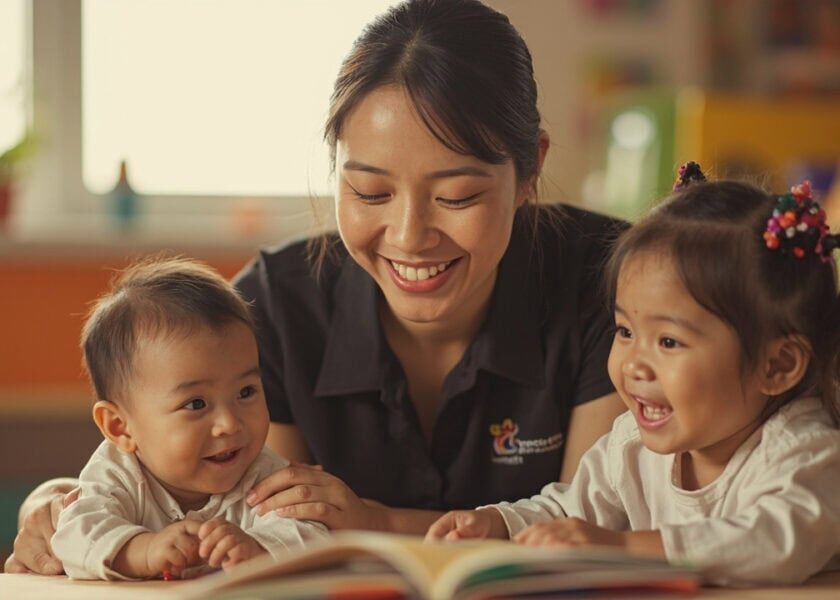
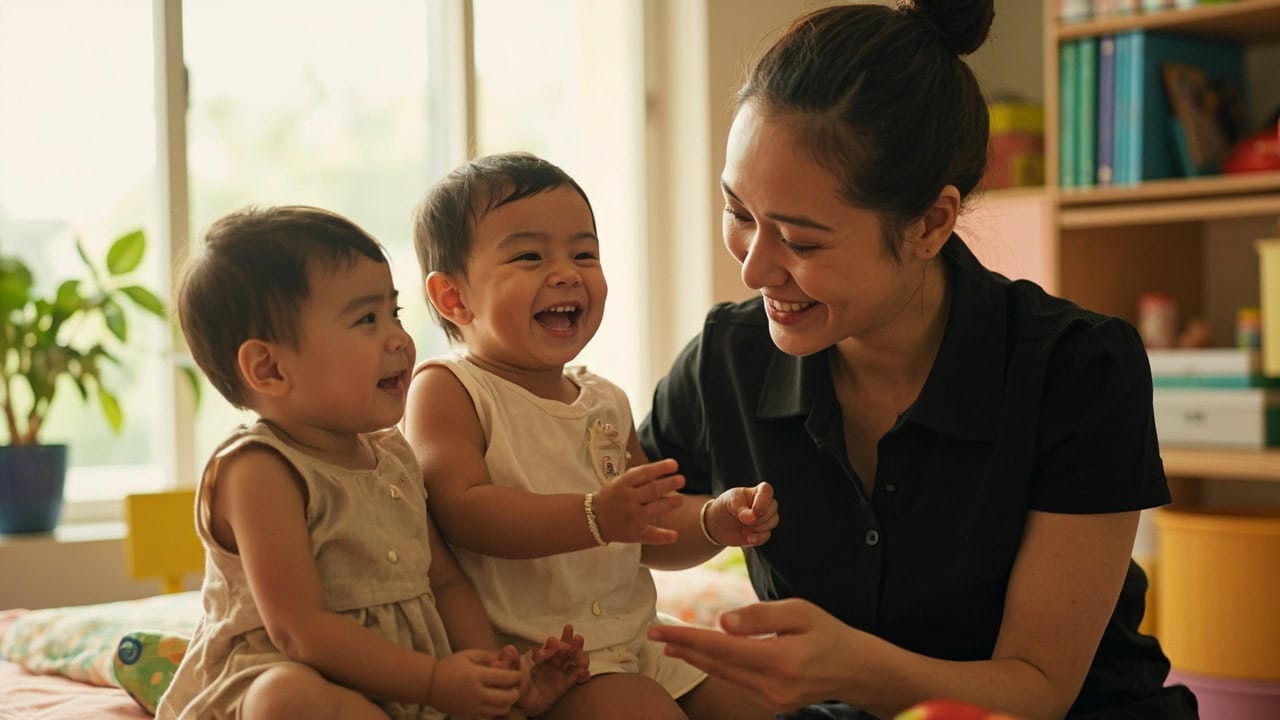
When your child returns home at the end of the day, full of the morning’s songs and the afternoon’s discoveries, carrying home the residue of a relationship that belongs entirely to them — that child is not diminished by what happened at childcare. That child is enlarged by it.
And when that child then offers you, the parent, the joy of reunion — the full, unreserved delight of your child sliding into your lap as though no one else in the world exists in that moment — both of those moments are real. Both of them matter.
The love for the caregiver and the love for you are not in competition. They are in conversation. And the conversation is the most beautiful sound a child’s development can make.
What Quality Childminding Actually Looks Like
The difference between a child who tolerates care and a child who thrives in it comes down to several observable qualities. When you are evaluating your options, here is what to look for:
Signs of Healthy External Caregiving
- Caregiver continuity: The same person shows up day after day. Attachment does not flourish in rotation. It deepens in repetition.
- Small ratios: In infant care, ratios matter enormously. One-to-three is categorically different from one-to-twelve.
- Attunement: The caregiver notices your child’s particular cues — the way they tilt their head when curious, the sound they make before wanting to be picked up, the exact pressure of touch that settles them.
- Developmental intentionality: Care is not just supervision. It is response, stimulation, and relationship.
- Communication: You know what happened in your child’s day. You receive updates that are specific, not generic.
Signs of a Healthy Caregiver Bond
Your child’s bond with their caregiver should complement rather than compete with your bond. It should result in your child feeling secure in multiple environments, allowing them to separate from both you and the caregiver without distress.
Look for joy at pickup that does not become distress when the caregiver leaves. Look for a child who returns home full of stories but also eager for family. These are the signs that the caregiving relationship is doing what it should — widening your child’s world rather than replacing you in it.
How EduNanny Approaches This Work
The parents who choose EduNanny have made a choice that speaks to something important. You did not choose childcare on the periphery. You chose a place built around caregiver continuity, around small ratios, around the understanding that an infant does not simply need to be fed and supervised.
An infant needs a relationship.
The ECDA Childminding Pilot that EduNanny by BUTLER participates in reflects exactly this philosophy — that childminding, when done with developmental intention, is not a lesser form of care. It is a different form of care, one that is intimate and responsive and built around the specific rhythm of your child’s early life.
When you chose a pathway that offers up to one-to-three infant ratios, that choice is not incidental. It is a decision that your child will not be one face in a crowd. It is a decision that the caregiver who holds your child on Monday will be the same caregiver who holds your child on Friday, and that this continuity is not a logistical convenience but a developmental necessity.
The Architecture of Trust
EduNanny understands that parents who feel secure in the external arrangements feel less fractured at home. That is not a marketing line. That is an observation about how parental guilt works.
When you know your child is in genuinely good hands — hands that are trained, consistent, respectful of your child’s developing personhood — the guilt loosens its grip. Not because the ache disappears, but because the ache is no longer compounded by doubt.
You can grieve the loss of those hours and simultaneously trust them.
The First Thousand Days
In the first thousand days of your child’s life — and they are almost unbearably short, even as they sometimes feel impossibly long — your child is building the template for every relationship they will ever have.
Every interaction teaches them something about whether the world is trustworthy, whether people are reliable, whether their feelings are noticed and met with care.
The people who populate those thousand days are not background figures. They are architects. They are laying the foundation of your child’s inner world.
When that world is populated only by family, your child learns one kind of security: the security of people who are biologically compelled to love them.
When that world is also populated by a caregiver who chose this, who was trained for this, who shows up every day to meet your child with skill and warmth — your child learns a different and complementary kind of security: the security of people who have chosen to be there, and who are good at it.
Both lessons are essential. Both are gifts.
And the fact that you chose EduNanny means that you understood, on some level that may not have had words yet, that the architecture of your child’s inner life deserves to be built with the best materials you can find.
Hold Both Things
Here is something that deserves to be said plainly: your child’s genuine bond with their caregiver is not a reflection of your failure to be present enough. It is a reflection of your success at teaching your child that the world is safe.
You did not just love your child into this. You taught your child that love is something the world contains.
And so when your child extends that trust to another attuned adult, you are seeing the fruit of your own teaching. You are seeing yourself, sideways.
This is what I mean when I say that the love grows sideways. It is not instead-of. It is also.
It is the widening of a circle that began with you and your family and is now large enough to hold more people who will love and know and protect your child. And every time your child adds a new person to that circle — a grandparent, a teacher, a friend — the circle grows, and you feel that ache again, and the ache is the proof that the circle is growing.
The grief and the growth are the same feeling, wearing different faces.
You Are Not Outsourcing Your Child’s Heart
You are adding rooms to it. Rooms that are warm, that are safe, that have good light, that are tended by people who understand the privilege of being let into a child’s world early and gently.
And when you watch your child reach for their caregiver, and feel that ache move through you — I want you to hold both things in the same hand.
The pride, and the grief. The joy, and the quiet displacement.
They are not contradictions. They are the twin signatures of a parent who is doing exactly what they are supposed to do.
You are raising a child who loves widely.
And that child learned that from you.
EduNanny exists for this. Not to replace what you do, but to join you in doing it. To be the second pair of arms that does not compete with the first, but extends the first.
To hold your child alongside you, with skill, with tenderness, with the full understanding that what they are doing matters — that every song sung, every hand held, every response to a child’s cry is a sentence being written in the story of who this child will become.
You brought your child into the world. You are watching your child reach beyond you and find it safe.
That is not the beginning of losing your child. That is the beginning of your child finding the world.
And the world, at least the part of it that EduNanny builds, is worthy of your trust.
Hold both things. The ache and the pride. They are both love.
And love, in the end, is not diminished by being shared. It is confirmed by it.
If you are ready to explore how EduNanny by BUTLER can walk alongside you and your child during these formative years, we invite you to schedule a conversation with our team.
Because you are not looking for just any childcare. You are looking for a place that understands what this choice means — and what it costs, and what it gives.
We would be honoured to show you what that looks like.
Find out more about who we are and what guides our approach.