Fraud Blocker edunanny.com
edunanny-0658e268c8bc68cf1673e6895e99d5d1
May 17, 2026

Your Children Are Both Individuals and Siblings

The Silence in the Back Seat: What Every Singapore Parent With Multiple Children Secretly Worries About

There is a particular kind of silence that lives in the back seat of a car on the way home from childcare. You know the one. It is the quiet between two children who have spent the day together, learning how to share a space, a caregiver’s attention, a set of toys, and the slow machinery of figuring out who they are in relation to someone else.

It is not the silence of boredom or of fatigue, though both of those may be present. It is the particular silence of a bond being built.

If you are a parent in Singapore navigating infant care and childcare with more than one child, you have probably felt it. And you have probably wondered — quietly, sometimes in the dark — whether the place you have chosen is really seeing each of your children. Not just tolerating them side by side. Not just keeping them safe and fed and entertained. But actually seeing them.

That question is one of the most important questions a parent with multiple children can ask. And it is, remarkably, a question that almost no one in the childcare conversation is asking.


Reading Two Worlds at Once: The Daily Reality of Parenting Multiple Children in Care

Most of the conversation around quality childcare — and there is a great deal of it in Singapore, as there should be — is built around a single child. It talks about developmental milestones, handover signals, the quality of the caregiver relationship, the all-important question of secure attachment.

All of that matters. It matters enormously. But it assumes a unit of one. And for a growing number of Singapore families, that unit has already expanded — or it will.

You may have a toddler and a newborn. You may have children three years apart who are in different stages of need. You may be planning for a second child while your first is already in care and feeling the weight of how that transition will work.

Whatever your situation, you are carrying something that parents of one child in care are simply not carrying: the double map. The feeling that you are trying to read two different sets of signals at once, interpret two different emotional landscapes, and somehow hold them together in your mind in a way that is coherent and fair and nurturing to both.

That is not a small thing. That is a significant, daily, often exhausting cognitive and emotional load.

What Siblings Actually Do for Each Other

Siblings in quality childcare are not simply sharing a space. They are learning from each other in ways that no curriculum can replicate and no amount of adult-led activity can substitute.

A slightly older child can model calm in ways that a caregiver, however warm, simply cannot. A younger child can elicit tenderness and protective instinct from a sibling that teaches both children something irreplaceable about what it means to care for someone.

They are building what developmental psychologists call a relational foundation — a set of experiences with another human being who shares their blood, their home, and their earliest sense of what it means to be known and to know someone else.

The sibling relationship is often the first true peer relationship a child encounters. It is a relationship of equals in some ways and of profound difference in others. It is where children first negotiate, first practice compromise, first experience the complex emotions of wanting something a sibling has and loving the person who has it.

That is not a small rehearsal. That is the raw material of the adult relationships they will carry for the rest of their lives.


Beyond the False Choice: What Sibling-Aware Care Actually Looks Like

One of the most persistent fears among parents with multiple children in care is that they will have to choose. That the system will demand they sacrifice one truth for the other — either their children are seen as individuals, or their sibling bond is nurtured.

But here is one of the great insights available when we step back and look at how children actually develop: the individual and the collective are not opposites. In a well-designed care environment, they reinforce each other.

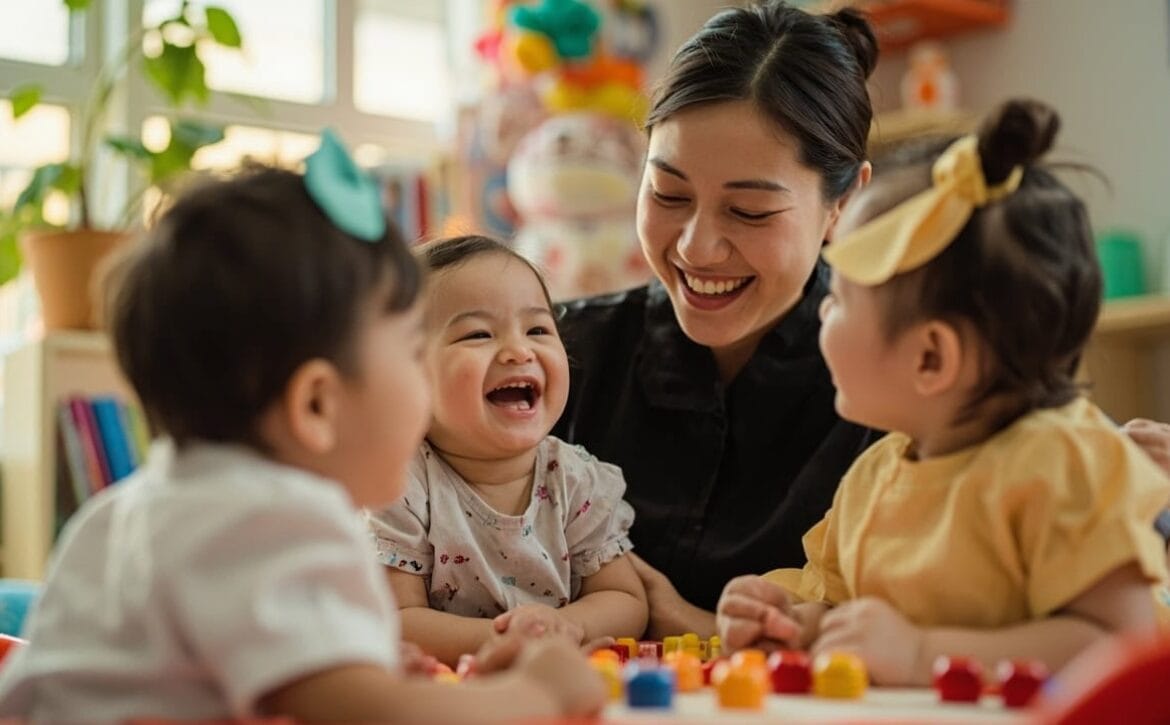
When siblings are in quality care — whether home-based, centre-based, or within the ECDA Childminding Pilot framework that EduNanny operates within — something remarkable becomes possible. Each child can be observed and nurtured as an individual with their own temperament, their own pace of development, their own particular way of showing the world who they are. And at the same time, the relationship between them can be actively, intentionally supported.

The Signs of Genuinely Sibling-Aware Care

So what does this look like in practice? Here are the daily, unscripted moments that reveal whether a care environment is truly sibling-aware.

A caregiver who notices and names. It looks like a caregiver who notices that your older child has been especially protective and tender with your younger one today — and who names that. “I saw how gently you helped your brother with that puzzle. That was really kind of you.”

This is not small talk. This is the adult in the room reflecting back to the child the best version of themselves, and in doing so, deepening a pattern that will outlast this afternoon.

A caregiver who creates space for individual stretching. It looks like a caregiver who notices when your younger child is ready to reach beyond the shadow of an older sibling and try something new — and who creates the conditions for that individual moment to happen without fracturing the sibling bond.

The older child is not punished for being more capable. The younger child is not held back to protect the older child’s sense of specialness. Both are seen.

Conflict as curriculum, not disruption. It looks like an environment where a tussle over a toy becomes an opportunity to learn conflict resolution, guided not by fiat but by skilled, patient facilitation.

In a quality, sibling-aware environment, a caregiver will not simply intervene and resolve the dispute. They will guide the children toward their own resolution, helping them use language, helping them understand each other’s perspectives, treating the conflict as a learning moment rather than a disruption.

This takes more skill, more patience, and more time. But it produces something invaluable: children who learn that relationships survive friction, that they can work through hard moments with someone they love, and that adults trust them to grow.

Three Observable Signs to Watch For

  • Individual observations at pickup. When you arrive, do the caregivers speak about each child individually? Do they have something specific to share about your younger child’s new physical confidence and something equally specific — different, distinct — about your older child’s growing verbal sophistication? Or do both children get described as a unit, a pair, a blur? The difference is enormous. It tells you whether two people are genuinely being seen.
  • Conflict handled as learning. Watch for how conflicts between your children are handled. In a sibling-aware environment, disputes are opportunities for growth. Children are helped to articulate their feelings, to hear each other, to find their own solutions. The caregiver is present and guiding, but not rescuing. This is how children learn that relationships are worth the effort.
  • The quiet moments of ease. Watch for the moments when your children are simply near each other — not playing together, not interacting, just present in the same space, at ease in each other’s company. That ease is not nothing. It is the signature of a bond that has been given room to breathe. It is siblings who are growing up together rather than alongside each other.

The Adjustment Nobody Talks About: Managing Different Settling-In Needs

There is a very real, very practical dimension that Singapore parents with multiple children understand viscerally: the adjustment is not the same for each child.

Your firstborn may have had months to settle into a care routine before your second arrived. Your second child may be entering care for the first time with an established, confident older sibling already present — which is both a comfort and a complication. They have a built-in anchor and also a built-in comparison.

Managing the different adjustment needs of multiple children simultaneously is one of the most demanding aspects of the return-to-work transition for Singapore parents, and it is almost never discussed with the nuance it deserves.

Quality care understands this. It understands that your older child may show regressions in some areas as they process the changed family dynamic. It understands that your younger child may need extra sensory comfort and a slower onboarding pace. It understands that both of these truths can exist at the same time, and that meeting them requires flexibility, observation, and genuine partnership with you as a parent.

This is what we mean when we talk about care that is sibling-aware. It is not a programme feature or a checklist item. It is a quality of attention — a willingness to hold complexity rather than simplify it away.


Why Home-Based Childminding Holds This Complexity Better

For many Singapore families, the question of childcare for multiple children is not only an emotional question but a financial and structural one. How do you find care that genuinely sees each child — and nurtures the sibling bond — without the cost becoming prohibitive?

The ECDA Childminding Pilot, within which EduNanny operates, is designed to address precisely this intersection of need. With home-based settings and small ratios, children receive a level of individual attention that is simply not possible in larger group environments.

When a caregiver is responsible for one, two, or three children rather than eight or ten, she can notice the subtle shifts. She can hold both the individual and the collective in mind. She can name the tender moment between siblings and create space for the younger child to stretch beyond comparison. She can guide conflict toward resolution rather than suppression.

The pilot fee structures, combined with Community Care Child Development Agency funding and Baby Bonus usability, mean that for many families, quality sibling-aware care is within reach in a way it might not have been before.

When childcare is affordable, families can make choices based on quality rather than cost alone. And quality, in this context, means care that sees your children as the small, specific, irreplaceable individuals they are — and as the siblings they are becoming.


Choosing Carefully for What Matters Most

We know that Singapore parents are thoughtful. You are ambitious for your children in the best and most meaningful sense of that word. You want them to be secure, capable, curious, and kind.

And quietly, underneath all the logistics and the school fees and the enrichment class decisions, you are proud of your family. You are proud of the way your children look at each other. You are proud of the noise they make together and the peace they find in each other.

That pride is not naive. It is well-founded.

Sibling bonds, when nurtured in the right environment, are among the most durable sources of well-being that a human being can carry into adult life. They are the people who show up without being asked. The ones who know your history in ways no one else can. The relationship that will be there at family dinners when they are teenagers who barely speak to you but who lean on each other in ways you cannot replicate.

EduNanny exists because we believe that the sibling bond is one of the most consequential developmental assets a child can have, and that childcare should be a space where that bond is nurtured rather than left to chance. We believe that parents with multiple children deserve a childcare partner who can hold the complexity of their family — the individuality of each child and the irreplaceable value of their relationship — without forcing a choice between the two.

As you think about the childcare decision — and for families with multiple children, it is never just one decision, it is a layered, evolving set of decisions — we want you to know that there is a place where your children can be seen as individuals and known as siblings. Where the caregiver holds both truths at once.

Where your firstborn learns to be a mentor and a protector and eventually, God willing, a lifelong friend. Where your younger child learns to reach beyond their older sibling’s expectations and find their own wings, safe in the knowledge that the sibling bond is there to catch them if they falter.

If you are a Singapore parent with multiple children exploring your childcare options, we would be honored to learn more about how EduNanny’s home-based childminding approach supports both your children’s individual development and their sibling bond — together.


Every family situation is unique. If you would like to explore how EduNanny can support your family, we welcome you to connect with us to discuss your specific needs.


edunanny-0658d421a42d64dd57c672d76b3942d3
May 17, 2026

Why Quality Childcare Expands What Your Family Gives Your Child

Quick Summary: What Your Child Actually Absorbs in Quality Childcare

  • Quality care does not replace family influence — it expands the context in which your family’s values operate
  • Children experience care as an ecosystem, not a competition between adults
  • Professional care excels at building social confidence, independence, routine fluency, and peer interaction skills
  • Your irreplaceable role is providing continuity of identity, cultural grounding, and emotional anchor
  • The right care partner sees your family as an asset, not a variable to be managed

The Fear Is Real — And It Tells You Something Important

The anxiety you carry is not a weakness to be soothed away. It is evidence of something profound: you understand, on a deep level, that the early years are not simply a waiting room before real life begins. The early years are real life. They are the foundation upon which everything else is built.

This understanding is as old as parenting itself. What is new — what is specific to our moment in Singapore — is the complexity of the decisions we now face. We are the first generation of Singapore parents navigating a childcare landscape that includes centre-based care, home-based care, infant care programmes, and childminding services. We have more options than ever before, and more questions about what those options mean for the children we love most.

The fear is not unique to Singapore. Parents in Tokyo, in London, in Sydney feel it too. But in Singapore, it carries a particular weight because we are a city of overlapping worlds.

You may be raising your child in a Mandarin-speaking household that honours Chinese traditions, while hoping they will grow into confident English speakers who thrive in international spaces. You may be Malay Muslim, navigating the rhythms of mosque and family gathering, while your child spends their days in a care environment where those rhythms are not the same. You may be Tamil or Sikh or Eurasian, holding traditions that feel precious and fragile, wondering if they will survive contact with a world that does not always see them. You may be navigating mixed-heritage families, where expectations pull in different directions, and the question of what your child “is” is not simple at all.

Add to this the modern pressure: the career that matters, the financial reality of raising a family in one of the world’s most competitive cities, the understanding that flexibility and opportunity often require choices that feel like compromises.

So here we are, at the intersection of heritage and ambition, tradition and modernity, love and logistics. And we are asking: can all of this coexist? Can my child be rooted in who we are and also ready for who they will become?


Reframing the Question

Here is the mistake that keeps being made. We talk about childcare as though it is a choice between two worlds: the family’s world and the professional’s world. As though there is a zero-sum game happening in your child’s mind, where every hour in a childcare setting is an hour taken from family influence. As though the caregiver and the grandparent are in competition. As though the centre and the home are rivals for your child’s identity.

This framing is understandable. It is how most childcare conversations are structured. But it is also fundamentally wrong. And it causes real harm, because it makes parents feel guilty for a choice that does not need to be guilty at all.

What if we stopped thinking about childcare as replacement and started thinking about it as something else entirely?

What if, instead of asking “who will raise my child,” we asked a different question: what does my child need that I am uniquely positioned to give, and what do they need that a quality care environment can provide?

What if we trusted ourselves to know the difference?


What Children Actually Absorb in Quality Care

Children do not experience care as a competition between adults. They do not sit in a childcare centre thinking, “my mother would do this differently.” They experience care as an ecosystem. They absorb from multiple sources, and what they absorb is shaped by the quality of what each source offers.

When a child enters a well-designed infant care environment, they enter a space thoughtfully prepared for their development. The routines are structured not to constrain but to build the internal architecture of security. The transitions — from meal to nap to play to exploration — teach a child that the world has rhythms, and that they can move through those rhythms with confidence.

In quality care, a child learns something invaluable: that they are part of a social world. They learn to read other children’s signals, to negotiate, to share space, to understand that other people have needs and feelings too. These are not skills that can be taught in a textbook or a screen. They are learned in the living of them — in the small moments of toddler conflict and resolution, in the morning greeting and the goodbye and the return.

Quality care also offers something that matters enormously in a diverse society like Singapore: exposure to difference. Your child will meet children from other backgrounds, hear other languages, encounter other ways of being in the world.

Consider a Malay family deeply committed to their heritage and faith who chose a childcare setting where their daughter encountered children from many backgrounds. They worried, at first, that this would create confusion. What they found instead was that their daughter became more, not less, grounded in who she was. She came home asking questions — about bahasa and Malay words and traditions — because she had a new frame of reference for understanding herself. The encounter with difference did not erase her identity. It anchored it.

This is what quality care does at its best: it gives your child the social confidence, the independence, the curiosity, the routine fluency that lets your family’s values and heritage land in a child who is ready to receive them.


Your Role Remains Irreplaceable

The family provides something that no childcare setting can replicate, no matter how excellent. You provide continuity of identity. You provide the language and the food and the songs and the stories that belong to your lineage. You provide the grandparent who speaks in a dialect that nobody else uses. You provide the aunties and uncles whose jokes land because your child knows the family they are part of. You provide the history and the future, the beginning and the end of every story your child hears about who they are and where they come from.

That is not something a childcare centre can give. And it is not something that is diluted by professional care. When you understand what you provide and what quality care provides, both become stronger. The family becomes more intentional about what it offers because it understands its irreplaceable role. And quality care becomes more effective because it can do what it does best, without being asked to be something it is not.

Think of it this way: quality childcare does not replace what families build. It expands the context in which your family’s influence operates. It adds new rooms to a house you have already started to build. It gives your child windows that look out onto other worlds. It gives them the social confidence to carry your family’s values into new spaces, and the curiosity to bring new ideas back home.

Your role does not diminish when quality care enters your child’s life. Your role expands. Because now your child has more capacity to receive what you offer. They have more context to understand who you are and why it matters.


How to Evaluate Whether a Care Setting Is Right for Your Family

The quality of the care environment is not incidental. It is everything. The difference between adequate care and excellent care is not measured in toys or facilities alone. It is measured in the training of the people who hold your child, in the philosophy that shapes daily routines, in the communication systems that keep you informed, in the respect with which your family’s culture and preferences are received and honoured.

When you choose a childcare partner, you are choosing more than a service. You are choosing a set of values that will operate alongside your own. The question is not simply “is this care safe and competent?” It is also: does this care setting understand what my family is trying to do? Do they see my child’s cultural background as an asset to be honoured, not a variable to be managed? Do they communicate with me as a partner, or as a client to be updated?

Here are the questions that matter most when you are evaluating a care setting:

Look at how they talk about your family.

Do they ask about your routines, your language preferences, your cultural practices? Do they see these as information to be gathered and respected, or as background noise to be set aside? A care setting that asks about your family’s values and heritage understands its role. A care setting that never asks sees itself as the primary environment.

Look at how they talk about your child.

Is the communication regular, honest, and specific? Does the caregiver describe what your child is doing and feeling, or do you receive only generic updates? You want a care partner who sees your child as an individual — who notices their particular temperament, their specific joys and struggles, the things that make them uniquely themselves.

Look at the training and values of the caregivers themselves.

Ask about their background. Ask about how they handle cultural and religious diversity. Ask about what happens when your child’s needs conflict with the centre’s routines. The answers to these questions will tell you more than any brochure or website ever could.

Trust your instinct.

You know your child better than anyone. If something feels off, if your child comes home consistently unsettled, if the communication feels like a performance rather than a partnership — those feelings matter. Quality care is not just about credentials and ratios. It is about fit. It is about whether this particular environment is the right complement for your particular family.


EduNanny’s Approach: Built for This Moment

EduNanny operates as a childminding service within the ECDA Childminding Pilot framework, designed with a recognition that not all families need the same thing. Home-based and community-based care options matter alongside centre-based pathways, and families deserve pathways that fit their lives.

For families with infants, EduNanny maintains ratios of up to one to three, ensuring every child receives a quality of attention that larger settings may not be able to offer. Fee structures are designed to be accessible, with CDA and Baby Bonus schemes applicable — removing at least one layer of the financial anxiety that weighs on Singapore parents.

What matters most about EduNanny’s approach is its philosophy. The service is not positioned as a substitute for family care. It is positioned as a complement — a way for families to access professional, trained, quality-assured care while maintaining the continuity of values and culture that only the family can provide.

This is why communication and transparency are built into the model. Parents receive regular updates, and where deployed, CCTV measures are in place not as surveillance but as trust infrastructure — so that the partnership between family and caregiver can operate with clarity and confidence.

EduNanny offers Monday to Friday care blocks, designed around the rhythm of working family life in Singapore, not around an abstract ideal of childcare availability. And it is available Singapore-wide, which means families across the island can access this kind of care without travelling unreasonable distances or compromising on quality.

EduNanny is built on the understanding that parental anxiety is not something to be overcome but something to be respected. The service is designed to help families do what they are already doing — not to take over.


Your Child Will Be Fine

Here is what I want you to know, as you sit with the anxiety and as you make the decisions that will shape your family’s next chapter: the family cannot be replaced. Not by any childcare programme. Not by any caregiver, however wonderful. Not by any environment, however enriching.

Your child will carry your family’s language in their bones. They will carry your family’s stories, your family’s food, your family’s way of moving through the world. They will carry the sound of your voice and the shape of your expectations and the particular quality of your love. This is not sentimental thinking. This is developmental reality.

The early years are not a competition between influences. They are a foundation, and you are laying the stones.

What quality care does — the right quality care, the kind that sees itself as a partner rather than a replacement — is add to what you are building. It gives your child new experiences, new support, new context for the extraordinary identity you are helping them discover.

Raise a child in Singapore today, and you are part of something remarkable. A society that is young and old at once, that honours its traditions and reaches for its future, that is made up of distinct cultures that somehow coexist, overlap, and enrich each other. Our children grow up in this world. They are Singaporean in ways that are specific and layered and complex.

They need both things to thrive. They need the rootedness that comes from knowing where they belong — their family’s culture, their heritage, their identity. And they need the wings that come from encountering the world — other people, other possibilities, other ways of being.

No family can give them both alone. And no childcare programme can give them both either. But together, in partnership, with intentionality and trust, we can give them something extraordinary. We can give them the best of what we are, as families, as communities, as a society.

We can give them the confidence to be who they are and the curiosity to keep discovering who they can become.

Approach your childcare decision not with fear, but with clarity. Ask the questions that matter. Look for a partner who sees your family as an asset. Trust that the love you have already given your child is not something that can be diluted, no matter how many hours they spend in quality care.

Remember: the early years are not a rehearsal. They are the real thing. Every moment matters. Every choice matters.

But here is what also matters: you do not have to do it alone. You were never meant to do it alone. The village that raises a child has always included more than family. In Singapore today, that village can include trained, professional, values-aligned caregivers who see your child as a whole person and your family as a trusted partner.

EduNanny is part of that village. We are here because we believe in what you are doing. We are here because we know the stakes. And we are here because we have seen, again and again, what children can become when families and quality care work together — not in competition, but in the kind of partnership that makes everything else possible.


If you are exploring infant care or childminding options in Singapore and would like to understand how EduNanny can partner with your family, we welcome the opportunity to connect with you.

edunanny-0658c64315dd8f8b489695cb102c7c17
May 17, 2026

What Your Child Learns Before Primary One Shapes Everything

The Quiet Question Every Singapore Parent Carries — And What It Actually Means for Your Child’s Future

There is a question that lives just beneath the surface of every Singapore parent we speak to. It rarely gets asked out loud, because it sounds almost too big to articulate. But once you hear it, you will recognise it immediately.

It goes something like this: when my child walks into Primary One in a few years, will the choices I am making today have quietly built something strong — or will I look back and wonder whether I got it wrong?

That question is not neurotic. It is not overthinking. It is the most honest expression of what it means to love a child and understand, on some level, that the earliest years are not just a phase to get through. They are a foundation being laid. And foundations, once built, are very hard to redo.

If you have been carrying this question in the quiet moments — between work meetings and bath time, in the gap between what you instinctively know matters and what the noise of Singapore’s educational conversation tells you to focus on — this article is for you.


Beyond School Readiness: The Foundation That Compounds

Let us talk about that foundation. Not the one made of bricks and school rankings and tuition schedules — the one made of something far more fragile and far more powerful.

The one made of how a child learns to pay attention. How she learns to wait. How he learns to feel safe exploring the unknown. How she builds the quiet, unshakeable belief that she is capable of figuring things out.

We call this school readiness. But that phrase barely does it justice.

What Singapore’s Education System Actually Rewards

Here is what most parenting advice misses: the children who thrive in Singapore’s education system — not just in Primary One, but across their entire educational journey — are not simply the ones who arrived knowing more letters or more numbers.

They are the ones who arrived knowing how to learn.

They can sit with a problem they do not immediately understand and stay with it. They can manage the disappointment of getting something wrong without collapsing under it. They can listen to a teacher, follow a multi-step instruction, hold a thought in their mind long enough to act on it later.

They are curious. They are resilient. They believe, in some deep and quiet way, that effort will lead them somewhere.

These are not things that Primary One teachers can teach from scratch. They are not things that the best curriculum in the world can simply deliver to a child who arrives without them. They are the product of thousands of hours in the earliest years — of responsive caregiving, of safe exploration, of being seen and heard and guided by someone who understood that a child’s play is not a break from learning. It is learning.


The Compounding Reality of Early Childhood

This is the truth that most parenting advice simply does not address: every month of quality care in the first thousand days is not just serving the present moment. It is depositing into an account that accrues interest across every stage of development.

Consider what this means in practice:

  • A child who has been supported in developing self-regulation by age three enters preschool with a head start that formal instruction does not easily replicate.
  • A child who has been encouraged in structured independence by age four walks into Primary One with a confidence that others are still building.
  • A child who has learned, in those earliest years, that their emotions are valid and manageable carries that capacity into every classroom, every exam hall, every social interaction that follows.

These advantages do not vanish. They compound. They create trajectories.

Executive Function: The Real Foundation

You may have heard the term executive function — it sounds clinical. But if you have ever watched a four-year-old put down a toy she desperately wants to keep playing with, because the teacher has asked everyone to clean up, you have watched executive function at work.

If you have watched a six-year-old sit through a lesson she finds difficult, without falling apart, you have watched the product of years of early emotional regulation being called upon.

Singapore’s educational system will ask your child to do both of these things, repeatedly, across twelve years of schooling and beyond. The children who do them most effectively are rarely the ones who were drilled earliest. They are the ones whose early environments built these capacities before formal instruction ever began.


What Quality Childminding Actually Looks Like

Let us be honest about what quality actually means, because the word is used so often it has almost lost its substance.

Quality is not a checklist. It is not the most expensive centre in the neighbourhood or the one with the prettiest classroom walls. Quality in early care is a set of active, deliberate practices.

The Three Pillars of Genuine Quality

  1. Ratios that allow true attention. Small enough groups that a caregiver can truly see each child — to notice when a two-year-old is on the verge of a breakthrough in language or motor development and create the moment that nurtures it.
  2. Consistency of relationship. A child’s brain does not develop its capacity for trust and exploration in the presence of a rotating cast of strangers. The caregiver who stays, week after week, is not a luxury — they are the stable base from which exploration becomes possible.
  3. Responsive interaction. The caregiver who narrates what a baby is reaching for, who names the emotion a toddler is struggling to express, who extends a child’s thinking rather than simply filling time. This is not warmth as an add-on. This is the mechanism through which the brain builds executive function.

These are not luxuries. They are the actual substance of what builds developmental advantage — or its absence.

Affordability Is Not Separate From Quality

Early childhood care is expensive. Singapore parents know this better than anyone, because they are already juggling mortgage payments or rental costs, school fees, the accumulated expenses of raising a child in one of the world’s most expensive cities.

The idea that quality developmental care should be accessible — not just available to families with six months of liquid savings — is not a naive aspiration. It is a conviction.

Singapore’s own support infrastructure — the Child Development Account and Baby Bonus scheme — was designed to bridge exactly this gap. The families who need quality care most are often the ones who are most constrained by cost. A system that does not honour its own design fails the families it was meant to serve.


EduNanny: Built for This Moment

This is where EduNanny enters the picture — not as a gap-filling solution, but as a developmental partnership that understands the full arc of what you are trying to build.

Through the ECDA Childminding Pilot, EduNanny offers families a pathway that brings together the warmth of home-based care with the structure and accountability that Singapore parents quite reasonably need.

What This Looks Like in Daily Practice

Infant ratios that matter. Small enough groups that every child is truly known — not just watched, but known. This is how responsive caregiving becomes possible at the level where it actually makes a developmental difference.

Care blocks built around real family life. Singapore parents are not working nine to five and going home. They are managing demanding careers, extended family obligations, and the logistics of a city that does not slow down. EduNanny’s approach is designed to meet you there, not to add friction.

Transparency that builds trust. Where CCTV measures are deployed, they are there not because we distrust our caregivers, but because we know that parents need more than promises. They need to see. They need to feel that the place they have entrusted with their child is a place where their child is genuinely safe, genuinely seen, and genuinely growing.

Thomas: Support Between the Visits

Parenting in Singapore is not a nine-to-five activity. The questions do not stop when you pick your child up. They multiply:

  • Is she hitting a developmental milestone or lagging behind?
  • Is his behaviour during separation something I should worry about?
  • How do I know if this play activity is actually building her cognitive skills, or just keeping her occupied?

These are not the concerns of a helicopter parent. They are the concerns of a thoughtful one. And they deserve answers that are evidence-informed, age-appropriate, and actually useful.

Thomas — EduNanny’s AI-powered parenting companion — exists for exactly these moments. When you have a question at ten p.m. after your child has finally fallen asleep, Thomas is there. Not because your child’s caregiver is not enough. But because you are a parent, and parents carry questions. They deserve a place to bring them.

What EduNanny Is Not

We want to be clear: we are not claiming that choosing EduNanny will guarantee your child a place in the Gifted Education Programme or a Direct School Admission to Raffles Institution. Anyone who promises you that is selling you something false.

What we are saying is something more important and more honest: the choices you make in your child’s early years are building something real. They are not arbitrary. They are not merely logistical. They are developmental.

And if you have the opportunity to make them thoughtfully, deliberately, with a partner who understands what they are doing — that is not an extravagance. That is wisdom.


A Practical Framework for Evaluating Early Care

Whether or not EduNanny is the right fit for your family, here is a framework that goes beyond the surface questions. These are the markers of genuine quality, in any setting:

  • What is the caregiver-to-child ratio? — Whether each child can receive responsive, individual attention
  • How consistent is the caregiver relationship? — Whether your child can build trust and secure attachment
  • What does a typical day actually look like? — Whether care is developmental or primarily supervisory
  • How does the caregiver respond to a child who is frustrated or upset? — Whether emotional regulation is actively taught or simply managed
  • Can I see how my child is tracked developmentally? — Whether progress is monitored or simply assumed

But beyond these practical questions, there is one that matters most: is the person caring for my child genuinely interested in how my child is developing — not just how they are behaving today?

The answer to that question will tell you more than any inspection report or parent testimonial.


Your Child’s Early Years Are Not a Waiting Room

There is a moment every parent in Singapore eventually faces, usually around the time their child turns five and the Primary One conversation becomes impossible to avoid.

A parent looks at their child and thinks: is she ready? Not just for school. For learning. For the experience of being in a room with thirty other children and a teacher who cannot give her individual attention every moment of every day. For the demands of a system that, for all its strengths, moves quickly and assumes a baseline of resilience and self-regulation that some children arrive with and others are still building.

The children who are ready in this deeper sense did not become ready by accident. Someone built that readiness, day by day, in the first thousand days and beyond. Someone paid attention. Someone responded. Someone created the conditions in which a child could grow into the confident, curious, capable learner she was always going to be — if given the right environment.

You are making that decision right now. The one you second-guess in the quiet moments. The one that keeps you up at night.

You are not wrong to feel the weight of it. You are not overthinking it. You are not being too cautious or too ambitious or too anything except exactly as thoughtful as this moment deserves.

Your child’s early years are not a waiting room. They are not a logistical problem to be solved until the real education begins. They are the beginning of everything.

And the fact that you are here, listening, thinking, taking this seriously — that is not just a good start. That is the very foundation we have been talking about. Already being built.


If you are carrying that quiet question — the one you have not quite been able to ask out loud — we would be glad to start a conversation about what a genuine developmental partnership could look like for your family.

Raising a child in Singapore was never meant to be done alone. The very best outcomes for children happen when families and caregivers operate as a team, with shared understanding, mutual respect, and genuine clarity about what they are building together.

We would be grateful for the opportunity to walk this road beside you.

Learn more about who we are and the standards we hold ourselves to.

edunanny-0658b80d6b52f830d72d03269a21b01f
May 17, 2026

The Real Work Begins After You Find Childcare

Why the Choice Is Only the Beginning

The early years community has understood something for a long time that is only now beginning to reshape how thoughtful parents think about childcare: the choice of childcare matters enormously, but it is only the beginning. What happens after — the daily, sustained, evolving relationship between the parent and the caregiver — is the variable that compounds. It shapes not just your child’s immediate wellbeing, but the architecture of their confidence, their security, and their capacity to learn, year after year.

The single most powerful thing you can do for your child, once you have found care you trust, is to become a genuine partner to the person providing it. Not a client. Not a supervisor. An architect, alongside the caregiver, of the world your child inhabits each day.

When parent and caregiver work as true partners, the developmental effect is not additive. It is multiplicative. A child thrives when the world feels coherent — when the same values, the same warmth, the same expectations, the same way of being responded to are woven together into something that feels safe and consistent. That coherence does not happen by accident. It happens because two adults are actively building the same world for that child.

When they are aligned, the child does not have to spend energy negotiating two different realities. That energy goes somewhere else. It goes into curiosity, into language, into the bold, messy, joyful work of growing up.


What Genuine Partnership Looks Like

The real question is not whether you will encounter moments of friction with your child’s caregiver. The real question is whether the structures and habits around you make it possible to address those moments with openness rather than defensiveness, with curiosity rather than assumption.

Genuine partnership means information flows in both directions — not just from caregiver to parent, but from parent to caregiver. It means telling your child’s caregiver not just that your child slept poorly, but what your child is working through right now. A new sibling arriving. A recent move. A fear of the dark that appeared last week and has not yet been explained. These details are not trivia. They are the raw material of responsive care.

When you and your caregiver are aligned on what your child is learning and exploring, you reinforce each other’s work naturally. Consider this:

  • Tuesday: The caregiver introduces a new texture — perhaps sand play or finger painting — and notices your child responding with particular focus and curiosity.
  • Wednesday: At bath time, you pick up on the same thread, offering a textured sponge or talking about how things feel.
  • The result: Your child registers that the world is consistent. That her learning is not fragmented but continuous.

That is not a pedagogical theory. That is a felt experience for the child — and one of the most powerful gifts two adults can give together.

Values alignment also requires maintenance. You chose a caregiver whose philosophy resonated with you on day one. But philosophies evolve. Children change. A caregiver who was a perfect fit for your infant may need to grow alongside your toddler, and the alignment you started with requires intentional, honest, ongoing attention. This is not a flaw in the system. It is the system working as it should.


When Things Do Not Go Smoothly

At some point, something will not go as smoothly as you hoped. A communication gap will open. A developmental approach will feel misaligned. A conversation will be had that neither party walked away from feeling completely satisfied. These are not failures. They are, if anything, the most honest proof that the relationship is real.

When challenges arise, the difference between a partnership and a transactional arrangement becomes unmistakable:

  • In a transactional arrangement: A concern is a complaint. It goes into an app or an email. The distance between the parties is preserved, but so is the problem.
  • In a partnership: A concern is a conversation. It is messy and sometimes uncomfortable, but it moves. It resolves into understanding or mutual respect, and both parties return to the shared work with a slightly clearer picture of what the other needs.

If something feels off, trust that instinct and raise it early — warmly, honestly, without accusation. A conversation between two partners is very different from a formal complaint in an app. The goal is not to document but to understand and recalibrate.


Why This Matters in Singapore

Singapore parents are navigating something genuinely unique. The pace, the expectations, the density of the city — it creates a childcare landscape that is both highly structured and deeply personal. You are competing for places. You are managing commutes. You are balancing the demands of a culture that simultaneously expects excellence in parenting and participation in the workforce.

Parents who are doing it with thoughtfulness, with intention, with a genuine desire to get it right — they deserve support structures that are as sophisticated as the challenges they are managing.

In Singapore’s childcare landscape, home-based and community-based care has long been underrepresented — despite offering something that institutional settings often cannot guarantee: a smaller, more personal environment where the child-to-caregiver ratio can remain as low as one to three.

That ratio is not a luxury. It is a statement about what the child deserves. Individual attention. Unhurried interaction. The kind of watchful responsiveness that only becomes possible when the caregiver is not simultaneously managing six other children at full capacity.


EduNanny Singapore: Built for Partnership

EduNanny by BUTLER was built with a different ambition. It is not simply a matching service. It operates within the ECDA Childminding Pilot framework, which means it takes seriously the professional integrity of home-based and community-based care — and the partnership between the families it serves and the caregivers in its network.

The model includes:

  • Communication infrastructure: Tools and pathways that make genuine partnership possible, even on the hardest days.
  • Transparency mechanisms: Where deployed, CCTV access gives parents a window into the daily rhythm — not as surveillance, but as participation. You are staying inside your child’s day, even when you are physically elsewhere.
  • Structured feedback pathways: Making it possible to address concerns with openness rather than defensiveness.
  • Accessible fee structures: Monday to Friday care blocks, CDA and Baby Bonus usability — practical scaffolding that allows a working family to build something sustainable.

EduNanny is also building infrastructure for informed partnership. Parents want to understand what they are seeing — whether a developmental milestone is on track, whether a behaviour is typical, whether there is research that might illuminate a question they have been turning over in their minds. The support tools available through EduNanny are designed to close the gap between a parent’s question and the answer they need — quickly, reliably, without judgment.

Let me be clear about what EduNanny is not claiming. It is not claiming to have solved the art of human relationship. The caregivers in this network are not performing. They are caring. And the families they serve are not clients to be managed — they are partners in the truest sense.

The families EduNanny serves are not looking for perfection. They are looking for someone who will notice what they notice. Who will take their child’s development as seriously as they do, day after day, through the boring stretches and the remarkable leaps.


The Compounding Effect: Raising Your Child Together

There is something worth pausing on here, because it runs counter to how most of us have been conditioned to think about childcare relationships. We tend to place caregivers in a professional box — competent, reliable, but ultimately separate from the family’s emotional core.

The caregiver who spends forty hours a week with your child is not peripheral to your child’s life. She is central to it. She is not a service provider you have hired and can replace at will. She is, in a real and meaningful sense, a co-parent — someone whose daily choices, daily words, daily responses are building the person your child is becoming.

If you are ready to move from a functional childcare arrangement to a genuine partnership, begin with these habits:

  • Share context, not just updates. Go beyond “she napped well” and “she ate lunch.” Tell the caregiver what your child is working through emotionally. This context transforms a report into a shared understanding.
  • Receive information with curiosity. When the caregiver shares something — a frustration, a breakthrough, a concern — resist the urge to immediately problem-solve or dismiss. Ask questions. Tell me more about that.
  • Speak about the caregiver with respect in front of your child. Children are exquisitely attuned to the emotional weather between the adults in their world. This is development work too.
  • Revisit values regularly. Schedule a brief check-in — quarterly or semi-annually — to talk about how things are evolving. Alignment is not a one-time box. It is an ongoing conversation.

The research on early childhood tells us that the first thousand days are extraordinary in their developmental density. But what it does not always emphasise is that the quality of the relationships surrounding the child during those thousand days matters as much as any individual intervention or curriculum.

The quality of the relationship between the two primary adults in that child’s world is not a soft, sentimental variable. It is the hidden engine. It is the thing that makes everything else run more smoothly, more sustainably, more joyfully.

The hours you invest in communication. The honesty you bring to difficult conversations. The consistency you create between home and care. The way you speak about your child’s caregiver — with respect, with warmth, with genuine appreciation. All of it compounds. All of it is development work.

You did not just find childcare. You entered into a relationship — one that will require tending, adjustment, patience, and care. And if you approach it with the same thoughtfulness you brought to the search itself, something remarkable happens.

The caregiver stops being someone who looks after your child and starts being someone who is raising your child with you.

And your child feels that. Quietly, consistently, without ever being able to name it — they feel that the adults in their world are aligned. That they are trusted. That the love and the structure and the expectation are not conflicting currents but a single, clear river moving in the same direction.


If you are exploring childcare options in Singapore and wondering what genuine partnership might look like for your family, learn more about EduNanny’s approach. The search may be over. But the most important work is just beginning.

Get in touch to start a conversation.

edunanny-0658aa5d8978d50ca62807ae36b353db
May 17, 2026

Beyond the Checklist: What Real Child Development Looks Like for Singapore Families

The Comparison Trap: Why Singapore Parents Feel This Way

Most parents, if they slow down and listen to themselves, actually do know their children. They know when their child is engaged and curious. They know when she is frustrated in ways that are productive versus ways that are depleting. They know when she is thriving in the quiet, inward sense that no report card could ever capture.

What parents lack is not knowledge. What they lack is permission to trust that knowledge, and a language for what they are actually seeing when they look at their children’s development.

Every enrichment program promises to accelerate something. Every assessment tool positions itself as essential. Every conversation at the playground can turn, almost without warning, into a quiet arms race of developmental one-upmanship.

Here is what I want you to hear clearly: most of the signals that our comparison culture tells you to watch for are noise. They are false signals. They tell you almost nothing about whether your child is genuinely developing well, and they tell you almost everything about whether your child is conforming to a narrow, culturally specific, academically-oriented definition of what development should look like.


What Genuine Child Development Actually Looks Like

Let me begin with a simple question. What does it mean for a child to develop well?

The answer most parents have been given, explicitly or implicitly, looks something like this: development means acquisition. Words added to vocabulary. Skills stacked upon skills. Motor milestones hit in the correct sequence and within the correct timeframes. A child who can identify colors, count to twenty, write her name, socialize with confidence, sleep through the night, eat everything on her plate, and demonstrate readiness for primary one before she has turned six.

That is the script. That is what our culture has decided development looks like.

And here is the problem with that script: it describes a performance. It describes a child who has been shaped to meet external standards, to demonstrate growth in ways that are visible, measurable, and impressive to other adults. But development in the truest sense is not a performance. It is a process. It is internal, uneven, deeply personal, and often invisible to anyone who is not paying the right kind of attention.

It is the child who is increasingly able to regulate her own emotions when she is frustrated. It is the one who, at two, can sit with a sensory activity for twenty minutes not because she has been trained to focus but because she is genuinely fascinated by the texture of rice or the way water moves. It is the three-year-old who, when another child takes a toy from her, does not immediately escalate into tears or aggression but pauses, looks at the other child, and tries to solve the problem. It is the four-year-old who asks why the sky changes color, and who will sit with your answer and turn it into four more questions.

These are not performances for adults. These are the signatures of a child whose mind and heart are growing in the ways that actually matter.

The Five Domains of Whole-Child Development

Understanding genuine development means understanding its different dimensions. These domains are not separate tracks running in parallel. They are braided together, each influencing the others in ways that make whole-child development the only kind worth nurturing.

Emotional Development

When we talk about emotional development, we are not talking about whether a child cries frequently or rarely. We are talking about something more structural. We are talking about whether a child is building an inner life, whether she is beginning to understand that she has feelings, and that those feelings have names, and that they can be managed rather than only expressed.

A toddler who has access to skilled emotional coaching will, over time, develop what child development researchers call emotional literacy. She will learn that it is okay to be angry but not okay to hit, that sadness is not dangerous, that she can ask for help when a feeling feels too big for her body.

This is not something that can be rushed or taught from a worksheet. It is built slowly, in moments of attunement with caring adults who notice what the child is feeling and reflect it back with calm, specific language.

“I see that you are really frustrated that the tower fell. You worked so hard on that.”

That sentence, spoken genuinely and often enough, does more for a child’s emotional development than any app or program.

Cognitive Development

Cognitive development, in the genuine sense, has almost nothing to do with academic readiness. It has to do with the quality of a child’s curiosity and the depth of her engagement.

A cognitively developing child is one who wants to understand things, who asks questions because she is genuinely interested in the answers, who can sustain attention on a problem or a puzzle or a story because she is internally motivated rather than externally directed.

The difference between a child who has been trained to answer questions and a child who asks them is the difference between performance and genuine cognitive development. When you hear your child asking “why” for the hundredth time in a day, you are not experiencing an annoyance. You are witnessing cognition unfolding.

Social Development

Social development is frequently misunderstood as sociability. A socially developing child is not necessarily the most outgoing child in the room. Some of the most profound social development happens quietly, in the careful, tentative exchanges between toddlers who are learning the rules of human connection: how to share, how to take turns, how to notice another child’s feelings, how to recover when an interaction goes wrong.

Social development is about the capacity to be in relationship, to navigate the space between self and other with growing grace. It is built in small moments: the child who offers a toy to a peer, the child who notices that another child is upset and brings a book or a stuffed animal, the child who is learning that she exists as a person in relation to other people.

Physical Development

Physical development is perhaps the domain most prone to comparison, because bodies grow on observable timelines and because we can see motor skills with our own eyes. But even here, the meaningful indicators are not always the obvious ones.

Yes, we want to know that a child can walk, run, climb, and manipulate objects with increasing precision. But genuine physical development is also about the child’s relationship with her own body: whether she feels safe in it, whether she is building confidence in what it can do, whether she is developing a sense of physical agency rather than physical caution.

A child who is allowed to climb, fall, and try again, in an environment that is safe but not over-protected, is building not just motor skills but something deeper. She is building resilience. She is building trust in her own capacity to meet physical challenges.

Communicative Development

And then there is communication, which is the domain most likely to trigger parental anxiety in Singapore because language is so visible, so measurable, and so tied to academic success in our cultural imagination.

But genuine communicative development is about far more than vocabulary size or sentence length. It is about the child’s growing ability to express herself, to be understood, to understand others, to use language as a tool for connection rather than only for request.

It is the infant who is learning that crying will bring a response, and that the response is meaningful. It is the toddler who is learning that words have power, that they can make things happen, that they can create connection. It is the preschooler who is learning the nuances of conversation, how to listen as well as speak, how to adjust language for different listeners, how to use stories to make sense of experience.

A child who is communicating genuinely is not just producing words. She is entering into the human conversation.


Why Milestone Checklists Miss the Point

Understanding these domains helps us recognize the difference between genuine developmental signs and the false signals that comparison culture amplifies.

The child who speaks late but with precision and purpose is not behind. She may be building a deeper understanding of language before she launches into speech—a pattern seen in many children who later become eloquent and precise communicators.

The child who is not reading at four is not disadvantaged. He may be developing spatial reasoning, physical competence, social intelligence, or emotional depth at a pace that will serve him far better in the long run than early literacy would.

The child who is not the first to share, the first to climb, the first to perform, may still be developing the inner architecture that will allow him to be patient, reflective, and deeply capable when the time comes.

This is not to say that developmental concerns should never be addressed. Of course there are children who need early intervention, and the earlier such needs are identified and supported, the better. But the ambient anxiety that Singapore parents carry—the daily, low-grade worry that their child is not measuring up—is not a sign of responsible parenting. In most cases, it is a sign that the environment has succeeded in making you doubt what your eyes and your instincts are telling you.

What School Readiness Actually Means

Singapore parents carry a particular burden around school readiness. We talk about children being “school-ready” as though readiness were a switch that flips on at a particular birthday, as though there were a checklist of skills that, once completed, marks a child as prepared for primary one.

But real school readiness is not about academic content. It is about emotional foundation. It is about whether a child can manage frustration, delay gratification, engage with curiosity, navigate social dynamics, and believe that learning is worthwhile. These are the capacities that determine whether a child thrives in school or merely survives.

A child who enters Primary One able to read but anxious about failure, unable to regulate her emotions, and disconnected from her own curiosity is not truly school-ready. A child who enters Primary One not yet reading fluently but confident in her ability to learn, comfortable asking for help, curious about the world, and capable of sitting with challenge—this child is ready.

The school system will change. What your child needs from you and from her caregivers is the foundation that will serve her across a lifetime of learning, not just the performance that will impress at a single point in time.


How Skilled Caregivers Observe and Support Real Development

So what does it actually look like when a skilled caregiver observes and supports genuine development? This is the question that shapes everything about how we approach childminding at EduNanny Singapore.

When an EduNanny caregiver enters into a day with your child, she is not entering with a checklist. She is entering with trained eyes and an attuned presence. She is noticing not just what the child is doing but how the child is doing it. She is noticing the quality of the child’s engagement, the ease or effort in the child’s movements, the texture of the child’s emotional state. She is noticing whether the child is curious, whether the child is connected, whether the child is building something inside herself that cannot be measured on any standardized scale.

Observation Versus Checklist

Consider a two-year-old at play with a set of stacking cups.

A checklist approach would note whether the child can stack the cups in size order. A developmental observation would note something deeper. It would note that the child is experimenting with the cups not just as objects to be stacked but as containers to be filled, as tools for understanding volume, as instruments for producing sound, as social objects to be offered to another child or to the caregiver.

It would note the child’s persistence when the cups fall, the child’s experimentation with different configurations, the child’s use of language or gesture to communicate something about the cups. It would note that the child is not performing for the caregiver but is genuinely absorbed in the process of understanding.

That is what skilled observation looks like. It is not watching for the output. It is attending to the process.

Multiply that kind of observation across a full day, across a week, across months and years of care. The EduNanny caregiver is building, over time, a portrait of your child that goes far deeper than anything a periodic progress report could convey. She knows how your child handles frustration. She knows how your child approaches new experiences. She knows whether your child is a social explorer or a social observer, and whether she is comfortable in both modes. She knows what makes your child laugh, what makes your child pause, what makes your child’s whole face light up.

Your Role as Your Child’s Developmental Partner

Something essential is rarely discussed: the parent’s role as interpreter and advocate alongside caregivers. Here in Singapore, where so much of the childcare infrastructure is institutional, parents are often positioned as consumers or clients rather than as partners in their child’s development.

You receive reports. You attend meetings. You are told how your child is doing relative to expected benchmarks. But rarely are you invited into a genuine dialogue about what you are observing at home, what your instincts are telling you, and how the caregiver’s observations interact with your own.

At EduNanny Singapore, we believe that you are your child’s first and most important developmental partner. You know your child in ways that no caregiver, however skilled, can replicate. You have seen your child across thousands of hours of life, in every emotional state, in every kind of day.

Your observations matter. Your intuitions matter. And when those observations and intuitions are brought into conversation with a trained caregiver’s observations, something richer emerges than either perspective could offer alone.


What Sets Quality Childminding Apart in Singapore

This is what transforms childcare from supervision into partnership. When you drop your child off in the morning, you are not leaving her in a holding pattern until you return. You are placing her in a relationship that is actively nurturing her development.

Several elements distinguish genuine developmental partnership from basic childcare supervision:

  • Trained observation—Caregivers who know what genuine development looks like and can recognize it in everyday moments
  • Attunement over compliance—Responding to the child’s actual needs rather than imposing external schedules
  • Communication that builds understanding—Regular, meaningful conversations about what your child is experiencing and becoming
  • Partnership with parents—Inviting your observations and intuitions into the developmental conversation
  • Whole-child attention—Recognizing that emotional regulation, cognitive curiosity, social confidence, physical competence, and communication are all braided together

The ECDA Childminding Pilot

The ECDA Childminding Pilot represents an important acknowledgment that home-based and community-based care pathways have a legitimate, valuable role to play in Singapore’s childcare landscape alongside centre-based options. It is an acknowledgment that children develop best in environments that feel like home, that are grounded in real relationships, that are woven into the fabric of daily life rather than divorced from it.

EduNanny Singapore is proud to be part of this pilot, because it aligns with everything we believe about how children grow. The pilot makes quality care accessible, with fee structures designed to be affordable and payment options that include CDA and Baby Bonus usability, so that more families across Singapore can benefit from the kind of developmental partnership we offer.


How to Choose Childcare Based on What Actually Matters

As you evaluate childcare options, it helps to know what to look for—not for performances, but for signs of genuine thriving:

  • A child who persists at something challenging, not because she is being watched, but because she is genuinely engaged
  • A child who can name and manage her emotions, not just suppress them
  • A child who asks questions because she wants to understand, not because she wants the answer right
  • A child who notices other people’s feelings and responds with care
  • A child who is physically confident, not fearless, but trusting of her own capacity to try and recover
  • A child who uses language to connect, not just to request
  • A child who is sometimes bored, sometimes frustrated, sometimes quiet—and who is okay in those states because she feels secure

If you are researching infant care or childminding options for your child, here are questions worth asking:

  1. How do caregivers observe children? Look for a focus on process and engagement, not just milestone checklists.
  2. How do caregivers communicate with parents? You should feel like a developmental partner, not just a recipient of periodic reports.
  3. What is the caregiver-to-child ratio? With a maximum of one caregiver for every three infants, genuine observation becomes possible.
  4. How do caregivers respond to emotional moments? This is where attunement is tested—in frustration, in conflict, in the hard moments.
  5. What does a typical day look like? Look for a balance of free play, guided exploration, and rest—not a schedule optimized for parental perception.
  6. How are parents invited into the conversation? You should feel that your observations at home are valued and integrated.

Coming Back to That Moment at the Pick-Up Gate

Let me close by returning to where we began.

When you stand at the pick-up gate, searching your child’s face for that sign, you are not being a bad parent. You are not failing to trust your child or the people you have chosen to care for her. You are participating in a deep, ancient human impulse: the desire to know that your child is well, that she is growing, that the world is a good place for her to be becoming herself.

That impulse is good. It is part of what makes you the parent your child needs.

But here is what I want you to know. The sign you are looking for is not on a checklist. It is not in a milestone chart. It is not in the number of words your child speaks or the colors she can name or the preschool she will attend.

The sign you are looking for is written in the quality of her engagement, the steadiness of her curiosity, the depth of her connection to the people who love her, the growing grace with which she navigates her own inner life and the world around her.

These are the signs of genuine development. These are the signs of thriving.

Your child is not a project to be optimized. She is a person in the process of becoming. And that process is unfolding, in ways that are profound and real, whether or not you are watching a progress report or comparing her to another child at the playground.

What EduNanny Singapore offers is companionship on that journey. It is the assurance that in your absence, your child is in hands that understand her, that see her, and that are actively helping her to grow into whoever she is meant to become.

Your child is becoming. Let us walk that path together.


To learn more about EduNanny Singapore and our approach to developmentally-aligned childminding, or to connect with our team, we welcome you to reach out. You can also read more about our story and our values.

edunanny-06589c3161776acd7efbeca73a7238fe
May 17, 2026

What Your Child Is Really Telling You Each Evening

What Developmental Science Tells Us About Your Child

The brain is not a passive recipient of experience. It is an active organizer of it. Every interaction your child has throughout the day—every moment of security, every small frustration, every discovery, every instance of being truly seen by another person—contributes to the architecture of how they understand the world.

This means something important for you as a parent: quality childcare and attentive parenting do not operate in separate spheres. They are part of a single system.

When that system works well, your child carries the security they have built during the day into the evening with you. They are more open, more curious, more willing to show you who they are becoming. The transition home matters. The decompression matters. And what happens in the hours that follow matters more than you might think.


Children Communicate Constantly—Here Is How to Listen

Children are not little puzzles to be decoded by experts alone. They are deeply expressive beings who are constantly telling us about their inner lives—if we know how to listen.

Consider what play reveals:

  • When your three-year-old builds a tower and then deliberately knocks it down, they are not just entertaining themselves. They are processing something—perhaps a feeling of control, perhaps a frustration from earlier in the day, perhaps the pure joy of mastery.
  • When your five-year-old assigns roles in their imaginary game and gives you the role of the helper rather than the hero, they are not being mean. They are working something out, probably about power and agency and their own growing sense of self.
  • When your toddler brings you a book for the fifteenth time and waits for you to say the same words in the same order, they are not being stubborn. They are building neural pathways through repetition, and they are also seeking the reassurance of your consistent presence.

The skill of developmental observation is not about reading your child’s mind. It is about noticing patterns over time, resisting the urge to interpret single moments too heavily, and developing a growing fluency in what your particular child is like when they are thriving versus when they are struggling.

When you notice something in your child’s behavior—an emotion, a pattern, a regression, a burst of new skill—resist the urge to evaluate it immediately. Instead, ask yourself three questions:

Question 1: Is this within the range of normal development for their age?

If you are not sure, that is okay. You can ask your child’s caregiver, who has seen many children at this stage. You can bring it to your pediatrician or a developmental specialist if it persists. Knowing what is typical at each age helps you worry less about what does not need worrying about—and notice what genuinely deserves attention.

Question 2: Is this a pattern or a single moment?

Children are not consistent. They have bad days, hard days, days when everything seems off. A single tantrum, one episode of food refusal, one night of poor sleep—these are not necessarily signals.

The signal is in the pattern: a sustained change in mood, a persistent regression in skills, a noticeable shift in how they connect with others. Look for consistency across weeks, not conclusions from moments.

Question 3: What is my child showing me about their inner experience?

Are they trying to tell me something through this behavior? Are they seeking connection, or space, or help with something they cannot yet articulate? Sometimes a child who is clingy after childcare had a day that felt overwhelming. Sometimes a child who is unusually quiet has been holding it together all day and finally feels safe enough to let down their guard.

These questions will not give you all the answers. But they will help you move from anxiety to curiosity, from uncertainty to engagement. And that shift—from watching with worry to watching with genuine interest—is one of the most important changes a parent can make.


Navigating Singapore’s Parenting Pressures

We live in a context that makes confident observation genuinely difficult. Understanding what the science tells us about child development is one thing. Living it, in a society shaped by comparison culture and generational expectations, is another.

The Comparison Culture

There is an unspoken list of milestones and markers that children are supposed to hit, and parents feel the weight of that list even when they know they should not. Grandparents have their own expectations, shaped by a different era. There is academic anxiety creeping earlier and earlier, and it can be hard to trust that development is unfolding as it should when the neighbor’s child seems to be speaking in full sentences or doing mathematics on a tablet.

You are allowed to slow down. You are allowed to trust what you observe in your own child rather than comparing it to what someone else’s child is doing. Developmental variation is normal. Children develop along their own timelines, and the research is clear that early academic acceleration does not produce lasting advantages.

What does produce lasting advantages is secure attachment, emotional regulation, genuine curiosity, and the willingness to try hard things. These are what you are building when you sit on the floor with your child and listen to what they are telling you through their play.

The Generational Gap

Your parents loved you and did their best with what they knew. Their parenting was shaped by their era, by different research, by different cultural pressures. When they tell you that you are spoiling your child by responding to their cries, or that you should not hold them too much, or that discipline means punishment, they are often reflecting what they were told.

The science has moved on. We now understand far more about the developing brain, about attachment, about how emotional regulation works. But that knowledge can feel lonely if you are the only person in your family who holds it.

You do not have to choose between respecting your parents and trusting what you are learning about your child. You can honor their love while also honoring your own growing understanding. And when the generational gap feels too wide, you can find community with other parents who are on a similar journey.

Common Concerns That Deserve Honest Answers

“Am I doing enough?”

You are doing more than you think. Showing up, paying attention, asking questions, sitting on the floor with your child—these are not small things. They are the substance of secure attachment. The evening hours are not a gap to be filled with activities. They are a window: a chance to see your child as they truly are in this moment.

“What if I miss something important?”

You will not catch everything, and that is fine. No parent does. The goal is not perfection—it is consistent attention over time. When you have a caregiver who is also observing, you have two sets of eyes, two perspectives, two opportunities to notice what your child is communicating.

“How do I know if something is really wrong?”

Trust your instincts, but verify with patterns. If something feels off, give it time to emerge as a pattern or bring it to a professional. A good caregiver can help you contextualize what you are seeing. But you do not need to carry the weight of diagnosis alone—that is not your role.


What Quality Childminding Looks Like and Why It Matters

Not all childcare is the same. This is not about finding any caregiver—it is about finding a partner in your child’s development.

A quality caregiver does not just mind your child. They observe your child. They notice the small shifts, the emerging interests, the moments of frustration and breakthrough. They build a relationship with your family that extends beyond logistics.

And they communicate with you—not just the surface-level update of what your child ate and when they napped, but genuine insights into who your child is becoming.

Ask yourself these questions when evaluating any childcare arrangement:

  • Does the caregiver seem genuinely interested in my child as a person?
  • Can they tell me something specific about my child’s day beyond routines?
  • Do they share observations that help me understand my child better?
  • Do they welcome questions about development and behavior?
  • Does the ratio of caregivers to children allow for real attunement?

The answers to these questions will tell you whether you have found a childcare arrangement or a developmental partnership.


EduNanny: A Partner in Your Child’s Development

This is the kind of partnership that EduNanny was designed to offer. As part of the ECDA Childminding Pilot, EduNanny brings together trained caregivers who understand that their role is not simply supervision. It is observation, relationship, and collaboration with families.

With infant ratios of up to one to three, caregivers can give each child the attention that genuine attunement requires. This is not a technical detail—it is the foundation of what makes meaningful observation possible.

EduNanny caregivers are not interchangeable. They are trained, they are observed, they are supported, and they are expected to notice. When your child comes home from a day with an EduNanny caregiver, you should expect more than reassurance. You should expect insight.

What did they discover today? What frustrated them? What did they laugh at? What are they curious about? These are the questions that matter, and a quality caregiver can help you answer them—not by doing the work of understanding your child for you, but by giving you the raw material you need to continue that understanding at home.

The pilot fee structures have been designed to be accessible, and families can use CDA and Baby Bonus funds in applicable scenarios. But the real value is the quiet confidence that comes from knowing someone is paying attention to your child with the same care you would if you were there.


The Evening Window: Putting It All Together

For parents in Singapore, this kind of partnership has never been more important. We are a fast-moving society. We value achievement and progress and preparation for the future. But in our hurry to prepare our children for what comes next, we sometimes forget to be present for what is happening now.

Understanding your child is not a burden you carry on top of everything else. It is the thing. It is the skill that makes every other part of parenting more meaningful, more joyful, and more effective.

When you truly understand your child, discipline becomes less about control and more about connection. Learning becomes less about performance and more about curiosity. The difficult moments become less frightening because you can see what is underneath them. And the good moments become even better because you can fully appreciate what you are witnessing.

Your child came into this world wired for connection. They came into this world ready to be known. And in the quiet evening hours, when it is just the two of you—or the three of you, if there are siblings—and the day’s logistics are done, you have an opportunity that no amount of money or planning can create:

The opportunity to be present with your child in a way that helps them feel truly seen.

EduNanny caregivers walk through the door each morning knowing that they are entering into this story. They are not replacing your presence. They are not relieving you of your role. They are holding a piece of it—carefully, attentively, with skill and with genuine care—so that when you pick up your child at the end of the day, you can meet them from a place of rest as well as love.

You can meet them with questions that invite them to show you more. You can meet them with the kind of curiosity that says: I want to know who you are becoming. I want to understand what this day was like for you. I want to be part of your story, not just as the person who drops you off and picks you up, but as the person who really sees you.

That is what EduNanny believes. That is what the ECDA Childminding Pilot was designed to support. And that is what I hope you will carry with you into the evenings ahead—not anxiety, but curiosity. Not uncertainty, but the quiet confidence that comes from knowing you are building something real, day by day, evening by evening, in the ordinary and extraordinary moments of being your child’s parent.

The evening window is open. Your child is waiting to show you who they are.


To learn more about EduNanny’s approach to development-focused childminding in Singapore, visit our website or get in touch with our team.

edunanny-06588dc2af6c8e36dc401c1570af5642
May 17, 2026

How Singapore Parents Find Childcare That Amplifies Their Family’s Influence

Childcare as Partnership, Not Replacement

The premise is this: childcare is a replacement. Choosing a caregiver means choosing a new centre of influence in your child’s life.

And for many childcare arrangements, that premise holds. You drop your child somewhere each morning and receive them back each evening. The days in between feel like a gap — a space you cannot see into, cannot influence, can only hope is good.

But that is not the only model. And it is not the model that serves children or parents best.

The most effective childcare — the kind that genuinely supports your child’s development and your own peace of mind — does not replace your influence. It extends it. It amplifies it. It creates a structure in which your values, your priorities, and your instincts as a parent continue to shape everything your child experiences.

What Partnership Actually Looks Like

When you choose a caregiver, you are not choosing someone to take over. You are choosing someone to work alongside you. Someone whose job is to understand what you are building at home and to reinforce it during the hours when you are not there.

Someone who notices the same things you notice. Who responds the way you would respond. Who sees your child not as a charge to be managed but as a person she is honoured to know — a person whose life she is helping to shape in conscious alignment with the family that loves them most.

Consider what this means for communication. In a transactional childcare arrangement, the caregiver does what she is asked. She follows instructions. She keeps the child safe, fed, and entertained. In a partnership arrangement, the caregiver is also listening. She is watching how your child responds to certain songs, which textures they seek out, where their frustrations come from and what helps them through.

She is building a picture of your child’s day that she shares with you honestly and regularly — not because you demanded reports, but because she knows that your understanding of your child is what makes you a more effective parent.

Not a daily log that reduces your child to nap times and diaper changes. But a real exchange — a caregiver who knows your child well enough to say, “She was so proud of herself today when she stacked those blocks. She kept looking over to make sure I saw.” A note that tells you your child is experimenting with persistence, that they care about being witnessed, that they are building confidence in ways you can now nurture and celebrate at home.


Why This Matters More in Singapore

The pressures on families here are real. The cost of living, the demands of careers, the distance from extended family that so many of us navigate — these are not abstractions. They are the daily reality of raising children in a city that moves quickly and expects much.

Many parents feel caught between the need to contribute financially and the desire to be present. Between the professional lives they have built and the family life they imagined. In a society where both parents often work, and where grandparents may be across the Causeway or across the region, the question of who shapes your child’s early days is not theoretical. It is urgent.

Singapore parents do not need to be rescued from their ambition or shamed for their absence. They need a partner who respects what they are trying to do and who has the systems, the training, and the philosophy to work alongside them.


The EduNanny Model: Built Around Alignment

EduNanny was designed with this reality in mind. Not as an afterthought, but as the starting point.

Before care even begins, there is a deliberate process of understanding — your family’s values, your priorities for your child’s development, the rhythms and routines that matter in your home. The caregiver is not sent into your life as a stranger with general childcare skills. She is introduced as someone who has been prepared to work within your framework, to honour what you have already established, and to communicate in ways that keep you informed and empowered.

The ECDA Childminding Pilot, within which EduNanny operates, reflects this philosophy at a systemic level. It recognises that childminding is not merely supervision. It is a skilled practice, grounded in developmental understanding, responsive to each child’s individual needs, and integrated with the family’s broader goals.

The pilot structure allows for thoughtful ratios — up to one to three infants — so that caregivers can give real attention to each child in their care. The fees are structured to be accessible, and the use of CDA and Baby Bonus funds is integrated, because financial clarity matters when parents are making decisions that affect their whole family’s wellbeing.

Visibility and Communication

This is not childcare that asks you to hope for the best. It is childcare that gives you visibility.

Where CCTV measures are in place, parents have the option of direct reassurance — not because trust is absent, but because transparency strengthens trust. Parents receive not just updates but insights — observations that help them understand their child’s development in ways that feel meaningful rather than administrative.

The caregiver herself is not positioned as a secondary figure. Her role is honoured. Her observations are valued. She is not a pair of hands executing instructions. She is a trained, thoughtful professional who has been prepared to partner with you — someone who extends your family’s influence into the hours when you are not there.

This is the dignity of the childminder: not that she replaces the parent, but that she collaborates with the parent. Not that she is interchangeable, but that she is chosen for her alignment with what matters most to your family.


Questions Answered Honestly

It is fair to ask: does this actually work in practice? Or is it a beautiful idea that sounds better in a speech than it feels on a Tuesday morning when you are rushing to a meeting and your baby is crying and the caregiver is a person you have only known for two weeks?

These concerns deserve honest answers.

How do I know I can truly rely on someone else with my child?

Trust is built, not assumed. The EduNanny model does not ask you to hand over your child to a stranger and hope. It asks you to engage in a deliberate onboarding process where your values, routines, and expectations are shared and documented before care begins. The caregiver arrives prepared, not as a blank slate, but as someone who has been briefed on your family’s specific approach. Trust grows in the space where preparation meets consistent, honest communication over time.

Will my child still know me as their primary person?

When partnership works — and it does work, in families across Singapore who have discovered what it means to have a caregiver who genuinely thinks alongside them — something shifts. The guilt that many parents carry about returning to work begins to soften. Not because the difficulty of separation disappears, but because the separation no longer feels like an absence of influence. It feels like a continuation. A partnership. A team.

What if we disagree on how to handle something?

A genuine partnership includes room for honest conversation. You are not choosing a caregiver who simply agrees with everything. You are choosing someone whose foundational values and approach align with yours — someone whose instincts complement rather than contradict your own. When day-to-day questions arise, the caregiver’s role is to observe, document, and communicate. Your role remains the decision-making one. The caregiver amplifies your approach; you remain the author.

Will my baby feel secure with someone else?

Attachment research consistently tells us that infants and toddlers can form multiple healthy attachments without this diminishing the primary parent-child bond — provided those secondary caregivers are consistent, warm, and responsive. This is precisely what the EduNanny model is designed to support. A caregiver who notices your child’s cues, who responds with attunement, and who communicates your child’s experiences back to you is not a threat to attachment. She is a structure that supports it.


What to Look For in Infant Care

If you are beginning to explore your options, here are the questions that actually matter:

  1. Does the caregiver share my values? Not just in theory, but in the specific, daily ways that matter to your family. Ask how they approach feeding, sleep, play, and comfort. Listen for whether they are curious about your preferences or simply presenting their own routine.
  2. How will I know what happened during the day? Look for communication that goes beyond logistics. A caregiver who tells you about your child’s curiosity, frustration, pride, and discovery is offering something fundamentally different from one who simply confirms that meals were eaten.
  3. Is the ratio manageable? In the Childminding Pilot framework, a ratio of up to one to three infants allows for genuine attention. Ask about how many children the caregiver will be working with and what that means for your child’s individual experience.
  4. Can I visit and observe before committing? Quality care should stand up to scrutiny. If a service is resistant to transparency or openness before you sign, consider what that suggests about their broader philosophy.
  5. What happens when something goes wrong? Ask about how concerns, disagreements, or unexpected situations are handled. The answer tells you a great deal about whether this is a genuine partnership or a service transaction.

You Are the Author. Now You Have a Partner.

When this works — when you have a caregiver who is genuinely aligned with your family’s approach — the experience of picking up your child at the end of the day changes entirely.

The child still runs to you with everything they have experienced in their body, their voice, their emerging sense of self. But now you know more about what shaped that run. You understand the morning when they finally mastered the shape-sorter and how proud they were. You know about the song they requested twice. You are not receiving a stranger back. You are receiving your child, whom you know more deeply than you did before.

And the caregiver? She is not a figure you resent or compete with. She is someone you trust — someone who has earned that trust by being intentional, by being aligned, by working to amplify your influence rather than create her own.

This is what EduNanny offers. Not a service transaction. A deliberate collaborative choice. A relationship designed to keep you at the centre of your child’s story, not by limiting what happens in your absence, but by ensuring that what happens in your absence is shaped by your values and communicated back to you with care.

The fear I named at the beginning — the quiet worry that choosing childcare means accepting a diminished role — is understandable. It is human. It comes from a place of love and responsibility, and it deserves to be taken seriously.

But it is also a fear built on an old model of what childcare can be. We are not in that model anymore. Or rather, we do not have to be.

When you choose a caregiver who thinks like you do, who works in alignment with your family’s approach, who communicates with you honestly and regularly about what your child is experiencing and discovering — that fear has nowhere to live. Because you have not stepped back from your child’s life. You have extended it. You have built a team that keeps you informed, that respects your role, that understands its own purpose as an amplification of what you are already doing.

Your child will not remember a caregiver who replaced you. They will remember a caregiver who was part of a team that loved them — a team that included you, at the centre, where you belong.

You are not the supporting character in your child’s story. You never were.


Choosing the right childcare arrangement is one of the most personal decisions a family can make. It is about finding someone who will walk alongside you during these formative years — someone whose values complement your own, whose approach honours what you are building at home, and whose communication keeps you connected to your child’s daily experience.

At EduNanny, we believe that great childcare is not about replacement. It is about building the right team for your family. Speak with us about how the Childminding Pilot framework could support your family’s specific situation.

edunanny-0658719b28bb67ea5c1dd683c92a4498
May 17, 2026

The Daily Handover: Why Trust Is the Real Foundation of Great Childcare

The Daily Moment That Deserves More Attention

There is a moment, every single day, that most parents in Singapore will recognise. It happens at the doorstep of a home, at the gate of a centre, or in the brief quiet of a handover room. You look at the person who is about to hold what matters most to you in the world, and you make a decision — not with words, but with a breath, a look, a small release of tension — to trust them.

That moment is ordinary. And it is enormous.

Ordinary because it repeats. Every morning. Every handover. Every time you walk away from your child’s side toward your commute, your meeting, your work, your life. But enormous because what you are doing in that instant is not small. You are extending yourself across a relational divide. You are placing your child’s morning, their sense of safety, their growing understanding of the world, into someone else’s hands.

Here is what we have come to understand deeply at EduNanny Singapore: this moment — this daily act of trust — is not a problem to be solved. It is a relationship to be built. And when it is built well, with intention and genuine partnership, it becomes one of the most transformative experiences a family can have in those early, irreplaceable years.


Partnership Over Transaction

For most parents, the conversation around childcare begins with a checklist. Qualifications. Experience. Ratio. Safety certifications. Police checks. These things matter — of course they do. But checklists describe what a caregiver knows. They do not describe what a caregiver builds with you.

The distinction — between what someone knows and what they build with your family — is where the real story of great childcare lives.

Because here is what every parent eventually discovers: you are not looking for someone to watch your child. You are looking for someone to share the raising of your child. There is a difference, and it is the difference between a transaction and a partnership.

Think about what you actually want when you leave your child in someone else’s care. You want them fed well, yes. Safe, absolutely. But underneath all of that, what you want — what you need — is for your child to feel held. Not just physically safe, but emotionally held. You want your child to know that the world is a reliable place, even when mummy or daddy is not in the room.

You want the person caring for your child to understand that when your daughter cries at drop-off, it is not just a phase. It is her way of saying that she is learning what trust feels like. You want someone who reads that cry with the same tenderness you would, and responds with the same patience you hope to model yourself.

And here is another truth worth naming: there will be moments when you feel a quiet fear that if someone else spends forty or fifty hours a week with your child, they will somehow become the more significant adult in your child’s life. That fear is not irrational. It is a sign that you love your child deeply, and that you take your role as a parent with the gravity it deserves.

But here is what we have observed consistently in great parent-caregiver partnerships: the caregiver who is a true partner does not replace a parent. They extend the family. They support the attachment your child already has with you. They give your child a secure base from which to explore the world, knowing that the important adults in their life are aligned, communicating, and working together on their behalf.


Trust Is Not a Feeling. It Is a Practice.

Let me speak plainly about what trust looks like in practice, because this is where parents often feel under-equipped. There is very little guidance offered about how to actually build a trusting relationship with your child’s caregiver. You are handed a list of credentials and left to figure out the rest on your own, in the ten minutes between drop-off and your first meeting of the day.

Trust, in this context, is not a feeling. It is something you do, daily, in small and deliberate ways.

The Handover: Where Partnership Begins

Trust begins with the handover. I want to name this because so many parents experience those morning exchanges as awkward, rushed, or emotionally loaded — yet we rarely talk about them as the relational events they actually are.

The handover is not just a logistics moment. It is a passing of the baton. How it is done — whether it is a genuine exchange of information, a warm acknowledgment of the child as a full person in that moment, a moment where both adult voices are heard and respected — shapes the quality of the entire care day.

When a caregiver receives your child with full attention, when they look your child in the eye, when they acknowledge what you have shared about your child’s mood or night or breakfast — they are already building the architecture of trust that will hold your family together through every handover that follows.

We call this partnership architecture. It is the invisible structure of respect, communication, and shared purpose that holds the parent and caregiver relationship together over weeks, months, and sometimes years. It is built in moments like these, in the pickup conversation, in the daily notes, and in the quiet confidence of knowing that the person caring for your child truly sees them.

When Friction Is Actually a Sign of Health

There will be moments in any parent-caregiver relationship where things are not perfectly smooth. There will be miscommunications. Different instincts about how to handle a particular situation. Days when you pick up your child and something feels slightly off, and you are not sure how to raise it without seeming like you are micromanaging or overreacting.

These moments are not signs of failure. They are signs that the relationship is real. And the way they are handled — whether with openness, curiosity, and a willingness to listen and adjust — is what determines whether the partnership deepens or frays.

Great parent-caregiver partnerships are not built on the absence of friction. They are built on the presence of trust strong enough to hold an honest conversation, and flexible enough to move through a misunderstanding without breaking. This is professional care at its highest expression: not caregivers who defer blindly, and not parents who delegate entirely, but two invested parties working together in the best interests of the child.


Cultural Alignment: The Dimension That Gets Overlooked

There is another dimension to great childcare that is particularly important in the Singapore context, and it rarely gets enough attention: cultural alignment.

Singapore is home to extraordinary diversity. Our families come from different backgrounds, different generations, different cultural traditions around parenting, discipline, food, language, sleep, play, and rest. The caregivers who walk into these families bring their own cultural histories, their own values, their own instincts about what a child needs.

This is one of the most nuanced and delicate aspects of quality childcare — and one of the most rewarding when it is navigated well. When a parent and caregiver find genuine values alignment — when they share an understanding of how they want to approach feeding, or language exposure, or emotional responsiveness, or the way a toddler’s frustration is handled — the child feels it.

They feel the coherence between the world at home and the world with their caregiver. It is not jarring. It is not two opposing realities. It is one warm, consistent world that loves them.

At EduNanny, we work to ensure that families and caregivers are not just matched by qualifications, but by relational compatibility and shared values around child-rearing. This is not a simple process, and we will not pretend it is. It requires honest conversations, ongoing communication, and a willingness on both sides to listen deeply. But when that alignment is achieved, it is extraordinary — for the parents, for the caregiver, and most importantly, for the child who moves between two worlds that feel, to them, like one.


What Quality Childminding Looks Like in Practice

Beyond philosophy, parents need to understand what this partnership actually looks like on a daily basis. Here is what it means when we describe quality childminding grounded in trust architecture:

  • Genuine handovers — not rushed logistics, but conversations where both voices are heard, the child’s mood is acknowledged, and the day is set up with mutual understanding
  • Notes and updates that reflect the whole child — not just what they ate or slept, but how they engaged, what delighted them, where they showed growth
  • Communication that builds confidence over time — parents should never feel they need to guess what happened in their child’s day
  • Consistent scheduling that respects family rhythms — reliability is not a luxury for working parents; it is a lifeline
  • Transparent practices — where monitoring measures are in place, they are communicated clearly and honestly to families

When these elements are present consistently, something shifts. Your child learns, implicitly and powerfully, about human relationships. That people can work together. That trust is possible. That the adults who love them can be on the same side. These are foundational lessons, learned not through words, but through the felt experience of a coherent, warm, communicative care environment.

This is what we mean when we say EduNanny makes parenting and childminding easier — not by doing the parenting for you, but by standing alongside you as a trusted, professional partner in the work of raising your child.


EduNanny Singapore: Built Around Partnership

At EduNanny Singapore, we have built our entire approach around the understanding that great childcare is a relationship to be built, not a service to be delivered.

We are part of the ECDA Childminding Pilot, operating within both home-based and centre-based pathways because we know that Singapore families are not a single type. Some families need the warmth and familiarity of care within their own home. Others find confidence in the community environment of a centre. What matters is not the setting. What matters is the quality of the relational foundation beneath it.

How We Operationalise Partnership

  • Infant ratios — up to one to three, depending on the pathway — ensuring attentive, individualised attention
  • Monday through Friday scheduling — reliable, consistent care that working parents can count on
  • Subsidy support — eligible subsidies, CDA balances, and Baby Bonus funds can be used within our fee structures because great care should not be available only to families with significant disposable income
  • Structured handovers — designed for genuine exchange, not just logistics
  • Thoughtful documentation — daily notes that reflect not just meals and sleep, but engagement, growth, and joy

The relational partnership we offer is not a premium add-on. It is the standard we hold for every family in our care.


Choosing Infant Care in Singapore: A Practical Guide

If you are researching infant care or childminding options right now, here is what we suggest looking for beyond the checklist:

Questions to Ask Yourself

  • Does this arrangement feel like it could become a partnership, or does it feel transactional?
  • Can I imagine having an honest conversation with this caregiver if something is not working?
  • Do the caregiver’s instincts around feeding, sleep, and emotional responsiveness align with what matters to my family?
  • Will my child experience coherence between home and care, or two different worlds?

Questions to Ask Potential Providers

  • How do you handle the morning handover? Is it structured for genuine exchange?
  • How do you approach communication with parents throughout the day?
  • How do you navigate situations where a parent and caregiver might have different instincts?
  • How do you ensure cultural and values alignment between families and caregivers?

Signs of Genuine Partnership

  • Communication that flows both ways — not just updates from caregiver to parent, but genuine dialogue
  • A caregiver who asks about your child’s preferences, routines, and what you are working on at home
  • Honest acknowledgment that the relationship will evolve and that friction is normal
  • An organisation that talks about trust as something you build, not just something they provide

Every parent in Singapore has stood in that moment. You have looked at someone and made the decision — not because you had all the information, not because there were no risks, but because the alternative — not returning to work, not pursuing your own purpose, not trusting anyone — was not truly an option.

You made the choice to trust.

And that choice deserves to be honoured with a partner who is worthy of it.

The work of raising a child is profound. It is exhausting and joyful and uncertain and transformative. No one should do it alone, and no great parent ever does. The best parents build their village deliberately, carefully, and with high standards. They choose partners, not providers. They understand, with quiet wisdom, that the daily architecture of trust — built handover by handover, conversation by conversation, day by day — is one of the most important investments they will ever make.

Because your child deserves more than a service. They deserve a partner.

Learn more about EduNanny Singapore’s infant care and childminding services within the ECDA Childminding Pilot.


edunanny-065863753fd721f7e0adc48a94f67de0
May 17, 2026

The Guilt-Free Investment Why Quality Childcare Pays Off in Singapore

The Guilt-Free Guide to Investing in Quality Childcare in Singapore

There is a moment—often unspoken—when a Singapore parent sits with a childcare proposal and feels something tighten in their chest. The fees are listed. The deposit is required. And somewhere between love and logic, a question surfaces: Are we doing the right thing? Are we being responsible?

The worry is not about whether their child deserves the best—of course the child does. The worry is whether spending this much is wise, or reckless, or an indulgence they cannot quite justify.

This is one of the most honest tensions in modern parenthood, and it deserves more than reassurance. It deserves clarity.


Reframing Childcare: Why It’s an Investment, Not an Expense

When we talk about childcare costs in Singapore, we tend to frame the conversation around price. Monthly fees. Annual increments. Deposit structures. We compare, we calculate, we negotiate. And in doing so, we treat childcare like any other service—something to be optimized, budgeted for, and if necessary, traded down.

But this framing misses something essential. It treats childcare as consumption rather than investment, and that distinction changes everything.

An expense is something you spend and move on. A meal. A utility bill. A streaming subscription. The value ends when the service ends.

An investment is something you spend that creates return—sometimes immediate, sometimes long-dated, sometimes in forms you did not anticipate.

Quality childcare is an investment in your child’s developmental architecture. It is a deposit into the neural pathways, social capacities, and emotional foundations that will shape how your child learns, relates, and grows for the rest of their life.

Consider what actually happens in those first years. From birth to age three, your child’s brain forms approximately one million new neural connections every second. This is not a metaphor. This is the pace at which human potential is being built. The experiences, interactions, and environments your child encounters during this window do not simply pass through them—they become them.

Researchers across developmental psychology, neuroscience, and economics converge on the same finding: the returns on quality early childhood investment are among the highest available. Not just for the child—for families, communities, and society.

A child who enters primary school with strong language foundations, self-regulation skills, and secure attachment does not simply perform better academically. They navigate transitions more smoothly. They form friendships more easily. They arrive at school ready to learn, rather than still learning how to learn.


The Real Arithmetic of Budget Childcare

There is a version of budget childcare that works well. Small ratios, trained caregivers, responsive environments, genuine warmth. This exists, and it is worth celebrating. But it is not the norm, and pretending otherwise does no one any favors.

The more common reality involves a different arithmetic. A center with twenty infants and three caregivers cannot offer the same responsiveness as one with six infants and two caregivers. This is not a failure of the staff—it is mathematics.

When a caregiver must divide attention across seven or eight non-verbal children simultaneously, something gives. Language interactions thin out. Individual rhythms are smoothed into group routines. The subtle cues that signal hunger, fatigue, or distress are caught less consistently. Not because no one cares, but because human attention is finite, and numbers matter.

The Costs That Don’t Appear on the Invoice

These hidden costs are real and substantial:

  • A child who picks up frequent respiratory infections in a crowded environment may require repeated medical leave—forgone work, disrupted schedules, and ongoing anxiety about whether the child is well enough to return.
  • A child who is not receiving adequate individual attention may develop behavioral patterns—separation anxiety, aggression, withdrawal—that require intervention later.
  • A child whose language development is not actively scaffolded may start school months behind peers who had richer interactive environments.

These costs do not show up in the childcare fee comparison. When a parent chooses budget care and spends the savings elsewhere, they are not simply choosing a less expensive option. They are making a different bet—one with different odds, different outcomes, and sometimes different costs that emerge years later.

This is not about shaming any parent who has made a different choice. It is about being honest: the economy of childcare is more complex than the monthly fee suggests.


What Quality Early Care Actually Looks Like

Not simply better facilities, though those help. Not simply smaller class sizes, though ratios matter enormously. What separates quality care is a fundamental orientation—a conviction that every interaction with an infant is an opportunity, and that the first thousand days are not a period to be gotten through, but a foundation to be built.

Premium care means caregivers who are trained not just in safety protocols but in the science of early development—understanding why sensitive responsiveness matters, how language acquisition unfolds, what secure attachment looks like in practice.

It means environments designed with intention: spaces where infants can explore safely, where stimulation is present but not overwhelming, where the pace is guided by the child’s needs rather than institutional convenience.

It means communication systems that keep parents informed—not just about meals and naps, but about developmental milestones, emerging interests, moments of wonder, and moments of struggle.

These are not decorative features. They are the substance of what your child actually receives when you choose quality.

EduNanny: A Different Path in Singapore’s Childcare Landscape

EduNanny by BUTLER operates within Singapore’s ECDA Childminding Pilot, and that context matters. It means they are part of a deliberate, government-recognized effort to expand the range of quality care pathways available to Singapore families.

What EduNanny offers is a home-based and community pathway—a model that sits alongside traditional center-based care as an alternative, not a compromise. In a home-based setting, your infant is not one of twenty in a large room. In many EduNanny arrangements, the ratio is one to three, sometimes better.

At one-to-three, a caregiver can notice when your child is about to pull up on a piece of furniture for the first time, can narrate what is happening in language your child is absorbing, can respond to a subtle shift in mood before it becomes a full meltdown. Attention at this scale is qualitatively different. It is the difference between supervision and nurturing.

The pilot structure also means that fees are designed with accessibility in mind—structured in ways that make quality care achievable for families who have been told it is only for those who can pay premium rates. For eligible families, CDA and Baby Bonus funds can be applied, reducing the net cost further. This is not charity. It is recognition that the investment in early childhood is a shared interest, and that removing unnecessary financial barriers serves everyone.


Questions Singapore Parents Actually Ask

“Can we really afford premium care?”

This question deserves a real answer, not a deflection. The honest response is: it depends on your complete financial picture. But consider this—many families who assume premium care is out of reach discover, when they do the actual math, that the comparison is more nuanced than it first appears. When you factor in potential hidden costs of inadequate care, the true cost differential often shrinks.

“Will I feel guilty spending this much?”

The guilt you feel around spending more is often the guilt of someone who has never been given permission to prioritize their child’s early years with full conviction. You have permission now. Not because quality care is without cost, but because you understand what the cost of underinvestment actually is.

“How do I know if the care is actually quality?”

Ask questions that go beyond certifications. Visit unannounced if possible. Ask caregivers about their understanding of developmental milestones and how they respond to individual cues. Notice the ratio. Notice whether you feel rushed or welcomed. Notice whether the caregivers seem present or going through motions. Trust your observations—they are more reliable than brochures.

“What if I return to work and feel torn?”

This feeling is normal and valid. The best childcare arrangement is one that eases rather than amplifies this tension. Quality care should make you feel confident, not guilty. If your current arrangement leaves you anxious throughout the workday, that anxiety has a cost—for you and for your child. The goal is not perfect arrangements but the best possible fit for your family’s circumstances.


The First Thousand Days Are Not a Rehearsal

You are not reckless for wanting quality care. You are not indulgent. You are not wrong to feel that your child deserves more than the minimum. That instinct—to want the best, to refuse to settle, to take this responsibility with the full seriousness it deserves—is exactly what your child needs in a parent.

Infants are not inconvenient. They are not problems to be managed until parents can collect them. They are the most important people in your life, and they deserve to be treated accordingly—not with performative care that looks good on a tour, but with the kind of thoughtful, responsive, developmentally informed attention that actually shapes their trajectory.

EduNanny’s caregivers are selected, trained, and supported to bring genuine skill to this work—not just because they are kind, though kindness matters, but because they understand what they are participating in. They are building something. One interaction at a time, one day at a time, they are contributing to the person your child will become.

The first thousand days are not a rehearsal. They are the performance. What EduNanny offers is not the only path to quality, but it is a path built with intention, backed by a pilot program that believes in expanding access, designed for families across Singapore who deserve a better answer than settling for less.

Your child’s potential is not waiting to be discovered. It is being built, right now, in every interaction, every response, every hour of attentive care.

The question is not whether you can afford to invest in that. The question is whether you can afford not to.


Ready to Explore What Quality Care Can Look Like?

EduNanny by BUTLER is here for parents who have decided that this investment matters. Not as a luxury. Not as an indulgence. As the most important financial and emotional decision they will make in these formative years.

If this resonates with you—if you are ready to stop asking “Can we afford this?” and start asking “What does quality actually deliver?”—then this conversation is just beginning. We would welcome it.


EduNanny by BUTLER offers thoughtfully designed infant care and childminding services for families across Singapore. Learn more about our approach or read about who we are.

edunanny-065855afd875c276473af1236cb5ceea
May 17, 2026

Why Your Baby’s Protest at Childcare Is Actually a Good Sign

What You Are Feeling Is Real and Valid

You have dropped your child at the door. You have walked back to the car. You have sat in the driver’s seat with the engine off, and you have wondered if you have made a terrible mistake.

This is where the real conversation about childcare begins.

Not at the point of decision — not when you are researching options, comparing curricula, reading reviews, asking friends for recommendations. That part, difficult as it is, has a structure to it. There are questions to ask, boxes to check, logic to apply.

But then the decision is made. The contract is signed. And the morning comes when you stand at the threshold of a classroom, or a caregiver’s home, and your child reaches for you with an expression that says everything their words cannot yet say.

And you leave anyway.

What you feel in that car park — and what you feel when you check your phone compulsively for the rest of the morning, and what you feel when you collect your child at the end of the day and scan their face for evidence of distress — all of it is not weakness. It is not overprotectiveness. It is the response of a mammalian brain that has evolved over millions of years to remain physically bonded with its young, and it is firing exactly as it should in the presence of separation.

In Singapore’s high-pressure professional culture, where dual-income households are often less of a choice and more of an economic reality, parents carry an additional weight. There is guilt about working. There is guilt about the act of leaving. There is guilt about feeling relieved when the crying subsides and there is, suddenly, a stretch of time that belongs only to them.

That relief can feel like betrayal. It is not.

There is guilt about trusting someone with the most vulnerable person in your life, and guilt about the nagging doubt that makes that trust hard to sustain. There is guilt about Googling symptoms of attachment damage at midnight after the first week. There is guilt about having, on certain difficult days, a fleeting wish that your child would just adjust already.

All of it belongs to this period. All of it is part of the picture. And none of it makes you a parent who is doing the wrong thing.

What you are doing is extraordinarily difficult. Not merely difficult in the way that parenting is generally difficult, but specifically difficult in the way that trusting someone else with your infant — in the full knowledge of how important those early years are — is difficult. You are not wrong to feel this weight. You are wrong only if you let the weight convince you that the decision itself was wrong, when the evidence from your child’s adaptation suggests otherwise.

This is the moment no checklist prepares you for. It is the moment this article is written for — and it is the moment that will tell you more about whether your childcare choice was the right one than any orientation meeting ever could.

The Neuroscience of Early Separation

Here is what science tells us about what happens in the minutes and hours after you have gone.

A young child’s brain does not experience separation the way an adult brain does. There is no rational framework to reason with. What there is, instead, is a cascade of physiological events — a stress response system activating, cortisol being released, the nervous system sounding an alarm that the secure base has moved out of sight.

This is not damage. This is the normal, healthy calibration of a system designed for attachment. The brain is registering a change of enormous significance and responding appropriately.

What happens in the days and weeks that follow — how quickly that stress response settles, how the child’s nervous system learns to tolerate the temporary absence of a parent and still feel safe — depends almost entirely on one factor: whether the environment they have been left in is consistently, responsively, predictably attuned to their needs.

This is where the real test begins. Not for your child, but for the entire system of care you have chosen.

Protest vs. Distress: Reading Your Child Honestly

We do a disservice to Singapore parents by presenting childcare as a decision with an endpoint — as though choosing well is the finish line. The truth is that the first three weeks of a child’s entry into any care arrangement are a living evaluation of everything you assessed on paper. Every warm word in the orientation meeting, every reassuring sentence in the welcome pack, every promise about communication and safety and developmental richness — the settling-in period tests whether those words hold.

Protest Signals (Expected, Normal, Healthy)

  • Crying at drop-off that resolves within 10–20 minutes after you have left
  • Clinginess in the evenings, particularly in the first week
  • Some regression in sleep or feeding in the immediate days following start date
  • Visible emotion at reunion — your child is glad to see you

When a child cries at drop-off and then settles, that is protest. It is the sound of a child whose attachment system is working correctly, who has learned what safety feels like at home, and who is now telling you — in the only language available to them — that this new environment is not yet home. The crying is not the problem. The failure to settle after a reasonable window is the signal worth noting.

Distress Signals (Warrant Attention, Not Panic)

  • A child who was previously cheerful becoming withdrawn and non-responsive
  • Feeding patterns that change dramatically and persist
  • Sleep deterioration that continues well beyond the first week
  • Previously confident children showing new fears that intensify rather than ease
  • Physical signs of sustained stress: unexplained rashes, unusual lethargy, marked appetite changes

When these signs appear, they warrant a deeper conversation with your caregiver — not an immediate abandonment of the arrangement. But they should be taken seriously, and you should feel confident that your caregiver is taking them seriously too.

The Counterintuitive Signs That Worry Parents Most

There are also signs that are deeply counterintuitive, and they are worth knowing because they are often the ones that cause the most parental anguish.

The Too-Calm Child. Your child may be utterly cheerful at drop-off — may wave you off without a backward glance — and you may find this more distressing than crying. Where is the attachment? you wonder. Does she not need me?

The answer is almost certainly yes. What you may be witnessing is a child whose nervous system has learned to suppress protest in order to manage uncertainty, and that is actually more concerning than active crying, not less. Pay attention to what is happening at pickup. Is there a delayed grief response? Does your child seem to be holding something back? Are there signs of over-compliance or unusual flatness? These are worth discussing with your caregiver.

The Meltdown After Pickup. Conversely, your child may come home from childcare every afternoon exhausted, irritable, clingy, and seemingly worse than before — and this can be entirely normal.

Social and cognitive stimulation outside the home creates a level of processing demand on a young child’s brain that we underestimate. The meltdown in the late afternoon is not proof that the day was bad. It is often proof that the day was full, and your child has used up every ounce of their regulatory capacity, and now they are letting down every guard in the safety of your presence.

This is not failure. This is trust. Your child is saving the real feelings for you because you are the person who can hold them.

If you can sit with that — if you can resist the urge to conclude that the childcare must be harmful because your child comes home undone — you will have learned something profound about the settling-in process. Your child is not falling apart. Your child is integrating.

Your Role as Your Child’s Emotional Regulator

Now let me speak directly to you about your own experience, because it is as important as your child’s.

You are the primary emotional regulator in your child’s life. When you are calmer, your child feels it. When you are dysregulated by guilt and doubt, your child registers that too — not as a thought, but as a vibration in the relational field that surrounds both of you.

This is why the settling-in period is not just about your child adapting. It is about you adapting as well. It is about finding a way to leave your child that does not feel like abandonment — to reframe the act of dropping them at the door not as a withdrawal of love, but as an introduction to a new relationship that will, in time, be a source of safety and growth for them.

The difference between those two framings is not semantic. It is the difference between endurance and intention.

You are not abandoning your child. You are building something. A second circle of security alongside the first.

Week-by-Week: The First 21 Days

Here is what adjustment looks like across the first three weeks, described honestly, because Singapore parents deserve a real map and not a tourist brochure.

Period What to Expect Signs That Adaptation Is On Track
Days 1–4 Turbulence. Crying at drop-off. Uncertainty in body language. Clinginess in the evenings that feels out of proportion. The nervous system registering a major change. Crying resolves within 20 minutes of departure. Child settles for naps and feeds. Shows some recognition of caregiver as a specific person.
Days 5–7 First signs of recognition. Awareness of caregiver as distinct from a stranger. Moments of engagement during the day that are unrelated to your presence. Crying at drop-off may persist — this is normal. Texture of crying may begin to change (less frantic, more intermittent). Brief periods of independent play. Responsive to caregiver’s comfort.
Week 2 Pattern feels less raw. Drop-off difficult but not catastrophic. Some capacity for engagement that carries over day to day. First signs of caregiver as a source of comfort. Child shows anticipation of routine. Responds to caregiver’s voice or presence with less immediate distress. Communication from caregiver tells you something real.
Week 3 Morning goodbye feels less like abandonment and more like a temporary parting. Beginning to build a small reservoir of trust with caregiver. Parent begins to feel less actively terrified. At least one moment where child shows interest in environment before you have left. Visible evidence of a secondary attachment forming. Honest two-way conversation with caregiver feels possible.

Children do not adjust on a predictable schedule. Some children need four, five, or six weeks to settle into a new care arrangement, and that is also normal. These signposts are not rigid benchmarks. They are guideposts.

The most important one is this: you should be able to have an honest conversation with your child’s caregiver about what you are seeing, and you should feel heard, and you should feel that your observations are being taken seriously. If that conversation is not possible, the problem is not the settling-in period. The problem is the care arrangement.

What Quality Childcare Actually Looks Like

Quality in the settling-in period is not a smooth transition. It is not a child who does not cry. It is a care environment that has a structure for protest — that does not interpret a child’s distress as a personal failure or a parent’s weakness, but as expected data, as information to be read and responded to.

A quality caregiver in these early weeks is not the one who promises to stop the crying. It is the one who tells you honestly what they expect, who checks in with you without prompting, who can describe what your child is doing in specific, observable terms rather than reassuring generalities.

Specifically, quality looks like this:

  • Communication that is specific, not generic. Not “your child ate well today” but “your child used both hands to pick up banana pieces today and seemed particularly interested in the texture.”
  • Honest expectations set in advance. A caregiver who tells you what the settling-in period typically looks like, rather than promising that everything will be fine.
  • Consistency of caregiver and environment. The same person, in the same space, at the same times. For a developing brain, prediction is the beginning of safety.
  • Appropriate ratios. When one caregiver is responsible for one, two, or three infants, there is no ambient chaos drowning out the signals. There is space to notice. There is time to respond.
  • Responsiveness to parental concern. You should feel that your observations of your child are welcomed, not defended against.

How EduNanny Approaches the Settling-In Period

EduNanny was built on a philosophy that holds two truths simultaneously and refuses to let go of either one.

The first truth is that infants and young children are not simply smaller versions of older people who need a place to be looked after. They are human beings in the most intense and consequential period of their neurological, emotional, and social development. Every interaction in the first thousand days — every response to a cry, every moment of eye contact, every consistent presence or sudden absence — is wiring something permanent into the architecture of their brain.

The second truth is that Singapore parents, in the overwhelming majority of cases, need and want quality care outside the home. This is not a failing. This is not a compromise. This is a reality of modern life, of dual-income households, of the demanding professional culture of this city-state, and of the perfectly legitimate desire of parents to pursue their own work and identity alongside their role as caregivers.

These two truths do not contradict each other. They create the necessity that EduNanny exists to meet.

Structure that supports attunement. EduNanny operates within the ECDA Childminding Pilot, where infant ratios of up to one to three create exactly the conditions in which individual attunement is possible. When one caregiver is responsible for one, two, or three infants, there is space to notice. There is time to respond. There is the slow, patient building of a secondary attachment that feels safe enough for a child’s nervous system to gradually tolerate and even welcome.

Consistency as a developmental necessity. EduNanny’s care blocks, running Monday through Friday, offer the consistency that developmental science tells us is non-negotiable during the settling-in period. A child who is in the same environment, with the same caregiver, at the same times each day, can begin to predict. And prediction is the beginning of safety for a developing brain.

Communication as trust-building. In the first weeks, you need more communication, not less. Not generic updates — but specific, honest, developmental communication. What did your child do with their hands when they were frustrated today? What did their play look like at the midpoint of the morning? What small, quiet moment showed that something is beginning to shift?

Where monitoring measures are deployed, they are deployed not as surveillance infrastructure but as transparency infrastructure — a shared window between the family and the care environment that reduces the anxiety of unknowing. When you can see, even briefly, even indirectly, that your child is in a warm, engaged, responsive environment, the quality of your own days changes. And that matters, because your regulation is not separate from your child’s.

Financial clarity that lets you commit. EduNanny’s pilot fee structure is designed to make quality infant care accessible within a framework that does not require parents to choose between what they can afford and what they know is best. When CDA funds and Baby Bonus contributions can be applied, the calculus of quality versus accessibility shifts in ways that genuinely matter for families.

The anxiety of wondering whether you are making the right choice is compounded tenfold when you are also wondering whether you can sustain it. Knowing that the financial structure of your child’s care is stable, predictable, and within reach does something to the settling-in experience that no amount of reassurance about curriculum can do. It lets you commit. And your ability to commit — to lean into the process rather than holding back, bracing for the next fee increase or the next schedule change — is one of the most powerful things you can offer your child in these first weeks.

Questions to Ask Before You Commit

Before you commit to any care arrangement, here are the questions that research and experience tell us matter most during the settling-in period:

  1. Who will actually be caring for my child? Not just on paper, but in practice. Ask about caregiver consistency. Ask what happens if the primary caregiver is unwell.
  2. What is the infant-to-caregiver ratio? For infants, lower is better. The difference between a 1:2 ratio and a 1:5 ratio is not just logistics — it is neurobiological.
  3. What does settling-in communication look like? Ask to see examples of actual updates. Are they specific? Developmental? Do they tell you something real about your child’s day?
  4. How does the caregiver handle protest? Listen to how they talk about crying. Is distress treated as data, or as a problem to be solved? Is the parent’s concern welcomed or defended against?
  5. What are the actual settling-in expectations? A quality care arrangement will not promise you a smooth transition. It will prepare you for what turbulence looks like and tell you when to be concerned.
  6. How is the financial structure set up? Is there clarity about costs? Can you apply CDA or Baby Bonus funds? Are there predictable fee structures?

There Is a Moment

I want to end with this, because it is the truest thing I know about the settling-in period.

There is a moment — you may not notice it at first, you may only recognise it in retrospect — sometime in the second or third or fourth week, when you drop your child off and they do not look at you with that expression of bewildered betrayal. When they turn, instead, toward the caregiver who has been learning their language, their rhythms, their preferences, their fears, and their joys. When they allow themselves, however briefly, to be interested in what is in front of them before you have even reached the door.

That moment is not your child replacing you. It is your child expanding. It is the brain doing exactly what it is designed to do — building new connections, testing new relationships, discovering that the world contains more than one person who can hold them safely. It is the most hopeful, most ordinary, most extraordinary thing a human being does in the first years of life.

And you made it possible. By making the decision. By doing the hard, uncertain, guilt-layered, beautifully human work of leaving and coming back, of trusting and doubting, of walking to the car and sitting in the seat with the engine off, again and again, until one morning you realise that what you were doing was not abandoning your child. You were introducing them to the world. Carefully. Responsively. With every safeguard you could put in place.

The first twenty-one days are not a hurdle to endure. They are the beginning of the most important partnership you will build outside your own family.

And the fact that you care this much about getting them right is the single best evidence that you are already getting them right.


If you are researching infant care in Singapore and looking for a childminding arrangement that understands the settling-in period not as an onboarding process to be completed, but as the beginning of a three-way partnership between parent, child, and caregiver — we would welcome the chance to speak with you.

The weeks ahead will ask a great deal of you. They will also reveal something you may not have expected to feel so soon: the quiet, unmistakable recognition that your child is not just adjusting to a new environment. They are expanding into one.

Welcome to EduNanny.


#SingaporeChildcare #InfantCareSG #ChildmindingSingapore #EduNanny #EarlyChildhoodDevelopment