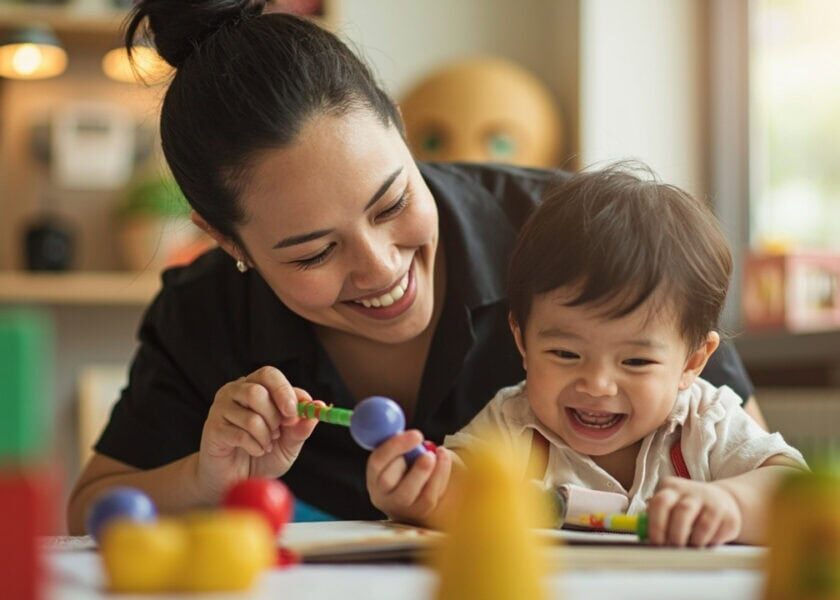
The Quiet Signs Your Child Is Thriving in Quality Childcare
Reading the Signs: Recognizing When Quality Childcare Is Working
After the placement is confirmed, after the settling-in visits, after the first week of tearful mornings that gradually become less tearful—there is a particular kind of mental work that begins.
It is the work of vigilance without crisis. It is the nightly review: Did they seem happy? Did they eat enough? Did they sleep? It is the morning question that lives in the back of your throat: Are we doing the right thing?
This question does not indicate failure. It indicates love. It indicates that you take seriously the weight of the choice you made and the years of development that hinge, in some invisible way, on the quality of care your child receives while you are not in the room.
But here is what most parenting resources miss: this question does not have a one-time answer. It has a daily, evolving answer that lives in your child’s behavior, your family’s rhythm, and the subtle shifts that accumulate over time into something you can trust.
The Evidence Is Right There
I have watched enough children in quality care to know the difference between what happens when care is adequate and what happens when care is genuinely excellent. The difference is often subtle. But it is there, and once you learn to see it, you cannot unsee it.
Quality care produces what researchers sometimes call behavioral synchrony—a state in which a child moves through the world with a kind of social ease that is not drilled into them but absorbed. A child in quality care will show what looks like genuine interest in other children: actual turn-taking, actual responsiveness to another child’s emotions.
A child in quality care will show what looks like confidence in navigating physical space—climbing, exploring, testing boundaries—not with recklessness but with the self-knowledge that comes from being in an environment where exploration is encouraged but safety is consistently assured.
They will show emotional range. A child who is genuinely thriving does not become a little robot who only smiles. They become children who show the full range of human emotion—frustration, sadness, anger, joy, wonder—because they feel safe enough to do so. They have learned that difficult emotions are not catastrophic. They have learned that adults in their world can handle their big feelings without collapsing or dismissing them.
And here is what is so beautiful about this: these signs are not invisible to parents. They are right there, in the evening hours, in the weekend interactions, in the small moments that make up family life. But parents often do not trust what they are seeing. They think, “Oh, she is just like that” or “Maybe this is just how children develop.”
Yes, children do develop. That is true. But the speed, the depth, the security with which they develop has everything to do with the quality of the environment in which they spend their waking hours.
Signs of Thriving You Can Watch For
- Separation confidence: Your child releases you at drop-off with increasing ease, not because they do not care, but because they trust the reunion will come.
- Social curiosity: Your child shows interest in other children beyond parallel play, attempting turn-taking and responding to others’ emotions.
- Physical assurance: Your child explores climbing, jumping, and testing boundaries with confidence rather than fear.
- Emotional openness: Your child expresses the full range of emotions—frustration, sadness, joy—because they feel safe enough to do so.
- Rest trust: Your child is learning that sleep will come, and so will you.
The Family Dividend: How Quality Care Benefits Your Whole Household
Quality childcare does not just benefit the child. It benefits the entire family system. Understanding this is essential to understanding why the decision you made matters in ways that extend far beyond the hours your child is in care.
Think about what happens in a family when childcare is working beautifully. The parents, freed from the background hum of anxiety that comes from wondering whether their child is okay, can be more present in the evening hours. They can engage in the kind of playful, patient interaction that requires emotional availability. They can listen to the day’s stories without the cognitive load of worry.
They can enjoy their children in a way that feels sustainable, rather than the kind of depleted, reactive parenting that comes from running on empty for too long.
The relationship between parents and child deepens. Not because quality childcare replaces parental attachment—it does not, it cannot—but because quality childcare actually strengthens the bond that parents are building. When a child knows they are safe and loved in two environments, they do not love the parents less. They love them more freely, because the security of consistent care allows them to explore the relationship with their parents rather than cling to it out of anxiety.
And the siblings, when there are siblings, benefit too. A toddler who has spent the day in rich, engaging care comes home to an older sibling with curiosity rather than neediness. They have the emotional bandwidth to play rather than compete. They have learned social skills in a setting outside the family that they can bring home. The family becomes an ecosystem that is strengthened, not divided, by the hours spent in quality care.
How Quality Care Strengthens the Whole Household
- Parents feel more competent: When you have evidence that your child is thriving, you trust your own instincts more.
- Evening interactions improve: Freed from background anxiety, parents can be genuinely present and playful.
- Sibling relationships flourish: Children come home with curiosity and bandwidth to engage rather than compete.
- The family breathes easier: Quality care creates a rhythm that the whole household can settle into.
What Flourishing Looks Like in Singapore
Singapore parents face a particular set of pressures that shape what quality care looks like in this city-state. Understanding those pressures is essential to understanding why the visible evidence of quality care takes on a particular character here.
Singapore is a dual-income country. This is not a cultural preference—it is an economic reality for most families. The cost of raising children, the expectations around education, the rhythm of life in one of the world’s most fast-paced cities: these all create a particular kind of pressure on parents that is different from what parents experience elsewhere.
There is less extended family readily available than in previous generations. There is more geographic distance from traditional support networks. There is the particular weight of academic expectation that begins earlier here than in almost any other country in the world.
All of this means that Singapore parents are making childcare decisions under a specific kind of stress. They are not just deciding who will care for their child. They are deciding how their family will function, how their partnership will survive the early years, how their career will proceed, how their child will be prepared for a world that is intensely competitive. The stakes feel high because they are high.
The Role of Caregivers as Translators
Quality childcare, when it is done well, does not insert itself into this web as a replacement for family. It offers itself as a complement—a reliable, professional partner that can work alongside whatever support already exists, filling gaps, providing consistency, and offering the kind of developmental engagement that busy lives may not always allow.
The best caregivers are not just people who keep children safe. They are translators. They translate child development into parental understanding. They are the bridge between what happens in the hours you are not there and what you are able to perceive when your child comes home.
A good caregiver notices things. They notice that your child has been working on a particular motor skill and is on the verge of a breakthrough. They notice that your child has been a bit more clingy than usual. They notice the subtle shifts in temperament, the new words emerging, the social dynamics forming between children.
And then they translate this into language you can understand. Not clinical language. Not development-speak. Human language.
“Your son figured out how to climb the ladder today. He was so proud of himself.”
“Your daughter has been asking about you. I think she misses you, but she is also having fun.”
“I noticed your child tried something new at snack time today.”
These small translations are not just nice-to-have communication. They are the raw material from which parental reassurance is built. They are the evidence, delivered by someone who was actually present, that allows you to trust what you are seeing at home.
They make you feel seen as a parent. They acknowledge that what you are experiencing matters. They treat you as a partner in your child’s development rather than just a customer of a service.
What Flourishing Looks Like in This Context
- A child who is curious but not anxious
- A child who is beginning to develop resilience—not because they have been pushed, but because they have been supported
- A child who can separate from their parents in the morning not because they do not care, but because they trust that the reunion will come
- A family that feels like it can breathe
A Note on Choosing the Right Fit for Your Family
Not every family is the same. Not every child thrives in the same environment. And the existence of multiple pathways means that families have real choice about what kind of care fits their values, their schedule, and their child’s temperament.
For families who are looking for something that feels more like home—more personalized, more attuned to the individual rhythms of their child—the home-based approach offers a different kind of environment. One where the caregiver relationship can develop with greater depth, where the setting is more intimate, and where the care can be calibrated to your child’s unique needs rather than a standardized schedule.
This is the approach that EduNanny Singapore offers. Operating within the ECDA Childminding Pilot, EduNanny represents a deliberate, structured effort to expand quality childcare options beyond traditional center-based pathways—giving families another meaningful choice as they think through what quality care looks like for their situation.
What EduNanny Offers Singapore Families
| Feature | What It Means for Your Family |
|---|---|
| ECDA Childminding Pilot participation | Structured, quality-assured approach aligned with national childcare standards |
| CDA and Baby Bonus eligibility | Financial structure that makes quality care more accessible |
| Home-based approach | Lower caregiver ratios, intimate setting, personalized to your child’s rhythms |
| Monday to Friday care blocks | Scheduling aligned with Singapore’s working week |
| Transparent practices and communication | Regular updates that help you see what is happening when you are not in the room |
| Thomas AI Chatbot | Real-time guidance beyond physical care hours, available when questions arise |
Beyond the logistics, EduNanny is built around a philosophy: that childcare is not simply matching families with caregivers. It is building an ongoing relationship with families that evolves as children grow and as parents’ needs shift.
The Thomas AI Chatbot, which offers parents real-time guidance and support, is an extension of this philosophy—an extension of care that extends beyond the physical presence of the caregiver into the digital space where parents live much of their lives. When you have a question at ten o’clock at night about your child’s sleep or your child’s behavior or your own transition back to work, you are not alone.
Common Questions From Singapore Parents
“How do I know if my child is actually thriving or just coping?”
The difference between thriving and mere coping shows up in emotional range. A child who is merely coping may seem calm but actually be suppressing expression. A child who is thriving shows the full spectrum of emotions—frustration, joy, sadness, anger—because they feel safe enough to be authentic. Watch for your child coming home with stories, with curiosities, with questions. A child who is thriving wants to share their world with you.
“What if I second-guess my choice forever?”
Second-guessing is not a sign of wrong choice. It is a sign of loving deeply. The goal is not to eliminate the questioning but to develop the skill of reading the evidence. When you can clearly see your child flourishing—behaviorally, emotionally, socially—the second-guessing naturally decreases. Quality care produces visible evidence. Learning to trust what you see is a skill that develops over time.
“Is home-based care really as good as centre-based?”
Different environments suit different children. Home-based care offers lower caregiver ratios, more intimate settings, and care calibrated to your child’s individual rhythms. Centre-based care offers peer interaction and structured curriculum. Neither is inherently superior. The question is which environment your particular child will thrive in. Both pathways deserve consideration.
“Can quality childcare really be affordable for us?”
Within the ECDA Childminding Pilot fee structures, quality care is more accessible than many parents realize. CDA and Baby Bonus funds can be used for childcare expenses, and EduNanny’s team can walk you through the financial planning. Quality care is an investment, but it is structured in ways designed to be manageable for Singapore families.
The Evidence Is Already There
Let me speak directly to the feeling that I know many of you are carrying. It is the feeling of having made the right choice and still not being entirely sure. It is the feeling of looking at your child each evening and wondering whether they are really okay, really thriving, really getting what they need.
This feeling is not a sign that something is wrong. It is a sign that you care deeply.
There comes a shift—subtle but unmistakable—when parenting moves from managing logistics to experiencing growth. It is the shift from wondering if your child is okay to trusting that they are flourishing. It is the shift from anxious nightly reviews to confident evening conversations. It is the shift from seeing childcare as a service you purchase to understanding it as an ecosystem that amplifies what your family is already building.
And here is what I want you to know: the evidence you are looking for is there. It is right in front of you, in your child’s behavior, in your family’s rhythm, in the way your child runs to greet you at the door or settles into sleep more easily at night or tries new things with a kind of cautious confidence that suggests they know the world is basically safe.
The child who comes home flourishing is telling you something. They are telling you that you chose well. They are telling you that the hours they spend in quality care are not wasted hours but hours of growth, learning, and security. They are telling you that the ecosystem you have built around them—home and childcare together—is working.
When your child is flourishing, you will be a better parent. Not because you are any more skilled than you were before, but because the weight of worry lifts enough for you to be present.
Explore What Quality Childminding Could Look Like for Your Family
If this article has resonated with you—if you recognize the evening moments and the quiet vigilance and the desire to trust what you are seeing—there are thoughtful, development-oriented childminding options available in Singapore that may be worth understanding better.
Whether you are just beginning to explore your options or are ready to take the next step, the EduNanny team is available to answer your questions and help you think through what quality care could look like for your situation.
Get in touch to start a conversation.
Because your child is showing you the evidence. We are here to help you read it.