Make a Shared Phrase Card for Your Baby’s Caregiver
EDUNANNY® BY BUTLER · PARENT GUIDE
What familiar words, songs and gestures would you like another caregiver to know? A small phrase card can hold a few family favourites while leaving the adult free to respond to your baby.
Choose one phrase, one short song line and one gentle gesture. Add a reminder to pause and notice what happens. The card is an optional memory aid for adults, not a set of responses your baby must produce.
Begin with what your family already uses
A caregiver may know the care routine without knowing your family’s little greeting, favourite song or familiar wave. You can share these details alongside the practical care information, without asking everyone to speak in an identical way.
Choose things you already enjoy using with your baby. A phrase might be a short greeting. A song entry might be a line from a family favourite or a greeting you sing yourself. A gesture might be a gentle wave the adult offers during a comfortable moment.
UNICEF’s baby tips suggest treating a baby’s sounds as a conversation and making songs personal with familiar words or the child’s name. These are broad ideas for family interaction. The three-part card here is our editorial suggestion, not a tested developmental programme.
Write the words as your family uses them, and explain their meaning if needed. If pronunciation matters to you, demonstrate it rather than expecting the next adult to guess from a spelling. Ask what the caregiver feels comfortable using, too.
You do not need a long vocabulary list. A few recognisable entries make it easier to discuss how you use them and when you leave the conversation open.
Keep the phrase, song and gesture easy to find
The example below is invented for illustration. Maya is a fictional baby, the greeting line is made up and the card does not describe an observed family or an expected infant skill.
| Card entry | Illustrative example | How an adult might use it |
|---|---|---|
| A familiar phrase | Illustrative example“Hello, Maya.” | How an adult might use itOffer the greeting when it fits the moment, then leave space to notice the baby. |
| A short song line | Illustrative example“Hello, Maya, here we are.” | How an adult might use itSing this made-up line in a familiar tune or rhythm, then pause. |
| A gentle gesture | Illustrative exampleA small wave. | How an adult might use itOffer the wave without taking the baby’s hand or asking for a copy. |
Change the entries to suit your family. You can write a word the adult uses, rather than one the baby says. There is no need for the baby to speak, sing or wave back for the card to be useful.
Under the entries, add one simple reminder: Notice the baby, offer a response that fits, then pause. Move on when the moment changes. This keeps the examples as options instead of a sequence to complete.
Keep the card where adults can consult it as part of the handover. It is for caregiver reference, not an item to give the baby to play with.
Explain one ordinary moment together
Read through the card with the caregiver and show how you usually say or sing an entry. Describe a particular situation if it helps: “We sometimes use this greeting when we sit together after the morning routine.” Leave room for their questions and their way of speaking.
Then explain how you choose what to do next. You might answer a sound with a sound, name something the baby is looking towards or simply acknowledge a look. A familiar card entry is available when it fits; it does not have to interrupt what the baby is already doing.
Harvard’s serve-and-return podcast describes back-and-forth interaction that begins with a child’s contribution, including sounds and looking. It recognises meaningful relationships with relatives and early childhood educators as well as parents.
The same discussion explains that children need time to process independently and do not need constant interaction. That is a useful boundary for this card: leave space for a sound, a change of attention or a quiet moment. Do not keep presenting the entries to obtain a particular reply.
A fictional handover of the card
A parent might say: “These are a few familiar starters. The greeting is something we say; Maya doesn’t need to repeat it. You can use one when it fits, or follow what she is already looking at.”
The caregiver might ask: “If she looks away during the song, shall I leave it there?” The parent can explain the reminder to pause, notice the change and move on. This is invented wording to show the discussion, not a report of a care session.
Adult care responsibilities still guide the moment. A phrase card should not delay feeding, rest, comfort or a safety task, and it does not replace the care brief agreed for your baby.
Keep the entries useful as things change
After the caregiver has used the card, ask whether the entries were clear and easy to recognise. You can clarify a word, show a gesture again or remove an entry that no longer fits your family’s routine.
If you compare an observation, keep it modest and specific: “We paused after the greeting” or “We left the song there when attention changed.” A single moment does not tell you that a word has been learned, a bond has been established or a milestone has been reached.
The adults do not need identical voices or identical exchanges. The shared part is the small set of familiar options and the willingness to attend to the baby, rather than a requirement to deliver the same performance.
Make one card, then leave room for a response
Choose a familiar phrase, a short song line and a gentle gesture. Explain them to the caregiver, add the pause reminder and keep the card for adult reference.
For the broader care information a new caregiver needs, see our caregiver handover guide. For choosing a reply during play, explore echo, name or add one detail for babies aged seven to twelve months.
Sources and image credit
- UNICEF: practical baby interaction tips — sounds as dialogue and familiar words in songs.
- Harvard: serve and return — responding to the child and allowing time without constant interaction.
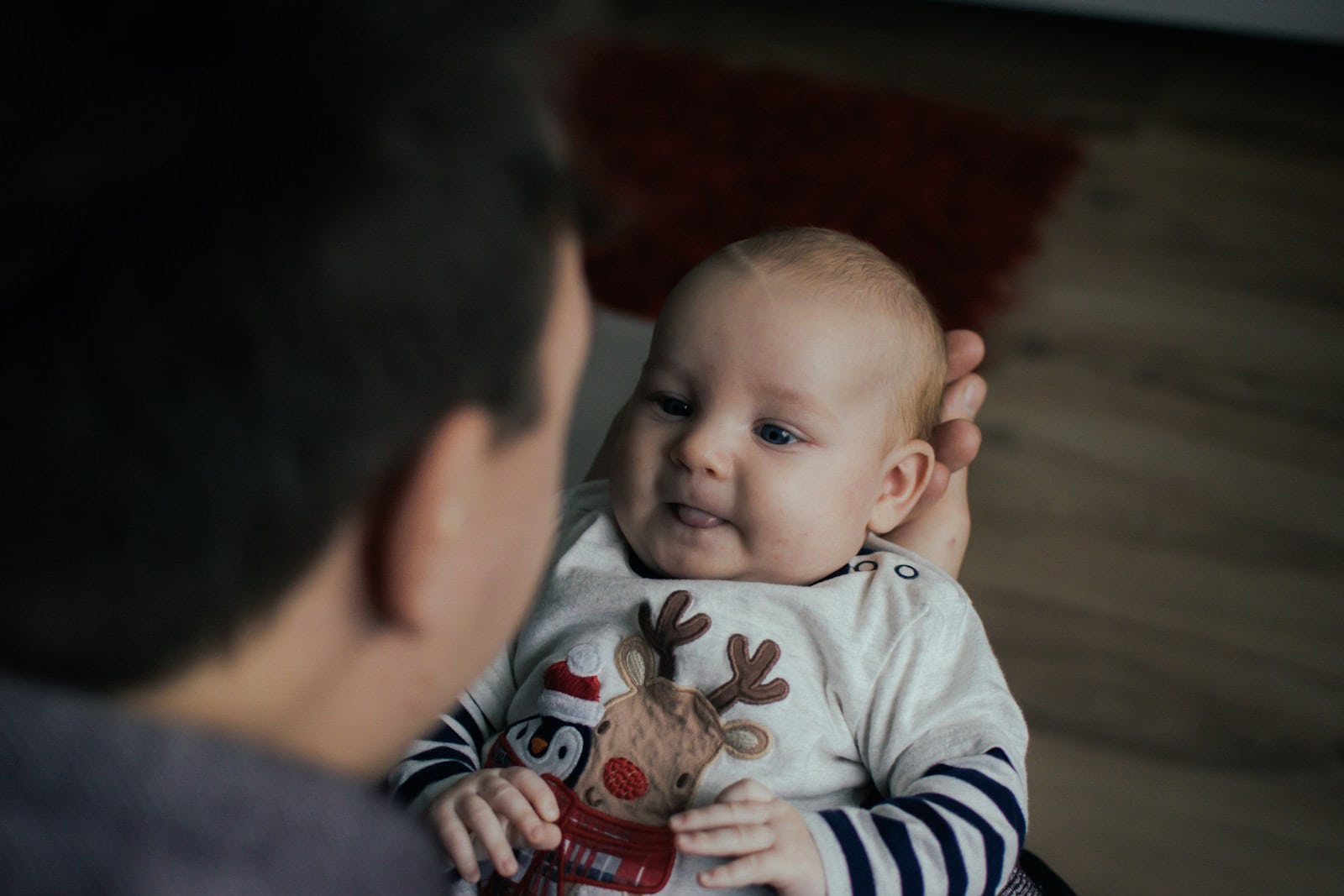
Stock photograph by Egidijus Bielskis on Unsplash, used under the Unsplash licence. An illustrative adult-and-baby interaction; it does not depict the fictional card example or EduNanny staff or clients.