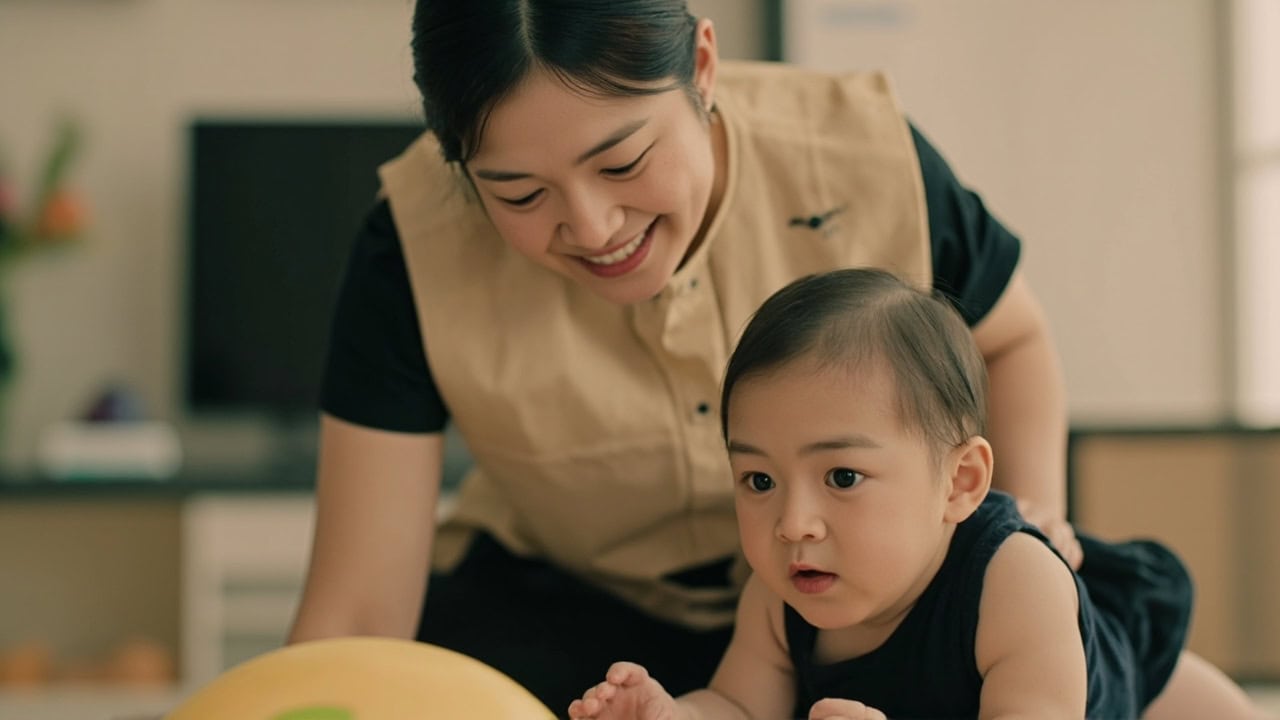
Baby Movement Play: A Three Step Routine for 7 to 12 Months
Use one large toy to invite reaching, rolling or shifting on the floor. Learn how to set an attainable challenge, notice your baby's effort and decide when to adjust or seek advice.
When a toy is just beyond your baby’s reach, it can be tempting to move it closer, offer a hand or wait to see what happens next. For a baby aged 7 to 12 months, a useful movement play routine is simple: prepare a clear space, place one suitable toy within reach and allow enough time to notice your baby’s response.
Our three step routine starts with an easy reach, leaves room for your baby to respond, then changes the invitation according to comfort and interest. It gives babies a chance to look, reach, roll, push up or shift position without turning the activity into a test for crawling, standing or walking.
The goal is not to create a particular movement on a particular day. It is to make movement possible, notice what your baby does and respond thoughtfully.
Start with the space, not the milestone
Clear a comfortable floor area before you begin and check it from your baby’s level. Remove loose small objects and breakable items, and cover accessible electrical sockets before play. HealthHub advises allowing plenty of space for rolling and, eventually, crawling. An open area gives your baby room to look around and choose a familiar or new way to move.
For the toy, choose one large, intact item that your baby can reach and explore comfortably. HealthHub’s guidance for babies at 7 to 9 months recommends larger toys with smooth, curved handles. The same guidance advises avoiding small objects that may be swallowed accidentally and toys with pieces that could break off. Check the toy before placing it in front of your baby.
One toy is enough for this routine. It gives your baby a clear focus without filling the space or competing for attention.
Turn one toy into a three step movement invitation
Try the following with a large soft ball or another suitable toy. Keep the whole activity playful and responsive rather than trying to produce a chosen movement.
- Set an attainable starting point. Place the toy within your baby’s easy reach, with enough room to stretch towards it. Keep it still. You can say something simple, such as, “The soft ball is here.” Then wait and watch.
- Leave time for your baby’s response. Notice whether your baby looks towards the toy, reaches, pushes up, rolls, shifts position, pauses or chooses something else. Give your baby time to notice and respond without repeatedly moving the toy or adding instructions.
- Adjust the invitation. If your baby moves away, pauses for a long time or seems uncomfortable, bring the toy back to easy reach or end the activity gently. If your baby remains comfortable and interested, move the toy a little farther away and pause again. HealthHub suggests encouraging babies to reach towards an object that is moved gradually farther away. Stop while your baby is still comfortable and engaged.
For a worked example, imagine your baby lying on a clear mat with a soft ball just beyond the fingertips. You place the ball within easy reach and say, “The soft ball is here.” Your baby looks, stretches and reaches. You wait instead of moving the ball again. After the first effort, you place the ball a little farther away. If your baby shifts forward and reaches comfortably, leave it there for another short pause. If your baby turns away or becomes uncomfortable, bring the ball back and finish while the interaction is still calm.
Each step changes the next invitation only for a clear reason. If your baby looked and reached when the ball was close, the first adjustment could be a slightly greater distance. If your baby became uncomfortable, the next adjustment brings the ball closer again. This makes the routine easy to repeat without increasing the challenge simply because a milestone chart says it is time.
For another round, return to the distance that held your baby’s interest rather than starting where the toy ended. The same setup can then change with your baby’s balance, reach, comfort and choice on the day.
Notice effort, strategy and enjoyment
A brief record helps you notice what happened without labelling the session. Write what your baby did, what you changed and how your baby responded. For example: “Ball within reach. Looked, reached and turned away. Brought it closer.” This describes one play session rather than assessing development.
Babies do not reach developmental milestones at one precise time or in an identical order. KKH explains that children reach milestones within a range and should be considered against the general pattern of development. Notes can make a repeated concern easier to describe, while avoiding conclusions based on one reach, pause or attempt at a new movement.
Keep movement playful and know when to ask
Use this routine for awake play on a clear floor with an adult close by. Stop when your baby becomes tired, unsettled or uninterested. The toy and the distance should always remain suitable for the response you observe.
Consult your baby’s doctor if you are concerned that their development does not follow the general pattern. KKH recommends seeking medical advice when the general pattern of development is not followed. As a specific age related checkpoint, HealthHub advises parents to consult a doctor if an infant is not sitting unaided by 12 months.
Sources and further reading
- The Beginner’s Guide To Taking Care of Your Infant: 7 to 12 Months · www.healthhub.sg
- Your Growing Baby · www.healthhub.sg
- Development · www.kkh.com.sg
The images in this article were generated with AI for illustration. They do not show actual EduNanny staff, children or facilities.
Try the three step routine once today, then note what your baby noticed, reached for and tried next.