Childminding Pilot Quality: A Four-Part Visit Note
Individual attention is easier to judge when parents record what changes after an infant's cue. A practical four-part visit note follows the cue, response and pattern, keeping care observations separate from unsupported promises about developmental gains.
A practical way to recognise individual attention is to record what changes after an infant’s cue. A caregiver notices, responds and leaves room for an answer. The exchange may be brief and ordinary. Rather than relying on a broad label, parents can trace a simple chain: cue, response and pattern. Its value lies in responsiveness, not in a polished activity or a claim about a future milestone.
That distinction is especially important for parents considering Singapore’s Childminding Pilot for Infants. The official ECDA page says the pilot runs from 1 December 2024 to 31 December 2027 and that Singapore Citizen infants aged 2 to 18 months may participate. It provides programme dates and eligibility context, not a measured developmental result. A grounded assessment of childminding pilot quality can therefore begin with what happens in the next exchange.
Begin with facts, not a developmental promise
Official information can answer some practical questions, including the stated age and citizenship criteria and the pilot period. It does not turn those facts into evidence that a particular setting will produce faster language, cognitive or motor development. Participation is a programme fact; an observed exchange is a description of care; an outcome is a measured change. They should not be used as synonyms.
That distinction prevents a practical question from becoming a sweeping promise. Ask what the caregiver noticed, what the infant did and what happened next. If a conversation moves from programme availability to a claim that care will accelerate development, ask what outcome is being measured, over what period and in whom. Without published evidence answering those questions, the stronger statement should be treated as a promise, not a finding.
A usable account identifies the infant’s cue, the caregiver’s action and the infant’s answer. A sweeping outcome statement requires evidence that defines and measures the claim. This is a more precise way to discuss quality than a promise the cited evidence cannot support.
The next turn is the unit of attention
The Harvard’s explanation of serve and return describes responsive, back-and-forth exchanges between a young child and a caring adult, and says these interactions play a key role in shaping brain architecture. That is a general developmental principle. It is not an evaluation of Singapore’s pilot, and it does not show that a particular provider or interaction caused a milestone.
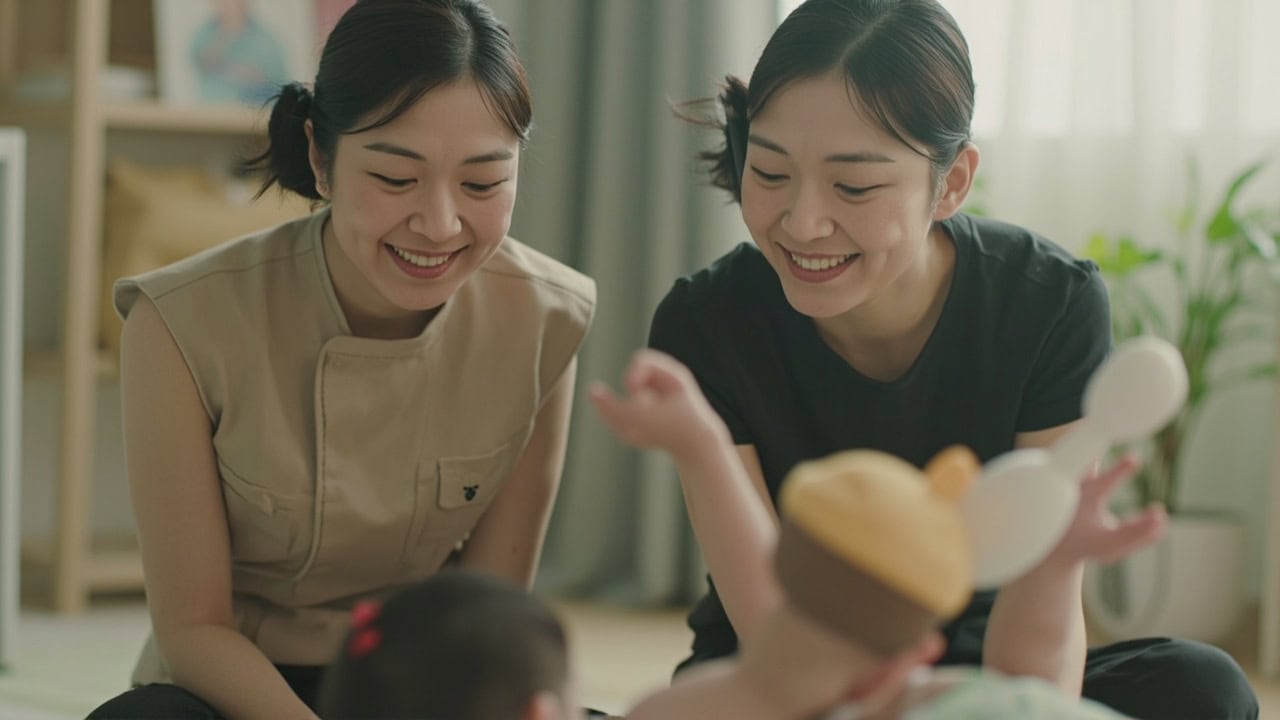
Consider a hypothetical exchange. An infant looks toward a cup and vocalises. A childminder follows the gaze, offers the word cup and pauses. If the infant reaches or answers with another sound, the adult responds again. The meaningful observation is not simply that a word was delivered; it is that the infant’s contribution shaped what happened next. This is an illustration, not a report of an observed family scene or a developmental test.
The five-step resource offers a practical sequence built around responding to a child’s serve, supporting and encouraging the response, giving the child a chance to answer and keeping the turns moving. The material notes that turns can be quick; it does not turn that observation into a fixed number of seconds. The aim is a fit between the child’s signal and the adult’s next move.
Make a visit a trace, not a performance
Parents do not need to stage a test or ask an infant to demonstrate a skill. A more useful observation follows a cue through the rest of an exchange. In a notebook or after a visit, record four details: what the caregiver noticed, what the caregiver did, how the infant answered and whether the next action changed. This format makes the judgement inspectable without pretending to measure development.
- What cue did the caregiver notice?
- Did the response fit that cue and leave room for an answer?
- Did the caregiver support the infant’s response and adjust when it changed?
- Can the caregiver describe the exchange without predicting a milestone?
These are questions about interaction, not a scorecard for a baby’s ability. One exchange is a glimpse. A recurring pattern across play, movement, transitions or quieter moments gives parents more context, but it still describes care rather than proving a programme-wide effect. Even then, it is one dimension of quality, not a developmental assessment. The pattern need not look identical every time; recognition and adjustment are more useful than performance.
Ask for examples across the day rather than relying on one song, toy or activity. A caregiver may describe a plan in general terms; the next step is to ask what happened when the infant did something unplanned. That question keeps the account tied to the care described, without turning anecdotal impressions into proof or a promise about another child.
Use age-accurate language and the infant’s pace
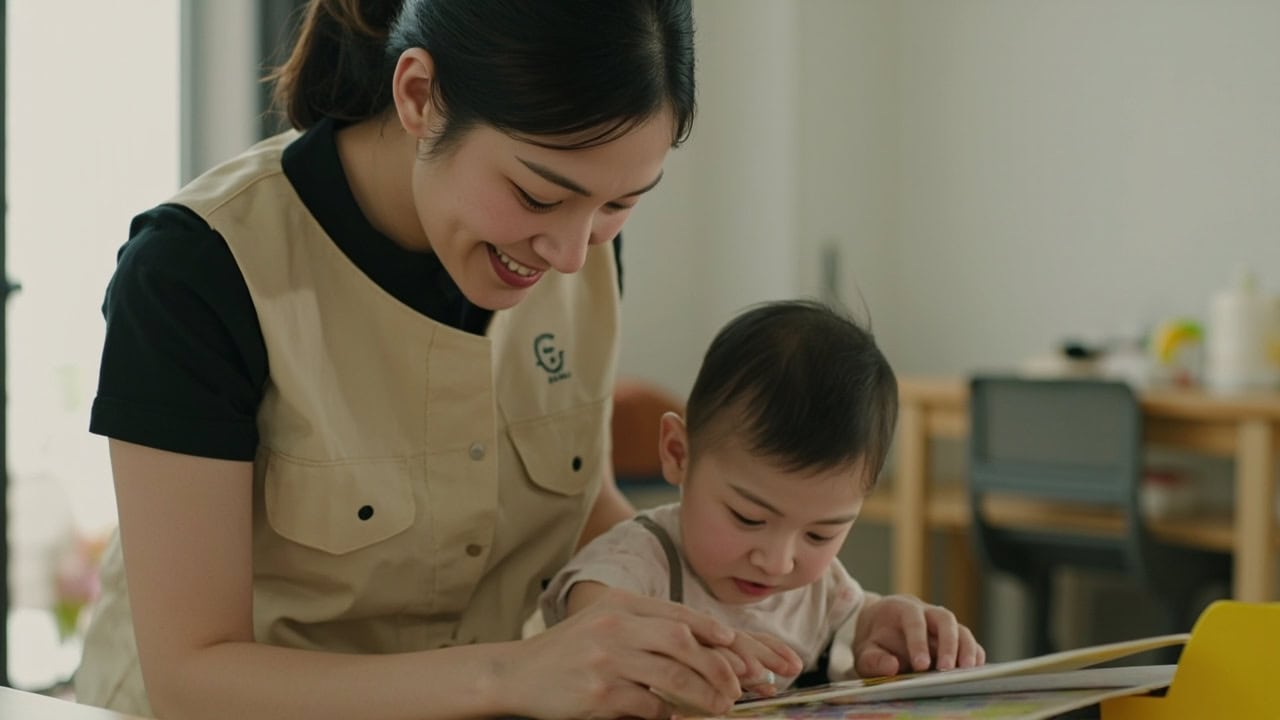
Responsive care starts with describing the child’s contribution accurately. Looking at a picture is not the same as identifying it; making a sound is not the same as producing words; watching or moving to a song is not the same as singing lyrics. These are not labels to attach to a child. They are practical reminders to match the response to what the infant is doing.
If an infant gazes toward a familiar object, an adult can name it and leave room for looking, reaching or turning away. If the infant vocalises, an adult can answer with a sound or word and wait for another turn. A pause does not need to be filled with more stimulation. The point is a response that fits the signal, not a performance designed to produce a particular result.
The EduNanny ECDA Childminding Pilot page describes age-appropriate floor play, reaching and exploration, with infants supported at their own pace. That is a first-party description of the provider’s approach, not independent evidence of a developmental effect. It can nevertheless prompt a useful visit question: what does support look like here, and how does the caregiver adjust when the infant’s interest changes?
Keep observation, principle and outcome apart
Observation. An observation can state that an infant signalled, an adult responded and another turn followed. It may support a judgement about attentiveness in that moment. It cannot by itself establish a lasting cognitive, language or motor gain, or show what would have happened without the interaction.
Developmental principle. The Harvard material supports the general importance of responsive exchanges. It does not show that every infant-care setting produces the same result, that a named provider caused a milestone or that participating in the pilot improved outcomes across families.
Programme result. A programme-level outcome claim would need published evidence that defines the outcome, measures change over time and, where relevant, uses an appropriate comparison. The cited ECDA information supplies dates and eligibility, not that evaluation. Keeping the layers separate is a way to value responsive care without turning a plausible expectation into a finding.
The provider’s own page is explicit that its individual development stories are observations, not a typical timetable or guaranteed result, and do not establish that a programme caused a milestone. That distinction is useful when a parent hears a memorable story: one child’s experience may illustrate an opportunity, but it cannot establish what will happen for another child.
Turn a visit into a careful quality decision
After a visit, parents should leave with a short record rather than a slogan. Write down one cue, the caregiver’s response, the infant’s answer and the next adjustment. Repeat the exercise across different ordinary moments. Then separate the conclusion into three sentences: what was observed, what the general responsive-care principle supports, and what remains unproven about programme-wide outcomes.
Ask how a caregiver handles a changing signal, not whether they can make an infant perform. Ask what they will do when the child looks away, pauses or chooses another object. Those questions reveal the quality of attention more directly than a polished demonstration or a marketing label.
The brand’s first-party description of its ECDA pilot approach – responsive infant care and purposeful early learning – offers a useful vocabulary for that conversation. It is a statement of the brand’s approach, not independent evidence that the approach produces superior outcomes. Programme facts should still be checked against the official ECDA information.
Individual attention is not a developmental guarantee. It is an observable practice: a cue is noticed, a response fits, an answer is welcomed and the next turn changes with the child. That is a stronger and more honest standard for judging childminding pilot quality than a promise that an infant will reach a milestone sooner.
Sources and further reading
- Childminding Pilot for Infants · Early Childhood Development Agency (ECDA)
- Serve and Return: Back-and-forth exchanges · Center on the Developing Child at Harvard University
- 5 Steps for Brain-Building Serve and Return · Center on the Developing Child at Harvard University
- EduNanny ECDA Childminding Pilot · EduNanny
The images in this article were generated with AI for illustration. They do not show actual EduNanny staff, children or facilities.
Every family has different care needs. Speak with EduNanny to discuss care that is right for your child.