Beyond Research: How Singapore Parents Find Childcare They Can Trust
“`html
The Evaluation Trap: Why Research Alone Cannot Quiet Your Doubts
We live in a society that has turned evaluation into a sport. Singapore parents are exceptional at it. You know how to compare curricula, ask the right questions on tours, and hold informed opinions about pedagogical approaches, staff qualifications, and meal nutritional content. You have done the work.
And yet, despite all of that careful research, something persists—a quiet, persistent whisper that asks: “But do I really know this person? Can I be certain they will love my child the way I do, protect them the way I would, notice the small things that only someone who loves them would see?”
This whisper does not disappear when you find a centre with excellent reviews. It does not quiet when you meet a caregiver with impressive credentials. It follows you to the classroom door, to the car seat, to the moment you walk away and leave your child in someone else’s arms.
Here is what we want you to know: this whisper is not your enemy. It is the voice of love, imperfectly expressed. Understanding why it persists—even when you have made what you believe is the right choice—is the first step toward moving beyond it.
Confidence vs. Trust: The Difference That Changes Everything
There is a difference—important, consequential, and often overlooked—between the confidence that comes from credentials and the trust that comes from observation.
Confidence is what you feel when you have done your research. It is the assurance that comes from a completed checklist, a satisfactory inspection report, a caregiver with verifiable qualifications.
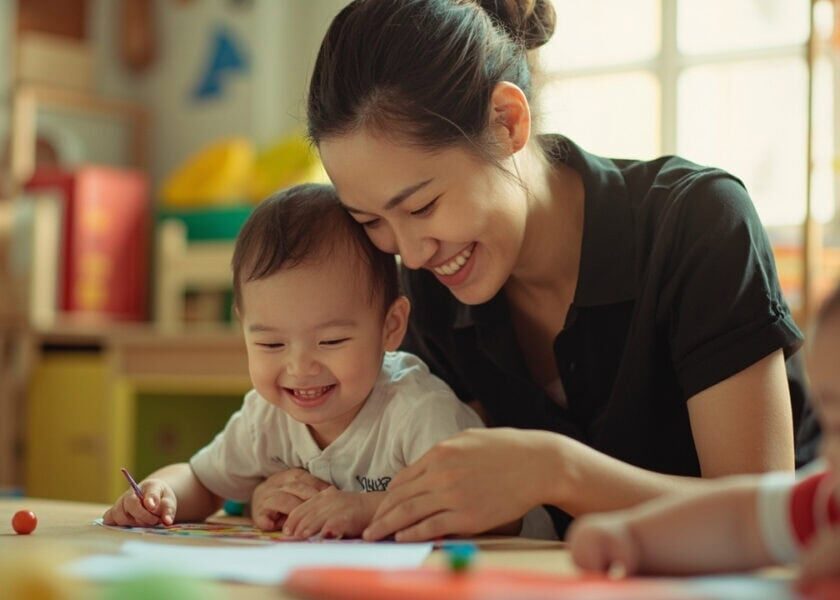
Trust is what you feel when you watch your child run toward their caregiver without hesitation. It is quieter than confidence. It lives in the body, not the mind.
Both matter. But they are not the same thing. The most effective childcare does not merely satisfy your need for confidence. It earns your trust.
What Credentials Can Tell You
When parents evaluate childcare on paper, they are measuring something real—qualifications, ratios, safety protocols, curriculum coherence. These are the foundations of quality care, and they should never be dismissed.
But paper tells you about the structure of care. It does not tell you whether that care will reach your child in a way that feels like warmth. It does not tell you whether the caregiver will notice when your usually chatty toddler goes quiet. It does not tell you whether the environment will make your child feel safe enough to be curious.
Those things cannot be captured in a brochure or a tour. They have to be built, over time, through the daily accumulation of small moments that prove—again and again—that your child is in a place where they can flourish. This is what secure attachment looks like when you are not in the room to witness it.
The Trust Signals That Tell You Quality Care Is Working
You may not know the term “secure attachment,” but you know the evidence. You know it when your child, after a day at childcare, comes home not just happy but genuinely settled. You know it when they speak about their caregiver the way they speak about a favourite aunt—not with the reflexive affection of family, but with the chosen warmth of someone they trust.
You know it in the questions they ask on the drive home, the songs they repeat, the way they describe what they did and, more revealingly, how they describe how they felt. A child in quality care does not simply tolerate their time away from you. They use it. They grow from it. And they come back to you more themselves, not less.
What Trust Looks Like in Everyday Moments
- When your toddler greets their caregiver with genuine recognition—not the performed politeness we teach children, but actual recognition—that is trust.
- When your child mentions something their caregiver said as casually as they would mention something you said, that is trust.
- When they fall asleep easily after a day of care because they have learned that mornings end in reunions, that is trust.
- When the caregiver texts you not because protocol demands it but because they noticed something worth sharing, that is trust.
- When your child asks about their caregiver on weekends or mentions them in contexts unrelated to drop-off, that is trust.
These are the observable moments that tell you your childcare is working—not because someone told you what to look for, but because your child is showing you every day.
The Hidden Variable: How Your Trust Shapes Your Child’s Experience
Here is what is less often spoken about but equally true: children sense your trust before they understand it.
The child whose parent lingers at the door, whose face carries the weight of doubt, whose goodbye includes three reassurances and a lingering look back—that child is receiving a message. Not a verbal one. A cellular one.
Children read their parents the way we read the weather. They know when we are at ease. They know when we are not. And their ability to settle into the care of another depends, in part, on whether the adults in their life communicate that this person is safe.
This is not about pretending to feel what you do not feel. It is about recognizing that your trust is not just an emotional state—it is an environmental factor. It shapes the atmosphere your child breathes.
From Hovering to Partnering
There is a difference, and it is not subtle, between hovering and partnering.
Hovering is what you do when you do not trust. It is the check-ins that feel like surveillance, the questions that feel like interrogation, the relationship that exists only on the surface of information exchange. Hovering keeps you at a distance from the very people who are caring for your child—and it is exhausting.
Partnering is what you do when you are building something together. It is the transparent communication where both sides contribute, the feedback that flows in both directions, the recognition that the caregiver is not an extension of you but a distinct human who brings their own warmth, their own instincts, their own relationship with your child.
This shift transforms parenting anxiety from a burden into a practice. It moves you from the lonely position of monitor—exhausting, isolating—into the collaborative position of partner. And partnership is where trust deepens.
What Quality Childcare Looks Like in Practice
In Singapore’s childcare landscape, families have access to different models of care—centre-based, home-based, and everything in between. Each has its strengths. Each serves different family needs.
But there are qualities that distinguish quality care regardless of setting. These are the hallmarks of a childcare relationship that earns trust, not just confidence:
- Genuine attention over managed ratios—The best care happens when the adult-to-child ratio allows the caregiver to truly notice each child, not just supervise them.
- Communication that flows naturally—Updates feel like sharing, not reporting. Questions feel welcome, not intrusive.
- Transparency as culture, not policy—Parents know what is happening not because they have to ask, but because sharing is natural.
- Observation as a core skill—Caregivers who notice when a usually chatty child goes quiet, who track developmental milestones with attention, who know each child’s rhythms.
- Partnership orientation—The caregiver sees themselves as an extension of the family’s care, not a replacement for it.
How to Know If Your Child Is Truly Safe and Flourishing
Safety is the foundation, not the ceiling. The question “is my child safe?” deserves a clear, verifiable answer—which is why credentials, ratios, and safety protocols matter. But safety alone is not what parents are really asking.
What you want to know is whether your child is not just protected but flourishing. Whether they are in a place where their curiosity can expand, their confidence can grow, and their emotional world is seen and supported.
What If You Do Not Feel Immediate Trust?
Trust is not a feeling that arrives on day one. It is a practice that develops over time. The permission to trust gradually—without guilt, without performance—is one of the most important gifts a childcare relationship can offer.
You do not have to pretend to feel what you do not feel. You do not have to perform confidence to prove you made the right choice. You can arrive uncertain, observe honestly, and allow your trust to develop as evidence accumulates. This is not a slow path to distrust. It is the slow, careful path to genuine trust—the kind that grows because it was given room to.
Is Something Wrong With You If You Keep Second-Guessing?
Nothing is wrong with you. The tension you feel each morning is the reasonable consequence of loving someone completely. It is also, paradoxically, the same energy that makes you an excellent researcher, a careful evaluator, a parent who shows up and pays attention.
The goal is not to eliminate this tension. It is to direct it—away from the exhausting work of constant monitoring and toward the generative work of partnership.
EduNanny: Built for Partnership, Designed for Trust
EduNanny was built with this partnership in mind. When we designed our approach, we understood that Singapore parents were not looking for another service. They were looking for a partner in the truest sense—someone who would not just receive their child but receive their concerns, their values, their hopes.
Someone who would communicate not because transparency was a policy but because partnership requires it. Someone who would welcome questions not as intrusions but as the natural expression of a parent’s love.
The Ratio Advantage
Our model begins with ratios that allow for genuine attention. When you care for one, two, or three infants at most, you are not managing a group. You are noticing. You are learning the rhythms of each child, the small variations in their moods, the way they communicate before they have words.
The intimacy of care at this scale is not a limitation. It is the condition that makes trust possible.
Communication as Culture
Communication is woven into how we operate, not appended as a feature. Parents in our programme know what is happening in their child’s day not because they have to ask, but because it is natural to share.
This is not about surveillance cameras or logged updates—though transparency measures exist where they serve genuine purpose. It is about a culture of openness that says: we know this is your child, and we know you need to know them too, even when you are apart.
Caregivers Selected for Relationship
Our caregivers are not selected only for qualifications, though qualifications matter. They are selected for their capacity to form genuine relationships with children and, equally, with the families who entrust those children to them.
The trust that matters most in infant care is not bureaucratic. It is human. It lives in the way a caregiver talks about your child when you pick them up, the way they remember small details, the way they speak about your child’s day with the specificity that comes from attention rather than obligation.
Making It Work: Practical Realities for Singapore Families
For families navigating the practical realities of childcare in Singapore, there are considerations that matter beyond philosophy. Not because money should be a barrier to quality, but because stress about logistics has a way of bleeding into everything else.
- Pilot fee structures designed to be accessible for Singapore families
- CDA and Baby Bonus are usable where applicable
- Monday to Friday care blocks structured around the actual rhythms of working parenthood
These are not glamorous features. They are the conditions that allow a family to stop worrying about logistics so they can focus on what matters: watching their child grow in the care of someone they have learned to trust.
The Trust You Are Looking For Is Real
Every morning, somewhere in Singapore, a parent hands their child to a caregiver and makes a decision—a quiet, profound, courageous decision—to believe that this person will love and protect and nurture their child in their absence.
This act is not naive. It is not weakness. It is the most tender expression of parenthood: the willingness to let go, because you have found someone worthy of the trust.
That trust, when it is placed well, does not diminish your role as a parent. It expands it. It creates space for partnership, for shared observation, for the recognition that your child’s development is not something you manage alone but something you steward together.
And it gives your child something invaluable: the experience of being loved by more than one person, securely enough that it does not compete with your love but complements it.
So if you are a parent who carries that quiet tension every morning, who has done the research and still feels the weight of the decision, who wants to trust and does not know how to stop hovering and start partnering—we understand. We have seen it in every family who walks through our doors, hesitant and hopeful and ready to believe.
The trust you are looking for is not a myth. It is not an achievement that belongs only to families who have somehow gotten over their anxiety. It is a destination you arrive at, slowly, when you find the right people and give them time to prove themselves.
Your child is already telling you what they need. The way they run toward their caregiver. The way they speak about their day. The way they fall asleep easy and wake up ready.
Listen to them. They already know what trust feels like. The only question is whether you will let yourself feel it too.
If you are exploring infant care or childminding options in Singapore and would like to learn more about how EduNanny approaches partnership with families, we would be glad to hear from you. Get in touch to start a conversation.
“`