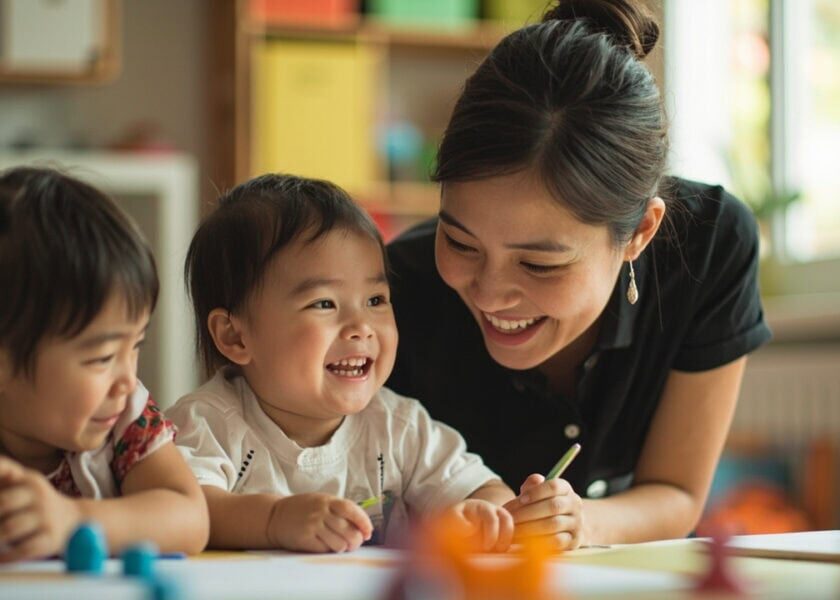
What Your Child Is Really Telling You at the Childcare Gate
The Language Your Child Is Already Speaking
There is a moment that every Singapore parent knows. It happens at the childcare gate, or perhaps just after pick-up, when your child runs toward you with something unnameable in their expression. You want to ask, “How was your day?” But something in you hesitates because you already suspect the answer will be “Good”—and good is not enough.
Good does not tell you what your child learned about patience this morning, or whether the sharing exercise left them feeling proud or quietly frustrated. Good is the surface of a deep lake, and you are standing at the shore wondering what moves beneath.
This is not a problem of love. Every parent loves their child with a completeness that needs no qualification. The challenge is something else entirely: it is the gap between wanting to understand and knowing how to look. It is the quiet frustration of receiving a childcare update that says “played well with others” when you are desperate to know what that actually looked like, what it meant, whether it was easy or hard-won.
This article is about closing that gap. Not with reassurance alone, though reassurance has its place. But with something more useful, more enduring, and more genuinely empowering: the skill of observation. The art of noticing. The practice of reading your child.
Why Singapore’s Early Childhood Ecosystem Needs a Parent Literacy Layer
Singapore has built an extraordinary early childhood ecosystem. Quality frameworks, accreditation systems, well-trained educators, and government support that many countries would envy—all of this exists. The ECDA Childminding Pilot represents one of the thoughtful responses to a very real need: the recognition that infants and toddlers require specialized care environments, lower ratios, and deeper attention than older children.
When you choose a pathway like EduNanny Singapore under this pilot, you are not simply outsourcing childcare. You are entering into a relationship with a system designed around developmental science and practical support for families.
But here is what childcare conversations rarely address: the skill you need to get the most out of that system is not the skill of choosing well. It is the skill of seeing clearly once you have chosen.
Your child’s development is not something that happens in a separate country called childcare, apart from your life, and then delivered back to you in a summary. It happens in real time, in small moments, in the way your toddler arranges their toys before eating, in the way they look to you for a reaction before exploring something new, in the way their shoulders drop slightly when they finally feel safe in an unfamiliar room.
These are not mystical signals that only experts can decode. They are observable. They are meaningful. And with a small investment in attention, they become legible.
Learning to Read What Your Child Cannot Yet Say
Let me give you a concrete example, because principles without examples remain abstractions.
Imagine you pick up your eighteen-month-old from care, and she is clutching a crayon that is not hers. The teacher mentioned she had a difficult moment during art time. Your first instinct might be to ask, “What happened?” But she is eighteen months old, and words will not serve her here. So instead, you watch.
You notice that she holds the crayon with unusual intensity. She keeps looking back toward the classroom as you walk to the car. She is narrating her own actions in a way that sounds almost like she is justifying them to an invisible audience. She is trying to tell you something. She just does not have the words yet.
What you are observing is the architecture of a moral experience. Your child encountered a moment of wanting something that was not hers, and she took it. Now she is living with the cognitive and emotional residue of that choice. She may be proud. She may be confused. She may be testing whether you will react the way the teacher did, or differently.
This is not a behavioral problem to be solved. It is a developmental moment to be understood.
Parents who have cultivated observational literacy do not feel panic in this moment. They feel curiosity. They ask themselves:
- What is my child trying to communicate?
- What does she need from me right now?
- Is this a moment for teaching, or for holding?
They do not have all the answers, but they have learned to ask better questions.
The Three Domains Where Observation Matters Most
The signals I am describing are not rare or exotic. They are happening every single day, often in the minutes between pick-up and home. Here are the three domains where parents most often crave this interpretive skill.
1. Behavioral Adjustment
When your child begins care—whether at three months or three years—their behavior will tell you how the transition is going, but not always in obvious ways.
- Some children cry at drop-off and recover quickly. This is an overt signal: separation anxiety, processed and resolved within the session.
- Others are silent and watchful for weeks before their true feelings emerge. This is a covert signal: the child is calibrating, gathering data about safety, before responding.
- Still others seem perfectly fine for months and then suddenly regress. This is a delayed signal: accumulated stress that has finally exceeded a threshold.
None of these patterns means something is wrong. They are all variations of how children calibrate to new environments. What matters is that you learn to read the specific signature of your own child’s adjustment rather than comparing it to a generic template.
2. Emotional Regulation
One of the most meaningful things quality infant care provides is scaffolding for your child’s developing ability to manage big feelings. Watch how your child handles frustration now compared to three months ago.
Notice whether they are beginning to use strategies they learned in care, or whether they seem to be carrying dysregulation home. These are not failures. They are data points in a long developmental arc.
When you notice them, you become a more effective partner in the work of teaching your child how to recover, how to self-soothe, how to ask for help. The bedtime routine tonight is an extension of what they learned in care today. When you understand this connection, you engage differently.
3. Developmental Engagement
When you ask, “What did you do today?” you are asking the wrong question. The right question is, “How did you experience today?”
A child who says they played with blocks is giving you a category, not a story. But a parent who has learned to observe will notice:
- That their child spent the afternoon building and destroying the same structure repeatedly
- That they preferred to work alone rather than alongside others
- That they showed visible satisfaction when the tower reached a certain height
This is the texture of your child’s cognitive and creative development, and it is available to you if you learn to look for it.
| Observation Domain | What to Notice | What It Tells You |
|---|---|---|
| Behavioral Adjustment | Crying patterns, recovery time, regressive behaviors | How your child calibrates to new environments |
| Emotional Regulation | Frustration tolerance, self-soothing attempts, carry-over from care | Where your child is in their regulatory development |
| Developmental Engagement | Play patterns, persistence, social preferences, satisfaction signals | Your child’s cognitive style and emerging interests |
The Gate Ritual: Your Daily Observation Practice
Let me bring this closer to what your child looks like right now. When you arrive at the childcare gate, pause before you speak. Just for a moment, let yourself look.
Ask yourself these questions:
- How is my child holding their body?
- Are they seeking proximity to the teacher, or to me?
- Have they noticed me yet, or are they still absorbed in what they were doing?
These few seconds contain a complete narrative about their morning, their current emotional state, and their sense of security.
Consider what these behaviors might mean:
- A child who runs to you immediately and then pauses, looking back at the classroom is telling you something complex. They are glad to see you, and they are also leaving something behind.
- A child who spots you and deliberately continues their activity before acknowledging you is showing you something about their tolerance for transition, their emerging sense of autonomy.
- A child who runs to you and buries their face in your leg without looking up may need a moment of quiet grounding before conversation.
Neither is better or worse. Both are information. Both are invitations to understand your child more deeply.
This is the practice I want you to take away: not the content of what to look for, but the habit of looking. Of slowing down at the gate. Of allowing your child’s behavior to be data, not just noise.
What Quality Childminding Actually Looks Like
For parents navigating the ECDA Childminding Pilot specifically, there are practical dimensions that deserve acknowledgment. The pilot was designed with real family constraints in mind.
- Affordable fee structures make quality infant care financially accessible, removing a layer of stress that often displaces attention from what matters most
- CDA and Baby Bonus can be applied, reducing the financial barrier to specialized infant care
- Monday to Friday care blocks provide the consistency that developmental research tells us infants need for secure attachment
- Low infant ratios mean your caregiver is not simply supervising your child. She is noticing, documenting, and reflecting on your child’s development in real time, and translating that observation into communication you can use
The distinction matters: a report tells you what happened. A developmental partnership tells you what it means and what to do next.
When your EduNanny caregiver notes that your child showed unusual persistence with a puzzle today, they are telling you that this is a characteristic to watch for, to encourage, to understand. When they mention a moment of friction during free play, they are opening a door to a conversation about what your child is learning about social negotiation—and how you might reinforce that lesson at home.
Where home-based care is your chosen pathway, EduNanny brings that same observational rigor into a setting that may feel more familiar and less institutional. Where centre-based care serves your family better, the same principles apply. The framework does not change. Only the setting adapts.
Reclaiming Your Parental Authority and Begin the Practice Today
You may feel that you do not have the background for this. That you are not trained in child development. That this kind of observation is for teachers and specialists, not for ordinary parents managing work, commute, household, and the accumulated weight of modern Singapore life.
I want to gently dismantle that belief—not because it is irrational, but because it is incomplete.
You already observe your child more carefully than anyone else in the world. You know the difference between their tired cry and their hungry cry. You know the facial expression that precedes a meltdown. You know the tone of voice that signals they need space. You have been doing this since the day they were born.
What we are talking about now is not learning to see for the first time. It is learning to see with intention and vocabulary. It is taking the knowledge you already carry in your body and translating it into a framework you can use and share.
In a world where parenting advice is abundant and contradictory, where social media amplifies comparison and doubt, where the childcare system can sometimes feel like a black box that receives your child in the morning and returns a cleaned and fed version in the evening—the ability to observe and interpret your own child’s development is a form of reclaimed authority.
You are not a passive recipient of expert opinions. You are not a worried consumer waiting to be reassured. You are a student of your own child, and your child is a teacher of extraordinary depth.
Think about the last time you watched your child sleep. Not in the anxious, monitoring way of a new parent checking for breathing, but in the quiet, contemplative way of a parent who has moved beyond fear into wonder. In that moment, you were not managing your child. You were not optimizing their schedule or worrying about their milestones. You were simply present with them, and you noticed something that no one else in the world could notice in quite the same way.
That quality of attention is the most powerful tool you have as a parent.
Your child is speaking a language every day. They have been speaking it since birth. The language is made of behavior, expression, movement, sound, and the thousand small choices they make about where to put their attention, who to seek out, what to persist at, and how to recover when things do not go as hoped.
Most of us have not been taught to read this language. But we can learn. And the learning does not require a degree, or a perfect schedule, or the absence of exhaustion and competing demands. It requires only a willingness to look, a willingness to ask what you are seeing, and a willingness to trust that your child is communicating even when they cannot yet form sentences.
EduNanny has built tools that support this framework of engaged observation. The Thomas AI Chatbot offers a way to translate general questions into developmental context. You might ask, “Why does my child seem more tired after some childcare days than others?” and receive guidance that helps you connect the pattern to stimulation levels, social density, or transition stress. This is not a replacement for the human relationship with your caregiver. It is an additional layer of support that keeps the conversation going between visits and check-ins.
The childcare gate is not where your involvement ends. It is where a different kind of engagement begins. Your child’s development is not a project to be managed. It is a story to be witnessed. And witnesses are not passive. They pay attention. They remember details. They notice patterns. They ask questions. They hold space for ambiguity and complexity. They resist the urge to simplify what is genuinely intricate.
EduNanny Singapore was built on this premise. Not as an accident of service design, but as a deliberate philosophical commitment to the whole family. The care does not end when your child leaves the classroom. It extends into your home, your conversations, your understanding of who your child is becoming. The caregiver is not a temporary custodian of your child’s early years. She is a collaborator in your child’s story, and by extension, in your journey as a parent.
This is what makes quality infant care transformative rather than merely convenient. It is not just that your child is safe. It is not just that they are fed and rested and stimulated. It is that their development is being held with intention by people who know what to look for and who are committed to helping you learn what to look for too.
Everything you will ever need to succeed in that engagement, you are already carrying. You simply have not had the framework to know how much you already have.
Your next step: At your next pick-up, pause at the gate for ten seconds before calling out. Look at your child. Notice one thing you have not noticed before.
That is where the practice begins.
If you are researching infant care options in Singapore and want a partner who will teach you to read your child as much as they care for them, explore what EduNanny Singapore under the ECDA Childminding Pilot has to offer your family.